
Finding Your Soulful Line
This week, I am excited to talk about the soulful line and share thoughts behind the new course Drawing Soulfully. This blog post can be watched as a video here!
We want to achieve something grand with art, but in reality, art begins with something so small it almost goes unnoticed. Art begins with a line. Style begins with a line. Bringing soul to paper begins with a line. When we say we can’t draw, it means we haven’t become friends with our line.
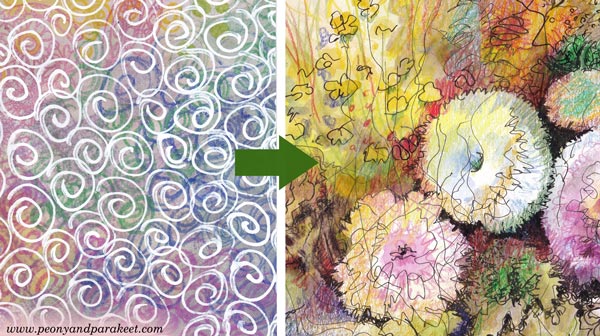
At first, a line can be clumsy and closed off. But when it opens up, and a connection is found, drawing becomes a channel for our creativity. Even when we draw every day, we don’t have to draw just everyday life, but we can also escape it by drawing. We can draw more than we dare to dream, because on paper, even the impossible is possible.
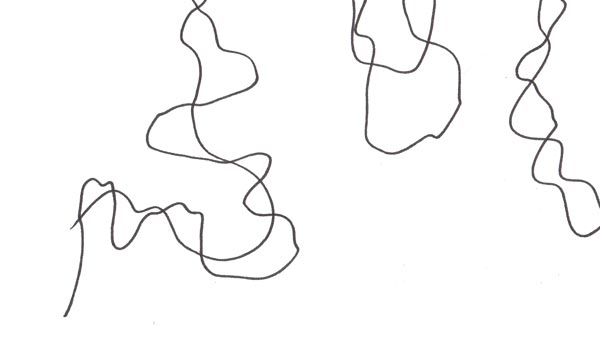
That is why art can’t be born only in your head; it is born when you create. Through the pen, you see further. Your soulful line connects you with art, making you understand your taste, your style, and as it all develops, a new world is born. Your art is born.
From Living Line to Soulful Line
For a long time, I have wanted to create a comprehensive course on drawing. In the past, I have had courses like that — Inspirational Drawing and its successor, Inspirational Drawing 2.0. Those courses were retired quite some time ago, and over the years, I have discovered new ideas and concepts that weren’t included in them. However, the core philosophy (which also forms the foundation of my own artistry) remains the same: in art, the line is the beginning of everything, the seed of expression from which everything else grows.
I decided to make the new course and name it Drawing Soulfully.
I have talked a lot about the living line, but when I started working on this course, ‘living’ no longer felt like enough. Our line may look lively, but do we live within our line? Do we feel the line all the way in our souls? This is what an artist wants to strive for!
Drawing Soulfully
Drawing Soulfully is about expressing yourself through drawing. It’s a journey into your artistry and teaches a way to work towards your style. We will draw mostly with black pens, and then color some of the drawings with watercolors and colored pencils. We will use reference images for some projects, but in a creative way that broadens your perspective.
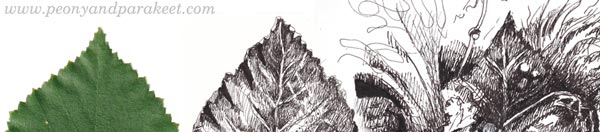
In Drawing Soulfully, I want you to think about your artistic roots – the cultural history that touches you. In the course, I also share some of mine. At the end of the 19th century, many artists who studied or worked in central Europe came back to Finland for the summer. They read, wrote, and painted in their summer cottages, and thus, captured the best season in their souls. Yet, in the past, they didn’t have all the ways to express their emotions. There were walls that no longer exist. Nowadays, we can free up our pens and pour it all out on paper.
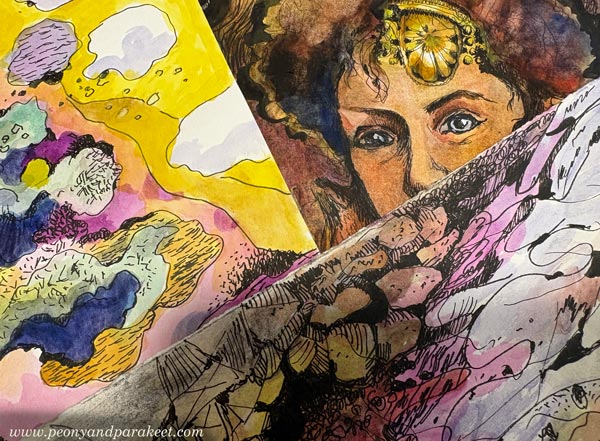
Your line is your voice. Just like for a singer, a great voice isn’t just about physical technique — it’s about connecting the voice to the soul.
Drawing Soulfully – Sign Up Now!
Drawing Soulfully begins on August 25, but the early-bird sale is now on!
Get 20 EUR OFF! >> Sign Up Now!
Sneak Peek at The New Course
This week, you get to see a sneak peek at the upcoming course! The course is about expressing yourself through drawing. It’s a journey into your artistry and teaches a way to work towards your style. We will draw mostly with black pens, and then color some of the drawings with watercolors and colored pencils.
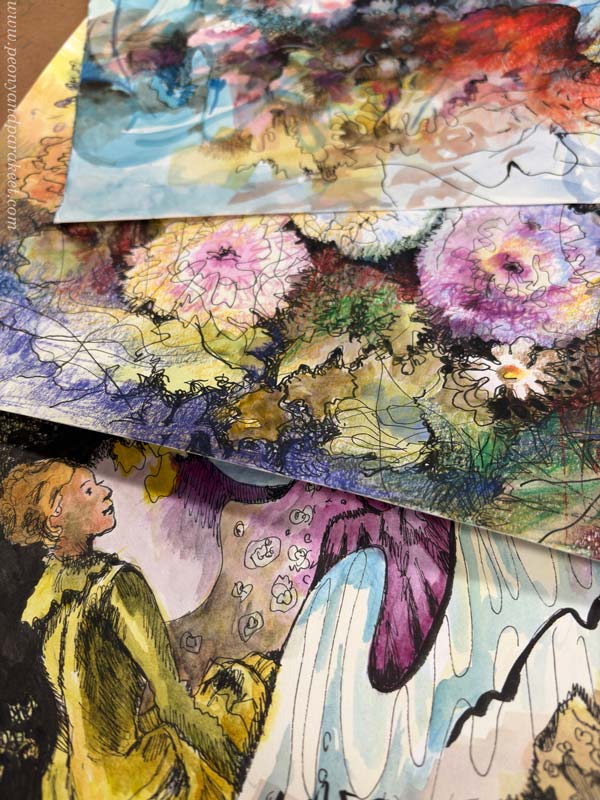
Drawing a line is in the center of the course. How to draw is not only about how to draw realistic objects so that they are recognizable, but also about how to find a living, soulful line that makes you want to pick up a pen again and again.
I believe that without the ability to draw, it’s impossible to create any visual art. Everything is based on a line, and thus, on drawing. And not just any kind of drawing but …
Drawing is not about sketching something that you quickly erase and change. When you draw soulfully, the pen opens up a new horizon, and you live within your drawing.
We will use reference images for some projects, but in a creative way that broadens your perspective.
You not only learn how to draw but also how to get the most out of the practice.
Your Journey to Drawing
In Drawing Soulfully, I want you to think about your artistic roots – the cultural history that touches you. At the end of the 19th century, many artists who studied or worked in central Europe came back to Finland for the summer. They read, wrote, and painted in their summer cottages, and thus, captured the best season in their souls.
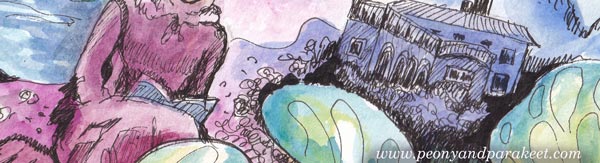
But it is also so that in the past, they didn’t have all the ways to express their emotions. There was suffocation, which no longer exists. Nowadays, we can free up our pens, the colors, and pour it all out on paper.
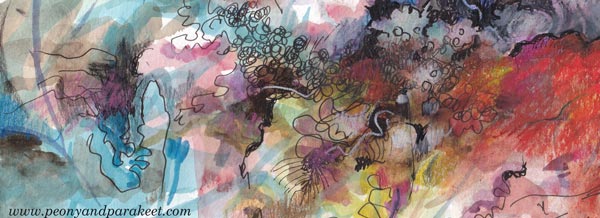
When lines are soulful, so will the art be.
Drawing Soulfully will begin on August 25th. The course will be published in three parts and will last three months. The early-bird sale will begin next week.
What do you think? Will you join me?
Drawing a Summer Ornament
This week, I want to show that an ornament can be more than just a decoration. An ornament can be a framework for expression in the same way as a portrait, a still life, or a landscape.
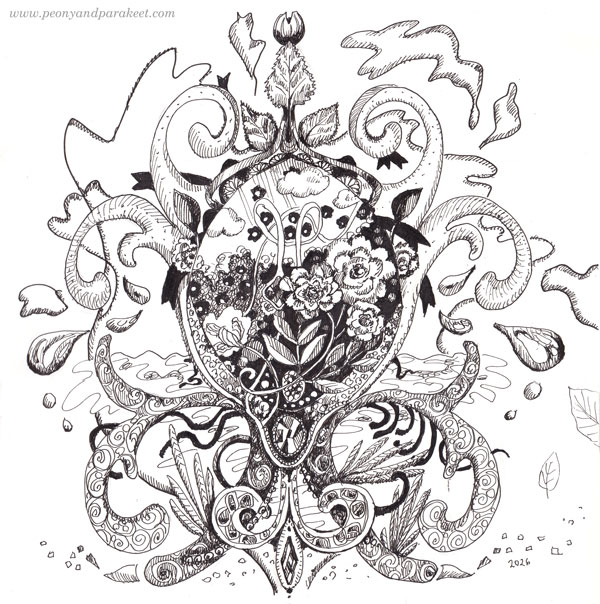
I love drawing ornaments. It feels as though the universe is shouting at me: “This is right, this is a good thing!” If I’ve had past lives, I’d think this is the work I’ve always done in some form, because it feels so natural.
Step 1 – Grid
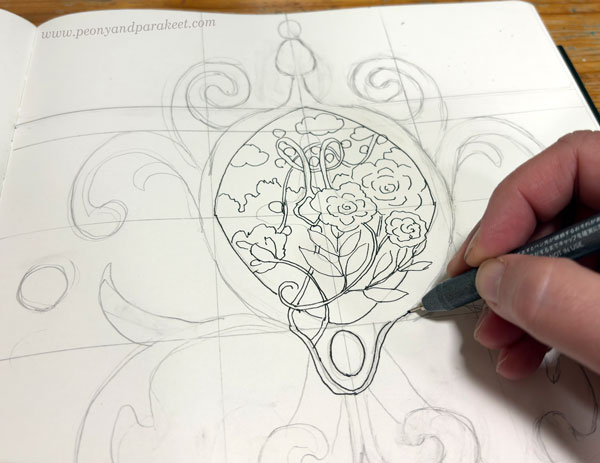
If I decide to draw an ornament, nothing holds me back—not even the requirement of symmetry. This time, I made a grid to help me achieve similarity on both sides more easily.
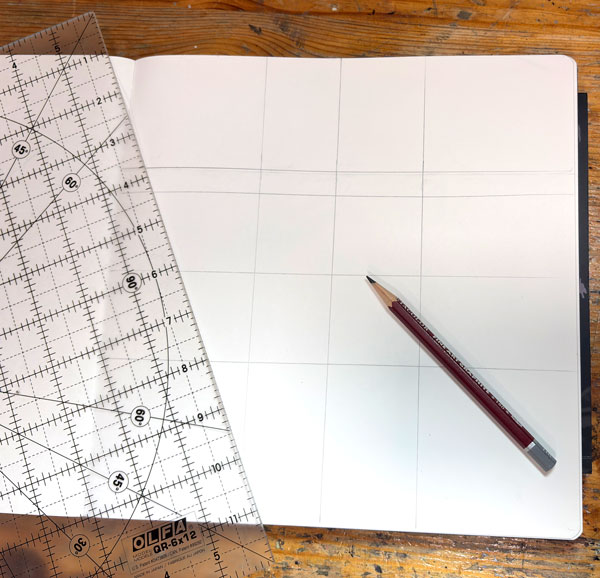
It’s good to have center guidelines, but there can be more and placed anywhere. All guidelines are helpful when drawing the ornament freely.
Step 2 – Pencil Sketch
I sketch the biggest symmetrical parts in pencil. But I try to keep this phase short because the best part of drawing ornaments is letting loose and discovering how the symmetry can be broken.
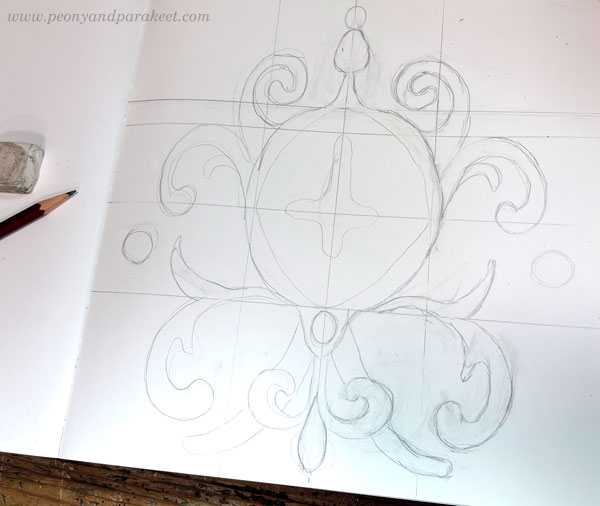
Drawing an ornament is like putting your soul into a lion’s cage and then watching it break out with cleverness, rather than violence.
Step 3 – Getting Creative with a Non-Erasable Pen
For the actual drawing, I use black markers. Here, I’m using Copic FineLiner pens and a Copic Gasenfude brush pen. An ornament is like a meandering canvas where you can draw anything. You can draw both the realistic and the abstract, and it all looks great because it’s embedded in the ornamental structure.
We currently have summer here in Finland, so I wanted to draw summer-related things: the sea, a garden, and birch leaves.
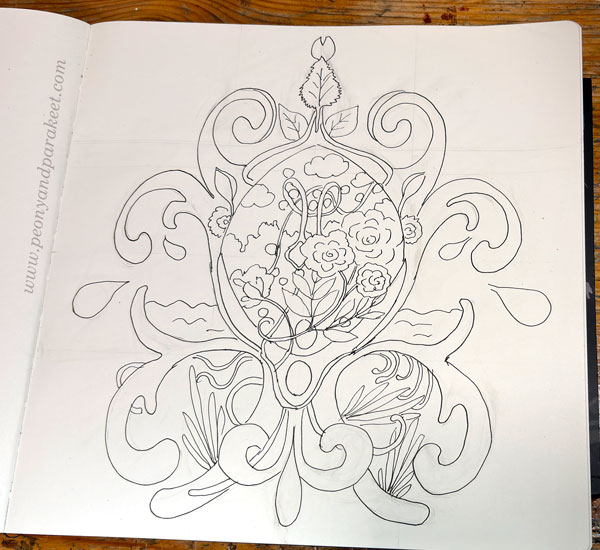
Step 4 – Getting Lost in the Details
When I have most of the things in place, I put on an audiobook or a talk show and focus on the details!
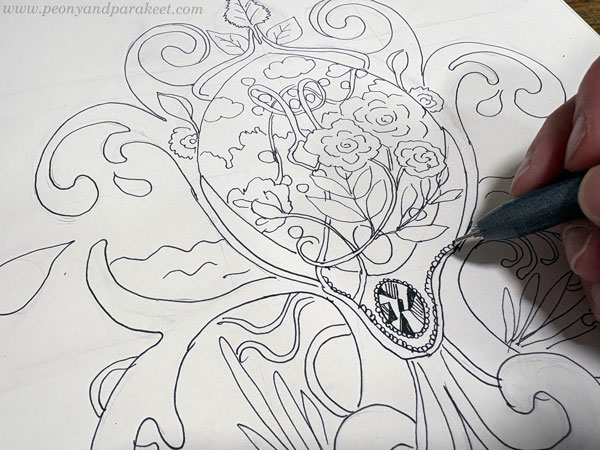
My ornaments almost always have jewels because I find them fun to draw and the result rewarding. A jewel comes to life when you draw geometric shapes with a fine pen and fill them differently.
I always include elements that are pitch-black to create contrast. The brush pen is quick in these details.
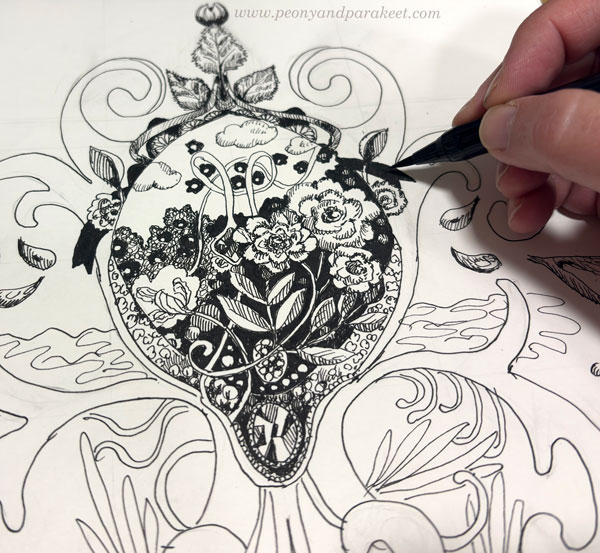
The Freedom in Drawing Ornaments
The longer I draw, the more I want to create tension and asymmetry. In this ornament, the lines took on a life of their own and spread beyond its borders. Ah, so liberating!
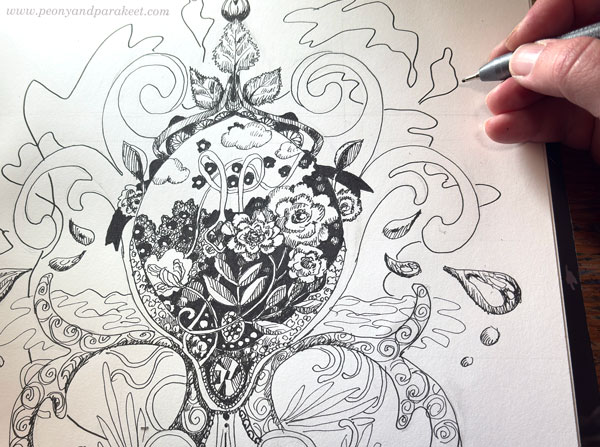
It’s exciting and even contradictory that such freedom can be evoked from a rigid ornament.
The Summer Ornament
Here you can see how I’ve used the pens for the fine details in the center.
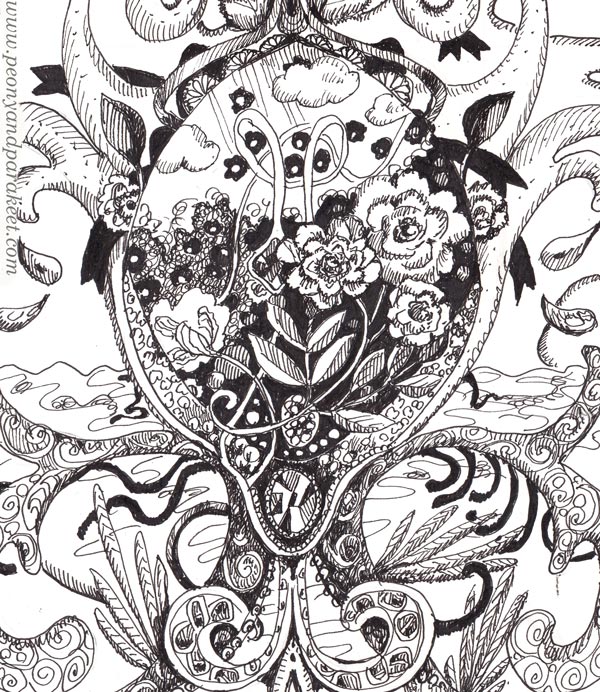
I hope this summer ornament inspires you to pick up your pens and start drawing!
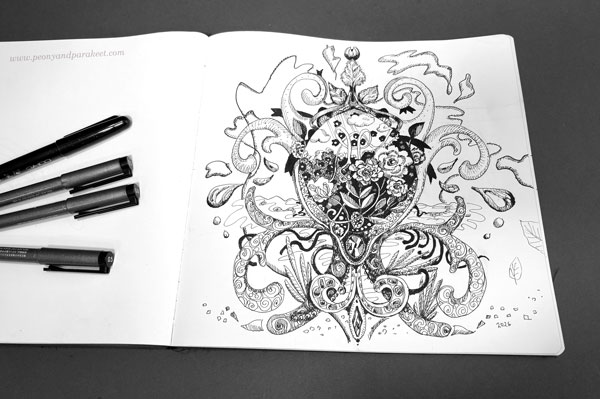
For more inspiration, see also these blog posts:
Abstract Composition in Watercolor
This week, we create geometric and modern art. Pick your supplies, and make an abstract composition!
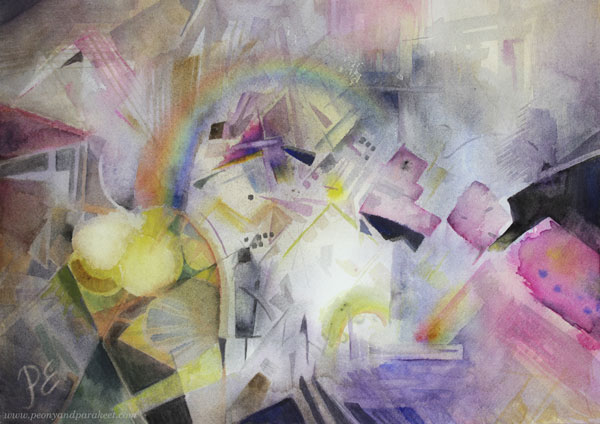
>> See this painting bigger at the Taiko online art store
Lately, I’ve been exploring the extremes of my own style, especially when it comes to visual language. I’ve been searching for something angular and adventurous for inspiration, as my style has recently drifted perhaps a bit too much toward the organic direction. Quite by chance, I noticed the summer issue of Watercolor Artist magazine in a local shop, which introduced me to an interesting artist named John Salminen.
John Salminen uses photos of urban landscapes as the foundation for his work. He converts the photo into a high-contrast image and sketches an abstract composition from it. He calls this approach “abstracted realism.” I like his paintings a lot. To me, they feel sophisticated yet masculine and go close to one extreme of my own style.
Starting an Abstract Composition
I now wanted to create an abstract watercolor using mainly geometric shapes. Unlike John, I started my work freely without any reference photos. First, I used plenty of water.
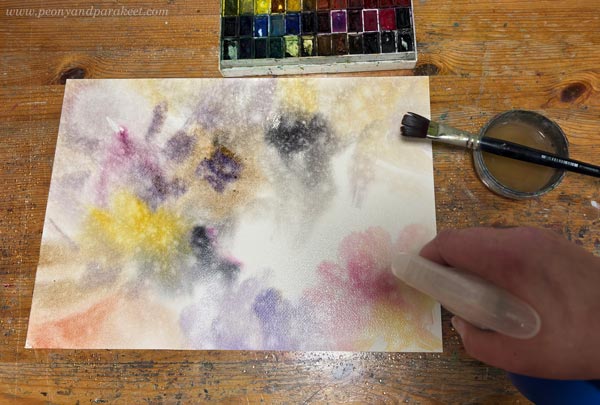
In the next layers, I applied less water to make sharper shapes.
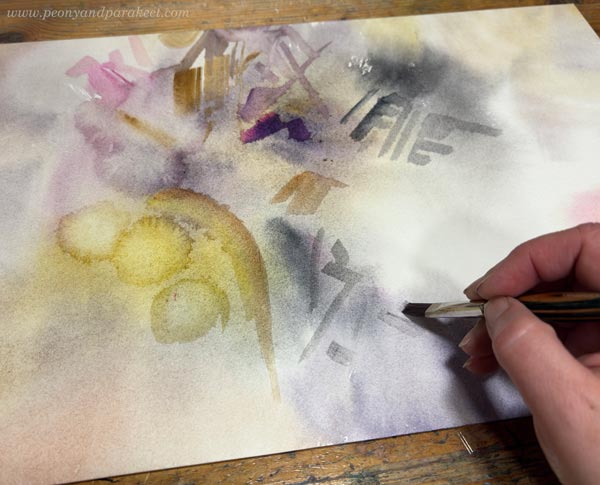
Geometrical Abstract Composition
The basic idea is to create both small and large shapes, arranged in an asymmetrical composition on the paper.
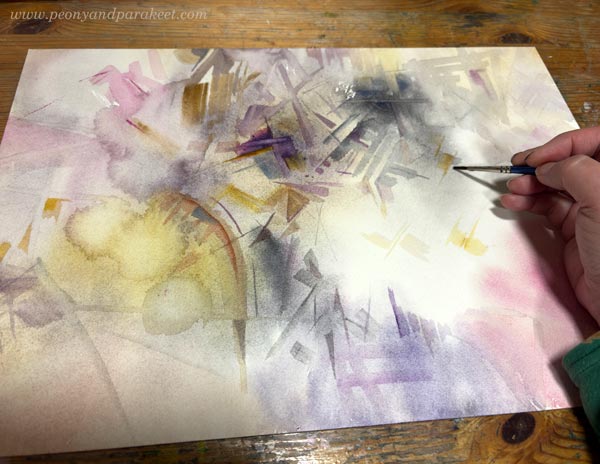
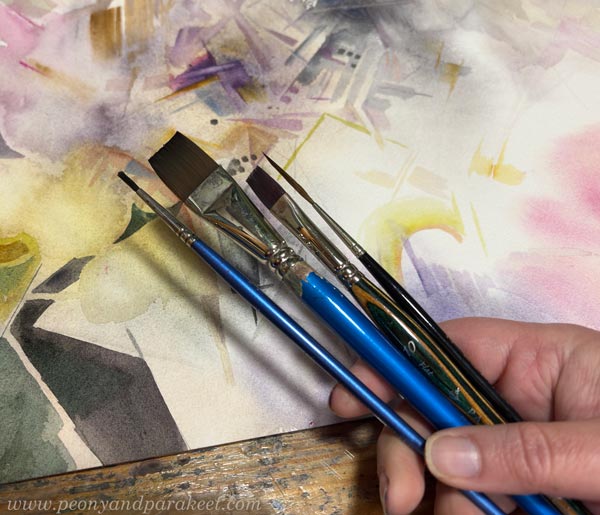
You don’t need a ruler for geometric shapes. Thin brushes make lines easy to achieve, and a flat brush is perfect for angular forms.
What Do You See?
When painting abstract art, it’s best to first focus on the shapes themselves and forget about looking for realistic objects in the painting.
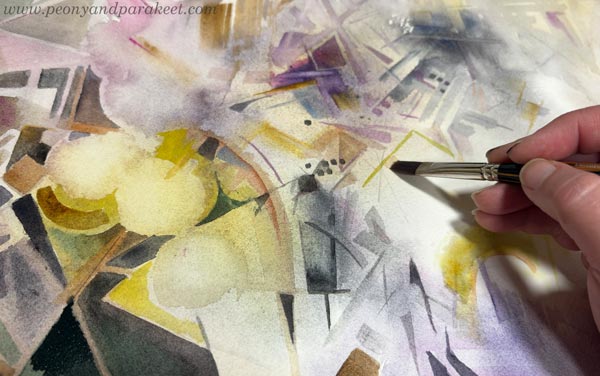
In my project, everything was going well until I realized that I was creating yet another flower painting. I’ve painted flower arrangements so many times that their structure is deeply rooted in my subconscious.
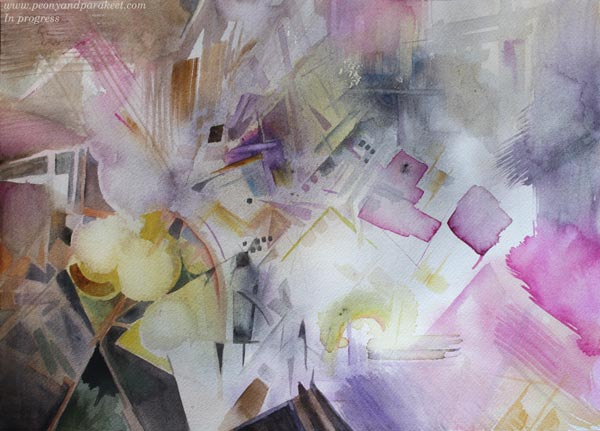
I turned my work upside down, hoping it would look different, but the flowers in the vase were staring right back at me! Give me any unfinished or finished painting, and I’ll turn it into a floral arrangement in a moment!
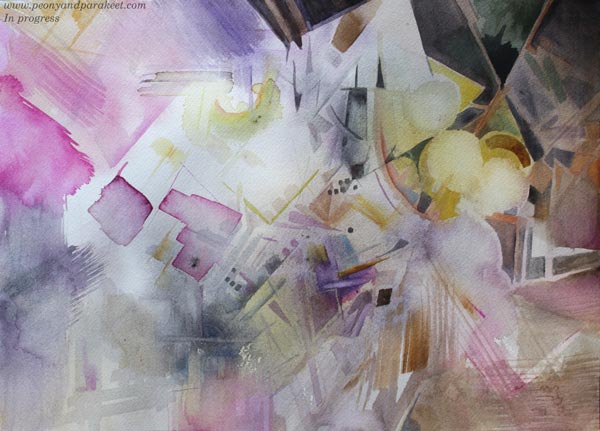
Shifting Direction – Making a Plan
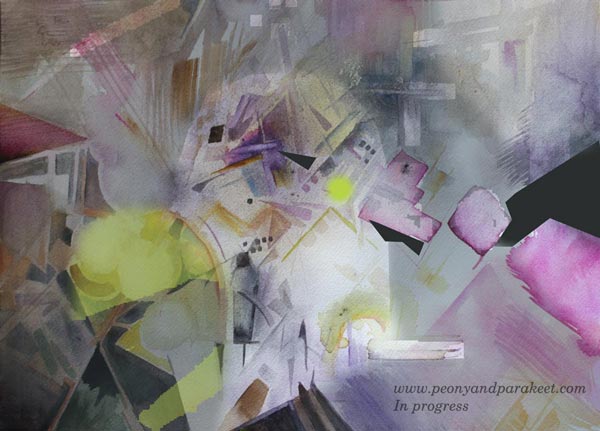
This time, I didn’t want to paint flowers. I wanted a sense of space and adventure. So, I moved from my small painting studio to the computer and opened Photoshop. I planned out the perspective and started looking for shapes to support it.
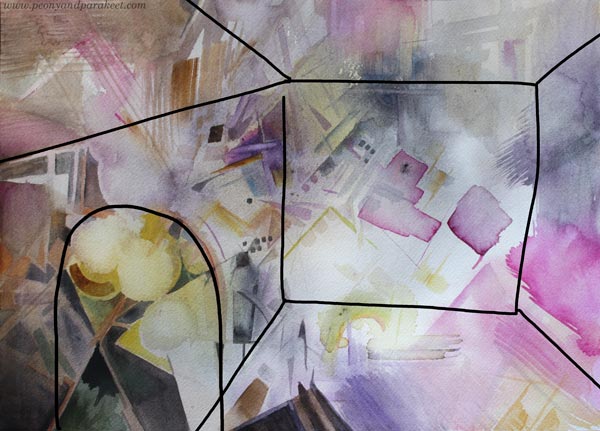
Then, I designed the composition. I could have worked this out through painting as well, but then the final piece wouldn’t look quite as effortless. You can wipe watercolor away with water, but it’s hard to get the paper completely clean again.
Here are my digital additions created on top of the unfinished painting.
Purity, Clarity, Effortlessness
Lately, I’ve been inspired specifically by purity, clarity, and effortlessness. I’ve been watching a Finnish TV show called “Tähdet, tähdet” (Stars, Stars). It’s a singing competition looking for the country’s best performer. Each season features about ten professional performers, most of whom are musicians. The performers are pushed out of their comfort zones, as each episode focuses on a different musical genre.
In the latest season, one of the performers was the reggae musician Jukka Poika. I had never really paid attention to his vocals before. However, the other musical styles truly brought out the singer in him. His voice emerged pure, direct, and yet full of rich tones (listen to an example on YouTube).
Isn’t that exactly what we all want in visual arts: for our own voice and thoughts to come through pure and clear? “It’s so inspiring to think about the purity, clarity, and effortlessness we can achieve when we know exactly what to do in its simplest form, and have the skills to do it
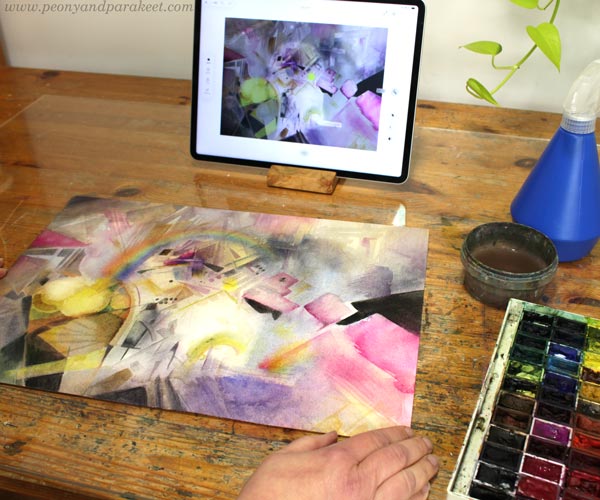
The plan allowed me to bring beautiful tones and nuances into my watercolor without having to stress about perspective and composition.
Finished Piece – The Portal of Hope
I named this piece “Toivon portaali” (The Portal of Hope). There are situations in life that require going through the darkest of times – through a grey stone, as we say in Finnish. It is risky and requires a fighting spirit, but at the same time, the situation is also exciting as it’s a way to move forward.
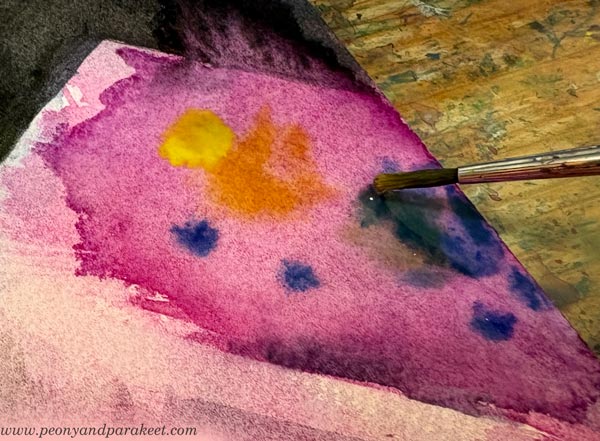
Here are some photos of the details.
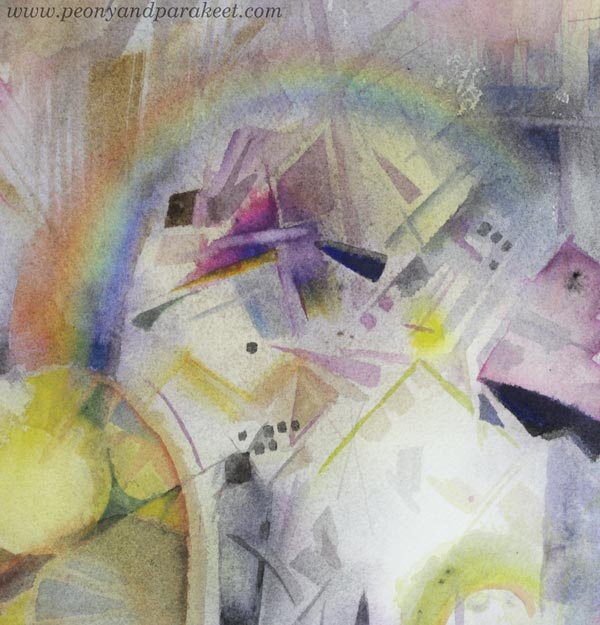
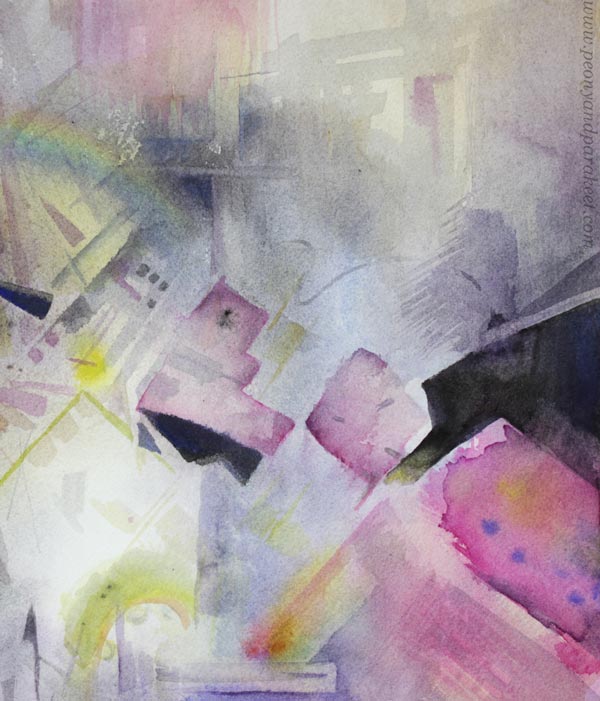
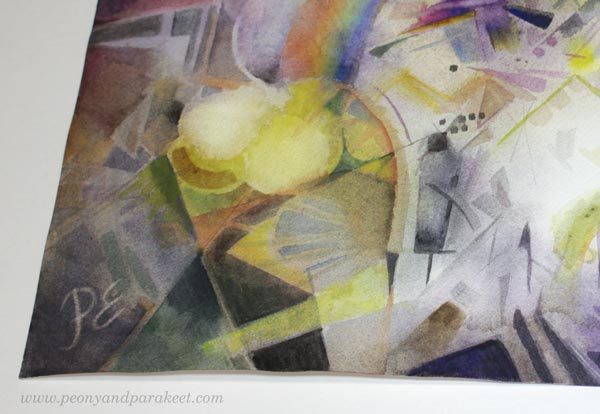
This was much faster to paint than flower paintings of a similar size. There were fewer layers, and geometric shapes are quick to execute.
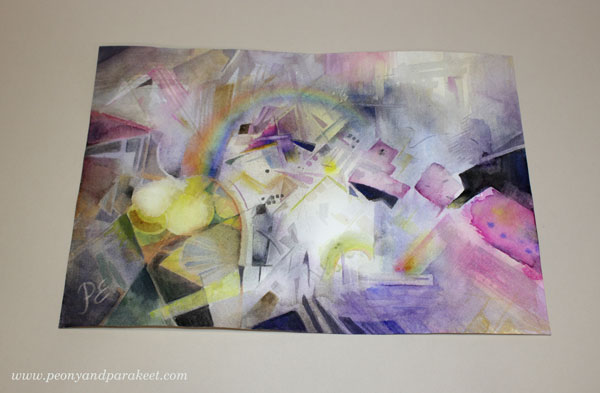
I hope this inspires you to try an abstract composition with watercolors or colored pencils—or use a combination of both. My painting was done entirely with watercolors.
P.S. Check also this blog post, with more detailed instructions and for watercolor pencils: Modernistic Style – Create Abstract Art Step by Step!