
Recent News with Mystical Thoughts
This week, I’m sharing a bit about what I’ve been up to. This fall has been and will be full!
Giving Life to a Line
Creating the course Drawing Soulfully has been one of my biggest projects this year. The videos are packed with content, and making them took a lot of time.
Now, it has been wonderful to see the participants’ drawings and discuss them together. Everyone has their own unique line, and I tried to design the exercises to bring that out as well as possible.
My motto is: Art begins with a line!
And you could also say: Style begins with a line.
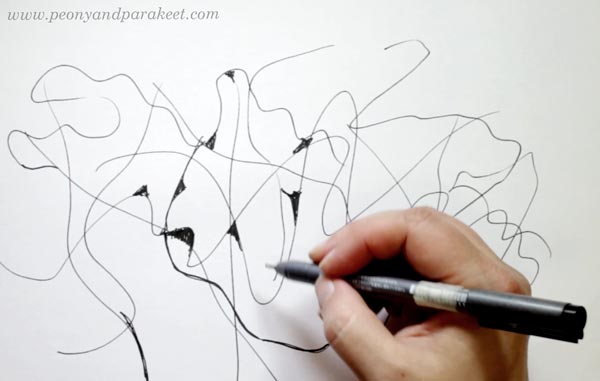
A line can be so much more than just an outline. It can express emotion, movement, space, and spirit.
Tough Break Ended
In August, I finished a series of 10 oil paintings that I had started last year. That was another big project, but as I was finishing up the final details, new ideas were already starting to pop up.
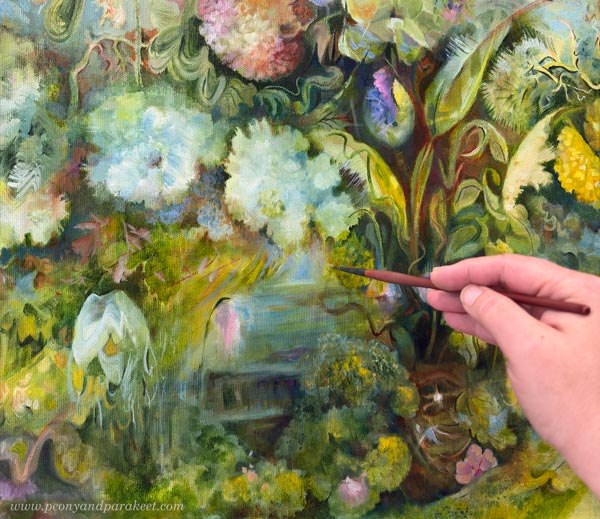
Most of the time, my ideas are connected to broader themes rather than exact subjects or techniques. These thematic thoughts are verbal, so I write them down in my calendar. But writing is not the same thing as expressing yourself visually. The breaks between paintings are always tough for me. First, I’m exhausted, but as new ideas start to pile up, I feel restless and suffocated. It’s like being a fish without water!
Fortunately, I’ve now been able to release the tension and start the first painting of a new series this week. It’s still in its early stages, but I look forward to working on it week by week.
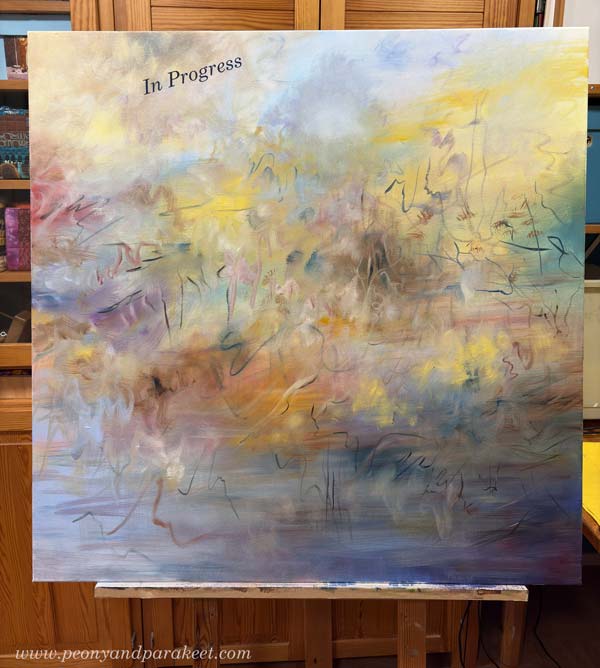
I usually work on two paintings at once, because that way, each painting has a sibling, so to speak, and doesn’t have to grow up alone. And even now, I have a canvas of the same size waiting that I hope to start soon.
Babies, Toddlers, and Hamsters – One Killed!
In my dreams, unfinished paintings and courses appear as babies or toddlers, while smaller tasks appear as hamsters. I used to raise hamsters a long time ago, and even though I don’t have them anymore, my subconscious has somehow given them a symbolic role.
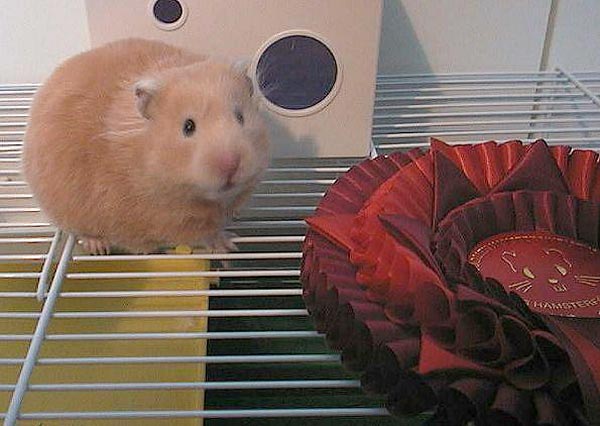
Usually in these dreams, I suddenly realize I’ve forgotten to feed the hamsters—but recently, I had a nightmare where I was trying to kill a hamster. When I woke up, I knew I had to let go of the mentoring program I had been advertising lately.
So, there won’t be a mentorship group, but if you buy any of my courses, you’ll get access to my Bloom and Fly Facebook group where I am very active!
Sales Table Preparation
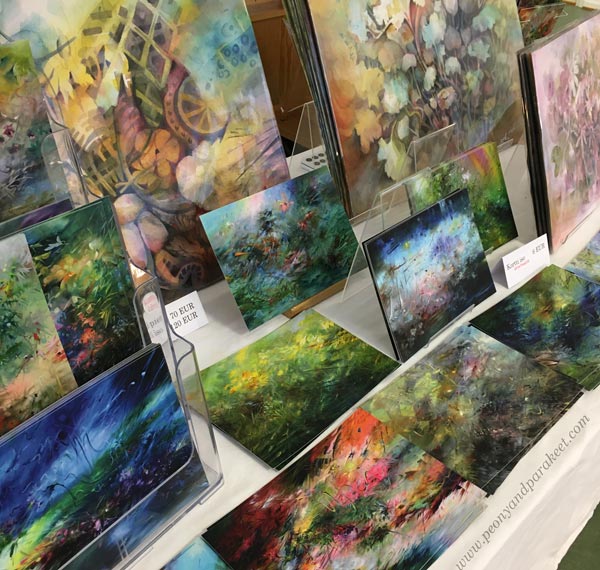
I’m attending at least one art fair at the end of this year. I’ll have cards and prints with me, but I also dug out some of my old watercolors from storage. I should probably touch up a few of them from this pile, as my skills have developed over the years.
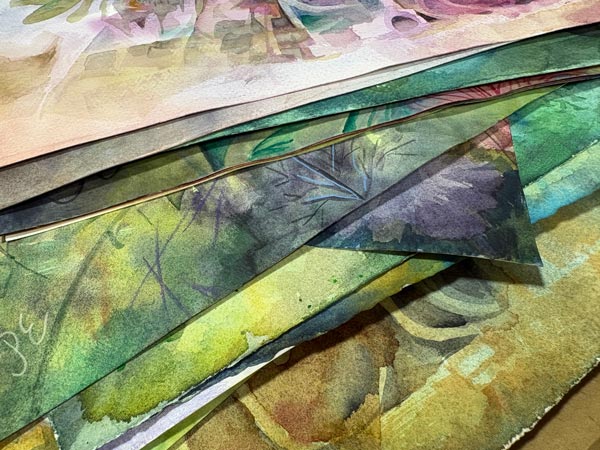
Do you like to see revamped projects here on my blog? Do you ever revamp your art?
My biggest paintings have their own sales channels, but attending a fair is a great way to meet people and see their reactions. The last time I had a sales table was in 2022, so it’s about time!
Mystical Meetup!
Do you remember when I launched a course called Mystical Minis at the turn of the year? Making that course was a mystical experience. It started when I heard a whisper: “Intuitive Power.” I then connected the words to the Swedish esoteric artist Hilma af Klint. The course was made in a flow state, and it’s perhaps my most unusual course yet. I took its structure from a short story by Virginia Woolf and included a third artist, the English painter Georgiana Houghton, in the exercises.

And guess what? At the end of October, a super-interesting exhibition called Arcana Borealis – Northern Women and Esotericism opens in Helsinki. It features paintings by Hilma af Klint and her partner Anna Cassel, alongside other Nordic female artists. I will go to see the exhibition and hope that Hilma starts whispering to me again. I’d love to make a new mystical course!
More Mystical Thoughts
It’s a bit sad that winter is coming to Finland. Our summer is exceptionally bright, but our winter is very dark. Still, I think the turn of the year is the best time for esoterics, as we find ourselves in a kind of extreme state.
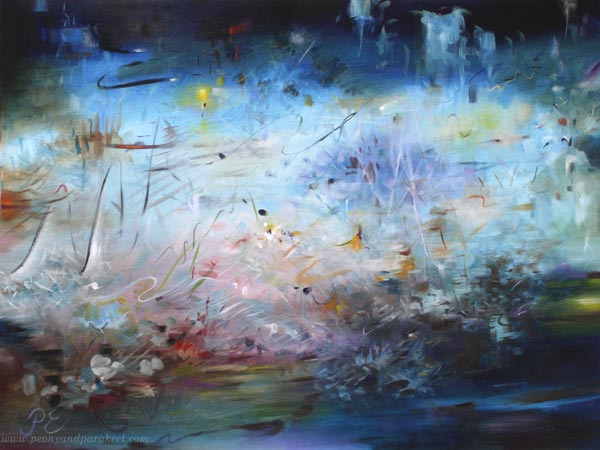
I’ve also been thinking a lot about what our world needs right now. My thoughts are that in the middle of fast consumption, we need a deeper connection with ourselves. Whether one believes in the supernatural or not, there is always something mystical and unexpected in going deeper. I also feel that in art, we don’t have to decide what is imagination, what is intuition, or what is a stream flowing directly from the outside.
Just by stopping to look and listen more closely, we bring mystical depth into our work. Visual poems start to rise, quieting the outer world.
What do you think?
Creative Freedom and Colored Pencils
This week, I want to celebrate creative freedom with colored pencils. There’s also a short video for you!
Enjoying a Concert
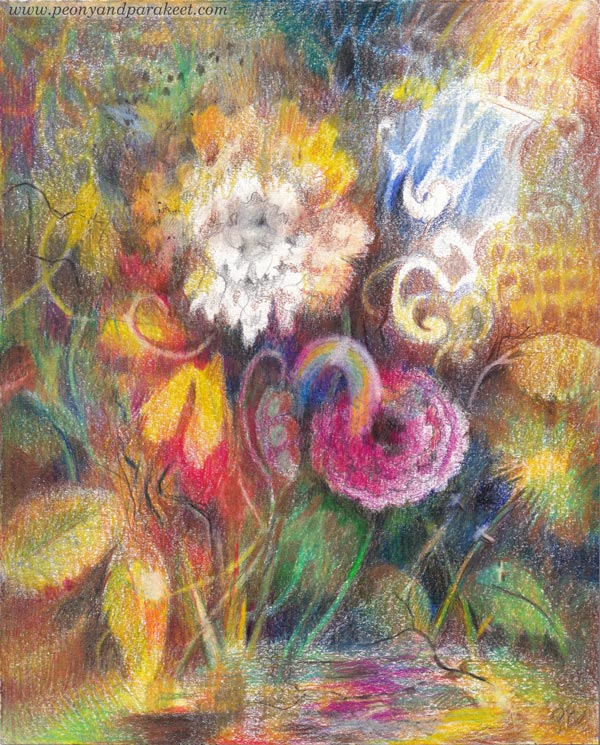
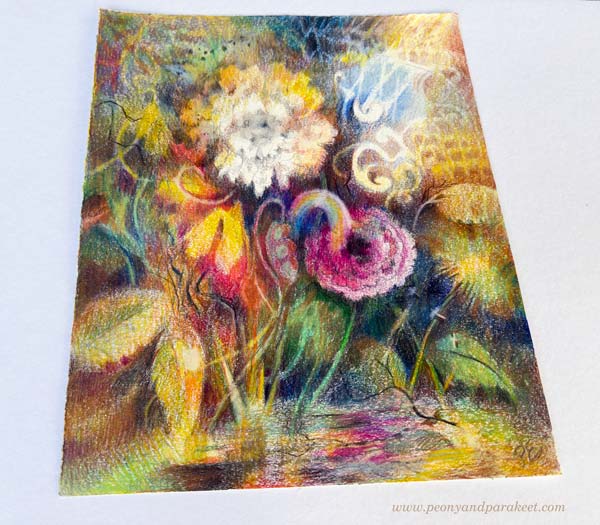
Last Friday, my husband and I went to a Baroque music concert. We went to hear the Finnish Radio Symphony Orchestra for the first time, but what made the biggest impact was the French countertenor vocalist Theo Imart. I think that the fall splendor we now have in Finland and his miraculous high notes found their way into this drawing, even if I just drew freely without any references.
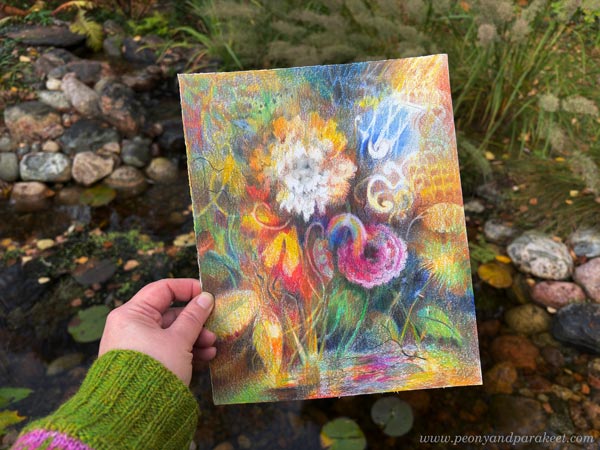
The orchestra played Vivaldi – not The Four Seasons, but other pieces. I find his music super-inspiring! In 2021, I blogged about creating while listening to music, and there’s also a Vivaldi-inspired painting. See the blog post: “Painting with Music and About Music”
Creative Freedom and Colored Pencils – Watch the Video!
In this 1-minute video, you can see how I started the drawing with simple strokes and then moved on to adding more layers and details. I also talk about my mentorship group at Mastrius and how it’s not only for painters, but also for everyone who loves colored pencils.
Get Creative at My Mastrius Mentorship Group!
Starting in November 2026, I’m mentoring a small group of artists at Mastrius! Mastrius is an online community dedicated to fostering community and mentorship amongst artists of all skill levels.
In my new mentorship group, we’ll be focusing on:
▪️Abstraction without references: Connecting lines, shapes, and color
▪️Expressing your own nature: Light, spirit, and mood
▪️Making your art more captivating
▪️Supportive group critiques
▪️Inspiration and motivation
If you’re new to Mastrius Mentorship, enjoy 50% off your first two months. Use coupon code 2for50 at checkout. >> Join here!
Colored Pencils – More Pictures about My Process
Because the video is very short, here are a couple of in-progress snapshots I took for you. I picked a limited selection of pencils out of their boxes and gradually added more layers.
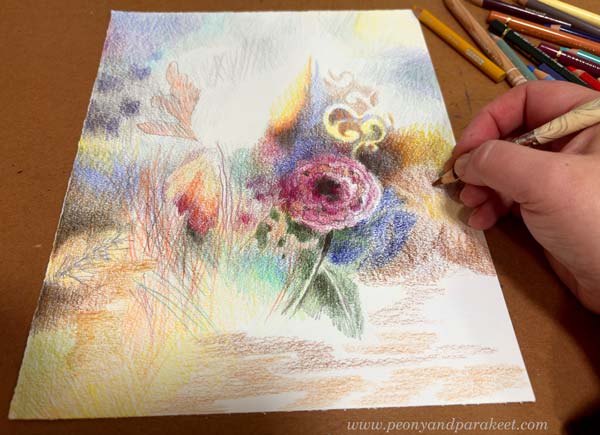
There are not many pencils anymore. I now only have three boxes and could soon fit them all into two! I only buy single pencils occasionally since mixing colors expands my palette.
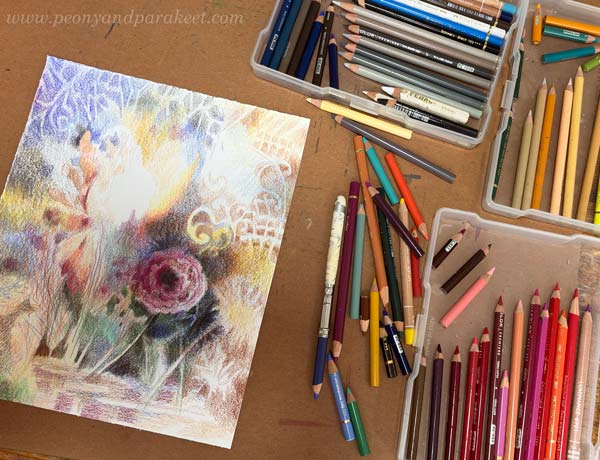
There was a long straight line under the big white flower, but then I remembered how Baroque music should be played: not sharply, but softly and fluently, so I changed that.
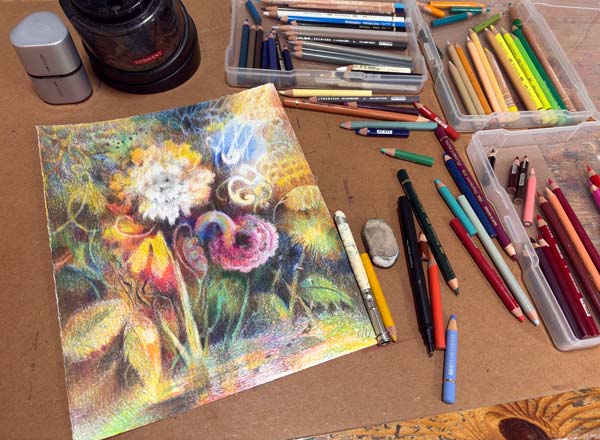
The long vertical line no longer dominates the image. Compare with the finished picture below!
Join My Mentorship Group at Mastrius!
My mentorship group is for aspiring artists who want to create freely without references and find their style.
Together, we will step away from the traditional route and enter the jungle where anything is possible. That jungle is the place where loosening up happens.
Mentorship Group in a Nutshell
- Zoom meetings in a small group.
- Personal guidance and feedback.
- Ongoing monthly membership. Join and cancel anytime.
If you’re new to Mastrius Mentorship, enjoy 50% off your first two months, plenty of time to meet your mentor (me!), settle into your group, and start feeling real momentum. Use coupon code 2for50 at checkout. >> Join here!
Painting Nature, Releasing the Dragon
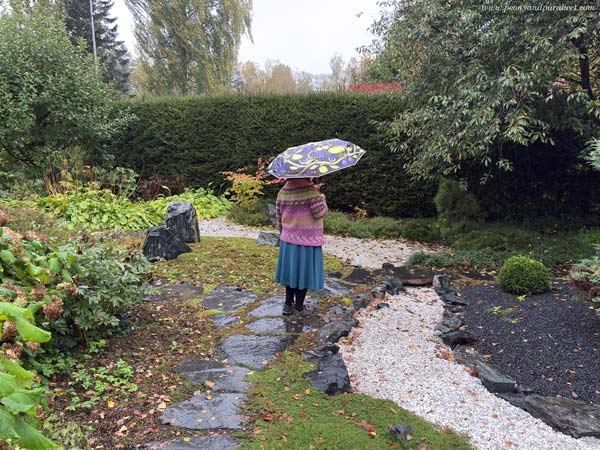
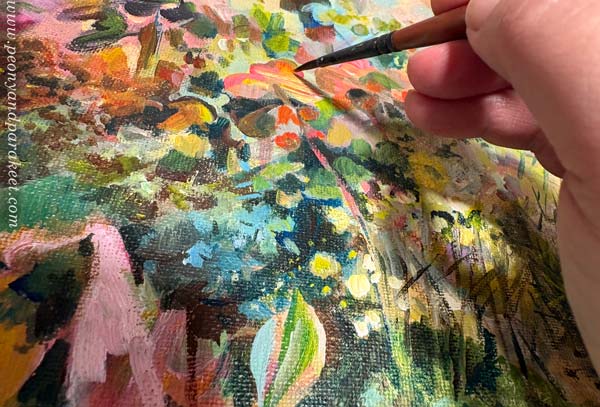
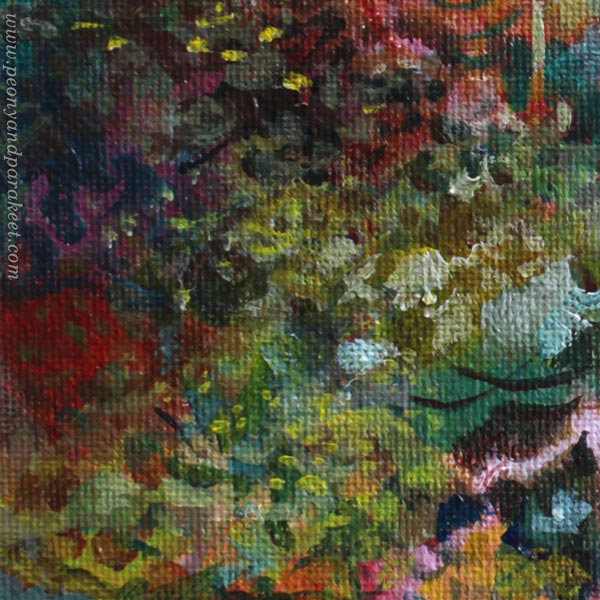
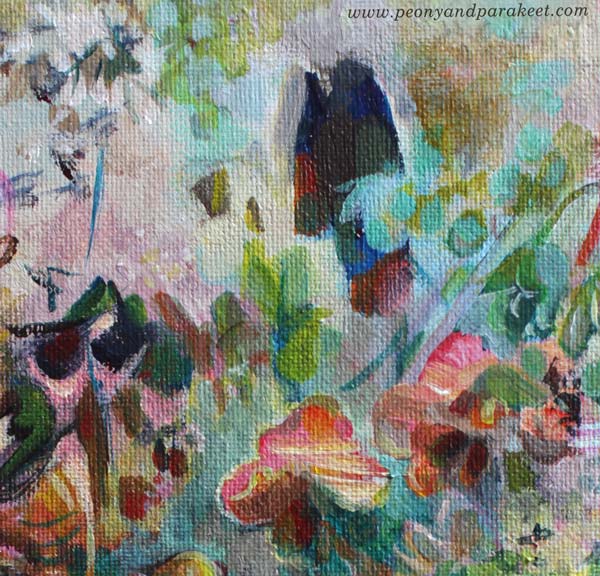
I love painting nature freely and intuitively —without reference photos, or even a clear image in my conscious mind.
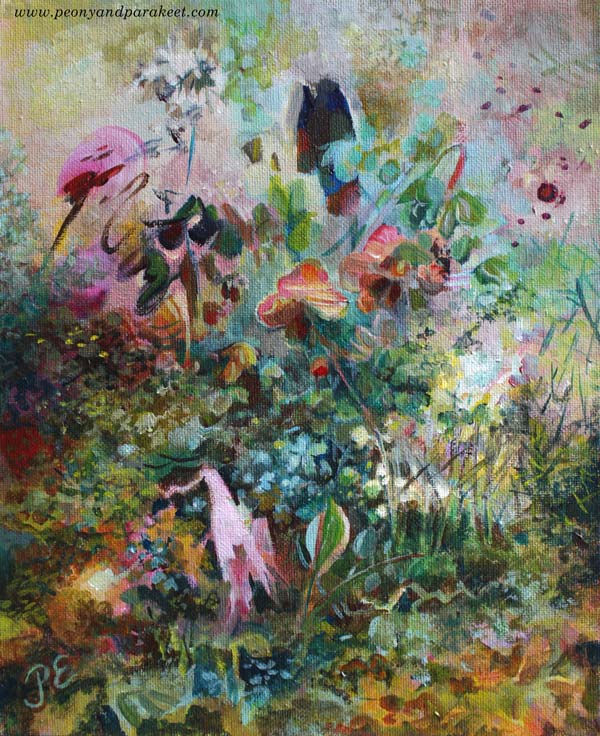
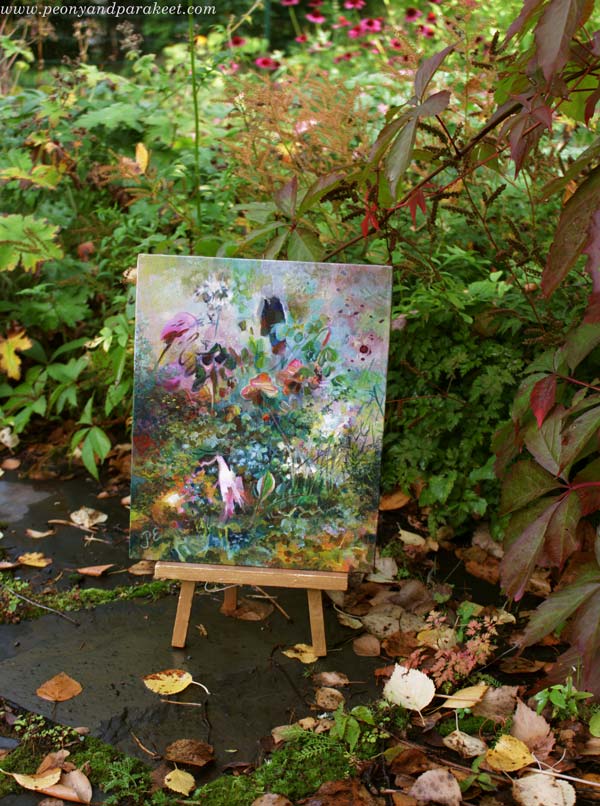
For me, the best way to create is when the picture simply flows from the pen or brush. It feels like my whole existence is tied to it. When I took this small abstract painting to the garden, it became clear where the inspiration had come from.
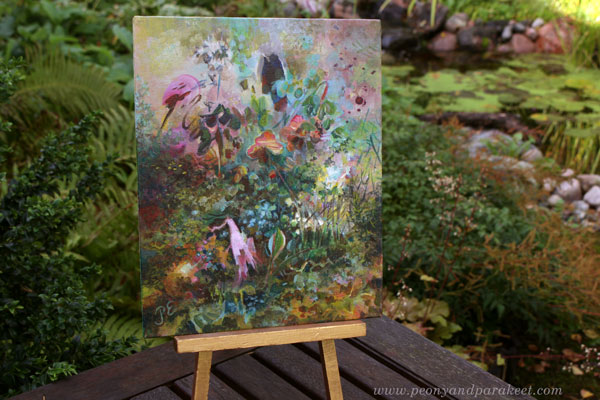
For me, nature feels freedom. And if I cannot make art freely, I get irritable and the colors disappear from my life.
Living in Between
Recently when I have been living in between painting series. One series ended, and the next one has not started yet. I have been gathering materials and ideas, thinking about canvas sizes, and all that planning is driving me crazy.
Yes, crazy!
I feel like I just need to create and create—the new images are already pushing to come out!
Still, this time has been meaningful. I have been working on my newest course, Drawing Soulfully, which is very close to my heart. As I have edited the instructional videos, it has been satisfying to pack deeply considered content – the explanations of how to create freely and grow that skill – into each minute.
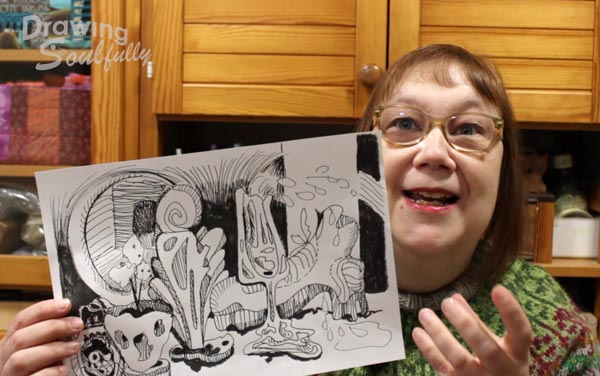
And it has been a pleasure to see the artworks from the participants. They are amazing, and I am so grateful I am able to see them.
Intuitive Nature Painting
This week on Monday, however, I rushed into my small studio feeling like I was about to burst. “Give me some paper or anything!” I yelled to myself. I found a small canvas board, grabbed my acrylic paints, and started painting.
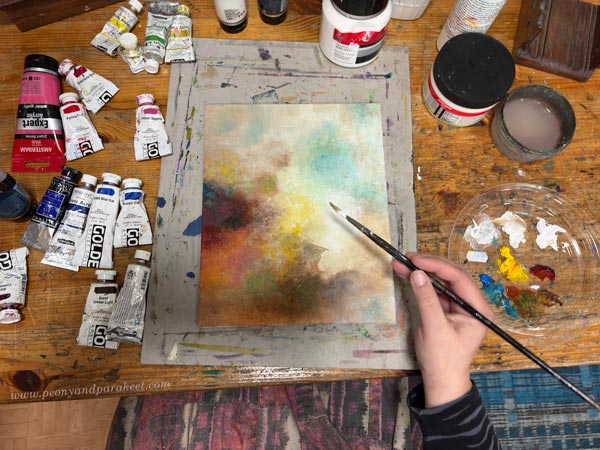
“What are you painting, Päivi?” I felt like asking myself, but soon swallowed the question.
There are artists who choose reference photos, plan color palettes, study the direction of light, reflections, and shadows, and paint landscapes of clearly recognizable places. All honor to them! But to me, nature appears as a system where one thing follows another.
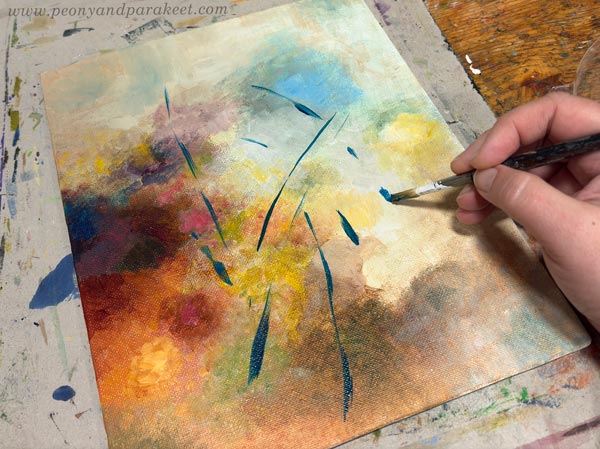
When I start painting, it’s like turning on a machine, and the machine feels both intuitive and logical.
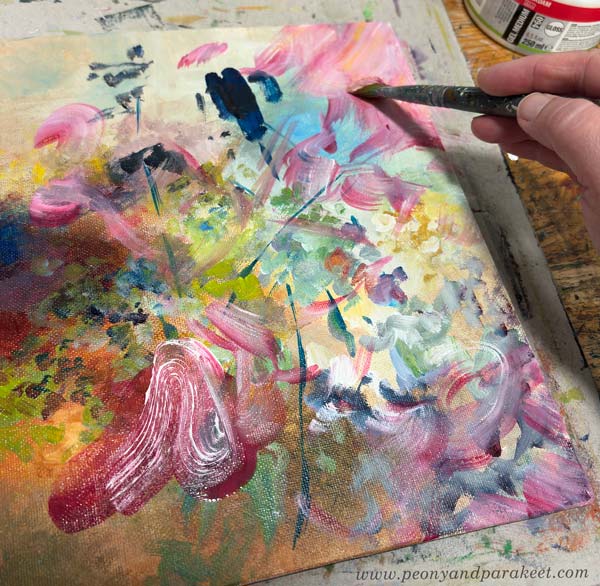
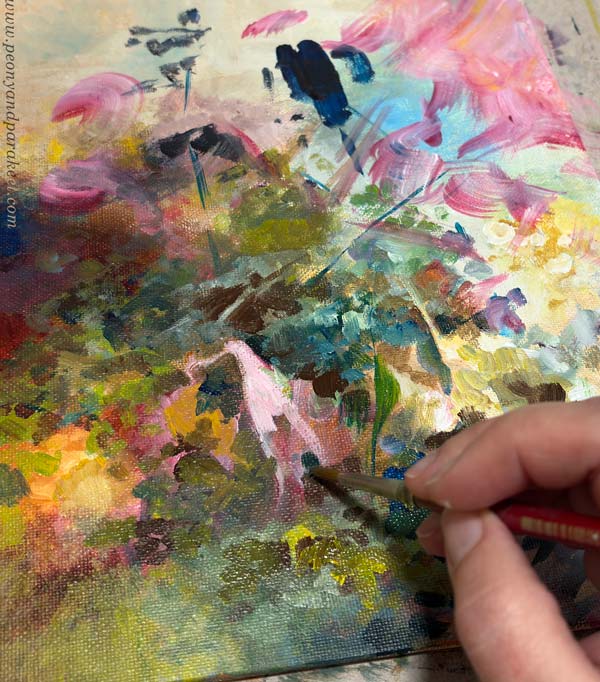
As the picture begins to take shape, I feel like I jump inside it, breathe its air, and hear its sounds. At the same time, I feel the tension inside me loosen and peace return to my mind. It’s the magic of intuitive painting! No shopping, scrolling, or even walking in nature gives me that same feeling.
Creative People Have Their Dragons
There is a lot of creativity in the world that people try to suppress by consuming more stuff, looking at more content, and seeking more experiences.
I also do those things. I often get the feeling that I should go buy new art supplies, browse master paintings online, or take photos of nature—right when the best solution is to just start creating. It is as if I have a dragon inside me that eats up beauty the longer it is kept locked up. But once it is released, it flies, carrying even heavy burdens with ease.
How about you? Do you ever catch yourself consuming or planning when you should just be creating?
Creating Art Inspired by the Garden – The Story Behind My Latest Floral Painting
Let’s create art inspired by the garden! This week, I share a couple of short videos about my latest painting called Jardin.
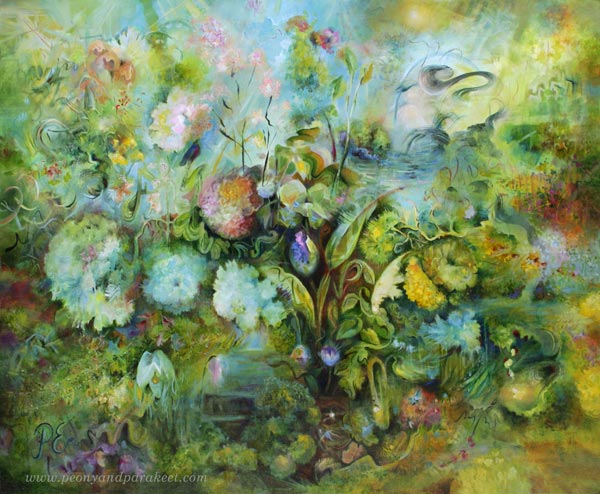
Let’s Finish a Painting – Making of “Jardin”
This video shows parts of the painting process, and it only has music. It’s a shortened version of the video that I published a couple of weeks ago. >> See the longer version here!
The Story Behind the Painting
Here’s the second video where I talk about the ideas behind the painting and share inspiration from our garden.
Transcript: We have two gardens – one in the back, one in the front.
As a painter, I often think of Claude Monet, who had his garden in France over 100 years ago. He said that the light and the air vary continually in the garden. And it’s so true. Every day, the light, the weather, birds, growth, and decay make our gardens look different.
Capturing the cycle of life is important to me. In this painting, plants at different stages are gathered in a tree-like vase. Right in the middle, there’s a bud that’s just about to open.
Monet once said he’d like to paint the way a bird sings. I think about birds a lot too – not their song, but their flight. I’d love to paint the way a bird flies. Imagine if their paths left trails in the sky, adding new shapes to the landscape. That’s the richness of nature’s motifs that I wanted to capture in this piece.
The hardest part was connecting the earth and the sky. A garden needs water and light, so it acts like a mirror to the sky. And the stronger the roots, the higher you can reach.
I brought the blue of the sky down to the bottom and filled the top so your eyes always have somewhere to land. Even a small garden can feel endless with layered plantings. That feeling of infinite space is what I wanted to create in this painting too.
I hope these two videos inspired you to paint and draw inspired by flowers, plants, and the beauty of gardens!