
Remembering Collageland
With this spread, I say farewell to a course called Collageland.
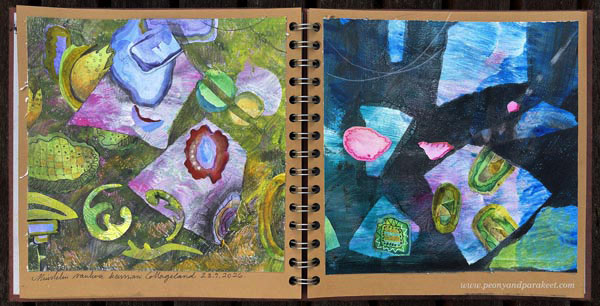
Yesterday, when I was making backgrounds and decorating handmade papers for this spread, I looked back on my artistic journey.
Three Stages
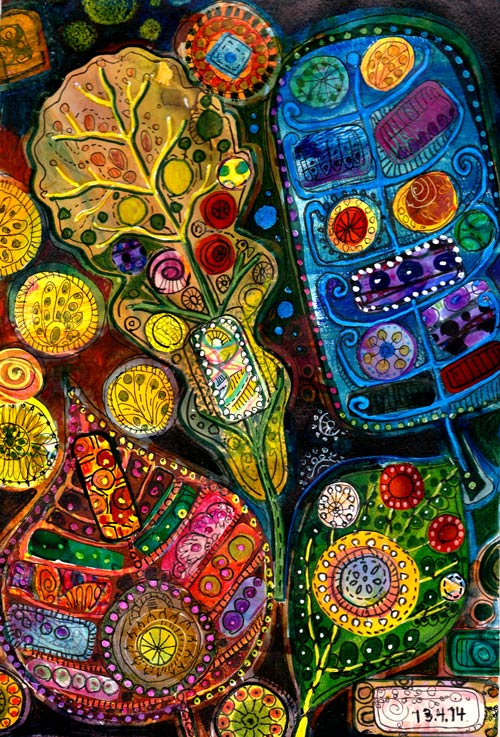
Stylistically, my artistic journey can be divided into three main stages. The first stage began around 2010 when I created decorative collages. My thing with collage art has always been to create every piece of paper myself and not cut anything from magazines or such. This approach requires more work, but it also grows your drawing skills. And most importantly, you can proudly say that you did it all yourself.
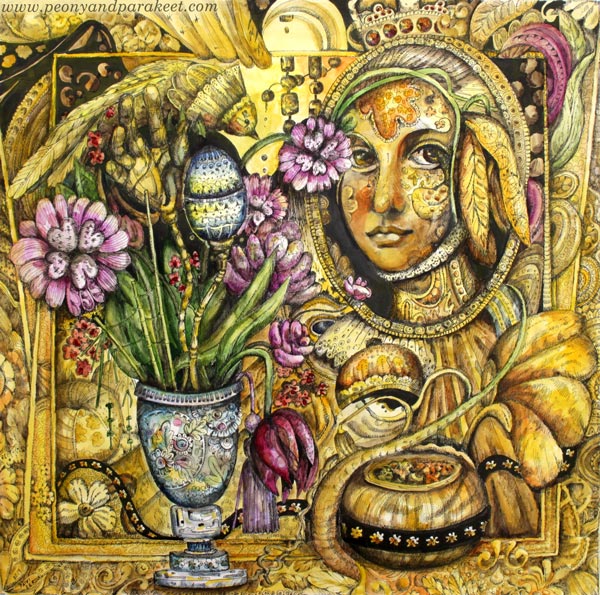
From 2016 to 2017, I gradually shifted toward a more illustrative style, drawing and painting representational fantasy art that often featured human or animal figures. I was highly influenced by art history and fantasy artists.
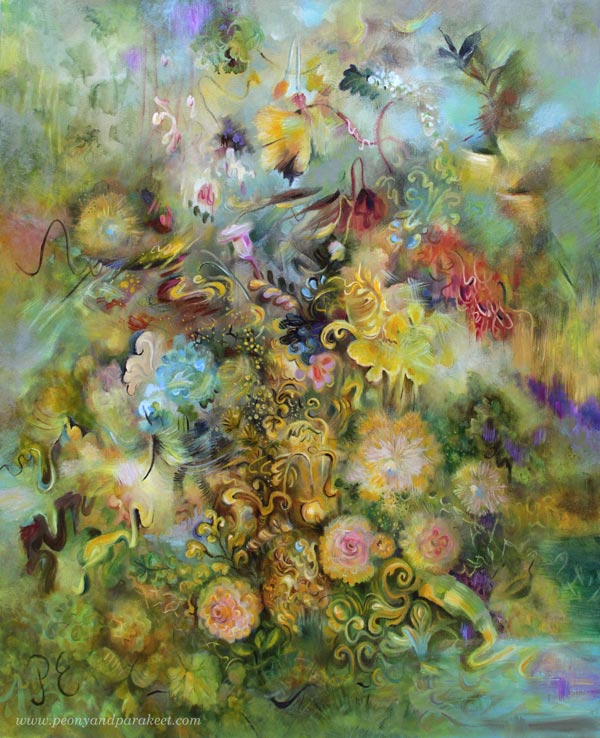
In 2020, I found my current painting style and focused on freely painted abstract landscapes and floral still lifes.
Considering I started my career as a full-time artist in 2014, you could say I moved forward in three-year leaps.
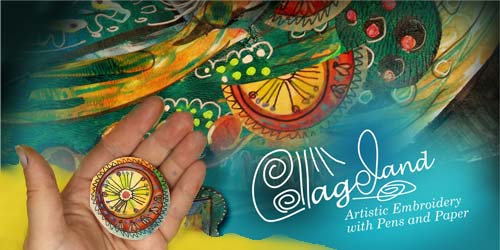
After the first stage, in 2018, I wanted to create one last course on decorative collages. It got the name Collageland. I felt that moving on is like leaving one place and founding another.
Remembering Collageland
Yesterday, I watched Collageland again. The course videos and the written materials evoked two strong emotions.
First, I felt tremendous inspiration. I just had to do those exercises one more time! I painted papers with watercolors, made prints on paper using a Gelli Plate, and decorated the papers with pens. One of my art journals now has a farewell to Collageland, where flags fly, sending prayers and good wishes to all artistic souls.
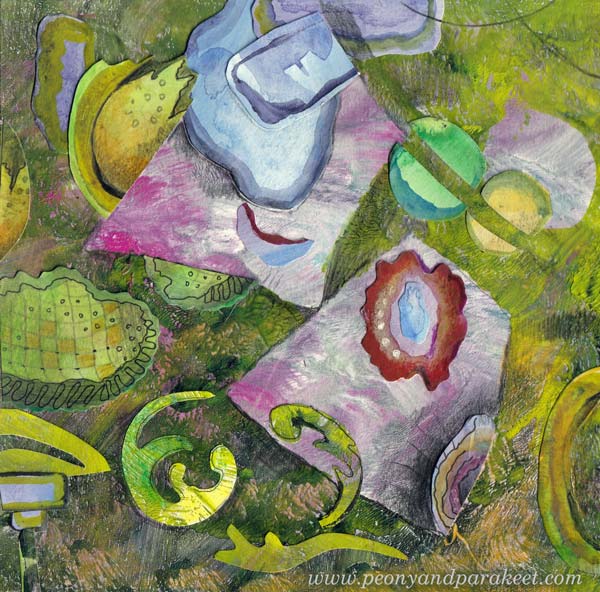
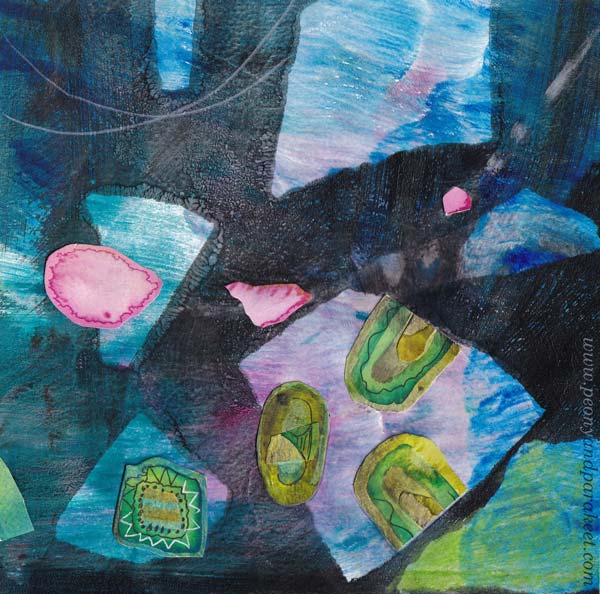
I used torn papers over the Gelli Plate and I think the backgrounds are really cool. It looks like the “flags” are glued, but they are just layers of paint!
Originals and Prints
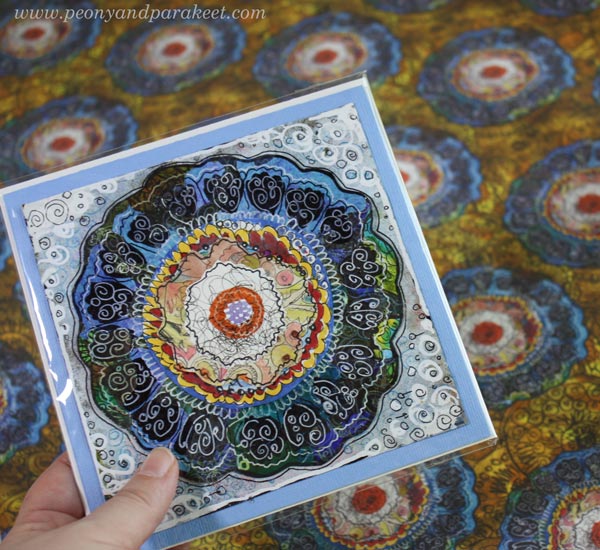
Viewing the first stage of my artistic journey from a distance was exciting. I didn’t remember how much inspiration is packed into the course, and I had forgotten surprisingly many techniques too. In Collageland, I share not just collage art made over the years, but also prints and fabrics created from them.
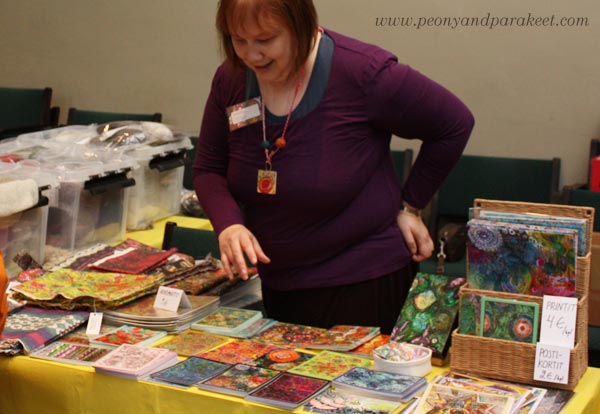
Changing the Needle to Pens
In Collageland, I also show inspiring needlework projects, as my drawing originally grew out of them.
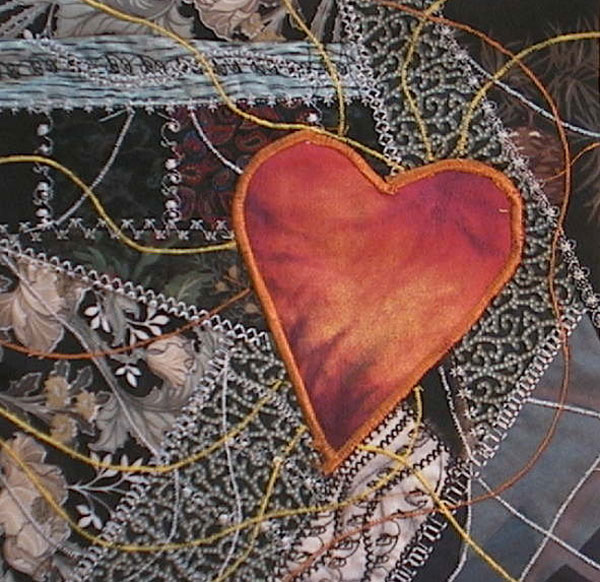
Embroidering with a needle, or even with a machine, eventually felt too slow, so I switched to a pen.
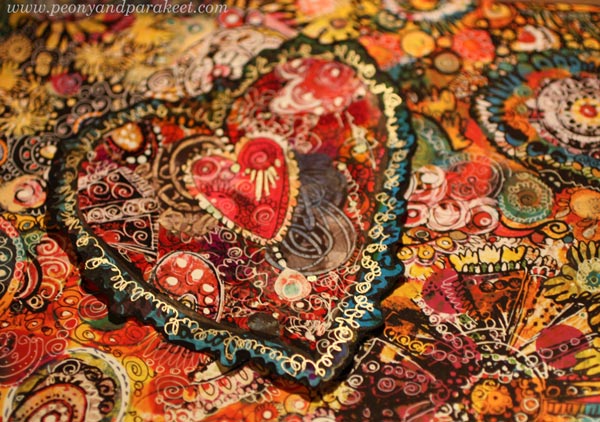
So, the subtitle of Collageland is “Artistic Embroidery with Pens and Paper.”
Collageland Is Retiring – Buy Now!
Yesterday, when the final video ended and my art journal spread was finished, I was moved to tears. “Hey Päivi,” I wanted to say, “hey younger Päivi, I want to become you again!” But at the same time, I felt that I was already living in a third, even more wonderful land, and that there is no turning back.
So, it is time to retire Collageland. If you haven’t taken it yet, I warmly recommend it! There are still a few days left to purchase, and the price is 50 % OFF! >> Buy Now!
The course videos are available to you for at least six months after purchase. And if you download all the course material, the course is for your personal use as long as you keep it on your device. >> Buy Now!
Collageland is no longer on sale after Sept 27, 2026, at midnight PDT.
Make Old Art Journal or Sketchbook New Again
This week, I have a 1-minute video about revamping my old art journal!
This sketchbook is from 2018, back when I was practicing different portraits and creating a course called Innovative Portraits. There’s still plenty of empty space left in the book.
My Old Journal and How the Cover Was Decorated
My old art journal is from The Pink Big. I decorated the cover around 2020.
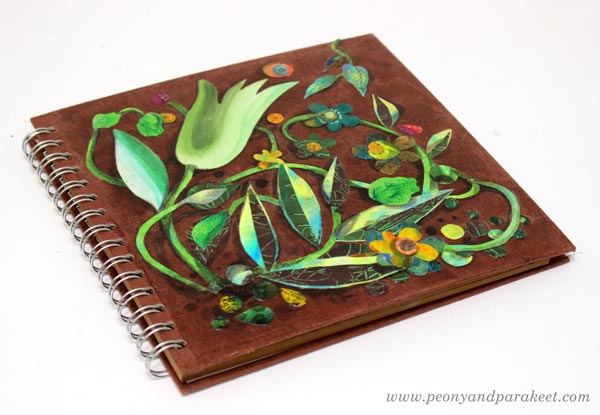
I cut hand-painted papers, added shadows, and protected the collage with gel medium. See an old blog post about how to create the collage!
Now I brought the book back out to start filling it up again.
Oil Pastels in A Journal
The first page was done with smudgy oil pastels, so I left the opposite page empty.
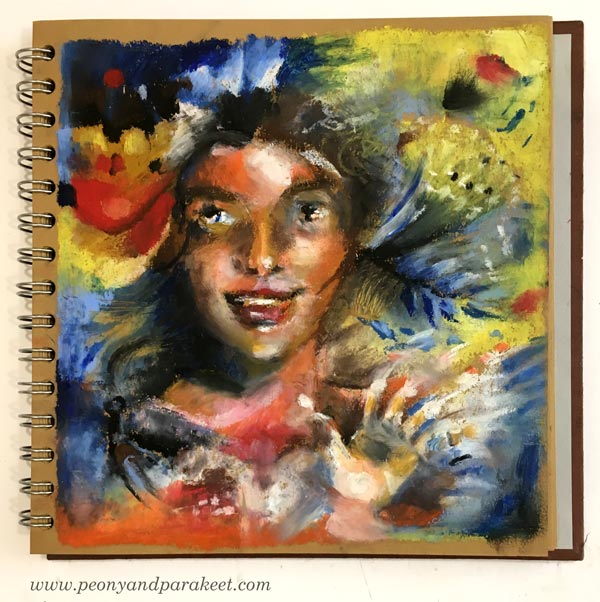
Oil pastels are fun, but maybe not the most practical for journals. See an old blog post about ideas for using oil pastels!
Abstract with Colored Pencils
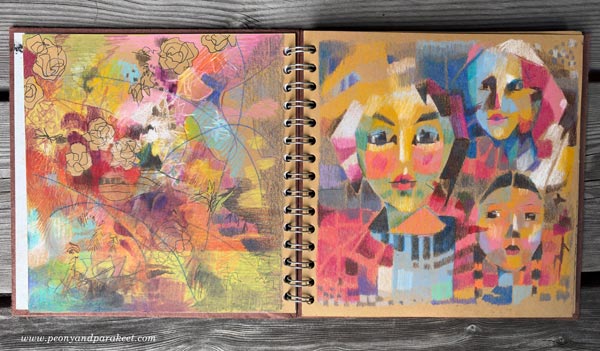
On the next page, I made an abstract drawing using colors that go well with the original 2018 page.
Fun with Sakura Gel Pens
These brown pages are great for trying out gel pens. I made a new drawing on the opposite side.
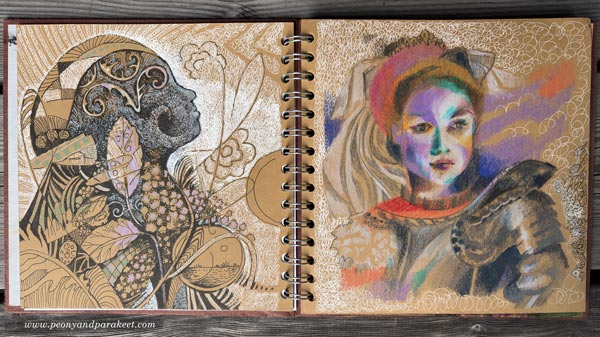
My newest course Drawing Soulfully is about drawing all kinds of lines, and it was fun to use those techniques here.
Flowers and Fabric with Colored Pencils
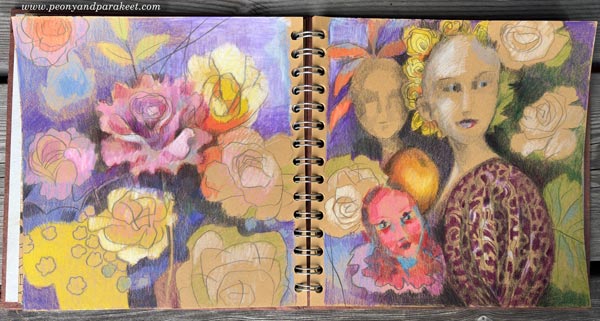
I placed a paper sheet to protect the previous page, and then colored flowers with colored pencils. The opposite page only had three faces, so I added flowers there, too. I love historical styles, so the main figure got a big, decorative sleeve with dramatic folds.
The next spread is already waiting! I hope this inspired you to make an old art journal or sketchbook new again and use your past pages as inspiration.
P.S. You can still sign up for Drawing Soulfully! >>Sign Up Now!
A Dot That Went For a Walk
Paul Klee said:
“A line is a dot that went for a walk.”
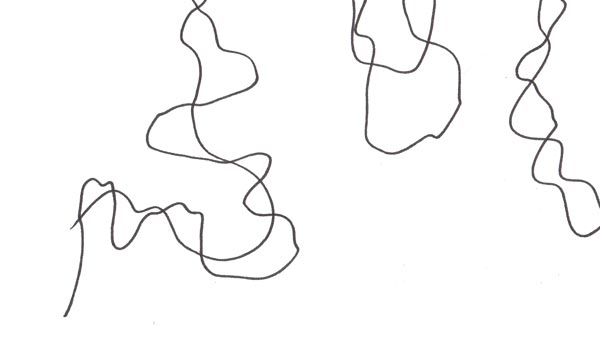
I would continue the conversation about the line:
“Art is a line that was freed to play.”
Everything starts with a single line. When people say they can’t draw, they simply haven’t made friends with their line yet.
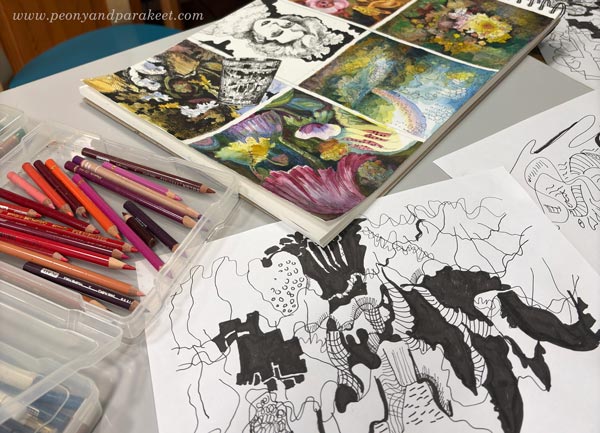
Art doesn’t start by comparing yourself to others. It starts with your own line. Observe where it turns naturally, and learn how to vary it—so that a drawing isn’t just a monologue, but a conversation, a play, an event.
When a drawing is a happening on paper, art happens. And that’s when you know you can draw!
Drawing Soulfully – Sign Up Now!
My newest course, Drawing Soulfully, is about finding your living line and starting a journey to your artistic style.
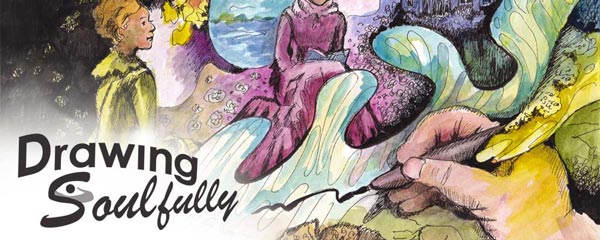
Drawing Soulfully goes much deeper than standard technique. In the course, I open up about the invisible side of art. I guide you to move beyond concrete ideas into conceptual thinking that frees your creative process. I also share how emotional needs shape our lines, and how to balance intuition and technique.
In my explanations, I’ve focused on what isn’t directly visible. Making art is so much more than just looking and creating. >> Sign up Now!
Starting a New Sketchbook with Botanical Art
This week, I share how I am starting a new sketchbook!
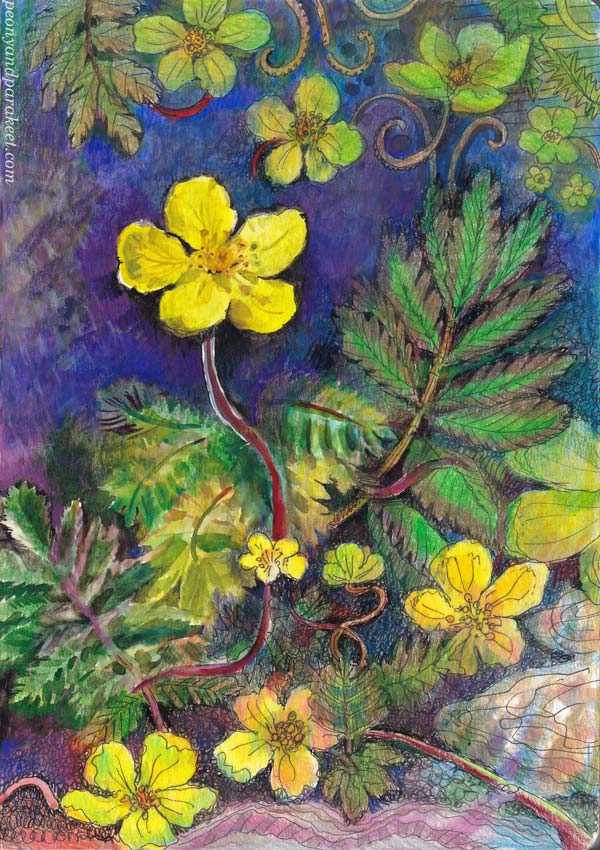
Eged’s silverweed (meriketohanhikki in Finnish)
Starting the Dingbats Pro Green Beetle Notebook
For a long time, I’ve been looking for a sketchbook that works well with both pens and watercolors. I’ve used Fabriano’s thick (200 gsm) Accademia drawing paper for individual drawings for years. But now that I’m gathering material for a new painting series, I really wanted to create my work in a book instead of keeping loose sheets in a folder. Flipping through a book’s pages just feels so much nicer than turning plastic sleeves in a binder.
I noticed that a Finnish stationery shop, Vihkokauppa, had added the Dingbats Pro Green Beetle Notebook to their range. The product description said that the maker spent a long time developing the paper to make it suitable for watercolors. I don’t live near the shop, so I took a chance and ordered it online.
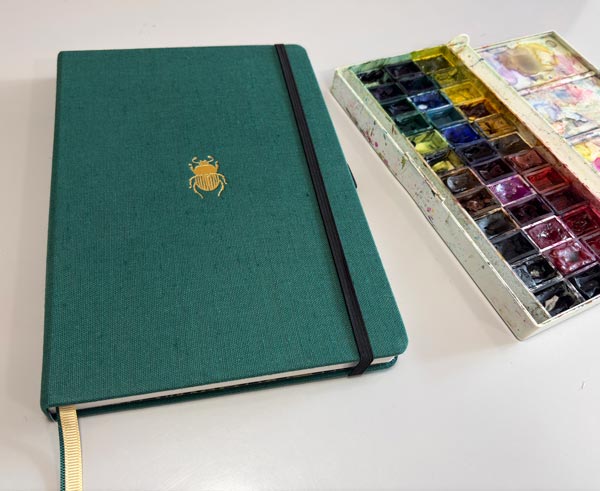
I was lucky. Based on the experience so far, the paper is truly great! It’s thin enough (160 gsm) so the notebook doesn’t feel bulky, but thick enough to hold water. The pages are wonderfully smooth and work great with fineliners and colored pencils. Because of its size (B5), it’s also a good fit for my new course, Drawing Soulfully, if you prefer to do your course drawings in a book.
Moving Away from Procrastination
I have a few topics I want to explore before starting my next series of big paintings. I have a short list, and I’ll share my ideas in future blog posts. These are mostly things I have wanted to explore more deeply for quite some time, but have procrastinated on for some reason. It’s time to stop that procrastination! Building the new course, Drawing Soulfully, has given me a lot of energy for that, and I hope that the course will inspire you too!
One of the topics on my list is plants. The exact species doesn’t matter, though of course I prefer to see the plant with my own eyes first. Plants have such interesting shapes and details that I want to add to my artistic repertoire. So now, when I was starting a new sketchbook, my first project was to pick a plant and draw it.
I took a few photos of a cute yellow-flowered plant during a little getaway in June, and later identified it at home. The silverweed made it as the very first entry in my new sketchbook!
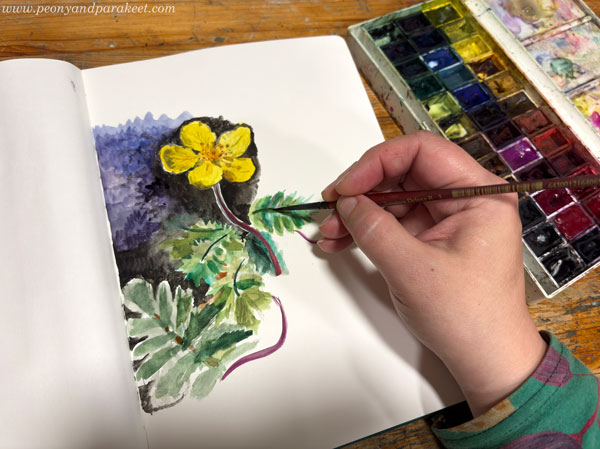
I started the drawing without any pencil sketching, going straight in with watercolors. For the main flower, I followed one of my photos quite closely, but after that, I let go and worked more freely.
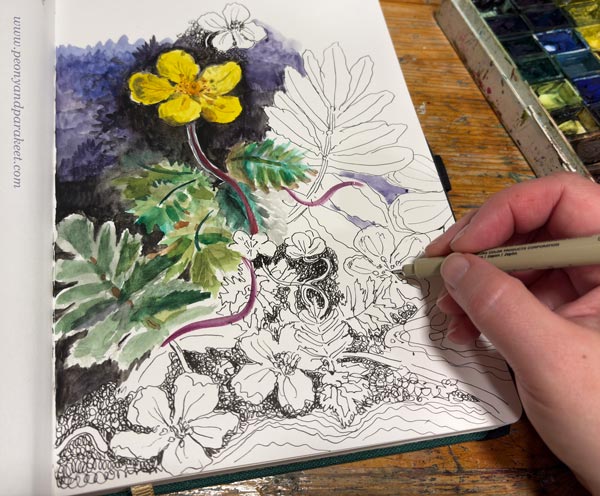
I think the soft feel of watercolors and the precision of fineliners go together so well. I just love drawing with thin pens.
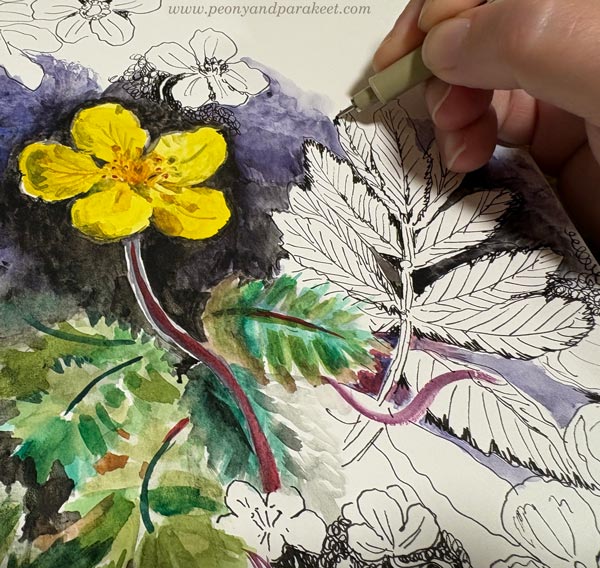
Using only a little water with thin brushes makes me feel like I am a decorative painter in the 18th or 19th century! I also made some notes about the plant on the opposite page.
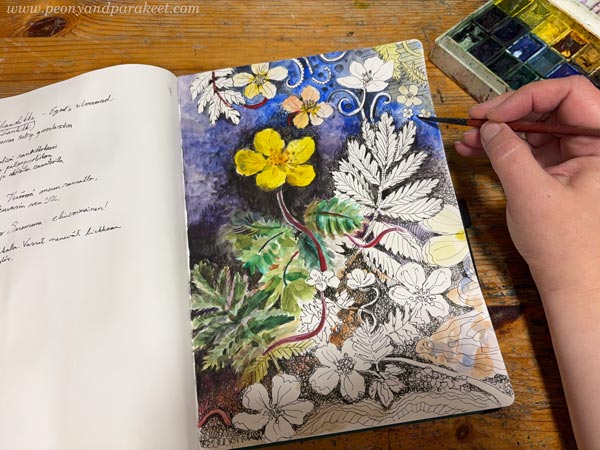
Having the black-and-white parts on the page didn’t bother me at all, so I actually thought about leaving the page like that—half black-and-white.
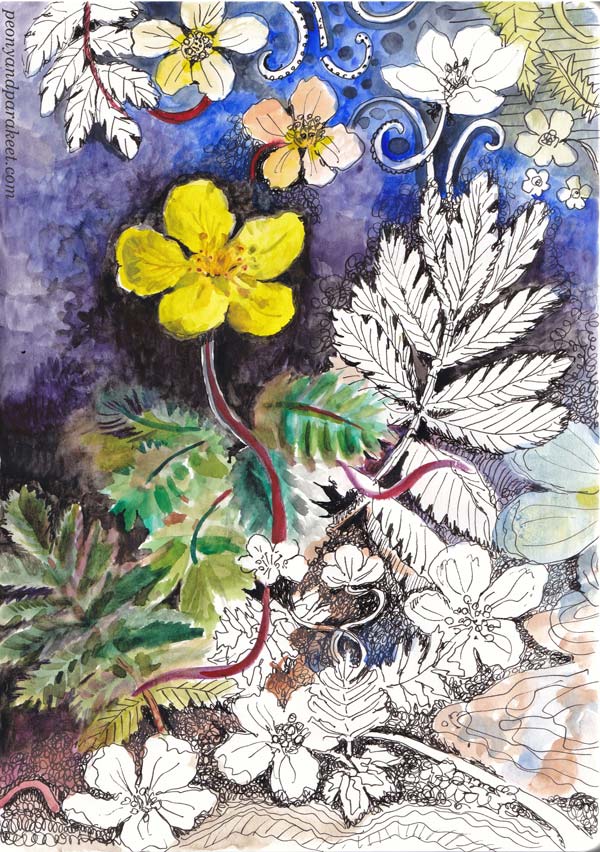
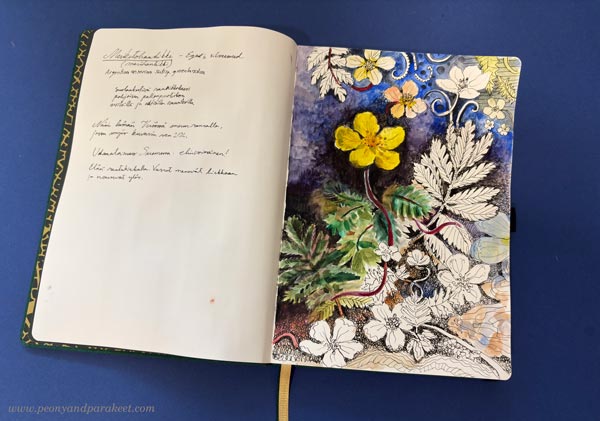
The next day, however, I decided to color in the black-and-white parts with colored pencils to bring more life and atmosphere into the drawing. It didn’t even take long, since the drawing itself and part of the coloring were already done.
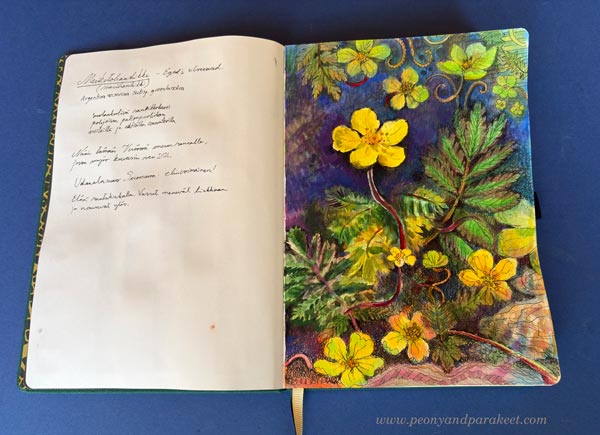
Starting a New Notebook – Watch the Video!
I recorded a few short videos while working. In the video below, you can see the notebook and how the first page came together. You’ll also see the watercolor swatch grid I made at the front of the book.
Even if the starting point is botanical, the finished drawing can be expressive rather than stiff. I hope all of this inspires you to draw more, and maybe you are starting a new sketchbook/art journal too!
For the Love of Drawing
Don’t forget to sign up for the new course Drawing Soulfully! In the short video below, I talk a bit more about the love for drawing and what the course is all about.
Drawing Soulfully – Sign Up Now!
In Drawing Soulfully, we work with and without photos but always with a creative approach.
Drawing Soulfully begins on August 25, 2026. >> Sign Up Now!