
Find a Focus for Your Art
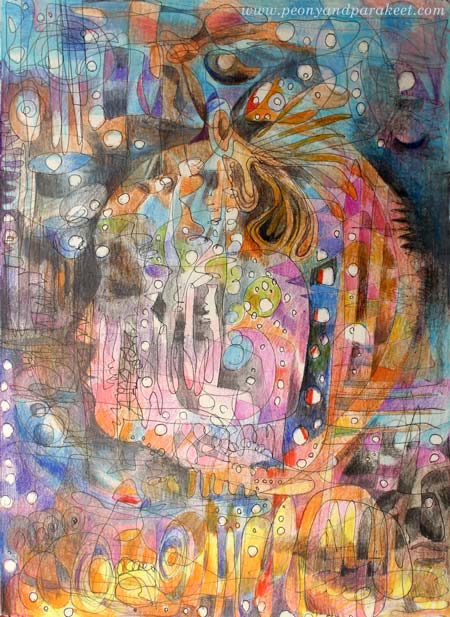
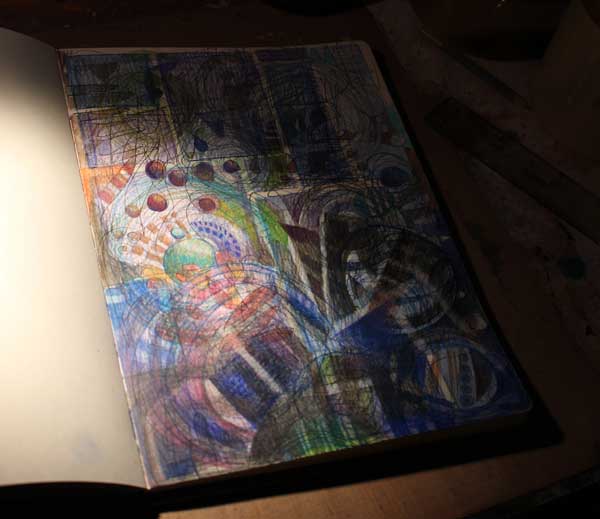
Here’s my latest art journal page with colored pencils. It is called “I Am Listening.”
Drawing Process
I knew that it would be a good moment to create art when I heard about a live broadcast of an opera La Traviata. To enhance the atmosphere, I adjusted lighting and closed sliding doors in the room where I was creating.

When I started drawing, I had no idea what the final result would represent.
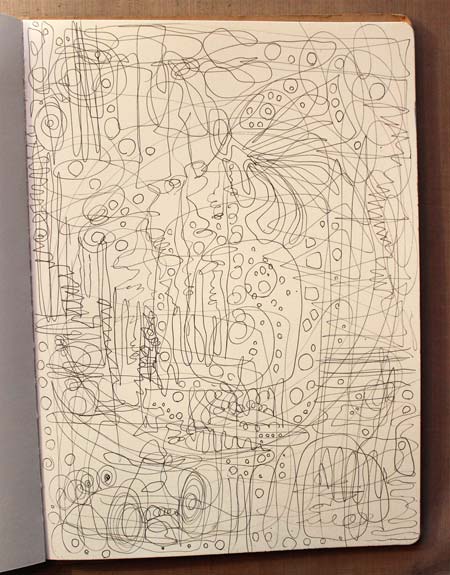
And even when I began coloring the page, I had no clue.
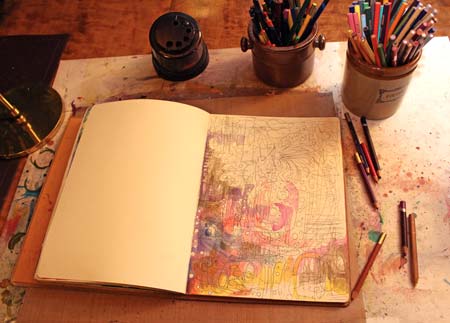
But once I had worked for a while, I saw the face appearing on the page. Soon I knew that the drawing would be about listening to music and how it activates the whole brain. I have experienced that personally, but Finnish researchers have proved it scientifically too.

Focus Sets You Free!
I used to hate people who repeated: focus, focus, focus! I questioned back: “Isn’t experimenting an essential part of creating art? Shouldn’t art set us free, instead of steering us to a narrow path?”
But after finding my focus, I realized that I had had misconceptions. The focus should not be a single subject like “birds” or “faces,” certain supplies like “acrylics” or certain style like “cubism”. The focus should not come from outside, but inside. It should answer the question: “When thinking of self-expression, where are you best at?” This kind of focus will lead you to see more possibilities. You will experiment more and you will broaden your perspective.
I did not mistakenly listen to dramatic music in the suitable surroundings. I used it as a tool to bring out where I am best at – visualizing experiences, systems, and transformations. That’s my focus. Whatever I doodle, I can feel free as I do not have to worry about what will appear. My focus will feed my subconscious and my imagination.
For some of my students, the focus has been “feelings in relationships”. For some, it has been “fairy tales” or “mysteries.” Some have been skillful in seeing “the beauty of everyday life,” others thrive on “atmospheres of dimensional spaces.”

Subscribe to my weekly emails – Get a free mini-course!
See What You Think!
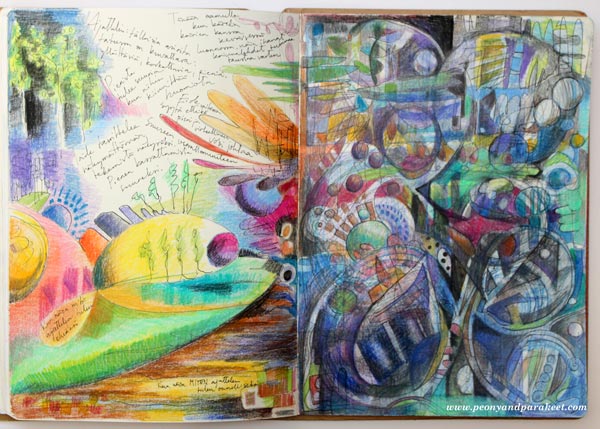
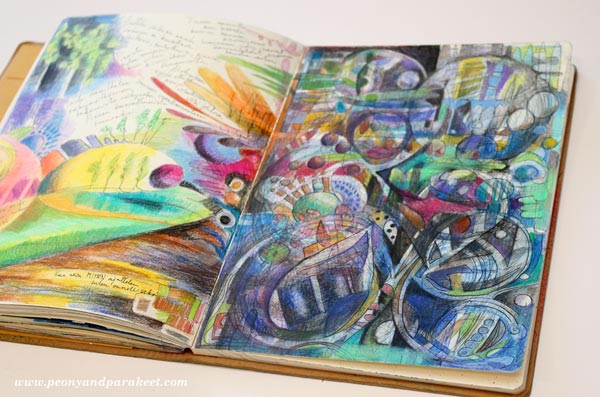
Here’s an art journal spread that I created from two little incidents: the intellectual and the emotional.
Visualizing an Intellectual Incident
Last week I went to an art gallery to see Ola Kolehmainen‘s photography exhibition. I often get very emotional when I see art, but this time I was more intrigued by structures and concepts. Ola Kolehmainen’s photo collages had a cubistic touch. They inspired me to experiment with squares and arches.
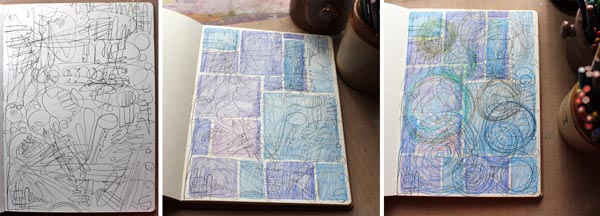
The art journal page looked pretty stiff and formal at this point. But also I felt excited about how it would direct my thoughts when continuing drawing and coloring.
Perfection Needs Order
Working intuitively means that I do not always know what ‘s going to appear next. I just focus on a small area at the time. While listening to some opera pieces, I remembered how close mathematics and music were in the 18th century. One of the great mathematicians Leonhard Euler was also extremely interested in music. I feel that similarly, drawing can be an experience where we use the intellectual side. By drawing we can find out new solutions, practice nuances and fine-tune shapes until everything seems to be in its place. Like Euler said: “… in any thing where there is perfection, there is necessarily also order.”

Visualizing an Emotional Incident
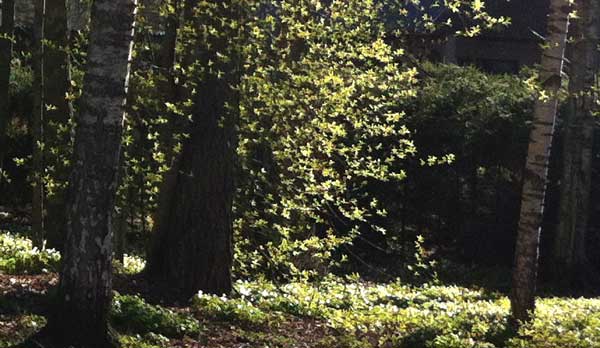
But then, when we aim for perfection, we often miss the experience. Like the exhibition last week – I went out without noticing any particular change in my feelings. Then, this morning when walking the dogs, I saw the growing leaves and how they glowed against the sun. The sight was so beautiful, although pretty ordinary at this time of the year. Nevertheless, it felt like opening the door to a great gallery – to nature’s supreme art exhibition!
Combining The Intellectual and Emotional Incidents
When I got back home, I thought that it would be interesting to express the controversy of the intellectual and the emotional on the same spread. First, I drew my nature experience with careless lines but with clarity. Then I made it work with the page that had become very detailed but pretty complex.
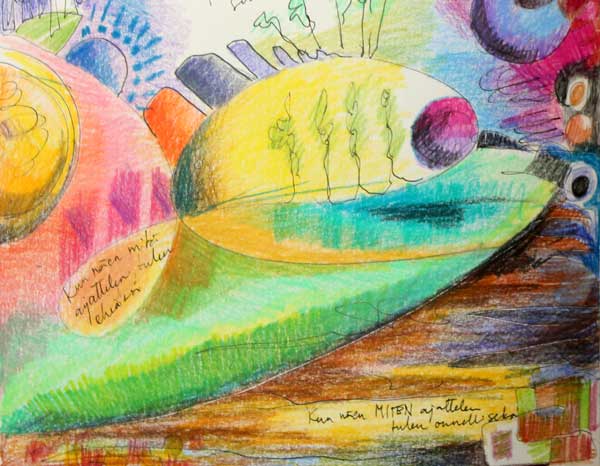
I wrote: “When I see what I think, I become whole” and “When I see HOW I think, I become happy”.
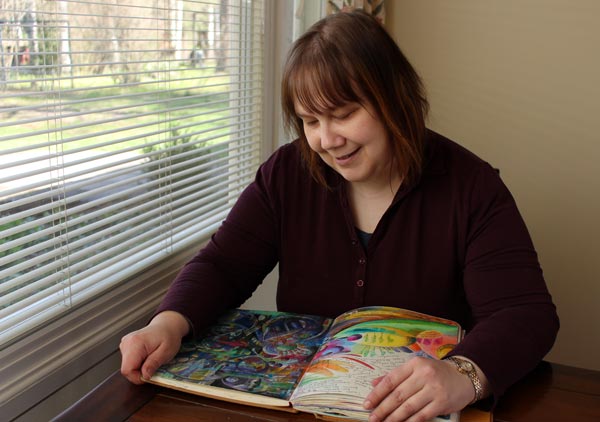
This page spread is not only about going to the art gallery last week and walking the dogs this week. It is what happened inside me and how these incidents were combined. They continue my story as an artist and help me to stay in touch with myself.
Visualizing thoughts and experiences bring it all together. There’s a lot of inner power in seeing what you think.
Subscribe to my weekly emails – Get a free mini-course!
Stop to See Your Inner World!
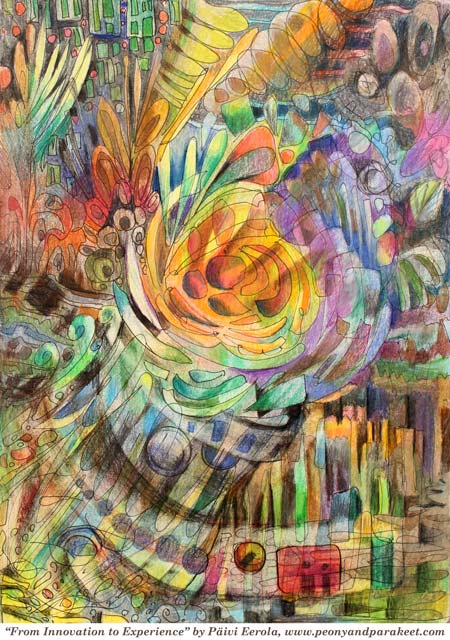
If you watched my recent video interview, you know that I love technology and innovations. People often say that technology is a tool. I do understand that phrase and agree with that to a certain point. But if I had to define technology, I would say that like art, it’s an experience. Whether I read about innovation in technology, or see an interesting artwork, I like to stop and think how I feel about it.
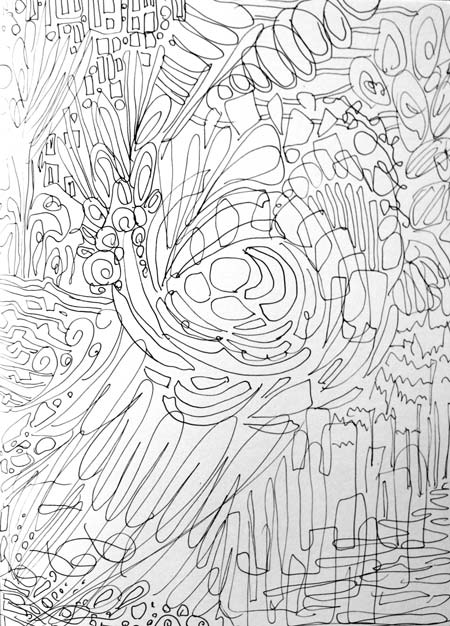
Now you might ask: “Why would I take any abstract concept or inanimate object and add emotion to it?”
My answer is: “Because that’s how you boost your imagination!”
When we see technology as a crowd in a concert or a tea cup as a gentle old lady, we will open the door to our inner world.

Often it requires that we stop. Stop taking in universal generalizations, and start adding our associations. It does not mean that you should do it all the time, but in small moments, every day. Because like Terry Pratchett has said: “Humans need fantasy to be human.”
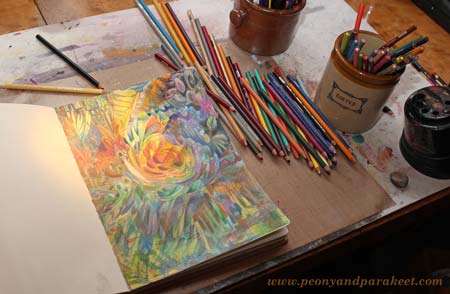
By drawing, we can work our fantasies so that they become insights. Instead of continuously searching inspiration from outside world, we can take time for processing information inside. When we integrate our past experiences with new ones, we can have an improved view of our life as a whole. As visual people, we can produce images that have that unified vision. These kind of holistic visions are almost impossible to express with words, that’s why they are called “the big picture.”
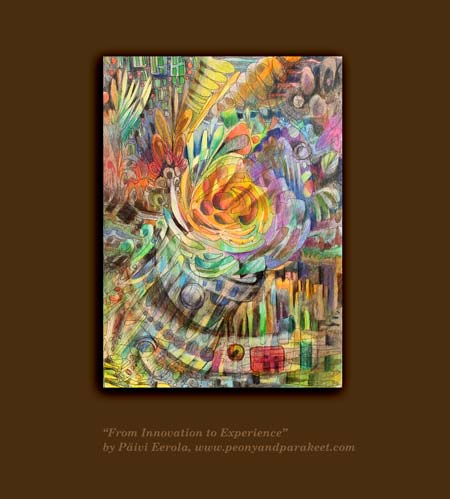
Sign up for Inspirational Drawing 2.0!
You will learn not only practical ways for processing inspirational material
but also how to let your subconscious take control.
Produce “the big pictures” of your experiences!
>> Sign up now!
Are You an Inspiration Seeker, Imitator, Mess Maker or Minimalist?
During the past years I have had the priviledge to get to know many beginning and more seasoned artists. Every person is unique, but there are also common nominators. Based on my experience of teaching art and being artist myself, I created this presentation about four common problems and four common profiles.
When watching the presentation, you might have noticed that I let my minimalist part create it!
>> Inspirational Drawing – Reserve your spot!
My Journey as an Artist
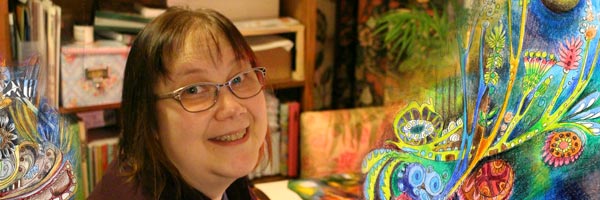
This week I also have a longer video for you. Connie Solera from Dirty Footprints Studio interviewed me on live video! You will get to know few life changing events that gave direction to my art and hear a great discussion between Connie and me about the process of creating art. Watch the interview!
>> 21 Secrets Spring 2015 online workshop, my class included – Buy now!