
The Essence of Your Art
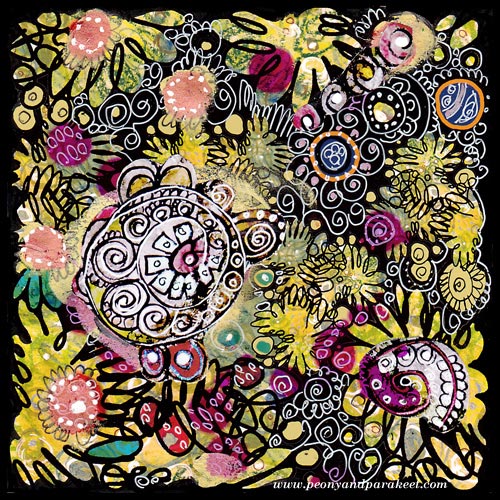
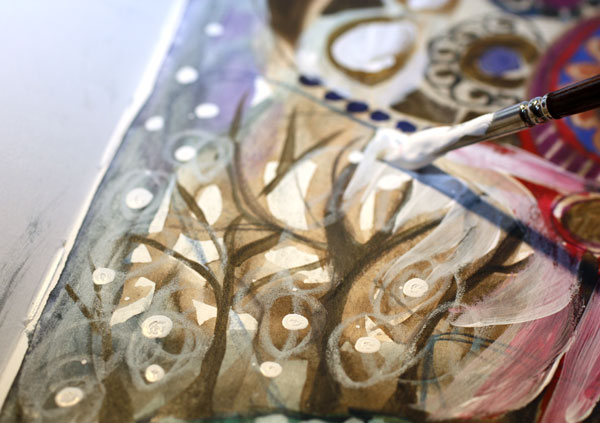
I found this old collage piece when I organized my archives. It is a design that I have used as a part of the fabric called Flow. As art journaling cute little girls with lovely little animals, is so popular nowadays, this made me think: what’s the essence of art is for me. And also, I would love to hear what it is for you!
For me, it’s not the play, even if I love playing. It’s not the colors even if I am totally for them. It’s not even the circles, my favorite shapes. I might aim for the certain styles, I love art nouveau and expressionism, for sure. But the essence of everything is that I want to create “everyday icons”, the images that make me stop, drop everything mundane and get in touch with my the inner thoughts.
Technically compositions, colors, shapes, styles, etc. create that. But when I am happy with the result, I do not think about those anymore. I think about what I feel and think right now and where it can take me.
The best thing is that everybody can create their personal icons, sacred images, mandalas, whatever you want to call them. They don’t need to be connected to any religion. They can just be connected to experiences, moments or beauty which uplift your spirit.
This is what I thought when I saw this old artwork. And now I wonder, what can I do better. How can I make this blog be the place for anyone to stop, then start creating – the essence of their art!
Subscribe to my weekly emails – Get a free mini-course!
Get the Most Out of Art Critique
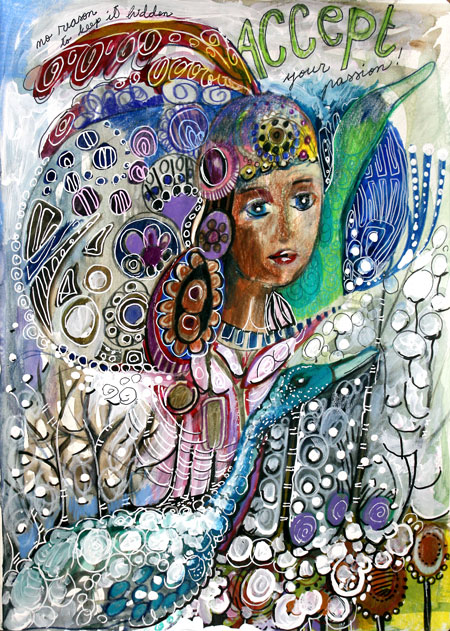
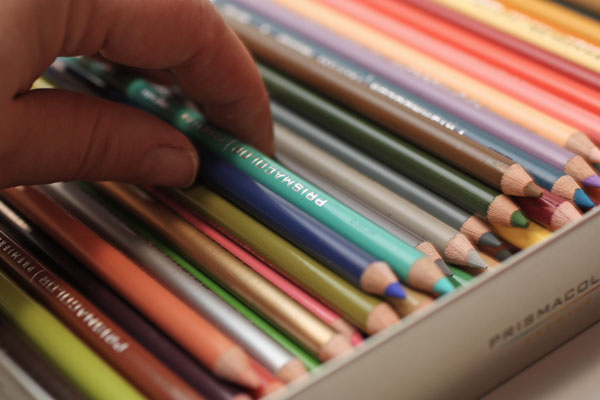
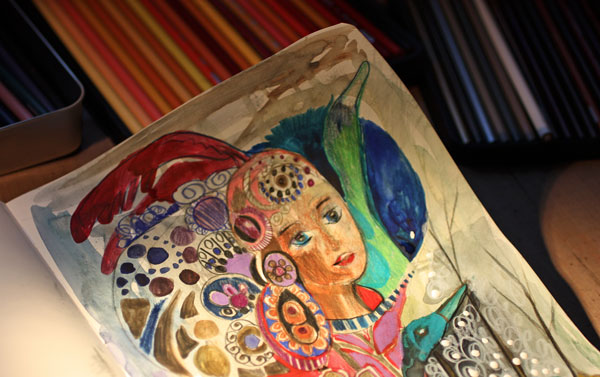
My latest art journal page is inspired by a discussion in an art journal group. It was about how to deal with the criticism towards your art. One woman told a story which touched me deeply. Someone had accidentally seen photos of her art and asked if they were made by her little grandchildren. After that she did not feel comfortable making art again. The story made me think about how important other people’s reactions to our arts and crafts is. How much we yearn for comments and how the critique can scare us. I also share those feelings. These are my conclusions of the subject. (And yes, I have new pencils!)
1) Pick Your Specialists
“Can you simplify, Paivi?”, said my teachers in so many words while I was studying industrial design. Because, in design, it all starts from the basic concepts, basic shapes and little alterations to them. I have always loved decorating. So I rushed through the first design decisions to get into adding swirls and tiny dots to the each of the designs. When I completed a sketch for a bar code reader, a teacher said: “What can I say, it is like a Russian icon painting with a flair of folk”. And he did not even know I had painted icons as a child!
“Your sketches all look the same”, he continued.
I did not get it. For me, they were all so different.
– “The same shape is repeated all over again.”
When I went back home, I thought that studying industrial design was going to change me to the direction I did not like. Within a year I would be living on a white box with no carpets on the floor and wear black glasses. But the end result was nothing like. My interest in art history and decorative art only increased within the time as practicing different styles helped me realize there’s no need to create a too narrow image of my own art.
At the end of the studies, one of the teachers said to me, carelessly: We just got an application from a person who reminded you: so many details, so little simplifying! We can’t accept him in. To design is to simplify. Despite your beginning, you do have learned that.” It meant a world to me – according to her, I was a simplifier, a designer.
In today’s world, there’s a specialist for everything. I yearned for the specialist to testify, objectively. And once she did, I was happy. But later I have begun to think that actually, in art, everyone has to define their own specialists. The range of art and design is huge and surely, everybody doesn’t like every piece of art.
So, don’t even expect that everybody likes your art – is a specialist of your style. Pick those that you want to please and forget the rest!
2) Improve Your Communication
An artist Ann Rea has said: “Art is communication”. I think that focusing on what we want to say with our art is often more beneficial than focusing on the techniques. When someone comments our art, whether the feedback is positive or negative, we can always ask: “What do you see here? How does it make you feel? What do you like the most?” (Or “like the least”, if you are brave enough, and if you have chosen the person to be your specialist.)
Sometimes it is not so much about delivering a certain message, but touching people. When we are touched by our own art, it may seem surprising that others do not get touched by it. Then we need to improve our visual communication or fill in the story verbally. (The power of art journaling!)
Instead of thinking “I want to become a better artist” you may want to think “I want to become a better visual communicator.” After that, you will often find art critique easier to swallow!
3) Set the Risk Level
If you only want to hear positive comments, set the risk level low. One way to do that is to stick with the realistic art and copy those who have a lot of general acceptance.
But if you want to find your own style and in the end, truly touch people, take more risks! Experiment, observe, let go of the definitions you use for yourself, think about before you start to create and while creating, stop thinking! You can set the risk level for each individual piece, and go higher from one artwork after another.
Once in a while, give yourself a permission to make high-risk art! Sometimes it may also be good to take high risks when asking for comments! But never let anyone keep you away from creating when you are on the way of unique self-expression.
In need of experimenting? – Join me for an art journaling workshop!
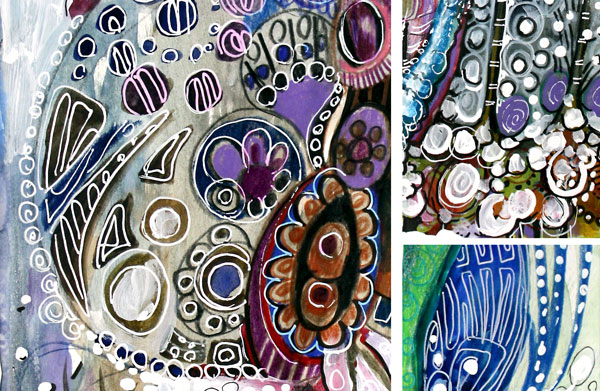
This is one of the many art journal pages inspired by embroidery techniques. Meet me at 21 Secrets Art Journaling Workshop where I will show you my favorite embroidered textiles and teach you how to imitate the embroideries with pens and paper! The perfect project if you want to stretch your style in a safe environment! The workshop begins in April, but you can preorder now!
Do You Paint Your Dreams?
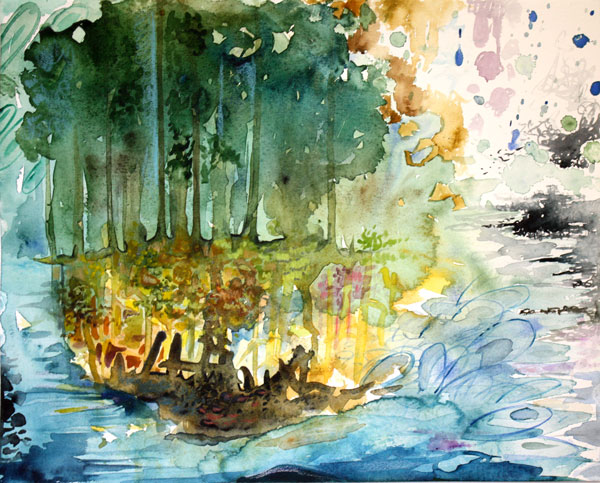
My recent watercolor painting is called “The Forest Speaks”. I painted it using the intuitive painting method which I show on the video “Watercolor 101 for Intuitive Painting”. The initiative for this painting came from a dream, almost a nightmare that I had a few days ago.
Before I quitted my day job, I developed e-services for the Finnish forestry sector. I had planned my resignation for a long time. It was a tough waiting period. A couple of months ago I finally entered the full-time creative entrepreneurship. After resignation, I felt free and happy and practically stopped thinking about my old job.
But just recently I began to see these dreams – some kind of nightmares. The setting was always the same: my last day at the old job. There was so much to do that I was never able to leave. I woke up sweaty and distressed. Then, in the latest of those dreams, I was given one final job: to paint a painting for the hall of The Forest Centre. I knew exactly how it should look like but somehow did not get it right. Again, I woke up with anxiety.
In the morning I began to think that maybe there’s something that needs to be handled and documented – painted that is! So I took my watercolors and began to paint the image visioned in my dream.

The painting is finished now and the last nights have gone smoothly. I became convinced that our minds can be slower than we think. Our subconscious may have a lot to deal with. By nurturing our creativity we can become more aware of all what’s going on inside us. They might not be any bad or weird things, they are just stories that need to get told. For many people that I used to work with, the forests and forestry were very important. The forests spoke to them. For me, it is art that speaks and that’s why I had to leave.
After this experience, I want to interact more with my dreams. Is that relevant to you too? Have you ever painted anything related to your dreams?
Subscribe to my weekly emails – Get a free mini-course!