
Four Steps to Finding Your Passion in Art
Sign Up for Paivi’s Weekly Emails and get a free mini-course, Color the Emotion!
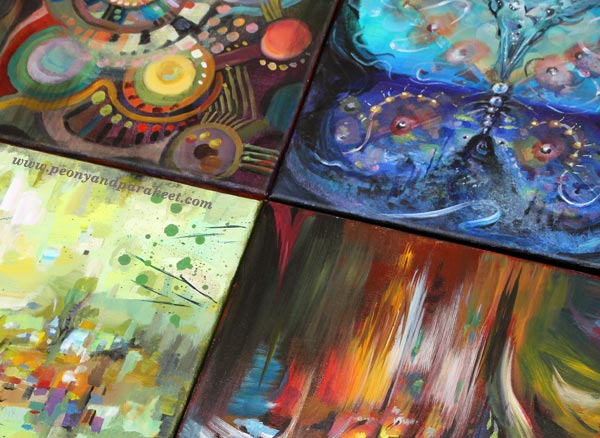
I have two painting workshops coming up in October. It’s terribly exciting. It has been an investment in time to create the classes. I have tried to create as coherent, useful, and fun classes as possible, taking all the comments and suggestions into account without losing the focus and the real benefits that these workshops can provide.
Planet Color celebrates color in a 7-step process.
Nature in Your Mind creates a natural connection between the mind and the brush.
Finding Your Passion in Art
This blog post is a pre-session for Nature in Your Mind. With this post, I want to show how much potential and passion you can have as an artist. I also hope that you will sign up for Nature in Your Mind, discover more possibilities and get personalized guidance while having a great time painting!
1) Discover through Experimenting!
Think about art as an exploration journey! Through experimenting, you can pick ways that feel most natural and enjoyable to you. Just like there are thousands of species of birds, there are many ways to paint. If you use only one technique and one approach to painting, it’s like sitting on a balcony and listening to the same bird every morning. But if you stand up and go walking in nature, you will hear a variety of melodies.
Discoveries happen through experimentation. Try painting with a dry brush, a wet brush, a brush that has thin paint, a brush that has multiple colors, etc. Start painting with one thought and then change your focus to another one. Learn to see the possibilities of an unfinished painting instead of judging it like it’s already finished. Start with safe and easy, and then be open to small mistakes that can show you a new direction. If you weren’t able to mix an even color, embrace the variety of colors, the painterly look, and go to a new path from there.
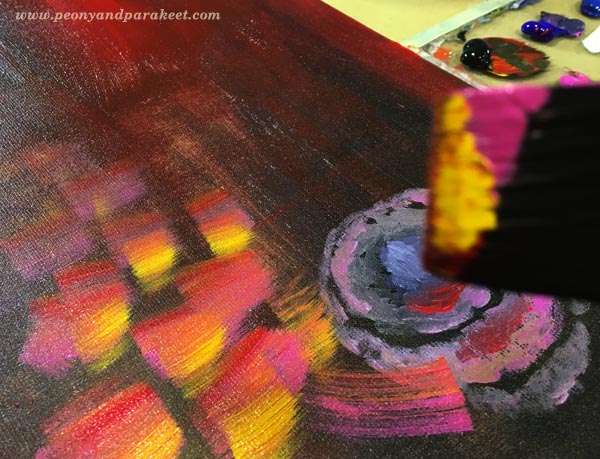
Three Levels of Experimenting
The way you paint most naturally isn’t what feels most comfortable at first. Staying on the balcony is easy. You can tell everybody that you have this friend, the bird that sings to you every morning. But you don’t know what you miss out if you only stay friends with one technique, one theme, or one way to plan your painting.
My painting workshop Nature in Your Mind contains experimentation with paint in three levels.
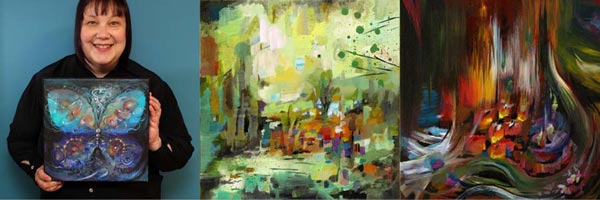
First, playing with the way you look at things by changing the perspective in the middle of the painting.
Second, playing with a theme by building abstracts from realistic images.
Third, playing with control by taking turns with controlled and loose strokes.
While experimenting with these, you can pick ideas and techniques that suit the best for you and then start applying them to your art. You can set new goals and see how your art can bring more enjoyment not only to you but also to other people.
2) Listen to What Others Say about Your Art!
Let’s get back on the balcony. I remember the time when I felt totally lost in art making. It was like I had opened the door, but didn’t see any birds singing. I felt alone. But then, I got tips on how to attract birds. I drew and painted what I saw other people do, too. I felt like I had company but still, I felt limited. I was one of the many who had the same bird singing on the balcony. Sometimes it even felt like we were competing with whom the bird would sing the loudest.
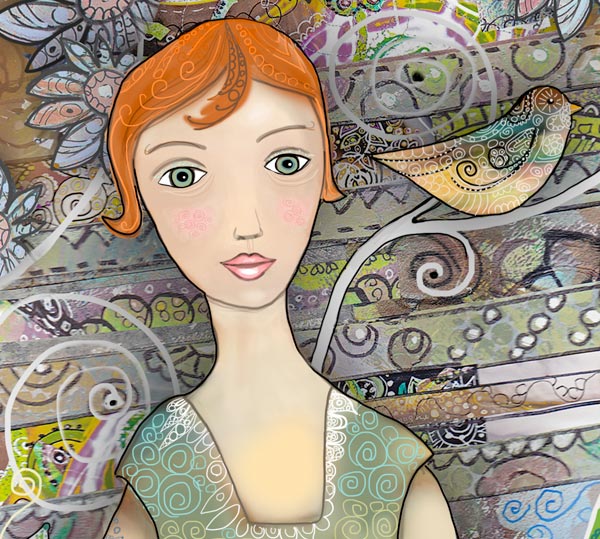
The situation changed when I started listening to what other people say about me. I expanded my attention to how my art affects others. I found many comments extremely useful, even if the person was a family member, a blog reader, an art teacher or anyone who saw my art. First, there was just a word or two that I could grab. When I felt like I was following a path that was hardly visible, I found asking follow-up questions beneficial. I asked: “Why did you like this picture?” or even “Why didn’t you comment on anything?”. The comments led me to strange places. But as I continued, my images changed, the voices got louder, and I heard more birds singing.
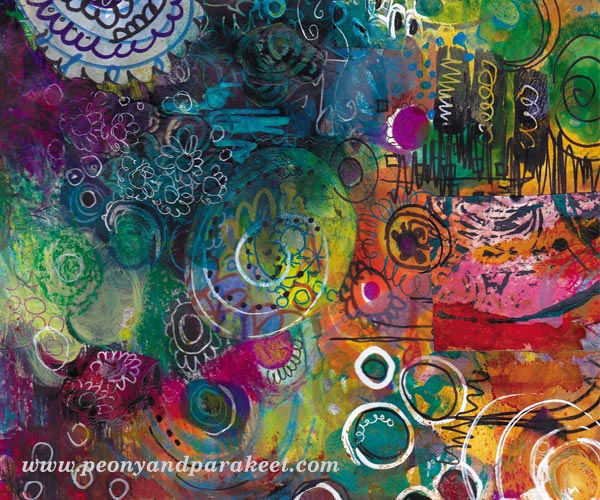
But I wasn’t quite there yet. I hadn’t found what would personally resonate with me. After trying to see the big picture from people’s comments, I understood why we read horoscopes, click through personality tests, and search for our personal style. We try to see our originality – where our talents truly are.
3) Accept That Your Flaws Can Be the Best in You!
I used to beat myself up for being too demanding, a perfectionist. I blamed myself for not being good with routines either. To get through the mundane work, I have reinvented the wheel too many times. My husband has found the perfect way to make a bed and fill the dishwasher. I have found many different ways, and I am in search of more.
But a couple of years ago, I made a test that described how other people see me. The test said that my ability to invent unconventional ideas, make new interpretations of old things, and always aim for the highest standard attract people the most! That’s probably the reason you are reading this blog. I have become more open with the worst in me, which, in turn, has inspired me to blog more and create more. Sometimes the best things in us seem ugly to ourselves. However, authenticity attracts people. Our black can be pure gold to others. Our black can be like soil for the flowers that we can grow from there.
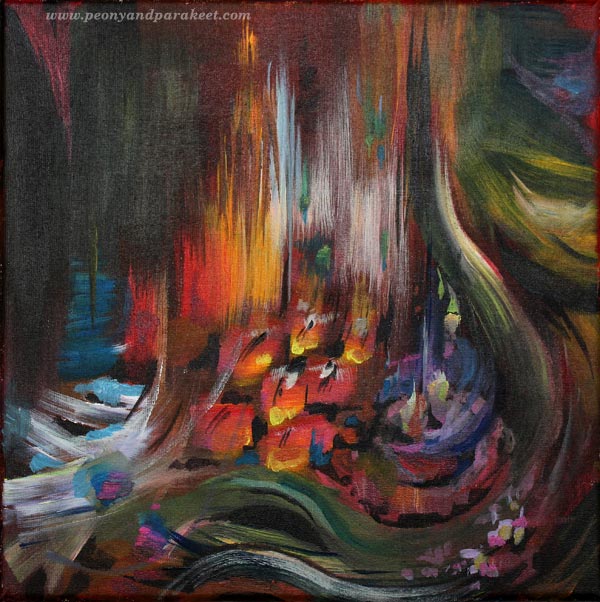
4) Find Your Real Reason for Creating and Put It Into Words
When people ask me why I create, my first answer is: “Because I need to.” I need to have time for balancing my life, be able to reflect on what has happened, and get energy from creative activities. But the answer doesn’t help me when I am staring at the blank canvas. I need a higher reason to create images that feel meaningful to me. I need more than some inspiring Pinterest boards to connect emotionally with my work. I need a direction, a statement that defines when I have succeeded and what I am passionate about.
I used to have a hard time evaluating my pieces. Some looked ok, but there was something missing. Others were clumsy and awkward, but I felt connected with them. I wanted to create unique pieces and still be as good as anyone creating with the same style. I wanted to make my personal version, but I didn’t have a clue what to include and what to exclude. I wanted to express myself, but still, play to be someone else. I wanted to escape, yet seek the truth. I felt I had to focus and limit myself, but at the same time, I wanted to be free when creating. It all felt controversial.
My solution has been to find the words that describe the real reason why I am creating. It’s surprising that the words have been the answer because the problem seemed to be visual only. I think that our left brain has to understand what our right brain wants to express. It’s like after naming the birds, you would hear them better. Whatever I create, I have the same focus. It’s not a theme, it’s not a style, it’s the emotional connection that I want to make through whatever I create.
My Artist Statement
In my art, I want to console people. I want to express grief and sorrow, blacks and browns. But I also want to show the power that is more joyful, and that comes in with brighter colors. I want my paintings to have the atmosphere of places that make you connect with your spirituality. I am inspired by churches, libraries, museums, and special places in nature. I see spirituality as an uplifting, timeless force that has no specific religion. I hope that even for a short moment, my art can be your icon, the image that connects you with your spiritual self. I wish that my art brings you hope, no matter what your source of melancholy is. I wish that the images inspire you to overcome darkness, and even more: to go and create yourself.
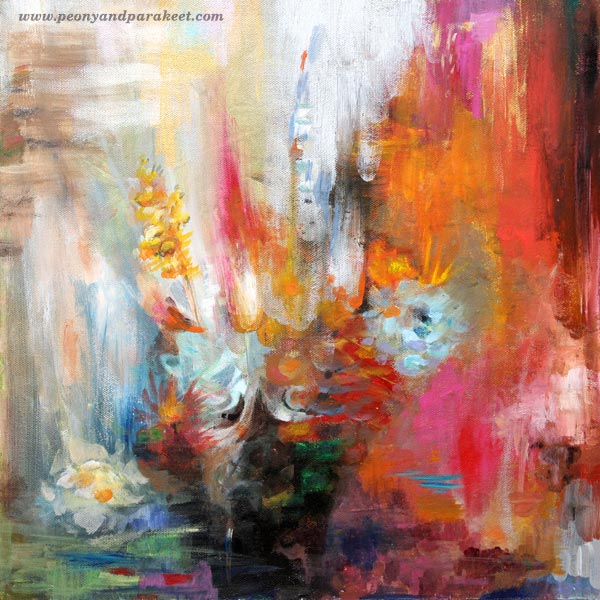
When you have your inspiration in words, nature in your mind is a happy place. When you hear the birds singing, you can pick the melodies that resonate with your mission. You can choose techniques, compositions, and colors that you feel most naturally aligned with. You may not always succeed, but your mission makes you continue creating. Instead of looking for the perfect technique, the perfect style, the perfect theme, search for what is behind all that! Search for the mission that makes creating art most meaningful and inspiring to you! That is the real reason why you paint, and that’s also the key to finding more passion for creating art.
I want to help you not only with painting techniques but also with your passion.
Sign Up for Paivi’s Weekly Emails and get a free mini-course, Color the Emotion!
What Artistic Direction to Take?
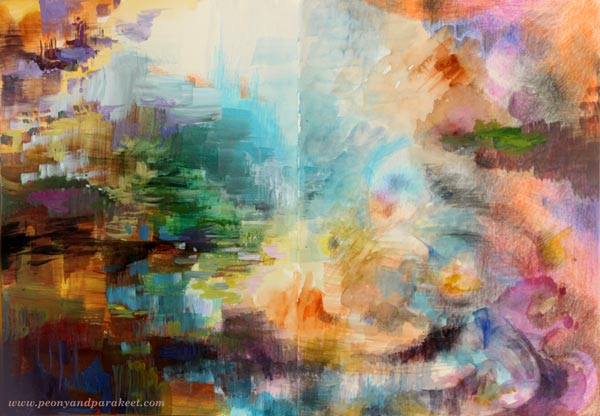
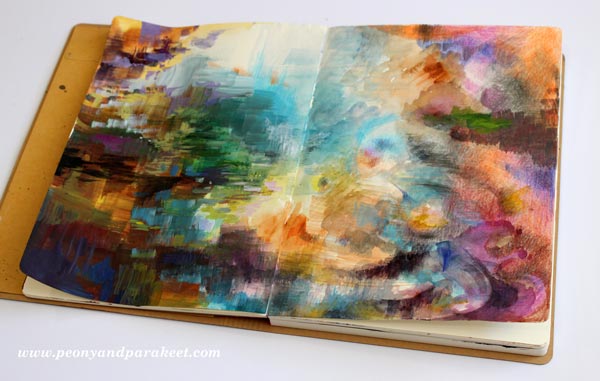
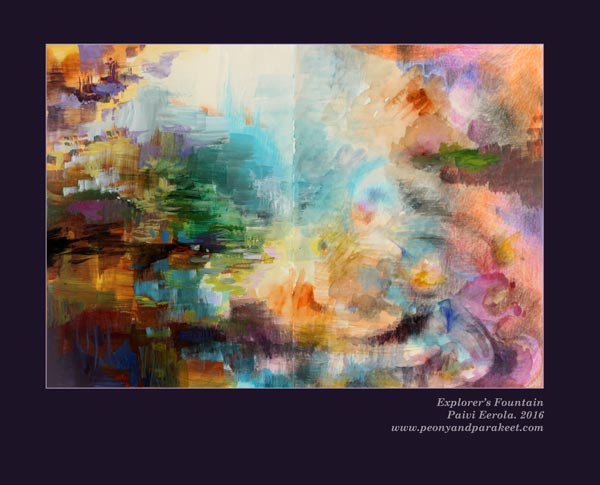
This is my latest art journal spread called “Explorer’s Fountain”. Before showing how I made it, I want to ask you the question that I have been pondering.
When Is the Beginning of a New Phase?
All artists have phases. But how to know when a new one begins? Is creating a continuum or are there certain points when you make the change? Or at least began to change?
I posted this image to Peony and Parakeet’s Facebook page with the text below, and I want to share this here too:
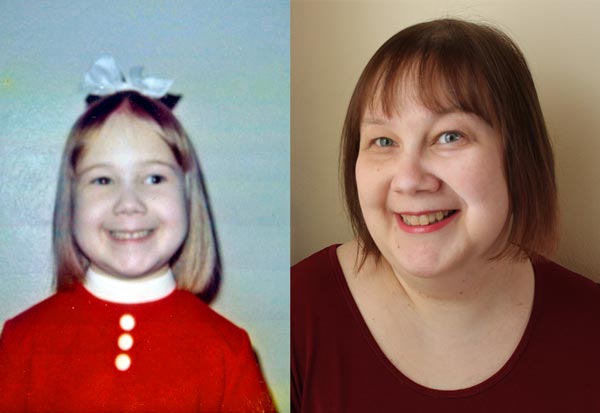
As children, we know what we love. I wanted to be an artist and a teacher. I wanted to write and publish books. I wanted to live with pets. When we grow up, there seem to be more possibilities, and still, they feel less. It’s not much to be a manager when you have dreamed to be an artist. This is how I have felt personally and this is why I think we should do what we have always loved. Because it feels more fulfilling than anything else.
Just recently, art has begun to feel more fulfilling and exciting than ever before. I feel I have new skills, even if I can’t fully point out what they are. I feel I have new thoughts but when I try to grab them, they seem to disappear. My mind is filled with new kind of artistic focus, and still, it’s like it has always been there, now I am just more connected to it. This makes me think that I am experiencing some kind of artistic change, moving from one phase to another.
The changing process is like a rain that starts with small drops. You can then decide whether you go back inside or get out and see what happens!
Learning from Practicing
Teaching classes have been small drops to me. As an art teacher, I see all kind of styles and seek solutions to many kinds of creative problems. I am often so excited about my students and their creations that my own art feels like a secondary thing. But while I have helped people to bring out the best of their skills and get more clarity for their creative direction, it has been a school for me too. It’s like I have got a gift from my students, being able to build my own focus in a new way. So while you have practiced, I have practiced too!
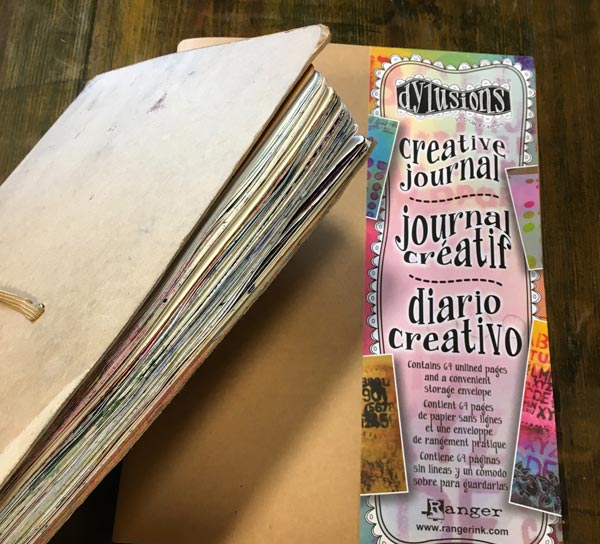
What’s Your Ambition in Art?
I have never understood the controversy between commercial approach and artistic freedom. I think we should search for the best audience to our art and find ourselves through the process. I know most of the people disagree with this. I do understand that many great art pieces wouldn’t have been born with this mindset. But my own ambition of being an artist doesn’t mean creating world-class art and being the greatest of all. I think art as a service instead of end result only. I want to understand how people experience art and develop ways to make creating as fulfilling as possible. – What’s your ambition in art?
Triptych Approach – Create with Me!
Instead of focusing on single artworks, I look for creative concepts and processes. Just recently I got an idea of a triptych. The piece would be created with three different mediums, each taking one-third of the final piece. But this triptych would have soft edges so that it would look like a one piece despite the three distinct elements. Create this triptych with me and while creating, ponder about your artistic direction!
1) Start with Colored Pencils
Color freely with colored pencils so that you fill approximately one-third of the page.
Add few small separate colored areas too.
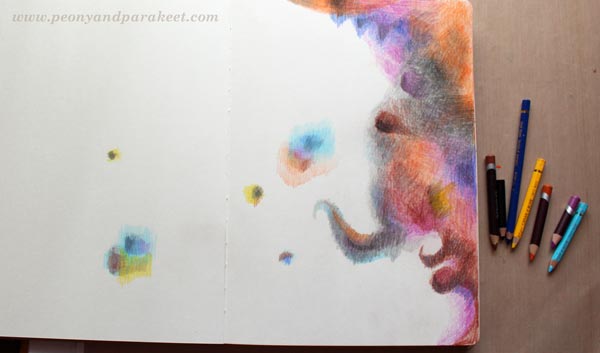
Using Old Pencils
I use Prismacolor and Garan d’Ache Luminance pencils “officially”. For example, all the images of the e-book Coloring Freely have been colored with them. But when I am making a quick spread like this one, I often grab some odd short pencils and use them instead of the fancier ones.
2) Continue with Watercolors
Change to watercolors and paint the second third of the spread.
Try to make the transition from colored to painted areas as soft as possible.
In the end, paint an area that is separate from the main area.
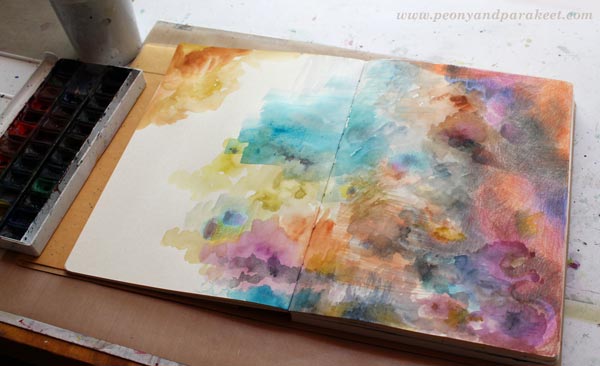
3) Fill the Rest with Acrylic Paints
Paint most of the remaining blank area with acrylic paint.
Add a small painted area on the right where you have colored with pencils. Acrylic paints can be used easily over colored pencils. Don’t cover too much, let every medium show!
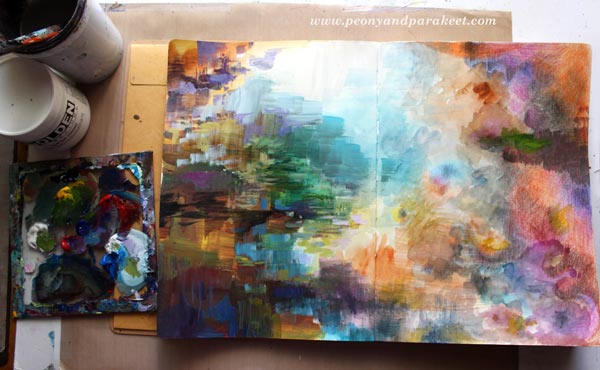
4) Finishing
Go through the whole page and fine-tune the spread with colored pencils and acrylic paints.
Add little details and nuances, don’t repaint the whole page.
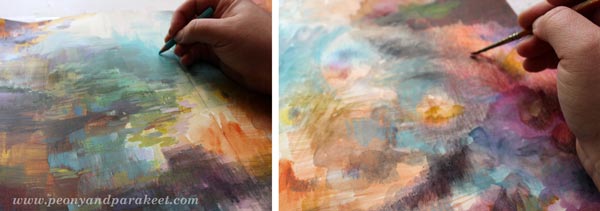
Here’s is my finished spread again.
5) Use Leftover Paint
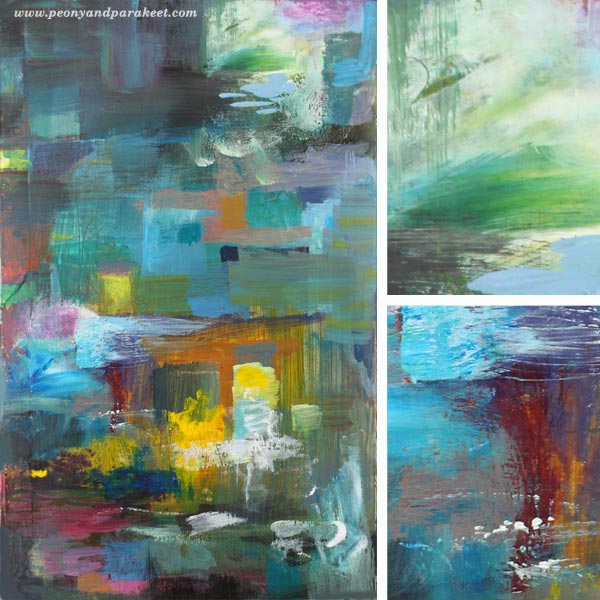
If you still have some leftover paint on a palette, grab a new page and create a quick abstract!
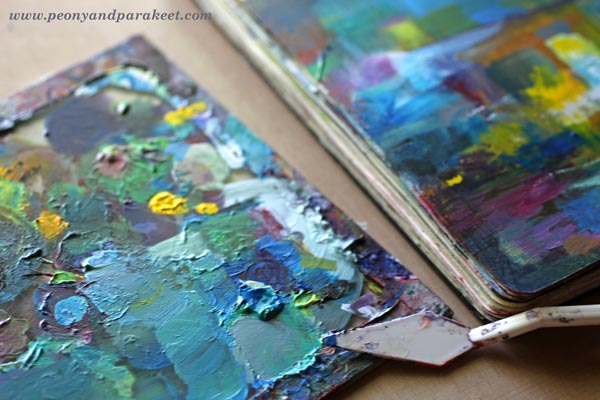
Here’s mine, called “House with a View”.
Analysing Artistic Direction
When thinking about artistic direction, it’s natural to analyze what’s good at the end result – what do you want to take from that to move forward. But it’s as important to think about the creative process and analyze that what felt good there.
After analyzing both ways, I think that my direction is this. I have always loved art history. I want it to show in my art but in a fresh way. I want to build bridges between old art created hundreds of years ago and today’s contemporary art. My latest art class Imagine Monthly already does a lot of that. But I also want to grow as an artist so that my personal expression grows stronger and so that I can reach more like-minded people with both my art and my classes.
Challenge yourself to find your artistic direction
Sign up for Imagine Monthly Fall 2016!
Do You Have a Talent for Creating Art?
This blog post is illustrated by students of the 4-week online workshop Inspirational Drawing. All the illustrations shown here are created at the class by these wonderful artists: Deb Weiers, Chrissie, CHB, Valerie Lima, Sandy Guderyon, Mary W, Gloria Schurman, Katia Maliantovich, Nea Wiseman, Gina Meadows, Joanne, Jacqueline Kriesels, Marie Jerred, Sue Rowlands and C in Ohio.
Let’s start the actual blog post with a personal question: Do you ever wonder whether you are talented enough?
I used to think that some day I will meet a person, both knowledgeable and prestigious, who would tell whether my art is good or bad. That thought made me both excited and worried. I became excited when I thought that someone saw more in my art than I did myself. And I became worried when thinking about the opposite result: that my art, that beautiful tower I had built, would just collapse. I would collapse.
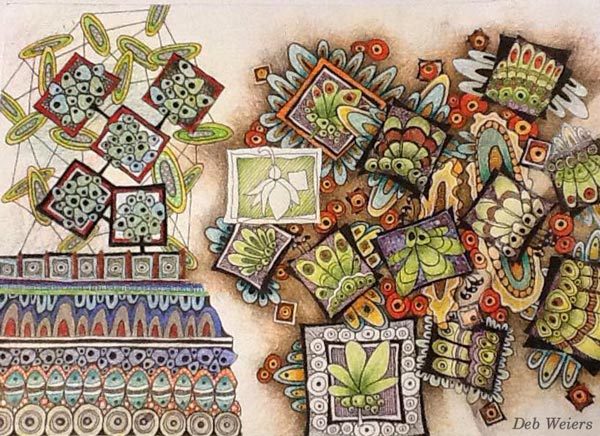
Years went by and I got tired of waiting for a specialist’s opinion. Maybe I could be my own critic? I went to study industrial design to find out how the quality of art and design would be set. While studying I realized that there are no right or wrong. People are different. Some may like art that somebody else does not, even if they both are art critics.
Somehow that made me even more puzzled. I didn’t know what kind of people would be my people, who would enjoy my art. And furthermore, if my art was bad, there wouldn’t be many of them.
However, I became convinced that somewhere in the world, there must be people that want to use their imagination and design whatever they like. They want to build houses …

… they want to travel …

… they feel drawn to beautiful patterns, and dream about enchanting gardens …

They want to learn from the history and use it to move forward in their own direction.
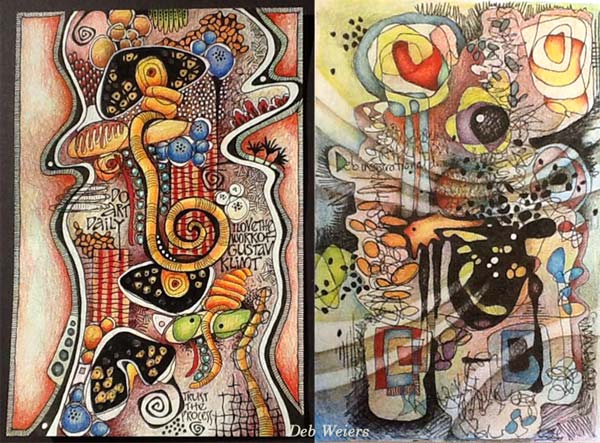
The more I examined whether I have the talent, I realized that art is not an absolute in any way. Art is a channel to express and communicate. If I look outside the window, and let my mind wonder on a path, the question is not how dimensional the window frames look like or how grey the stepping tones are. I find my people by sharing how uplifting the coolness feels like when walking barefoot on a hot summer day.

Even if there are theories about aesthetics, originality, playfulness etc. which determine good art, it is the experience that matters the most. If we feel connected to our art, there are much more chances that others will too.

By strengthening our connection, we will become more talented. We start creating more and seeing more. We will have more to express and more imagination to use. We can make people calm down in front of our art, or make them run and catch thoughts about their possibilities.

Nowadays, many ask me whether they have the talent. Even before they actually start.
Here’s the answer: Your talent cannot be determined by the grades you got while you were at school. Your talent cannot be determined by an opinion of a knowledgeable and prestigious specialist. Art is not about talent. It is about having something to say and work for saying it. It is about asking “what if” and finding the answer by using both your life experience and imagination. It is about looking out the window, seeing numerous possibilities for the perspective, and bravely picking your point of view.

So, do you have a talent for creating art? Always.
Subscribe to my weekly emails – Get a free mini-course!
Transfer Your Expertise to Your Art

If you want to grow as an artist, the best advice anyone can give you is this: Recognize your expertise and bring it to your art! If you breathe art and only art, you will become shallow and miserable, and it will also show in your art.
When I left my day job a year ago, I would not have said all this. I had my last days marked on the calendar (a special gift from a friend from the UK!) and I could not wait to forget most of the things I had learned from developing IT systems.
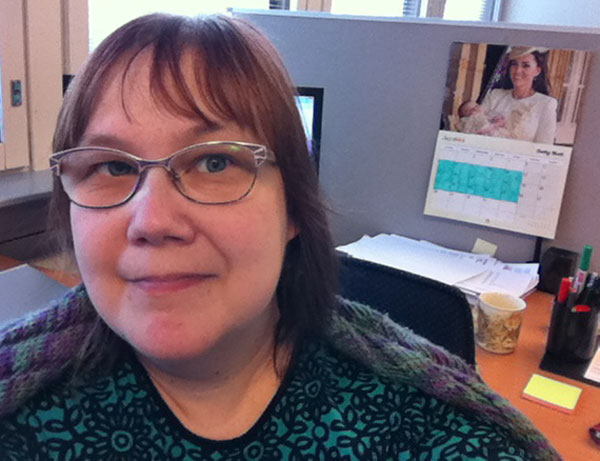
But the more I got distance from my past, the more I began to realize why I chose computers before art some 25 years ago. I realized that I also love to think, not only create. When I get a crazy idea, I try to put it into a logical form too. The architecture of computer systems still inspires me. Layering, hierarchy, interfaces … all those are concepts that I often apply to my art too. Being accurate and always questioning why – these basic nerd characteristics continue to describe me.
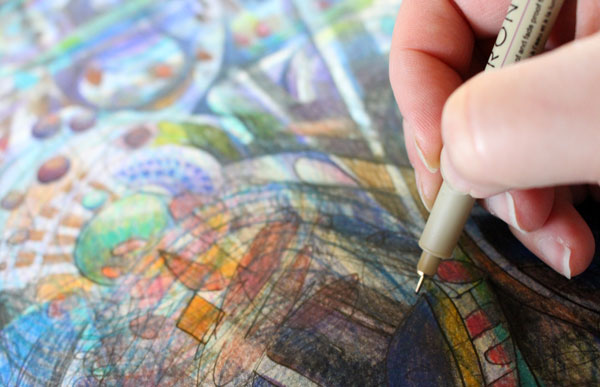
In the eyes of a systems developer, the world is full of details that have to be edited and classified.
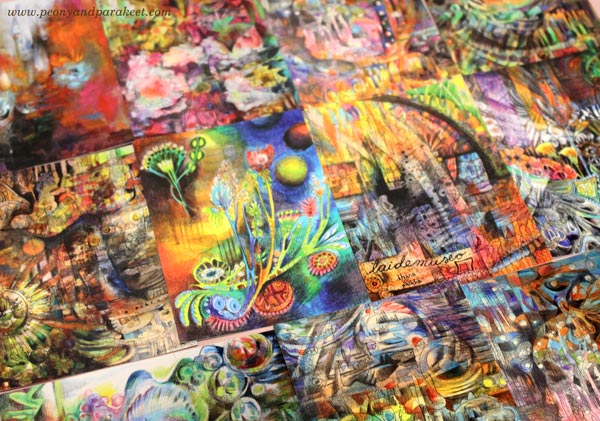
I have realized that the more I show my understanding in my art, the more it also relates to other people. They don’t have to be computer engineers to feel drawn to my art. Behind every expertise, there are values that communicate much more widely.

In computer science, innovations are constantly made. People working in the field always have to be ready to learn new things. And not only that, but they also have to make existing systems work with the latest technology, so they are constantly adapting old with the new. For me, creating new from the history of art and design is one way to use that skill.
I believe that when people say they don’t know what to create, they overlook their expertise. It is not very easy to notice all the things you already know and deeply comprehend. In information technology, it is common knowledge that the projects where many systems are integrated together are the trickiest ones. I used to manage that kind of projects. I became interested in them after I realized: if you really want to build something that will have a bigger impact, integration is the key.

When you begin to integrate your other expertise to your art, I am pretty sure that things get … just like in IT projects … a bit rough. Different values and opinions will fight, and co-operation seems impossible at first. But after the merging process begins, you will be more creative, and you will have much more to express than ever before.
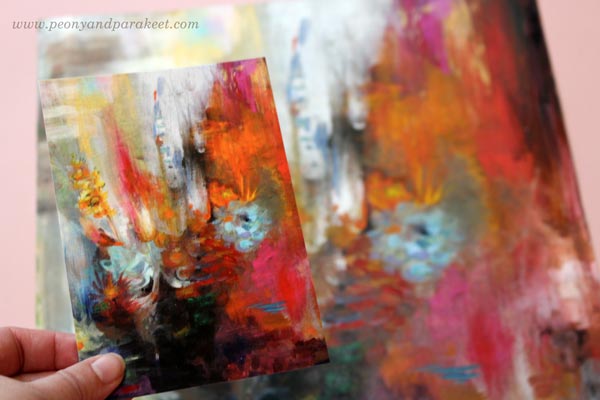
When I create art, I try to always arrange the time for the little nerd inside me. I know that if I just let my creativity decide, there’s a nagging voice inside my head saying: “You could do this better, why did you do that …” By taking breaks and thinking before creating, I accept my past and the part of my personality that is more logical than creative.
When you hear your inner critic speaking, maybe it is the voice of your expertise! Maybe part of you is disappointed not to get fully involved. Make your inner critic work with you, not against you!
Subscribe to my weekly emails – Get a free mini-course!
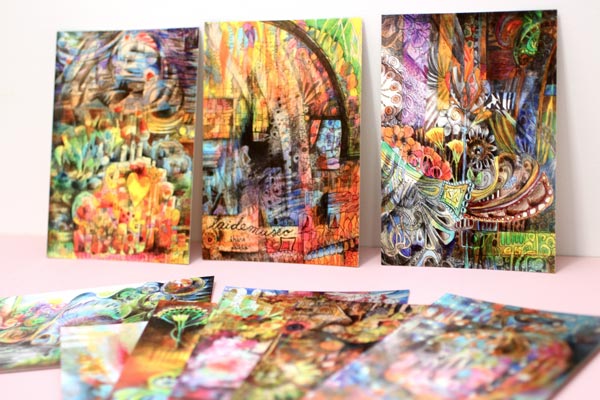
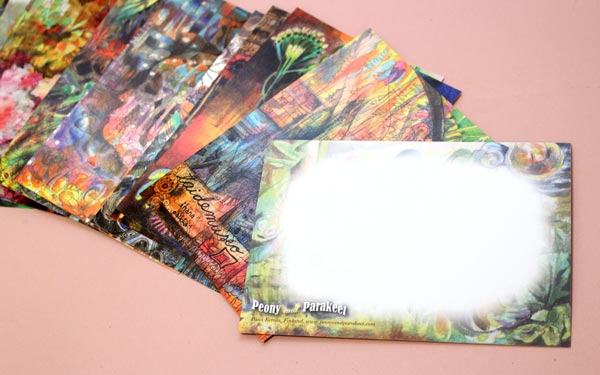
P.S. You can buy postcards at Paivieerola.com