
Finding Your Purpose in Art – Remember that You Never Create Just for Yourself!
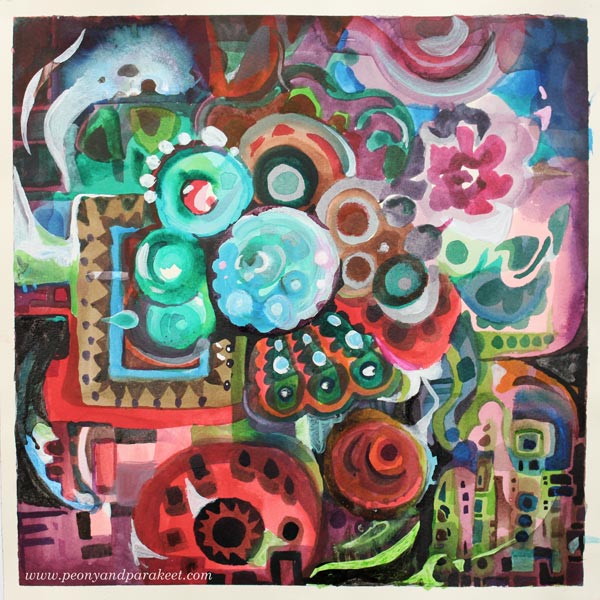
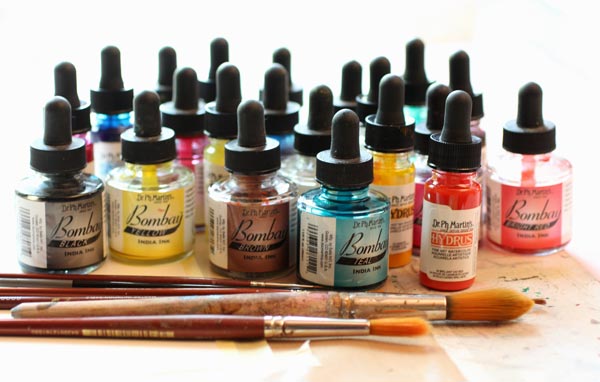
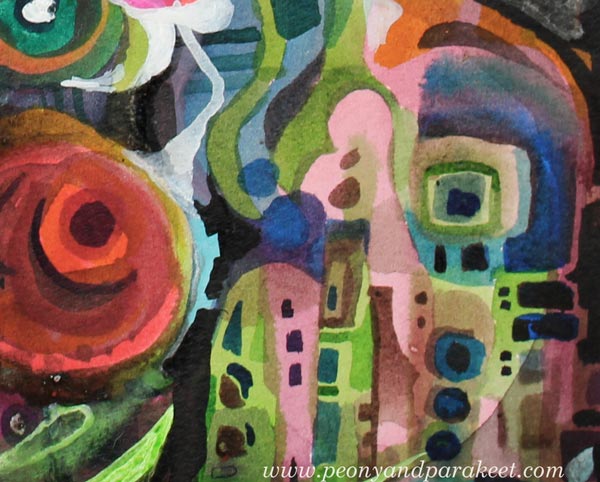
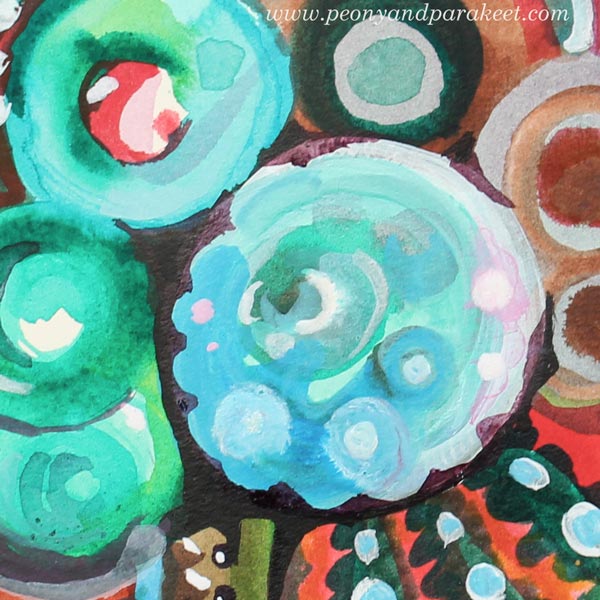
Here’s my latest small mixed media painting called “A Day in The Garden.” I used Dr. Ph. Martin’s Hydrus Fine Art Watercolors and Dr. Ph. Martin’s Bombay India Inks for making it. Like the title says, the inspiration for the painting came from the time spent in the garden.
Garden Inspiration – For the Beauty of Tulips

Even if the spring is about two weeks behind this year in Finland, we had a lovely weather last Sunday. The tulips were blooming, and I decided to go out and do some weeding to make them stand out.
As I was working in the sun, I soon warmed up. When putting away my cotton cardigan, I noticed a little red robin watching me. He sat in the bushes but had a curious look on his face. As I often talk to my budgies, I couldn’t help myself telling him how fine looking little bird he was. He clearly enjoyed my voice because he flew closer. He must have been a young bird as it didn’t take long before he was so close that I could almost touch him!
Garden Inspiration – For the Nourishment of A Red Robin
As the little bird grabbed an insect in his beak, I realized why he was so interested in me. Working the soil made it easier for him to find food. In the first place, I had thought about having some me-time in the garden and making room for beauty, but then unexpectedly I had got an audience, a client even! It caused me to think how similar it is with art. In the beginning, the practice can be very self-serving, but art never lives in a vacuum. Even if we would hide our pieces, art always has an impact on its surroundings. If not directly, then through our actions.
Purpose Needs People
Our soul-searching through art making can start similarly as the day in the garden, with an intention to spend some time with beauty. But as we progress, we begin to yearn for a deeper meaning. I believe that this purpose is related to people. Even just thinking about sharing art with other people brings in a wider perspective, a bigger vision, and more ways to use the imagination. No matter whether you ever share, sell, blog or show your pieces to anyone, you can still work with the themes like opening up, finding words that boost your art-making process, and imagining the people you want to connect with through your art.
If we focus on style issues only, we will never see the whole ecosystem. We are like gardeners who sweat for their tulips but miss the impact on their environment.
Ideas Change but the Passion Stays the Same
In a coaching program The Exploring Artist, I talk about finding “Your People.” There may be only one red robin in the beginning, but recognizing that they do exist is inspiring. Imagining what you can be for them is a big thing when you want to find a passion and a direction for your art making.
Namely, your targets of interest can and should change all the time. But your passion stays the same for a much longer period. You don’t have to create similar pieces again and again. You can freely explore the world of art and imagination. Your red robins will follow you because they know that you’ll always find something that benefits them too.
An American singer-songwriter Conor Oberst has said:
“Art is essentially communication. It doesn’t exist in a vacuum. That’s why people make art, so other people can relate to it.”
Sign up for The Exploring Artist to discover the passion behind your art
and to become more confident with the big word “artist”!
4 Big Misconceptions I Have Had About Creating Art
I come from a family who always valued arts and crafts, but my parents and relatives were not artists themselves. I spent my childhood drawing and painting, mostly animals because I feverishly wanted to have a pet of my own. My ultimate dream was to become a visual artist. Now when I look back, I see big misconceptions that I had about art. These misconceptions are not rare or unique, I hear and see people talking about them all the time. So I wanted to tell how I currently think about them and what I would say to anyone who has the same experience.
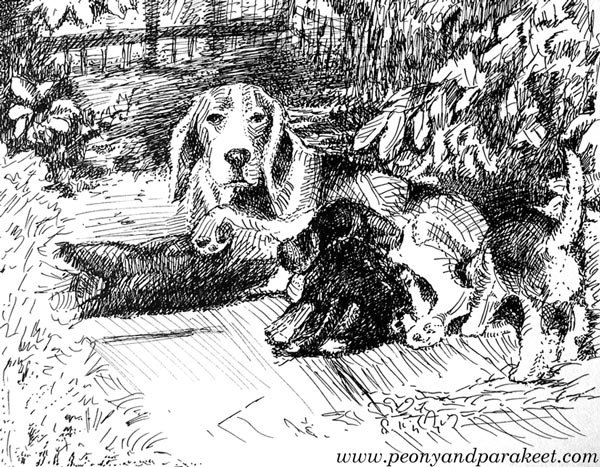
Misconception #1 – “Am I talented enough?”
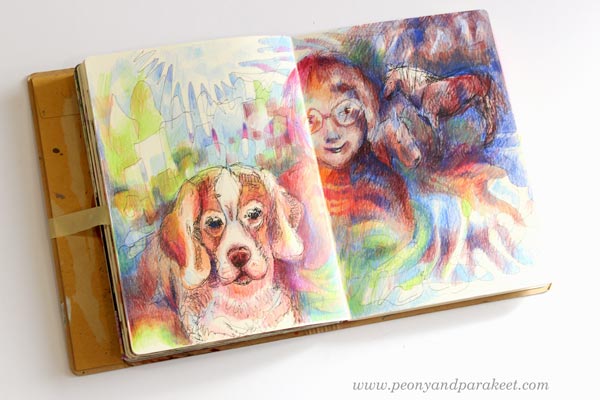
People talk too much about talent when they talk about artists and art. I think the word should be banned, especially when talking about children and their creations. There are many other ways to encourage and admire. The problem about the word “talent” is that it implicates a thing that you can’t change in yourself – it’s there, or it’s not. Yes, some people are more visual than others. But there are so much more qualities that are needed for becoming an artist. For example, growing and combining ideas, and seeing principles and concepts behind real objects and events. Instead of just redrawing a photo of my beagle and her puppies in 2007, I could have put the warmth into focus and tell a bigger story about the unconditional love that I was witnessing at that moment.
If you question your talent, stop! Start learning how to process ideas, how to apply visual principles, and how to evaluate the quality of your work. The question implicates that you need to start learning and practicing! I love the ambition behind the question, but stop agonizing over it and start learning!
If you say, that you already are learning, but still question your talent, you are not learning enough on a higher level. If you are watching videos about someone painting, you also need to know the reasons behind the decisions the painter is making. You need to connect the theory with the actions. (That’s why I built the class Inspirational Drawing 2.0 – you will get not only the hows but also the whys)
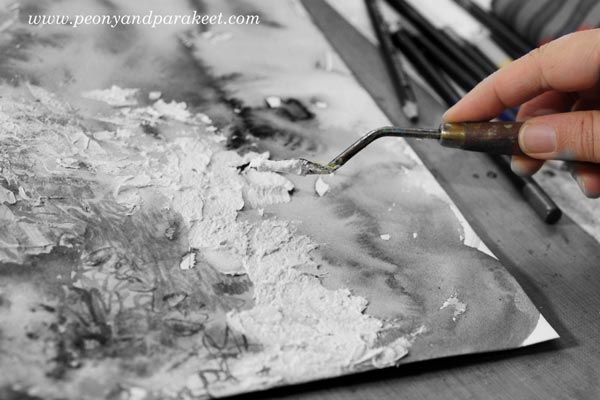
Misconception #2 – “All I want is creative freedom.”
Many years ago, when managing IT projects by day, I needed a creative outlet by night. I wanted to feel free, create loosely and make a beautiful mess. And so often, I only made a mess that didn’t set me free at all. When I was able to freely choose from the vast amount of art supplies, the beginning often felt suffocating. Then there was an agony in the end when I wasn’t able to be satisfied with the result. I added new layers after another and desperately tried to make it work.
There’s one big problem in creative freedom that I missed. To feel free, I needed the opposite. I needed limits and a direction. I didn’t need anything as defined or restricted as a reference photo or an image in my head. I needed to limit my supplies, my colors, and my feelings. As the work progressed I could have become more focused and experienced the freedom through the gained focus. Instead, I was overwhelmed by the choices.
If I could talk to myself now, I would say: “You don’t need freedom, you need to educate yourself in art. You need to explore what and how the master artists have expressed. That way you can find what’s your take on the big themes like landscapes, portraits, still lifes, and abstracts. Knowledge will give you the direction and set you free.”
There has to be a balance between creating and acquiring information. If you only make a mess, you easily invent the wheel again and again. On the other hand, if you only study art history, it can make you feel intimidated. However, knowing more doesn’t make you less unique. There’s no reason to avoid going to art museums, art galleries, browse and read books about art history (I often listen to art related audio books while creating). Understanding the background stories of artists and artworks, helps you to find your personal focus. (That’s why I sell Imagine Monthly Bundle 1 and Bundle 2 – so that you can connect dots between art history and your creative inspiration)
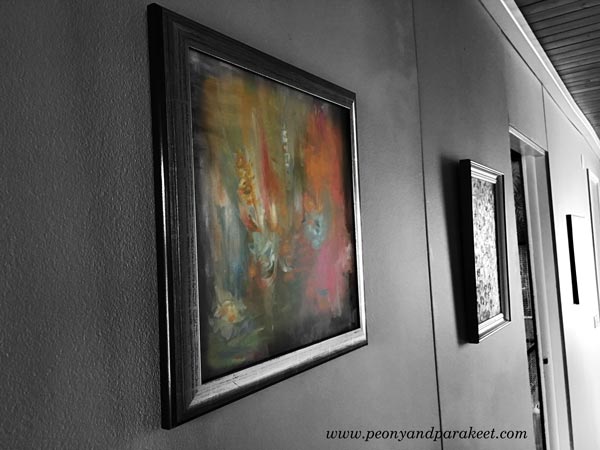
Misconception #3 – “Someday somebody will find me.”
When I started blogging over 10 years ago, I thought that someday someone would get in touch and say something like: “Hello, I am a hugely famous art critique, and I would like to buy your art because it’s so fabulous.” Not probably in those exact words, but you get the idea. I also wished that there would be a lot of people visiting my blog and admiring what I had created. But there were practically very few people visiting my blog even if blogs were very popular at that time.
The best thing that I did back then was that I started following business people. Many recommended setting up an email list. It felt awkward enough to blog, so it didn’t feel natural at all. In 2010, I decided to trust the advice and sent my first group email to 9 subscribers. Even if they had deliberately subscribed my emails, I felt like I was spamming the world. After a year and seven more emails, I had 95 subscribers. I still felt like a spammer, but because the number was growing, I couldn’t stop either. By blogging and sending emails regularly, I got more subscribers, and my feelings changed. Sending the emails felt more like a service than spam, and in 2014, I started posting them weekly. (If you are not a subscriber yet, subscribe here!)
When I write my weekly emails, I don’t write to “hugely famous art critics.” I write to my soul-mates who love art and are always eager to learn more. I write to people who want to explore all kinds of approaches to art and who want to share the enthusiasm and ambition behind all that.
If you are waiting for somebody to find you, make sure that you also do the work. Being consistent and learning business and marketing means a lot. But there’s also one more misconception that I want to bring up that relates to this one.

Misconception #4 – “Images are enough.”
Let’s get back to the time when I started blogging and was hoping to get more readers. Well, yes “readers,” even if I wrote very little. I thought that images are enough. If I made a picture pretty enough, where would I need the words? Do I even have to say my real name “Paivi Eerola,” isn’t “Peony and Parakeet” enough?
But we need the names, the words, the faces, the stories to get connected with people. It’s scary and difficult, but it’s also necessary. As artists, we need to make the process visible. We need to make the knowledge that we have gained visible. We need to open our minds and tell what we feel when we create. We need to tell how our creations can relate to the viewers as well. Even old master painters still need the words. The museums organize guided tours and offer audio guidance through headphones. There are books and biographies. The sad truth is that many of the artists who died undervalued didn’t use enough words.
There are also other things that we need to include than just words. These are the ways we photograph, exhibit and handle our art; the way we show joy about what we have created; the way we participate and include people in discussions rather than staying silent. I refuse to call all that with the word “marketing” because I think it’s much larger than only that. It’s about growing your artistic identity where you can spread your passion and where you feel the need to do so. Then it’s more than about your images – whether they are “good enough” or whether you are “talented enough.” It’s about using art as diversely as possible to connect with people. It’s a good cycle to build, as these connections also improve your art.
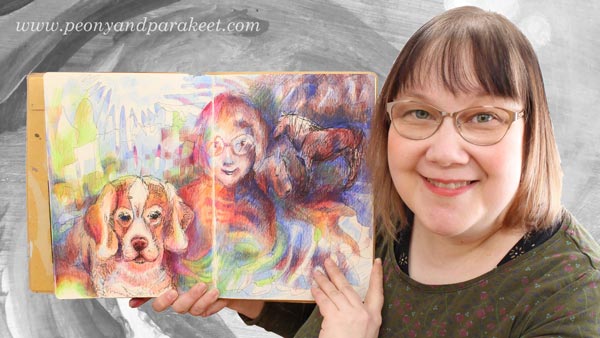
Check out my new coaching program “The Exploring Artist” for building belongingness, making art that matters, and strengthening your artistic identity! >> Sign up now!
Technique, Style or Identity – Which Comes First to You?
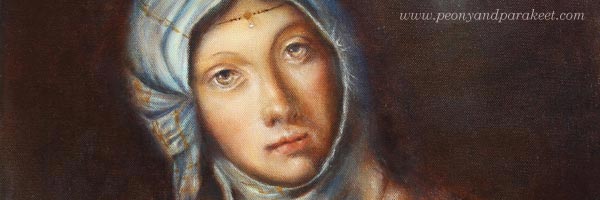
Technique
During the recent ten years, I have wanted to learn and experiment with art techniques. It has been fun to combine all kinds of media and see what comes out. And even when using one medium only, techniques have been important to me. Like recently, when I have learned to paint like the old masters. But with techniques, come the rules: first this, then that. It feels safe at first, but then, it can also be too restricting.
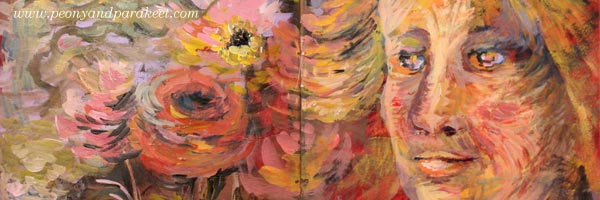
Style
To me, the personal style means something that I am comfortable with doing, and that makes my work recognizable. But for a long time now, I have felt a sense of sadness when people say that they want to find their voice. One of my favorite creative play has been to play with styles. Being very intentional about the style issues can take the play out of the game.
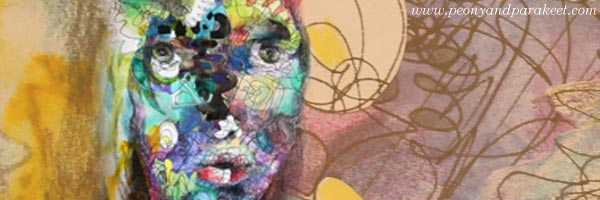
Identity
The more I have tried to focus on techniques or style, the more I have thought about the third thing, the artistic identity. I tried to keep all that inside me, but I am not very good at hiding things, so I was about to explode before finally, in the last month, I wrote on Facebook:
“Style or Identity? – Even when working full-time as an artist, I sometimes still have problems in calling myself an artist. I wonder, why there’s so much talk about finding your style and so little about finding your identity as an artist?
It includes me too. I often talk and think about style issues when I should think about identity issues. It’s easier to analyze the line, the theme, the mark making, than talk about things that go deeper.
I mean things like:
1) Why do you make art?
2) How do you define the quality of your art?
3) What’s your role in the art community?
4) What’s different with you from the artists that you admire?
5) When and how do you know that you have succeeded as an artist?Most of these questions are valid whether you are a beginner or more advanced. The answers change when your journey progresses.”
When your order is 1) identity, 2) style, 3) technique
you allow more play,
you take on bigger challenges,
and you connect more with other artists.
Stay tuned for a new challenge-based coaching class to grow your artistic identity!

This post is a sample of my weekly emails. Subscribe here!
Have You Ever Felt Like an Outsider?
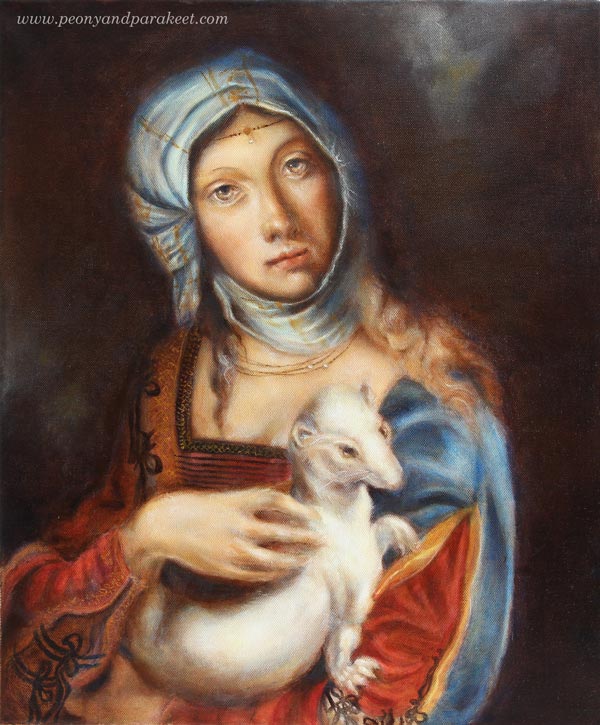
I have finished a new oil painting called “Gypsy Madonna.” I painted it at Emmi Mustonen‘s class during this spring while learning more about old masters’ painting techniques. It took about 42 hours from start to finish and about four months in calendar time. Every thin layer of paint had to dry before adding a new one. I show you some phase photos, but I focus on the deepest thing that I learned from this painting: feeling like an outsider and what to think about it.
The Basics of the Painting Process
My Gypsy Madonna combines two Renaissance paintings: Boccaccio Boccaccino‘s Gypsy Girl and Leonardo da Vinci’s Lady with an Ermine.

First I was just on a mission to get better with the painting technique.
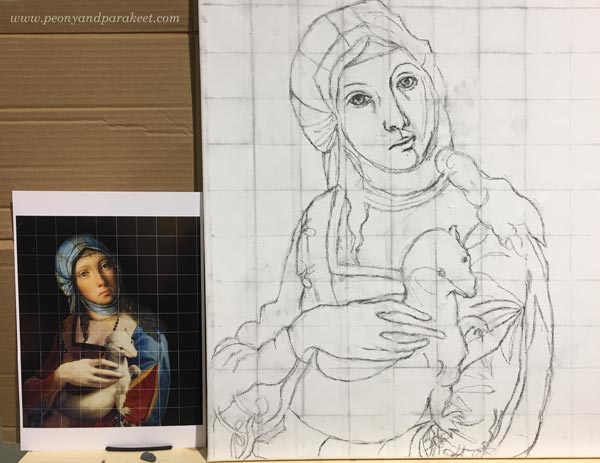
Then I wanted to play with the setting and discovered several stories that could be told through that (some of them are in this blog post).
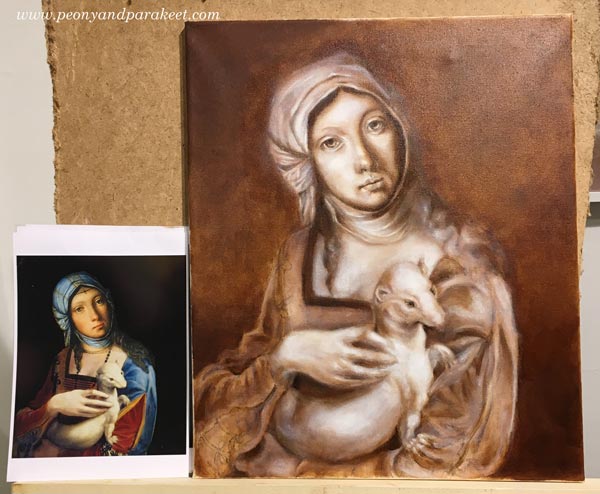
Experiences of Being an Outsider
One day during the painting process, I remembered a childhood memory of a real gypsy girl. The local library had a weekly hour for children to listen to fairy tales and to play together. We were playing a game where two of us danced in the middle while others were watching. There were a lot of children, all waiting for to be chosen. Someone picked me, and we danced in the center of the ring while others were cheering.
Then it was my turn, and my friend Anne almost stepped up. But I had seen a sad gypsy girl sitting there, head drooping. She knew that nobody would pick her up. It was one of those games that would only depress her. It broke my little girl’s heart to see her sadness. I just had to do it, leave Anne sitting and ask the girl to dance with me. I never forget that smile when we were swirling around. It may have been the best thing that I have done in my life so far.
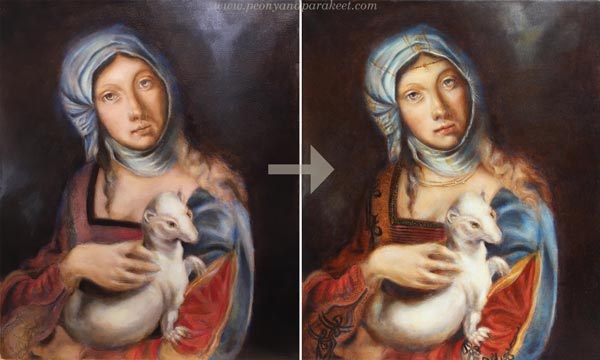
When I continued painting, it was suddenly me in the picture. I became the gypsy girl who gently scratches her pet. The outsider who never got children because she was much more enthusiastic about her love for animals. The outsider who was the only girl in most of the classes when studying technology. The outsider who dreamt about art while trying to tackle the more practical career. There are so many moments when I have felt like a black Madonna, not quite fitting in.
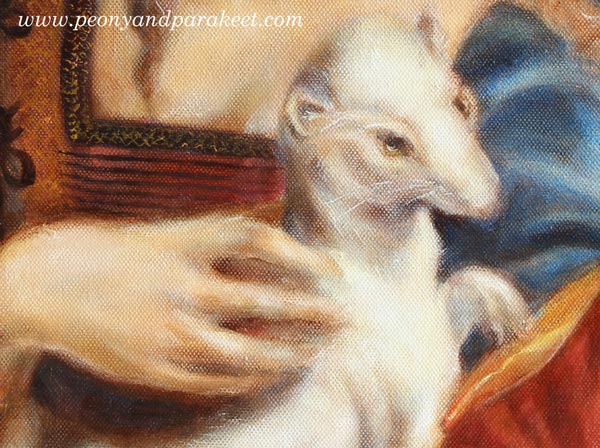
Everybody Is an Outsider
To me, the finished image symbolizes the beauty of choosing differently, being different. Even if I know that it’s perfectly ok to be different, the painting helps me to connect with the feeling on a deeper level. It makes me empathize with other people as well. Everybody is an outsider despite their personal story. We all belong to a minority in some ways. We are all Gypsy Madonnas in one way or another.

Have You Ever Felt That Nobody Understands Your Art?
To be honest, I feel shy about showing this painting. It’s not what I usually create, and I have shared some very personal stories. It has crossed my mind for several times how you, as a reader of this blog, might feel confused: “Is this what Paivi is creating nowadays? Is she going back to the Renaissance age?” I have also feared that the dark colors of the painting will make you want to stop reading. But on the other hand, I don’t want to stop exploring. If you don’t explore, you are unable to integrate new things into your creative work. Pablo Picasso has said: “To copy others is necessary, but to copy oneself is pathetic.” So no wonder if there are times when nobody understands what you are creating!
It’s also difficult to grow artistic identity when a part of that experience is feeling like an outsider. When you start creating art, you want to find your personal way to do it, but those discoveries can also make you feel lonely sometimes. This contradictory has caused me to challenge myself. I want to be better at not only understanding my personal feelings but also supporting other artists in their explorations. In the end, we are all on the same journey. We are standing together on the border of art and the rest of the world, expressing the same view through different eyes.

Stay tuned for my new class for building belongingness, making art that matters, and strengthening your artistic identity! The registration will open in May!