
Get the Most Out of Art Critique
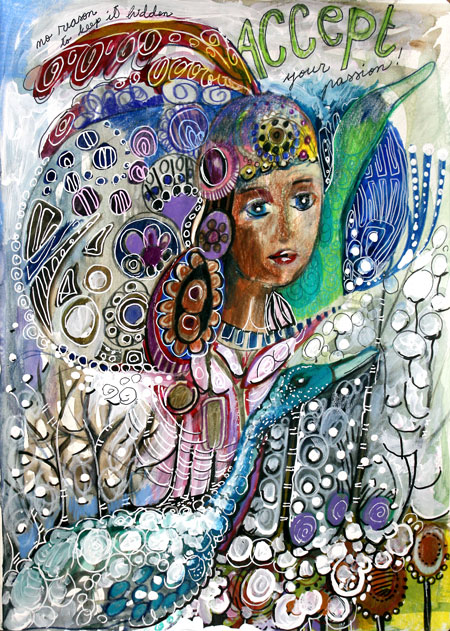
My latest art journal page is inspired by a discussion in an art journal group. It was about how to deal with the criticism towards your art. One woman told a story which touched me deeply. Someone had accidentally seen photos of her art and asked if they were made by her little grandchildren. After that she did not feel comfortable making art again. The story made me think about how important other people’s reactions to our arts and crafts is. How much we yearn for comments and how the critique can scare us. I also share those feelings. These are my conclusions of the subject. (And yes, I have new pencils!)
1) Pick Your Specialists
“Can you simplify, Paivi?”, said my teachers in so many words while I was studying industrial design. Because, in design, it all starts from the basic concepts, basic shapes and little alterations to them. I have always loved decorating. So I rushed through the first design decisions to get into adding swirls and tiny dots to the each of the designs. When I completed a sketch for a bar code reader, a teacher said: “What can I say, it is like a Russian icon painting with a flair of folk”. And he did not even know I had painted icons as a child!
“Your sketches all look the same”, he continued.
I did not get it. For me, they were all so different.
– “The same shape is repeated all over again.”
When I went back home, I thought that studying industrial design was going to change me to the direction I did not like. Within a year I would be living on a white box with no carpets on the floor and wear black glasses. But the end result was nothing like. My interest in art history and decorative art only increased within the time as practicing different styles helped me realize there’s no need to create a too narrow image of my own art.
At the end of the studies, one of the teachers said to me, carelessly: We just got an application from a person who reminded you: so many details, so little simplifying! We can’t accept him in. To design is to simplify. Despite your beginning, you do have learned that.” It meant a world to me – according to her, I was a simplifier, a designer.
In today’s world, there’s a specialist for everything. I yearned for the specialist to testify, objectively. And once she did, I was happy. But later I have begun to think that actually, in art, everyone has to define their own specialists. The range of art and design is huge and surely, everybody doesn’t like every piece of art.
So, don’t even expect that everybody likes your art – is a specialist of your style. Pick those that you want to please and forget the rest!
2) Improve Your Communication
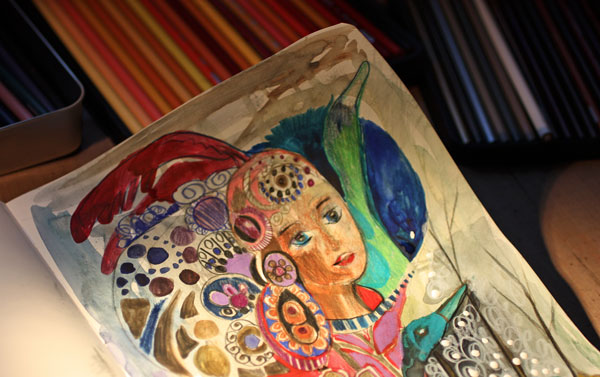
An artist Ann Rea has said: “Art is communication”. I think that focusing on what we want to say with our art is often more beneficial than focusing on the techniques. When someone comments our art, whether the feedback is positive or negative, we can always ask: “What do you see here? How does it make you feel? What do you like the most?” (Or “like the least”, if you are brave enough, and if you have chosen the person to be your specialist.)
Sometimes it is not so much about delivering a certain message, but touching people. When we are touched by our own art, it may seem surprising that others do not get touched by it. Then we need to improve our visual communication or fill in the story verbally. (The power of art journaling!)
Instead of thinking “I want to become a better artist” you may want to think “I want to become a better visual communicator.” After that, you will often find art critique easier to swallow!
3) Set the Risk Level
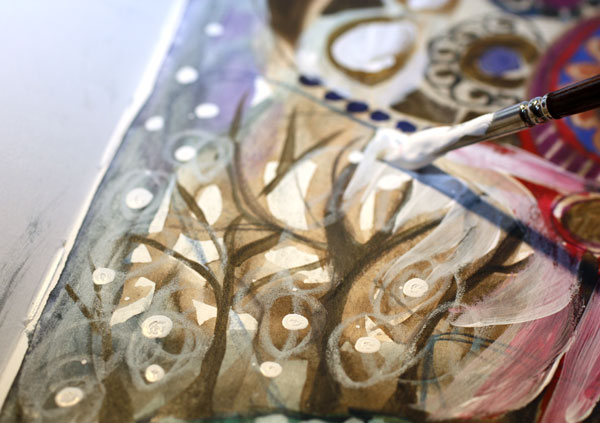
If you only want to hear positive comments, set the risk level low. One way to do that is to stick with the realistic art and copy those who have a lot of general acceptance.
But if you want to find your own style and in the end, truly touch people, take more risks! Experiment, observe, let go of the definitions you use for yourself, think about before you start to create and while creating, stop thinking! You can set the risk level for each individual piece, and go higher from one artwork after another.
Once in a while, give yourself a permission to make high-risk art! Sometimes it may also be good to take high risks when asking for comments! But never let anyone keep you away from creating when you are on the way of unique self-expression.
In need of experimenting? – Join me for an art journaling workshop!
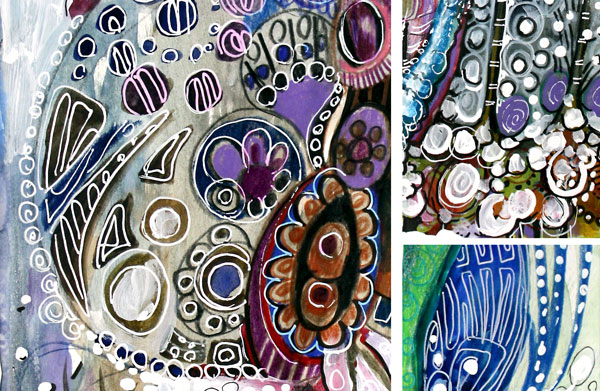
This is one of the many art journal pages inspired by embroidery techniques. Meet me at 21 Secrets Art Journaling Workshop where I will show you my favorite embroidered textiles and teach you how to imitate the embroideries with pens and paper! The perfect project if you want to stretch your style in a safe environment! The workshop begins in April, but you can preorder now!
Art Nouveau Christmas!

Thank you for following this blog, subscribing the weekly newsletter and purchasing my products! It’s time to enjoy the beauty of holiday decorations, relax, maybe pick a brush on a quiet moment and fly to the world of imagination. With this video, Art Nouveau Christmas, I wish you happy holidays!
The Power of Positive Self-Criticism in Art
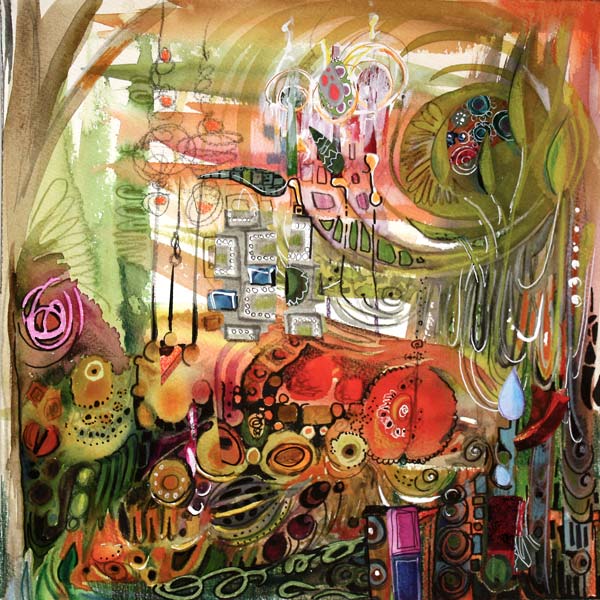
My latest mixed media artwork is called “Positivity Grows”. It is dedicated to all of you who have a strong inner critic. If you want to improve, it is essential to evaluate your own work. But sometimes the self-criticism can have too negative tone. Have you experienced any of these?
1) Big Picture Panic
The artwork gets evaluated as a whole in a too early stage. It is like making a meal and after tasting the raw potatoes, you’d decide that it’s not going to succeed. “I must have done something wrong when peeling those potatoes!”
2) Overclean Obsession
You take the safe way: you don’t mix colors, don’t let anything intersect, draw sloo-owly, keep everything plain, simple and controlled. This reminds me of a tadpole (a baby frog) which I got from my friend when I was a child. The tadpole lived in a jar filled with muddy water. I picked a clean vase, poured plenty of tap water and put the little frog there. It did not live long. I did my best to take care of it but did not understand that for the tadpole, there was nothing to eat, nowhere to hide. So – Mix those colors! Add diversity! Give some nourishment to the growing artist in you!
3) Mistake Hunt
If you focus on the things that “went wrong” instead of those which “went right”, you are playing the wrong game. Art is in small nuances, it requires sensitivity and openness. If your self-evaluation is too negative, you do not notice the beautiful little details that appear in your art. They are often lucky accidents if you take care of the diversity. When enhanced, those details can take over and bring your end result to the new level.
Positive Self-Criticism
You can get cured of any of those diseases with a healthy dose of positive self-criticism. From the moment you make the first brush stroke, focus on the details and look for beautiful and interesting areas. I will show you how I did that while creating the artwork of this post.
Phase 1 – Watercolors
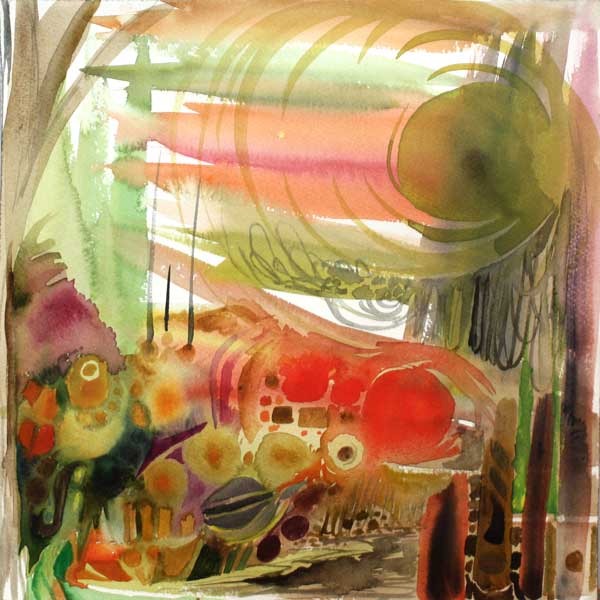
When I began the artwork of this post, I just made a mess with watercolors. I kind of made the muddy jar for tadpoles to prosper!
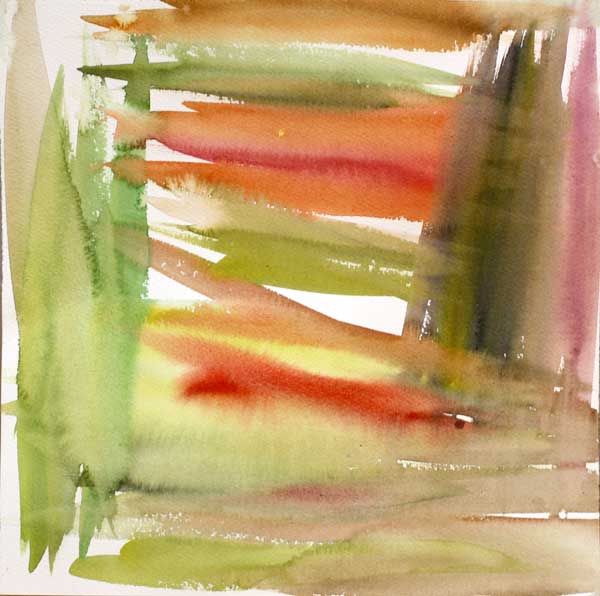
After painting this, I could have just quitted and called it ruined. Or I could have tried to make that dark muddy area brighter. But instead, I began to investigate the painting closely.
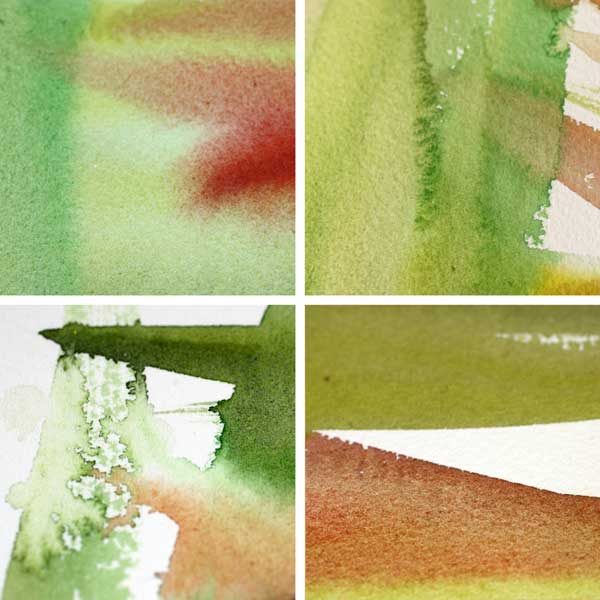
My inner critic pointed the little details with so much beauty that I began to feel confident and excited. The whole process of making this artwork began to feel like an adventure. Instead of mistakes, I was hunting treasures!
Phase 2 – Watercolors
Next, I continued with watercolors and created new layers of elements. I took care of the diversity: there’s a lot of various hues and shapes. And even more important: the layers intersect so that they create new happy accidents.
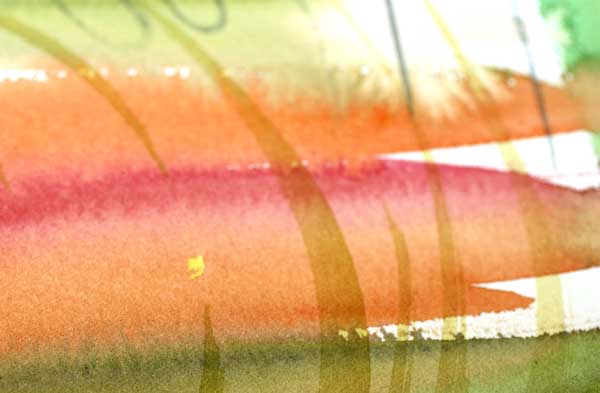
After painting this, I enjoyed this tiny detail: a yellow spot. It was like a little star! I felt I was lucky and genius at the same time.
I spent some time searching for more beautiful areas and enjoying them. With watercolors, the edges of brush strokes are often really beautiful.

Phase 3 – Colored Pencils
To keep the diversity level high, I changed watercolors to colored pencils. I also changed the music I was listening to. Working from a small area to another, I enlarged the beautiful details found after another.
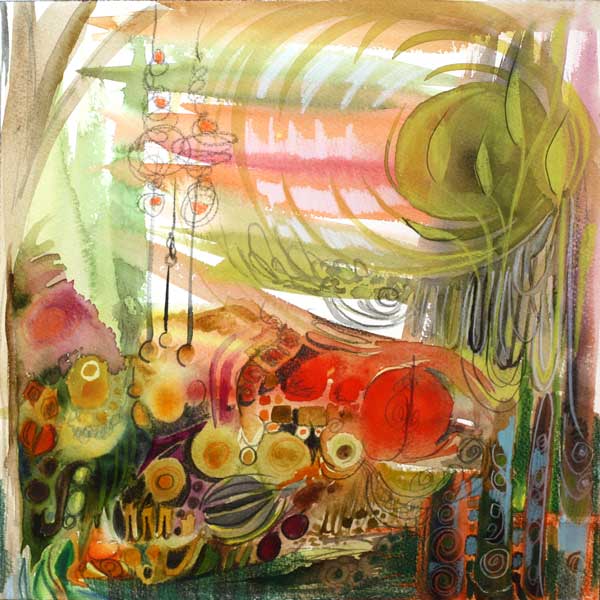
In this phase I realized that the main theme of the artwork would be growth. I searched for the details that would express the theme. I found several and they made me happy!
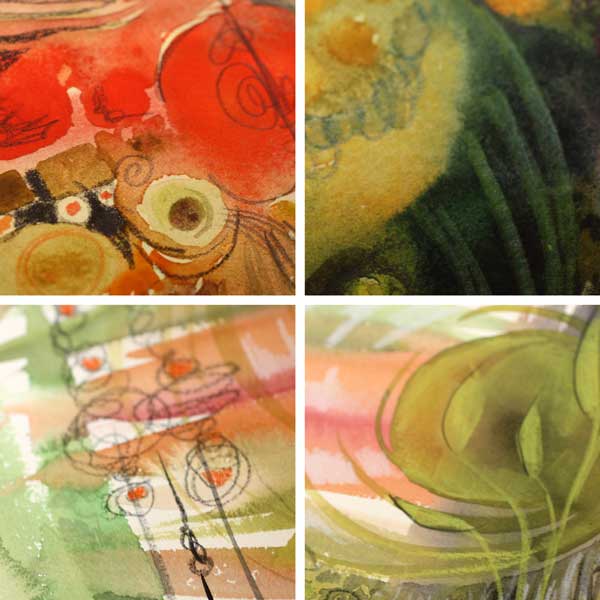
Phase 4 – Pens
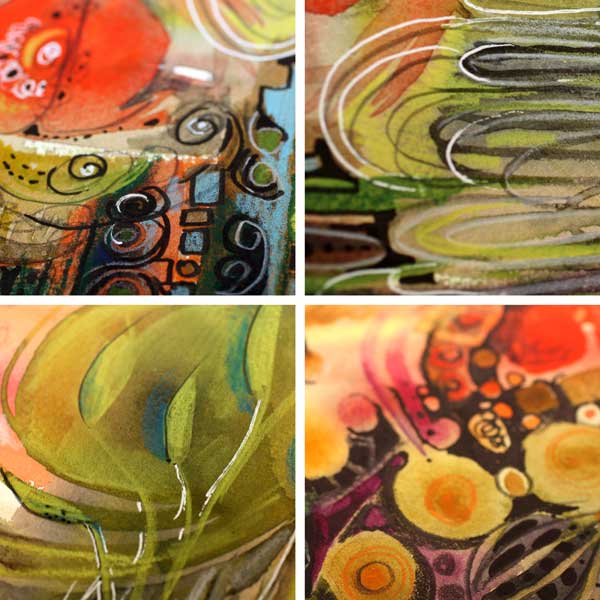
New music and new supplies! This time I picked a black PITT Artist Brush Pen and a white gel pen (Uni-Ball Signo). I was encouraging myself to create strong contrasts. They would make the pretty details really pop. Again, I was not worrying about hiding the not-so-pretty details but enhancing the good ones.

In this phase I began to look the artwork as a whole. However, instead of correcting the poor composition, I analyzed which of the details looked most appealing and how they were located.
Phase 5 – Finishing
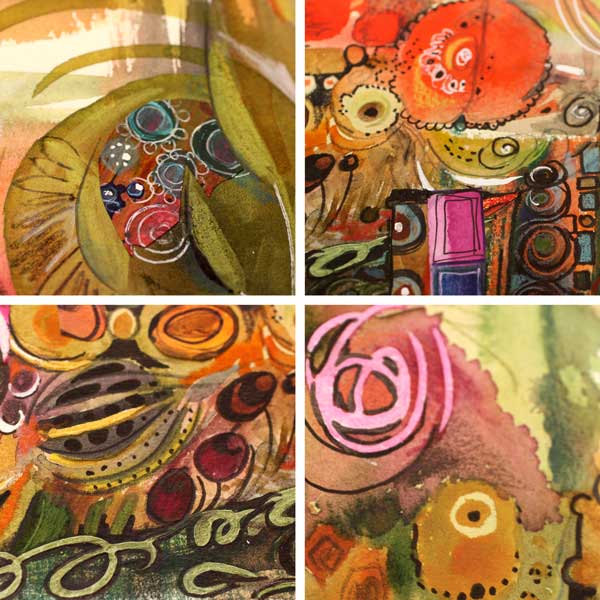
When finishing, I like to listen to the rhythmic music which gives me the confidence to carefully adjust the balance of the work. I picked a white correction pen and a box of hand decorated papers. By doodling and cutting papers, I changed the composition so that the eye would find all the pretty little details one by one.
The Summary
You can be analytical and critical when making art. You can also be strict: mix the colors, change the tempo, keep the image alive! But maintaining the gentleness and sensitivity is crucial too. Let the little details that appeal to you be the foundation for your self-expression!

Blank Page Syndrome before Big Picture Panic?
Buy the video “Watercolor 101 for Intuitive Painting” where I will show you how you can get a fast start and keep going! Click here for the preview!
Art Deco Journal Covers
My sisters will get empty handmade journals from me for Christmas. They both like writing and literature so I hope they will put the journals in use. My idea is to include some photos, decorative papers, scrap pictures and such – so that the journal is like a handmade version of Smash book more than a basic blank book. I have also chosen the themes for the journals. The older sister will get an art deco themed book and the younger sister will get flowers and fairies. Here’s a snapshot of the latter.
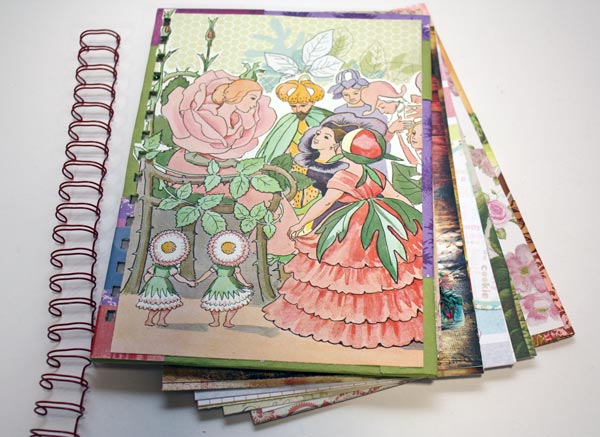
I had an old Elsa Beskow’s children’s book which I used for the cover image. There are plenty of pretty papers too! My other sister would not have this, it is much too cute for her. She likes something more artistic.
I chose art deco as I have been thinking a lot about that style lately. I love the muted, sliding color transitions combined with black and white. And I have been more and more into using graphic, sharp shapes.
Art Deco Journal Covers
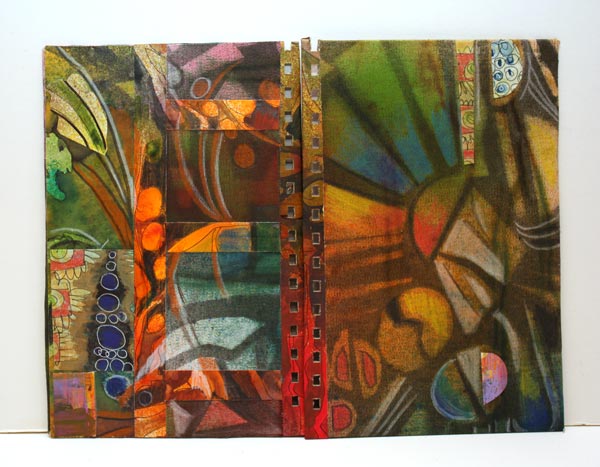
I will show you how I made the covers for the art deco themed journal. First, I picked some Sticky Canvas by Claudine Helmuth Studio. It is a canvas sheet that is like a huge sticker. You can attach it without glue after you have finished it. You do not need sticky canvas for this project. You can use a drawing paper or thin fabric instead.
1) Background Colors
I started with watercolors, then used some Dylusions ink sprays. As the canvas got all wet, it got wrinkled. I emphasized the wrinkles by brushing Distress ink pads against the canvas.
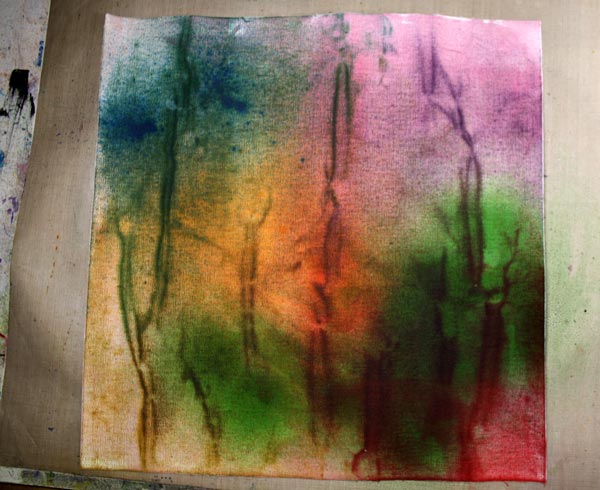
Now I got the muted, soft color transitions. Next task was to add contrasts and sharpness to it.
2) Background Motifs
I cut art deco styled shapes from old cardboard boxes and arranged them on the canvas.
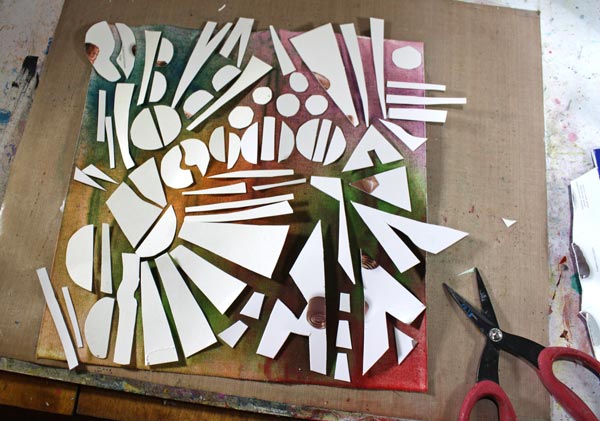
Then I sprayed with the black Dylusions ink spray over the shapes.
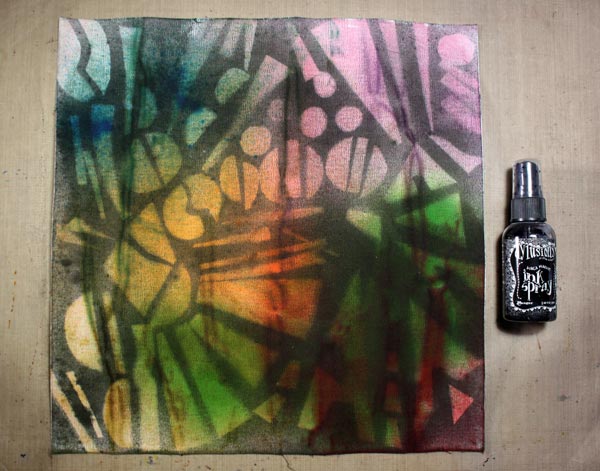
3) Finishing the Covers
I cut two thick cardboard pieces for covers. Then I covered them with the sticky canvas. I had a couple of handmade decorated papers which I wanted to use too.
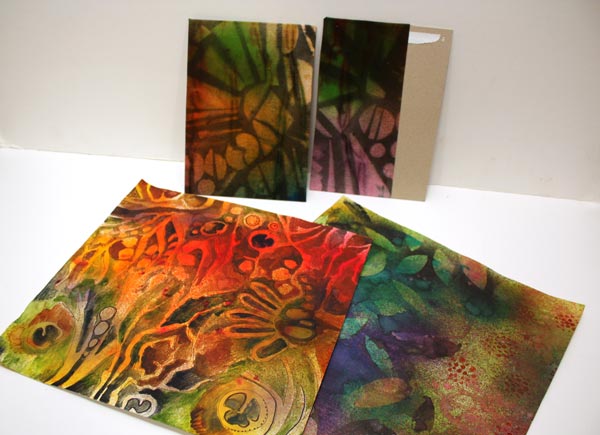
I added decorated papers to the covers. Colored pencils were used to highlight the muted tones. The holes were punched with Zutter Bind-It-All. It is amazing how thick it can cut!
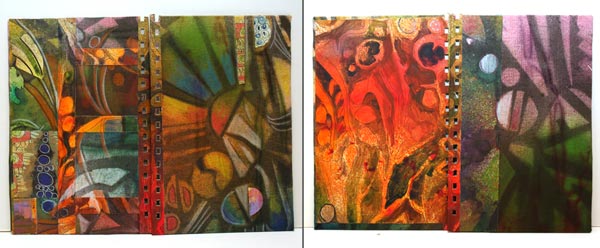
The front and back covers are shown on the left, and the inside covers on the right.
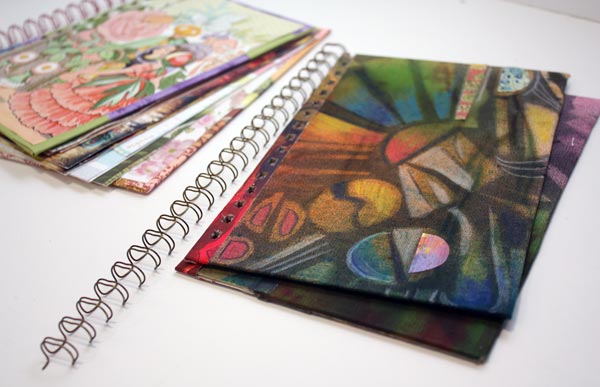
Now I just have to add pages, draw some art deco style ornaments to them and find a photo of my sister where she looks a bit like a beauty of that era!
Art Deco appeared first time in 1920-40s, just after Art Nouveau.
Leave a comment, what do you like in Art Deco or have you noticed it at all? Have you ever made anything Art Deco?