
Move Towards the Flow State!
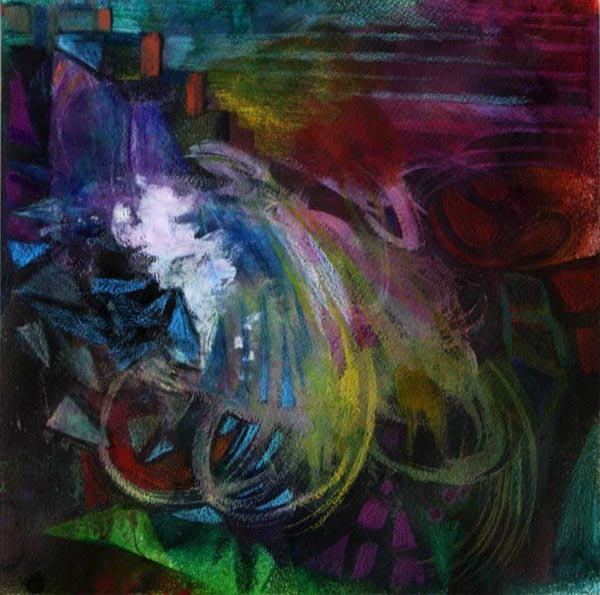
This mixed media painting is called Waterfall. It is inspired by the light in dark spaces.
Last week, I visited two places with old glass windows. The first was National Museum of Finland in Helsinki. The second was the Finnish painter Pekka Halonen’s summer cottage “Halosenniemi” in Tuusula. Both of them were built at the beginning of 20th century. Despite their windows, there’s fairly dark inside. While walking there, I saw how dark colors can be seen as soft and how daylight can look sharp.
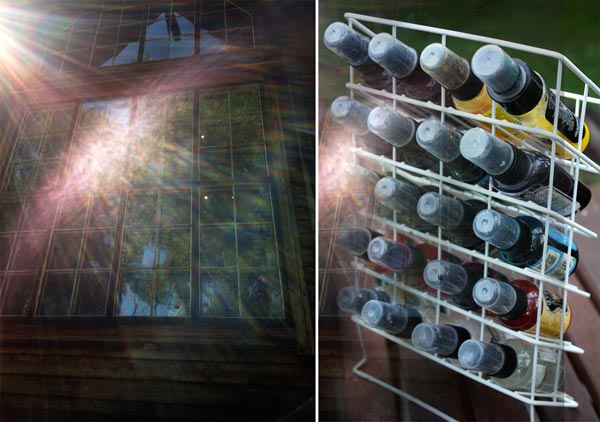
Perhaps the especially hot summer weather had it’s role too. No wonder I thought so positively about shadows and … water! I was tempted to use color sprays for this artwork. That way I could work outside and move around while creating.
A Big Mess with Acrylic Paints
Before spraying, I used acrylic paints to create color areas. They would work as a resist so that I could reveal them again after spraying. But the most important thing with the acrylics was: I grabbed a wide brush and said goodbye to rational thinking.
When you start with big brushes and create intersecting layers, you will naturally get into the creative mood. You will also begin to move. It’s often necessary to even stand up to make those big strokes wide enough. Check the front page of Heikki Marila’s website. He is a Finnish painter who creates huge paintings inspired by art history. See how those paintings are created, lots of movement there!
Also remember to change and mix colors as often as possible! Think that you are climbing towards the flow state where the creativity meets the happiness! Each interruption, the change in the movement and color, is one step closer to the flow.

The mess that I created with acrylics made my rational side cry and emotional side warm up. I was ready to get some fresh air and start even the bigger mess with sprays.
Entering the Flow State using Spray Mists and Handcut Stencils
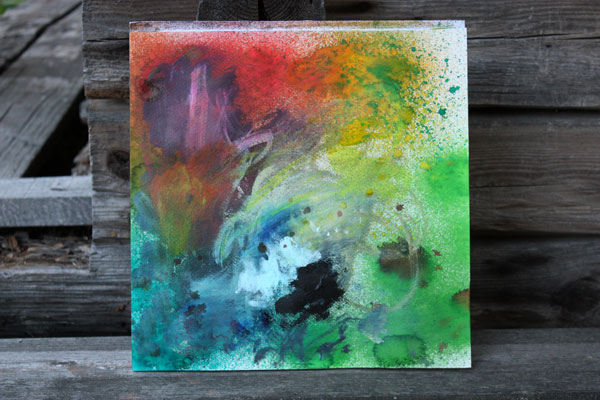
Here’s the first sprayed layer. Moving around the lawn and shaking the spray bottles were like a jump towards the flow state. I shook away the last rational thoughts and entered the happy state. I was flying.
Now, this is important: Be prepared to work quickly! When you get creative, you will get faster. There should be no need to rationalize what to do next or where to get the materials. They all have to be there. I had taken the scissors and a piece of paper with me. That allowed me to create stencils while waiting the layers to dry. I had also set up the blow dryer near the back door.
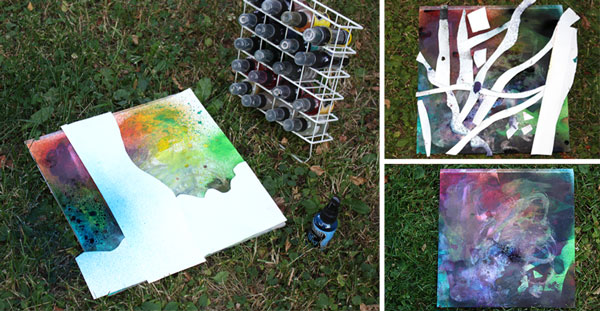
Running around the back garden with spray bottles, then inside to dry layers, then back again, I sprayed about five layers in total. As a result, I got the ugly mess shown in the photo right below. But I was not worried. I thought it looked amazing! One good thing when moving towards the flow: the inner critic leaves far behind!
I ended the day with spraying some areas with water. When wiping some of the spray ink away the acrylic paint areas were revealed.
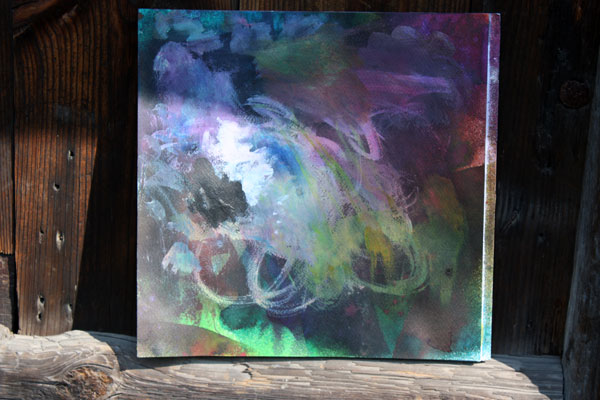
Next morning I had a problem to solve. How to finish the painting? I decided to create small geometric shapes with colored pencils to resemble the sharpness that light makes in the dark space.
Finishing with Colored Pencils
When using big brushes and big movements, creating details with small strokes adds interest and balance.

Colored pencils are wonderful to highlight the best and reshape the worst areas. When working with small details, I try to focus on one small area at the time.
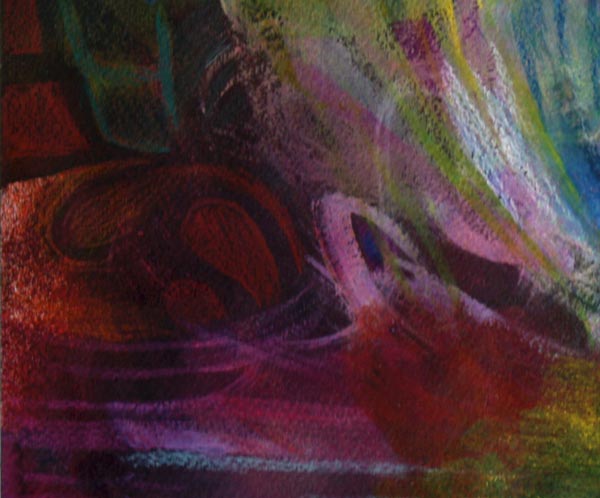
In the “big” phase, my focus was in the big picture. Now, when working small, my focus is in the details.
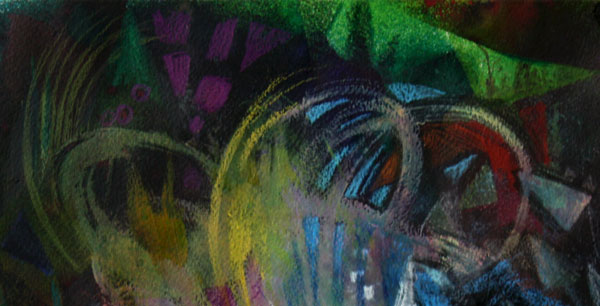
Balanced Composition
When I had gone through all the areas, I began to look at the big picture again. Then I made the final tweaks. So here it is:
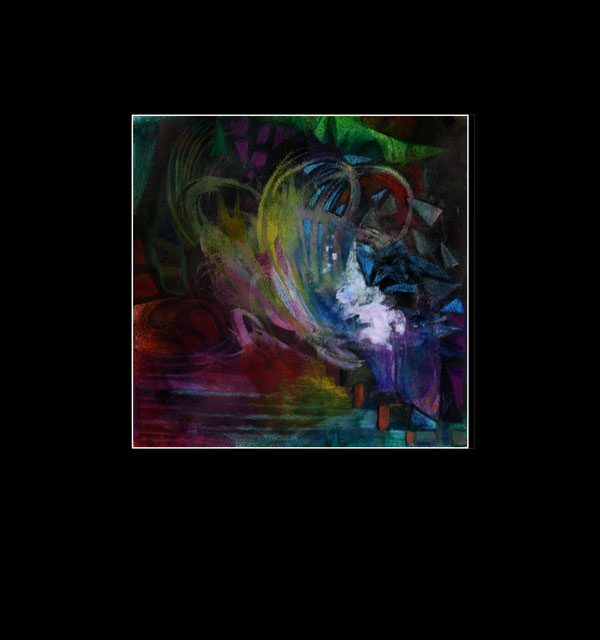
Hmm … wait a minute! Now it is upside down! Well, while coloring the work, I thought the direction would be this. But then, I noticed that it could be any of these three:
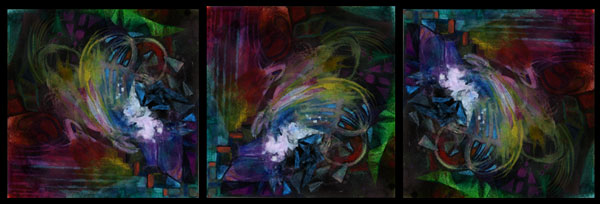
If the composition is balanced, the work will look balanced in any directions. By changing the direction, you can test if your composition is successful. Still, I rarely come to the result where changing the direction not only works but also tells the same story. I think that moving around the lawn had an impact here!
Experiment this in your art: Try to include physical movement into your creative process!
Subscribe to my weekly emails – Get a free mini-course!
Stretch Your Artistic Style
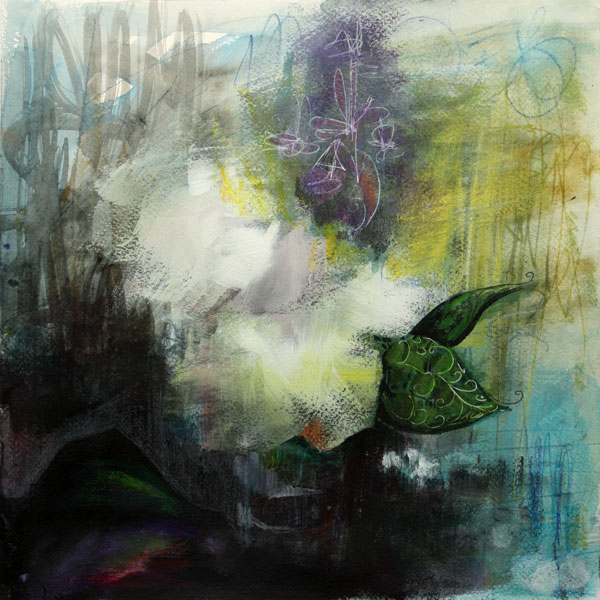
In art, I am fond of thin strokes and decorative details. I have often thought that blurry painting is like a bad photo – in need of sharpening. But slowly I have begun to get interested in blurry paintings. Those wide strokes have begun to feel tempting. The concept, where colors can take the leading role, has been sneaking into my thoughts. So, when I wanted to express something very familiar to my home country, I thought that the impressionistic style would go well with the theme.
The theme was melancholy and for me, it’s all about white flowers. In general I do understand the beauty of white, but personally, I see it as a symbol of loss and emptiness. The painting called “Condolences”. I wanted to give both white and black the position where they can be heart-breakingly beautiful. I wanted to treat them as real colors, not only as the elements to create contrast or compositional space.
Taking a New Route in Painting
Before I began to paint, I spent weeks of pondering the idea in my mind. After I had got hold of the feeling I wanted to express, I felt unsure of how to master the technique. Then I realized: if you want to stretch your style, you need to take a new route at some point in the creative process.
My new thing would be the way I used the acrylic paints. But I could start with familiar things: watercolor the background and set the basic color scene.
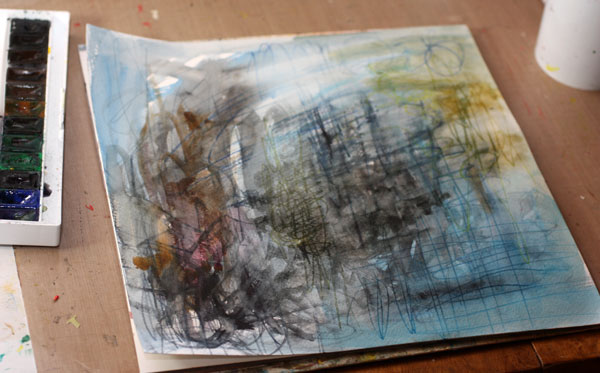
After creating this background, I felt comfortable: same old, same old! Then, with the help of Coldplay’s best hits, I got into the mood where I felt no uncertainty. When I have a clear theme in mind, I prefer to listen to the music that is pompous and not too deep. Then the music helps to improve my self-esteem without taking the focus away from the theme.
After few moments of walking around the room – that is a great way to boost your creativity too – I took the step. I mixed the paint, picked the broadest brush and dipped it into the paint. Then I began to brush boldly and very fast.
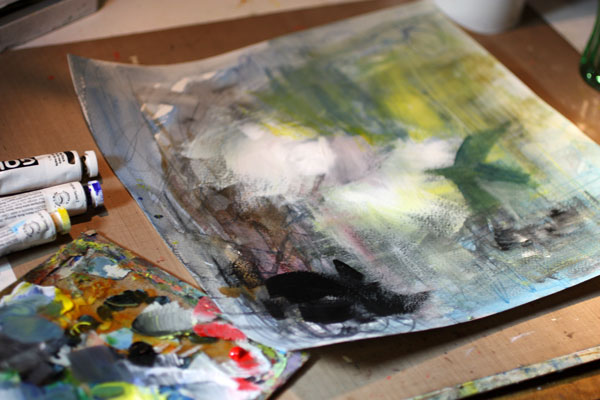
If you want to accomplish something new: think before you do it, not while you do it. Let your reason go through what you should create. But while you are creating, work very fast so that you reach the pace of your creativity. If you have some kind of image in your mind about the end result, it is important to focus on the feeling you want to express. The feeling should overcome the image while you are working.
Finishing Touches with Colored Pencils
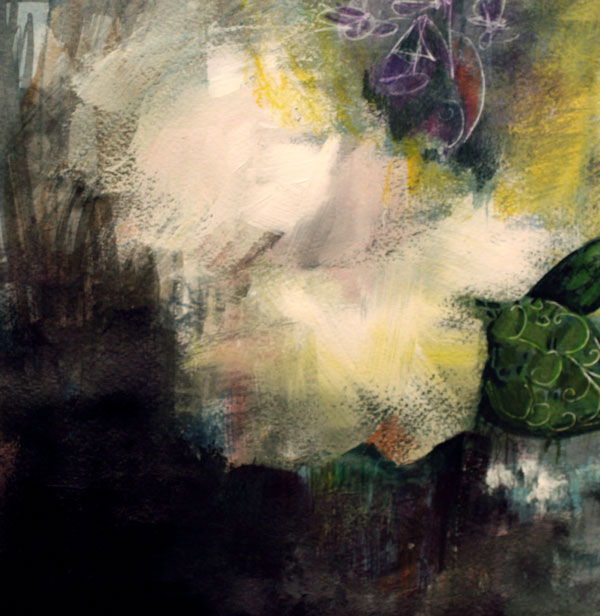
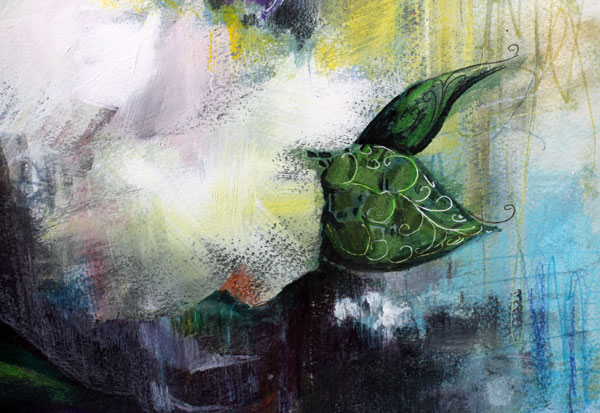
There is something quiet and covered in the way the people grief, so I added a lot of blacks and other dark tones. After passing the most exciting phase, I became worried about the lack of depth in dark areas. After working with acrylics, I added details with colored pencils. The white lines were made with a white gel pen.

I made the final touches with colored pencils by picking complimentary colors or colors very near their complementary.
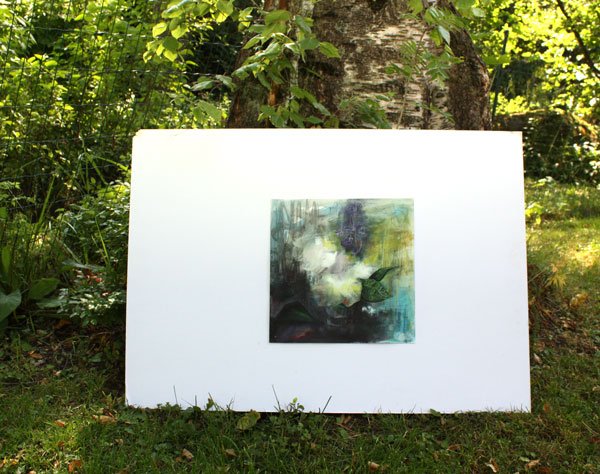
It felt somehow controversial to create this melancholic piece when the Finnish summer is at its best. But this was a good experiment. It raised an important question: Have I limited myself too much? Without too much questioning, could I try to create whatever comes to my mind?
Stretch Your Artistic Style!
Give yourself permission to experiment! Here are my tips:
1) Pick the direction to go! When stretching your style, remember to pick something you kind of like, but still have reservations about it.
2) What are the factors the new style has? Using a dry brush and only a few strokes were essential for my experiment. Think about techniques, colors, composition and pick the things that are essentially different than your ordinary methods.
3) Which the step in your process is the one where you take the new route? When will you start incorporating those new things? In my process, it was after making the background. Preferably start with the familiar way to get into the flow of creating.
4) Get emotional so that your emotion leads the way while creating. Think about the stories behind the emotion. Get into the state where expressing the emotion is more important than mastering the new method. Turn the music on if you need some courage to express your emotion.
5) Work fast without too much thinking. If you need to think, interrupt your work. Stand up and move around. Never forget the feeling you want to express.
6) Sleep overnight and finish your work on the next day. Embrace the good and fix the bad. Do not make major changes anymore as there will be a new day, a new blank paper, a new play, a new chance!
Stretch your artistic style
and get inspired by the world of art: Sign up for Imagine Monthly Fall 2016
The Art of Finishing

This collage is called Dawn of Change. It is inspired by the history of art. There was a time when I preferred modern art. If I went to an exhibition showing older than 20th century’s art, I used to yawn and think how pretentious it was. But the more I have examined art, the more I see in the old art. I see colors and concepts that can be reproduced in many different angles. Also, seeing good art makes me think of finishing – how much it affects the experience of the viewer.
The Creative Process
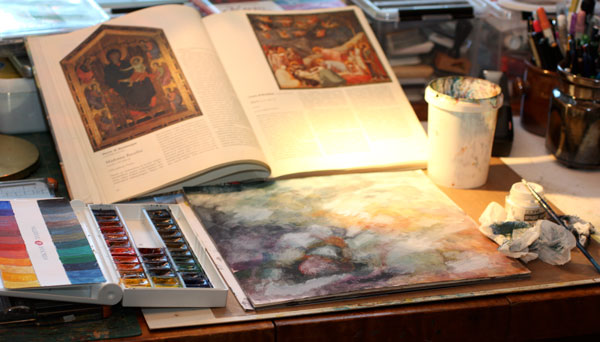
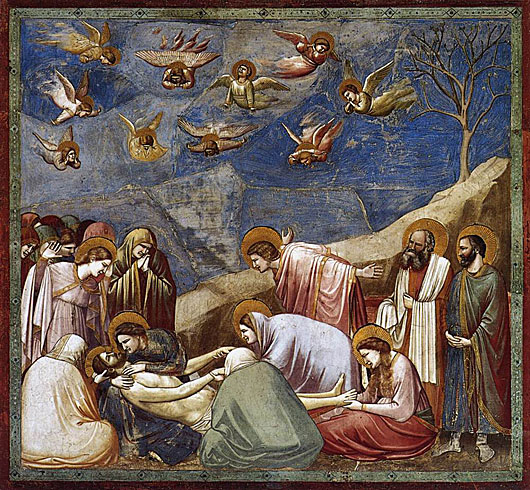
When I began to create Dawn of Change, I kept the painting of Giotto di Bondone visible on the table. I did not copy the image; I just kept it as a reminder of what to aim for.
The first layers were painted with watercolors. Then I added some Copic Opaque White to create lighter areas. The white layers were rubbed so that they shined vaguely on the watercolored surface. I also sprayed some Dylusions mists to make the background even foggier.
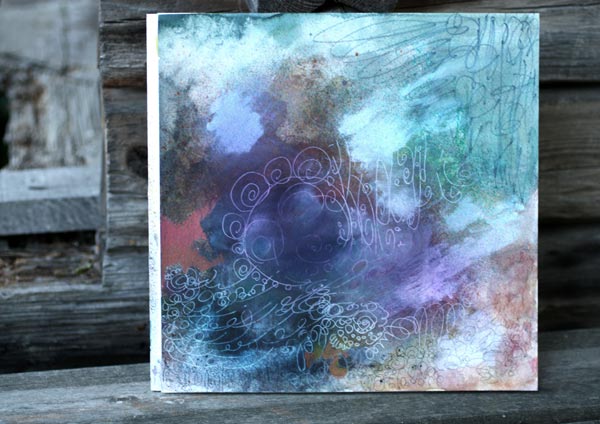
After a little bit of doodling with colored pencils, black marker, and white gel pen, the background started to show the guidelines for collage pieces.
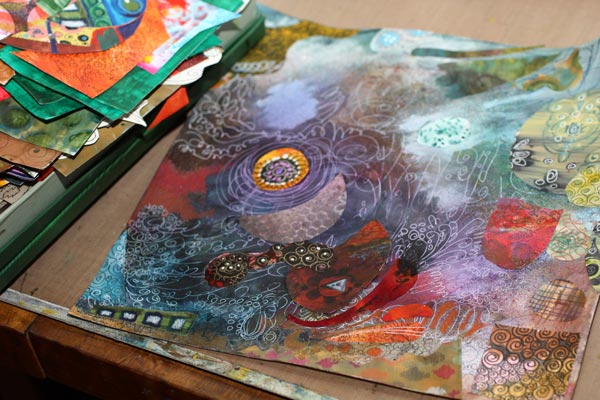
Then I picked up the box of hand decorated papers and began to attach the paper pieces. In this phase, I always get surprised how well the papers fit the artwork even if they are all different. Creating your own papers will bring you that happiness! Try to avoid using same papers many times in the same artwork. That way the result looks more interesting.
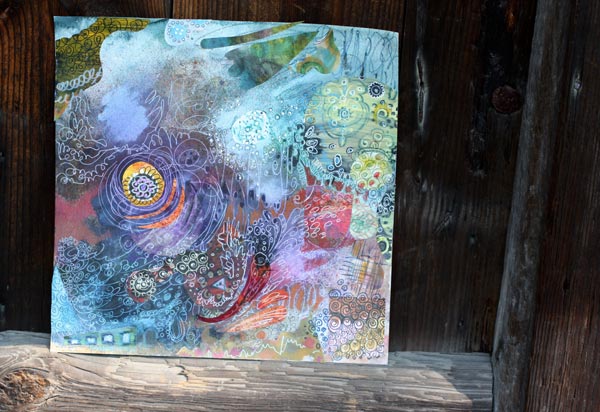
After a little bit of doodling, I was getting tired and decided to end my session. Even if the composition was accomplished and nothing major decisions left to make, I felt that the work was incomplete. I needed to ponder how I was going to finish it. Over the years I have noticed that finishing does make a difference. In arts and crafts, the finishing rarely alters either the message or the use of the work, but still has a high impact on how appealing we will find it. Sometimes that extra addition of quality will change entirely what we think about it.
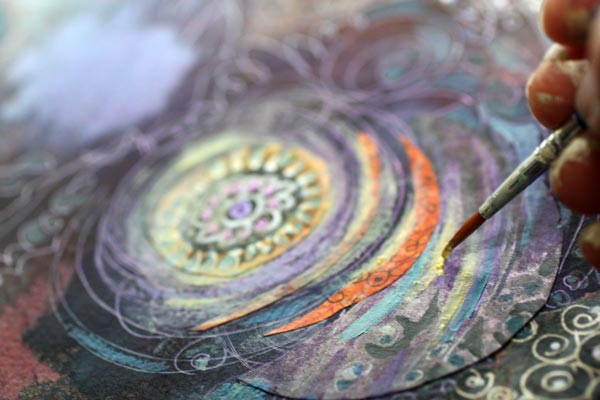
So, if you want to improve your results, get into the habit of taking breaks. I like to have a good night sleep, walk the dogs or work in the garden. Especially physical activities make the subconscious work best. Then, when I grab the thin brush I know exactly what I want to achieve and how to do it.
Finishing Art – Making Subtle Changes
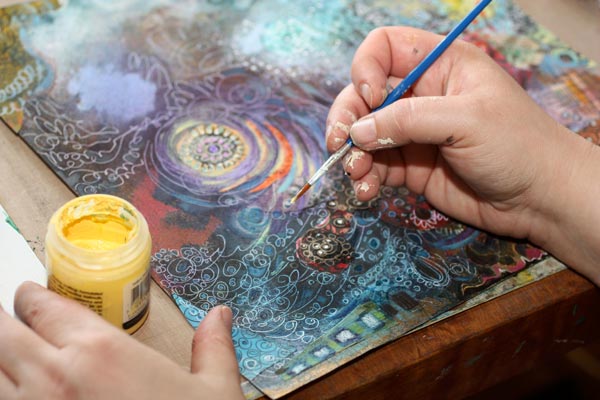
In this piece, I wanted to increase the impression of the colors fading together. The acrylic paints were the best to accomplish that. I added small strokes of various shades of grays to create a more muted look. Then I also added some pale yellow and off-white to create the fading in lighter areas.

The difference between before and after is not big. When placing the two pictures side by side, you have to search for the differences. But I claim that the overall experience of the quality is better after finishing.
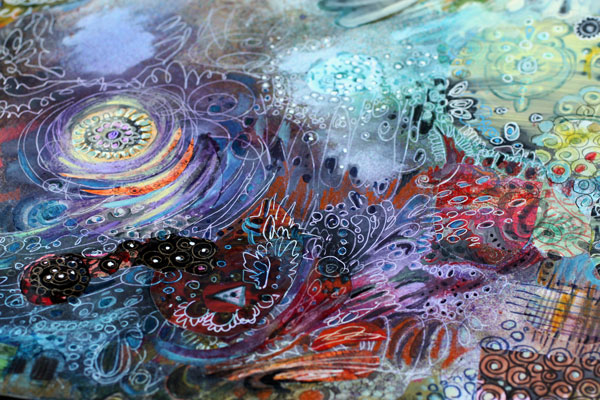
So I challenge you to finish your work – even if it already feels finished!
Let me be your mentor in art: Subscribe to my weekly emails!
Kiwi Patterned Paper

I am continuing the theme of the week to celebrate yellow. Here are step-by-step instructions for a striking patterned paper where yellow and orange are combined with dark colors. You can make variations on the pattern by choosing different colors, adding you own details and picking the materials that you prefer.
1) Fill the Paper with Big and Small Ovals
Fill the paper with intersecting ovals using freely cut templates. Cut plastic templates for a big and a small oval. To achieve an organic form, handcut the shapes freely. I used transparent plastic from a plastic sleeve meant for name tags. Also transpacency sheets for overhead projectors or any easy to cut plastic will do.
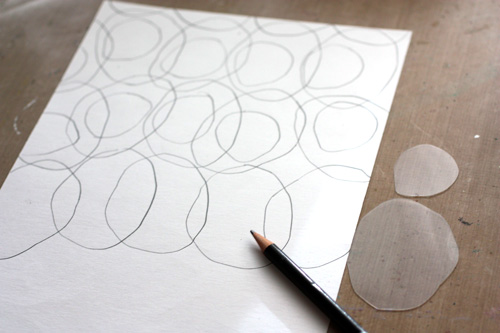
Starting with the bigger template, draw ovals on the paper so that they intersect slightly. Change the orientation of the template now and them. That way the pattern will look more lively. After filling the paper with bigger ovals, draw smaller ovals inside the bigger ones. Each smaller oval should cross one or two lines of the bigger ovals. Change the orientation and placement of the smaller ovals as you did with the bigger ones.
2) Paint the Centers of Small Ovals
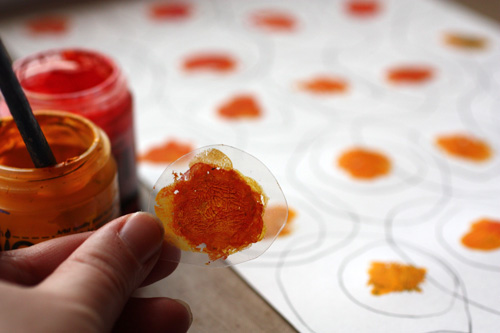
Add acrylic paint to the centers of the smaller ovals. Paint the centre of the smaller template and press one center at a time. Mix yellows and reds to get orange hues on the template. Each center can be a bit different from another.
3) Add Watercolor to the Smaller Ovals
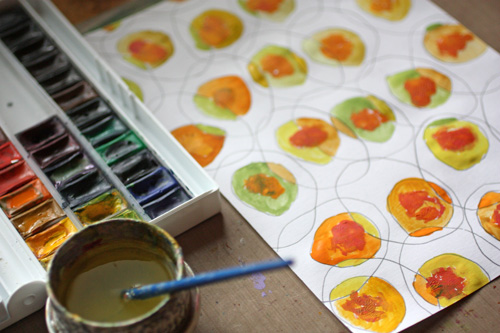
After the acrylic paint has dried, paint the smaller ovals with watercolors. Use yellows mixed with blues and reds. Color each part of the oval with different color. This way you will get an appealing look of ovals that have many hues.
4) Add Watercolor to the Bigger Ovals
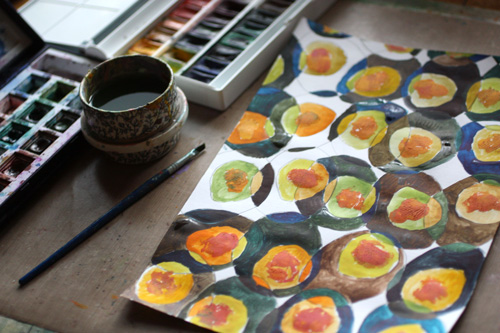
After the smaller ovals have dried, paint the bigger ovals with watercolors. Use mixes of browns, blues and blacks. Color each part of the oval with different color.
5) Fill The Background
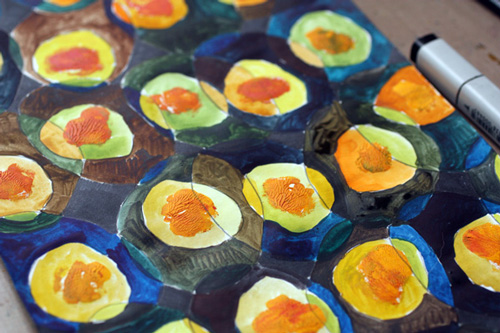
Using black marker, color pencil or watercolor, fill the small white background areas with black.
6) Add Details with Colored Pencils
Draw white lines around smaller ovals. Add black outline for smaller ovals. Color the edges of smaller ovals with red and green depending on the hue of the oval.
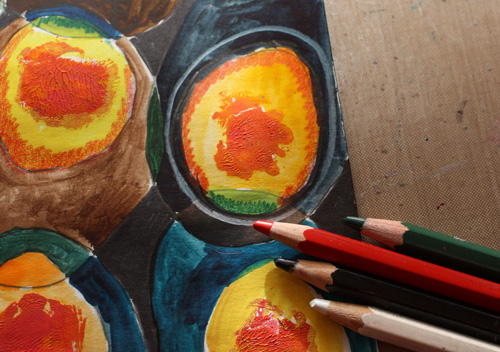
7) Final Touch: Thin Lines and Dots
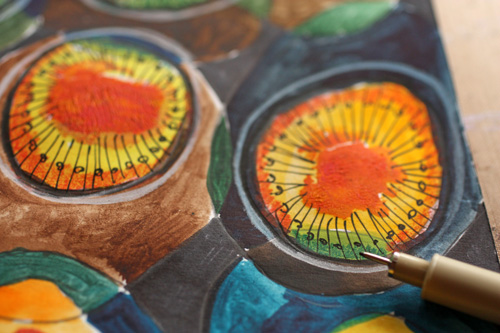
Finally pick a thin black marker or drawing pen. Add radial lines to the smaller ovals and decorate the lines with dots.
Let me be your art teacher: Subscribe to my weekly emails!