
Finding Visual Voice – Prepare for the Free Webinar!
What to Think About Finding Visual Voice? – Watch the video!
Currently, I look at my art with a different point of view than when I created it. Non-art-related things in the past can also get integrated into art. Watch the video to dive deeper into these insights and to see examples!
Free Webinar – Save Your Spot!
Let’s meet! I am broadcasting live from my studio and talk about finding your visual voice. I have a subtitle: “How to start the journey?” because I think it’s a thing we need to rediscover again and again!

When you register, enter your time zone, and you will see when the webinar begins where you live. Save your spot even if you couldn’t come just at that very moment. You can then watch the recording later that week! >> Register here
Draw and Paint Flowers Like Never Before – Sign up for Floral Fantasies!
I am rerunning my best technique workshop so far, Floral Fantasies in 3 Styles. It’s about taking the best tricks from three visual approaches and immersing into the beauty of flowers. The workshop is now in the early-bird sale, so reserve your spot!
Finding Your Visual Voice – Free Webinar!
A letter to the reader of this blog:
Dear friend and soulmate in art,
Like you know, I have had this dream to be an artist from a little girl. Back then, and many times before taking the leap, I didn’t quite understand how unsure and tentative the life as an artist can be. When I was about five years old, I thought I knew what I liked to create and how. In a way, I did, but life got more complicated year after year. When I was about 16, I had a turning point. I discovered the way to paint that made me tremble with joy. Two of those paintings are still displayed here in my home, and they remind me of that time.
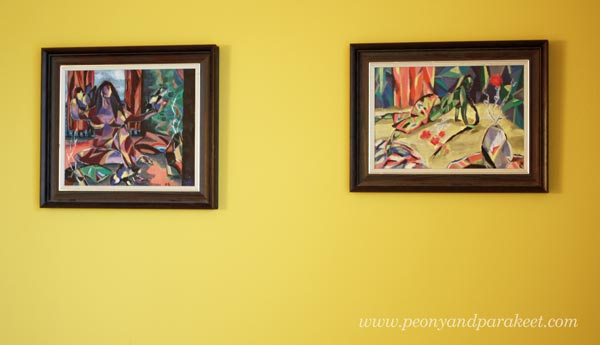
But then I got critical towards myself. I thought that my paintings lacked content, something. I thought that I need some experience in life to become a better artist. Soon after that, I started studying, lost my parents and all that made me stop painting. In the perspective of art, I became nobody to myself.
But if you have been following me, you already know that. And you know that my journey in art has been quite obsessive in the last years. It has felt like I had wasted all those years when I was not painting, and I need to hurry and fast forward before life ends. Losing close people make you realize that. That life does end some day, and the dreams can remain dreams. That’s why it’s sometimes necessary to step into the unknown and try the wings.
I started painting a new series about a month ago. ” I have put so much thought into the series that my brain hurts,” I wrote on Instagram. And the more I have been painting recently, the more I feel the same than as a teenager! Wow! It’s even better now when I have more ways to handle with the self-criticism.
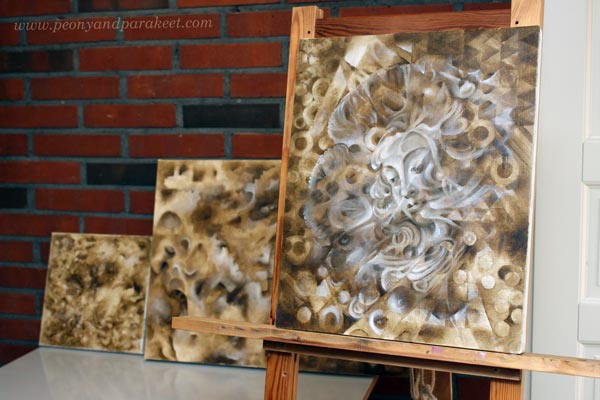
I also understand that this new euphoria has a simple explanation. My imagination, expression, and the technical skills finally meet. I have also discovered a process that feels natural to me. I know this won’t last forever. When the life changes, as it constantly does, I can’t develop or even maintain this. But at this very moment, I feel joy and relief. It is a pleasure to rest in this new base camp for a while before I feel the need to start climbing up or walking down to the mountain called art.
Because I am painting with oils, I need to wait for every layer to dry for a week or so. So these paintings will get more color slowly but surely. You will be surprised!

During painting, I have been thinking: do you want to find your visual style or your visual voice? Is there a difference for you? To me, the voice is at a deeper level than style. I can play with styles, but the voice is more static, something that you have born with. Or is it only me who sees similarities between those teenage paintings and these recent ones?
I thought I record a video of these thoughts and show you some examples. But even if I can edit out all the umms and breaks from the video, it doesn’t feel so good to talk on a camera instead of talking to you. So I suggest we meet live on Jan 31, 11 am PST and chat about this together. Can you come?
Many warm greetings from
Free Live Webinar about Visual Voice
So yes, come to my live webinar “Finding Your Visual Voice – How to start the journey” where I tell some key points that have made a big difference to me!
When you register, enter your time zone, and you will see when the webinar begins where you live. Save your spot even if you couldn’t come just at that very moment. You can then watch the recording later that week!
“Floral Fantasies in Three Styles” is Back!
One of the big things to me has been to find enjoyable techniques, including the ones that old master painters used. You can now study them too! I am rerunning my best technique workshop so far, Floral Fantasies in 3 Styles. It’s about taking the best tricks from three visual approaches and immerse into the beauty of flowers. The workshop is now in the early-bird sale, so it’s a great time to reserve your spot!
If you haven’t attended my classes before, please be assured that you will be supported and your questions will be answered. I also run discussions and give visual suggestions if you run into problems. See what students have said!
So I hope to see you in the class and of course, at the webinar too!
Three Artist Types and Why You Should Become All of Them!
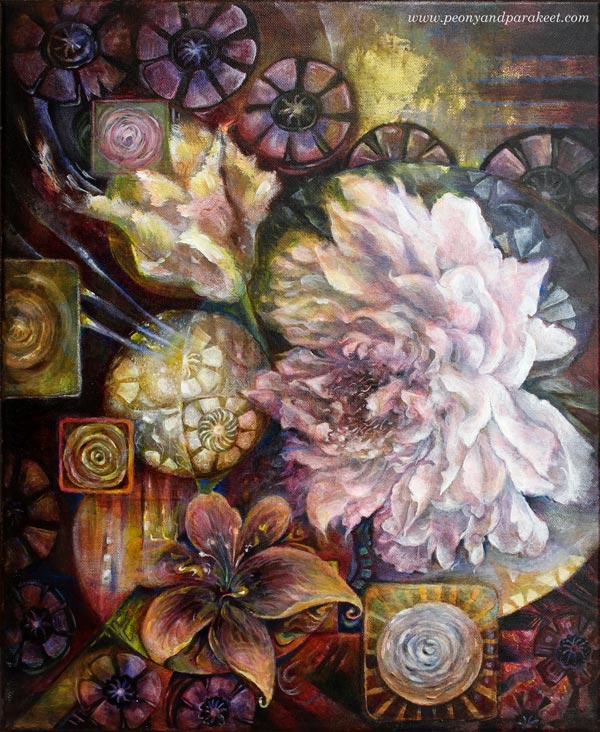
Here’s my latest acrylic painting “Blooming Centuries”. With this piece, I show you how stepping into roles of three different types of artists can grow your skills.
Tight Focus – Don’t Believe it!
The conventional way to grow artistic skills is to choose your media, mindset, and style and stick with the choice. To me, this kind of tight focus has never worked. It feels boring and too straight-forward to work in practice. It forgets the fact that creativity comes with limited persistence but with unlimited imagination.
For example, when I have a heavy heart and want to get quickly into the core of it, I don’t want to stick with the technique that is more labor-oriented. On the other hand, when I want to think and adjust, quick and simple is not what makes the most of the contemplation. Sometimes my imagination wants to be playful, other times it wants to be timeless and deep. When the moment and the mood can define the supplies and techniques, I not only enjoy more but also surprisingly, learn more!
3 Moods – 3 Artist Types
In my upcoming workshop, I will expand your toolbox for creating art in various moods, rather than trying to force everything under one media and one way of working. I have defined three types of artists and picked the techniques accordingly.

The most interesting column in the table above is “Emotion” because it brings up the benefit of the mood. When you imagine being a designer, you aim for clarity. You get happiness out of clearing your thoughts and communicating the essence. When you step into the role of an intuitive watercolorist, your core desire is freedom of expression. What appears on paper, is exciting and your adventurous mind makes the most of it. As a Renaissance painter, you are searching for the peace of mind. By creating a layer after another, you gently caress your way away from busy life.
Now you might say: “But Paivi, I am nothing but an intuitive painter. I am all about quickly creating a beautiful mess.” But don’t let your successes take you on the wrong track. Think about your struggles and what you can learn from the other artists. For example, if your mess has become nothing but beautiful it’s often because the small portion of clarity that we all need has been missing. Or if your mess looks too flat, it’s because your work doesn’t follow the concepts of the three-dimensional world. Also, the time that it takes to create tens of pieces quickly could be used to creating one piece that rises to another level.
I believe that growing as an artist is about learning the best of the many approaches. It’s like getting ingredients for the soup and then making a personal recipe to fit the current mood and style.
3 Artist Types – 1 Painting!
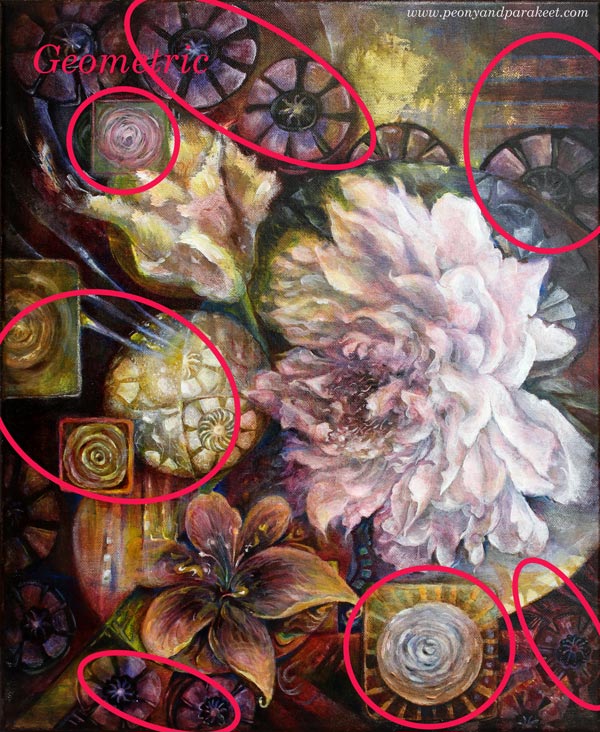
With “Blooming Centuries,” I wanted to express how flowers may be fleeting things, but in general, they have a strong position in the history of art and design. Flowers have inspired artists and designers through past eras, and they still inspire us to create no matter what mood we have. This painting is based on playing with different artist types from a designer to a Renaissance painter.
Designer: Some elements of the painting are more related to crafts and design than to the fine art. They are built from geometric shapes and are quite minimalistic.
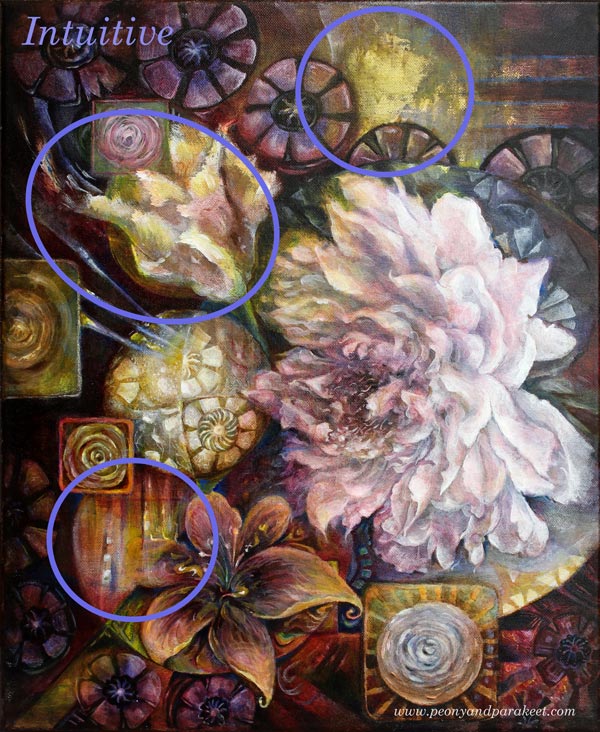
Intuitive artist: There are also elements that have been born freely and intuitively.
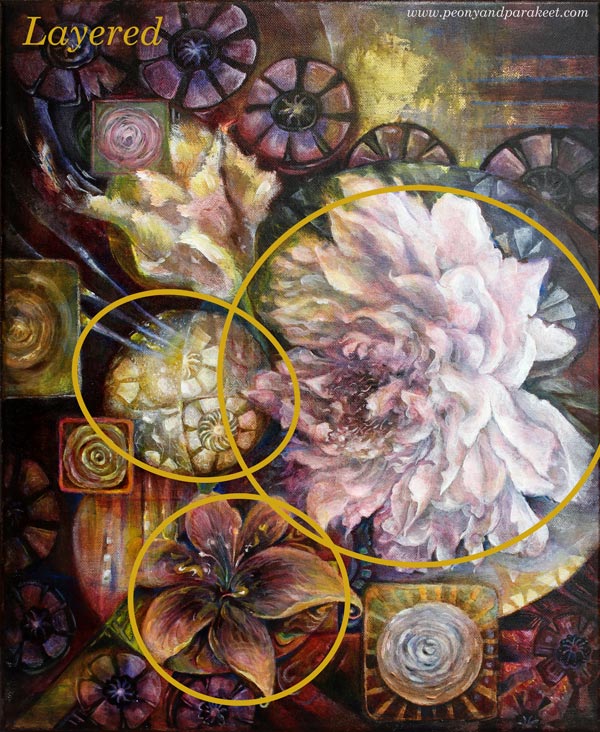
Renaissance painter: Some of the elements have a lot of layers and are more 3-dimensional than others.
Another Example – Combining Intuitive with Art Nouveau
Let’s imagine that you love Art Nouveau. You adore Alphonse Mucha’s work and everything from the beginning of the 20th century. You want your style to include a lot of Art Nouveau but in a refreshing way. So you might think you need to focus on developing your drawing skills only. You draw and draw, and you get closer and closer to Alphonse but the new twist that you want to give to your drawings, “your personal style,” is missing.
But if you start learning from Intuitive Watercolorist and Renaissance Painter, your Art Nouveau designs will take a new turn. By adding more transparent layers, you can express liveliness so that it still looks graceful. By finding ways to manipulate water, you get free-flowing shapes more effortlessly. Your art no longer is a copy of what someone else has created, but it takes a direction of its own. You begin to appreciate all kinds of art because you want to add more spices to your recipe. Your passion for art gets stronger, and the joy you get from it grows bigger. When you struggle, you see a wider range of solutions than before.
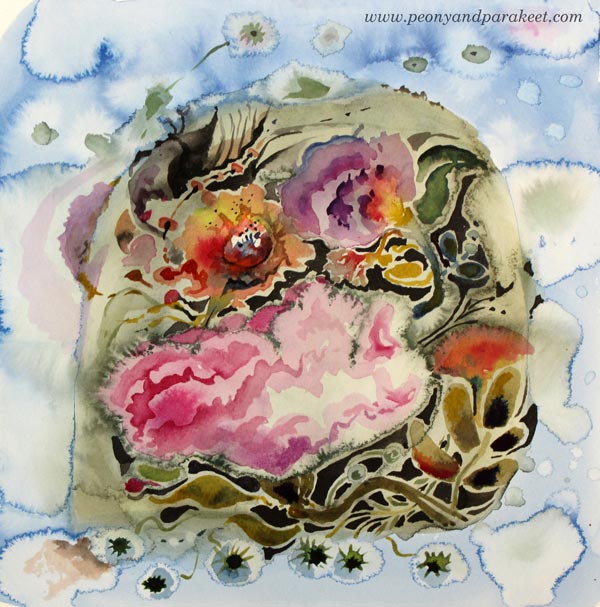
So, every Designer or Illustrator has something to learn from a Renaissance painter or an Intuitive Watercolorist. And the same applies to all artist types.
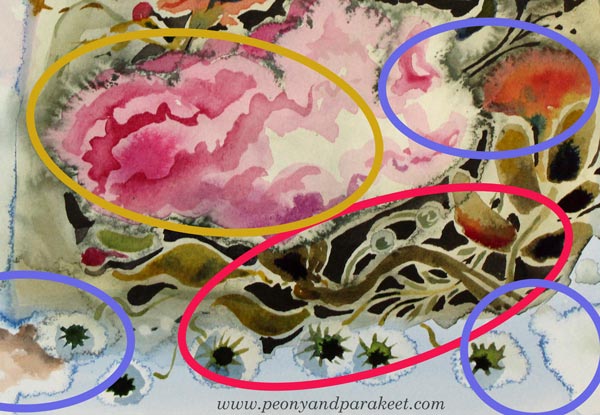
Get into the Minds of the Three Artist Types!
In my online workshop Floral Fantasies in Three Styles, we will dive deeper into the three artist types. It will expand your impression of style and how to construct one. It’s the class you don’t want to miss if you love flowers and want to become an imagination-driven artist! Reserve Your Spot Now!
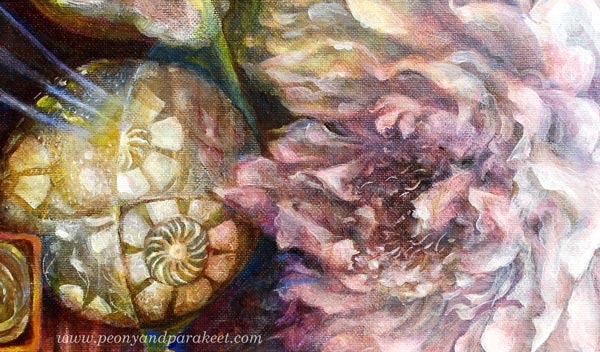
Floral Fantasies in Three Styles: Reserve Your Spot Now!
Mixed Media Painting Idea – Revisiting Your Old Style
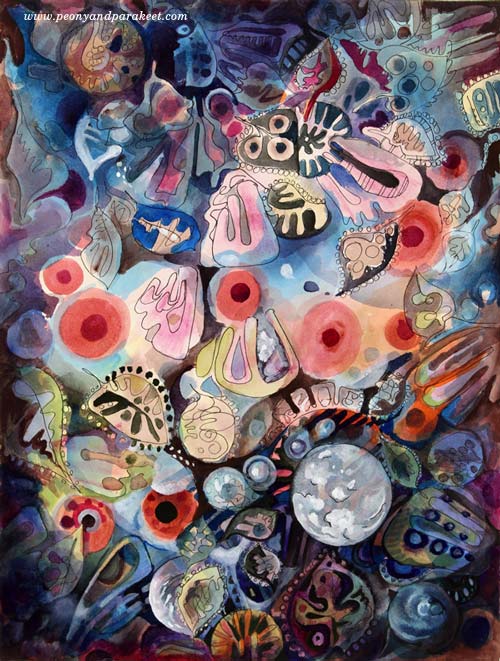
Between 2010-2014 I was enthusiastic about decorative art. I called myself as a “decorative artist” and saw myself more as a designer than as an artist who focuses on expression. My upcoming class Collageland (thank you, everyone, for the feedback you gave in the last blog post!), is a retrospective to that period in my life. While editing the videos, I have been pondering about what inspired me back then and how it’s different from what motivates me now.
Some themes and styles often feel too familiar to me. They don’t seem to challenge me anymore, so I have moved on. But now it hit me how harsh it sounds and how unnecessarily harsh it sometimes also is. So when creating the pieces shown in this blog post, I gave myself permission to take it easy and get decorative. I also became curious about comparing my past decorative work with the pieces that I would produce today.
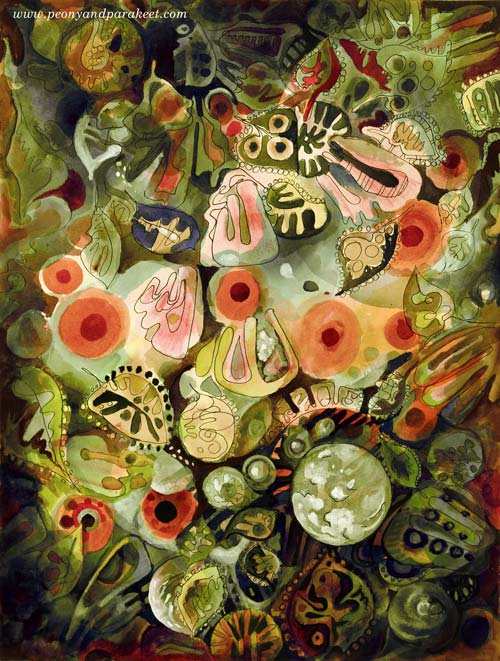
My comfort zone is getting inspired by design and translating that inspiration into art. So I made a mixed media painting that is inspired by the world of fashion, jewelry, lace, Renaissance murals, and botanical art. I call it “Lost and Found”. To embrace a designer’s approach to art, I also made two different color versions by processing the photo of the original artwork digitally in Photoshop.
Here’s Marine:

And here’s Botanical:
I don’t have many phase photos because I wanted to relax with that too but this is what I drew on my planner the previous day:

These quick sketches are the core of my creative process.
Another Painting with the Same Idea
I also made another design-inspired painting. The idea came from the ceramic art of the 1960s.
The photo below shows how the piece looked like before adding the decorative layers. Glowing watercolors remind me of the glazing used in ceramics. When this happens, I feel like I am a ceramic artist, playing with colors.
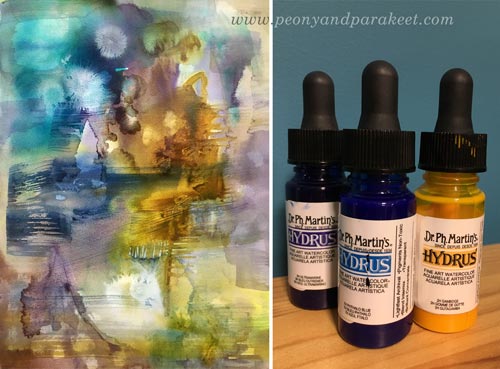
A student of mine kindly donated Dr. Ph. Martin’s Hydrus watercolors some time ago. First, I liked them, now I adore them. They are intensive and easy to use, and I especially love the coverage of white. I used Hydrus watercolors for “Lost and Found” too.
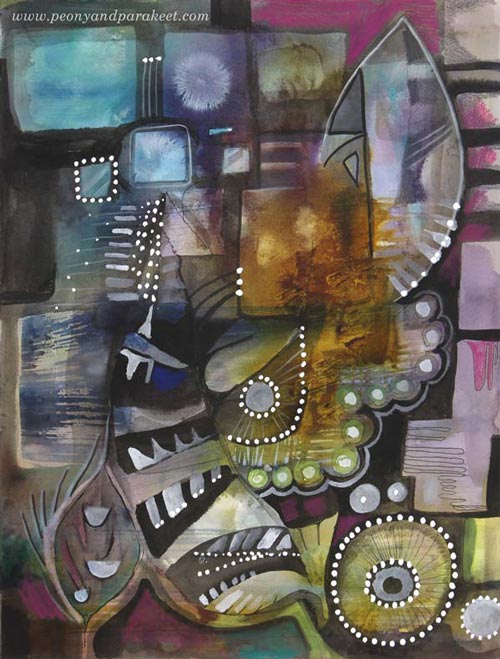
Here’s the finished painting called “Retro Living”. It is also a mixed media piece. I used colored pencils, PITT Artist Pens, and a correction pen for the last layers. I love these muted colors, so typical for the Finnish ceramics from the 60s. But then, I thought they might be too gloomy for many, so I made another version digitally that reminds me of furniture from that era:
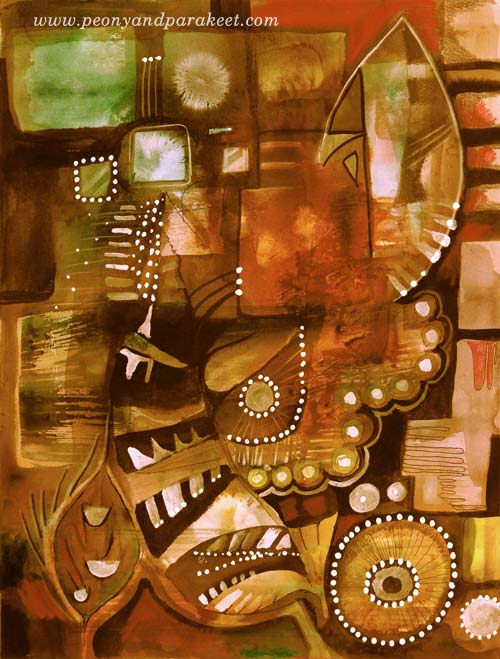
Comparison
See my new gallery showing decorative art and designs from 2011 to this day. When I look at the newly-created pieces as a part of that collection, it looks to me like I have traveled a long journey in art. And I have – I just never thought that it would show in this decorative style as well. It makes me want to explore more of this and also, see exciting challenges in this direction too.
My challenge to you: Pick an old piece and make a new one using the similar techniques and style!
Let me be your mentor in art: Subscribe to my weekly emails!