
Secret Language – Combining Two Ideas and Two Styles into One Image
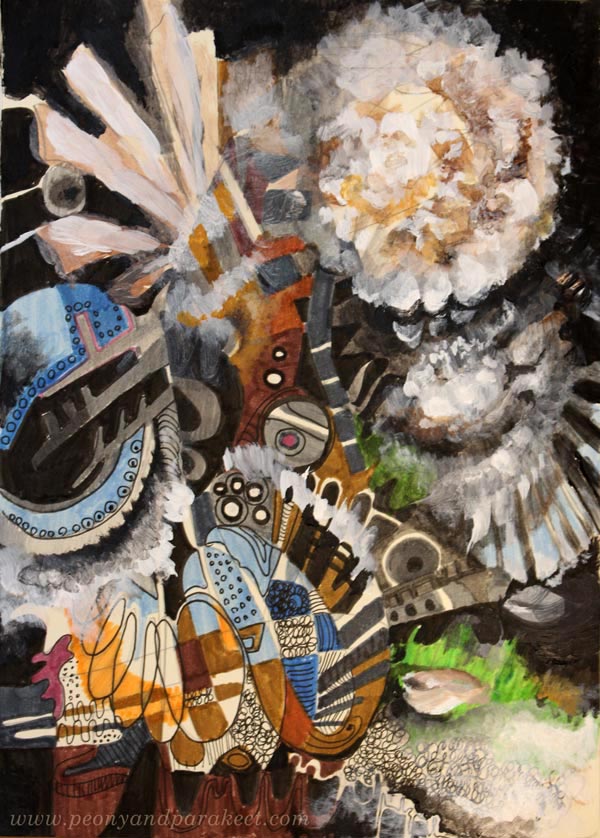
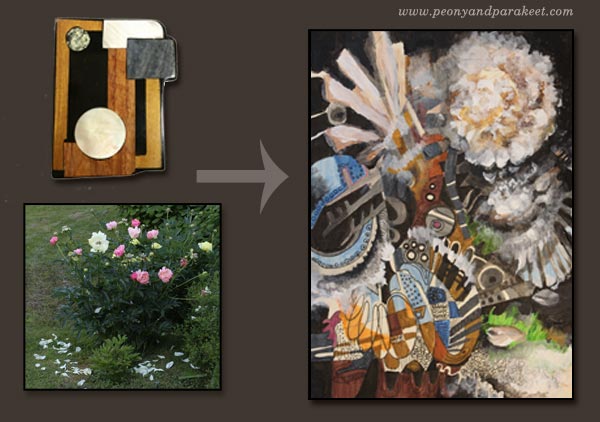
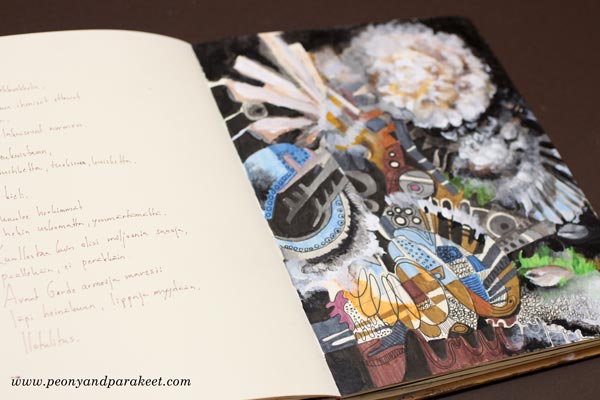
This is my latest art journal page called “The Secret Language of Peonies.” I had two inspiration sources for this page.
Mid-Century Modern Brooch
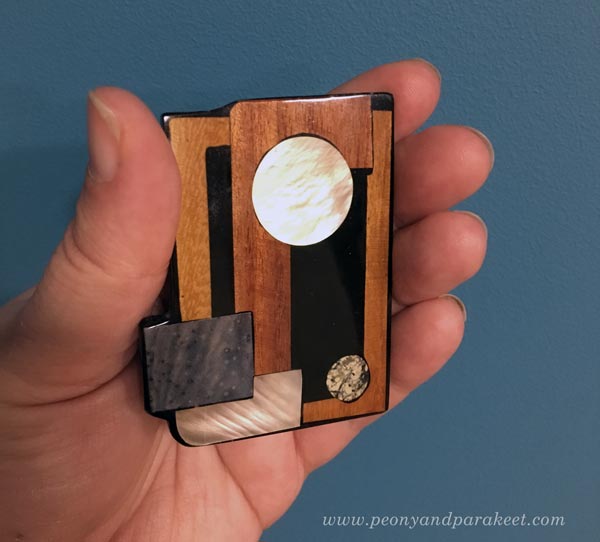
The first part of my inspiration was a brooch that I found at an antique fair. I think it could be a Danish design from the 1950s or 1960s. It only cost 5 EUR, and I liked the idea of having a brooch that is like a piece of abstract art.
Drawing Shapes – Pencil and Felt-Tipped Pens
When I began the journal page, I only had an idea of creating something more graphic than usual.
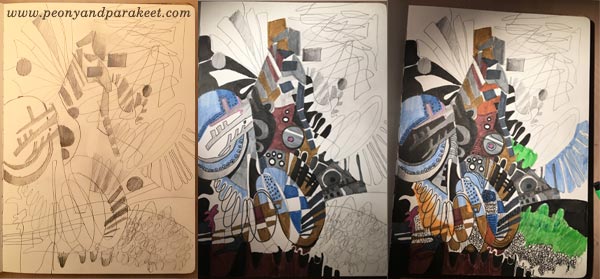
I made a rough sketch with a pencil and then colored a part of it with Faber-Castell PITT Artist Pens. Once the coloring progressed, I felt that I need another idea for the page. I also needed to get more clarity of what I want to say with the image. So I didn’t finish the page but left it to wait for another time and inspiration.
For the Love of Peonies – If They Could Speak …
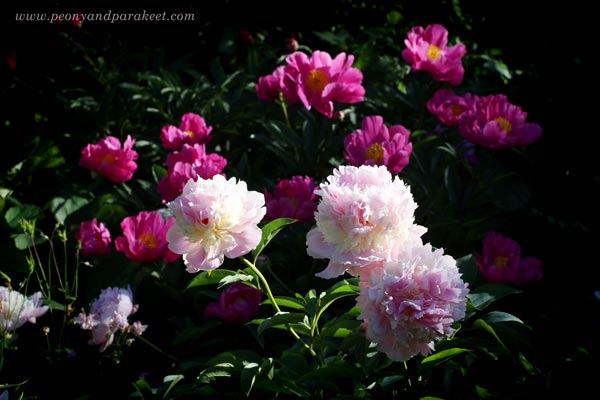
I have nine peony bushes in the garden, and eight of them are blooming this summer. It’s like a big celebration to me, and I have been taking photos a lot. I also belong to the Finnish Peony Society, and they have a lively discussion group. While browsing my photos and seeing other people’s snapshots of peonies, I began to wonder why we always take these close-up photos, like the ones below.
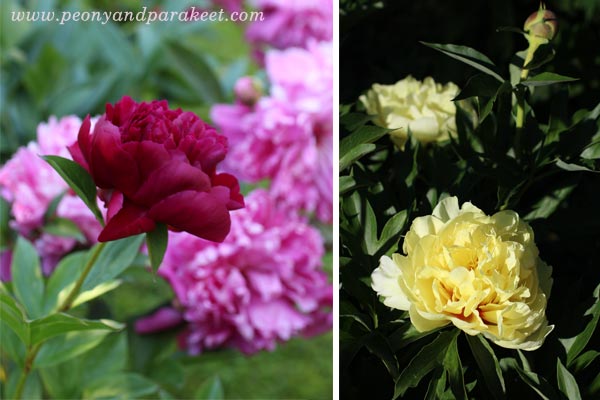
I took some steps further away from the flowers and tried to capture the atmosphere in my garden, instead of photographing just one flower.
And then it hit me: I should also include the falling petals, the whole thing.
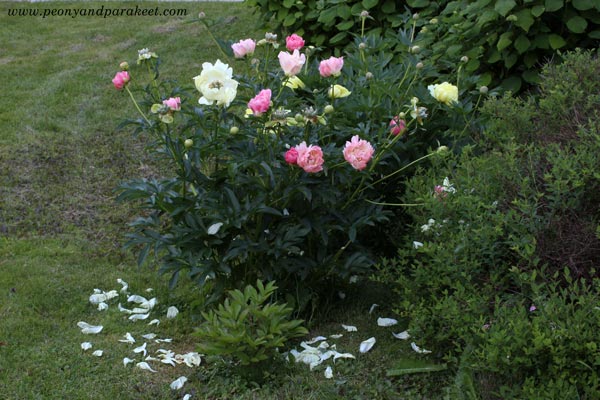
I imagined how peonies are setting a big show, fireworks included, and how we people don’t always get it. Everything in this performance is beautiful in some way. We should let go of the idea of a single flower and embrace the whole experience instead.
It also made me think how it can be liberating for the peony bushes to let go of the flowers. Falling petals and the wind blowing through the bushes must make soft sounds that only spiders and ants can hear. This whispering sound, in turn, made me think about the imaginative language of peonies – what kind of language would that be? And while I photographed the bushes, it became apparent to me: if that language exists, if peonies can really talk, it would be something rich, with a lot of nuances, many kinds of words, complicated structures. Something that we people are perhaps too inadequate to understand.
Two Ideas and Two Styles – Combining Ideas to Deliver the Message
I felt the urge to express my thoughts about peonies visually. Then I remembered the art journal page that I hadn’t finished yet. The complicated and secret language of peonies fit perfectly with the abstract shapes. All I needed to do, was to add some reference to peonies to complete the visual message. Because the language was something that had a dimension of its own, I wanted to use different media for the flowers.

So I painted the flowers with acrylic paint, just intuitively, without any fixated idea of how peonies should look.
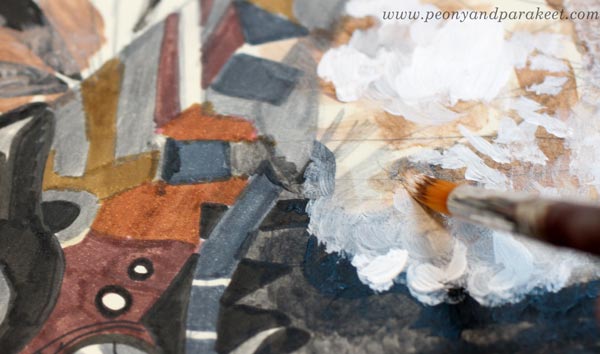
When peonies talk to each other, they see themselves in a different way than how we people see them. The flowers are just the frills. The heart of peonies is more intelligent than we think. It’s more like the brooch that I bought! Showing this controversy with two styles makes the page more interesting than sticking with one approach. What do you think?
When there’s an imaginative story behind the image, I like to write down some thoughts on the opposite page of the journal. It makes the journal as an idea book for bigger paintings where I want to include more than one or two ideas.
I also have something else to share …
Coming up: “Collageland”
Many of you who have been following me for some time, know that some years ago I made a lesson for 21 Secrets Spring 2015 art journaling class called “Artistic Embroidery with Pens and Paper.” This class is no longer available, and I have got back the rights to publish the lesson as an individual piece separate from the rest of the class. However, a lot has happened in the video quality since those times. When I watched my lesson, I wanted to re-record it. And not only re-record it but add more ideas and inspiration into it.
I got the idea of inviting you to my studio to get inspired by the many embroidered pieces, fabrics and quilts I have to show you. I also wanted to deliver the experience of spending a day in my studio and creating paper collages from that textile inspiration. So it would be like seeing my country Finland as “Collageland” and then rebuild it in your imagination.
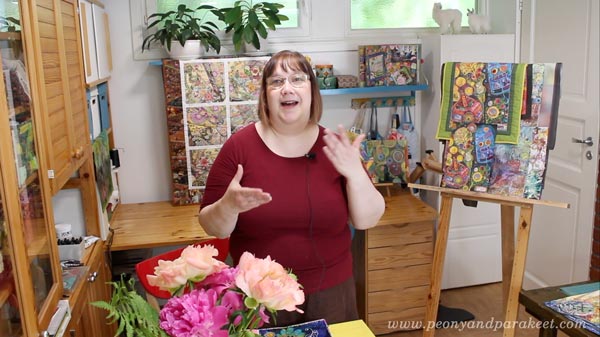
Last week, I recorded videos for one whole day from morning to evening. My husband also helped me so that we got the best footage for each step. I am currently in the process of editing the videos. Collageland is geared for beginners who like to doodle and see more possibilities in self-expression through it. My original thought was to publish a self-study, but I also want to ask you: are you interested and if so, how would you like this class to be delivered?
Helene Schjerfbeck – Step-by-Step Formula for Her Style

In this blog post, I will show you how to create a stylish portrait and learn from a Finnish artist Helene Schjerfbeck (1862-1946).
The Famous Helene Schjerfbeck
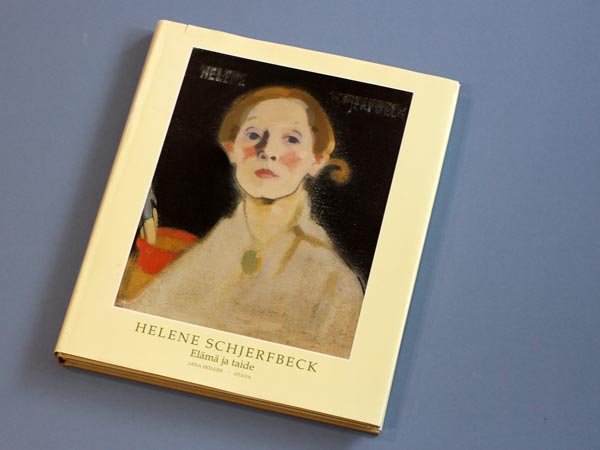
Helene Scherfbeck had an impressionistic and fairly detailed style. But during the years, she became a true expressionist, a master of expressing the most essential through simplifying. She painted a lot of portraits, and many of them have become very valuable. The Red Haired Girl II was sold for 1.5 million euros at Sotheby’s last year. One of my aunts admired Helene Schjerfbeck, and many years ago, she bought me a book about her paintings. The book is called “Helene Scherfbeck – Elämä ja taide” (Life and Art), and it’s written by Lena Holger. To be honest, I wasn’t a big fan of the style and didn’t even browse the book for years. But the more I have learned about art, the more enthusiastic I have become to study various styles. As I love to figure out a formula behind a style, it started to feel tempting to solve Helene’s secrets too.
Independent Visions – Helene Schjerfbeck in New York!
There’s also another reason why I am writing this. Currently, there’s a rare opportunity to see Finnish female masters in New York, USA. The Ateneum Art Museum, which is part of the Finnish National Gallery, displays an excellent exhibition at Scandinavia House from 29 April to 3 October 2017. The exhibition presents four early 20th-century Finnish artists from the Ateneum collection: Helene Schjerfbeck, Sigrid Schauman, Ellen Thesleff and Elga Sesemann. If you visit New York this summer, do go and see it, I promise you won’t be disappointed!
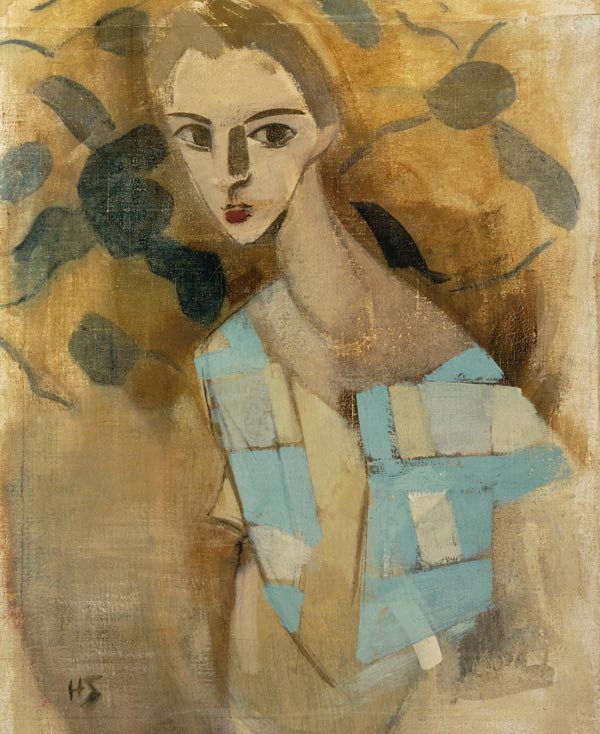
Here are a couple of Helene Scherfbeck’s paintings that you will see there.

I find the abstract nature of Helene’s style especially fascinating. The way she simplifies the spots where the light hits or where a shadow is formed is like she is building an abstract composition instead of painting a face.
Furthermore, the girl below is wearing a shawl that is like an abstract painting!
Mixing Helene Scherfbeck’s Style with My Personal Approach
One primary factor in building a style is the shape of the elements. I for one love organic elements and flowing form. Simple rectangles are not as appealing to me as more complicated and diverse shapes. However, I wanted to add Helene’s twist to a couple of watercolor paintings. As Helene Scherfbeck also painted still-lifes, I decided to paint a woman with a flower or two. First, I made a tiny painting and played with layers to create angular shapes. Then I painted a bigger watercolor painting with familiar flowing shapes but using the insights that I had got by painting the first one.

After these two paintings, I was ready to record a simple formula for achieving Helene Scherfbeck’s style.
The Formula for The Modern Woman – Step by Step!
During this drawing process, improvise, but also check that your drawing is not symmetric. It makes the drawing dynamic and reduces stiffness.
1) Draw a couple of arcs to create a face. Then add rectangles and triangles for hair. It is a fun and easy way to add hair without focusing on the shape of the head.
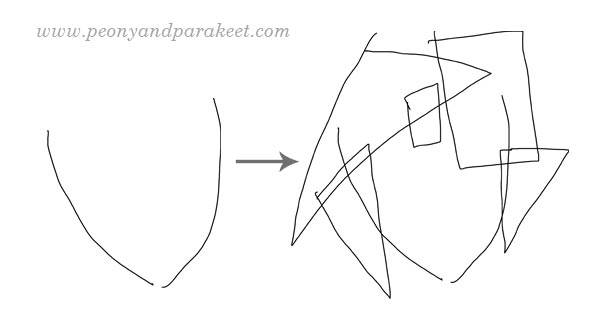
2) Add a neck and shoulders by drawing a rectangle and a couple of triangles that point to different directions. Then draw eyes, mouth, and other facial features. Use as many geometric shapes and simple lines as you can. After facial features, turn the work upside down and complement the drawing with geometric shapes so that it’s more like a balanced, asymmetric abstract painting than a portrait of a woman.

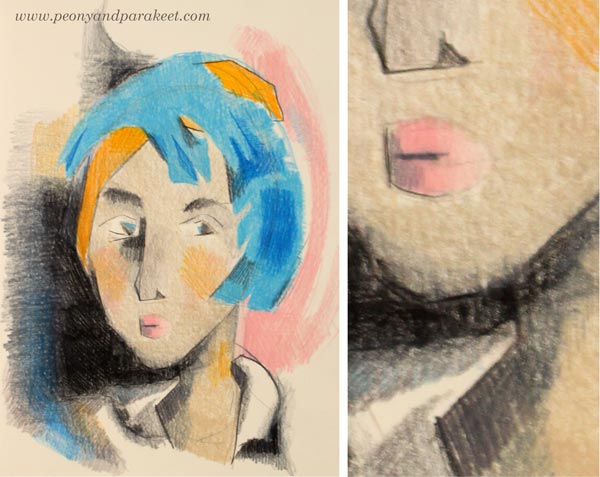
3) Soften the shape of the hair, the clothing, and some of the facial features. Then color the face, neck, and hair. Helene Scherfbeck often used grayish colors for the skin and a more striking color for the hair.
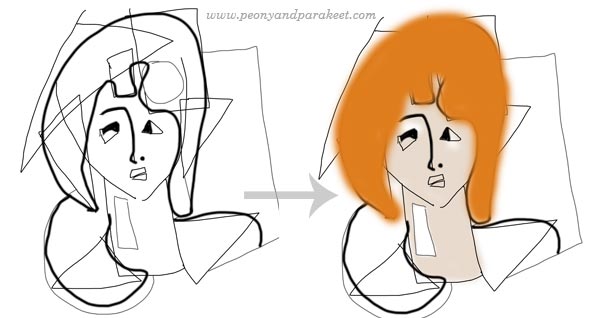
4) Add light and shadows on the face. Use mostly simple geometric elements. Then turn the work upside down and finish the abstract composition by using color to balance the painting. Remember to maintain the asymmetry!
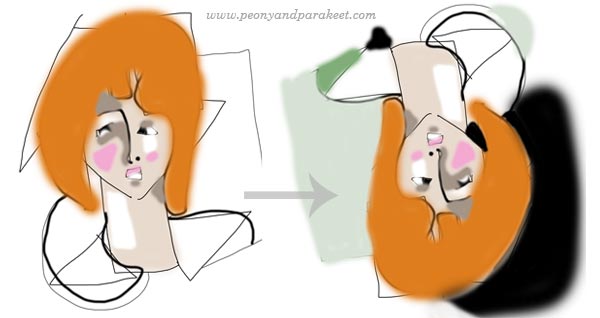
5) Remove some sketch lines and add more finishing details if needed. If you used long lines, make some of them shorter so that your drawing is not so stiff.
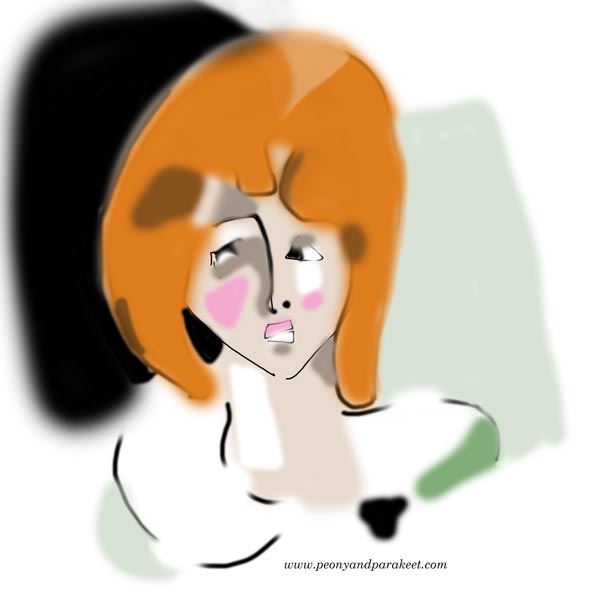
Helene Scherfbeck’s Style – The Combination of Simplicity and Softness
Even if Helene Scherfbeck’s style is very graphic, she also embraced uneven edges and soft color changes. This softness combined with distinct, even clumsy-looking geometric elements is the essence of her style.
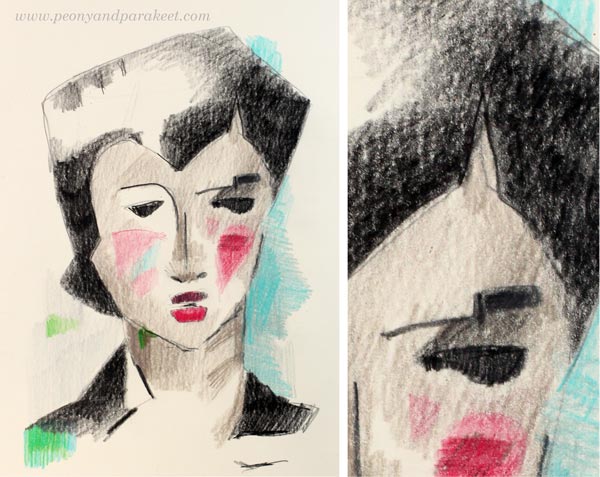
She also uses strong lines and bold colors to draw the viewer’s attention to the selected details. However, she does that very sparingly like there would be a limited storage of lines and pigments.
Find The Passion Behind Your Many Styles
I often find it distracting when people talk about their personal style like it would be the final destination for their artistic journey. They say tat once they have found their style, it would be like coming home and they would never need to go back to explore. I think it can be a harmful mindset. It leads to thinking that artists could be divided into three categories: a) those who search their style, b) those who stick with their style, and c) those who are afraid of going deeper because they don’t want to stop playing. That kind of controversy is not good at all! Going deeper allows, not prohibits, playing! Creative people are meant to travel spiritually!
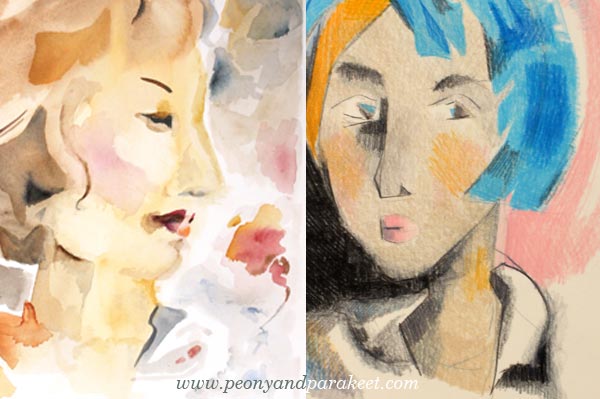
Instead of searching for your perfect style, your final destination, connect with your passion! Your passion can be like a base camp for your explorations, energizing you to take up new challenges.
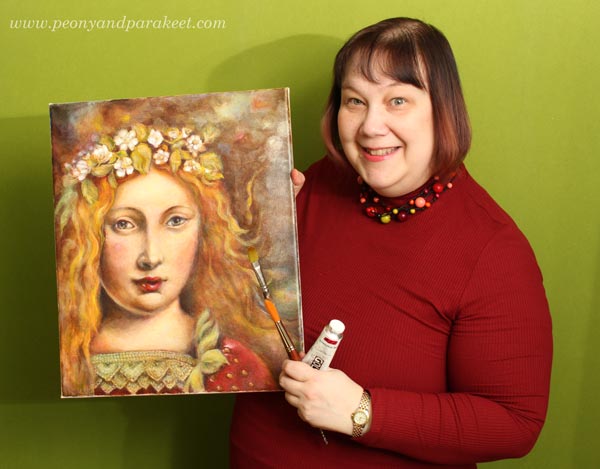
Sign up for The Exploring Artist to discover the passion behind your art
and to become more confident with the big word “artist”!
Want to Find Your Art Style? Need to Focus?

This blog post is dedicated to you who have been creating art for some time, and want to find your art style and a clearer focus. I have a bit different take on these issues than what you would probably expect. I think that forcing your creativity is not the way to go. Instead of making yourself to focus on one idea, I suggest that you learn to integrate your many ideas. And instead of trying to find your perfect art style, start building your artistic identity by doing some soul searching on a deeper level!
Finding Focus and Your Art Style – Watch the video!
I talk about focus and art style while creating the gouache painting. Watch the video below!
Sign up for The Exploring Artist to discover the passion behind your art
and to become more confident with the big word “artist”!
See the full program description for The Exploring Artist and sign up now!
When you sign up before June, you will get an early bird discount!
Technique, Style or Identity – Which Comes First to You?
Technique
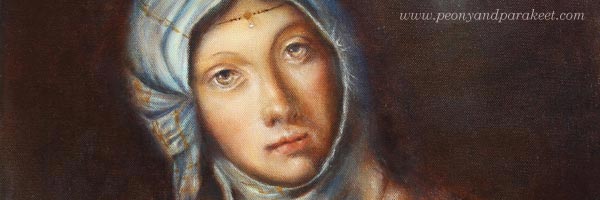
During the recent ten years, I have wanted to learn and experiment with art techniques. It has been fun to combine all kinds of media and see what comes out. And even when using one medium only, techniques have been important to me. Like recently, when I have learned to paint like the old masters. But with techniques, come the rules: first this, then that. It feels safe at first, but then, it can also be too restricting.
Style
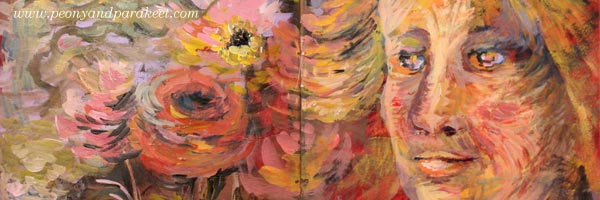
To me, the personal style means something that I am comfortable with doing, and that makes my work recognizable. But for a long time now, I have felt a sense of sadness when people say that they want to find their voice. One of my favorite creative play has been to play with styles. Being very intentional about the style issues can take the play out of the game.
Identity
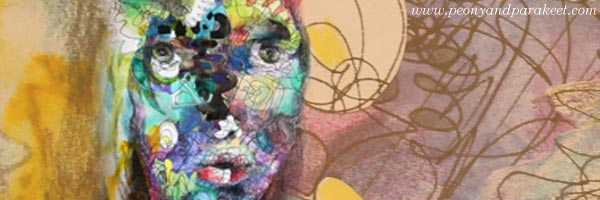
The more I have tried to focus on techniques or style, the more I have thought about the third thing, the artistic identity. I tried to keep all that inside me, but I am not very good at hiding things, so I was about to explode before finally, in the last month, I wrote on Facebook:
“Style or Identity? – Even when working full-time as an artist, I sometimes still have problems in calling myself an artist. I wonder, why there’s so much talk about finding your style and so little about finding your identity as an artist?
It includes me too. I often talk and think about style issues when I should think about identity issues. It’s easier to analyze the line, the theme, the mark making, than talk about things that go deeper.
I mean things like:
1) Why do you make art?
2) How do you define the quality of your art?
3) What’s your role in the art community?
4) What’s different with you from the artists that you admire?
5) When and how do you know that you have succeeded as an artist?Most of these questions are valid whether you are a beginner or more advanced. The answers change when your journey progresses.”
When your order is 1) identity, 2) style, 3) technique
you allow more play,
you take on bigger challenges,
and you connect more with other artists.
Stay tuned for a new challenge-based coaching class to grow your artistic identity!

This post is a sample of my weekly emails. Subscribe here!