
Paul Klee and the Art of Learning
This blog post is a personal story about being a student of Paul Klee. I will also share my thoughts about art classes and about their effect.
Paul Klee’s Pedagogical Sketchbook
It was a late evening at the beginning of July – one of those white nights that take place in the middle of summer in Finland. When the sun is up, it’s more tempting to stay awake than to go to sleep. It also felt better to pick a brush and paint than to slow down with knitting or watching tv. My brain activity was high. I didn’t want just paint, I wanted to learn something new.
While pondering about learning, I remembered a thin book that had been on my shelf for a while. It was borrowed from a library a few weeks ago and I hadn’t opened it since. The title was called “Pedagoginen luonnoskirja” – Pedagogical Sketchbook, written by a famous abstract artist Paul Klee in 1925. The original version was written in German. In 1953, it was translated into English and finally into Finnish in 1997. The long timespan proves that the book has some ever-lasting content. But when I began to examine the first chapters with the brush in my hand, it seemed very uninspiring. The pages were black and white, no color, but the worst thing was: it looked like a math book! It had formulas, diagrams, references to geometry, anatomy, physics … What was I thinking about when I borrowed this book!
Abstract Art Theory for the Left Brain
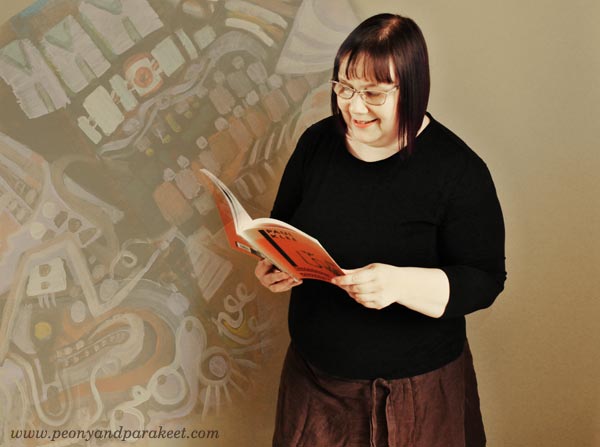
But then, I remembered that my artistic side wasn’t playing along when I found the book at the library. Being so thin, it could hardly be seen on the shelves filled with thick art books. Seeing its cover, my engineering side that got interested: can there be formulas for art? Is this the book that teaches the left brain to understand the right brain?
So even if I had my art journal open on the table and paints ready on the palette, I decided to switch gears and start reading the book – slowly and carefully like engineers do. After a couple of minutes, I was hooked. I was mesmerized by the world the book presented. Phenomenon familiar from my physics studies were tied into modern abstract art. The book was broken into three parts. Each part contained short chapters. like tiny lessons. I decided to begin studying each chapter so that the engineer in me would read it first. Then she would explain it to my artistic side who in turn, would fill an art journal page by playing with the concepts.
Side note: Interested in the book? Here’s a link to Amazon.com. There’s also a free PDF of the book available if you google it but I don’t link it here, as it may be an illegal copy.
Paul Klee’s Ideas in Practise
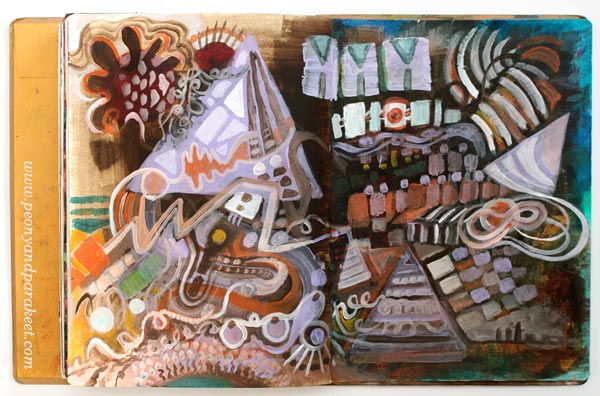
When I eagerly studied the book, I felt I had a teacher, Paul Klee himself. It was exciting to listen to him talking about muscular movement, material structures, disturbed balance, how the perspective is experienced or how the blood circulates in a body. And most of all, how it’s all connected to visual communication and visual art. I imagined being one of his many students and even one of the most enthusiastic ones. I was constantly raising my hand, not only asking questions but also questioning: how did you come up with this idea, why have you omitted this fact?
Do These Ideas Suit My Style?
Even if I was painting and reading like a maniac from one chapter to another, I was also in doubt. Stiff figures that I painted looked very old-fashioned to me. I had a teacher who hadn’t experienced the digital age, who hadn’t seen or created any contemporary art. “Tell me, Paul Klee, do these rules apply to many styles, including mine?”, I kept asking.
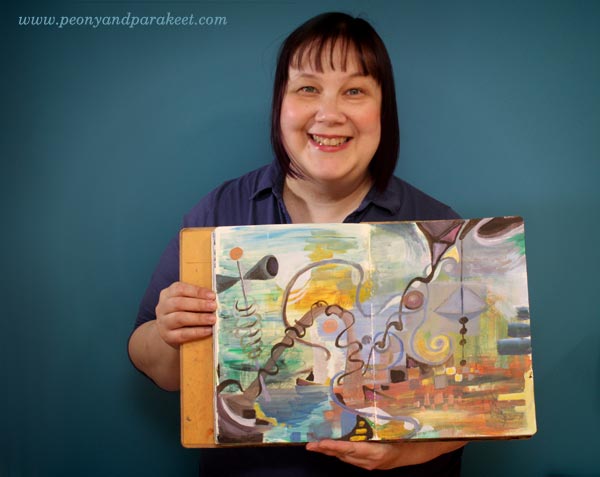
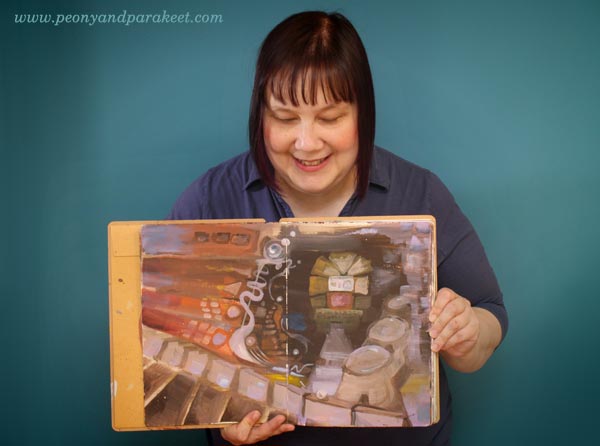
But despite of the constant battle in my mind, I couldn’t put the book away. I went from one chapter to another and eagerly waited what my teacher would present in the next one. And when the last chapter was completed, I felt sad to leave the classroom and say goodbye to my teacher. During the session, I had completed three big art journal spreads. They all looked like the middle of 20th century to me. The session seemed to be nothing else but a fun engagement when the sun finally set down.
The Aftermath of Learning
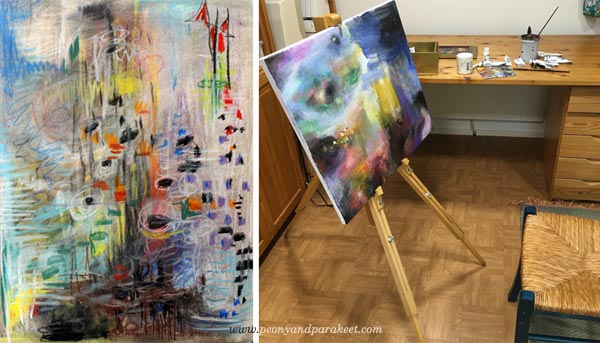
During the next weeks, I saw sudden glimpses of Paul Klee. When I was taking photos, drawing, painting or just observing, Paul Klee’s theories began to merge with my own thinking and with my own style. The three spreads that I had made were exercises only. Once I left the classroom, I was free to apply those theories where suitable. This is what happens in every art class. You might think that the exercises are not fit for you. You might have doubts if the class fits your current style. And when you leave the class you might think: “Oh well, I don’t know if I ever do this again.”
But like the blood needs oxygen, creativity needs new theories, techniques, and ideas. They are no threat to your style, they are essential to continue developing your style. That’s one main reason why I challenge you to learn new techniques at Imagine Monthly (you can still sign up!). That’s also a reason why I will be inviting you to join my newest online painting workshop, starting in October.
Coming Up: New Painting Workshop
I am really excited about this! Be assured that I will have something special for the beginners and a lot of new to focus on for the more advanced painters. The theme for the class is expressing nature. The registration for the new workshop will open next week with a short-time early bird pricing. I will give more details about the class then.
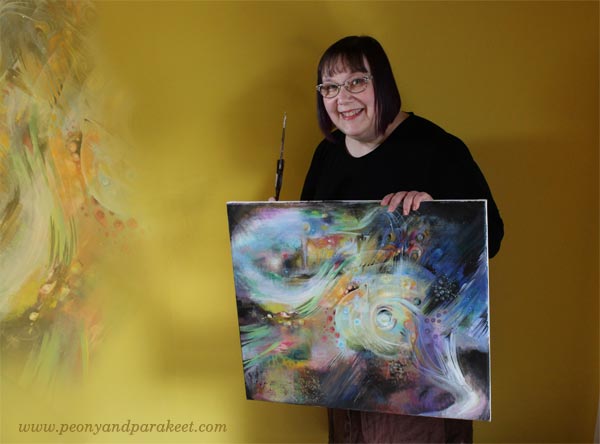
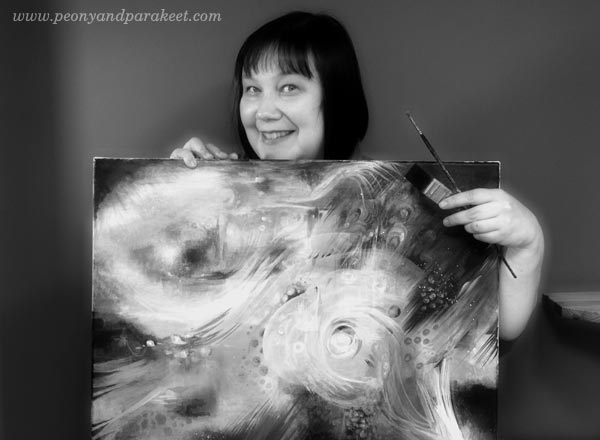
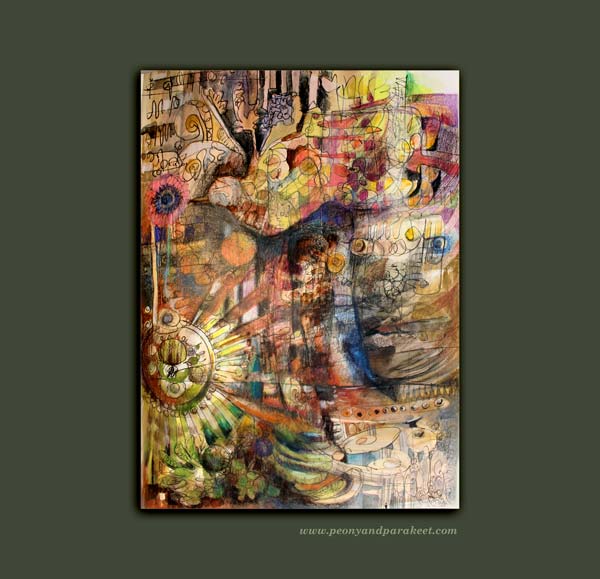
While building the class I have practiced the techniques and ideas on a big canvas. This painting is still in progress, but I want to show it to you just to be able to compare the art journal pages above and how Paul Klee’s teachings have merged into my own style. That’s what’s my goal with you too: that you’ll have a fun time with the classes and that you will be able to mix new things with what you already know and love.
Update 4 years later: I have a new class based on Paul Klee’s and Wassily Kandinsky’s teachings – Floral Freedom! >> Buy now!
8 Style Tips from the Students of Peony and Parakeet
This spring, I have seen gorgeous pieces of art made from the mini-course Flowing Greenery. Like in the previous blog post, I want to share some of them with you.
Various Styles with Style Tips
This time I show pieces that are very different in style. I also include style tips and analysis. This kind of comparison can be positive and beneficial. By creating similar work and then comparing it with other artists’ pieces can make you understand more about your own signature style.
1) Warm and Dominant
The first piece is by Terttu Laitinen. Her way to use visually heavy elements feels like a weighted, warm blanket that you want to snuggle into! This piece makes you stop and calm down and still feel inspired! It’s so loaded with energy that the fruits could drop down at any moment.

2) Detailed and Holistic
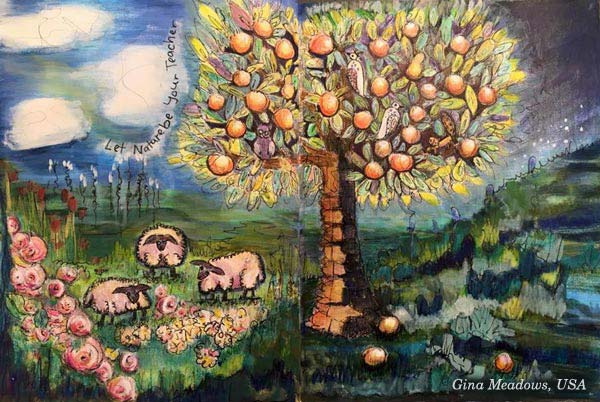
Gina Meadows takes a step away and makes you think about your life as a whole. It feels like every element in her work has a designated mission, connected to the cycle of living. Her strokes are clearly defined, but living and expanding as she uses very few straight lines.
3) Playful and Social
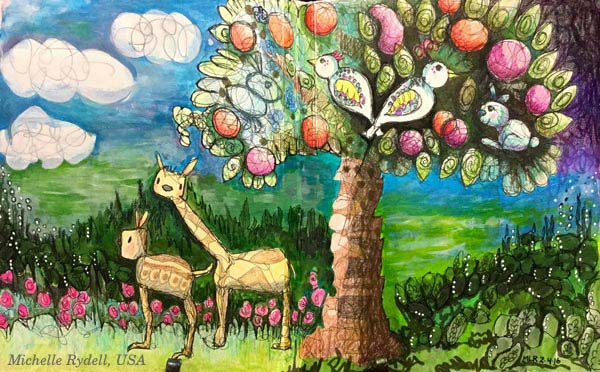
Michelle Rydell combines round strokes with angular ones very playfully. It looks like every little leaf and cloud has a personality of its’ own. She is also a master of combining imagination with visual clarity. A clear focus looks always appealing.
4) Intimate and Symbolic
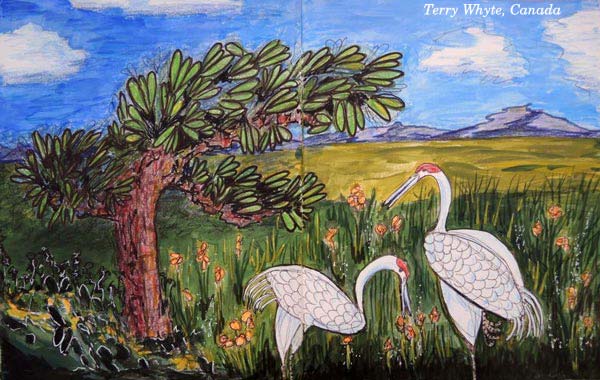
Terry Whyte‘s work is more intimate. It’s like the tree protects the like-minded couple. A lot of care and thought has been put into shapes of each element to make them look both aesthetic and meaningful.
5) Primitive and Mysterious
Ulla M. Holm combined William Morris with Henri Rousseau. Her own unique style goes perfectly with Henri Rousseau’s naive masterpieces. This is an insight that’s worth pondering: how could you combine your favorite artists so that they enrich your own unique style?

6) Decorative and Sophisticated
Patricia Bush has an eye for details. But she also knows how to make them differ in size and color so that the result doesn’t overwhelm you. You might stare the gorgeous pegasus first, but take a look at the trunk of the tree too. It’s wonderfully ornamental and has a very wooden feel. Sophistication in every detail, including the castle and the moon, is her magic!

7) Relaxed and Emotional
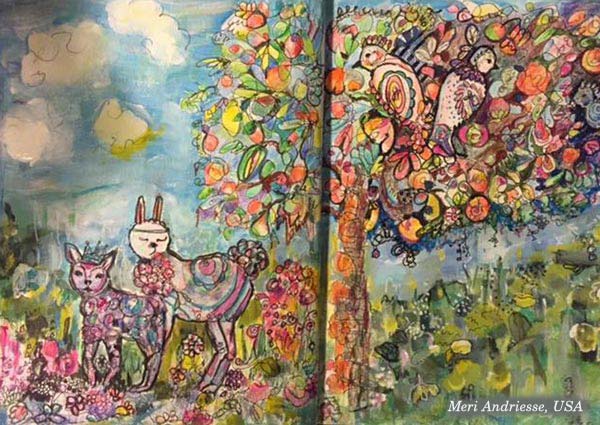
Meri Andriesse’s style goes to other direction. Her relaxed piece is more than all the careless elements together. Her strength is to create an atmosphere that any creative aspires to have. It’s loose and sunny, just perfect to get inspired and go creating!
8) Connecting and Thoughtful
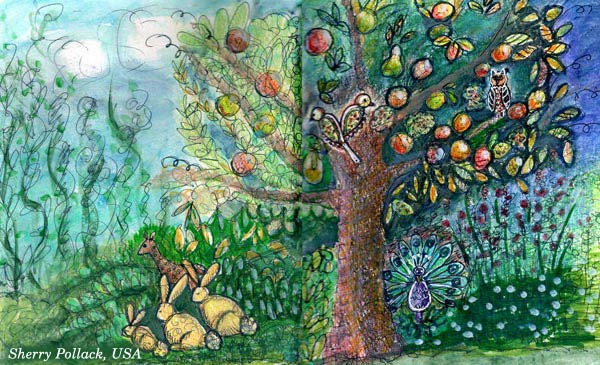
Sherry Pollack has whimsical style with lively lines but it’s also extremely thoughtful. It’s like every little creature has its’ own thoughts even if the creatures share the same experience. This makes it so easy to imagine being among them. It feels like I could listen to the same sounds, observe the same things and join the conversation that is more spiritual than outspoken.
Flowing Greenery
When using the same mixed media techniques, how would your scene look like? This mini-course, Flowing Greenery, was published at “Imagine Monthly Spring 2016” art journaling class. It’s now available individually as a self-study class – Buy here!
You can also buy all the 6 monthly classes as a bundle. I will also release the classes individually one by one later this summer, and show more ideas on how to apply them.
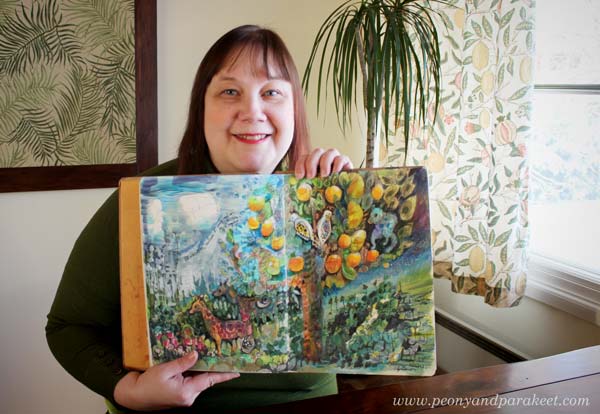
Create your own fruit trees and whimsical animals, right now!
Look Back to See Your Artistic Style!

We often search for something new: new art techniques, new ideas, new approaches. When I pulled out a worn-out cardboard box filled with my old drawings and paintings, they all felt very familiar at first. I saw only the obvious: a skill level, a theme or technique. But when I stopped looking at the pieces individually and started grouping them, new insights occurred.
1) Look for Repeating Elements and Themes
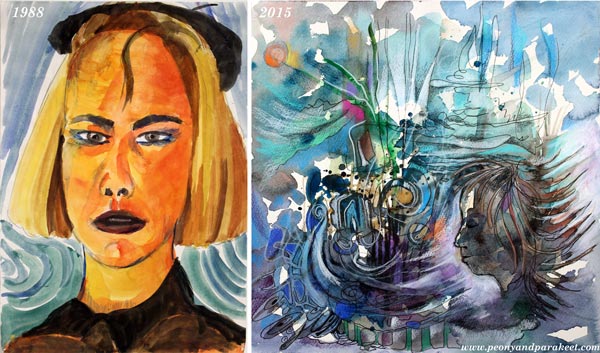
In 1988, when I was 19 years old, I made a watercolor painting called “Self-Portrait as an Artist.” Soon after that, I went to study computer engineering, and art didn’t seem so important anymore. But now, when working full-time in art, I love to compare these two paintings. There are 27 years between them, but they still relate to each other. It is interesting to see how my understanding of being an artist has changed. The importance of ideas, visions, and expression has grown, and the ego and stereotyped appearance have shrunk. I see similarities too: color choices, dynamic lines and dramatic atmosphere, foundational elements of my artistic style.
If you are hoping to find a new style, it is easy to miss that most of the elements are already there, just a little bit of fine-tuning is needed!
2) Combine Past Ideas
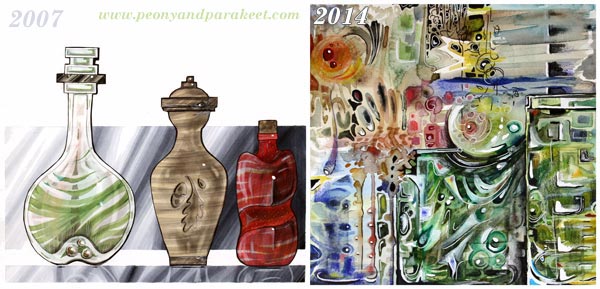
In 2007 I began studying industrial design. One of the courses taught us to draw various materials like glass, wood and plastic. After seven years I realized that I could use that kind of imitations for more expressive art too. I could play with the proportions and compositions. I also understood that I could use the things learned in the past, more widely and more freely. Instead of having only some ideas and simplifying those, I can have hundreds of ideas and combine most of them!
If you don’t know what to create next, combine what you have done before to a single artwork!
3) Embrace Your Roots

In 1985 I made this watercolor painting and remembered my family liking it. For me, it was important that this image came out of my imagination, it wasn’t made by following a photo or anything. It was born surprisingly easily, and I felt a bit puzzled: “So quick, and everybody likes it!”

In 2014 I worked with a similar theme and again, with watercolors. This painting contained more emotion than the old one. This painting was about leaving back a certain phase in life and entering a new one. However, when I look at both of them now, I think about my country, Finland, and its nature. This country is a land of forests and lakes and for Finnish, it is natural to use them as symbols in self-expression too. I can’t escape my roots and the older I become; I don’t even want to.
When you look back at your work, what kind of themes and changes do you see? Could you create collections showing art that tells your personal stories and your journey to your current artistic style? See also the post about stretching your artistic style!
Subscribe to my weekly emails – Get a free mini-course!
Inspirational Adjectives for Your Art
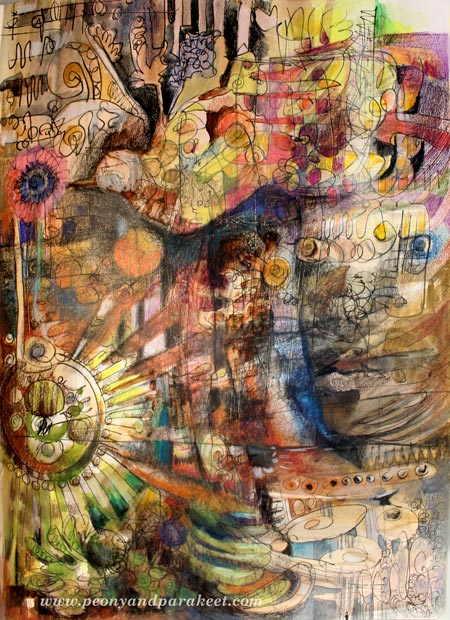
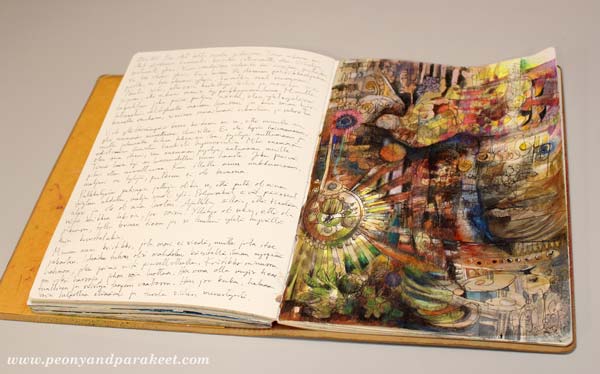
This art journal page is called “Introvert.” I made it while thinking about how much I enjoy spending time alone. My love for sharing and interacting are not the only things that make me; I am also an introvert who needs time to ponder and visualize what’s going on in my inner world. I find it often difficult to express myself in writing, so I like to create an image first and then write down the thoughts. Usually, my thoughts have moved forward and become clearer after processing them visually.
My Inspirational Adjectives
When I begin creating and while I am creating, I often get inspired by single adjectives. The same words continue to fascinate me, at least for a while, before I have found new ones. These words challenge me to both start and finish the artwork.
These are my current adjectives: “imaginative”, “forward-thinking”, “avant-garde”, “visionary”, “historical”, “futuristic”. I am especially fascinated by the words that are somewhat opposites like “historical-futuristic” or which describe a new kind of idea like “forward-thinking – imaginative”. While creating the page, I introduced the word “introvert” and got inspired by the word pair “visionary – introvert”. Brown watercolor felt just the right choice to express those words!

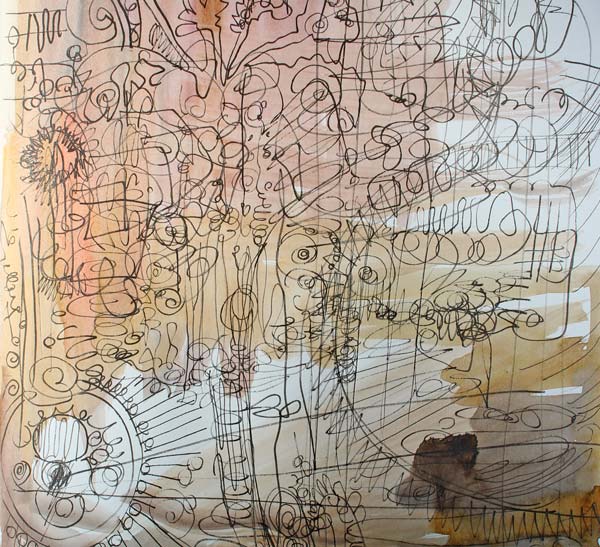
I continued with the black pen, not worrying about what to draw. Namely, it’s difficult to express “visionary” without first having something to look at!
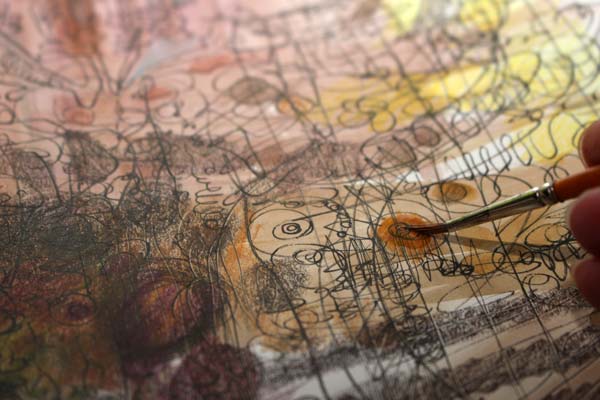
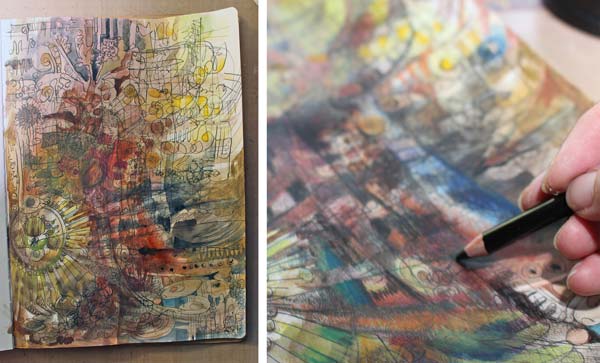
It was a warm summer day, so I took my colored pencils outside and started coloring carelessly.

After a while, I added some watercolors with a thinner brush.
How to Choose Your Words?
Some people think that art is a set thing. But pre-named styles and standards don’t define it adequately. On a general level, yes. But when creating art, your uniqueness should be your standard. Thus your adjectives should be set so that you respond to them emotionally. They should make you feel not only excited but also a little bit scared. For example instead of “caring” you might choose “sensitive” or “connected”. Think about your personality and what you value. Don’t take the first words that come to your mind. Seek for specific words that define the adjectives more accurately.
Express Your Adjectives!
Start seeing and enhancing your words, your personality, and your values in what you create. Whatever your piece looks like when you are in the middle of the creative process, think about those adjectives and find ways to express them.
“Introvert” instantly brought black color to my mind. “Visionary” made me look for circles like eyes. As there’s something mystique in the combination of those adjectives, I set a quite dark and little bit dramatic color scheme.
When you focus on things that excite and scare you, your art becomes more meaningful. It can bring new kinds of thoughts and ideas not only for you but also for others. Everybody doesn’t need to know your adjectives. Art can often be interpreted in many ways. But your creativity is most powerful when it’s focused, and few inspirational words can bring that focus!
Subscribe to my weekly emails – Get a free mini-course!