
How Inktober Helped Me To Cure a Creative Block
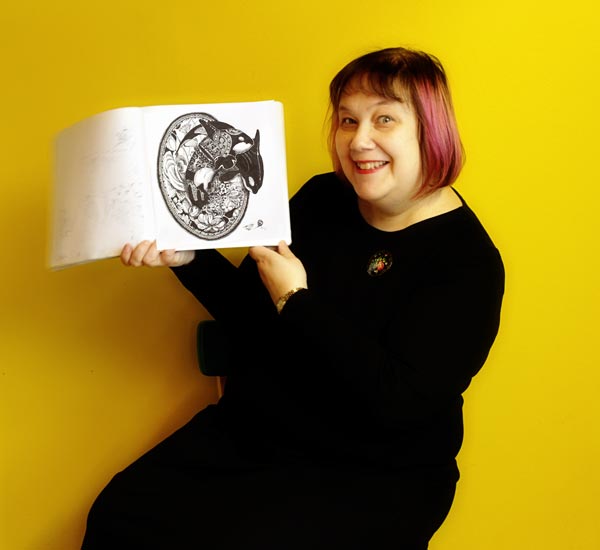
This month, I am participating in a daily drawing challenge called Inktober. My goal was to make 10 ink drawings based on the first ten official prompts. I have passed the goal, and now I am trying to make as many as I can. As an experience, this challenge has had a ground-breaking effect on me. With Inktober prompts, I have discovered a creative block and cured it!
Supplies
For the first five drawings, I used black pens and inks from the stash. My illustrations have been quite detailed, so they take a lot of ink. I have made some purchases and will need more pens if I keep going. Here’s what I have currently in use!

I make the drawings on Nuuna Square Bang Sketchbook. It is 9,5 x 9,5 inches, which is a good size for daily work. The basic pens are Copic Multiliners. The tip sizes that I now have are 0.1, 0.3, and 1.0. I am planning to purchase 0.05 too because I like to draw small elements! I also have a Pentel brush pen for larger areas. I love this pen. It is refillable and comes with extra ink tanks. The brush is wonderfully soft and precise and the ink flows effortlessly.
My Expectations – Stretching to a More Masculine Zone
I started the challenge with an open mind. Building Watercolor Journey was a huge workload. I wanted to make a comprehensive class, and it took a lot of my time during the summer. Now when I got the self-study version available, I wanted to reward myself by taking part in the challenge. My idea was to draw what I love, the only limitations being that I had to use black ink and follow the prompts.
Because Inktober is mostly for fantasy artists, the themes are very different than what I would choose. Many of the prompts are about the darker side of life, but I thought that little stretching would do me good. The biggest fear that I had was that the people who follow me on social media would totally ban me. I knew that because of the prompts and the black ink, my work would look more masculine than before. But I didn’t expect anything ground-breaking to happen regarding my style or visual voice. But something did happen, quite unexpectedly.
Discovering a Creative Block
When I picked a pen and started drawing the first image, I heard myself saying: “Paivi, be careful.” The tone was gentle but the voice was definitely of my inner critic. And as soon as I wondered what I should be careful about, an old drawing came to my mind. It was a black ink drawing as well, an exercise for the first class that I took in industrial design. We had to make a series of images showing the product, and mine was a hilarious collection of detailed drawings showing all the enthusiasm I had for industrial design back then. I don’t remember the exact words that my teacher used but I got the message that it was all wrong, a bit pathetic even. I should be more systematic and not so decorative.
It was a critique that was beneficial for an industrial designer but totally irrelevant and wrong for a person who is more of an artist and illustrator. But back then, I was not able to see that the direction that I was heading was different so I took it deep into my heart. I also remember some other situations during my studies when I was accused of being too decorative. That was good for me back then, opening my eyes for expressing the form instead of the surface only. But now when working in the field of art, the situation is different.
So when I heard the whisper to be careful, it meant that I should not be too decorative when drawing industrially manufactured items like syringes that I intended to include in the first drawing. Becoming aware of this block has turned a new page in my artistic path.
Inktober #1 – Poisonous
Maybe sometimes we think that something is poisonous when it’s not?

While drawing the first entry for the challenge, I allowed myself to be as decorative and detailed as possible. I accepted the union of industrial objects and more abstract elements and went with the flow. Here’s to those past student years!
Inktober #2 – Tranquil
To me, tranquility and yarn go hand in hand. In the evenings I like to knit, cross-stitch, or quilt to calm myself down. So it’s like the threads and yarn tie little moments happened during the day together. The day that felt chaotic in the afternoon becomes tranquil and meaningful before I go to sleep.
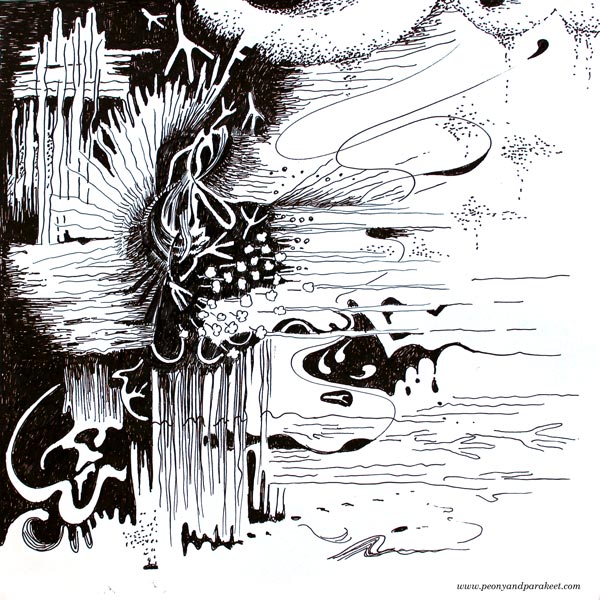
The second insight came with the second prompt. I haven’t even considered myself a surreal artist, but the drawing came out so naturally that it started to make sense.
Inktober #3 – Roasted
After starting to work from home, I have been forced to get deeper into the world of cooking. I have made some disastrous meals because I don’t like to follow recipes and don’t have much experience either. But now, after four years, I have found a way that works quite often. I buy good ingredients. I study several recipes and then figure out what my version could be. I use a timer a lot, just because I am often in my thoughts and don’t realize how minutes fly. I like roasted vegetables, especially roasted carrots, so this is for them!
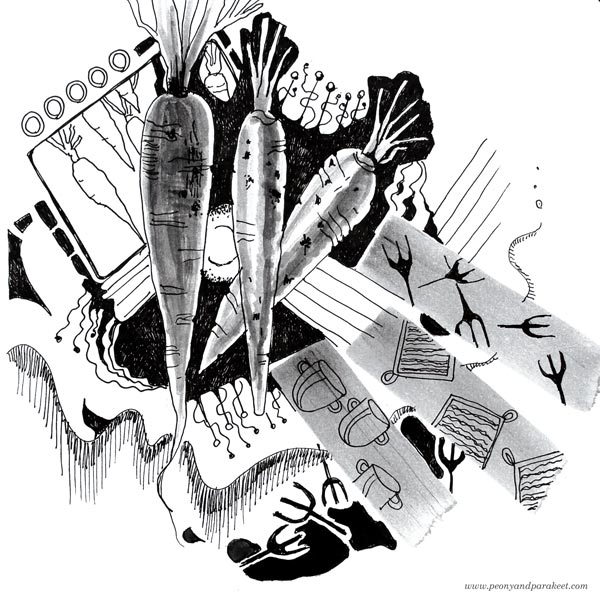
With the third prompt, I wanted to try if I could make something out of less romantic subjects that I would normally choose. Here, I found drawing the oven most inspiring which was an interesting observation. Is the industrial designer raising her head?
Inktober #4 – Spell
I connect the spell with the atmosphere of the inner world. It could be like a cloud hanging over the scenery, sending sounds and lighting candles. I haven’t been a big fan of fantasy novels or such, but when I am creating, the fantasy can easily take over!

The prompt was a weird one for me, but the result is the old average. It didn’t feel so comfortable anymore. Something was lacking there.
Inktober #5 – Chicken
Something big is happening and the change feels scary.
– “I can’t do it! I have to protect what I already have.”
And then the whole universe shouts “Chicken!”
You can’t stop the change. You need to follow the eggs.

The fifth drawing started as a funny one, but at the end, it felt like it was speaking about me. Consciously, I didn’t have any idea what had changed but it felt that I can’t keep on creating like before.
Inktober #6 – Drooling
When your mind is drooling for beauty so that you feel you are eating all the forbidden fruits.
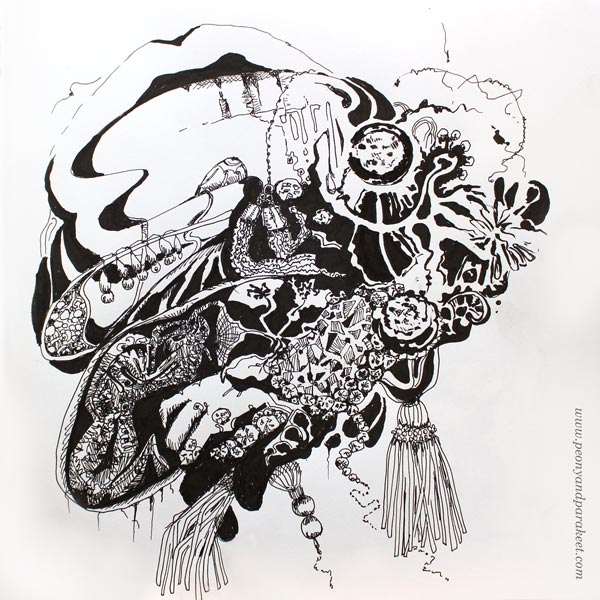
In this drawing, it became visible and clear to me that my creative block had forbidden me to draw decorative items that I adore. I love high fashion, jewelry, elegant fabrics, tassels, pearls, fur, you name it. I don’t grave them so that I would like to wear or own them but my world of fantasy never has a lack of this luxury. I have always thought this is a superficial characteristic in me, but this attitude feels too restricting now when I am more conscious of it.
Inktober #7 – Exhausted
Here’s how I define the exhaustion of the 21st century: You have done too much, and it feels like you have done nothing yet. You have too much stuff to sort out, and it feels like you haven’t got all you need. You are at the bottom of the big pile, and the clock is ticking: “Don’t forget! You are late!”

When drawing like this, I feel the satisfaction that I have never had before. It’s not that this way of expression would be technically more brilliant than my best work so far or superior to what everybody else does. It’s just that it’s like looking myself in the mirror, seeing all the goods and bads, and accepting what’s there. Isn’t it so that no matter how much you admire other artists if you imagine their work to be yours, it feels empty or defective in some ways? At least to me, there are hundreds of artists that I admire passionately and would happily hang their paintings on my walls, but if I were the one creating them, my fingers would itch to change something.
Inktober #8 – Star
Even if I work from home and live an extremely boring life (if you look at it from outside that is), I am a nomad, we all are. We get it when Harley-Davidson advertises motorcycles with the slogan: “Everything you need, nothing you don’t.” It’s about The Freedom – a full-designed package of service including a couple of woven carpets, one string of prayer flags, five long minutes of photographing bokeh and flares on the mountains, a ride downhill feeling a warm wind and hearing the sound of the beautifully polished engine. Some change the motorcycle to a horse or even to a Corvette, but it’s all the same, here’s to The Freedom!
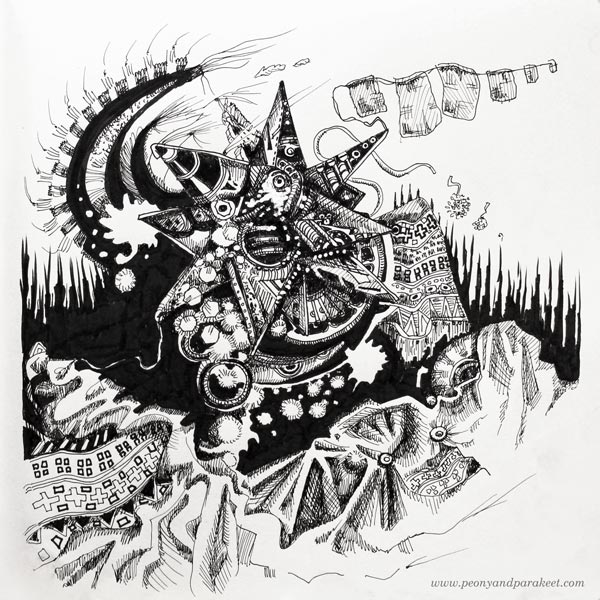
During the challenge, I have not only found new ways to draw, but I have also discovered that I am bursting with stories! Most of the stories are connected with items that have a symbolic meaning to me.
Inktober #9 – Precious
We get excited about a new thing. The next thought is that we need the products. All the products. Happened to me so many times! But hey, let’s not get lost in the products. Discovering yourself is more precious than any product.
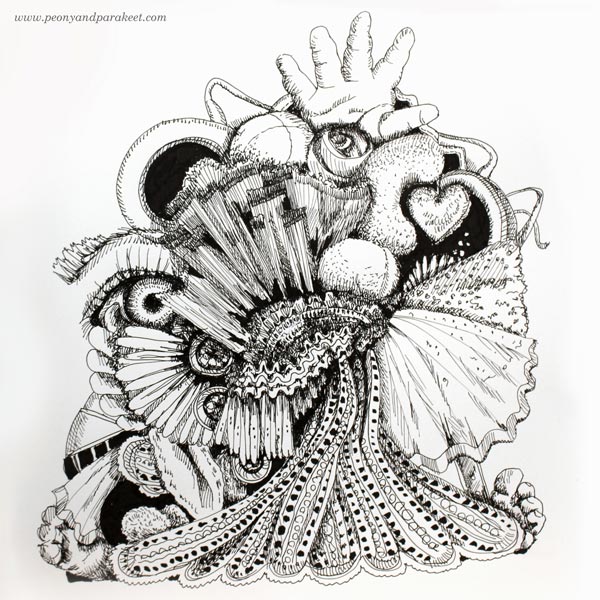
What if the challenge wouldn’t have the restriction of supplies, and what if it wouldn’t be specifically for inks, related to my creative block? It’s possible that nothing would have changed. Seeing the stream of simple drawings and how they change one after another, has brought such clarity that I wonder how many times the creative blocks hide under products. When I have bought a new set of this or that, have I subconsciously avoided the block?
Inktober #10 – Flowing
In the Renaissance, the strong currency called Florin enabled the birth of financial professionals like bankers. Today, their working environment looks very different, and the change may feel vast, but that’s only if we keep our perspective narrow.
The facts:
Renaissance was about 500 years ago.
The age of the earth: 4,5 billion years.
The age of our universe: 13.8 billion years.
Here’s to honor all who work in finance but also to remind how money is just a tiny island in the flowing ocean of time.
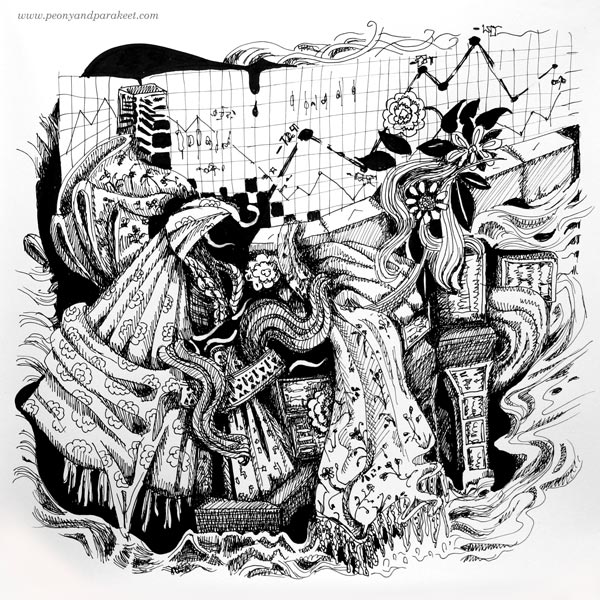
As a former engineer, I believe in the power of knowledge. But it’s new that I want to express that in my art too!
Inktober #11 – Cruel
Life can be cruel. It throws more and more for those who already have plenty while those who have nothing can’t get anything.
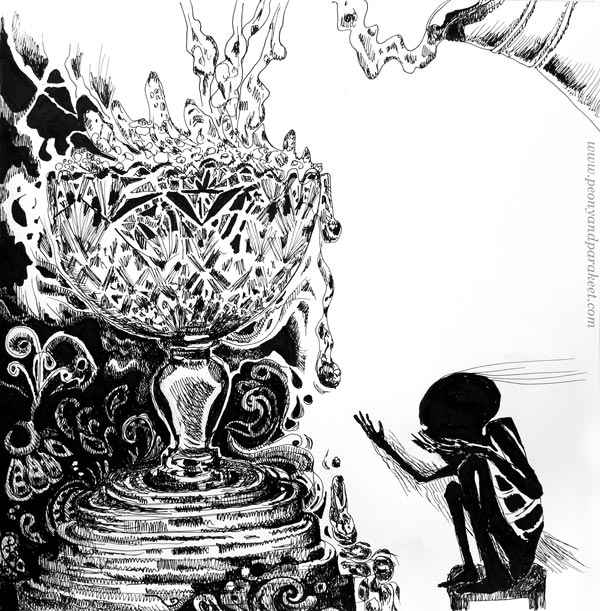
This prompt was not an easy one. I felt sadness and shame. But once I got the idea, I had to draw it out.
Inktober #12 – Whale
Love makes us brave. No matter how timid we are, we can do anything for those who we love.

During Inktober, I have found a way to connect the things that I love from storytelling to decorative designs and illustrational art. So far, it has brought a new sense of happiness in my artistic path. It’s also a scary feeling – what will happen next, what will I do with all these? Time will tell!
You can follow my entries daily (as long as I can keep up) on Facebook or on Instagram.
Technique, Style or Identity? Which comes first to you?
I re-wrote an old blog post because this is the subject that’s close to my heart!
Technique
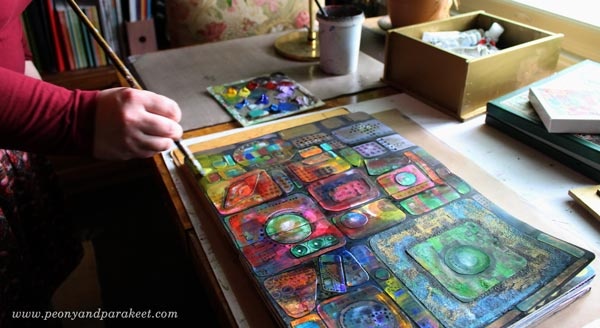
During the past ten years, I have wanted to learn and experiment with art techniques. It has been fun to combine all kinds of supplies and see what comes out. It has often felt that after I have learned the technique, I can then do whatever I want with it. But many times, adding a new technique to my repertoire has just grown more doubts about my style.
Style
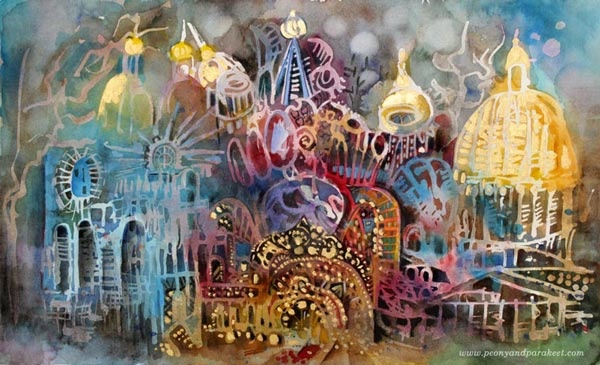
Style means something that you are comfortable with doing, and that makes your work recognizable. When I have been unsuccessful in finding my visual style, I have had too much focus on the result and too little on the play. Techniques may change, but discovering the how you can process inspiration and what inspires you, and then connecting all that with shapes and colors and compositions, produces style.
Identity
Even when working full-time as an artist, I sometimes still have problems in calling myself an artist. I wonder, why there’s so much talk about finding your style and so little about finding your identity as an artist? It includes me too. I often talk and think about style issues when I should think about identity issues. It’s easier to analyze the line, the theme, the mark making, than talk about things that go deeper.
Things like:
1) Why do you make art?
2) How do you define the quality of your art?
3) What’s your role in the art community?
4) What’s different with you from the artists that you admire?
5) When and how do you know that you have succeeded as an artist?
Most of these questions are valid whether you are a beginner or more advanced. The answers change when your journey progresses.
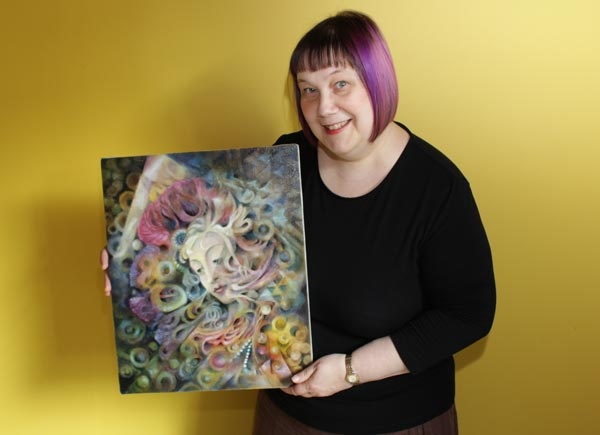
When your order is 1) identity, 2) style, 3) technique
your art becomes more expressive because you allow more play,
you take on new challenges because your art has a purpose,
and you connect more with people because you have a natural urge to share.
The Exploring Artist – Few Spots Left!
In The Exploring Artist, you will grow your artistic identity in a small and tight-knit group. I will personally help you to put your passion into words and visual insights. We will work together to discover what you want to change in your art, where you want to move forward and how to do it. The registration closes on Sunday, Sept 9 (midnight PDT).
>> Sign up now!
Take Your Art to a Passionate Level
What Does “Passionate” Mean to You?
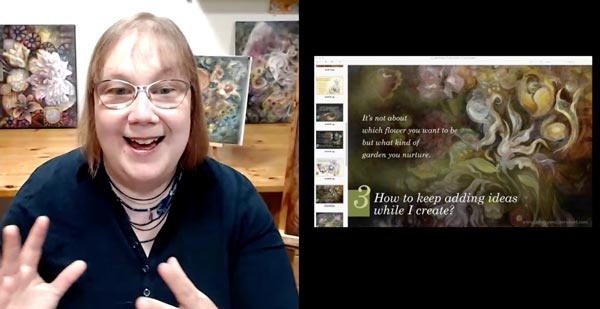
This week, I had a free live webinar of how to conquer the excuses and become more passionate about art. I asked what does “passionate” mean to you and then divided it into four categories. After that, I re-phrased five excuses so that you see them from a new perspective. It may sound theoretical, but you also get ideas of how to apply these things in practice as well. I hope you will enjoy watching the recording below!
Take Your Art to a Passionate Level – The Recording of the Webinar
The Exploring Artist Begins on Sept 10 – Sign Up Now!
The Exploring Artist is a 12-week group coaching program for artists, between Sept 10 – Nov 30, 2018. This coaching is for you who wants to get clear about your artistic passion and become more open about your art, for example, share your art in social media, blog about art, sell your originals and prints, teach classes, etc.
In The Exploring Artist, you will get coaching as a part of a small and tight-knit group. I will personally help you to put your passion into words and visual insights. We will work together to discover what you want to change in your art, where you want to move forward and how to do it.
The maximum number of the participants is 12,
and the early-bird sale ends on August 19 (midnight PST), so sign up now!
Discover Your Style by Building Your Visual Dreamland!
This week, I talk about how you can change your mindset so that you really feel like you are heading towards the style that fits you. I show examples of my work and share how I have built my visual dreamland. I also tell more about the new class Collageland. Watch the replay of Thursday’s live broadcast!
Visual Dreamland – Watch the Recording!
Collageland is a class for you who loves decorative textiles but wants to save time and effort by creating with pens and paper. Rather than trying to succeed and capture your style through a single project, start exploring your creativity as a process, designing your visual dreamland one stroke at a time! >> Buy Collageland!
Coming Up!
Next week, there will be a written blog post! If you haven’t yet, subscribe to my weekly emails so that you won’t miss the blog posts and there’s also a bonus – a free mini-course Loosen up!
Subscribe to my weekly emails – Get a free mini-course!