Peony and Parakeet

Fly to Your Inner World and Color the Emotion

Mixed Media

Self-Expression with Gelli Plate

Humanity - a monoprint by Peony and Parakeet. See my tips for using Gelli plate as a tool for self-expression!

Printing with a Gelli plate was one of the things that popped up from the reader’s survey. As I happen to love mono printing techniques, it was quickly selected for the theme of the week!

Glass Plate

Almost 30 years ago, long before Gelli plates, I used glass plates for mono printing. I usually made a sketch first and then added each color as a separate layer.

Sisters by Peony and Parakeet. Printed with a glass plate. See my tips for creating monoprints!

This monoprint was made in 1988, and it represents my sisters.

Gelli Plate

Gelli plate is a great invention, and it’s available in various sizes and shapes. My plate is 8 x 10 inches in size. Acquiring one is not a necessity. Glass plates work fine even today. You can also use any plastic transparent like overhead projector transparencies. The advantage of Gelli plate is that it has a flexible and sticky surface. That makes the using of masks easier. So if you fall in love with mono-printing, I would recommend purchasing the Gelli plate.

See 6 tips for using Gelli plate as a tool for self-expression!

In addition to the plate, I have Golden Open acrylic paints. These paints have extended drying time, so they are especially suitable for mono-printing. I only have six colors, but by mixing them, I can get a huge variety of colors.

To create monoprints that include self-expression, I have 6 tips for you.

Tip 1: Use brushes instead of a brayer

The most common tool with the Gelli plate is a brayer. I have a Speedball brayer, but I often use brushes instead. They make the prints much more artistic, unique and expressive. With brushes, you can easily create non-repeating details and large color areas – the elements that contain more communication than monotone repeats.

Tip 2: Use a variety of tools

See 6 tips for using Gelli plate as a tool for self-expression!

Your artwork is much more interesting if you use a variety of tools. For this post, I have used two different brushes, a double-ended embossing needle for doodling and a long palette knife for wider strokes. Your imagination is the only limitation when tools are considered. Just remember to avoid sharp objects!

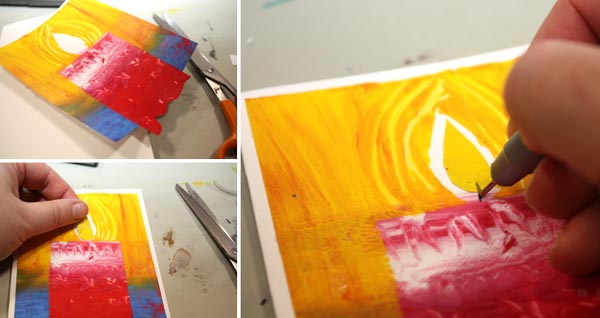
Tip 3: Use hand-cut shapes for masks

When combining a variety of colors and surface patterns with hand cut shapes, the result is much more organic than using one color and cutter-cut shapes. The temptation to create a repeated design is bigger than when using freely cut unique shapes.

Here are some patterned papers that I printed from machine-cut shapes.

I made these with Gelli Arts Gel Printing Plate, and this might work as a fabric design too.

But with freely cut shapes, I avoided repeating the same motif.

See 6 tips for using Gelli plate as a tool for self-expression!

Tip 4: Let each layer bring something new to the artwork

See 6 tips for using Gelli plate as a tool for self-expression!

When creating a new layer, I do not mix and match colors too much. Sometimes colors look even more amazing on a plate than on a print, so I had to take a close-up from the plate!

See 6 tips for using Gelli plate as a tool for self-expression!

I also think that cutting new shapes for each layer can really pay off. Add new and different with each layer, still letting the lower layers show too!

Tip 5: Create at least two monoprints at the same go

If you use slowly drying acrylics, you can get at least two monoprints from the same layer of paint. You can also experiment with that by creating two different artworks by changing the printing direction. I have turned the last layer upside down in the second monoprint. Thus the two prints differ slightly.

Monoprints by Peony and Parakeet. See 6 tips for using Gelli plate as a tool for self-expression!

Tip 6: Doodle and color over

A monoprint before and after decoration by Peony and Parakeet. See 6 tips for using Gelli plate as a tool for self-expression!

I doodled over the other of the two monoprints created for this post. Besides a white gel pen and a black thin tip marker, I also used colored pencils to fine-tune the colored areas slightly.

Here’s the bigger picture of the decorated print:

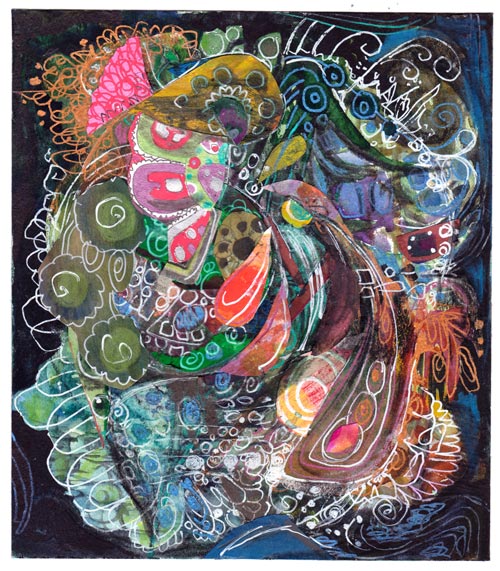
Technology - a monoprint by Peony and Parakeet. See 6 tips for using Gelli plate as a tool for self-expression!

Finished Prints

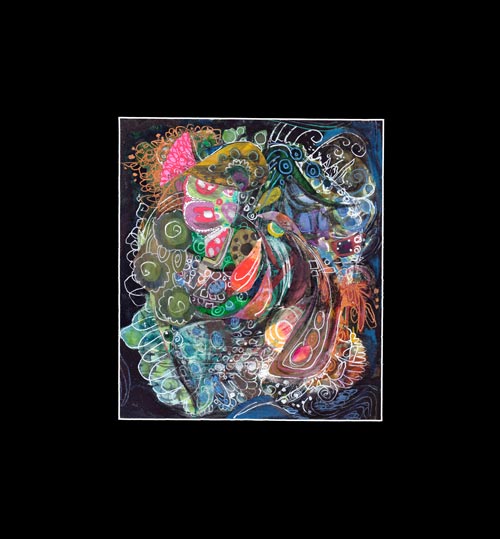
Humanity and Technology - monoprints by Peony and Parakeet. See 6 tips for using Gelli plate as a tool for self-expression!

Here are the two finished pieces. Which one do you like more, the one that is not decorated or the one that is?

My husband asked after seeing these: What are you thinking while making these? – I try to think of nothing while creating, I said. I believe that you have to think before you create, not while you create. However, after a vivid discussion, I named these: the one on the left is Humanity, and the one on the right is Technology.

Gelli Printing Project in a Video – Apples and Tomatoes!

In this video, I talk about how and why to add diversity to your art. At the same time, I am creating a monoprint with a Gelli plate showing easy techniques to create an image.

All Gelli Posts

>> More Gelli printing ideas

Let me be your mentor in art: Subscribe to my weekly emails!

Video Blog Post: Free Doodling

Here it is – my first video blog post! Here you can see how I create a small artwork by doodling freely with colored pencils and markers. It took about 30 minutes to create the drawing. You will see every single phase, but a part of it is fast forwarded.

This was terribly exciting, so please excuse my slow talking and grammar mistakes!

Start Art Journaling!

An art journal page by Peony and Parakeet. Read instructions to create this kind of page with only few basic supplies!With this post, I want to introduce more people to art journaling. I will create this art journal page step by step using a simple concept and few basic supplies. You only need watercolors, colored pencils, and a thin black marker pen.

I have created this page on a Moleskine notebook (size: 5 x 8 1/4 inches, 13 x 21 cm). Your journal can be larger or smaller. This page is created on the actual page of a journal. But you can also use a separate paper and attach it later, so you do not even need a journal to get started!

Journals

You can make an art journal from almost any notebook or old book. You can also bind one yourself. If you paint on the pages, thick pages are better than thin ones. For watercolors, absorbent paper is better than waxy one. But if you use water sparingly, even pages with a waxy surface can handle some watercolor.

Art journals by Peony and Parakeet. An art journal page by Poeny and Parakeet. Read instructions to create an art journal page with only few basic supplies!

I am currently working on three various sized journals. In addition to the Moleskine notebook, I have a black Smash book and a Dylusions journal. The paper in Moleskine notebooks is less absorbent than in the other two, but it still works with watercolors.

General Inspiration

An art journal can consist of any visual material. You can create a collage of cut-out images or printed photos. Or you can paint or draw, or do it all! The pages often have some writing too. You can cut words from magazines, write them on a computer and print them or journal by hand. As art journaling is a form of self-expression, I think that pages are at their best when you create everything by hand.

An art journal page by Peony and Parakeet

I do not believe in waiting for the inspiration. Once I have made the page, I usually realize what things have affected on it. Like when walking in the garden, I realized that my marigolds had had something to do with the page! So, do not wait until you have something to say or draw, just start creating! With these step by step instructions, you do not need a single idea before you begin!

Step by Step Tutorial for an Art Journal Page

1) Choose the page and draw the first shape

Read instructions to create an art journal page with only few basic supplies!

When I begin an art journal page, I usually feel quite stiff. The routines of everyday life can block our creativity. So it is no wonder that when you hold that brand new journal, you feel intimidated to start. Pick the page randomly as the first pages are the most usual causes of the blank page syndrome. Then take your thin marker and begin to draw. Slowly. Then a bit faster.

My imagination at this point was close to zero. I drew a rectangular and was able to mess it up so that I needed many lines to hide those clumsy strokes. Now I could have easily given up, no inspiration, nothing, just ruined one perfect blank page. But I knew better and went on.

2) Paint the shape with watercolors

Read instructions to create an art journal page with only few basic supplies!

To get my creativity flowing, change the marker to the watercolors. Constant interruptions are something that our rational side hates. That’s why it is important to be impatient, work quickly and continuously change the way of working. Paint the shape with watercolors and do not care how ugly it looks!

Painting the square did not make me feel especially creative. And with all the color choices I had, I chose a very conservative blue. Some would say that all the hope is lost, but I promised myself to continue to the next step.

3) Doodle around with colored pencils and finish with a large shape

Read instructions to create an art journal page with only few basic supplies!

Start doodling with colored pencils. Believe me; you want to stay focused and work close to the shape. The rational thing to do would be doodling all over. Just stick to the area around the shape!

At this stage, I began to feel a bit anxious. It would have been so much fun to fill the page. But I followed my rules and remembered to change the color so that the process of coloring got interrupted. You can see that I began very traditionally, just with strokes. Then I changed the color and moved to drawing circles. After that, I picked another pencil and colored the circles.

The whole process so far has been pretty dull: First a square, then strokes, then circles. I felt a bit sarcastic at the moment: “What next? Triangles?” You can choose your doodles freely but end this phase with a bold movement: draw a large shape. Then abandon the colored pencils for a while.

4) Paint a new large shape with watercolors

Creating an art journal page by Peony and Parakeet. Read instructions to create an art journal page with only few basic supplies!

Watercolor the large shape drawn in the previous step. Then clean your brush by dragging it around the shape.

You can see that when choosing the colors, I did not repeatedly use the same colors so that they would have spread evenly. Instead of that, I created two color areas: blue and orange. They both contain various hues of color. The blue area varies from gray-blue to blue-green, and the orange area includes warm red. This way there are two elements on the page: blue rectangle and orange circle.

They say in poetry: two is a conversation. Even at this early point, the page looks like an image. It makes you think: who are they?

5) Doodle with the marker

Doodling by Peony and Parakeet. Read instructions to create an art journal page with only few basic supplies!

Fuzzy watercolors and soft color drawings look beautiful when they are partnered with a thin marker. Like in photos where something is blurry, and something is sharp, your page will look more appealing when you create the same effects.

Doodle around and over the shapes that you created in the previous steps. Don’t be afraid of crossing the shapes. In art journaling, a lot of time and energy can be spent in layering, but it requires nothing more than drawing over something beautiful to create even more beauty!

6), 7), 8) Colored pencils, watercolors, doodling

Creating an art journal page by Peony and Parakeet. Read instructions to create an art journal page with only few basic supplies!

At this point of repetition, I began to feel pretty inspired. After coloring some doodles with colored pencils and painting some blank areas with watercolors, I felt inspired enough to write something that I thought that I am experiencing. I wrote: “When I decide that I have to be under control, I will be out of control. Then I make an agreement with myself: let’s be both!” 

9), 10), 11) Watercolors, colored pencils, doodling

Creating an art journal page by Peony and Parakeet. Read instructions to create an art journal page with only few basic supplies!

Now we are in the final round of making the page. Because these are the steps where you fine-tune your artwork, use a thin brush and very little water with watercolors. When adding details with the marker, change the orientation of the work once in a while. Many times it is easier to focus on the details if you turn the page upside down.

In poetry, they say that if two is a conversation, then three is a dance. I emphasized the upper left area to create a third element. It made the page more dynamic. Namely, at that point, I was feeling super dynamic and inspired!

12) Finished?

Unfinished art journal page by Peony and Parakeet. Read instructions to create an art journal page with only few basic supplies!

When you assume that your page is finished, it is time to take a pause and examine the work.

When I examined mine, I saw that my rational side is there in the form of a computer screen and my creative side in the form of an orange flower. I decided to add a little hand decorated paper piece under the computer screen to make it look more like a computer. Then I added another tiny blue piece besides the orange flower to make the orange pop.

Cutting hand decorated papers. Read instructions to create an art journal page with only few basic supplies!

When you use your own hand drawn papers for collage, they will integrate beautifully. (New to hand decorated papers? See the basic instructions.)

An art journal page by Peony and Parakeet. Read instructions to create an art journal page with only few basic supplies!

The finished piece now expresses my love for the internet and computers. If that subject was given to me at the beginning, would you think that I could have created that image? Never! I would have stared the blank page and after a while, be as bored as my beagle is at the moment! Getting started even if you don’t feel like to and still finding the happiness of self-expression along the way – that is the magic of art journaling!

Let me be your art teacher: Subscribe to my weekly emails!

Gobelin Tapestry in Mixed Media

New Winds, a mixed media collage by Peony and Parakeet. Read more about using fiber paste and imitating gobelin tapestry.

I like the sources of inspiration be quite distant. They should not instantly make my mind figure out the result. While packing craft supplies to empty a sewing room for renovation, I found some pieces of woven upholstery fabric. Those reminded me of a Gobelin tapestry, the woven wall hangings.

Upholstery fabrics. Read more about imitating fabric with fiber paste and watercolors.

You could think there’s nothing more conservative and static than those, but I was immediately inspired by two things: 1) to show how beautiful muted colors can be 2) to create a dynamic composition that still reminded of textiles.

Fiber Paste in Mixed Media Art

To get into the spirit of heavy woven tapestry, I chose to use a lot of fiber paste to create a texture on a fairly smooth watercolor paper.Making of a mixed media collage by Peony and Parakeet. Read more about using fiber paste and imitating gobelin tapestry.

Now, the rational thing would be to spread the paste evenly. Or to spread the splotches evenly. But as I wanted to create a dynamic composition, I chose to add fiber paste mostly to the left side of the work.

Making of a mixed media collage by Peony and Parakeet. Read more about using fiber paste and imitating gobelin tapestry.

With fiber paste, you can create interesting, uneven surfaces by using tissue paper or various tools to spread the paste. You can also use fiber paste for creating layers and attaching collage pieces (more about those later in this post).

One more good thing in fiber paste is that once it’s dried, you can paint with watercolors over it. I find the change in the surface texture somehow good for my creativity. It is impossible to paint accurately when working on fiber pasted area. That makes me accept the imperfections right at the beginning. Too much self-control can be destructive to the creativity. So, fiber paste is one of my medicines to let go!

Making of a mixed media collage by Peony and Parakeet. Read more about using fiber paste and imitating gobelin tapestry.

Watercolors

Here I chose to work with watercolors instead of acrylic paints because they are much faster when creating delicate color variations. I usually mix watercolors by dipping the brush to many color pans on the same go and letting them mix naturally on paper.

Making of a mixed media collage by Peony and Parakeet. Read more about using fiber paste and imitating gobelin tapestry.

With watercolors, you can easily change the intensity of color. I often start with a fairly dry brush and intensive color. After a stroke or two, I then add plain water to dilute the color. This technique is shown well in the video where I paint watercolor postcards. On the fiber paste surface, you can use a lot of water for lighter shades.

Mixing Colors

I still remember my moment of mixing black with other colors. I was a teenager, and it was a warm summer day. Acrylic paints were quite new to me, and I wondered how they should be mixed to express the hot weather.

A Hot Day, a painting made by Paivi from Peony and Parakeet as teenager

The dark shadows made me think of black. I remember the surprise of getting beautiful purples and browns. That was a moment when I  realized that the power of colors is not just what I admire in other people’s work, I can learn it too. By mixing colors, I could express anything!

Just this year when I bought my newest watercolor set, I discovered browns. I wondered why there are so many brown shades in the set, but now I know: mixing colors with browns create beautiful hues! In this piece, I have mixed the colors from both browns and blacks.

Making of a mixed media collage by Peony and Parakeet. Read more about using fiber paste and watercolors.

Collage

I was pretty happy with most of the painting – except the lower center area. The composition of the center elements did not work.  To create something totally new, I used my most common method: to make it ugly and then try to save it. I took the jar of fiber paste and began to cover the bad areas with the paste.

Making of a mixed media collage by Peony and Parakeet. Read more about using fiber paste and imitating gobelin tapestry.

“You have ruined it now,” said a bitter voice in my head.

Have you ever experienced the same? It is the moment where you can truly stop pleasing others and begin creating art.

I took the pile of hand decorated papers and started cutting. Fast!

Making of a mixed media collage by Peony and Parakeet. Read more about using fiber paste and imitating gobelin tapestry.

Some time ago, when I made those decorated papers, they were so ugly I almost threw them away. But now they looked like they were made for this muted color palette! And the fiber paste works as glue so it was easy to attach the pieces.

While cutting the pieces, I watched the fabric of the two chairs in the library room where most of the creating happen. I found the chairs at a recycling center a few years ago. I took them for renovation, so I was able to choose the fabric.

Floral upholstery fabric. Read more about creating a fabric inspired collage art.

I love the fabric’s silky texture, romantic pattern and how well it goes with the wallpaper and William Morris’s curtains! Looking at that chair made me realize what I needed to add the feel of fabric to the artwork. To cut several similar flowers to represent a repeating pattern!

Finishing

New Winds, a mixed media collage by Peony and Parakeet. Read more about using fiber paste and imitating gobelin tapestry.

After drawing some detailed lines with colored pencils and markers, the collage seemed to be finished. But then I remembered the original idea: Gobelin wallhangings. Don’t they often have deer in them? A small deer was added in the lower left corner to wonder about the blowing winds!

New Winds, a detail of a mixed media collage by Peony and Parakeet. Read more about using fiber paste and imitating gobelin tapestry.

I have noticed that many mixed media pieces are made from commercial products. I want to encourage you to create your own elements and textures. Your art will be much more original and complete. No factory-made flower can express your emotions as accurately as the ones you make yourself!

Let me be your art teacher: Subscribe to my weekly emails!

Scroll to top