Peony and Parakeet

Fly to Your Inner World and Color the Emotion

Mixed Media

Art Journal Inspiration from Children’s Books

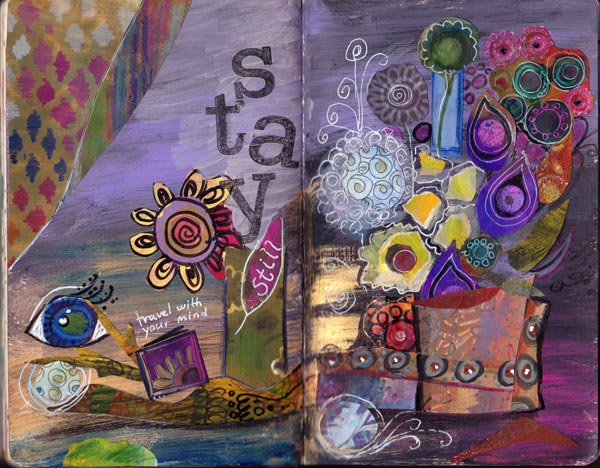
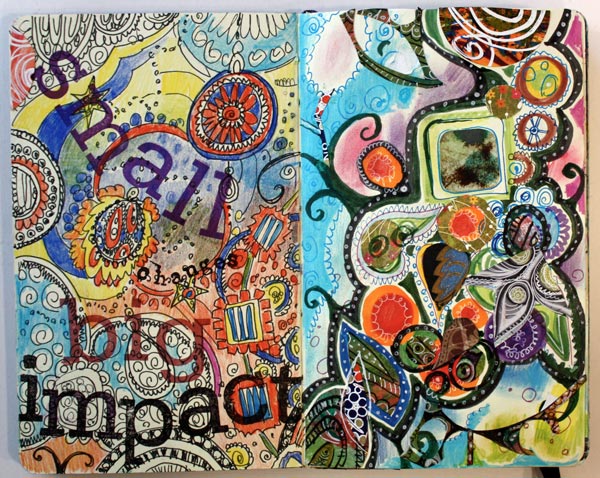
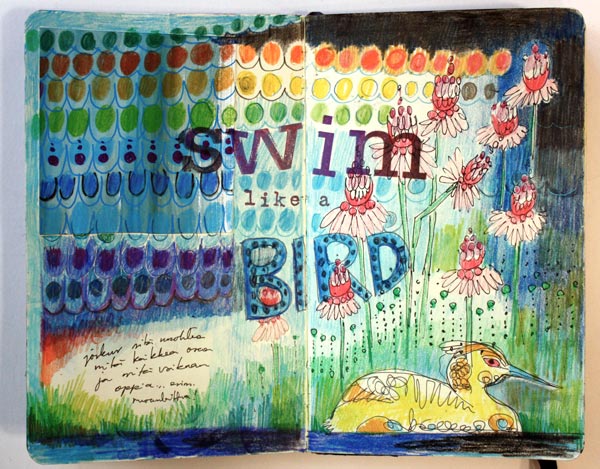
An art journal page spread by Peony and Parakeet. Read more about finding inspiration from children's books.

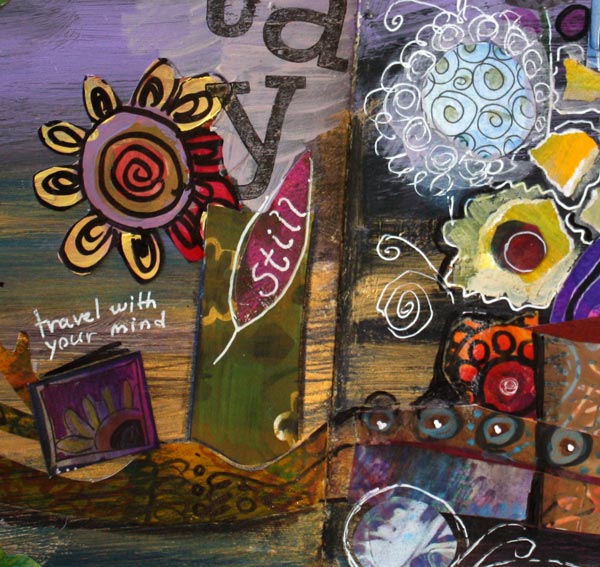
The art journal spread shown above is created from hand decorated papers, colored pencils, and markers. The main message here is “You can ride with your imagination in any way you want.” As it implies, I like my art journaling to capture dreams and fairy tales, not so much everyday life.

Mini-Worlds and Fantasies

I think that an art journal can be childish and playful. The way I see it, children’s books are the predecessors of them. Children’s books also combine illustrations and text to create mini-worlds and stories. I love to add both decorative and naive elements on the same page, and children’s books are great inspiration for that!

Read more about finding inspiration for art journaling from children's books.

I buy used children’s books from recycling centers. They cost only a few euros (few dollars). That is a fantastic value considering all the inspiration they can give. I pick the books that have a lot of good quality illustrations. As I love detailed drawings, I try to find books with sharp lines and many details. Browsing children’s books can be a good practice for finding your artistic style. Pick the books that you feel most drawn to and then list all the things they have in common. I prefer books that have matte pages because I sometimes create collages from them. Then it is good if I can draw or paint on them.

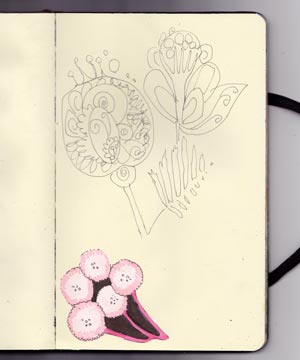
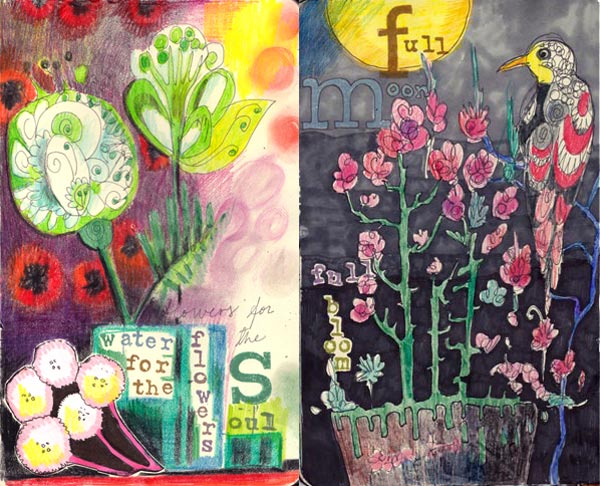
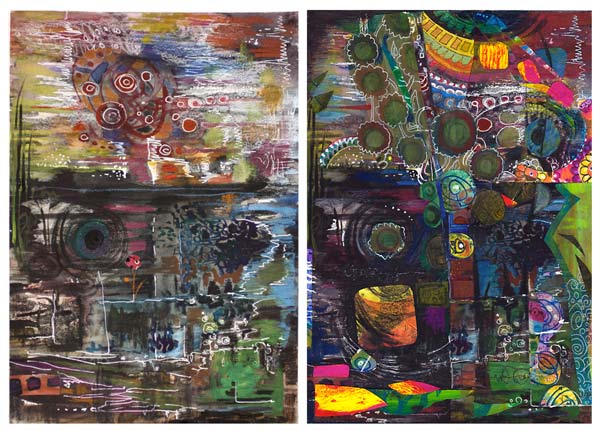
Illustrations from children's book and a collage by Peony and Parakeet. Read more about finding inspiration from children's books.

I made the collage on the right while teaching at a workshop last fall. It’s one of the pages where I have used the papers from children’s books. I often give few pages from various books for each participant of the workshop. It’s much easier to start creating when you don’t need to stare blank paper.

That little explorer resembles anyone who is entering the world of children’s books!

Subscribe to my weekly emails – Get a free mini-course!

How to Trust Yourself when Creating Art

I Feel the Power, a collage painting by Peony and Parakeet. Read about making this and how to get rid of self-doubt when creating art
When I begin creating art, I often have petty thoughts like: “I want to draw a flower” or “I want to create something pink.” Even if I create regularly many times a week, I am still bothered by the fear of failure. I know I have to handle that at as soon as it comes, preferably before the first brush stroke. Why? Wouldn’t it be fun sometimes to draw that single flower or create that pink square? I believe that if we give ourselves that kind of clear commands and simple tasks, we don’t really trust our creativity. The big question is always: do you trust yourself when creating art?

The Unpredictable Nature of Art

If you trust yourself, you can step into the world of unpredictability. Not knowing exactly what to aim for is a major factor when creating art. We can set restrictions and principles, but we have to leave space for unpredictability. It means that we are more creative if we do not have the clear picture of the result.

Setting Restrictions on Supplies

Art supplies. Read about using fiber paste and how to trust yourself when creating art.
These are the art supplies that I gathered when I began making the collage of this post. Watercolors, acrylic paints, and fiber paste. I also picked a thick watercolor paper and cut it to a square. I chose the supplies but left behind the thoughts about what I was going to make.

Find what You Want to Express

My method is to browse art books just before creating art. I do it only for few minutes, and I try to pick art that really lifts my spirit, raises the bar, sparks my imagination. Usually, it is something from the history of world art. This time I browsed a picture book from impressionism.
Read about how to use art books to trust yourself when creating art.
So, do I advise you to get a book of impressionism? No. I advise you to name what spheres you want to reach when making art and pick images which resonate with that. They do not have to be the same style than what you want to accomplish. The more important is the feeling that they evoke in you. When I browsed the book of impressionism, I thought how art is above all the mundane things. How those artists who lived at the end of the 19th century have managed to describe the beauty in the way that is still understood. How the brush strokes, full of paint, were successfully set to represent weightless light. All that would be exciting to see in my piece too.

Watercolor strokes. Read about how to trust yourself when creating art.
When the first watercolors hit the paper, I still had some self-doubt: I could not ever do anything like the great impressionists. I heard the sarcastic voice in my head: “Reborn Monet, yeah right!” But that sarcasm is the moment when I know I am almost there: I am almost leaving the rational side of me behind. Then I just need to wow to trust myself, stop seeing any desired images in my mind and start working fiercely.

Layering (With Some Moments of Self-Doubt)

Watercolor background by Peony and Parakeet. Read about making this and how to trust yourself when creating art.

I often start with watercolors because they cover the paper quickly. Even if I have the idea of creating some surface structure, I wanted to use watercolors first to get into the mood of uncontrolled splashes.

Acrylic paints. Read about how to trust yourself when creating art.
While waiting for the watercolors dry, I mixed some acrylic paint. Pastel shades like many impressionists used to choose. Using pallette knife. Read about how to trust yourself when creating art.
To get some interesting texture with the paint, I used a palette knife instead of a brush.
Making of a collage painting by Peony and Parakeet. Read about how to trust yourself when creating art.
After playing a little with the palette knife and thick paint, I became clueless of how to continue. It’s important to recognize these moments. If you are not aware of these, your rational side takes the control and decides to do things you really cannot justify. Like: “Let’s use the rest of the paint to cover the surface evenly.” Or: “Let’s get some other colors and splash the paint here and there.” When you feel that you do not know what to do, don’t do the obvious. I might browse some pages of the book again to get back into the mood. Or change the media, the solution that I made this time. I doodled something not so important with the colored pencils just to realize I wanted to continue with watercolors and a thin brush.

Making of a collage painting by Peony and Parakeet. Read about how to trust yourself when creating art.

When I got bored with colored pencils and watercolors, I opened the jar of fiber paste. Even if I often prefer to stay with the basic art supplies, fiber paste is something I like. It not only creates an interesting texture like watercolor paper, but it also works like a watercolor paper. You can paint over it with watercolors and create beautiful details to your work! Making of a collage painting by Peony and Parakeet. Adding fiber paste. Read about how to trust yourself when creating art.

Trying to achieve distinct variation in the surface texture, I used the palette knife again.

Making of a collage painting by Peony and Parakeet. Read about how to trust yourself when creating art.

Then my mind was empty again, so I browsed few pages from the book again and then continued with colored pencils.

Making of a collage painting by Peony and Parakeet. Read about how to trust yourself when creating art.

When I reached the next point of frustration, I decided to change to the watercolors and work with high speed. Working fast helps to get creativity flow.

Making of a collage painting by Peony and Parakeet. Read about how to trust yourself when creating art.

Once the paper was covered all over, I started adding details. A white correction pen is great as it usually works on any surface.

Making of a collage painting by Peony and Parakeet. Read about how to trust yourself when creating art.

Hand decorated papers are great for details. I picked some of my prettiest papers and began to cut them. The paper shown in the picture isn’t that great as an artwork, but it’s versatile for collages as it has a lot of variation.

Finishing

Finishing a collage painting by Peony and Parakeet. Read about how to trust yourself when creating art.

I felt that it was time to begin finishing the work. It is always useful to stop and think. I often put the artwork somewhere where I can look at it, like on the nearest bookshelf. Then I step away and try to figure it out where to lead the viewer’s eye. Here’s another step where you should not question your trust: It will be great! You just need to connect some dots and find the lost pieces of the puzzle. Like I did when I realized that there is someone in the picture. I added the faces and made the rest of the character more visible. Then some tiny adjustments to the composition and after that, the work was finished.

A detail of a collage painting by Peony and Parakeet. Read about how to trust yourself when creating art.

I think that this piece is aesthetically very much my style, but the impressionistic approach to the surface structure makes the work interesting.

A detail of a collage painting by Peony and Parakeet. Read about how to trust yourself when creating art.

Never underestimate the power of layering: this is my favorite detail, the white area showing the blank watercolor paper. It was created in the first phase, and it still exists in the end. If I had done the obvious and filled the paper with each media layer by layer, this little detail would not exist. So, cherish each stroke and trust your creativity! Focus on the feeling, not to the result! You are allowed to feel like a world-class artist even if you know you are not. Fly to the world of imagination!

This might also interest you: – Stretch Your Artistic Style

Let me be your mentor in art: Subscribe to my weekly emails!

Illustrating Poems in Art Journaling

An art journal page by Peony and Parakeet. Read about illustrating poems in art journaling!

A lace doily waits to be picked up again.
A young girl’s fingers where an old woman used to fiddle.
How many beginnings can one hold?

This is an art journal page which illustrates a poem. I usually create the image first and then add the text. This time, I wrote the poem first and then illustrated it. Namely, for a long time I have had a desire to include creative writing in my art journals. I have loved poems since a small child and I used to write them all the time. After I grew up and moved away from home, it gradually stopped. But now years later, poems seem a great addition to art journal pages. Especially because I usually start writing a poem with a visual image in mind. Wouldn’t it be suitable to document that image too?

Of course, you do not have to be a poet to get into illustrating poems. You can also illustrate the poems that other people have written. Poems are great tools to get connected with the visual images that represent feelings. I think poems make a perfect pair with visual self-expression!

Illustrating Poems

1) Getting in touch with the feeling

Read the poem several times.
What kind of atmosphere does it create?  What metaphors does it use? Are there physical objects or people to include?

There’s a risk of getting too rational here. Try answering these too:
What kind of memories or thoughts does the poem raise in you? What kind of rhythm, music or dance does it resemble?

2) Sketching

Lightly sketch the elements you want to include to the page. Write the poem or at least reserve a place for it.

I used watercolors for sketching. Light painting can bring a more intuitive approach to your work than using a pencil. You don’t need to know your exact composition yet. Think this phase as the first steps in the dark! Do not take it too seriously (= too rationally)! Focus on the feeling you want to express!

An art journal page in development by Peony and Parakeet. Read about illustrating poems in art journaling!

3) Expressing with composition

After sketching, adjust the composition by adding more elements to the page! With poems, I often feel that if the composition delivers the message, the rest is trivial or easy. There’s so much content in the words itself.

I wanted my page to lean to the right and then up. Right – because there’s a strong connection to the future in the text. Up – because the doily waits to be picked up in the story. I also chose the colors accordingly: blue representing the old and red representing the new.

An art journal page in development by Peony and Parakeet. Read about illustrating poems in art journaling!

4) Finishing

This phase is to fine-tune everything already created.

I wanted to add the feeling of fabric and emphasize the upward movement by adding thick lines with watercolors. I also made the lace more detailed. Then I added some dark areas to make lighter areas pop. A thin black marker and colored pencils are great for the finishing touches when using watercolors on the page.

A detail of an art journal page by Peony and Parakeet. Read about illustrating poems in art journaling!

The page was made on a separate watercolor paper and then attached to the journal. Watercolors work best on watercolor paper. Even if you use a thin watercolor paper it’s better than using a smoother surface.

An art journal page by Peony and Parakeet. Read about illustrating poems in art journaling!

Illustrating Poems – A Minimalistic Approach

You know that I am not a particularly fond of minimalism in self-expression but with poems, I think it can be a very effective approach.

An art journal page by Peony and Parakeet. Read about illustrating poems in art journaling!

A yellow spot on a white painting.
A happy thought when leaving.
I saw the sun on a cloudy morning,
The one to brighten my being.

This poem of mine began with a visual image that called for simplicity. When aiming for lots of space, acrylic paints can be a better medium to use than watercolors. Acrylic paints have more substance themselves, and it’s easy to add slight, yet powerful color changes with them.

In this page, I divided the poem into three parts. The composition was built accordingly.

A detail of an art journal page by Peony and Parakeet. Read about illustrating poems in art journaling!

The first part is focused on expressing the latter sentence: the leaving. It is bittersweet, light peachy orange.

A detail of an art journal page by Peony and Parakeet. Read about illustrating poems in art journaling!

The second part visualizes the sun in cloudy weather.

A detail of an art journal page by Peony and Parakeet. Read about illustrating poems in art journaling!

The last part communicates the person, her being and her relation to the world that she is leaving behind.

An art journal page by Peony and Parakeet. Read about illustrating poems in art journaling!

With acrylics, it’s easy to work on any surface. I used white gesso instead of white paint but only to save some money.

Art Journal of Poems

Think about having an art journal that is filled with illustrated poems! What a treasure would it be! The best things in life are those we can create ourselves.

Let me be your art teacher: Subscribe to my weekly emails!

Express Yourself with Colored Pencils

An art journal page by Peony and Parakeet. Four easy techniques to express yourself with colored pencils.

Simple art supplies fascinate me. Colored pencils have been my favorites recently. They are so easy! There are no worries about making the pages too thick even if there’s a lot of layers.

Colored pencils seem to be used for traditional artwork mostly. I think they are as suitable for improvising as any other media, like watercolors. In this post, I will show you few easy techniques for expressing yourself with colored pencils.

1) Color by Doodling

Four easy techniques to express yourself with colored pencils by Peony and Parakeet

Starting with a blank page or paper, draw circulating and continuous lines to color a small area. Then change the color and continue. Create layers and let the colors intersect. You can get a wide range of colors with layering. Think your pencils as doodling tools!

2) Rotate the Page while Coloring

Four easy techniques to express yourself with colored pencils by Peony and Parakeet : Rotating the page.

You will get more variety and interest to the page if you rotate it while working. Work one area at a time, changing the orientation once in a while. The areas can be fairly large as in my page, or smaller.

Four easy techniques to express yourself with colored pencils by Peony and Parakeet: work in progress

Here’s the page before I used the eraser …

3) Use Eraser to Create Lighter Areas

Four easy techniques to express yourself with colored pencils by Peony and Parakeet

Erased areas bring light to the work. In an art journal page, use the eraser for the areas where you want to write the journaling.

4) Add More Clarity

Four easy techniques to express yourself with colored pencils by Peony and Parakeet : before and after final touches

I am a big believer of finishing. When you improvise, the result may be self-explanatory for you without the finishing touches. But if you want to communicate with others too, then sharpening some areas and adding some layers here and there for more intensive color is a minimum. I realized that my page had some animals in it so I made them easier to see. Like the photos include sharp and unsharp areas, you do not need to work through the page. Picking the focal points and working with them is often enough.

Coloring with Pencils is Like Painting by Drawing

By discovering these easy techniques, I have learned to love colored pencils. It is like mixing painting with drawing. With colored pencils, you can have a gorgeous art journal or a unique greeting card collection! Show your free expression with colored pencils!

Express yourself with colored pencils! >> Buy Coloring Freely!

Scroll to top