
Loving Vincent and Purchasing Oil Paints
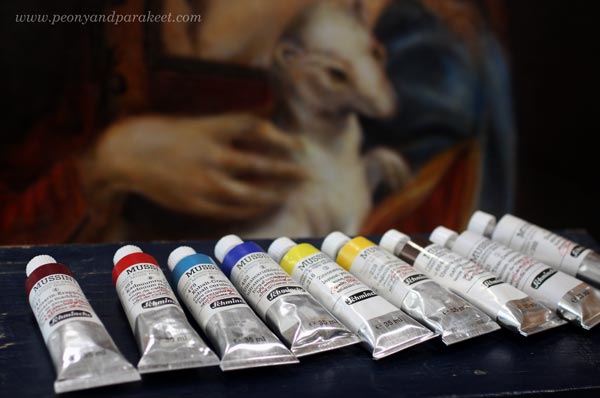
Yesterday, I opened the door of a local art supply store and headed to a specific shelf. On my way to the store, when walking on the narrow streets in the center of Helsinki, I felt it. The feeling that I got a year ago when I opened a tube of Mussini oil paint for the first time. I was attending an art class about old masters painting techniques, and we used the best oil paints I could imagine. Not that I could imagine so much because I had never used oil paints before. But I didn’t expect to experience that strange feeling. It contained both appreciation and excitement. The appreciation of color, and the excitement to learn more from it.
It was not that I would have been new to color. I had been painting with acrylic paints for a long time. When I was a teenager, I got them from my parents who thought that it was a perfect solution to me. No worrying about toxic painting fluids and still being able to paint with ease. The acrylic paints have developed a lot since that time, since the eighties. They have worked perfectly for my needs. I have found a good brand too. I really like Golden acrylics.

But now I was standing in the front of a vast collection of Mussini oil paint tubes. I picked the color chart and went through my choices one more time. For a whole year, I had been going through this in my mind: raw umber, zinc white, titanium white, yellow ochre and so on. It had been a mantra that changed a little bit every month. The paints are expensive, and I had to pick the colors carefully. One tube can cost more than 70 euros.
Plan for the Hand and Mind
After trying out the paints for the first time, I went to live in denial. Yes, I had painted the class pieces with oils because they were provided by the class. But the odorless and water-soluble acrylics felt much more suitable for me. After a while, my attitude changed a bit. I let myself dream about the oil paints. I visited the art supply store, touched the clean and shiny tubes, imagined getting just a bit of paint on a palette and make it last for as long as possible.
But dreaming and reality are surprisingly close. It’s difficult just to dream and not to do anything. So I made a plan that felt more like extortion. I had to get my floral painting class finished. I had to get several acrylic paintings finished. I had to figure out where and how I would store the paints. I had to get more information about the oil paints and the painting liquids.
I still had some finishing touches to do for my paintings in progress, but other than that I had followed the plan. So I started picking the tubes: raw umber, zinc white, titanium white, yellow ochre and so on. After selecting the colors, I went for the liquids: poppy oil, turpentine, and glossy dammar varnish.
When I left the store, my mind summarized the past year. Learning the old masters’ techniques had been essential for growing my technical skills. My art had become less imaginative, and more conventional.
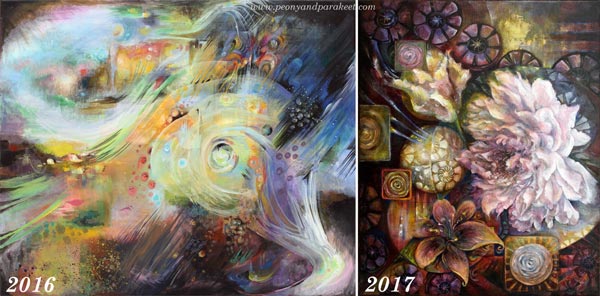
I had a turning point in 2016 when I felt that my imagination and my hand didn’t function so well together anymore. My imagination wanted to proceed to new territories, but my hand couldn’t follow. But now when my hand is wiser, I can also challenge my mind more freely. Purchasing the oil paints were a reward for the persistence that I have had for the last twelve months. However, it wasn’t the only reward. I was also going to see the new movie Loving Vincent.
Loving Vincent – The Movie
The movie theatre was about 10 minutes walk away from the art supply store. When I arrived, there were several queues for the tickets. I joined one. While I was waiting for my turn, a young man suddenly came to me and asked: “Do you want a free ticket? I have two, and my friend wasn’t able to come.” I happily accepted it and thanked the man. “Is this a sign?”, I asked myself. “Is this the final sign that I should do this – go forward, open the tubes, start painting my newest, odd ideas?” I don’t believe in destiny so much, but at that moment, it felt like Vincent van Gogh was talking to me: “Do that, paint those ideas, just like I painted mine.”
I found the movie very emotional. Every time, I saw a familiar painting coming to live, tears came to my eyes. I realized that this movie had to be published now, not earlier. Vincent’s art has become so well-known during the past decades that it unifies us. Art that was odd for masses of the 19th century is understood by every one living the 21st century. It has become so familiar that it’s sometimes difficult to appreciate it. And still, we need to feel the togetherness that Vincent’s paintings can offer. They are like icons that make us stronger together.
Looking back helps us to move forward. As artists, we are all Vincent’s descendants. No matter how we paint, what technique we use, we know about modern art because of Vincent. We know more than the people of the 19th century, and that enables us to explore art to all kinds of directions.
Loving Vincent – Art from the Students
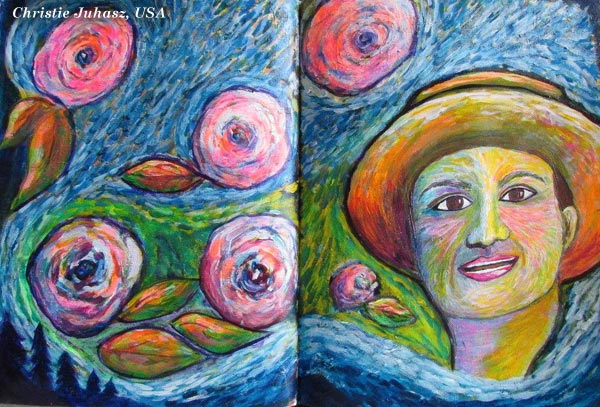
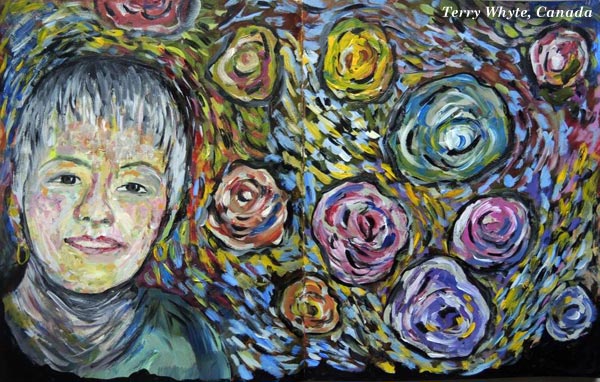
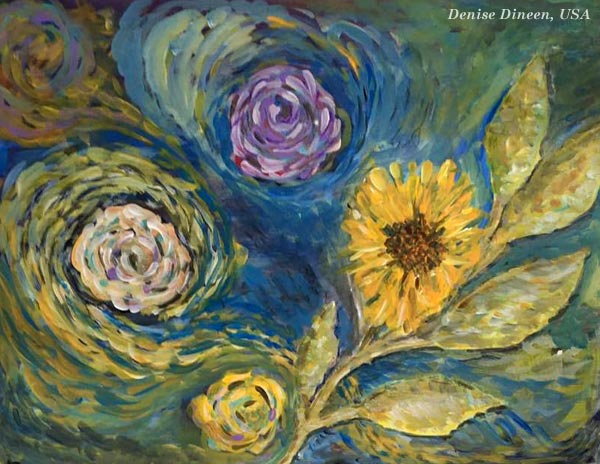
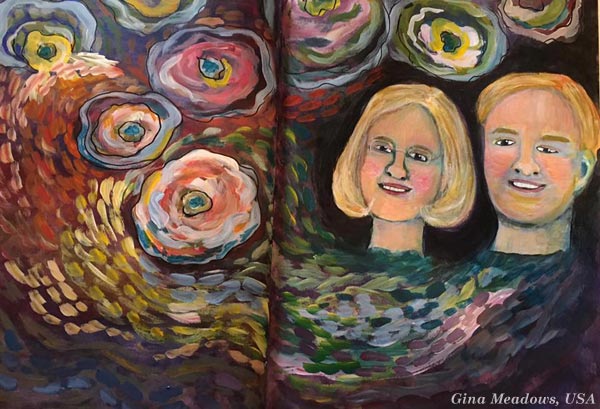
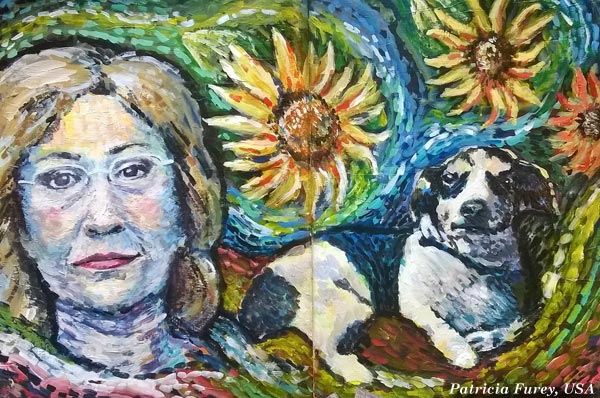
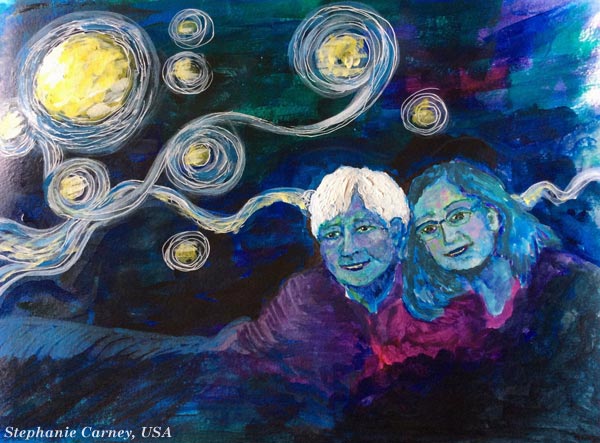
I want to celebrate Vincent by showing beautiful pieces made by my students. They are made from my class Selfie Fantasy that shows an adaptation of Vincent’s technique.
Christie Juhasz:
Terry Whyte:
Denise Dineen:
Gina Meadows:
Patricia Furey:
Stephanie Carney:
Have you seen the movie? What did you think about it?
Imagine Through Art – Buy 5 inspiring mini-courses! (including the Vincent-inspired one)
Klimt’s Garden with Students of Peony and Parakeet
We are heading for the winter in Finland. It has made me pull out the photos taken during the recent years from the garden. They remind me that the summer will come again. Together with my students, I dedicate this blog post for the famous Gustav Klimt (1862-1918) and the way he saw the world. It’s a perfect perspective when you want to get inspiration from the garden!
Portraits with Scenes Instead of Faces Only

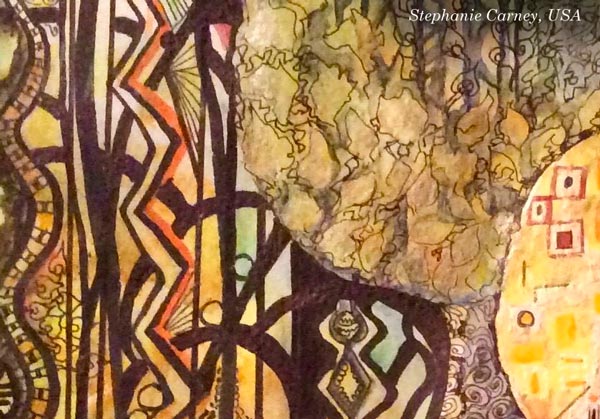
Stephanie Carney shows so well how Gustav would see our gardens: full of decorative elements! This way of looking combines two perspectives. First, examining the details and their decorative nature. Second, seeing the big picture: how plants are not just individual and separate but integrated into a scene.
When browsing my photo library, I realized that I have a lot of close-up photos of flowers. But for this post, I picked images that show more than just ethereal petals. The images that have more than a few details make me more attached to my garden. I think it’s the same with paintings and drawings: instead of just sketching faces, we can show the whole experience.
That’s how Gustav Klimt built most of his portraits: not only focusing on faces but showing more of the world around the person by expressing it through decorative and abstract elements. Klimt’s mission was to combine decorative designs with fine arts, and I think it’s one of the reasons why his work is fascinating for us who like to sew, quilt, embroider, or do any crafts. When looking at Stephanie’s work, inspired by Klimt, I can easily imagine wearing that dress and stitching any of the beautiful motifs that can be picked from the picture!
From Messy Garden to Klimt’s Garden
I claim that we can look at the garden using “everyday eyes” or “magical eyes.” When using the everyday eyes, everything is “should,” “could” or “have to.” We see weeds, neglected areas, messy grass. But with the magical eyes, we see nature as art.
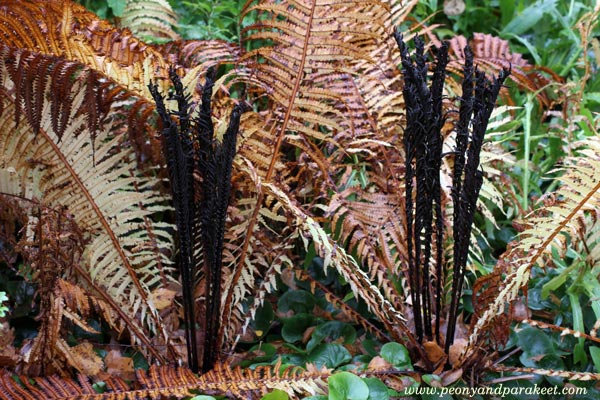
For example, these ferns from my back garden horrified me when I looked at them with the everyday eyes. All I could see was a neglected flower bench getting ready for the cold weather. “I should cut those,” I thought. Then I took a step back and … wow! Nature had made an Art Deco pattern for me! I felt grateful and inspired. For a moment, I was in Klimt’s garden.
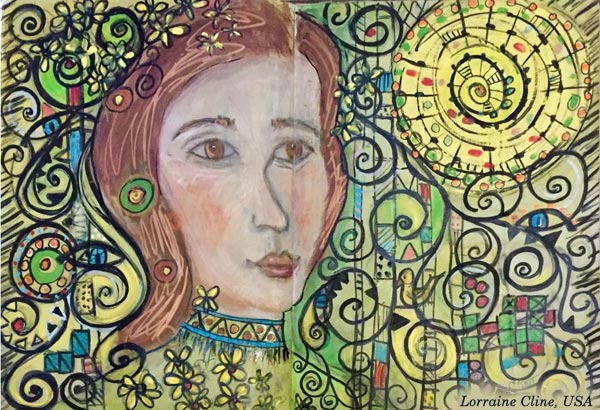
Gustav Klimt understood that when we want to express the beauty, we want to express the experience, not just copy what we see. When looking with the magical eyes – when being in Klimt’s garden, our feelings get mixed with the things we see, and nothing is fully organized. That’s why the sun feels more than just a bright spot in the sky in Lorraine Cline’s work. It doesn’t only make flowers grow, but it’s an uplifting force for humans as well. We get wrapped in its warmth, and for a moment, we are just one of the many plants in Klimt’s garden.
Quilted Garden
Gustav Klimt saw the world as a stream of patterns and colors. Sometimes they were symbolic, sometimes more literal like the artwork below, showing a baby’s quilt. Even if the painting is fine art, it honors crafts.
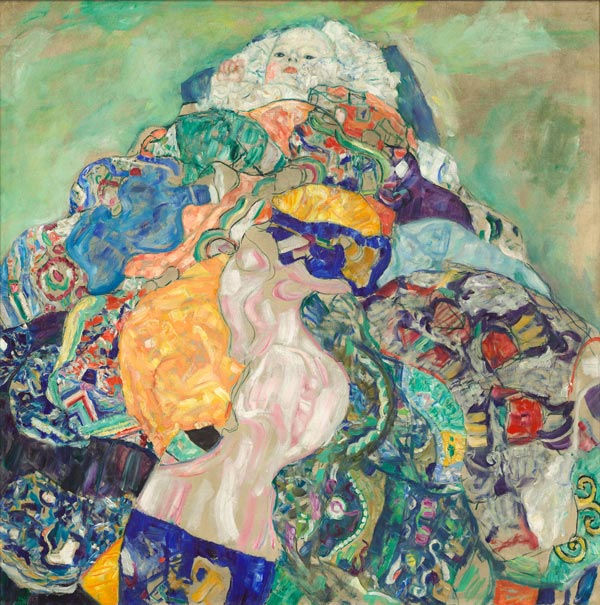
At Klimt’s garden, there’s no distinct border between nature’s and man’s creations. When you look at the world with the magical eyes, they become one.
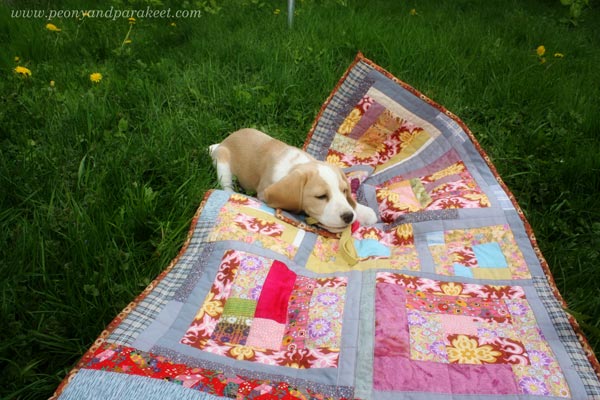
Pirkko-Liisa Mannoja’s piece combines drawing and painting, but to me, it also looks like an art quilt.
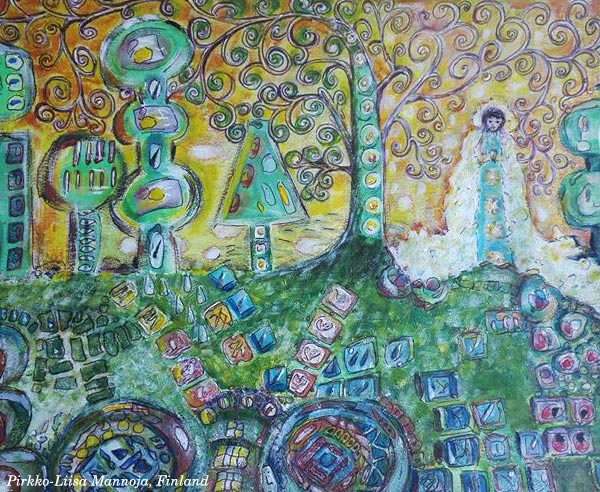
When we use the everyday eyes, we see the world as clearly-defined objects. We see green grass and red flowers. But when we look with the magical eyes, we see things that are more abstract, like the way the light forms spots in the background. That’s one of the subtle things that make Pirkko-Liisa’s work shine.
In Klimt’s garden, the grass can be white, and the observer can be green.
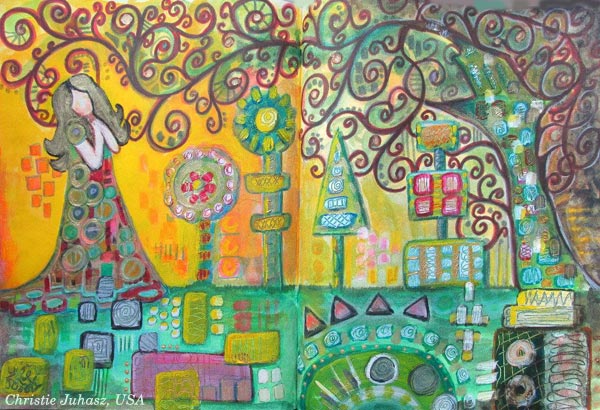
In Klimt’s garden, we treat trees like they were close friends. I love how Christie Juhasz expresses that in her beautiful art journal spread.
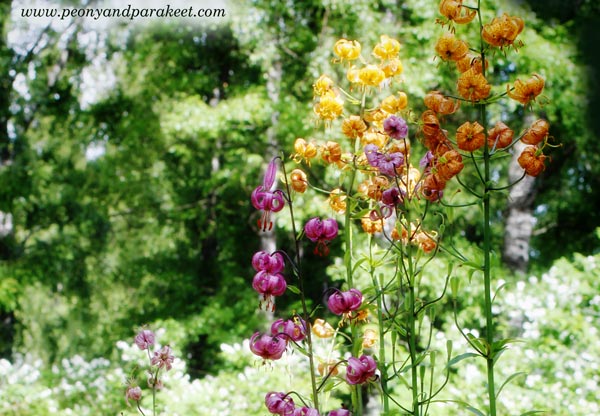
In Klimt’s garden, martagons take us back to Art Nouveau with their decoratively shaped stems and delicately colored flowers.
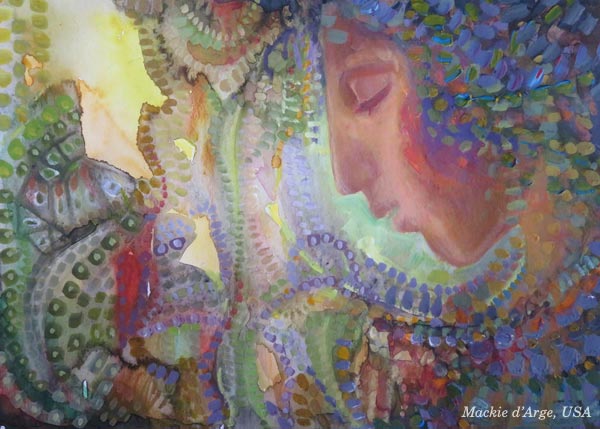
In Klimt’s garden, we connect with the outside world so that it lightens up our inner world. When I look at Mackie d’Arge’s gorgeous piece, I feel connected to both.
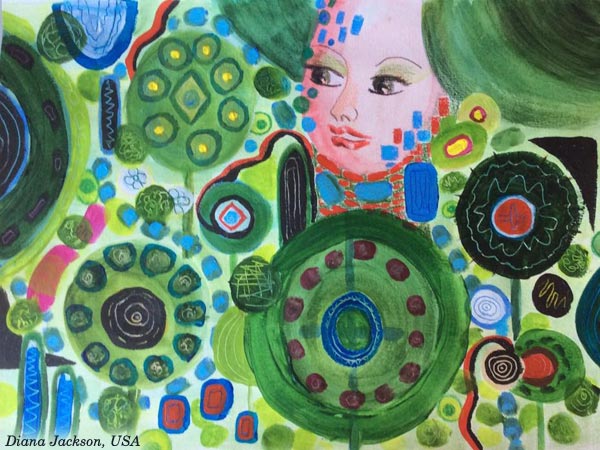
When we look at the world with the everyday eyes, we worry about the weather when we look up.

But when we change to the magical eyes, the sky and the earth are not separate at all. Just like in Diana Jackson’s expressive piece!
Winter in Klimt’s Garden
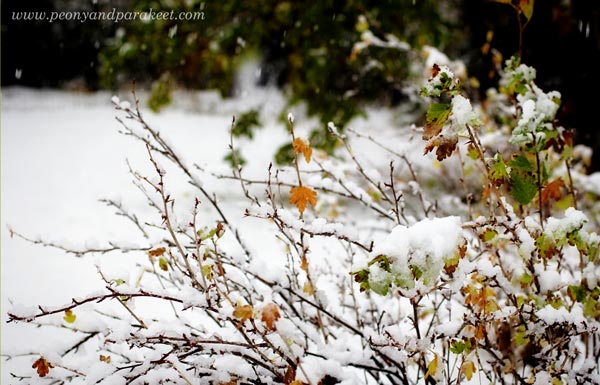
I wrote most of this blog post yesterday. When I woke up this morning, the snow had come to Finland. It felt depressing. “The garden is gone,” I said to myself. But then I realized that I had my everyday eyes. When looking with the magical eyes, Klimt’s garden is there for sure. It has just changed its colors.
Klimt’s Garden in Your Art Journal!
The student artwork in this blog post is created from the mini-course Patterned Topiary. In the mini-course, you can create a decorative garden scene in Gustav Klimt’s style. The mini-course is available as a part of Imagine Monthly Fall 2016 art journaling bundle, packed with four more inspiring themes and techniques. And to celebrate the snow arriving in Southern Finland, you will get the generous 30% off during the weekend (from Oct 26 to Oct 29, midnight PST). >> Buy now!
Create Klimt’s Garden: Buy Patterned Topiary + 4 inspiring mini-courses!
Three Artist Types and Why You Should Become All of Them!
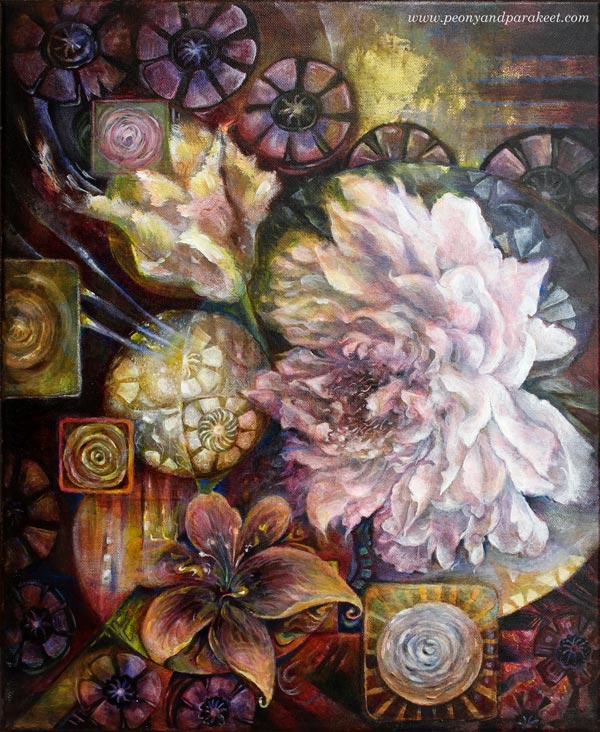
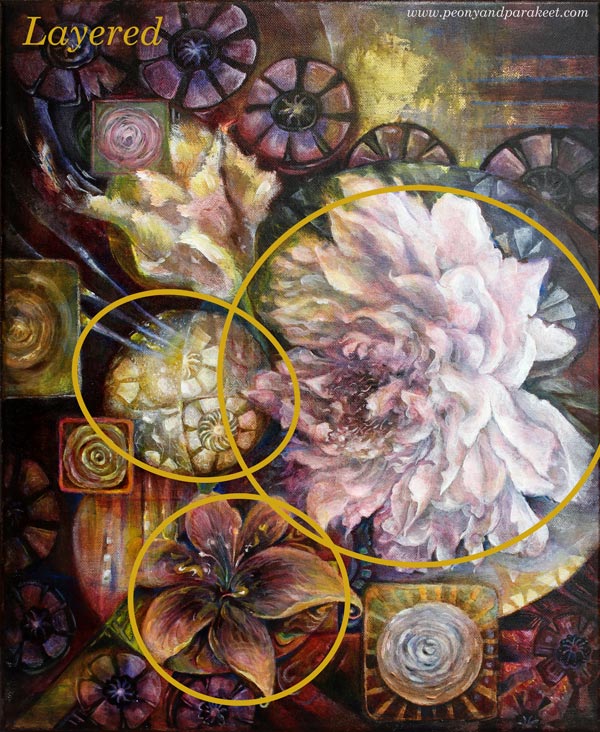
Here’s my latest acrylic painting “Blooming Centuries”. With this piece, I show you how stepping into roles of three different types of artists can grow your skills.
Tight Focus – Don’t Believe it!
The conventional way to grow artistic skills is to choose your media, mindset, and style and stick with the choice. To me, this kind of tight focus has never worked. It feels boring and too straight-forward to work in practice. It forgets the fact that creativity comes with limited persistence but with unlimited imagination.
For example, when I have a heavy heart and want to get quickly into the core of it, I don’t want to stick with the technique that is more labor-oriented. On the other hand, when I want to think and adjust, quick and simple is not what makes the most of the contemplation. Sometimes my imagination wants to be playful, other times it wants to be timeless and deep. When the moment and the mood can define the supplies and techniques, I not only enjoy more but also surprisingly, learn more!
3 Moods – 3 Artist Types
In my upcoming workshop, I will expand your toolbox for creating art in various moods, rather than trying to force everything under one media and one way of working. I have defined three types of artists and picked the techniques accordingly.

The most interesting column in the table above is “Emotion” because it brings up the benefit of the mood. When you imagine being a designer, you aim for clarity. You get happiness out of clearing your thoughts and communicating the essence. When you step into the role of an intuitive watercolorist, your core desire is freedom of expression. What appears on paper, is exciting and your adventurous mind makes the most of it. As a Renaissance painter, you are searching for the peace of mind. By creating a layer after another, you gently caress your way away from busy life.
Now you might say: “But Paivi, I am nothing but an intuitive painter. I am all about quickly creating a beautiful mess.” But don’t let your successes take you on the wrong track. Think about your struggles and what you can learn from the other artists. For example, if your mess has become nothing but beautiful it’s often because the small portion of clarity that we all need has been missing. Or if your mess looks too flat, it’s because your work doesn’t follow the concepts of the three-dimensional world. Also, the time that it takes to create tens of pieces quickly could be used to creating one piece that rises to another level.
I believe that growing as an artist is about learning the best of the many approaches. It’s like getting ingredients for the soup and then making a personal recipe to fit the current mood and style.
3 Artist Types – 1 Painting!
With “Blooming Centuries,” I wanted to express how flowers may be fleeting things, but in general, they have a strong position in the history of art and design. Flowers have inspired artists and designers through past eras, and they still inspire us to create no matter what mood we have. This painting is based on playing with different artist types from a designer to a Renaissance painter.
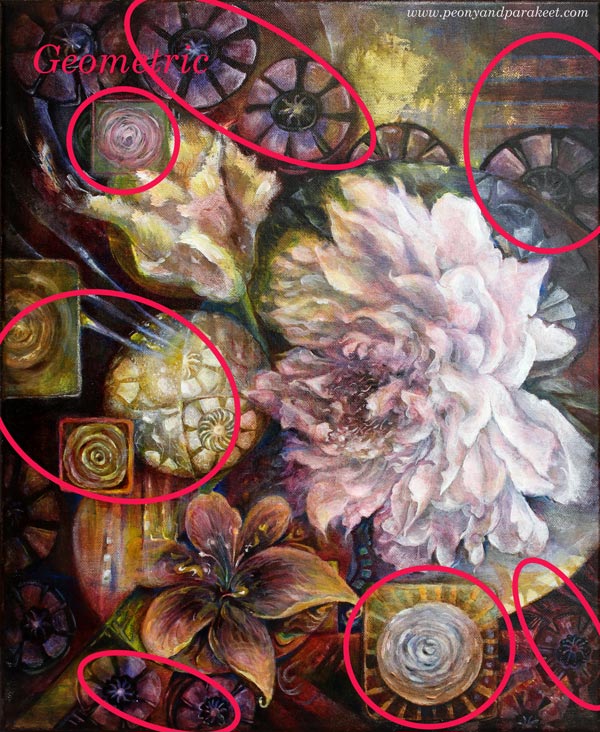
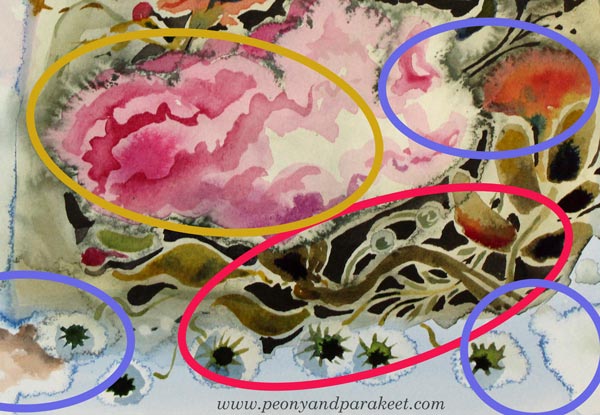
Designer: Some elements of the painting are more related to crafts and design than to the fine art. They are built from geometric shapes and are quite minimalistic.
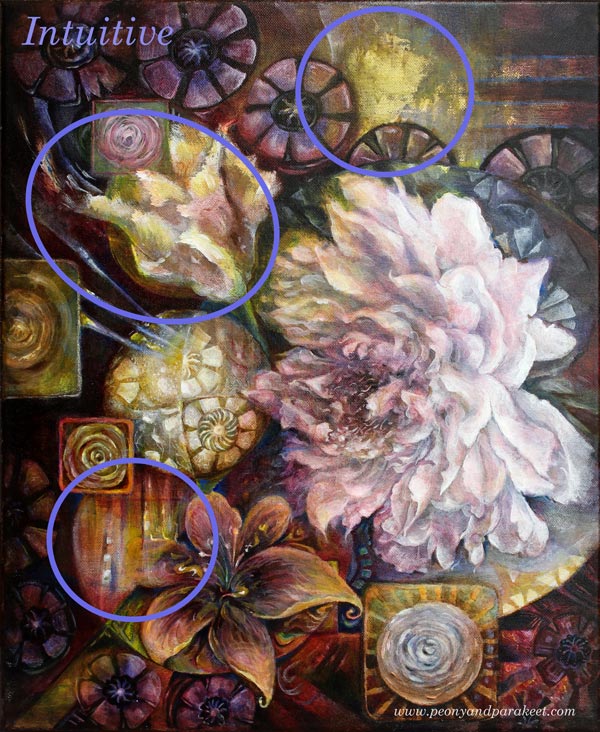
Intuitive artist: There are also elements that have been born freely and intuitively.
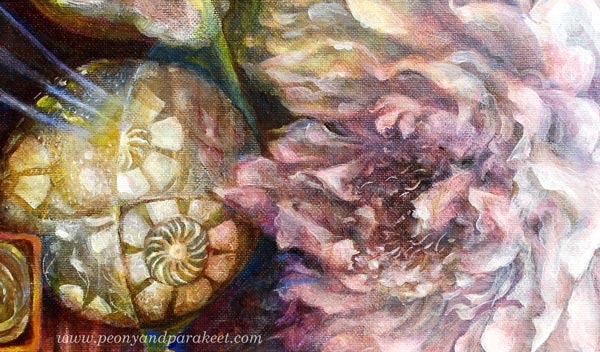
Renaissance painter: Some of the elements have a lot of layers and are more 3-dimensional than others.
Another Example – Combining Intuitive with Art Nouveau
Let’s imagine that you love Art Nouveau. You adore Alphonse Mucha’s work and everything from the beginning of the 20th century. You want your style to include a lot of Art Nouveau but in a refreshing way. So you might think you need to focus on developing your drawing skills only. You draw and draw, and you get closer and closer to Alphonse but the new twist that you want to give to your drawings, “your personal style,” is missing.
But if you start learning from Intuitive Watercolorist and Renaissance Painter, your Art Nouveau designs will take a new turn. By adding more transparent layers, you can express liveliness so that it still looks graceful. By finding ways to manipulate water, you get free-flowing shapes more effortlessly. Your art no longer is a copy of what someone else has created, but it takes a direction of its own. You begin to appreciate all kinds of art because you want to add more spices to your recipe. Your passion for art gets stronger, and the joy you get from it grows bigger. When you struggle, you see a wider range of solutions than before.
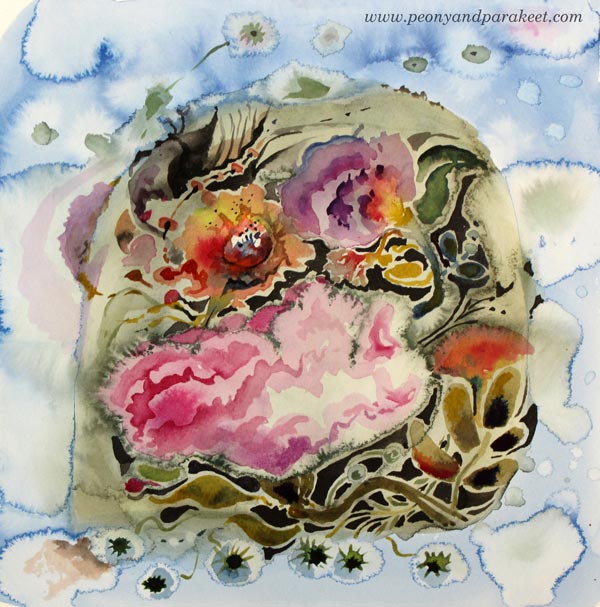
So, every Designer or Illustrator has something to learn from a Renaissance painter or an Intuitive Watercolorist. And the same applies to all artist types.
Get into the Minds of the Three Artist Types!
In my online workshop Floral Fantasies in Three Styles, we will dive deeper into the three artist types. It will expand your impression of style and how to construct one. It’s the class you don’t want to miss if you love flowers and want to become an imagination-driven artist! Reserve Your Spot Now!
Floral Fantasies in Three Styles: Reserve Your Spot Now!
Do You Feel Insecure About Your Art?
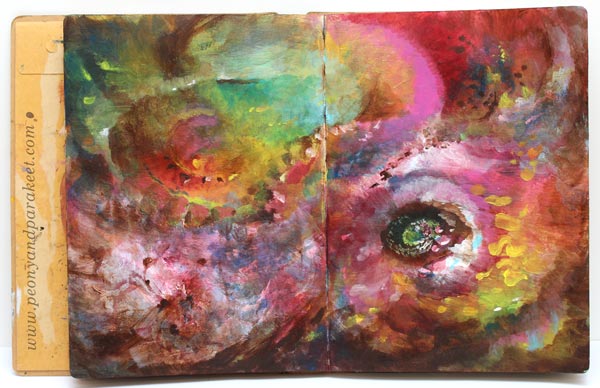
On Wednesday morning, I prepared my studio for a recording. Usually, when I set up the camera, I am excited and ready to paint. But this time I was struggling. However, I did manage to put the video together because it gave me the opportunity to talk about insecurity and self-doubt – common feelings for all artists!
Feeling Insecure and Why? – Watch the Video!
Follow the Inspiration – Join the Live Webinar!

Meet me in a free live webinar! I will be sharing what inspires me currently and giving ideas for your art as well. Join me on September 21st, 11 AM PST / 2 PM EDT / 7 PM BST / 9 PM EEST!
To participate the webinar:
1) Register by choosing “Save My Spot!”
2) Mark the date Sept 21st and your local time to your calendar.
3) Follow the link a few minutes before the webinar begins.
I will be broadcasting live from my studio. Come to get new ideas for your art and chat with your friends in art! You will also hear more about my upcoming classes and how I have been collecting inspiration for them.
The event will be recorded, and the replay will be available for all who register.
Follow the Inspiration: Register here!