
Begin Like a Crafter, Finish Like an Artist
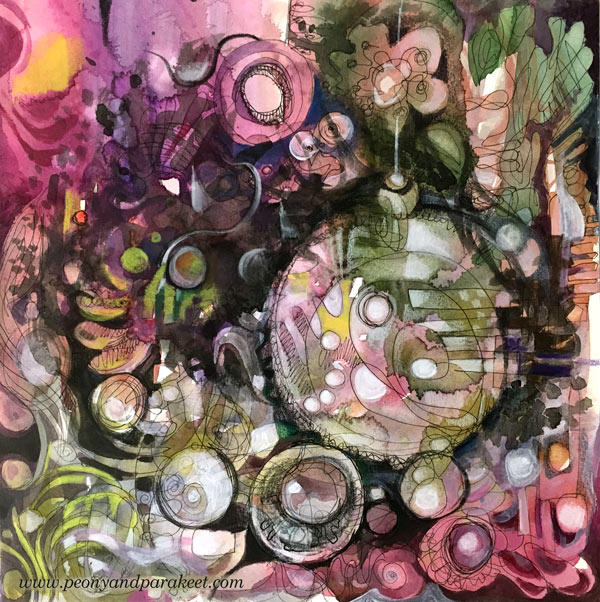
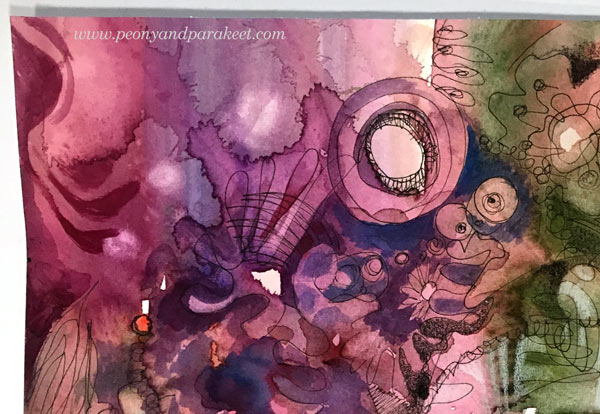
Here’s what I made today: a mixed media painting with a Christmas theme. When I began creating, I had no idea that this will express the season. I didn’t even start with a blank paper but cut a piece of a big pre-painted watercolor paper. It had just careless splotches of color, and I had painted it months before to wait for the right moment. I had just enjoyed knitting some old sock yarn into socks, so I thought to use up that paper with the same mindset: using what I already have and making that more inspirational.
Begin Like a Crafter
I picked a black Zig drawing pen and started doodling without any idea in my mind. I often think about knitting or crocheting when I doodle. I feel more like a crafter than an artist at the beginning of the process. Exploring the paper with a pen is like crocheting with a hook and yarn. It’s much more relaxing than trying to find a grand idea first. When you start as a crafter, you are ready to do the work. You don’t expect miracles to happen, you know you just have to keep on going, and it will get easier after a while.

After filling most of the paper with crossing lines, I felt that there was a lack of connection between the drawing and the background painting. They looked like they were two separate layers, each made by a different person. But because I had used a good quality watercolor paper, I was able to add water and wipe off color here and there so that the layers began to interact.
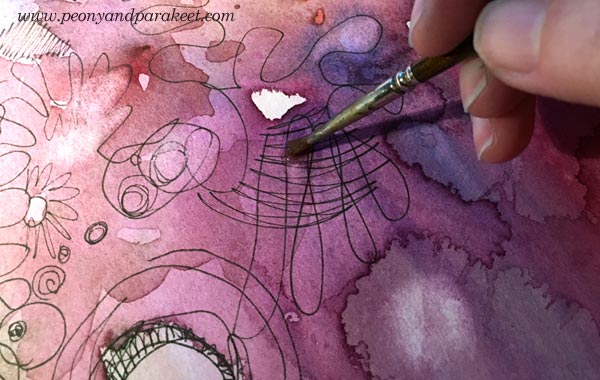
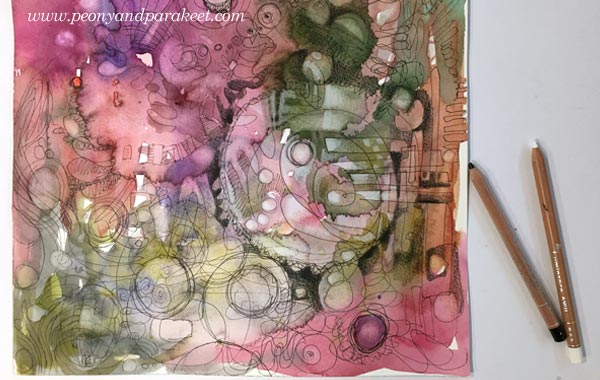
Again, I felt like a crafter adding stitches that would tie the two layers together. I also used white and black colored pencils to enhance the effect.
Find Routines that Start the Change
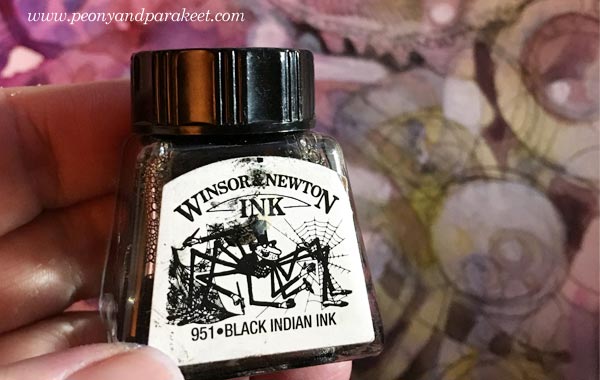
Working with black is my thing. It always brings in more excitement, more drama, and my identity begins to change from a crafter to an artist. This time, just holding a black pencil, made me want to start painting. I picked few bottles of India ink first.
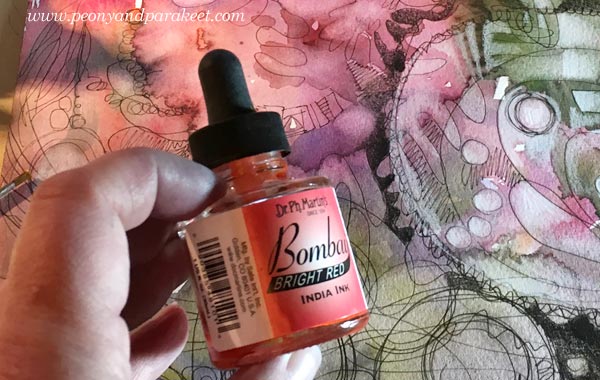
My brush felt stiff, and the shapes that I painted were controlled and modest. But I knew I just had to keep going. There were times when I stopped too soon, and I have seen that happening to many people too. When you stop too soon, you are still too much of a crafter. You try to focus, and you don’t feel like doing anything risky.
I changed to white acrylic paint to get more ideas and contrasts. There were some round shapes on the paper, but I had no idea what they could be.

Finish Like an Artist – a) Do Something Risky
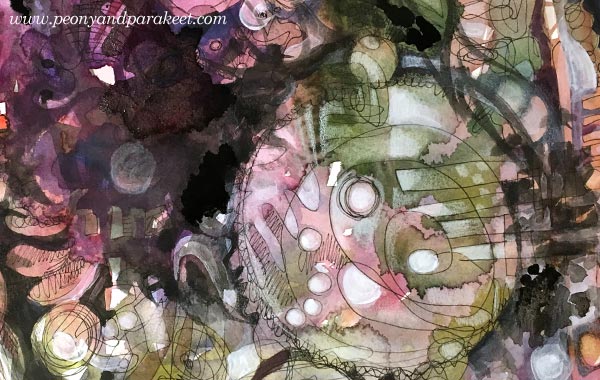
After spending some time painting, I was ready to take risks. All I needed was to choose a little black ink bottle and turn on Jean-Michel Jarre’s Stardust, a song that always gets me into the flow. Uncontrollable black brush strokes felt scary, and of course, there’s a risk of “ruining everything”. I often set an area, where I don’t go. This time I decided to be as wild as I want but leave the center of the biggest bubble alone.
Before doing this phase, I convince myself that my subconscious knows what I could bring up from the mess because I have been staring that for a while already. I often repeat the words “trust” and “knowledge” before I turn to the music. I try to be as quick as I can and focus on adding more speed to my brush. This short phase where I leave the crafter behind is the most enjoyable thing in creating. I feel free while pushing the limits of my creativity.
Finish Like an Artist – b) Bring in the Intention
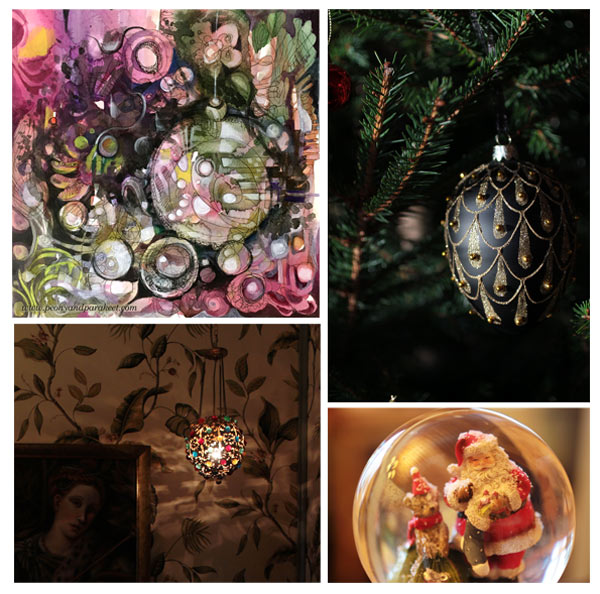
After adding those black strokes and splotches, I knew what I was expressing: holiday decorations on this black Christmas. In the southern Finland where I live, all the snow melt away just before Christmas Eve. I had taken photos just a couple of days ago that connect well with the painting. In this last phase, I try to find the fastest and most natural route to finishing the painting and focus more on composition and clarity than trying to make the image other than what it seems to be already. Accepting that my image can go to the area that is unknown to me at the beginning of the process, allows me to be less stiff.
I find it so fascinating that art is a combination of knowledge and letting go. There are clear guidelines for communicating visually such as how to set your composition. And still, it’s also about taking all that knowledge and jumping into the unknown. Every day, I want to know more and then, relax more!
First Lesson of Inspirational Drawing 2.0 – Start with a Mood, Finish with an Image!
Like knitting starts from the first stitch, drawing starts from the first line. Somewhere between the lines the transformation happens and the crafter changes to an artist. The ideas grow with the imagination. Moods turn to motifs, motifs to modules, modules to streams, streams to images.
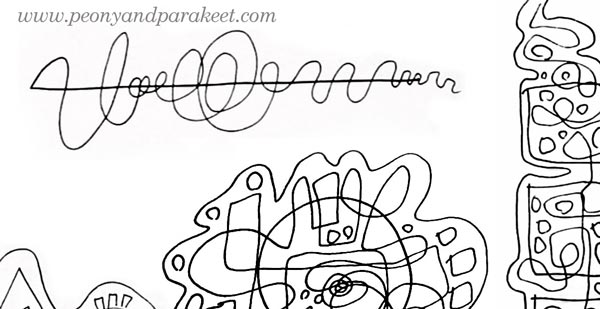
The first lesson of Inspirational Drawing 2.0 will be published on January 1st. This is the class you don’t want to miss! Every lesson takes you further in enjoying drawing from inspiration and imagination! I will help you create unique art in unique ways that will make you absorb the knowledge and then let your ideas grow.
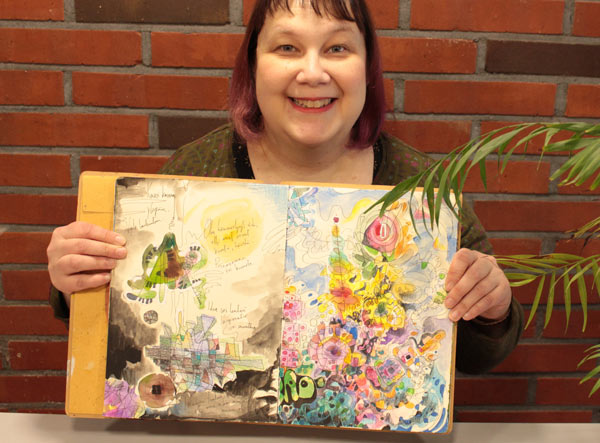
Enjoy drawing from inspiration and imagination!
>> Sign up for Inspirational Drawing 2.0
Finding Balance through Journaling Practice

Here’s an art journaling spread that I created for December’s mini-course at Imagine Monthly Fall. The mini-course is called Romantic Geometry, and it’s about creating abstract art and traveling through the history of art and design. It’s a perfect example of what journaling has brought to my life: a sense of freedom and limitlessness. When you paint, draw or write, you are limited only by your imagination.
Everybody is an Introvert
I want to dedicate this blog post to introvert in us. They say that most people have some introvert characteristics in them. To me, very little needs to happen and I get a lot of ideas, associations, and thoughts to go through. It feels like a curse sometimes. If I don’t get enough time to be alone, I become unhappy and everything feels overwhelming. We in Finland, have the most forests in Europe. For many Finnish introverts, forests are the places to go to process the thoughts. I do like to spend time in nature with my dogs, but it’s not the same as spending time with my journals. I need to get out what’s inside me and even more: use my imagination to create something playful, no matter how childish or stupid that might feel first.
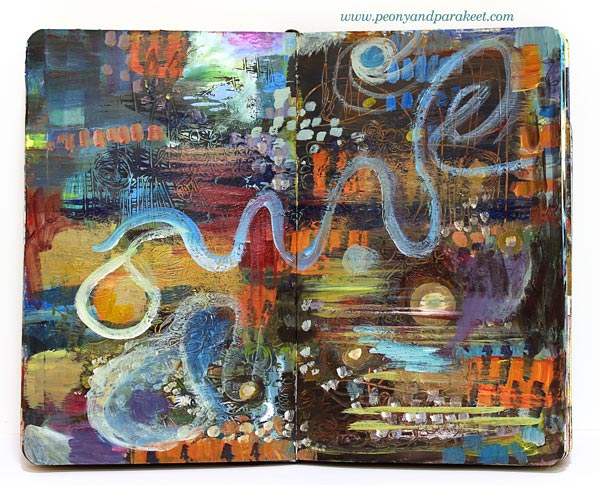
My art journals contain a lot of painting and drawing, but I also like to write down my thoughts, especially after I have created the image. I also like the practice where I write a question, then answer it, and then find a new question related to my answer. These kinds of internal conversations fill me with positive energy. I also like to analyze what I did wrong but have found a positive way to do that. I look back, pick things where I succeeded and then make notes how I can still improve.
Everybody Needs “Me-Time”
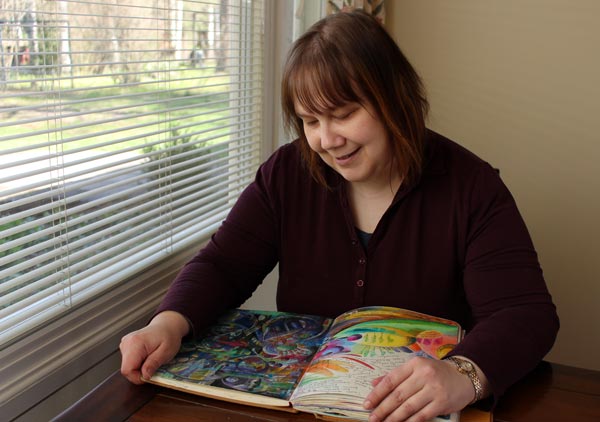
When I browse my journals, it’s easy to feel grateful and forgiving because the pages complement my life’s story. I fill them randomly, and in many sessions but try to do that as regularly as I can. When I start to journal, I often don’t feel particularly inspired, but after a while, I am fully enjoying the creative challenge. I have never been an introvert in the sense of being a quiet person. But when they say that introverts live in a world of their own, I recognize the habit through my journaling practices. My journals are like mini-worlds with limitless possibilities.

Everybody Needs a Place to Experiment
Behind every bigger art piece that I create, there are plenty of art journal pages where I have experimented with the ideas. This possibility of experimentation also happens with my writing. I don’t always write about myself but empathize with a fantasy character. This fall I wrote a haiku poem with the help of my husband, also an introvert.
I think that many who haven’t fell in love with their journal yet, forget to experiment. They drool over beautiful notebooks at bookshops or pin colorful art journal pages at Pinterest. But when they begin a journal, they feel they need to make decisions and stick with those. They pick the supplies they should use, or the style they should follow, and then get bored or disappointed with how the pages look. But you can change the direction as many times as you want, explore what excites you today, and cherish all that diversity. The more I have journaled, the more I feel the calling to show how paper books can balance your life. Life is less mess when you save some time for journaling.
Classes for Art Journaling
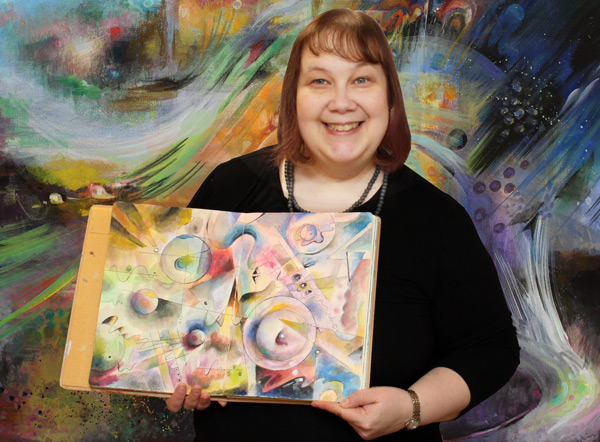
Romantic Geometry guides you to create dynamic abstract art from simple shapes. It’s the last mini-course of Imagine Monthly for now.
I will be running a new class “Inspirational Drawing 2.0” in spring 2017. Like Imagine Monthly, it will also have a monthly format. Inspirational Drawing 2.0 is about drawing from imagination and inspiration. It’s a skill-oriented, excellent class when you want to free up your expression and add more abstract ideas to your journal. This class will be all new content. If you have attended Inspirational Drawing previously, you will still want to sign up!
Moleskine Sketchbook – Another Full Art Journal!

I just finished my red Moleskine Sketchbook. It always feels like an accomplishment when an art journal gets full. So I’m happy to show a couple of photos and a flip-through video of all the pages!
Moleskine Sketchbook as an Art Journal
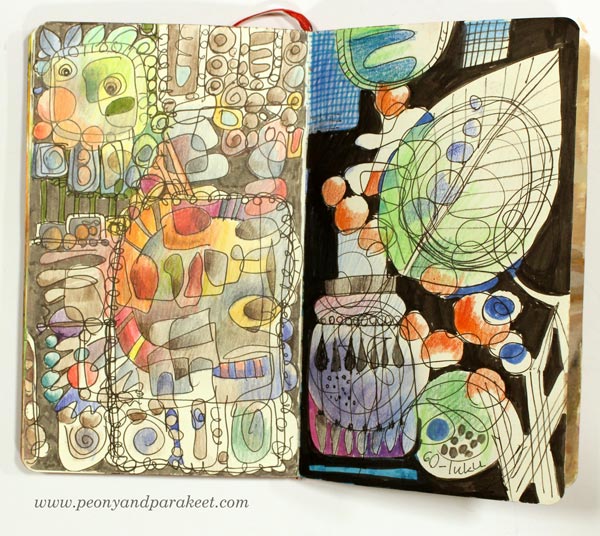
Moleskine Sketchbooks are one of my favorite books for art journaling. The paper is sturdy, and it can be used with a variety of supplies. I use mostly watercolors, acrylic paints, colored pencils and PITT artist pens. But I also use inks, gel pens, hand-decorated papers for collages, etc. The small size is handy for quick pages and easy to put in a bag. However, sometimes the size is a little bit too small, especially for acrylic paintings. So I also use other journals, especially large Dylusions Creative Journals. The paper is very smooth, so it’s not ideal for watercolors. But I don’t mind that too much, I use a little less water to make watercolors work with the paper. Some prefer coarser paper for colored pencils but I love how effortless it is to color the pages in Moleskine Sketchbook.
The Purpose of an Art Journal
For me, art journals are little more than just sketchbooks. I like to call them “idea books” as I often process my ideas further when I am working on the page. I don’t always make one page on the same go, but work with it several times, adding more ideas as the page progresses. However, I have quite low expectations on how my pages will look. They are not pieces of art but more like collections of ideas to me.
As you can see from the flip-through video, my ideas are often connected to art history and different styles. The first photo of this blog post shows a spread inspired by Rococo. The second photo shows a spread that I made after browsing designs from the 1960s. Even if I sometimes write short stories or make notes about my current thoughts, I mostly write about beautiful things that I have seen and visualize the ideas I have gotten from it.
My art journals are not chronological diaries but random visual notes that I process to full images. I can make a quick sketch of a rose one day and then continue the page with painting on the other day. When I am working with a new art class, I use art journals to record my visual ideas and practice the techniques. I also see creating art journal pages a route to bigger paintings. When I paint on canvas, I use the ideas that I have come up with when making the pages. Every artist should also be an art journaler!
Flip-Through Video
Create Step by Step!
I have gathered all the most popular free step-by-step instructions and all my flip-through videos on a separate page. Go to Create Step by Step!
Creative Struggles in the Middle of Possibilities

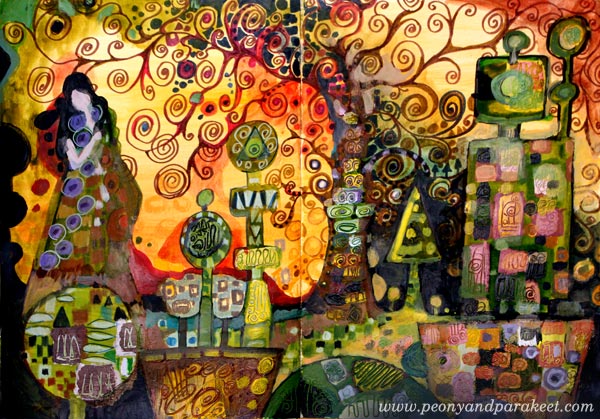
Here’s an art journaling spread that I made for Imagine Monthly Fall. It’s a part of November’s mini-course called Patterned Topiary. For the mini-course, I chose three main themes for the inspiration:
1) Gustav Klimt, the famous artist, and especially his Golden Phase pieces
2) playing with patterns and repeats
3) topiary art, the art of cutting trees and shrubs into shapes. As Gustav Klimt has brilliant portraits, I also included a woman there.
Predictions and Creative Struggles
Some time after creating the mini-course, I started the renaissance painting technique class under Emmi Mustonen. Now when I look at my work (which is still in progress), I see the same woman appearing there. It’s like art could predict the future!

The two projects are very different and still – it’s easy to see that the person who created the first image, the art journaling spread, is the same who’s painting the copy of the portrait. I think this is a brilliant example of why we shouldn’t put ourselves in one corner, but be always willing to learn new perspectives. I could have said that I love freedom and won’t go to the class that is “just copying.” Or the vice versa: that I value old masters so much that I won’t combine them with mixed media techniques or with less-valued art forms like cutting trees. I might have avoided some creative struggles, but I would also have missed the possibilities.
My second project for November’s mini-course is also like a prediction.
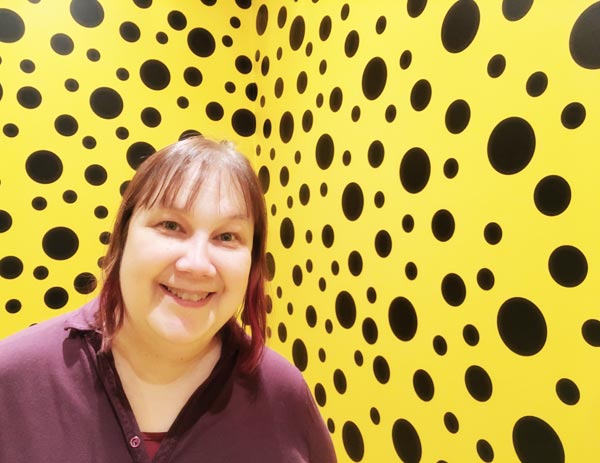
Namely, last Saturday, I went to see Yayoi Kusama‘s exhibition at Helsinki Art Museum. Another celebration of dots and patterns!
Diversity of Themes and Techniques
I have now released 4 of 5 mini-courses for my art journaling master-class Imagine Monthly Fall 2016. There’s a lot of diversity in the projects: painting, drawing, making collages and combining the techniques to create mixed media art. You can still sign up and get all the published mini-courses immediately. There’s also a great community that you don’t want to miss! Seeing many versions of monthly themes is part of the enjoyment! I also lead a discussion related to the theme every month.

Struggles in the Middle of Possibilities
When creating and teaching the mini-courses, I have experienced that art is full of possibilities but still, we fight with the fixations all the time. To me, the word “artist” has so much emotional overload that it feels difficult calling myself one.
But I got a wake-up call recently when someone said to me: “You’re already an artist and you should just embrace that. Doing otherwise is denying who you are.”
Selling My Art in Public!
After pondering that, I decided that I have to stop selling secretly based on occasional requests. I should make my art more accessible. So I set up a shop at Saatchi Art, which is a commercial site for artists. The great thing about Saatchi Art is that you can now also order fine art prints from my pieces, not only buy originals. Some of the paintings are sold already, but you can buy them as prints.

Tell me, which struggles do you have with your creating right now? Are they due to a certain technique, certain conditions or a certain mindset?