
5 Lessons Learned When Painting on a Big Canvas
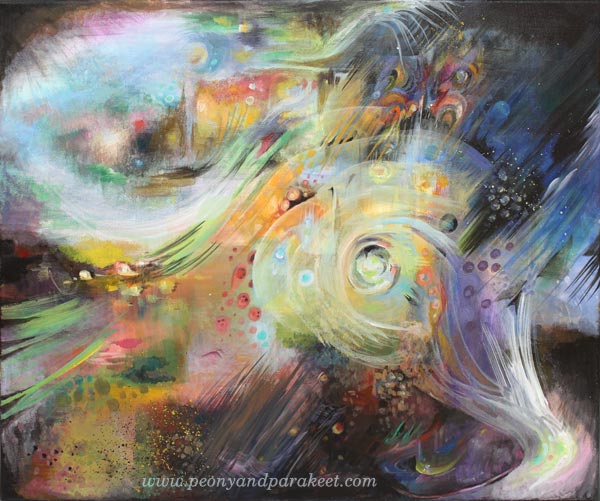
I have now finished my first big canvas painting. It is called “Human Nature.”
1) Smaller Paintings Can Take As Much Time
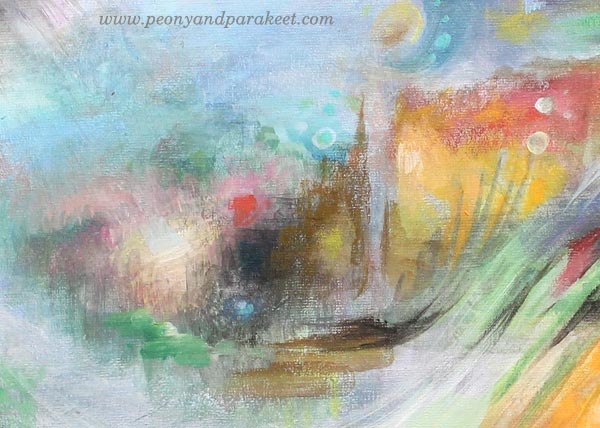
About two years ago, when I left my day job, I had a dream about creating a big painting. But my job is to teach art, and I don’t have much spare time, so it felt impossible to fit in the schedule. Now when I think about that, I kind of feel that the lack of time was an excuse. I think I was intimidated even by the thought of painting on a big canvas. The usual question raised: “What should I paint?” And then: “How could I maintain my focus for such a long time?” I exaggerated the time that painting would take. I thought it would take months and months. But when I started painting, I realized that I could use broader brushes and be less detailed. If you have ever tried to make small paintings as finished and polished as possible, it takes a long time. Adjusting the details on a big canvas is much easier.
2) Use an Easel, at Least in the Beginning and Finishing Phases
My canvas was not huge. It’s 60 cm x 50 cm (appr. 23.5 x 19.5 inches) Still, it was hard to see the whole painting when it was laid down on the table. I painted parts of the canvas so that it was on the table but set the foundation and finished the final details with the help of the easel.
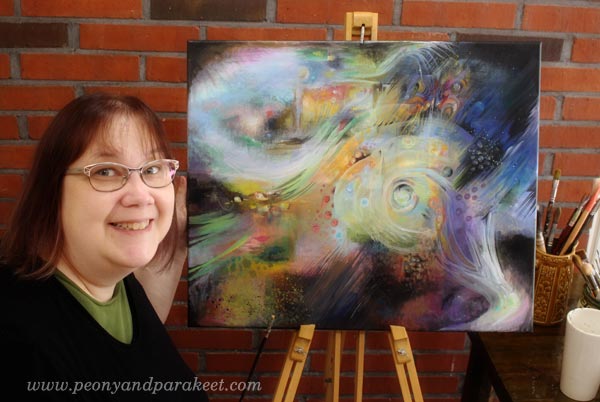
My easel also has sentimental value. My father who passed away a long time ago has made it. He was a skilled woodworker. We didn’t talk much, but I think that making the easel was his way to encourage me to paint.
3) Eat the Elephant One Bite at a Time
I got the courage to start the painting when I realized that I could combine painting with building an art class. My upcoming workshop Nature in Your Mind (do sign up!) has instructions for the techniques that I used. I treated the canvas as my sketching board for the class.
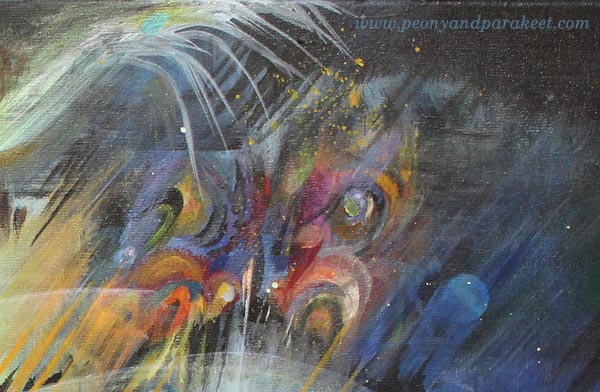
For example, the project for the first week of the class is “Rising Butterfly.” I practiced the techniques on a big canvas and then sought for the easiest and most enjoyable way to create a butterfly on a smaller canvas.
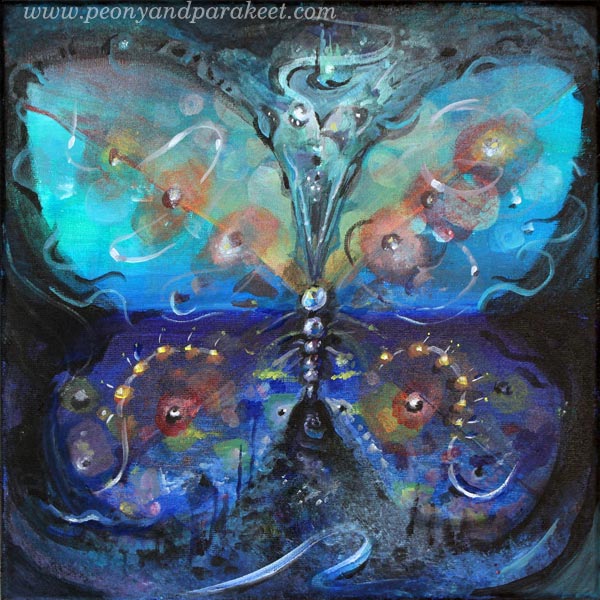
This kind of experimenting transformed the big canvas to my playground. The size was no longer intimidating.
4) Big Brushes are Great for Details
Thin lines, little dots, all look so much better when working with a big brush! It has changed my attitude towards broader brushes. I have started to use them on smaller paintings too.

It was surprising that sharp lines can be so easy with a big brush!

5) Big Canvas, Big Story
If you have been following my blog for a while, you know that my style is detailed. I know now why I wanted so badly to create a big painting and why I was so intimidated by it. You can express a much greater story on a big canvas. It’s much easier to create images that are like events or scenes on a big canvas. When one detail connects with another, it’s like moving from one chapter of a book to the next one.
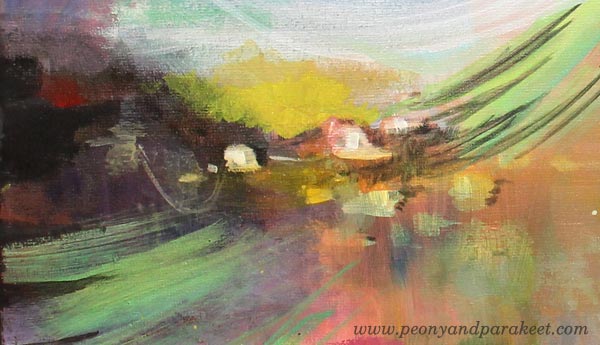
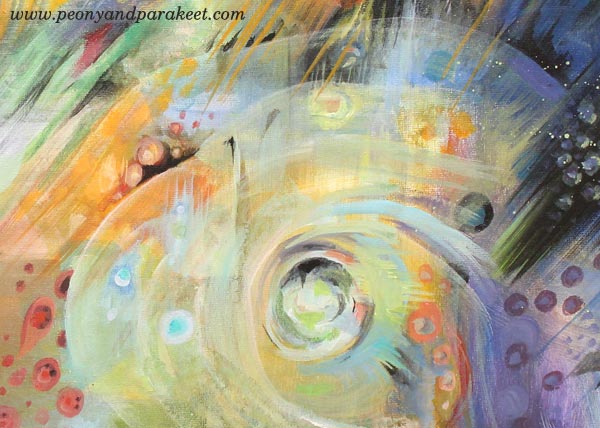
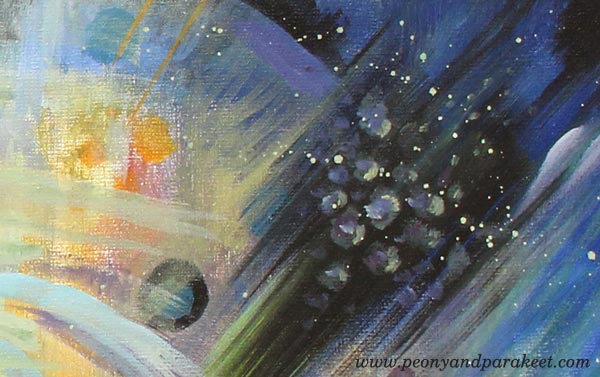
My story is about human nature: how we are spiritual beings, have imagination and ideas and are conscious about the circle of life. I doubt if I could have expressed all this on a smaller canvas.
Let me be your mentor in art: Subscribe to my weekly emails!
What’s in a Good Composition?
Quick question:
When you create art, how much time do you spend for composition?
I mean: trying to make it work, trying to balance it, trying to make it look more eye-catching?
For me, finishing the composition can take as much as 50% of my creating time! Some years ago, it was easily 75 % … I don’t find adjusting the details particularly relaxing. I take photos, use a mirror, and change the orientation of the piece to see if I have missed something. Sometimes I sleep overnight and make the last adjustments in the morning.
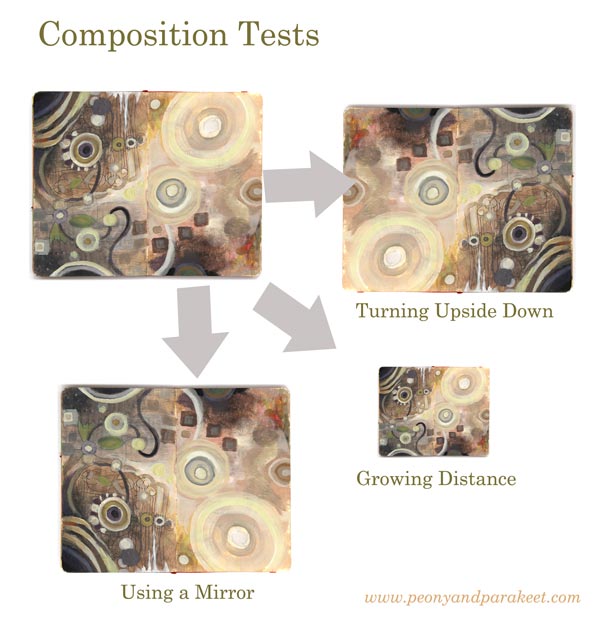
But teaching art has had some benefits here. I get to help people to make better compositions and thus, I have become faster. Namely, the two top requests that I get in my classes are: 1) How can I make this look finished? 2) What more could I add here?
So when I created a new class, Planet Color, I wanted to build a step-by-step creative process so that when you add elements, you don’t have to worry about the composition so much. I wanted to find ways that support you so that you can release your mind and fully enjoy working with colors.
What’s in a Good Composition?
Here’s my conclusion. A good composition has elements that a great party has:
1) concierges who invite the viewer to the painting
2) a star singer who takes the viewer’s attention
3) clear routes and breathing space which make wondering around easy
4) good food and good company which makes the viewer stay in the party
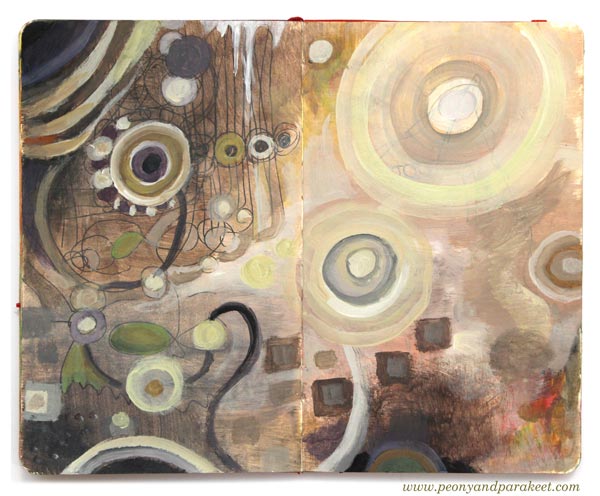
I have built all these elements in one 7-step process. It doesn’t mean that this process produces identical paintings. It means that when you enter the finishing phase, you have already done most of the work you should do anyway. But without all the agony and with all the creative enjoyment! That’s why my workshop Planet Color is as much about composing elements as about releasing your mind with colors.
And again, if you have problems in making the final adjustments, I am there to help for all the 14 days.
See you there!
How to Transform Ideas into Paintings
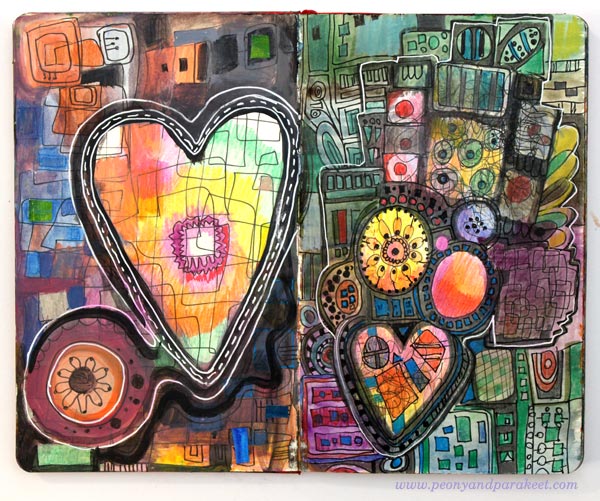
I am an idea person. When I get exposed to new things, my mind fills up with new ideas. Most of the ideas that pop into my mind are not that good. They are either too conventional or too radical. Some ideas are impossible to implement, and some have nothing to take on.
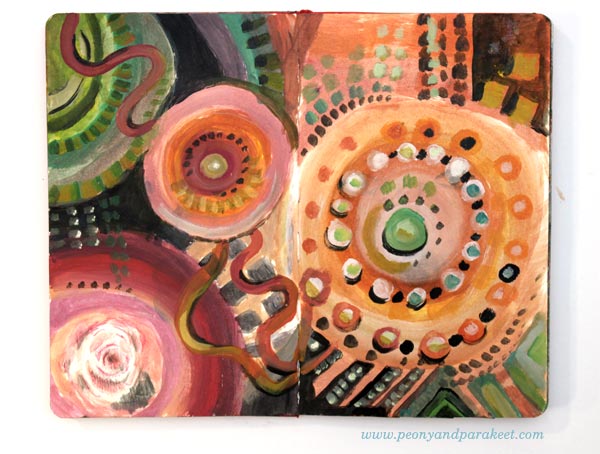
When I was a child, I happily filled the days playing with what came to my mind. But when I was studying computer engineering at a university, I became a master in shooting down my ideas. It may sound depressing, but it has led to a brilliant realization for me: the number of ideas doesn’t equal to the number of projects. When you have limited creative time, you don’t have to divide it with all your creative ideas.
Raw Ideas – Bad that Produce Good
When a new idea comes to your mind, call it “a raw idea.” If you get visual ideas, quickly sketch them on your journal. If they are more words than images, write them down. Don’t over-analyze your sketches, treat this just a routine that makes you move on and continue producing new ideas.
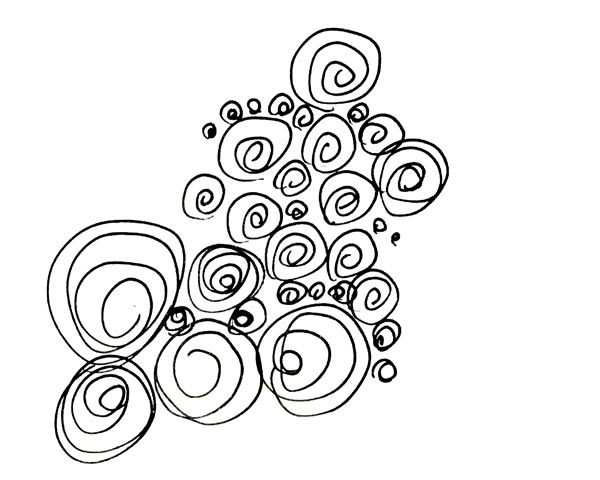
Raw ideas are often not so great, and you have to be careful not to spend too much time in implementing them. Raw ideas are like raw potatoes. Add some rosemary, salt, pepper, olive oil, carrots, onions, and zucchini and put them all in the oven for 30 minutes, and you will have a brilliant idea.
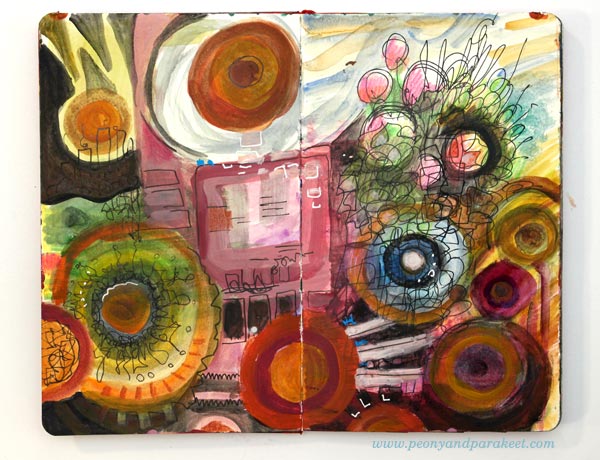
Many believe that getting new ideas is the thing. They fall in love with their raw ideas and then get disappointed with how they look on paper. But the essence of creating is in the processing. It’s about combining tens of ideas into one focused idea.
Record Everything!
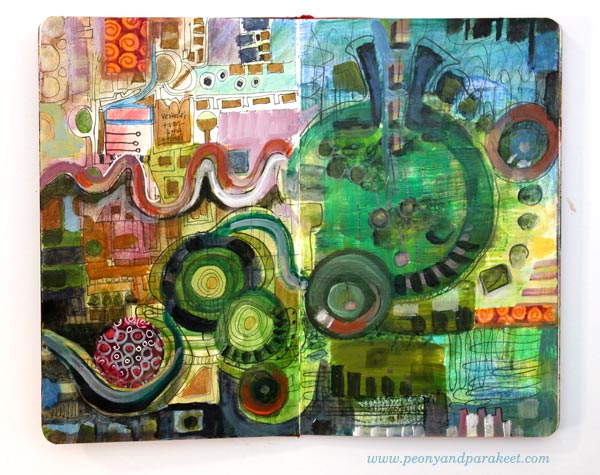
We humans are very similar to computers in one aspect. We have a limited capacity of processing unsaved ideas. If you never draw or paint or write down your ideas, the processing of them becomes difficult, almost impossible.
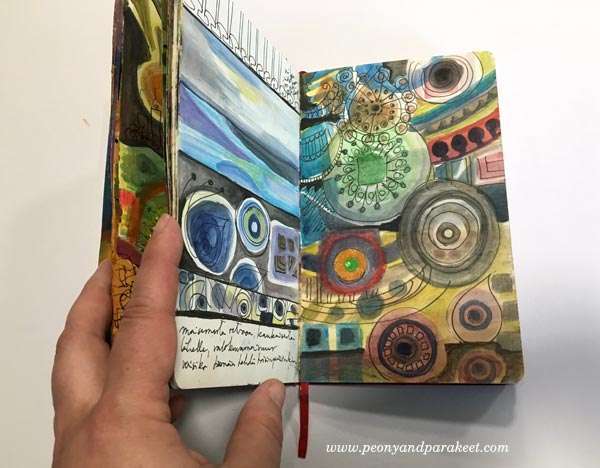
I often have an illusion that if I just think a little bit longer before I begin painting, l can start with better ideas. But then I remember that it’s just the opposite: when you see your raw ideas on paper, you can make them better. When you use the raw ideas to create the new painting, you can then visualize stories instead of creating single conventional elements.
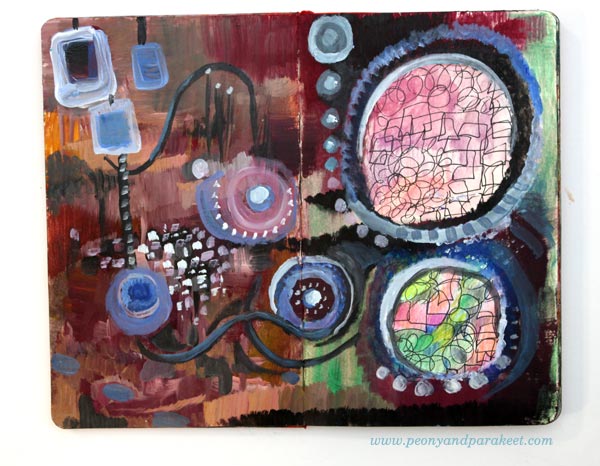
From a Disappointment to a Happy Art Journal Page
Here’s an example of how a conventional raw idea can turn into an expressive story.
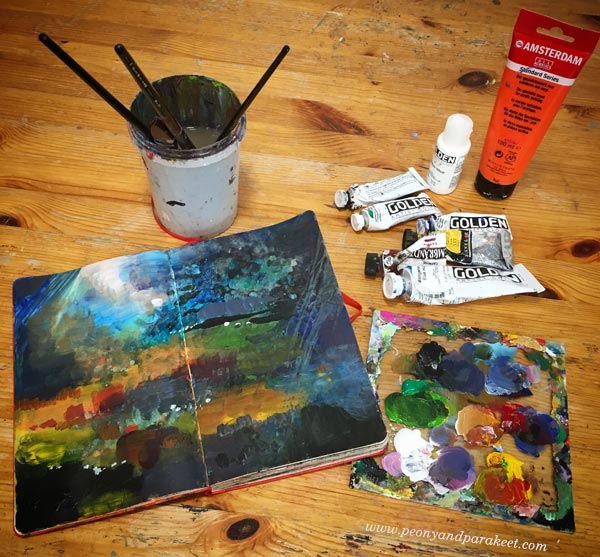
When I am finishing a painting session, there’s always the same problem: I still have paint on my palette. Have you confronted this too?
It doesn’t feel good just to wash it away, so I take one of my art journals, and use it up. I often feel tired already, and painting isn’t particularly inspiring, especially when there’s a limited amount of colors left on the palette. I made this gloomy landscape on one of those moments. The painting looked sad and empty. It felt like I had wasted my time for a lousy raw idea. But then, another day came, and I got the idea to add pastel elements in the dark painting.
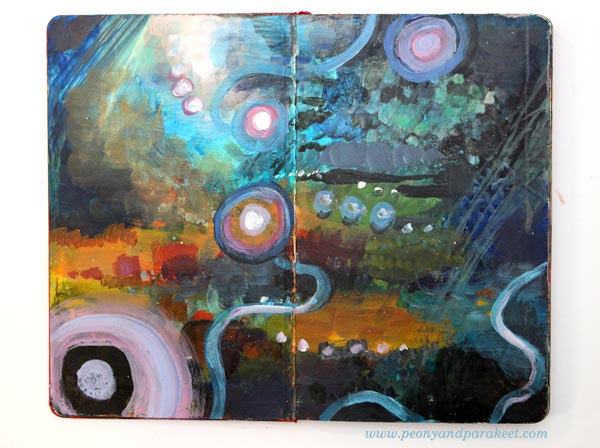
While painting, I remembered a television series, The X-files, that we used to watch with my boyfriend, now a husband, a long time ago. When an episode began, I always whistled the tune then grabbed my knitting. Although the episodes were terribly exciting, we always laughed at the whistling. The same mixture of suspense and happiness entered my spread after adding the pastel elements. The painting that had no real emotional connection became a reminder of a happy memory.
Ideas that Keep Coming Back
When you sketch ideas, you will also notice that most of them are very not different from each other.
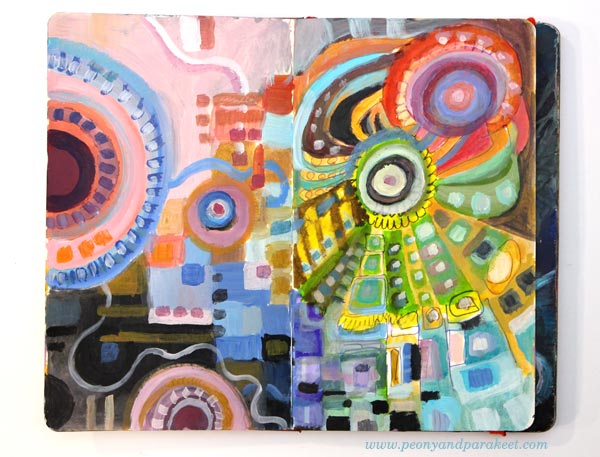
This similarity of ideas is fascinating. When I come up with the same idea again and again, I have to find out what’s behind it. Why does my mind repeatedly travel to the same place?
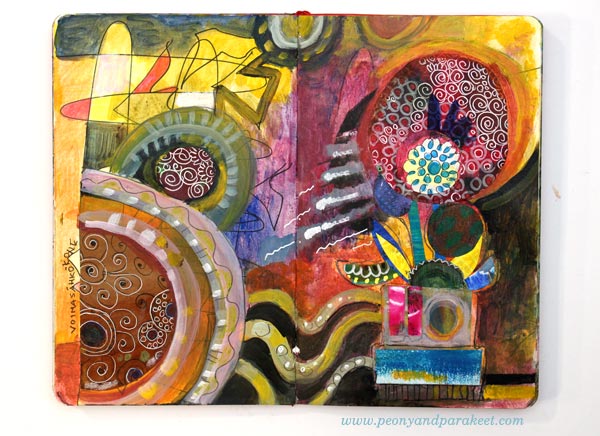
When preparing for the fall, I was about to release only one new painting workshop: Nature in Your Mind. It’s an online class where I have processed a lot of technique ideas to give you the very best experiences and results in painting. But while working with Nature in Your Mind, I had one more idea that I kept shooting down again and again. No matter how much I did that, it always came back. I saw color. I saw circles. And yes, I sketched them hundreds of times just to get rid of them! But then one day I said to myself: “Ok let’s find out what behind this idea.” So I discovered a compelling formula for creating abstract paintings so that you can fully enjoy painting with colors.
Planet Color – Get the 7-step Formula!
With the 7-step formula, you can release your mind and focus on color. You can create unique paintings while experimenting with unique color combinations. You can work with your raw ideas and combine them to a bigger picture. The workshop is called Planet Color, reserve your spot now!
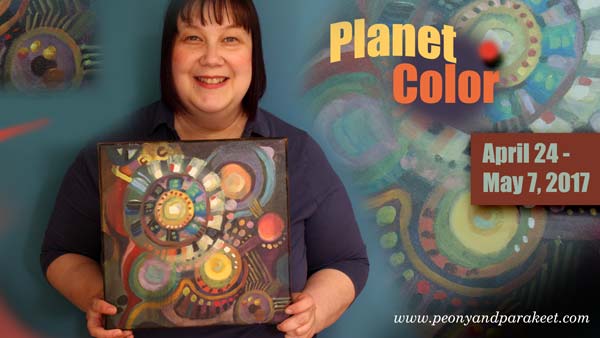
Enjoy colors and release your mind!
>> Sign up for Planet Color!
Tribute to Georgia O’Keeffe

When walking the dogs, I wondered what could I take with me for the next painting. I saw a fallen oak leaf and felt a bit melancholic; it’s time to say goodbye to summer. Then I did exactly what Georgia O’Keeffe, an American artist (1887-1986), would have done: I picked up the leaf and once got home I painted it! Here’s how I got to know more about her and her painting style.
Portrait of an Artist: A Biography of Georgia O’Keeffe
When so many of the participants of Imagine Monthly, my monthly art journaling class, named Georgia O’Keeffe as a favorite artist, my project during the summer was to get to know her better. I only knew that she had painted large flower paintings and some abstracts. But I didn’t know anything specific about her background and about her way of working. So I purchased a book about her life. It’s written by Laurie Lisle, and it’s called “Portrait of an Artist: A Biography of Georgia O’Keeffe.” I bought an audio version so I could listen to it while I paint. I don’t recommend the book to anyone who wants to read an entertaining novel. I think it’s more like a historical study. But for anyone, who wants to learn the facts, it’s excellent.
Georgia O’Keeffe’s Mindset
There are two things that I have thought a lot after reading the book. First is Georgia O’Keeffe’s personality. Apparently, she was not a very social person and quite straightforward in her sayings. Second is how her photographer husband supported her both by being her manager and her muse. I don’t think Georgia would have discovered her painting style without the discussions with her husband related to photography. These two facts make me believe that her mindset was very analytical. Even if she was a visual artist, she also was a scientist in her closed personal world. She examined plants like they were scientific specimens. It was like she could measure beauty and then create a new version of it. The more I listened to her life story, the more fascinated I became about her.
Those who live in the UK or are visiting the UK: There’s a big exhibition of Georgia O’Keeffe at Tate Modern until October 30!
Botanical Discovery – Create Unique Collage Art!
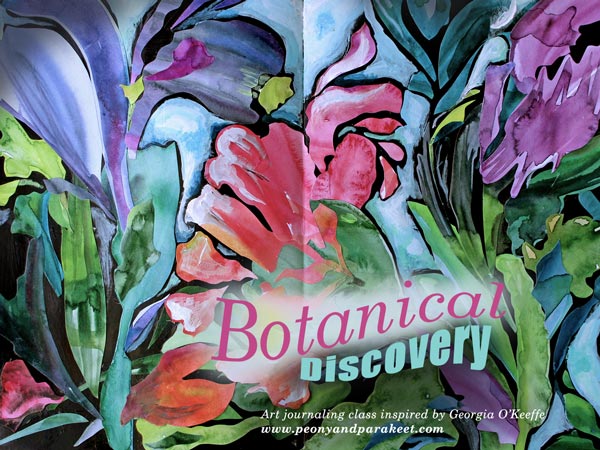
As a part of Imagine Monthly Fall 2016, I have published a class where you can create botanical art inspired by Georgia O’Keeffe. It has directions on how to cut organic shapes from watercolored papers and build a painted collage out of them. Sign up for Imagine Monthly and get this class immediately after registration!
Painting an Oak Leaf – Watch the video!
The oak leaf shown at the beginning of the page is an acrylic painting on an art journal. I made it as a tribute to Georgia O’Keeffe and recorded a short video of the process. In the video you see me painting with a broad brush and flowing strokes. This is one of the techniques that I’ll show more in depth in my upcoming workshop Nature in Your Mind. I hope to see you there too!
Create collage art inspired by Georgia O’Keeffe:
>> Buy Art Journaling Bundle 2!