
A Decorative Pattern for Art Journals and Beyond
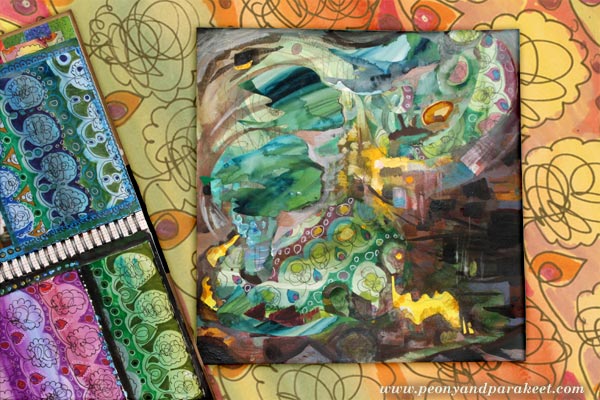
A couple of months ago, I made a flip-through video of a full art journal. Many noticed a spread that was made from decorative papers mostly. I remembered that I took some photos while making the papers and I will share step-by-step instructions here. This pattern is good practice for motoric skills and drawing, but it can also go beyond! I used it for a more expressive purpose, for a collage art piece.
1) Paint Stripes with Watercolors
Use a fairly thin paper and paint it with watercolors. Use a selection of colors to create stripes or curves.
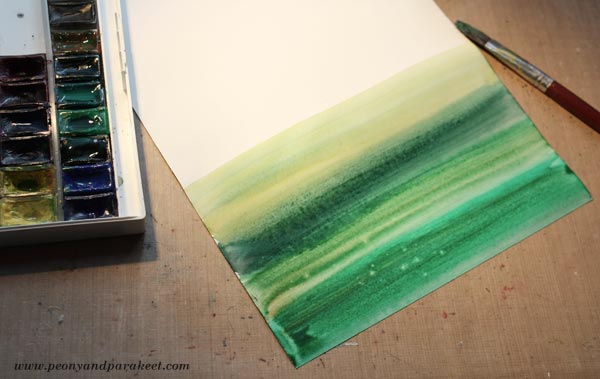
You can add drops of water if you want to make the background more interesting with bleeds.
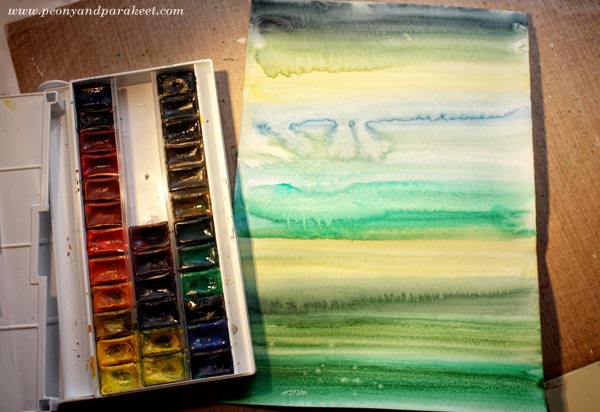
Let the paper dry properly.
2) Decorate the Stripes with a Simple Loop Pattern
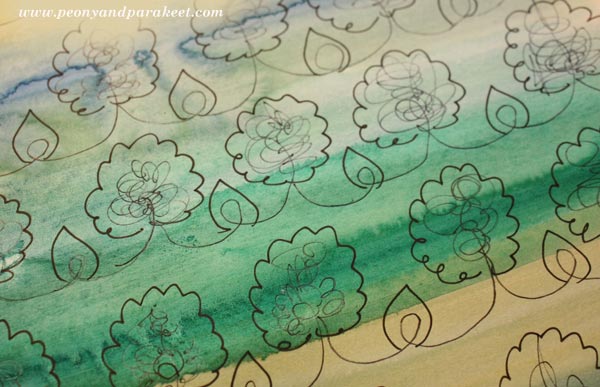
Using a thin-tipped black drawing pen, draw a simple loop and end it with a curve upwards. Without lifting the pen off the paper, add a bunch of loops on the top of the curve. Then continued by drawing a curved line downwards. Repeat and draw the whole row on the same go. Work fast and don’t worry too much about the symmetry or similarity of the loops.
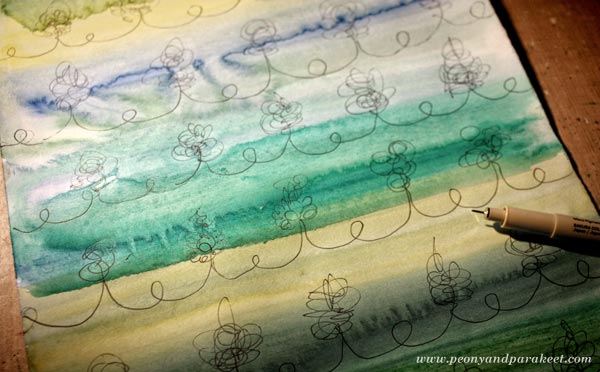
After drawing the rows, frame the loops to make them more distinct. I used simple shapes to create flowers and leaves.
3) Color the Background and Add More Decoration
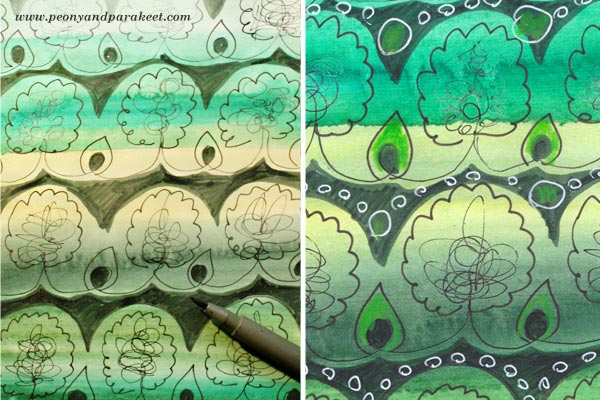
To make the watercolored layer look more lively, use felt-tipped pens (marker pens) and color the background around the doodled shapes. You can also add more color to doodled details and use a white gel pen to add more decoration to colored areas.
Decorative Pattern in Many Colors
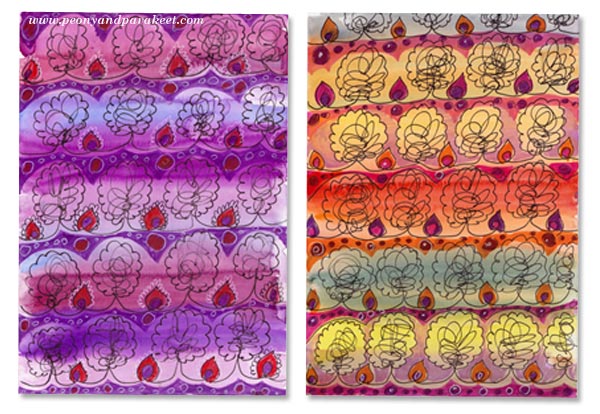
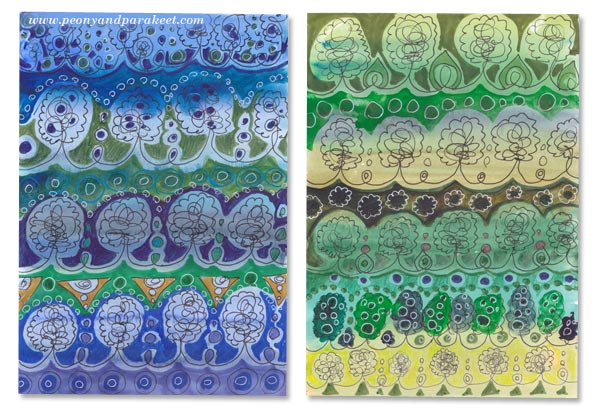
This pattern looks luxurious when you make many papers in many colors with slightly different decorations.

Here are some that I made!
Decorative Pattern in Collage Art
I am fascinated by the interface between art, design, and crafts. The idea for the pattern came from knitting. I wanted to find a similar relaxing circular motion using a pen instead of a knitting needle. So that’s how a craft transformed into a design. But design can also be a part of a more expressive piece.

In this collage, I use decorative paper pieces with paint. My starting point was a watercolor background, acrylic paint, and a piece of decorative paper.
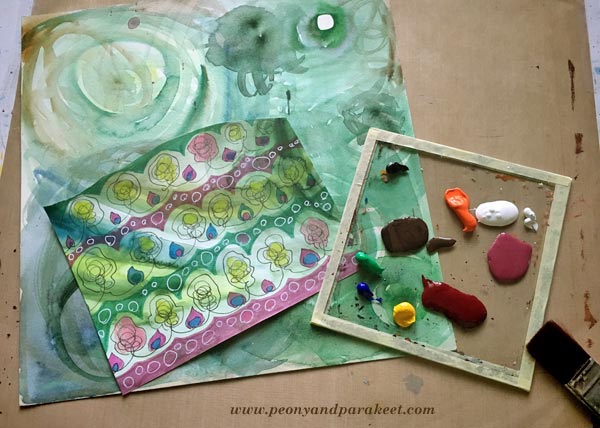
I cut a couple of decorative shapes and glued them on the background with gel medium.
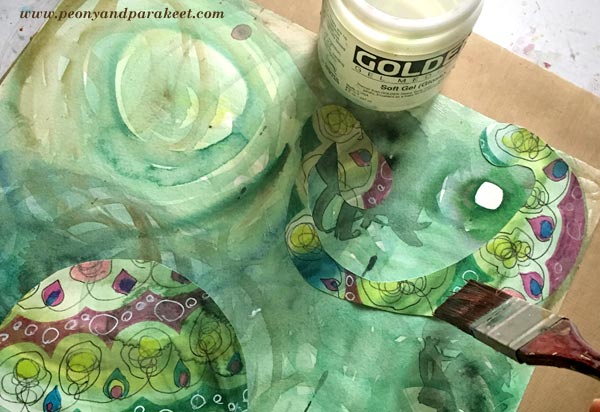
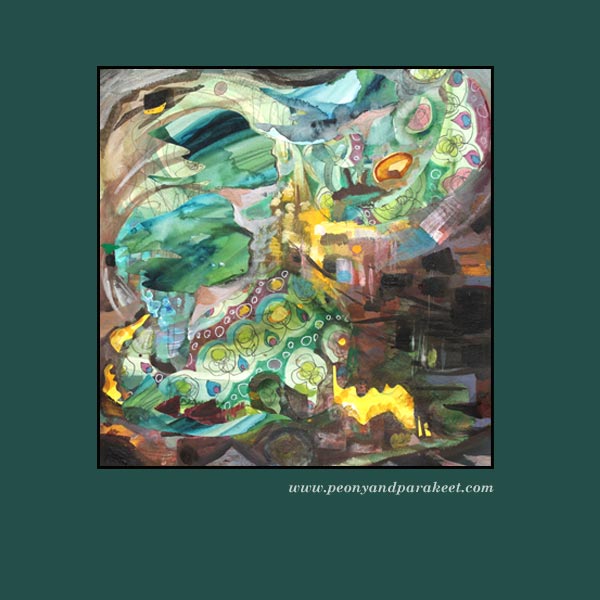
Then I continued with painting using acrylic paints. In the finishing phase, I also used some more paper pieces and few colored pencils. A week or two ago, I heard the geese flying over our house. They were leaving Finland, going to a warmer place for a winter. Their sounds made me think how limited we people are, not being able to fly so freely, not always being able to stick so tightly together. The screams of the geese felt bright yellow and for a short moment, I wanted to join them and not stay in Finland, waiting for snow …
Get step-by-step instructions for doodled collage art – Buy Doodled Luxury!
New Online Painting Workshops – See the videos!
I have two new online painting workshops in October! See the videos and sign up!
Planet Color is suitable for beginners and focuses on color!
Nature in Your Mind is for those who have been painting for a while and who love nature themes!
I have got quite a lot of feedback about the intensity of my workshops: that people wish they could reflect more and have some time after the most intense part of the workshop with the opportunity to get more personal feedback. So I have taken this into account in this workshop, thank you all who have filled the feedback form after my workshops! I get back to them all the time and use them when planning new courses like this one!
Come along and free up your painting!
>> Sign up for Planet Color!
>> Sign up for Nature in Your Mind!
Hopefully I will meet you in either of these – or in both!
Paul Klee and the Art of Learning
This blog post is a personal story about being a student of Paul Klee. I will also share my thoughts about art classes and about their effect.
Paul Klee’s Pedagogical Sketchbook
It was a late evening at the beginning of July – one of those white nights that take place in the middle of summer in Finland. When the sun is up, it’s more tempting to stay awake than to go to sleep. It also felt better to pick a brush and paint than to slow down with knitting or watching tv. My brain activity was high. I didn’t want just paint, I wanted to learn something new.
While pondering about learning, I remembered a thin book that had been on my shelf for a while. It was borrowed from a library a few weeks ago and I hadn’t opened it since. The title was called “Pedagoginen luonnoskirja” – Pedagogical Sketchbook, written by a famous abstract artist Paul Klee in 1925. The original version was written in German. In 1953, it was translated into English and finally into Finnish in 1997. The long timespan proves that the book has some ever-lasting content. But when I began to examine the first chapters with the brush in my hand, it seemed very uninspiring. The pages were black and white, no color, but the worst thing was: it looked like a math book! It had formulas, diagrams, references to geometry, anatomy, physics … What was I thinking about when I borrowed this book!
Abstract Art Theory for the Left Brain
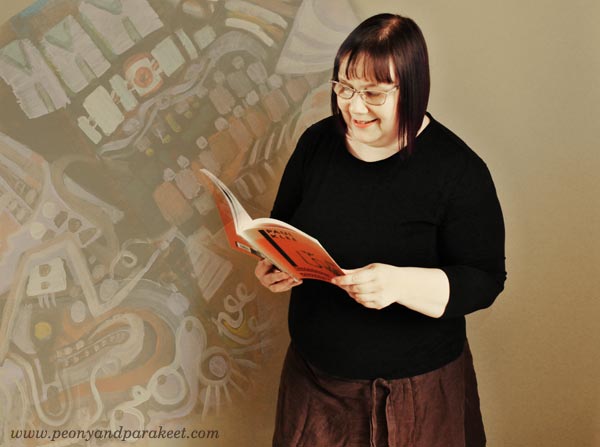
But then, I remembered that my artistic side wasn’t playing along when I found the book at the library. Being so thin, it could hardly be seen on the shelves filled with thick art books. Seeing its cover, my engineering side that got interested: can there be formulas for art? Is this the book that teaches the left brain to understand the right brain?
So even if I had my art journal open on the table and paints ready on the palette, I decided to switch gears and start reading the book – slowly and carefully like engineers do. After a couple of minutes, I was hooked. I was mesmerized by the world the book presented. Phenomenon familiar from my physics studies were tied into modern abstract art. The book was broken into three parts. Each part contained short chapters. like tiny lessons. I decided to begin studying each chapter so that the engineer in me would read it first. Then she would explain it to my artistic side who in turn, would fill an art journal page by playing with the concepts.
Side note: Interested in the book? Here’s a link to Amazon.com. There’s also a free PDF of the book available if you google it but I don’t link it here, as it may be an illegal copy.
Paul Klee’s Ideas in Practise
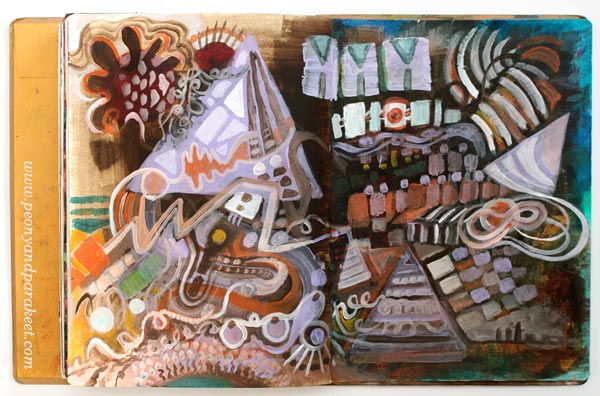
When I eagerly studied the book, I felt I had a teacher, Paul Klee himself. It was exciting to listen to him talking about muscular movement, material structures, disturbed balance, how the perspective is experienced or how the blood circulates in a body. And most of all, how it’s all connected to visual communication and visual art. I imagined being one of his many students and even one of the most enthusiastic ones. I was constantly raising my hand, not only asking questions but also questioning: how did you come up with this idea, why have you omitted this fact?
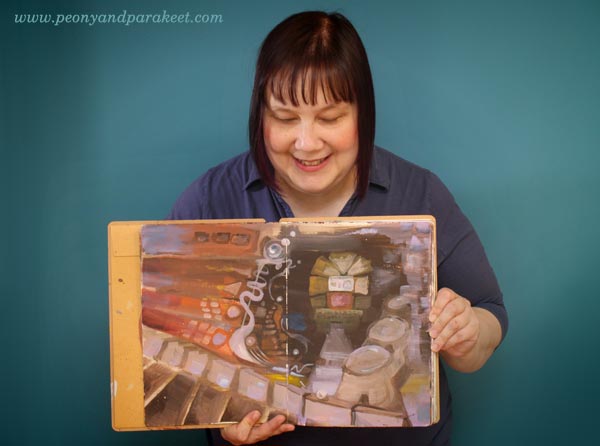
Do These Ideas Suit My Style?
Even if I was painting and reading like a maniac from one chapter to another, I was also in doubt. Stiff figures that I painted looked very old-fashioned to me. I had a teacher who hadn’t experienced the digital age, who hadn’t seen or created any contemporary art. “Tell me, Paul Klee, do these rules apply to many styles, including mine?”, I kept asking.
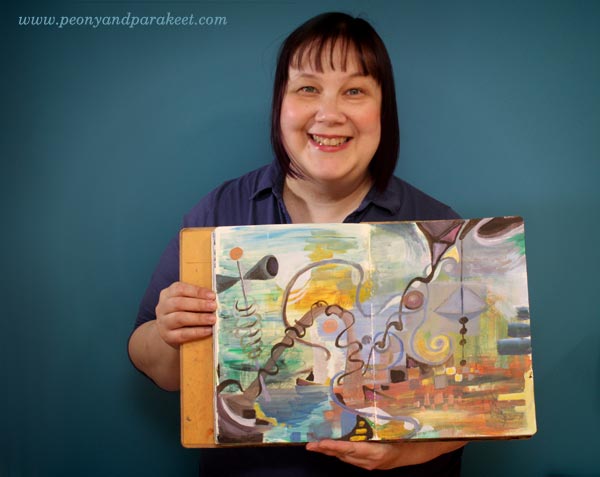
But despite of the constant battle in my mind, I couldn’t put the book away. I went from one chapter to another and eagerly waited what my teacher would present in the next one. And when the last chapter was completed, I felt sad to leave the classroom and say goodbye to my teacher. During the session, I had completed three big art journal spreads. They all looked like the middle of 20th century to me. The session seemed to be nothing else but a fun engagement when the sun finally set down.
The Aftermath of Learning
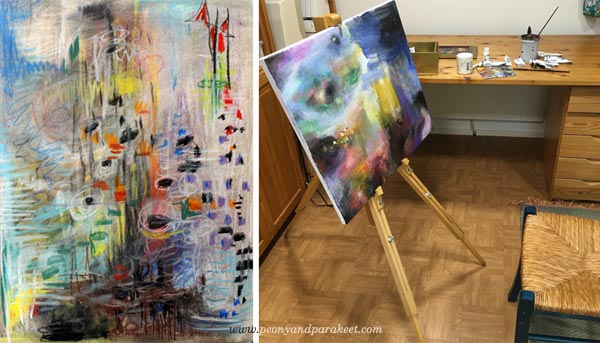
During the next weeks, I saw sudden glimpses of Paul Klee. When I was taking photos, drawing, painting or just observing, Paul Klee’s theories began to merge with my own thinking and with my own style. The three spreads that I had made were exercises only. Once I left the classroom, I was free to apply those theories where suitable. This is what happens in every art class. You might think that the exercises are not fit for you. You might have doubts if the class fits your current style. And when you leave the class you might think: “Oh well, I don’t know if I ever do this again.”
But like the blood needs oxygen, creativity needs new theories, techniques, and ideas. They are no threat to your style, they are essential to continue developing your style. That’s one main reason why I challenge you to learn new techniques at Imagine Monthly (you can still sign up!). That’s also a reason why I will be inviting you to join my newest online painting workshop, starting in October.
Coming Up: New Painting Workshop
I am really excited about this! Be assured that I will have something special for the beginners and a lot of new to focus on for the more advanced painters. The theme for the class is expressing nature. The registration for the new workshop will open next week with a short-time early bird pricing. I will give more details about the class then.
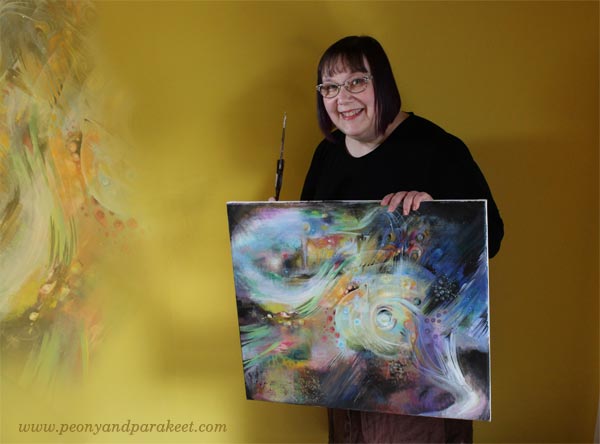
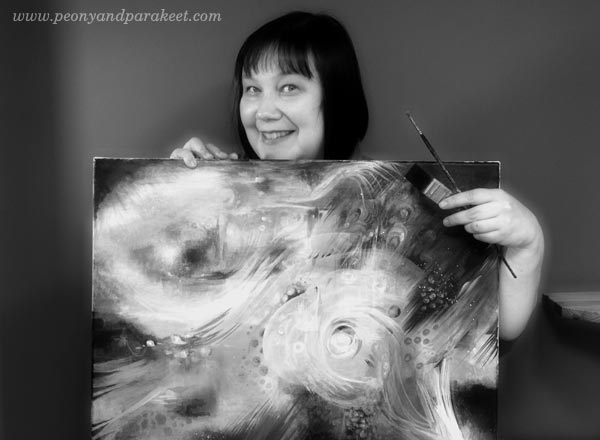
While building the class I have practiced the techniques and ideas on a big canvas. This painting is still in progress, but I want to show it to you just to be able to compare the art journal pages above and how Paul Klee’s teachings have merged into my own style. That’s what’s my goal with you too: that you’ll have a fun time with the classes and that you will be able to mix new things with what you already know and love.
Update 4 years later: I have a new class based on Paul Klee’s and Wassily Kandinsky’s teachings – Floral Freedom! >> Buy now!
What to Create from Simple Shapes? 6 ideas
When I catch myself building a visual image in my mind, I say to myself that my hands have to process the idea first. The idea can be a decorative design or a new painting or anything visual. When my mind is vigorously trying to create images that I would be happy with, my hands don’t understand my mind at all. My mind is a fool and my hands are ruthless.
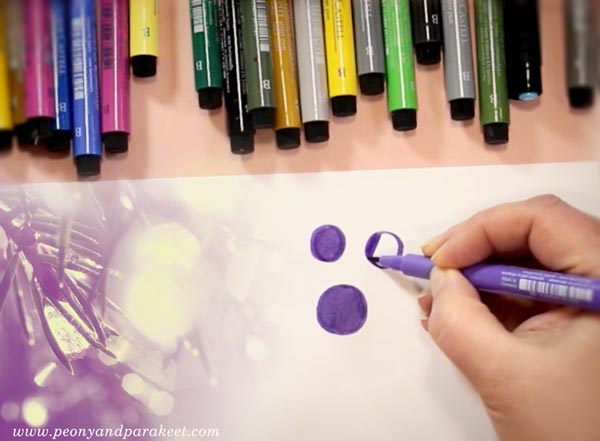
In my mind, I can easily miss the elements that are needed for building the beautiful image. If I imagine a scene, the details that make the scene look so wonderful, are not all there. My mind only has a glimpse. The connection from the mind to the hands feels easier if it’s the other way around. The hand draws a couple of circles and the mind gets creative with them. This way building the bridge from my mind to my hands seems to work much better. Big pictures, personal stories, attractive designs are not born in my mind first. They are born in a conversation that is led by my hand drawing with pen on paper.
But hands don’t decide when to get started, the mind does. This is why I will give you few ideas to start the conversation between your hands and your mind. Like this, this and this post, this blog post is illustrated by my students. The art journal pages that you see here have been made at Modern Mid-Century art journaling class.
1) Build ornaments by grouping simple shapes.
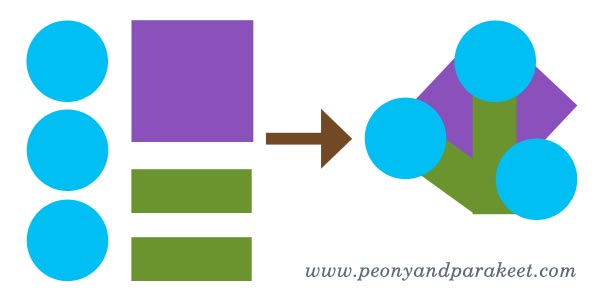
Nel Wisse has created colorul clusters and then grouped them to bigger ornaments.

2) Create a surface pattern and cut a shape from it.
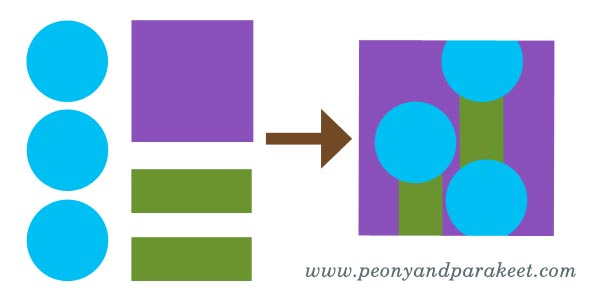
For example, see Darci Hayden’s cat and the stairs! Shapes that include patterns look always fascinating. (More patterned paper ideas)

3) Play with Sizes and Layers
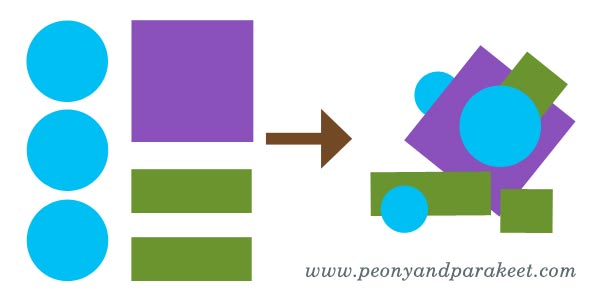
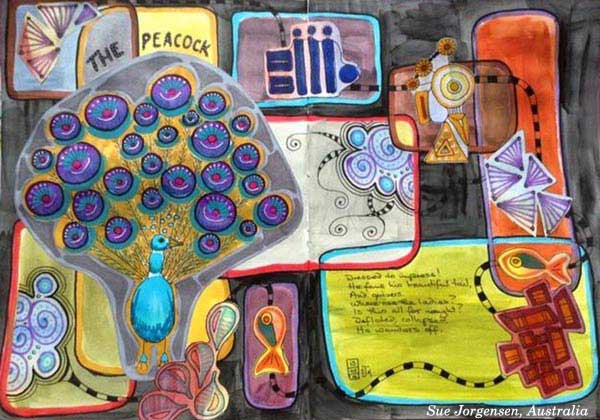
Cut some elements smaller and add dimension to your page by playing with layers.
Sue Jorgensen has a good variety of both large and small elements.
4) Build a map, a house or a room plan
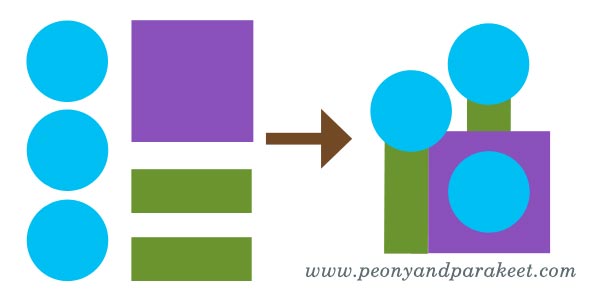
A clear hierarchy between the elements pleases also your left brain.
Marie Jerred’s fox is in the middle of an adventure!
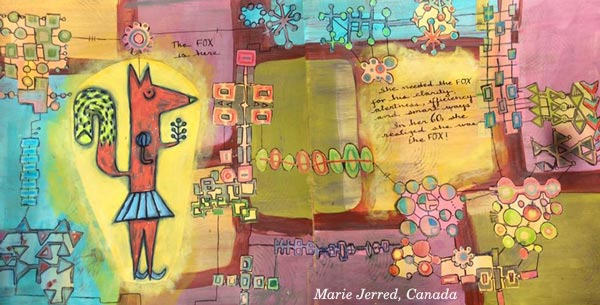
Stephanie Carney’s Flamingo is just entering a house of dreams.

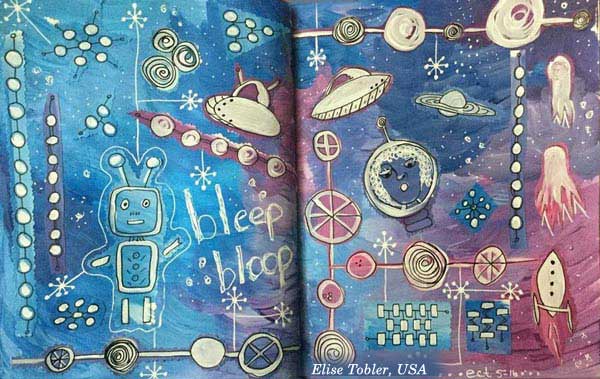
5) Express Micro or Macro World
Both micro and macro biology deal with basic shapes. Explore either molecules or satellites!
Susan Prothero’s micro world is captivating.

Elise Tobler‘s space is full of life!
6) Find a connection to a story
Explain what you associate with the shapes and then move on to a more illustrational approach. Elaine Wirthlin’s spread is an awesome example!

Buy the class: Modern Mid-Century!
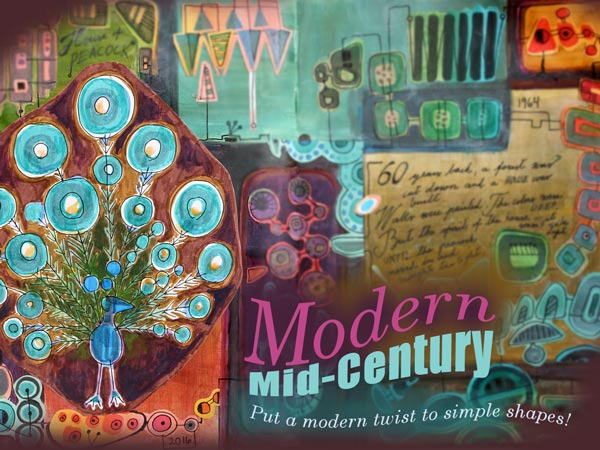
Designers in 1950s and 1960s (like Annikki Hovisaari from Finland and Lisa Larsson from Sweden) truly knew how to play with simple shapes. Modern Mid-Century is a self-study art journaling class where I am inviting you to my living room and showing inspiring examples from the middle of the 20th century. Then I will help you to design your own unique motifs and build a collage that is both decorative and expressive.
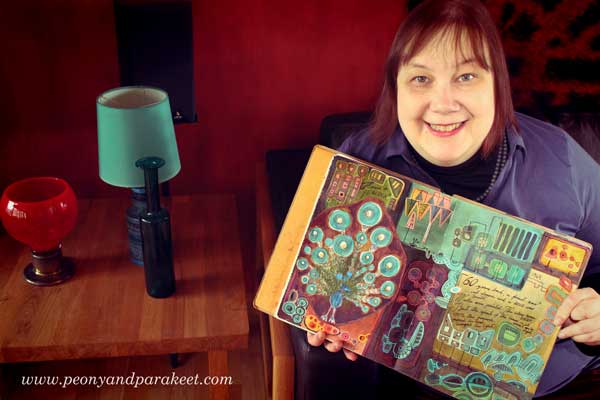
Modern Mid-Century
Start playing with simple shapes! >> Buy Now!