
Recent News with Mystical Thoughts
This week, I’m sharing a bit about what I’ve been up to. This fall has been and will be full!
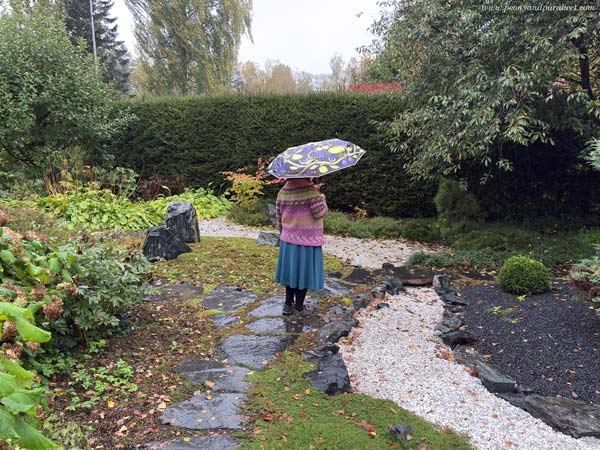
Giving Life to a Line
Creating the course Drawing Soulfully has been one of my biggest projects this year. The videos are packed with content, and making them took a lot of time.
Now, it has been wonderful to see the participants’ drawings and discuss them together. Everyone has their own unique line, and I tried to design the exercises to bring that out as well as possible.
My motto is: Art begins with a line!
And you could also say: Style begins with a line.
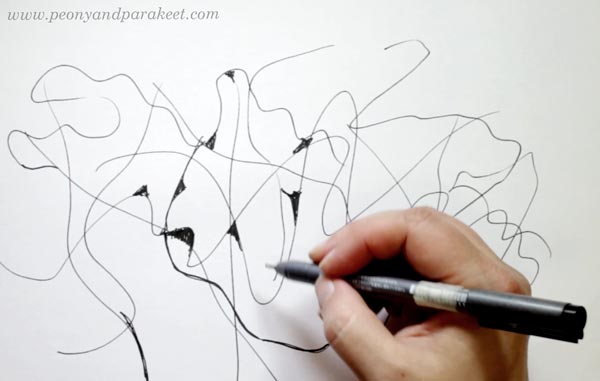
A line can be so much more than just an outline. It can express emotion, movement, space, and spirit.
Tough Break Ended
In August, I finished a series of 10 oil paintings that I had started last year. That was another big project, but as I was finishing up the final details, new ideas were already starting to pop up.
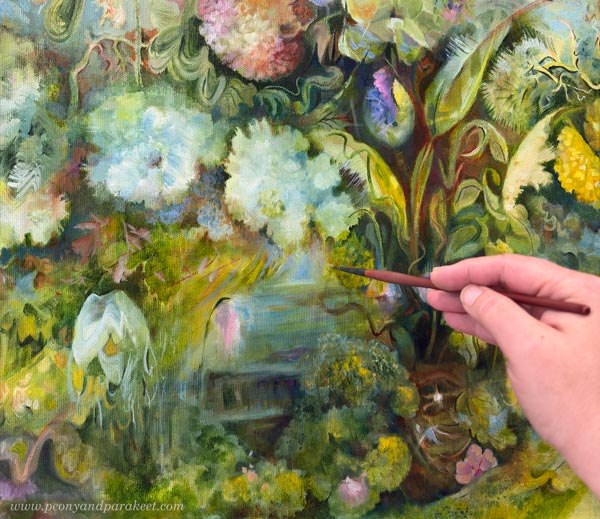
Most of the time, my ideas are connected to broader themes rather than exact subjects or techniques. These thematic thoughts are verbal, so I write them down in my calendar. But writing is not the same thing as expressing yourself visually. The breaks between paintings are always tough for me. First, I’m exhausted, but as new ideas start to pile up, I feel restless and suffocated. It’s like being a fish without water!
Fortunately, I’ve now been able to release the tension and start the first painting of a new series this week. It’s still in its early stages, but I look forward to working on it week by week.
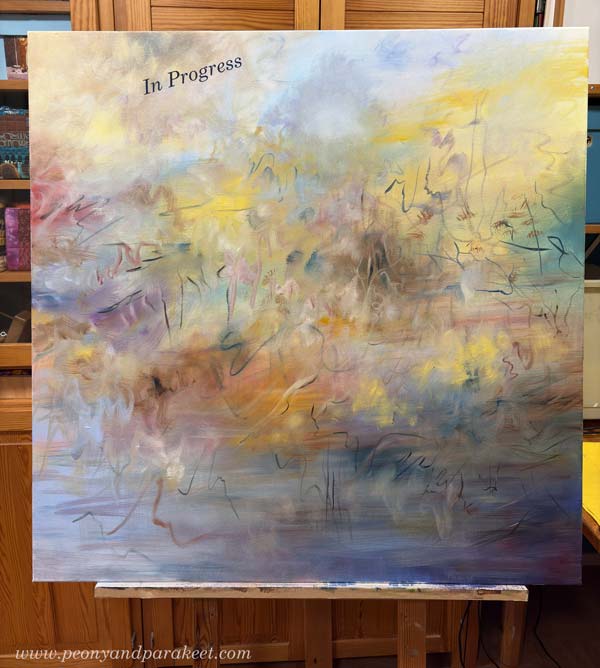
I usually work on two paintings at once, because that way, each painting has a sibling, so to speak, and doesn’t have to grow up alone. And even now, I have a canvas of the same size waiting that I hope to start soon.
Babies, Toddlers, and Hamsters – One Killed!
In my dreams, unfinished paintings and courses appear as babies or toddlers, while smaller tasks appear as hamsters. I used to raise hamsters a long time ago, and even though I don’t have them anymore, my subconscious has somehow given them a symbolic role.
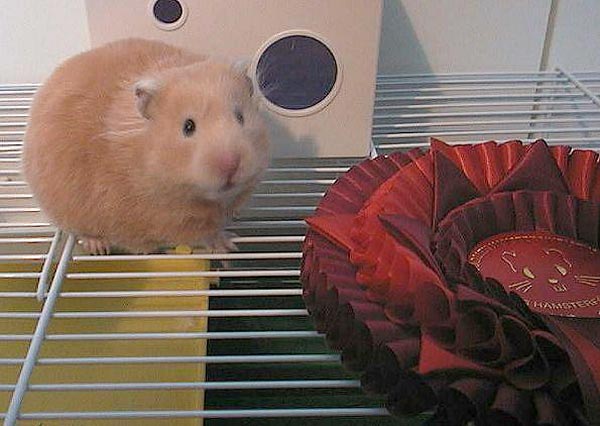
Usually in these dreams, I suddenly realize I’ve forgotten to feed the hamsters—but recently, I had a nightmare where I was trying to kill a hamster. When I woke up, I knew I had to let go of the mentoring program I had been advertising lately.
So, there won’t be a mentorship group, but if you buy any of my courses, you’ll get access to my Bloom and Fly Facebook group where I am very active!
Sales Table Preparation
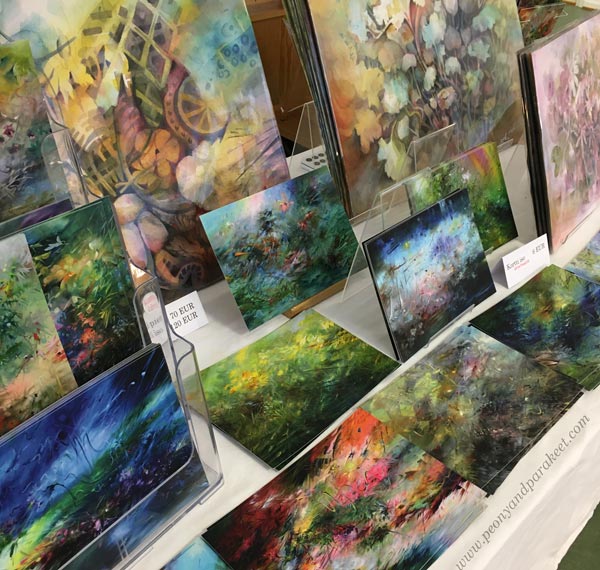
I’m attending at least one art fair at the end of this year. I’ll have cards and prints with me, but I also dug out some of my old watercolors from storage. I should probably touch up a few of them from this pile, as my skills have developed over the years.
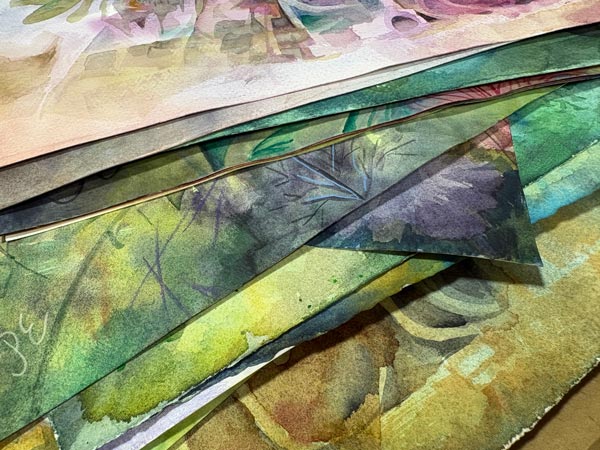
Do you like to see revamped projects here on my blog? Do you ever revamp your art?
My biggest paintings have their own sales channels, but attending a fair is a great way to meet people and see their reactions. The last time I had a sales table was in 2022, so it’s about time!
Mystical Meetup!
Do you remember when I launched a course called Mystical Minis at the turn of the year? Making that course was a mystical experience. It started when I heard a whisper: “Intuitive Power.” I then connected the words to the Swedish esoteric artist Hilma af Klint. The course was made in a flow state, and it’s perhaps my most unusual course yet. I took its structure from a short story by Virginia Woolf and included a third artist, the English painter Georgiana Houghton, in the exercises.

And guess what? At the end of October, a super-interesting exhibition called Arcana Borealis – Northern Women and Esotericism opens in Helsinki. It features paintings by Hilma af Klint and her partner Anna Cassel, alongside other Nordic female artists. I will go to see the exhibition and hope that Hilma starts whispering to me again. I’d love to make a new mystical course!
More Mystical Thoughts
It’s a bit sad that winter is coming to Finland. Our summer is exceptionally bright, but our winter is very dark. Still, I think the turn of the year is the best time for esoterics, as we find ourselves in a kind of extreme state.
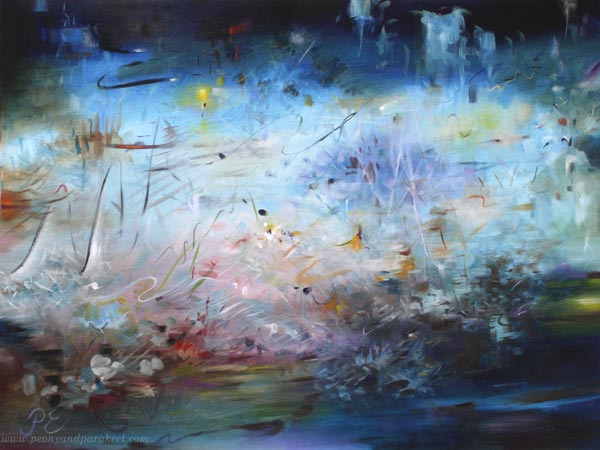
I’ve also been thinking a lot about what our world needs right now. My thoughts are that in the middle of fast consumption, we need a deeper connection with ourselves. Whether one believes in the supernatural or not, there is always something mystical and unexpected in going deeper. I also feel that in art, we don’t have to decide what is imagination, what is intuition, or what is a stream flowing directly from the outside.
Just by stopping to look and listen more closely, we bring mystical depth into our work. Visual poems start to rise, quieting the outer world.
What do you think?
Loosen Up Your Art!
This week, I want to share what I think about the popular art term: “loosening up”. For me, loosening up isn’t about interpreting a reference minimalistically and thus aiming for something more abstract. Instead, I loosen up when I create freely. Imagination, empathy, and playfulness play an important role in this kind of art-making.
Loosen Up Your Art – Watch the 1-minute Video!
I find this free approach inspiring, and it makes every piece an adventure.
Imagination and Intuition
The longer I have created freely, the more I have started to value the ideas and expression behind the drawings and paintings, and not just focus on their technical quality.
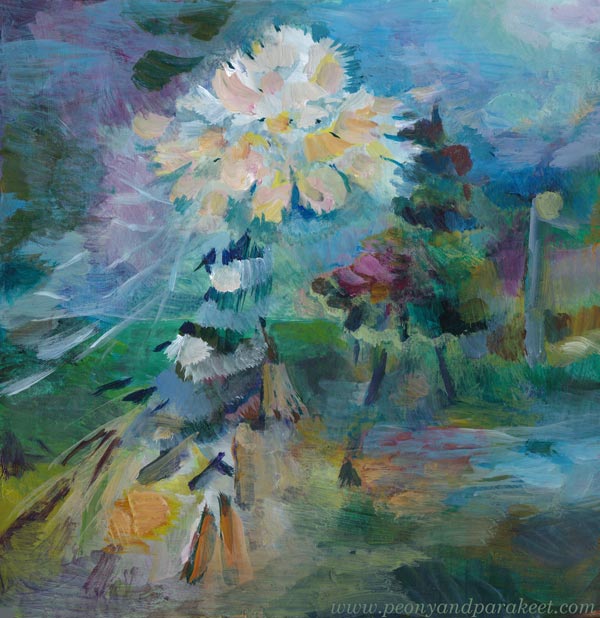
Yes, we want to grow our technical skills, but it can’t be the only goal! The flow of ideas and inner connection matter. Thus, loosening up is freeing the mind and creating a mental connection, not just strokes.
Imagination and intuition – how important are they to you?
Join My Mentorship Group at Mastrius!
My mentorship group is for aspiring artists who want to create freely without references and find their style.
Together, we will step away from the traditional route and enter the jungle where anything is possible. That jungle is the place where loosening up happens.
Mentorship Group in a Nutshell
- Zoom meetings in a small group.
- Personal guidance and feedback.
- Ongoing monthly membership. Join and cancel anytime.
>> Join here!
Drawing a Summer Ornament
This week, I want to show that an ornament can be more than just a decoration. An ornament can be a framework for expression in the same way as a portrait, a still life, or a landscape.
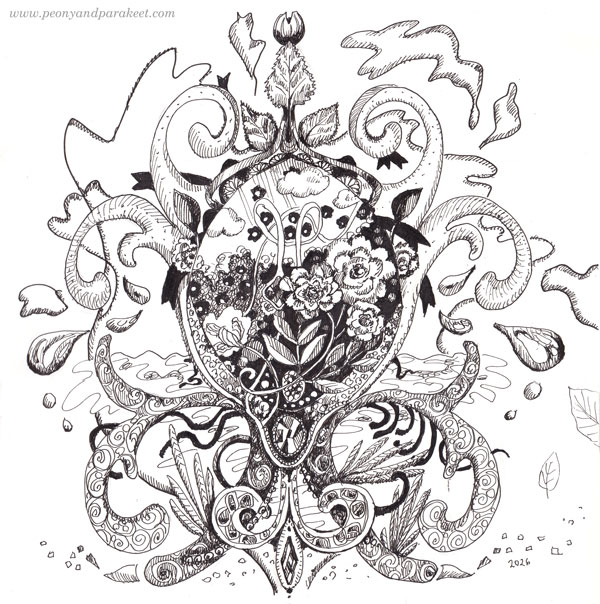
I love drawing ornaments. It feels as though the universe is shouting at me: “This is right, this is a good thing!” If I’ve had past lives, I’d think this is the work I’ve always done in some form, because it feels so natural.
Step 1 – Grid
If I decide to draw an ornament, nothing holds me back—not even the requirement of symmetry. This time, I made a grid to help me achieve similarity on both sides more easily.
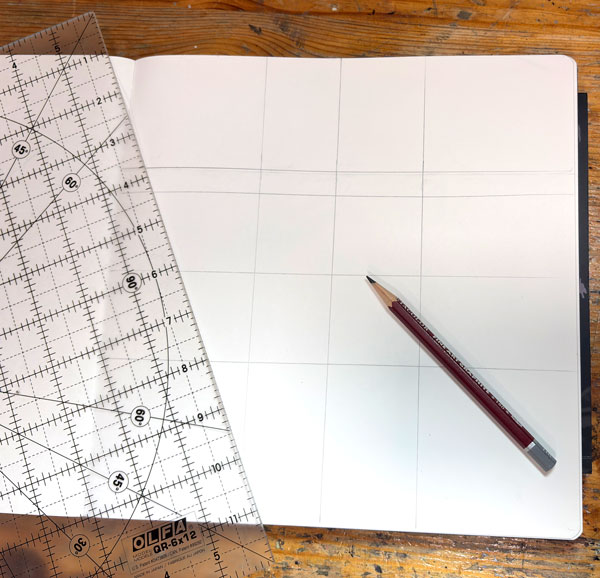
It’s good to have center guidelines, but there can be more and placed anywhere. All guidelines are helpful when drawing the ornament freely.
Step 2 – Pencil Sketch
I sketch the biggest symmetrical parts in pencil. But I try to keep this phase short because the best part of drawing ornaments is letting loose and discovering how the symmetry can be broken.
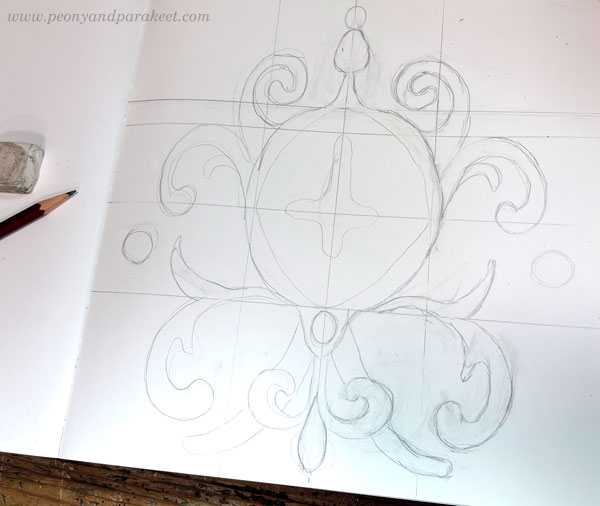
Drawing an ornament is like putting your soul into a lion’s cage and then watching it break out with cleverness, rather than violence.
Step 3 – Getting Creative with a Non-Erasable Pen
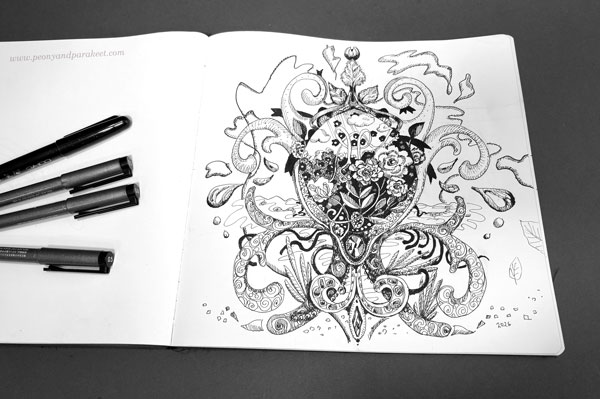
For the actual drawing, I use black markers. Here, I’m using Copic FineLiner pens and a Copic Gasenfude brush pen. An ornament is like a meandering canvas where you can draw anything. You can draw both the realistic and the abstract, and it all looks great because it’s embedded in the ornamental structure.
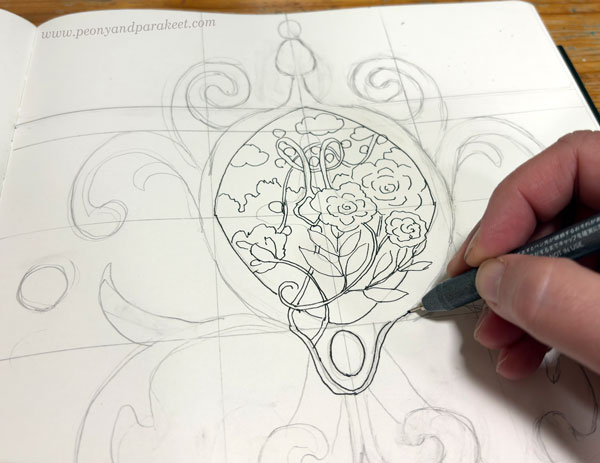
We currently have summer here in Finland, so I wanted to draw summer-related things: the sea, a garden, and birch leaves.
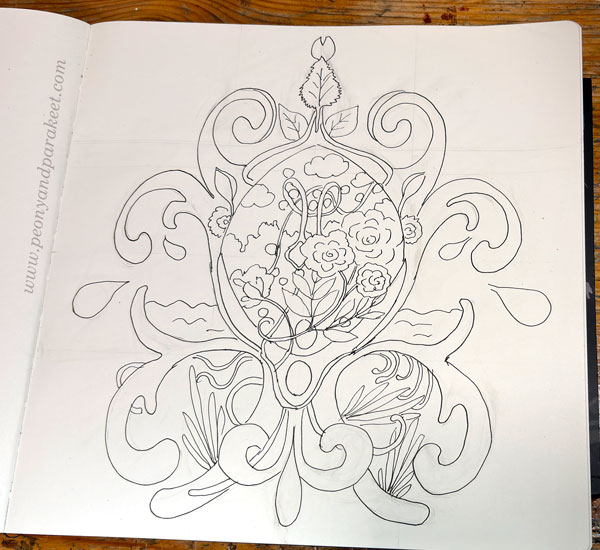
Step 4 – Getting Lost in the Details
When I have most of the things in place, I put on an audiobook or a talk show and focus on the details!
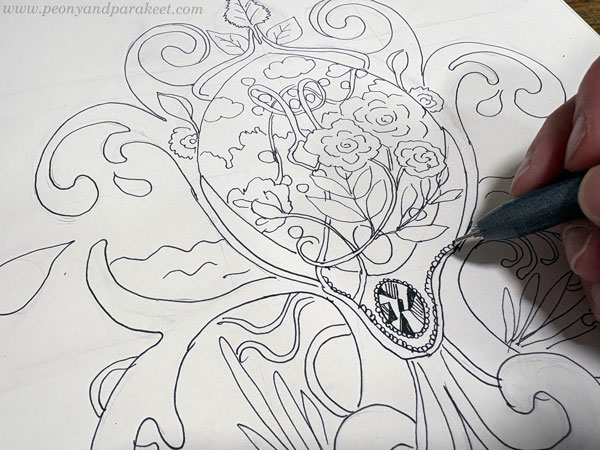
My ornaments almost always have jewels because I find them fun to draw and the result rewarding. A jewel comes to life when you draw geometric shapes with a fine pen and fill them differently.
I always include elements that are pitch-black to create contrast. The brush pen is quick in these details.
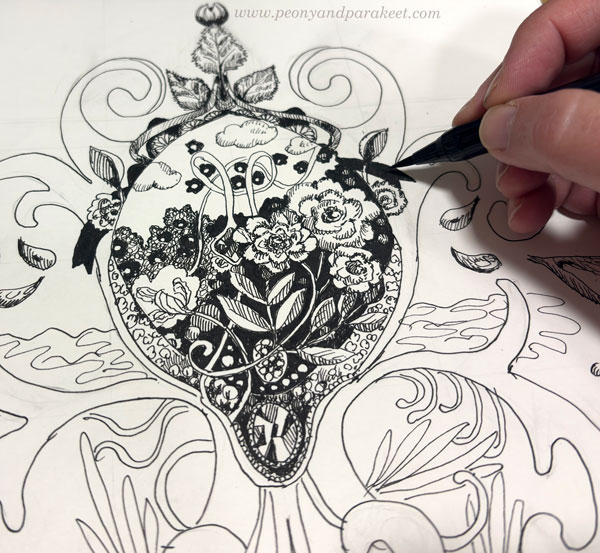
The Freedom in Drawing Ornaments
The longer I draw, the more I want to create tension and asymmetry. In this ornament, the lines took on a life of their own and spread beyond its borders. Ah, so liberating!
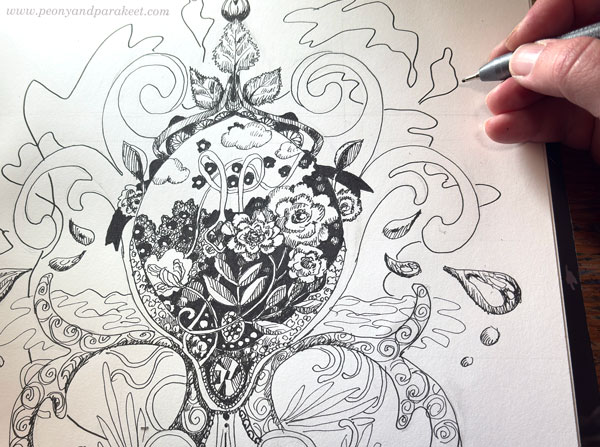
It’s exciting and even contradictory that such freedom can be evoked from a rigid ornament.
The Summer Ornament
Here you can see how I’ve used the pens for the fine details in the center.
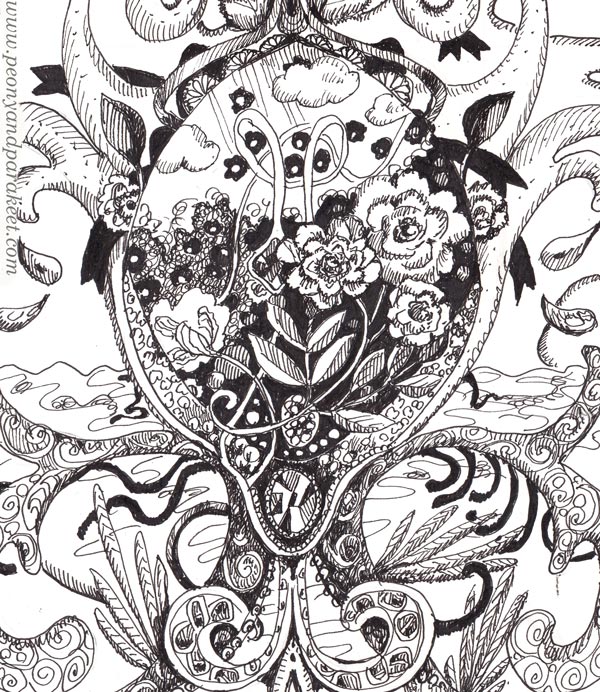
I hope this summer ornament inspires you to pick up your pens and start drawing!
For more inspiration, see also these blog posts:
What Tsubaki Stationery Store Taught Me About Making Art
I listened to a wonderful book. It was like a refreshing rain pouring straight into my heart.
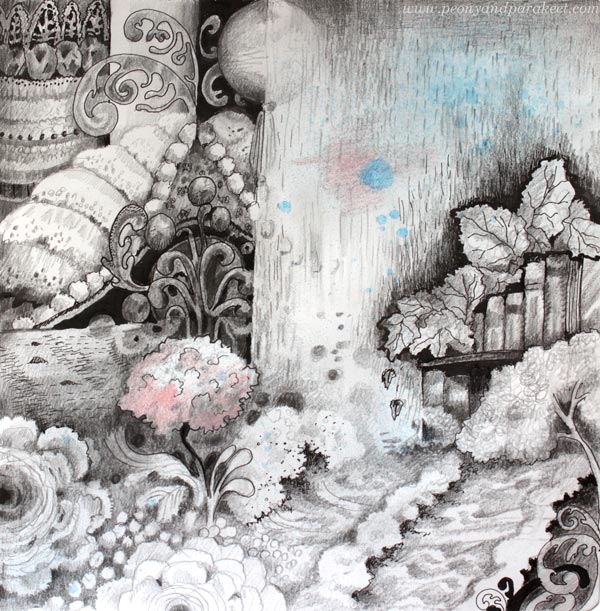
The book is new and by the Japanese author Ito Ogawa. Its Finnish title is Paperikauppa Tsubaki, and it is also being released in English as Tsubaki Stationery Store (Amazon – affiliate link, Goodreads)
Tsubaki Stationery Store
The book tells the story of Hatoko, who has inherited a small paper shop from her late grandmother. It isn’t a sticker shop, but a very minimalistic one. Additionally, Hatoko offers handwriting services. For Hatoko, “beautiful” isn’t a static concept. Case by case, she carefully considers not only the message itself, but also the shape of the letters, the paper she chooses, the writing instrument, the envelope, and even the postage stamps.
You absolutely must read this book.
Refreshing Rain
I loved the book so much that I wanted to make a drawing about its impact. It started by spraying some ink.
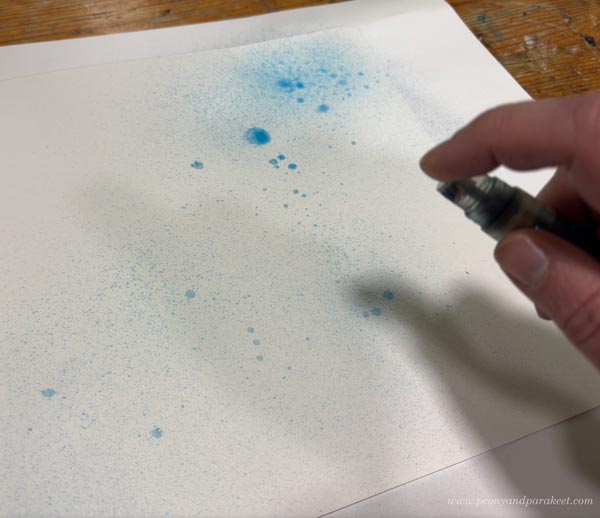
I got the idea of spraying ink when browsing the pages of my sketchbook. See this blog post from 2019: 10 Black and White Art Techniques with Personal Stories
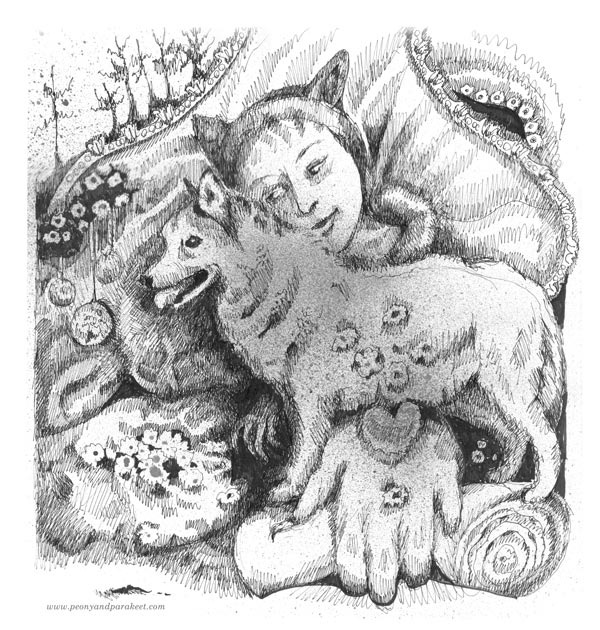
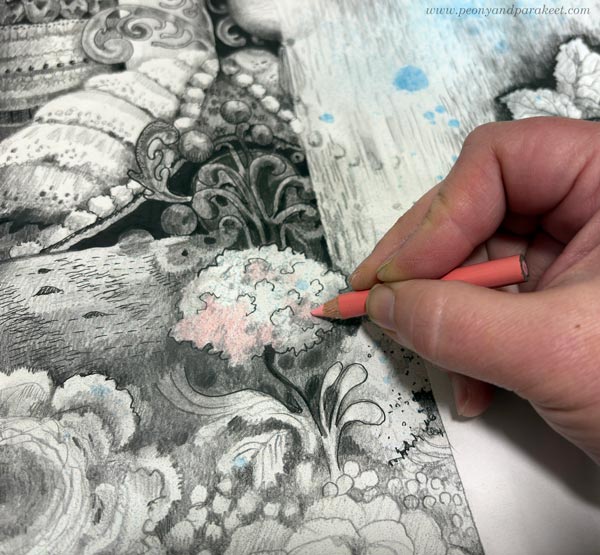
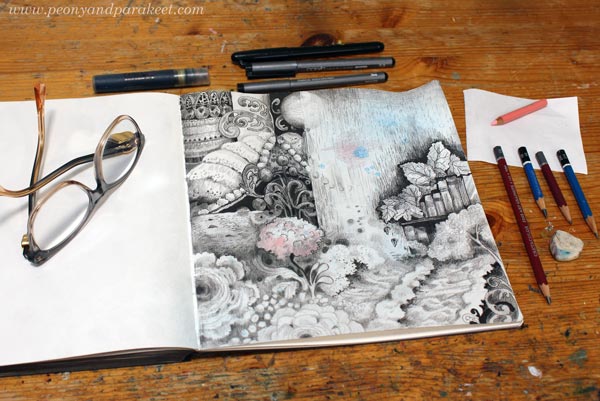
I then made the drawing with pencils and ink pens (Copic brand).
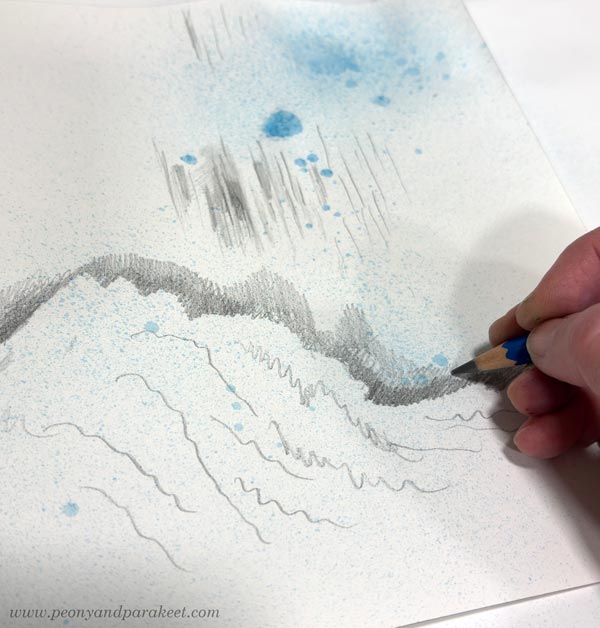
I started with graphite pencils.
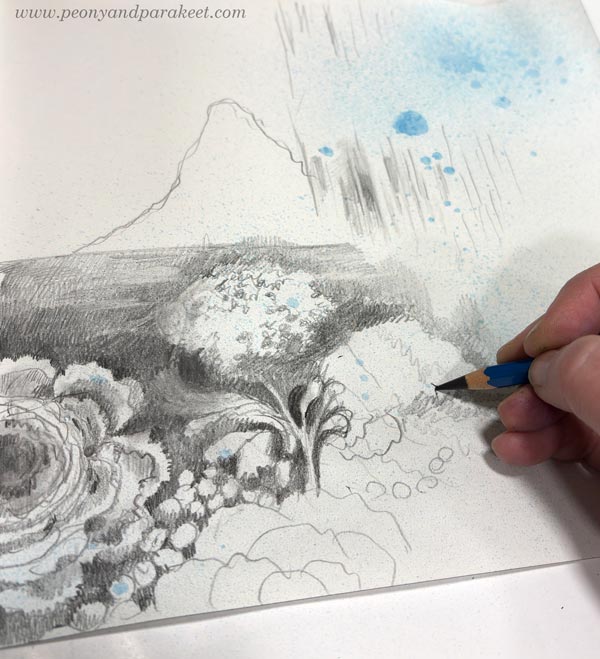
And then introduced black ink pens.
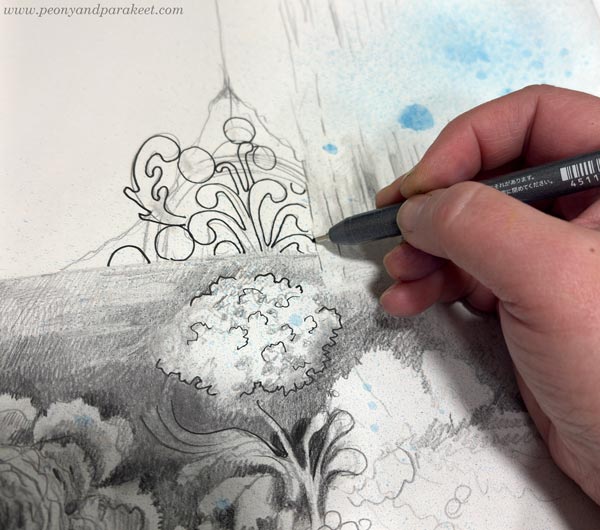
When I wanted to have something darker or more clearly outlined, I used the ink pens. The pencils were for softer greys and shadowing.
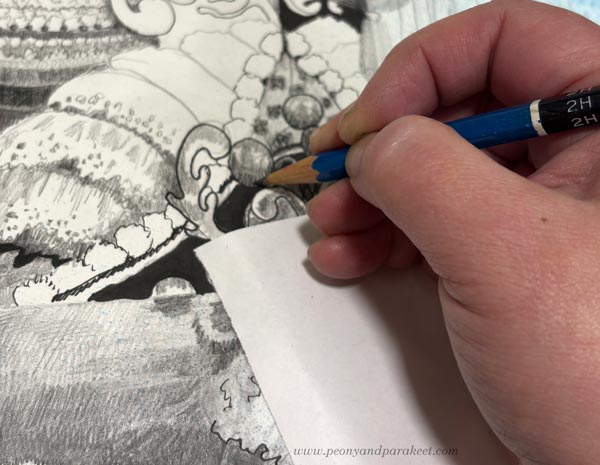
A piece of paper under the hand protects the drawing.
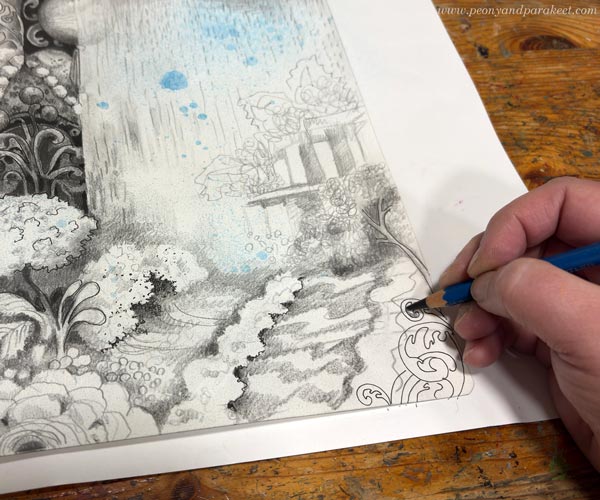
I wanted the drawing to grow freely and express the impact that the book had on me. The last step was to add a little color to the central flower.
Here’s the finished piece again. I had so much fun drawing the waves. When I draw, I try to follow the principle: “Draw what you love.”
This is about my inner world getting the refreshing rain from Ito Ogawa’s wonderful book.
Simple and Small Can Lead to Better
Tsubaki Stationery Store made me think about how simple things can become when we stop ignoring the basic truth.
You see, this spring I have been thinking a lot about how I could make better paintings. It has felt like a complicated question. Just breaking down what “better” means takes time. The choices feel big, as if I were standing at a highway junction in the middle of this constantly changing, chaotic world.
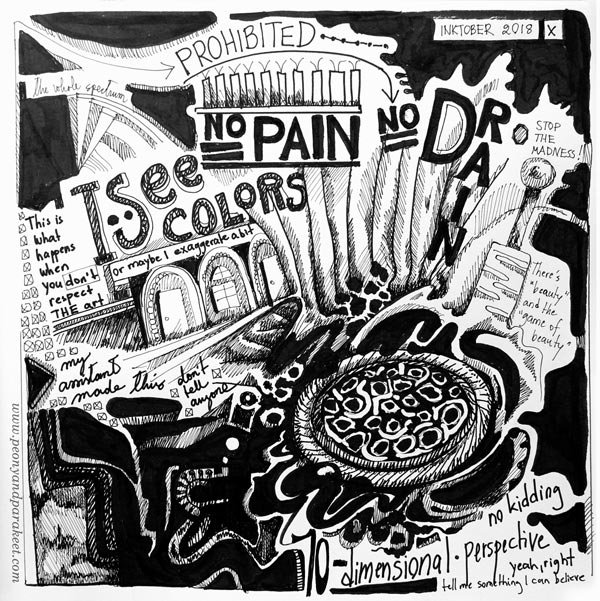
But Ito Ogawa’s book brought me back to a small street. A series of small decisions that naturally follow each other can overcome grand choices. At its best, that is exactly what drawing is about, too. One thing leads to another, and only small adjustments are needed to take the drawing to the next level.
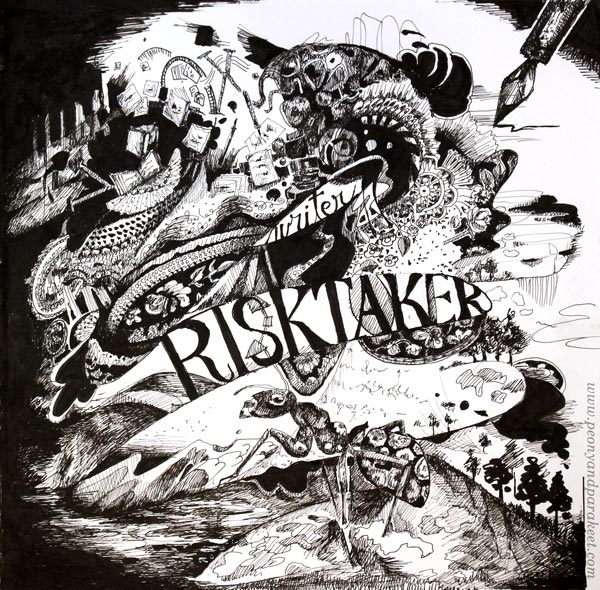
Tiny Things in Practice
Instead of this week’s small drawing project, I was actually planning to show you a much bigger one – a painting called Ikigai. I have been working on it for a couple of months now. But after listening to the first few chapters of the book, I realized that the painting isn’t finished yet. The book helped me to see small fixes that would make the painting “better.”
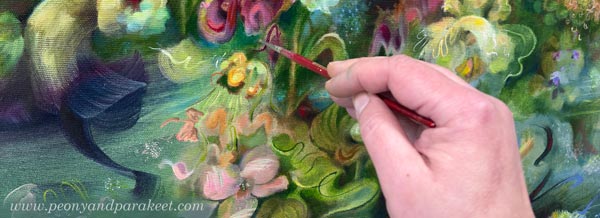
Now, Ikigai needs to dry before I photograph it. You will see it in a week or two.
But in the meantime, let’s keep drawing!