
Inspiration from Art History – Watch the Video!
To celebrate the weekend flash sale, here’s a short video to brighten up your Sunday about inspiration and art history – the two things that can be easily put together!
Imagine Through Art – Buy 5 inspiring mini-courses!
Klimt’s Garden with Students of Peony and Parakeet
We are heading for the winter in Finland. It has made me pull out the photos taken during the recent years from the garden. They remind me that the summer will come again. Together with my students, I dedicate this blog post for the famous Gustav Klimt (1862-1918) and the way he saw the world. It’s a perfect perspective when you want to get inspiration from the garden!
Portraits with Scenes Instead of Faces Only

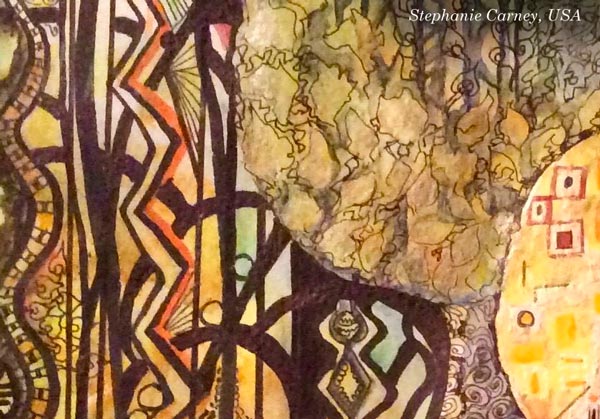
Stephanie Carney shows so well how Gustav would see our gardens: full of decorative elements! This way of looking combines two perspectives. First, examining the details and their decorative nature. Second, seeing the big picture: how plants are not just individual and separate but integrated into a scene.
When browsing my photo library, I realized that I have a lot of close-up photos of flowers. But for this post, I picked images that show more than just ethereal petals. The images that have more than a few details make me more attached to my garden. I think it’s the same with paintings and drawings: instead of just sketching faces, we can show the whole experience.
That’s how Gustav Klimt built most of his portraits: not only focusing on faces but showing more of the world around the person by expressing it through decorative and abstract elements. Klimt’s mission was to combine decorative designs with fine arts, and I think it’s one of the reasons why his work is fascinating for us who like to sew, quilt, embroider, or do any crafts. When looking at Stephanie’s work, inspired by Klimt, I can easily imagine wearing that dress and stitching any of the beautiful motifs that can be picked from the picture!
From Messy Garden to Klimt’s Garden
I claim that we can look at the garden using “everyday eyes” or “magical eyes.” When using the everyday eyes, everything is “should,” “could” or “have to.” We see weeds, neglected areas, messy grass. But with the magical eyes, we see nature as art.
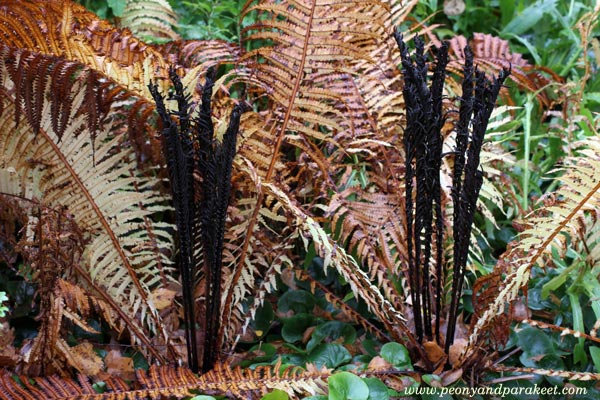
For example, these ferns from my back garden horrified me when I looked at them with the everyday eyes. All I could see was a neglected flower bench getting ready for the cold weather. “I should cut those,” I thought. Then I took a step back and … wow! Nature had made an Art Deco pattern for me! I felt grateful and inspired. For a moment, I was in Klimt’s garden.
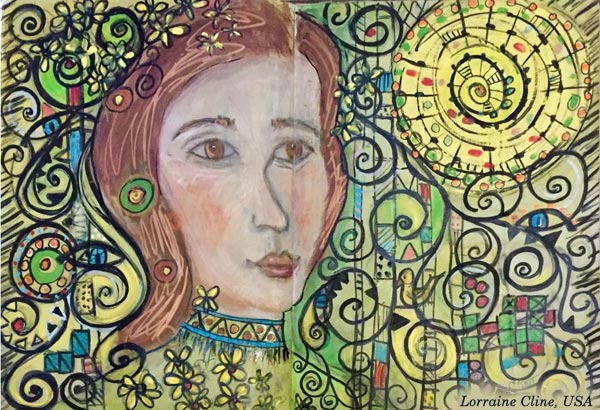
Gustav Klimt understood that when we want to express the beauty, we want to express the experience, not just copy what we see. When looking with the magical eyes – when being in Klimt’s garden, our feelings get mixed with the things we see, and nothing is fully organized. That’s why the sun feels more than just a bright spot in the sky in Lorraine Cline’s work. It doesn’t only make flowers grow, but it’s an uplifting force for humans as well. We get wrapped in its warmth, and for a moment, we are just one of the many plants in Klimt’s garden.
Quilted Garden
Gustav Klimt saw the world as a stream of patterns and colors. Sometimes they were symbolic, sometimes more literal like the artwork below, showing a baby’s quilt. Even if the painting is fine art, it honors crafts.
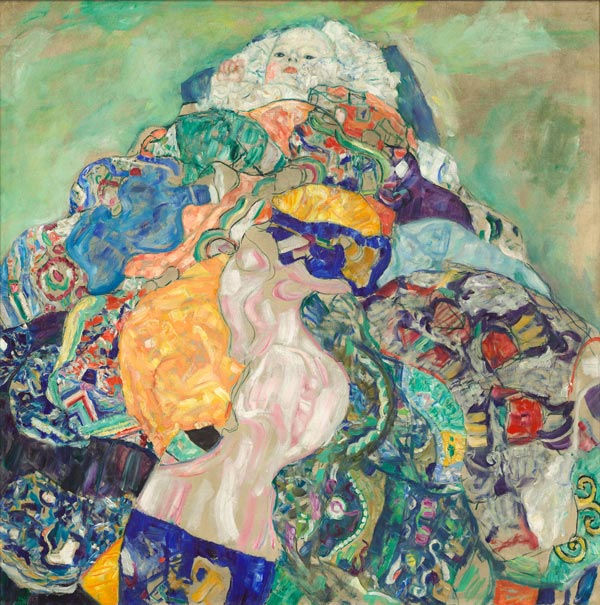
At Klimt’s garden, there’s no distinct border between nature’s and man’s creations. When you look at the world with the magical eyes, they become one.
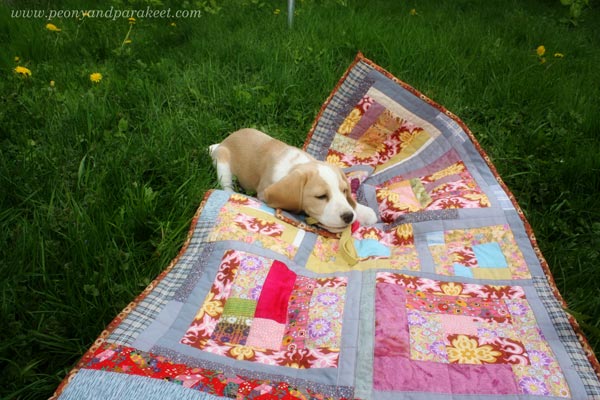
Pirkko-Liisa Mannoja’s piece combines drawing and painting, but to me, it also looks like an art quilt.
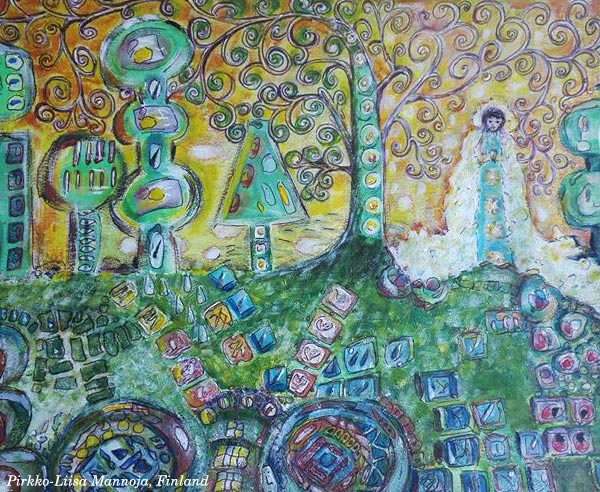
When we use the everyday eyes, we see the world as clearly-defined objects. We see green grass and red flowers. But when we look with the magical eyes, we see things that are more abstract, like the way the light forms spots in the background. That’s one of the subtle things that make Pirkko-Liisa’s work shine.
In Klimt’s garden, the grass can be white, and the observer can be green.
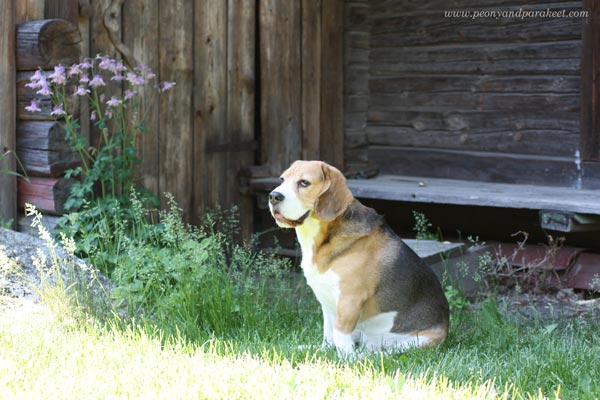
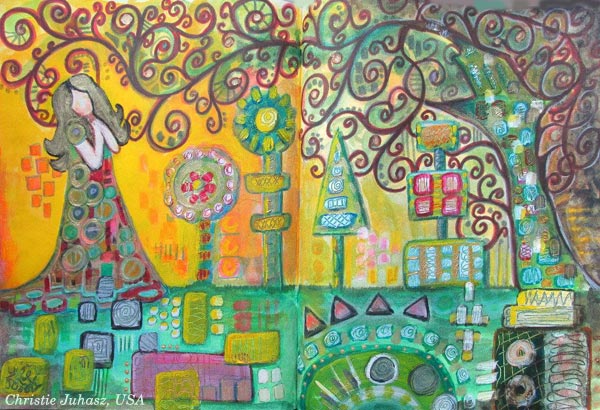
In Klimt’s garden, we treat trees like they were close friends. I love how Christie Juhasz expresses that in her beautiful art journal spread.
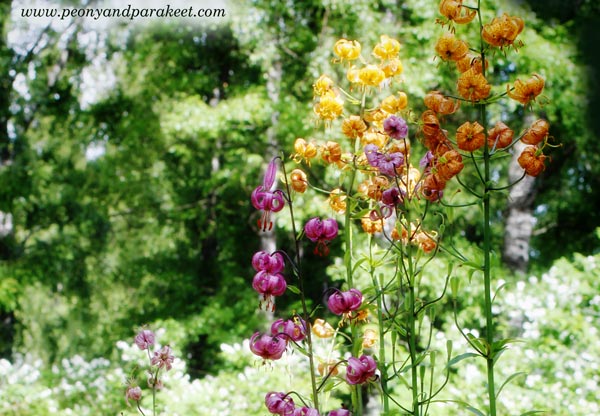
In Klimt’s garden, martagons take us back to Art Nouveau with their decoratively shaped stems and delicately colored flowers.
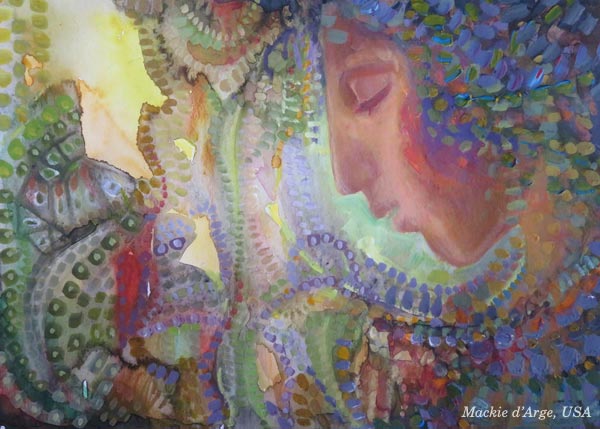
In Klimt’s garden, we connect with the outside world so that it lightens up our inner world. When I look at Mackie d’Arge’s gorgeous piece, I feel connected to both.
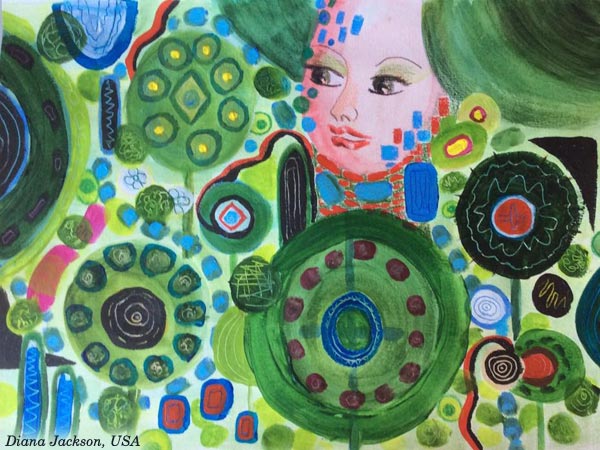
When we look at the world with the everyday eyes, we worry about the weather when we look up.

But when we change to the magical eyes, the sky and the earth are not separate at all. Just like in Diana Jackson’s expressive piece!
Winter in Klimt’s Garden
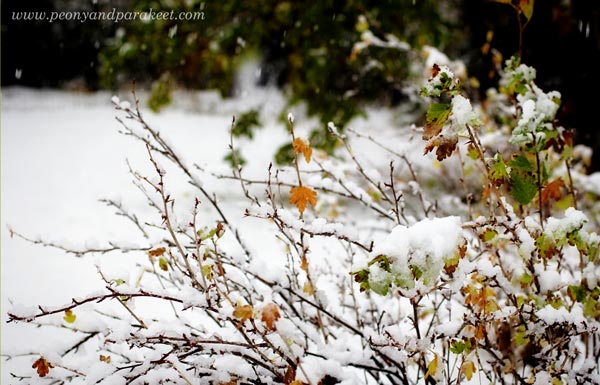
I wrote most of this blog post yesterday. When I woke up this morning, the snow had come to Finland. It felt depressing. “The garden is gone,” I said to myself. But then I realized that I had my everyday eyes. When looking with the magical eyes, Klimt’s garden is there for sure. It has just changed its colors.
Klimt’s Garden in Your Art Journal!
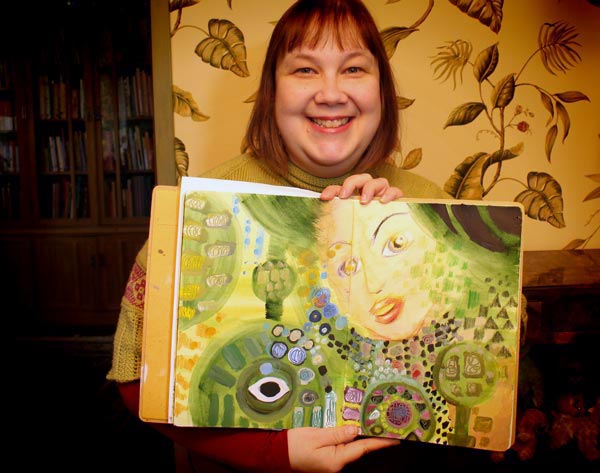
The student artwork in this blog post is created from the mini-course Patterned Topiary. In the mini-course, you can create a decorative garden scene in Gustav Klimt’s style. The mini-course is available as a part of Imagine Monthly Fall 2016 art journaling bundle, packed with four more inspiring themes and techniques. And to celebrate the snow arriving in Southern Finland, you will get the generous 30% off during the weekend (from Oct 26 to Oct 29, midnight PST). >> Buy now!
Create Klimt’s Garden: Buy Patterned Topiary + 4 inspiring mini-courses!
Paint Brush Holders and Artful Woodworking
This blog post is dedicated to my skillful husband. He has always supported me as an artist. The support he has given to me hasn’t only been mental but practical as well. He has made countless of wooden items that I have needed for my art, using hand tools mostly. These projects often begin so that I carelessly draw something on paper and ask him to follow the drawing. My sketches inspire him to ask more questions, create prototypes, and when I see the final piece, it’s much more detailed and beautiful than I ever could imagine.
Paint Brush Holders
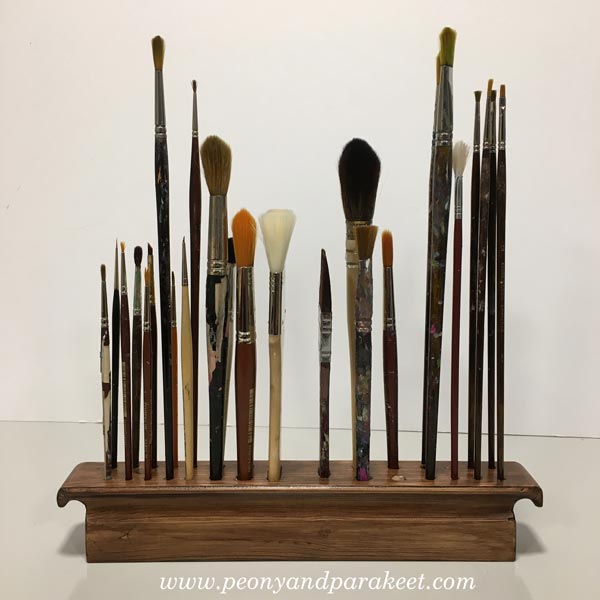
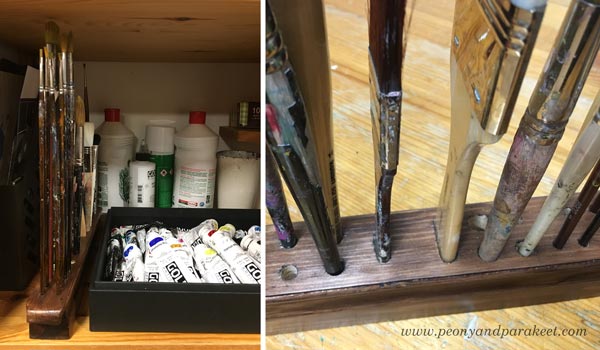
One of my favorite wooden treasures is the paint brush holder that can hold most of my brushes. It is designed so that I can put it on the shelf and then take it out when needed. I love seeing the brushes in one glance and storing them so that the bristles won’t pend. My original idea was just a simple wooden block with holes but my husband designed and finished the holder so that it’s like a valuable antique piece!
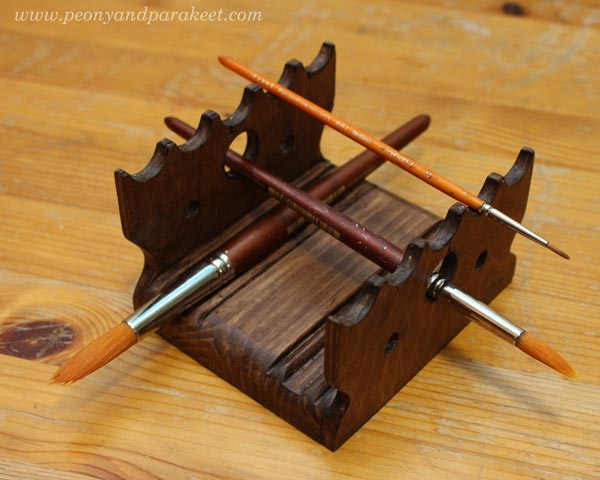
Because the vertical position ruins wet brushes, I always dry the brushes first. That gave me the idea of having a separate holder for wet brushes. “Something simple,” I said again. But my husband came with a better version. This beautiful paint brush holder can hold a lot of brushes in different sizes, and I love how practical the decorative holes are as well. The other side of the holder is slightly taller so that the brushes point downwards. It makes sure that the water won’t travel to the handle.
The Best Easel
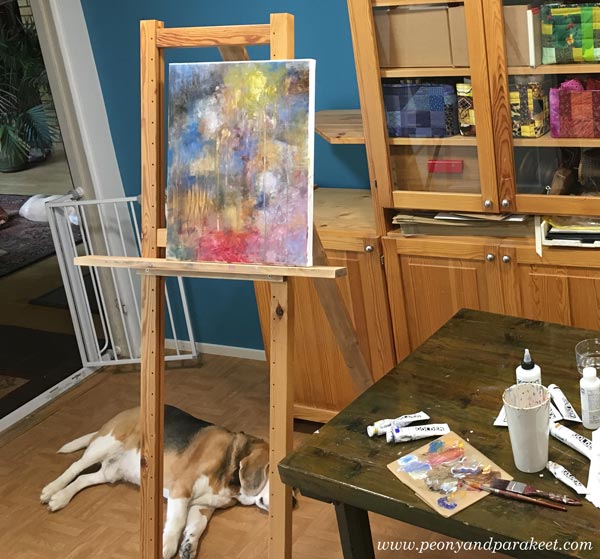
We had an extra upright support of a shelving unit, and I wanted a new easel that would fit with the rest of the furniture in my studio. By adding one more leg and a holder for a painting, my husband turned the support into an adjustable easel!
Light-Weighted Storage Box
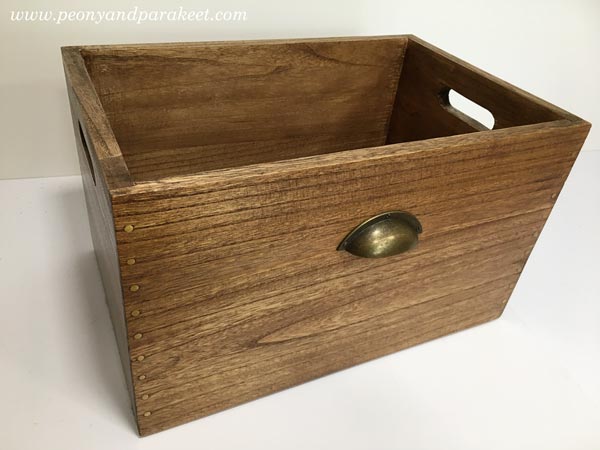
My husband has made many storage boxes for the art supplies, and this is the newest one. It’s made from paulownia tree that comes from Asia, and it’s very light-weighted. I wanted this box look heavy but feel light, and my husband found the solution!
Perfectionist’s Wastepaper Basket
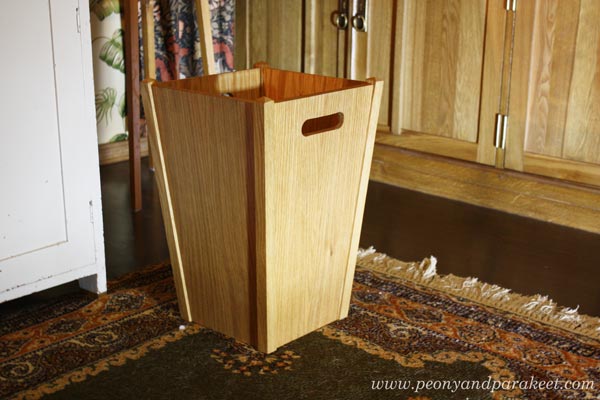
Much heavier but one of my ultimate favorites is the wastepaper basket made from oak. I think it’s luxurious and it makes me smile every time I see it. There’s some humor in living an imperfect life, creating imperfect art in the imperfect world – and having a perfect wastepaper basket!
My Husband’s Journey as a Woodworker
When we were living in our previous home, there was no room for woodworking. About five years ago, we moved to our current house that has more space. That enabled my husband to start the hobby he had dreamed for a long time. Namely, for years he had watched woodworking videos from Youtube. While I was dreaming about the life as an artist, my husband sat on his computer and watched skillful woodworkers drill and plane. Based on the sounds of our small living room, it was like some serious wood projects were going on all the time.

Then, finally when he got his space, he was able to join the gang – get a collection of hand tools and make something beautiful that he can be proud. He thought that his skills would grow in a very short time – that he had learned the most of the necessary lessons by watching the videos. But as you may guess, it wasn’t that easy. He got disappointed. He drew a hole in a wrong place, he chose wood that wasn’t perfect for the project, he made errors when calculating the proportions, and he was surprised by the visual skills that the woodworking required. It was not only that his technical skills were lacking. His ability to balance his designs and to generate ideas for unique pieces were lacking too.
But I encouraged him to continue, and he did. Every project grew his skills. After a couple of years, he made a small table that shows how far he has come. It’s inspired by Japan and the early 20th century. It’s made from oak and finished with shellac.
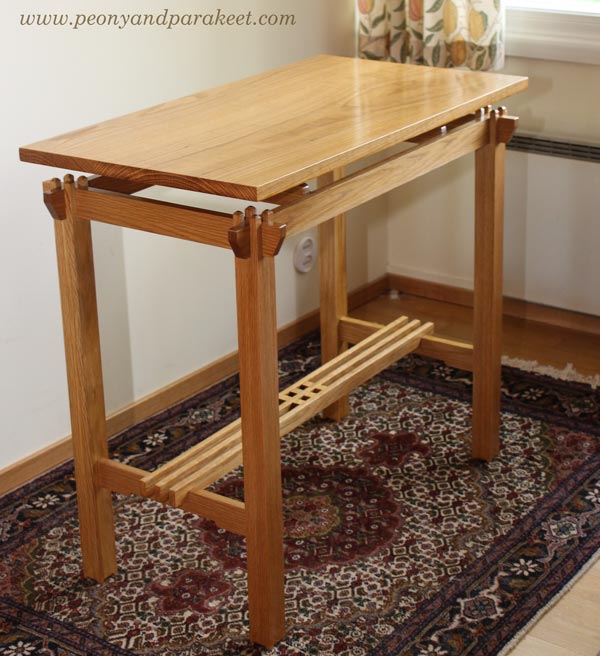
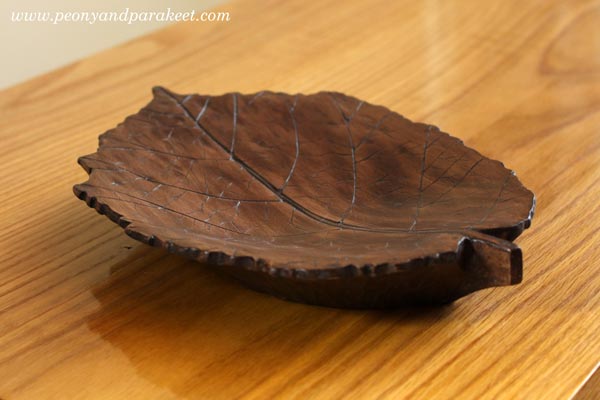
At the beginning of the hobby, my husband wanted to learn to carve. So the very first project of his was a wooden leaf. He started the carving, but it felt too difficult, so he gave up. After finishing the table, he remembered the unfinished project and completed it without struggles.
Even if this post was not directly about painting and drawing, I think that we all can relate to my husband’s journey. Creating art is never as easy in practice than in our dreams. But the happiness that it can bring is priceless. You just need to start and keep on creating!
Let me be your art teacher: Subscribe to my weekly emails!
Creating a Floral Art Class
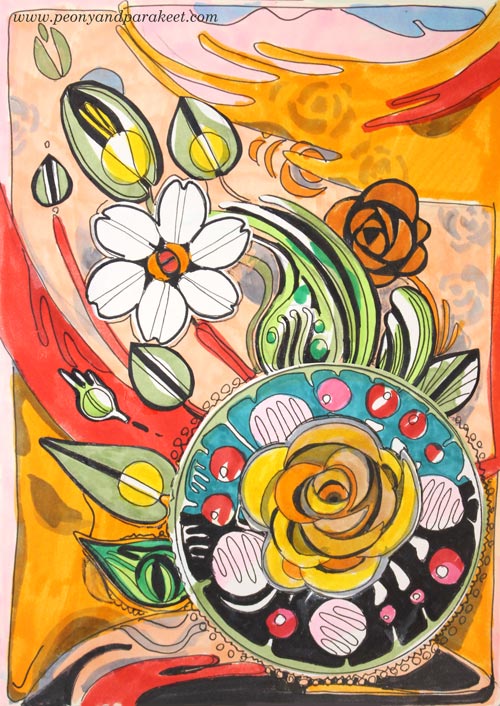
This hand-drawn collage is one of the projects that I have made for the upcoming floral art class Floral Fantasies in Three Styles. It begins on Monday, 16th October and lasts for five weeks. Because developing a new class is a big thing and requires a lot of thoughts, I wanted to share some in this blog too. Now it’s also the best time to sign up because I close the registration once the class begins!
Do You Do Flowers?

The idea for the class came to my mind last spring and honestly, I have been processing it almost every day ever since. I wanted to create an event where we learn from flowers and express our love for flowers.
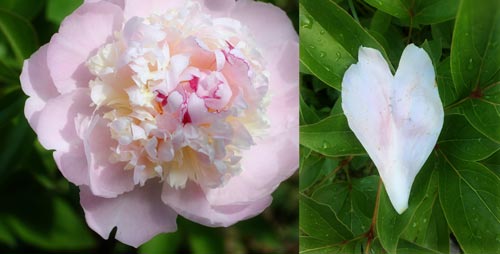
Some artists declare: “I don’t do flowers!” But I think that in art, flowers are never just colorful plants. When you draw and paint florals, it’s your imagination that’s blooming there. It’s your emotion that grows and fills the blank space. Flowers are perfect ambassadors for the messages that you want to deliver through art.
Are You Still Moving Towards Your Kind of Art?
Yesterday, I read about a famous female composer Unsuk Chin from the local newspaper “Helsingin Sanomat.” She had just won the Wihuri Sibelius Prize of 150 000 EUR.
The journalist asked her:
“When did you find out what you want to express through art and how?”
She answered: “There’s no such moment. I am still moving towards my kind of music, and it’s a continuous struggle.”
I could relate with the reply so well. Aren’t we all there – continuously working towards something that feels more us, that’s more our kind of art!
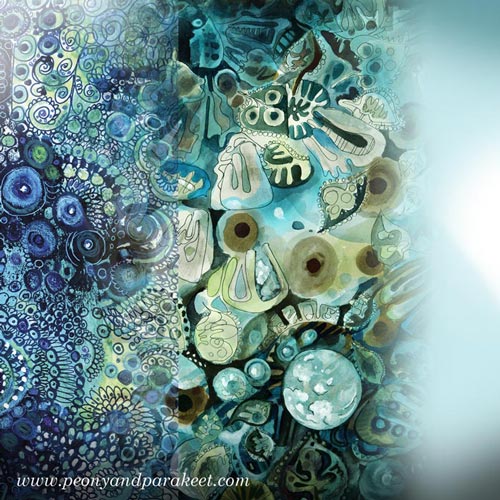
That’s why when building classes, I aim for delivering methods that connect with the imagination. It’s challenging, but when succeeding, the results that I see in the participants, are heart-warming. I believe that we all want to learn new perspectives, but they also have to be designed so that everyone can make unique art out of them. In the end, you don’t create to copy but to express, and that’s always a personal thing.
Let Flowers Make You an Imaginative Artist!
So when developing Floral Fantasies in Three Styles, I wanted to find ways that connect us to the beauty and diversity of flowers. I wanted flowers to be food for the imagination, and I wanted you to feel and work as a floral artist in this art class.
Floral Illustrator
Some of you feel the Week 1 most inspiring as it’s about creating floral designs and illustrative work. If you love any of the 20th century’s styles or have been working with textiles or other crafts for some time, it will be inspiring.
Intuitive Watercolorist
Some of you make the most of Week 2 when we get looser and play with watercolors. If you see or feel stiffness in your art, this will be valuable.
Renaissance Painter
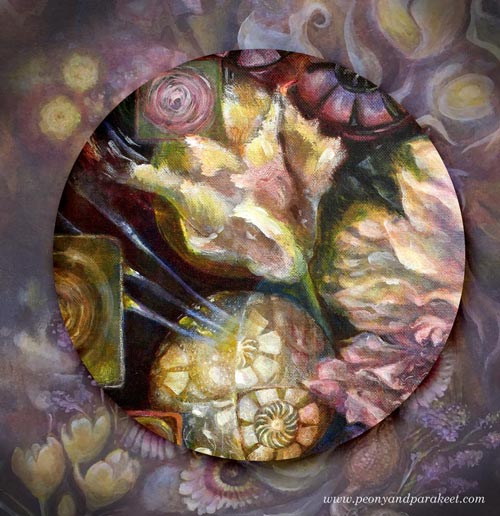
I think that for the most of you, the technique that I teach in Weeks 3 and 4 is a new one. It’s a really old painting technique, but I show how you can use it for today’s art. I have built the class so that the everything you learn from Weeks 1 and 2, set the foundation for the technique. We dive deeper into old art and learn to look at the paintings of the old masters in a new way. These two weeks will be especially enjoyable for you who want to find gentleness towards yourself and soft luxury to your expression.
Giving the Attention to Your Art
In Week 5, we will gather together for a live session and look at the art created during the first four weeks. We will share tips and encouragement, and enjoy your beautiful floral art. For all the five weeks, we will also have a Facebook group dedicated to sharing and discussions. This connecting part is one of the main reasons why I love teaching art so much. I love to see your work and also, dig a bit deeper – see the potential for moving to new directions or fine-tuning what’s already there.
So, I hope to see you in Floral Fantasies – Reserve your spot before the class begins!
Floral Fantasies in Three Styles – Reserve Your Spot Now!