
Painting My Mind’s Eye – Abstract Color Fun!
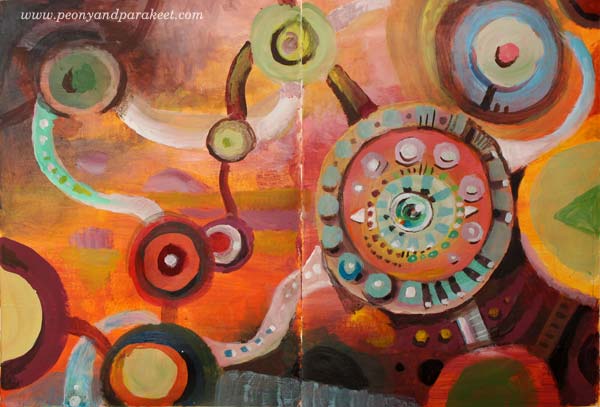
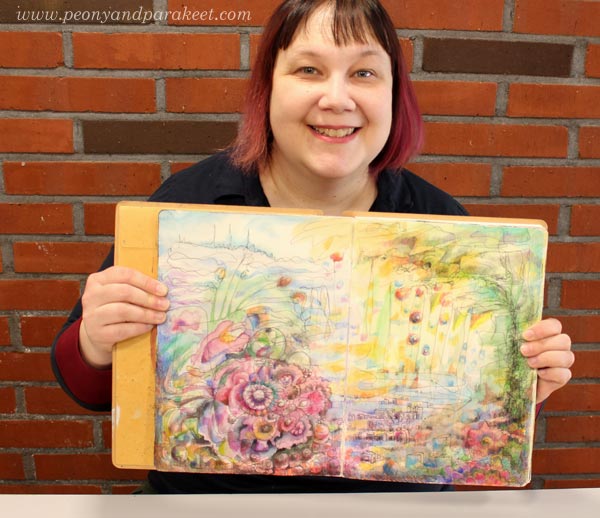
I call this art journal spread “My Minds Eye.” It has one central element that resembles both an eye and a compass. Isn’t that how things are for visual people: seeing interesting things evokes all kinds of thoughts and lead to all sorts of paths? Like this morning when I had to stop on a walk to admire fragile ice on water puddles. When I was standing there, I wished that nobody sees my weirdness. I was staring at the ground, holding a phone to get photos, with two beagles that were very impatient, eager to move forward.
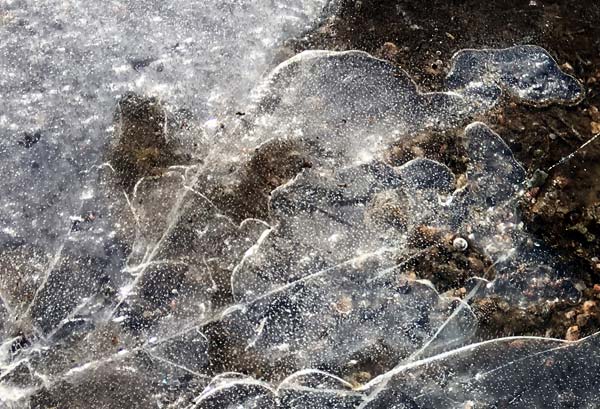
Maybe the beginning of the spring made me paint with hot tones, and the ice most probably inspired me to include a similar translucent element in the painting.
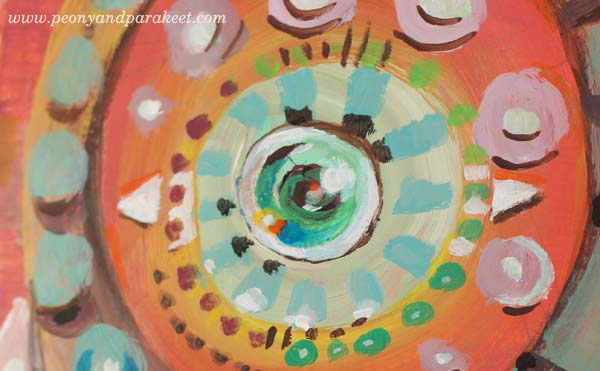
7-step Method of Planet Color Used for Abstract Color Fun
I created the spread by following the 7-step method that I developed for the class Planet Color. I have repeated this process many times because it’s a fun and worry-free way to paint unique abstracts. For example, see the blog posts What’s in a Good Composition?, Using Color Schemes for Home Decor, and How to Transform Ideas into Paintings. I know I am not the only one who worries about the composition while painting and the 7-step method makes everything fall into place effortlessly.
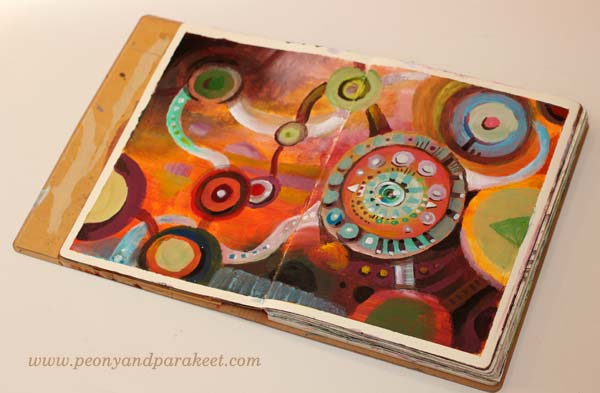
Masking tape was used to frame the piece. I haven’t done that a lot in my journals, but I like the result.
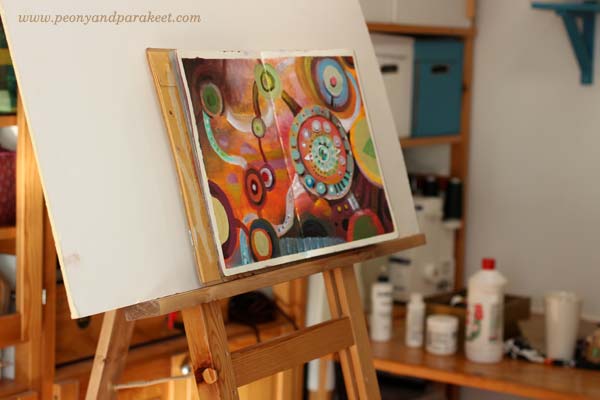
My husband made me a new easel from an upright support of a shelving unit. It’s so handy and adjustable that I have started to use it a lot. I can use it even for art journal pages, not only for canvas art.
Planet Color – Sign up Now!
I ran Planet Color for the first time last fall, but it’s coming back now! Whether you want to paint art journal pages, thick paper or canvases, this is a fun online workshop. It’s suitable for beginner painters and all who struggle with color compositions. >> Sign up here!
Don’t Just Create Circles! Moving on with Freehand Drawing
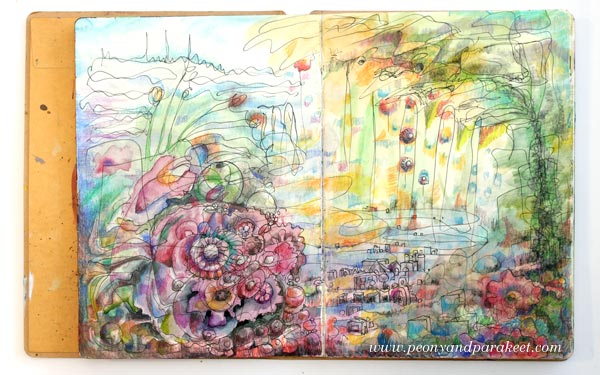
I have created this journal spread for the class Inspirational Drawing 2.0 where I teach freehand drawing that goes beyond just drawing circles. Don’t get me wrong; I don’t have anything against circles. I think that I, if anyone, have had a real love affair with circles. In fact, it was all I drew for a long time.
Circle Love
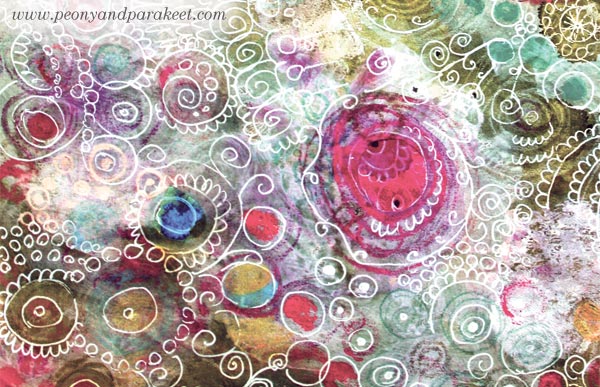
In 2010-2012, I spent most of my free time drawing circles.
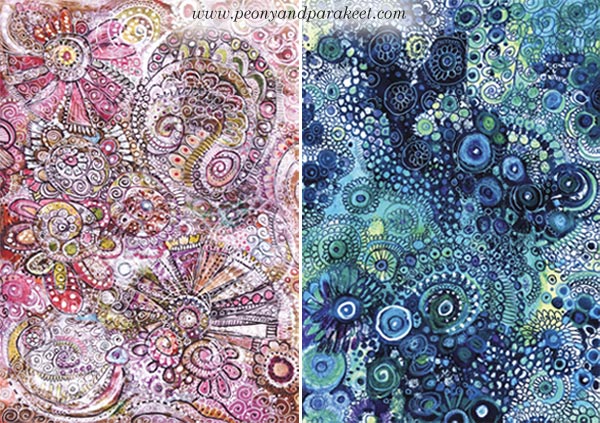
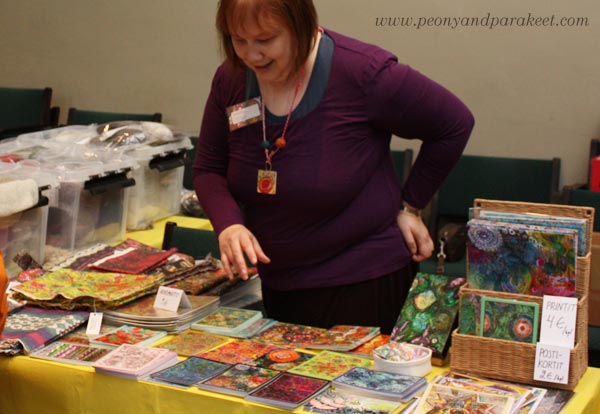
I even went to a few craft fairs to sell – hand-drawn circles!
I firmly believed that if I create enough circles, I will find something new behind them. And yes, I slowly started to realize that there’s more than just making repeated circles that are more like backgrounds and patterns than expressive images. Now years later, I wish someone would have shown me how to move on – how to combine those repeating graphic shapes with lines that express more.
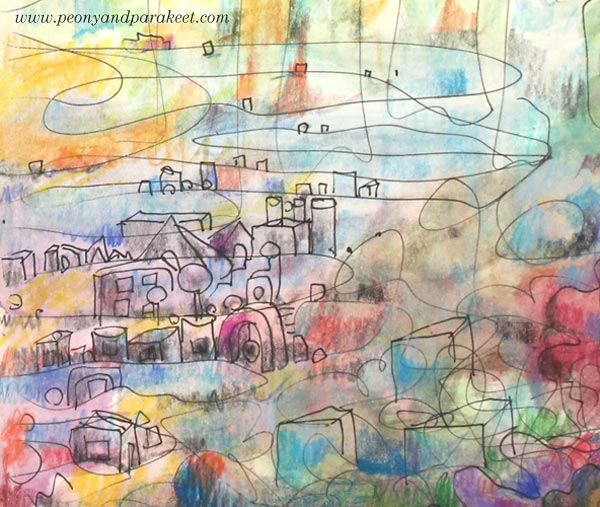
Do You Make Abstracts but Still Feel the Stiffness?
Circles and other geometric shapes are fun to create. But no matter how good I became in that, I never felt the same satisfaction that I felt when I was able to go beyond that. So when I meet people who say that they “make abstracts” and “want to get away from stiffness,” I totally get it. “I don’t really know what my abstracts represent,” says many who come to my classes. Drawing circles and playing with layers feels free first, but the more you want to express yourself, you need to explore more.
“More” doesn’t mean that you have to throw away what you have already learned. If you look at my two pieces, you can still see similarities. The first one made in 2011 called “Romance,” and the second in 2015 is called “Withering Peonies.” I called the first one “Romance” because I thought it’s all so romantic. But in the second one, I was able to express my love for peonies with much more expression without just drawing stiff flower-like shapes.
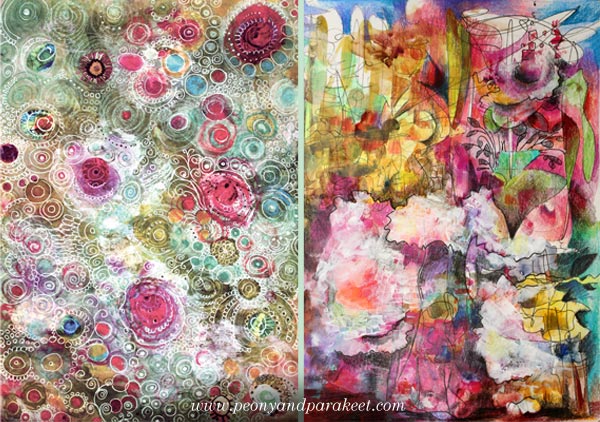
The satisfaction that came from being able to deliver a message, instead of just an atmosphere, was ground-breaking to me. My art became more powerful, impactful, it spoke not only to me but others as well.
That’s why I now teach
– how to open up and liberate the line
– how to communicate visually: create illustrations instead of backgrounds
– how to express inspiration and explore imagination in its full potential.
And that’s why my class Inspirational Drawing 2.0 exists.

Freehand Drawing Video – Create with me!
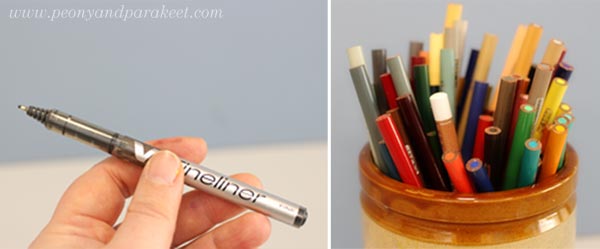
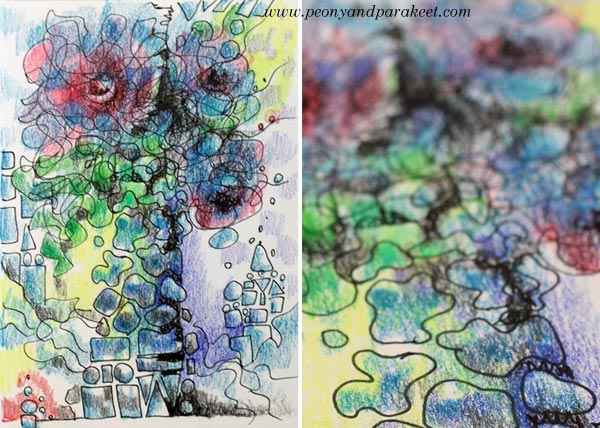
I have made a video where we start with geometric shapes and then move on to liberate the line. To create with me, you will only need a black thin-tipped drawing pen and colored pencils (or any coloring supplies).
Here’s the little drawing that we will create together.
And here’s the video!
Inspirational Drawing 2.0
is now available as a self-study class! Buy here! (Update: August 17)
Let me be your mentor in art: Subscribe to my weekly emails!
Life in an Art Journal – Dylusions Creative Journal Flip-Through
Don’t miss a flip-through video in the end of this blog post!
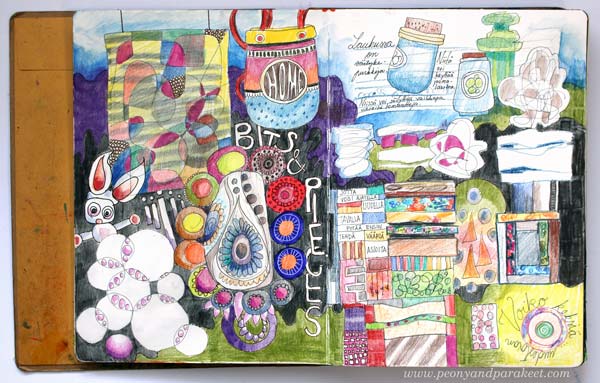
Four years ago, I purchased a new art journal – a big one. It was Dylusions Creative Journal, the largest size. In the beginning, I wanted to do everything “right.” I wanted my journal to have pages that are well-thought and carefully executed. The first couple of spreads went ok, but then, ugly pages started to appear. They were pages that I had just started but got tired on the way. Or pages which began so ugly that I didn’t feel like finishing them. But the longer I used my journal, the more I realized that I could have fun with those ugly pages. I could add more simple motifs and then color them all. I could add black paint and leave only some of the background visible. I could add more ugliness, and once it hit the saturation point, it became – something else.
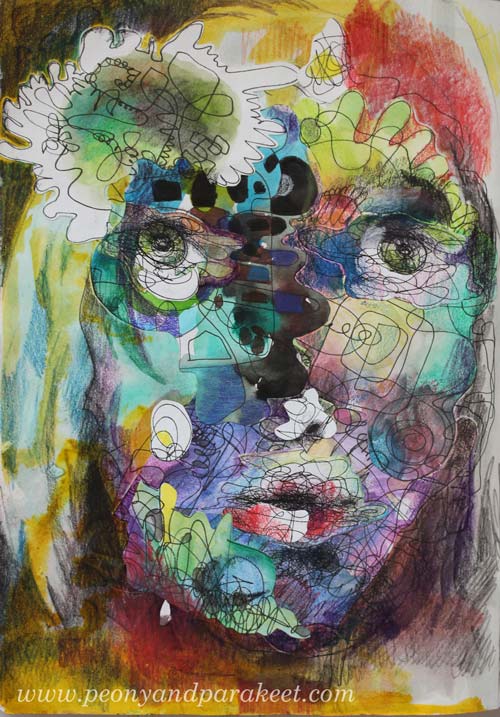
I am interested in learning all kinds of visual styles. Art journaling has supported it. One day I played a fashion designer and made a quick line illustration with poodles and all. It didn’t look inspiring back then, but a long time later, I had a lot of fun coloring it.
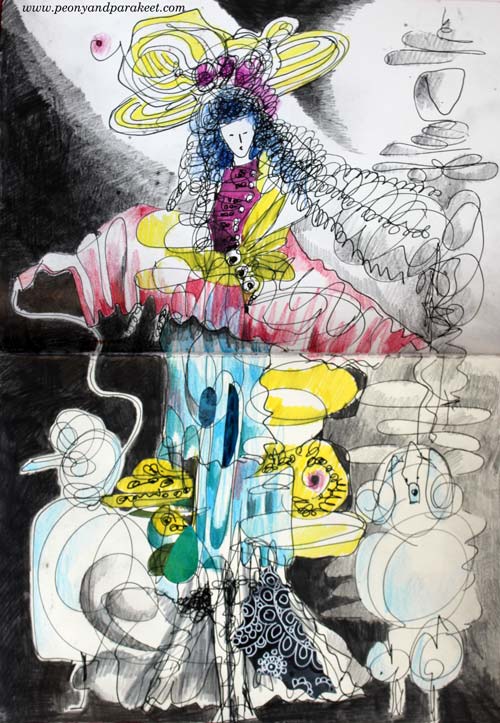
That’s what I love with art journals. The pages don’t get lost, and the ideas don’t get forgotten. Sometimes the ideas are abstract and timeless …
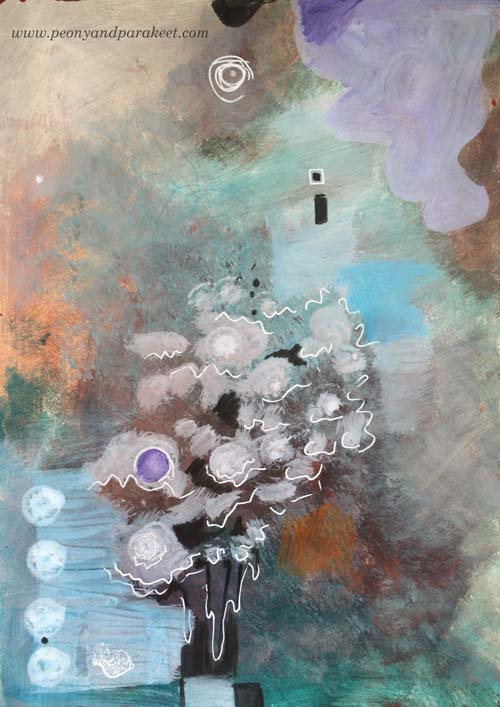
… and sometimes they are illustrations about what’s happening around the world.
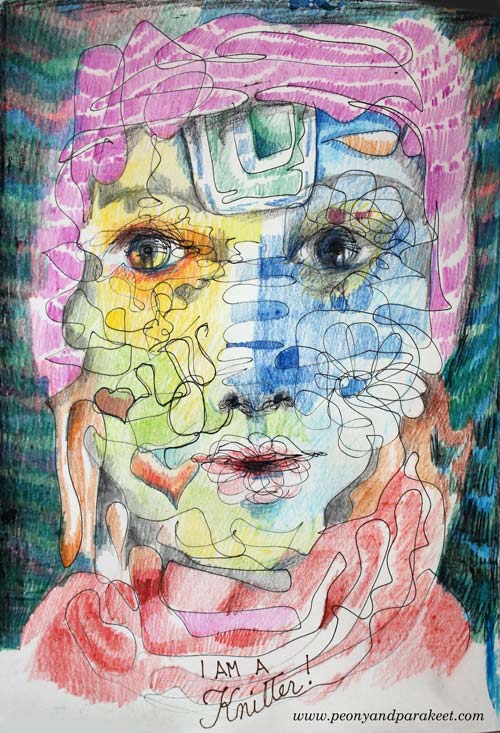
Filling the pages in a random order adds its flavor to the journal. A grid-like paper patchwork felt innovative once, but not anymore. It feels pretty stiff, especially when there are freely doodled elements on the opposite page.
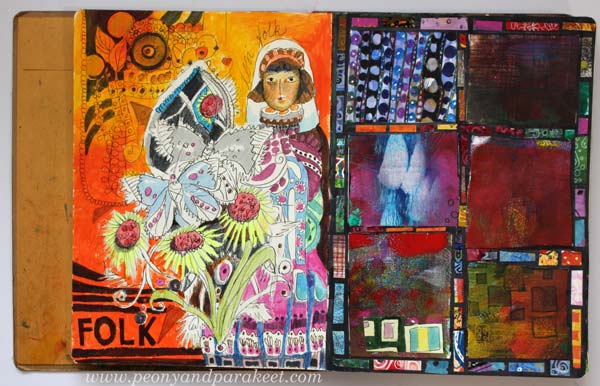
But I don’t want to rip off the pages that don’t seem to fit. I accept them all. They are all explorations on the land of Art and Imagination. Sometimes I didn’t get very far, but I believe that all the trips benefited each other. I also believe that when painting on canvases, I feel more confident because I have played freely in my art journals.
Dylusions Creative Journal – Watch the Flip-Through Video!
See all the pages of my large Dylusions Creative Journal!
Enjoy drawing by starting from stick figures! – Buy Drawing Factory!
Rebuilding Art – Using Reference Images for Self-Expression
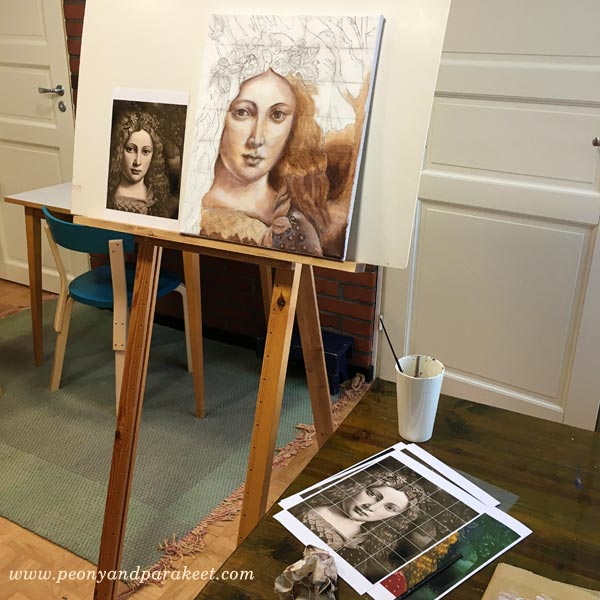
This blog post is about composing new art by using reference images. At the moment, I have a couple of paintings in progress that are based on reference images, and I also show other examples as well.
Why Don’t Artists Always Tell About Using Reference Images?
While painting my first oil painting at The National Museum of Finland, the visitors of the museum were able to visit the studio and watch us paint. Many people asked why we paint copies of the old paintings. The teacher Emmi Mustonen replied that it’s a good way to learn the old painting techniques and develop the understanding of formal elements. But I got the feeling that some of the people didn’t get it. Their facial expressions were imprinted on my mind, and it made me ponder why using reference images raises conflicting feelings.
Even if most artists who create realistic art or include realistic elements in their art, use reference images, many are not very open about it. I think that one reason is that many artists believe that people know that already and another reason that the process is not interesting. My experience is that there are surprisingly many people who assume that artists don’t take photos or use other than live models. And to me, the process of composing a new image from old ones is fascinating. I always stop to see an article where an artist shows how the reference images were used. I am especially interested if it’s about choosing the photos and combining several reference images into one piece.
Strawberry Madonna – Combining Several Reference Images to Tell a Story
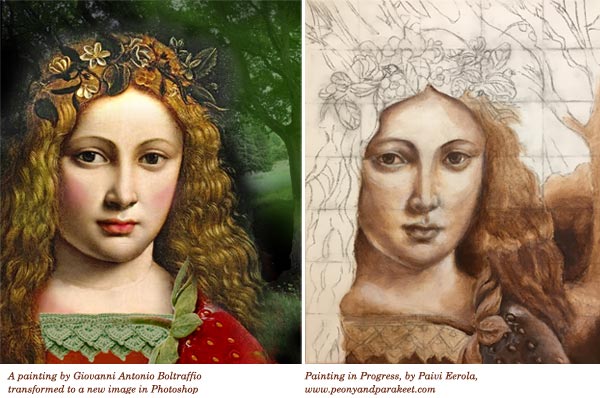
I am currently painting an acrylic painting on canvas that I call “Strawberry Madonna.” It’s my first using old masters’ painting techniques with acrylics instead of oil paints. The idea for the painting started differently than usually. I invented the title first and then started to think how Strawberry Madonna would look. I wanted to find a young woman who would have lips like she had just eaten a strawberry. By googling Renaissance paintings, I found Giovanni Antonio Boltraffio‘s painting. After that, I moved to building a story around the original idea.
Strawberry Madonnas are young girls who enjoy life without worries, have long summer holidays, eat strawberries, learn to crochet and read books like Emily of the New Moon or Anne of Green Gables. I have been one of them, and I feel quite nostalgic about it. I wanted the painting to include surrealistic elements. It has a big strawberry that is placed so that it could be a sleeve of the madonna’s dress. I am also going to change the flowers in the hair wreath to strawberry flowers and play with green and red paint. It will happen when I move on from underpainting to adding colors. In the background, there’s a photo that I took last summer. I am going to make it a little less detailed.
I used Photoshop to compose the reference image and made the sketch on canvas with charcoal. I drew a grid to make the sketching quicker.
Girl with a Ferret – Changing the Meaning with a Simple Trick
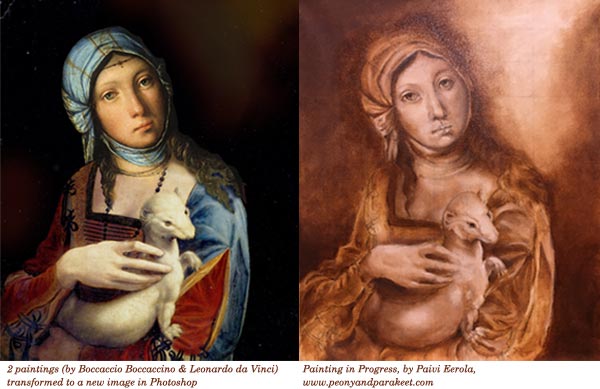
I have also started a new oil painting under the guidance of Emmi Mustonen. I got to pick the reference image freely. I wanted to pick an old Renessaince painting, but I couldn’t find any that would have a couple of my favorite features when painting with old masters’ techniques. I love to paint fur and fabric, and I wanted to find a face that would include openness. I fell in love with Boccaccio Boccaccino‘s portrait of a gypsy girl, but it didn’t have any fur. So I remembered Leonardo da Vinci’s “Lady with an Ermine” and created a new image by combining the two in Photoshop. I have several stories about this one.
The first one is about today’s society and how the pets have become more human in our eyes. I want to show the similarities in the wild gypsy girl and the tame ferret. Another story is about young girls and their love for taking care of animals. They might not know the wildlife, but they help to rescue animals and are ready to work hard when taking care of them. They are against fur clothing and not afraid to show it. The third story goes back to the 16th century. I imagine that the gypsy girl was hired to dress up and hold the ermine because the lady didn’t have the patience to pose for the artist. In the end, she never showed. The artist became frustrated and painted the girl instead. I can imagine the magical moment when the girl realized that she would be in the final painting instead of a lady.
I would like to talk with Boccaccio Boccaccino about my version. I also wonder, how he was able to paint the portrait of the gypsy girl when the artists mostly painted for churches and aristocrats back then.
At Monet’s Garden – Including All the Good Stuff to the Same Image
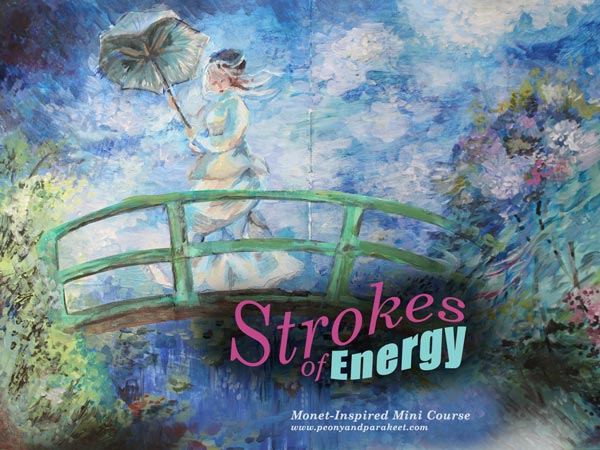
Last spring, I published a mini-course called Strokes of Energy as a part of the Imagine Monthly Spring series. I asked my students to name their favorite artists, and Claude Monet was among most popular ones. But when I thought about Claude Monet, I didn’t want just to serve those who love the garden or those who adore his way to paint the sky or those who want to express the windy scenes. I wanted to have all the good stuff in one image and then some more.
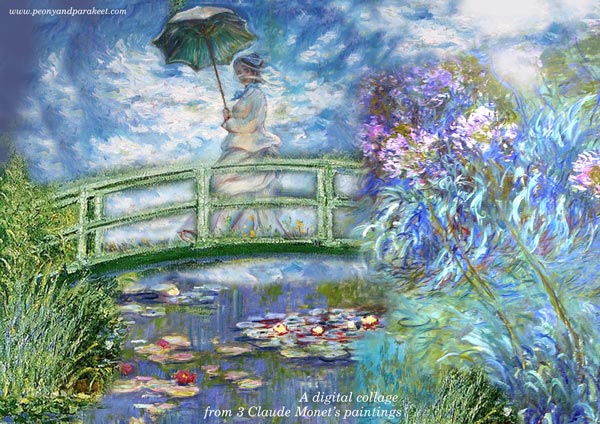
So I created a reference image in Photoshop combining three of Claude Monet’s paintings: “Woman with a Parasol” and a couple of paintings from the water lily series. Then I invented a technique where you can paint some of the elements as collage pieces so that you can adjust the overall composition before making the final decisions. This way it is possible to add more details one by one and improve the image during the actual creative process.
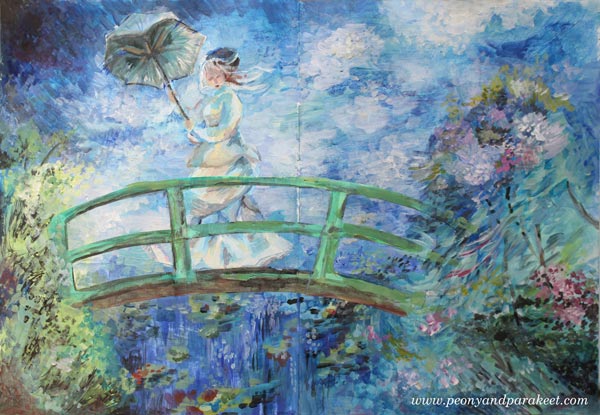
So this painting is about a woman who is experiencing strong wind. She doesn’t mind wind catching her parasol. She enjoys the fresh air and the beautiful scene around her.
Ulla’s Take
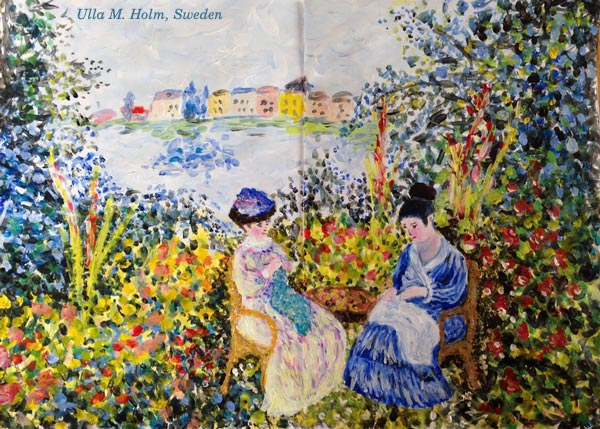
One of the students, Ulla M. Holm, made a Photoshop sketch from another set of Monet’s paintings and then painted the image with short impressionistic strokes. I love how the result also reminds me of her home country, Sweden!
Using Reference Images More Intuitively – From a Story to an Experience
I admit having mixed feelings about following the reference images carefully. With my art, I want to express freedom, and I don’t think that following reference images too closely helps with that. On the other hand, I don’t want to restrict myself doing abstracts only or creating similar paintings one after another. Many artists create the same again and again and become better and better with that. To me, art is about exploring and the hook there is to widen my perspective continuously.
So even if you would prefer abstract art, it doesn’t mean you can’t have reference images. Instead of connecting with the actual story, you can connect with an emotional experience.

I picked colors and ideas from Emile Vernon’s painting and imagined what it would be like wearing that soft dress. The dress felt like a dream, so I wrote: “Muisto unelmasta” – “a memory of a dream” in the image.
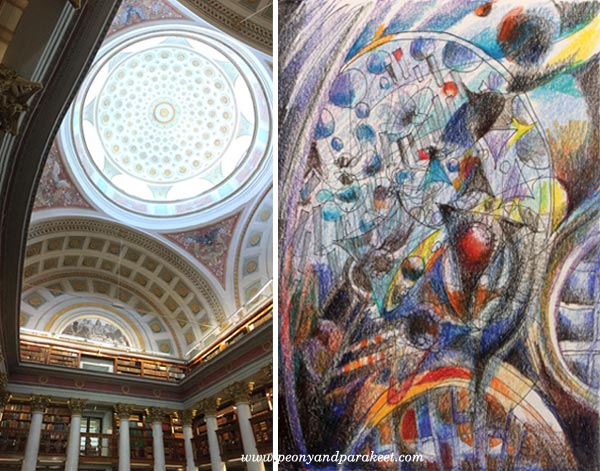
Here’s another example from my class Inspirational Drawing 2.0: a photo from The National Library of Finland and my interpretation, “The Power of Knowledge.”
Do yo want to experiment with this approach using your personal reference images? >> Sign up for Inspirational Drawing 2.0!
For the Fans of Monet – Strokes of Energy
My Monet-inspired mini-course Strokes of Energy is now available as an individual self-study course. >> Buy Strokes of Energy!
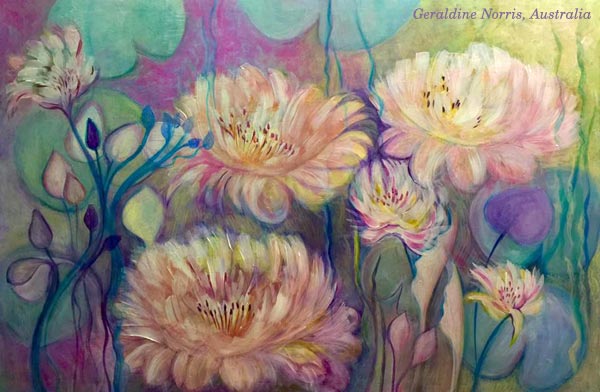
Geraldine’s Take
I want to end this blog post with a skilled artist Geraldine Norris from Australia who created her version of Monet in my class. She had just seen an art exhibition showing Monet’s work, and I think it shows how deeply she connected with the experience.
But wait, there is more beautiful Monet-inspired art from my students, see the presentation page of Strokes of Energy!
Until next time!