
Surface Patterns for Hot Summer Days

This July has been wonderful in Finland. I have enjoyed gardening and photographing and it shows in my art journal too.
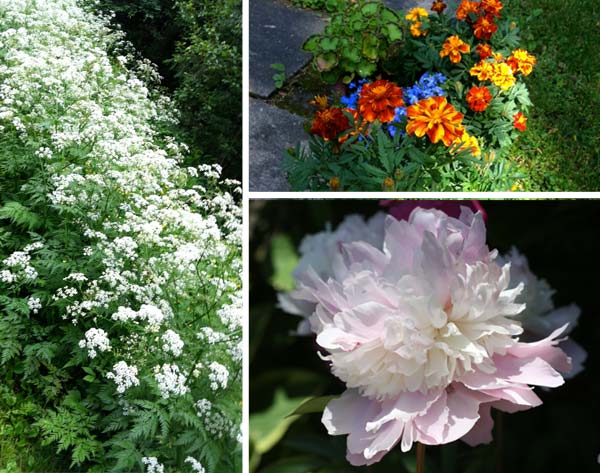
Both the wildflowers and flowers in the garden look great with a dark background. So when I made the drawing with colored pencils, I added some shadows too. Great way to express sunshine is to combine black with yellow!
But my main focus was on summer fabrics. It is so much fun to design prints for summer dresses.
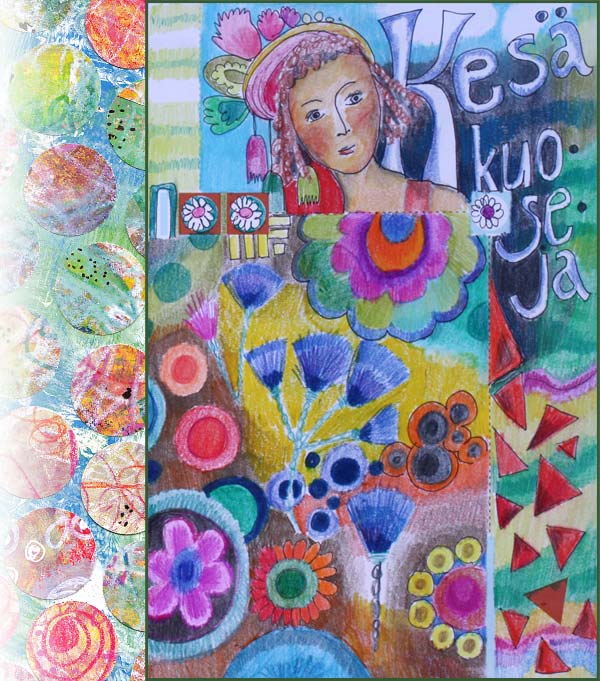
The collage of the left is an old one. A sketch for a surface pattern made in 2011. It was made by cutting circles from handdecorated papers. This time I replicated the design by cutting circles from stamped papers.
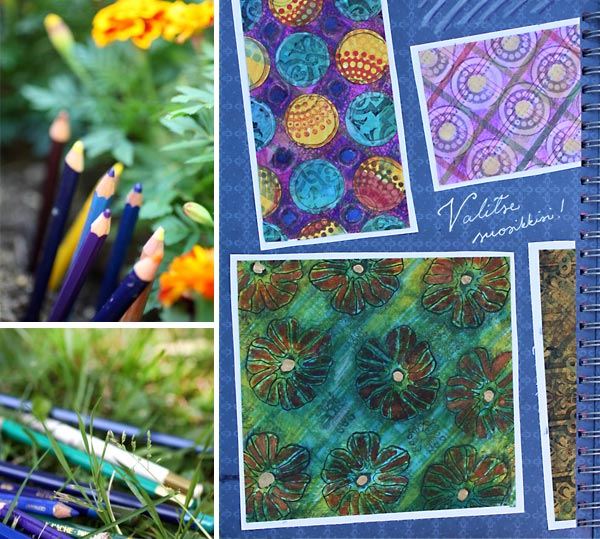
The summery prints are mostly made by stamping here. Paper scraps like old scrapbooking papers can be altered easily with markers, colored pencils and stamps. I always try to add subtle color variation in the background to keep the result interesting. Thinking about shadows help here too.
As you can see, my colored pencils are always with me! Hopefully your summer has been as wonderful as mine!
From Fact Finding to Quick Start
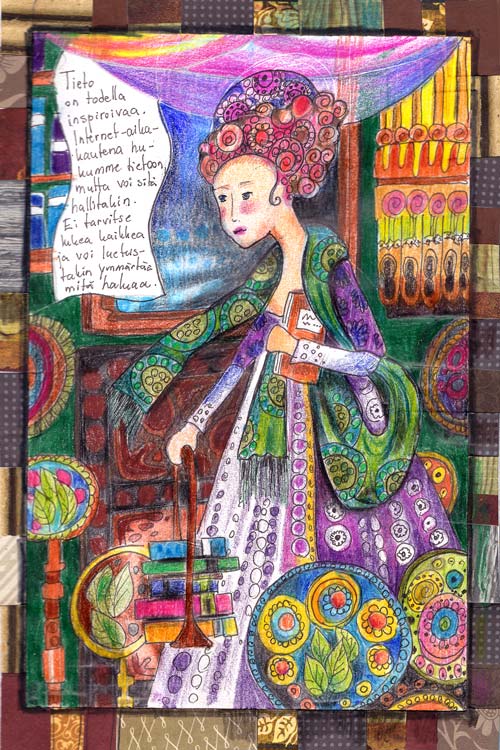
She searched ideas by watching what others had made. Then she realized that she had spent hours trying to find the inspiration. And it was already too late to start making anything by her own. Besides, she was feeling overwhelmed.
Does this sound familiar to you? You might get inspired of this or that, but feel powerless to start making your own. It can be only that you are tired after a long day. Then the best you can do is to go to sleep. But if repeatedly find yourself having difficulties to begin, it might be that you are using the wrong method when searching for inspiration.
Use your imagination when browsing other people’s work.
When you use your imagination, you will get your own, not other people’s ideas. This requires that you do not take anything you see as a fact. Instead, you should focus on the feelings and associations which they raise.

Here’s a crayon drawing which I made as a teenager. It is about a girl coming from the library. The weather is predicting the end of summer.
But actually, you don’t need to know anything like that. The fact that the girl is standing in the middle of the picture should be irrelevant to you too. The purple dress is interesting only if you react to the color. Maybe you are touched by the combination of blue purple and bright yellow? Or maybe you get cold vibes when watching the image? Like when you were sitting on the floor of your new unfurnished home thinking of how to renovate it. Which reminds you of new beginnings and how much hope they hold. A little bit like puppies and young children …
Now you ask: would that mean that I should draw a puppy dog? Or just grab the idea of softness? You could if you feel inspired enough but I would advise you to have a bit larger mix of things. So let’s pick another image.

Here’s another work from decades ago. I used watercolors to replicate a black and white photograph of my grandmother and her three friends. Here you might think how stiff and serious people used to be in photographs. Those forced gestures are a complete opposite for the puppies. How funny the similar photo of four puppies would be!
Now you might get inspired by expressing the two opposites: stiff and free-form, hard and soft. Hard can still be soft inside, like the hearts of the four young girls.
Make a Quick Start using the ideas as a starting point.
When I began working from this standpoint, I knew only this: I would begin with coloring four soft areas and at some point add both organic and angular lines to express the opposites. Then I turned the music on and went with the flow.
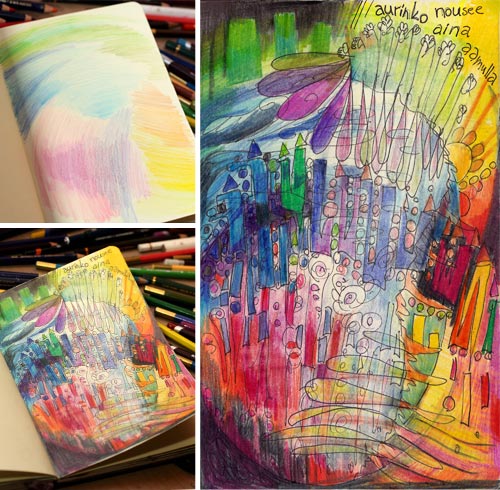
In the end, I wrote where my thoughts had led me to: “The sun always rises in the morning”. I had illustrated the change of day and night and expressed how every morning is a new beginning. Now, there’s hardly any resemblance to the images I started with. Still, they gave me a jumpstart on creating.
When browsing, focus on your inner thoughts.
If you get stuck with having no ideas and being overwhelmed by other people’s work, you think too much about facts and give too little value to your inner thoughts. You will browse endlessly because facts never stop if your own thoughts will never get noticed. Instead, look at few images or read few sentences and think: What is here that comes to my mind? What basic combination could I create from these just to get started?
If you look for the perfect inspiration starter, you may never find it. In fact, there’s no such thing. But if you value your own thoughts, creating art will generate happiness regardless of the source of inspiration. Your art journal or any end result will become more and more perfect because you are perfect for yourself.
Subscribe to my weekly emails – Get a free mini-course!
Make Samplers to Save Bits and Pieces

My sampler madness began when I found an unfinished embroidery project. I had started it two years ago on an online course called Happy-Go-Lucky Stitchalong. It was led by Amy Powers and the goal was to embroider a sampler showing all the things that make you happy.
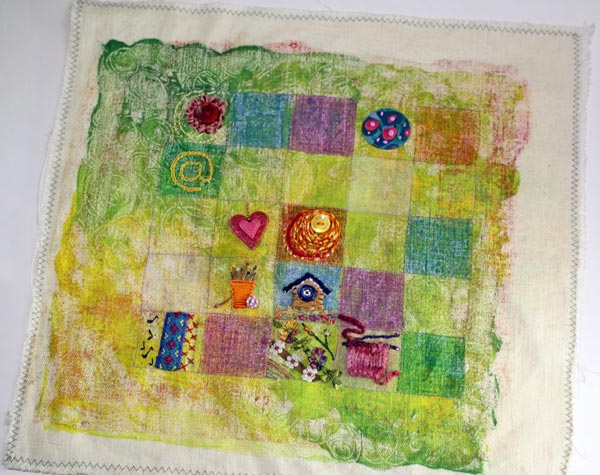
It was only a two-week course and I got some more squares done than what is shown here but there was still plenty to go. I had dyed the fabric with monoprinting method and quite liked it. I was not happy with all the embroidery that I had made but I felt compelled to finish this project. The embroidery floss I had to finish this looked so tempting!
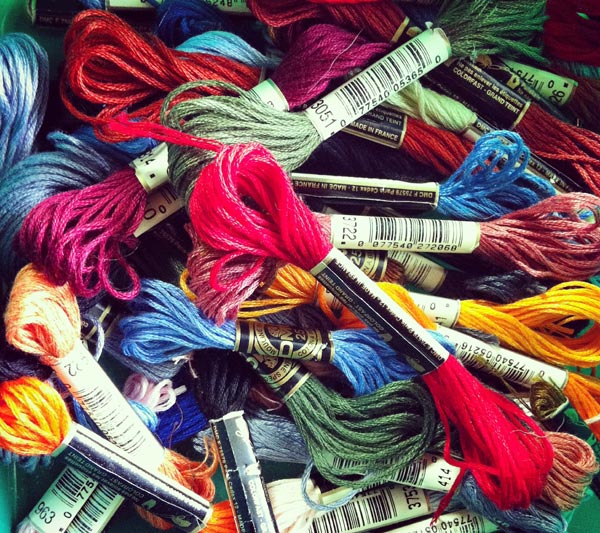
So I began to work little every day for a couple of weeks. Some of the squares were remade and some were complemented with extra stitches.
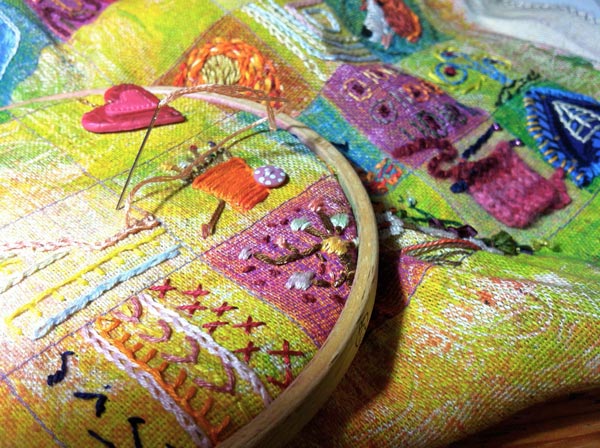
In the end I added some more details to the background fabric using the same method than in the beginning. By using a glass plate and textile dye I was able to prints some more color and doodling to make the result even more interesting.

I painted the frame with bright coral red to create an athmosphere of hot summer days (which I love and which are all too rare in Finland).
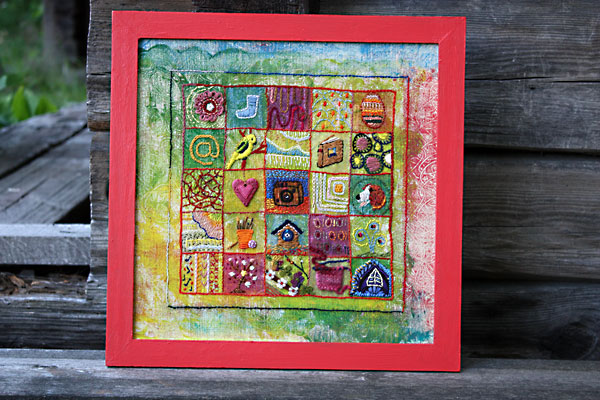
I am pretty happy with the finished piece. Can you spot a peony and a parakeet there?
While stitching the sampler, I was thinking about samplers in general. They can be really handy of saving things. Even virtually! Isn’t Pinterest like a big sampler too?
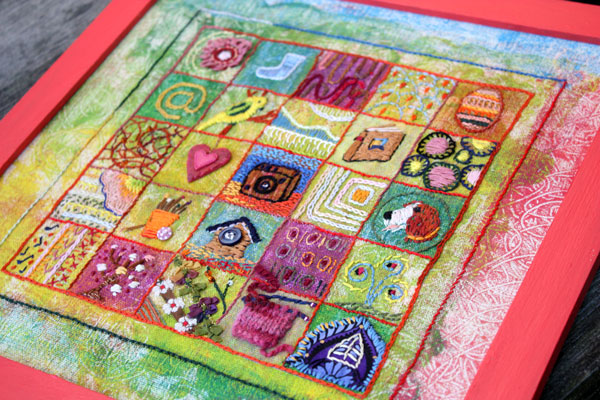
I chose not to spend an extra hour at Pinterest but make a stamped sampler showcasing some of my favorite stamps.
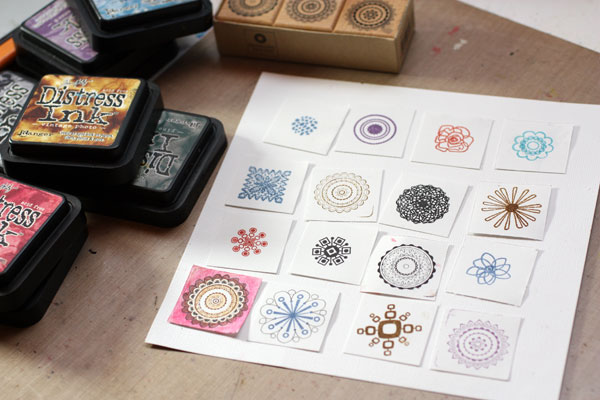
Folk style suits well to samplers so I decided to make a sampler that reminds me of folk costumes. I doodled around the stamped images to get extra details. Then I colored them with colored pencils and markers.
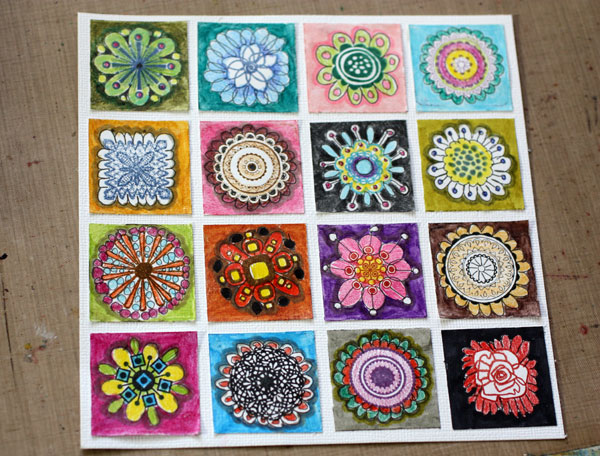
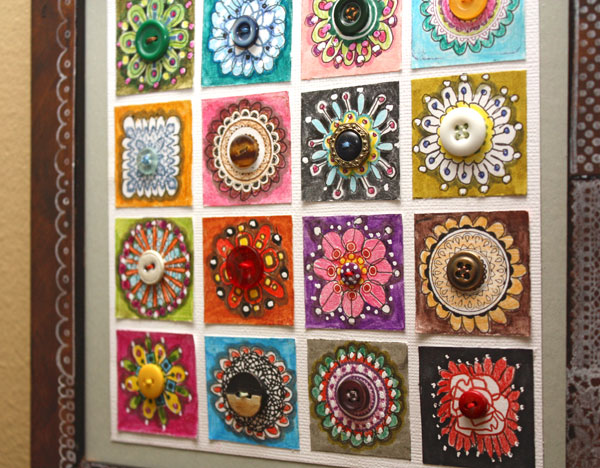
Thinking of folk costumes, I got the idea of adding buttons in the middle of each square. They all had to be different, of course. That way they would repeat the idea of a sampler too.
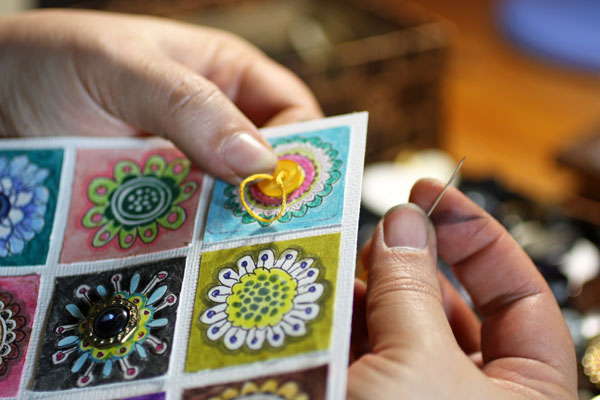
Before sewing the buttons I had painted the frame with faux antique paint. Many folk costumes use a lot of lace and ribbons so I picked all the stamps which were like them. Luckily I had so many that I was able to use each once and get the decoration around the frame.
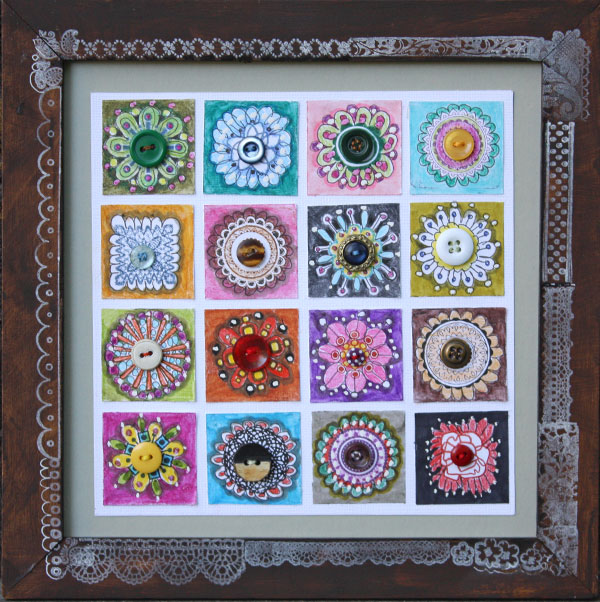
While making this sampler I got the idea of a sampler made from handdecorated papers. Wouldn’t it be cool to have an art journal page showcasing the scraps of papers? Or just coloring and drawing 9 squares while on vacation, one per day and then gather them into a sampler. Or giving each family member a square … The possibilities are endless!
Let me be your art teacher: Subscribe to my weekly emails!
Stretch Your Artistic Style
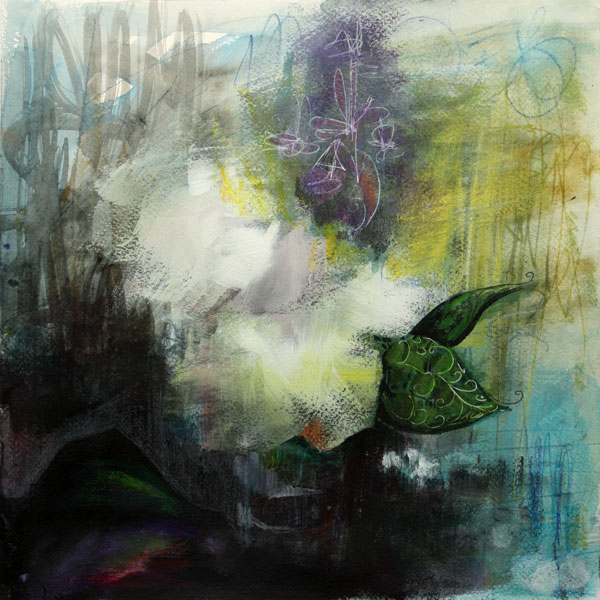
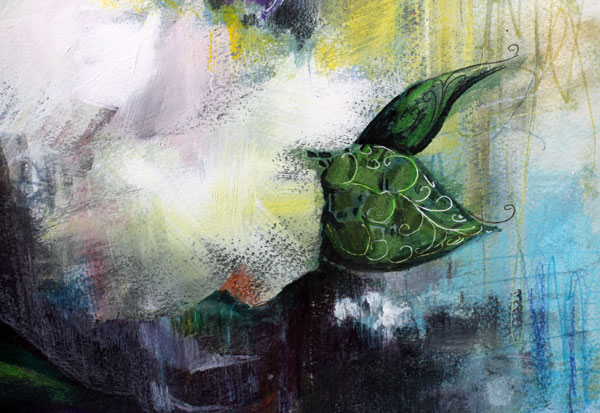
In art, I am fond of thin strokes and decorative details. I have often thought that blurry painting is like a bad photo – in need of sharpening. But slowly I have begun to get interested in blurry paintings. Those wide strokes have begun to feel tempting. The concept, where colors can take the leading role, has been sneaking into my thoughts. So, when I wanted to express something very familiar to my home country, I thought that the impressionistic style would go well with the theme.
The theme was melancholy and for me, it’s all about white flowers. In general I do understand the beauty of white, but personally, I see it as a symbol of loss and emptiness. The painting called “Condolences”. I wanted to give both white and black the position where they can be heart-breakingly beautiful. I wanted to treat them as real colors, not only as the elements to create contrast or compositional space.
Taking a New Route in Painting
Before I began to paint, I spent weeks of pondering the idea in my mind. After I had got hold of the feeling I wanted to express, I felt unsure of how to master the technique. Then I realized: if you want to stretch your style, you need to take a new route at some point in the creative process.
My new thing would be the way I used the acrylic paints. But I could start with familiar things: watercolor the background and set the basic color scene.
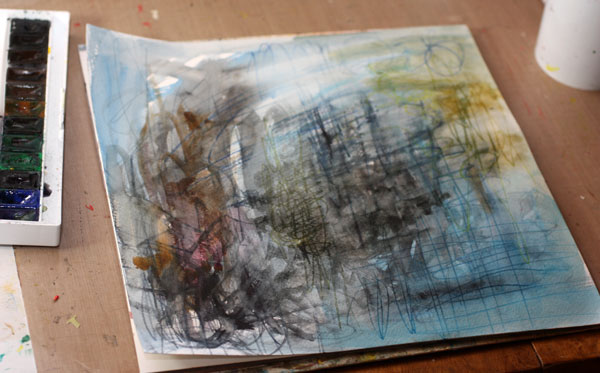
After creating this background, I felt comfortable: same old, same old! Then, with the help of Coldplay’s best hits, I got into the mood where I felt no uncertainty. When I have a clear theme in mind, I prefer to listen to the music that is pompous and not too deep. Then the music helps to improve my self-esteem without taking the focus away from the theme.
After few moments of walking around the room – that is a great way to boost your creativity too – I took the step. I mixed the paint, picked the broadest brush and dipped it into the paint. Then I began to brush boldly and very fast.
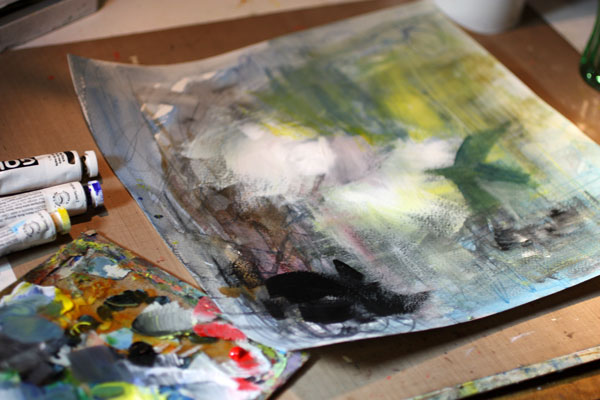
If you want to accomplish something new: think before you do it, not while you do it. Let your reason go through what you should create. But while you are creating, work very fast so that you reach the pace of your creativity. If you have some kind of image in your mind about the end result, it is important to focus on the feeling you want to express. The feeling should overcome the image while you are working.
Finishing Touches with Colored Pencils
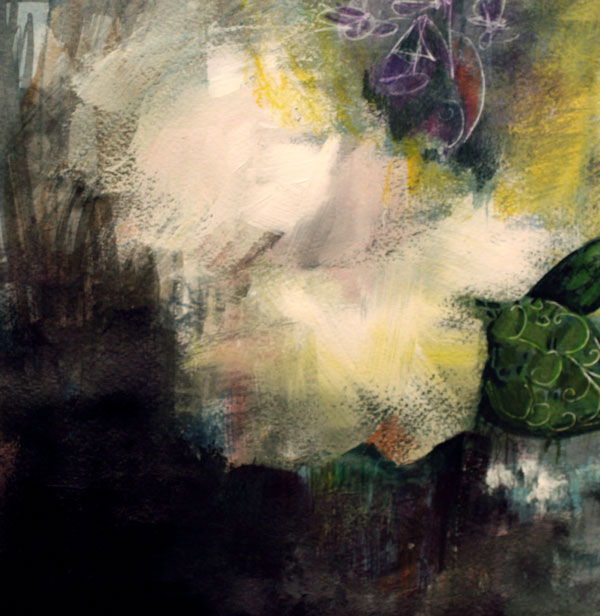
There is something quiet and covered in the way the people grief, so I added a lot of blacks and other dark tones. After passing the most exciting phase, I became worried about the lack of depth in dark areas. After working with acrylics, I added details with colored pencils. The white lines were made with a white gel pen.

I made the final touches with colored pencils by picking complimentary colors or colors very near their complementary.
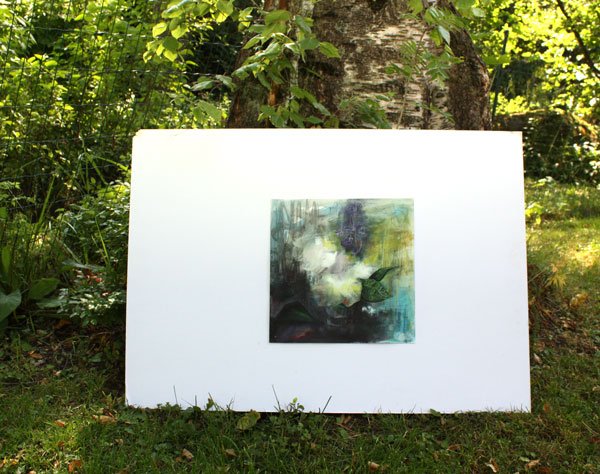
It felt somehow controversial to create this melancholic piece when the Finnish summer is at its best. But this was a good experiment. It raised an important question: Have I limited myself too much? Without too much questioning, could I try to create whatever comes to my mind?
Stretch Your Artistic Style!
Give yourself permission to experiment! Here are my tips:
1) Pick the direction to go! When stretching your style, remember to pick something you kind of like, but still have reservations about it.
2) What are the factors the new style has? Using a dry brush and only a few strokes were essential for my experiment. Think about techniques, colors, composition and pick the things that are essentially different than your ordinary methods.
3) Which the step in your process is the one where you take the new route? When will you start incorporating those new things? In my process, it was after making the background. Preferably start with the familiar way to get into the flow of creating.
4) Get emotional so that your emotion leads the way while creating. Think about the stories behind the emotion. Get into the state where expressing the emotion is more important than mastering the new method. Turn the music on if you need some courage to express your emotion.
5) Work fast without too much thinking. If you need to think, interrupt your work. Stand up and move around. Never forget the feeling you want to express.
6) Sleep overnight and finish your work on the next day. Embrace the good and fix the bad. Do not make major changes anymore as there will be a new day, a new blank paper, a new play, a new chance!
Stretch your artistic style
and get inspired by the world of art: Sign up for Imagine Monthly Fall 2016