
Look Back to See Your Artistic Style!

We often search for something new: new art techniques, new ideas, new approaches. When I pulled out a worn-out cardboard box filled with my old drawings and paintings, they all felt very familiar at first. I saw only the obvious: a skill level, a theme or technique. But when I stopped looking at the pieces individually and started grouping them, new insights occurred.
1) Look for Repeating Elements and Themes
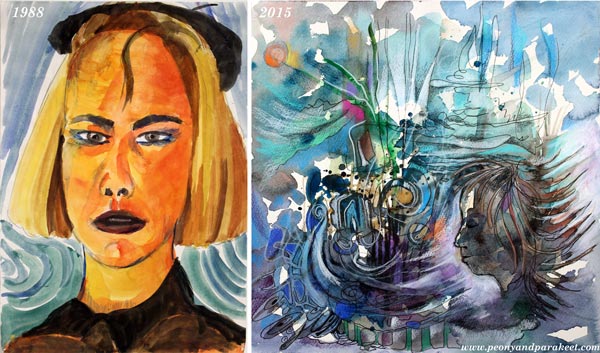
In 1988, when I was 19 years old, I made a watercolor painting called “Self-Portrait as an Artist.” Soon after that, I went to study computer engineering, and art didn’t seem so important anymore. But now, when working full-time in art, I love to compare these two paintings. There are 27 years between them, but they still relate to each other. It is interesting to see how my understanding of being an artist has changed. The importance of ideas, visions, and expression has grown, and the ego and stereotyped appearance have shrunk. I see similarities too: color choices, dynamic lines and dramatic atmosphere, foundational elements of my artistic style.
If you are hoping to find a new style, it is easy to miss that most of the elements are already there, just a little bit of fine-tuning is needed!
2) Combine Past Ideas
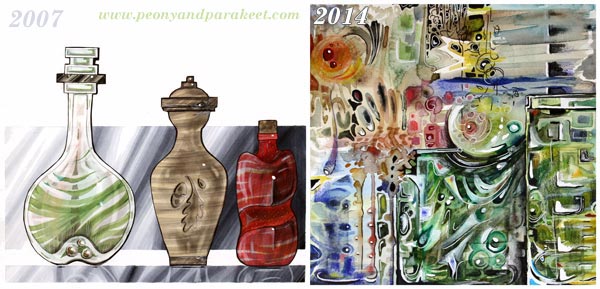
In 2007 I began studying industrial design. One of the courses taught us to draw various materials like glass, wood and plastic. After seven years I realized that I could use that kind of imitations for more expressive art too. I could play with the proportions and compositions. I also understood that I could use the things learned in the past, more widely and more freely. Instead of having only some ideas and simplifying those, I can have hundreds of ideas and combine most of them!
If you don’t know what to create next, combine what you have done before to a single artwork!
3) Embrace Your Roots

In 1985 I made this watercolor painting and remembered my family liking it. For me, it was important that this image came out of my imagination, it wasn’t made by following a photo or anything. It was born surprisingly easily, and I felt a bit puzzled: “So quick, and everybody likes it!”

In 2014 I worked with a similar theme and again, with watercolors. This painting contained more emotion than the old one. This painting was about leaving back a certain phase in life and entering a new one. However, when I look at both of them now, I think about my country, Finland, and its nature. This country is a land of forests and lakes and for Finnish, it is natural to use them as symbols in self-expression too. I can’t escape my roots and the older I become; I don’t even want to.
When you look back at your work, what kind of themes and changes do you see? Could you create collections showing art that tells your personal stories and your journey to your current artistic style? See also the post about stretching your artistic style!
Subscribe to my weekly emails – Get a free mini-course!
Do You Have a Talent for Creating Art?
This blog post is illustrated by students of the 4-week online workshop Inspirational Drawing. All the illustrations shown here are created at the class by these wonderful artists: Deb Weiers, Chrissie, CHB, Valerie Lima, Sandy Guderyon, Mary W, Gloria Schurman, Katia Maliantovich, Nea Wiseman, Gina Meadows, Joanne, Jacqueline Kriesels, Marie Jerred, Sue Rowlands and C in Ohio.
Let’s start the actual blog post with a personal question: Do you ever wonder whether you are talented enough?
I used to think that some day I will meet a person, both knowledgeable and prestigious, who would tell whether my art is good or bad. That thought made me both excited and worried. I became excited when I thought that someone saw more in my art than I did myself. And I became worried when thinking about the opposite result: that my art, that beautiful tower I had built, would just collapse. I would collapse.
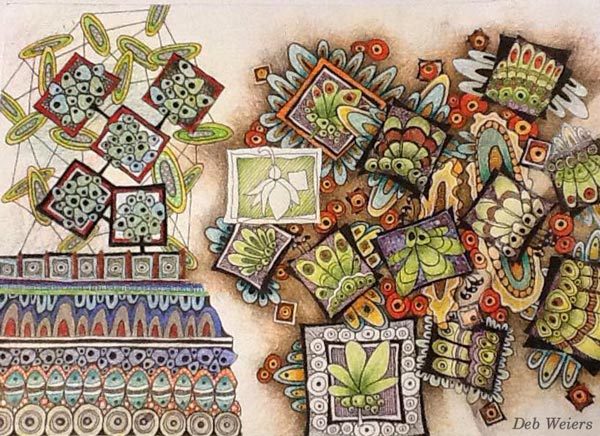
Years went by and I got tired of waiting for a specialist’s opinion. Maybe I could be my own critic? I went to study industrial design to find out how the quality of art and design would be set. While studying I realized that there are no right or wrong. People are different. Some may like art that somebody else does not, even if they both are art critics.
Somehow that made me even more puzzled. I didn’t know what kind of people would be my people, who would enjoy my art. And furthermore, if my art was bad, there wouldn’t be many of them.
However, I became convinced that somewhere in the world, there must be people that want to use their imagination and design whatever they like. They want to build houses …

… they want to travel …

… they feel drawn to beautiful patterns, and dream about enchanting gardens …

They want to learn from the history and use it to move forward in their own direction.
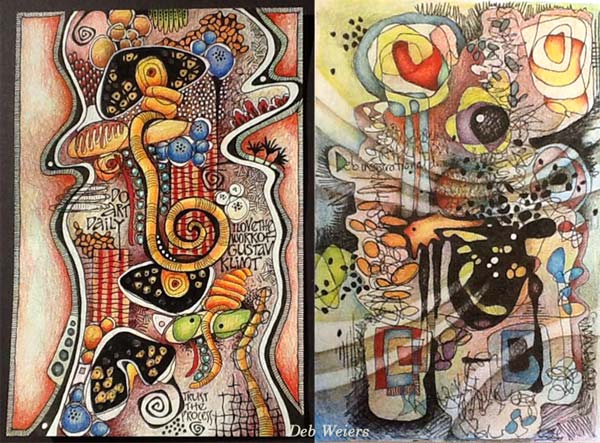
The more I examined whether I have the talent, I realized that art is not an absolute in any way. Art is a channel to express and communicate. If I look outside the window, and let my mind wonder on a path, the question is not how dimensional the window frames look like or how grey the stepping tones are. I find my people by sharing how uplifting the coolness feels like when walking barefoot on a hot summer day.

Even if there are theories about aesthetics, originality, playfulness etc. which determine good art, it is the experience that matters the most. If we feel connected to our art, there are much more chances that others will too.

By strengthening our connection, we will become more talented. We start creating more and seeing more. We will have more to express and more imagination to use. We can make people calm down in front of our art, or make them run and catch thoughts about their possibilities.

Nowadays, many ask me whether they have the talent. Even before they actually start.
Here’s the answer: Your talent cannot be determined by the grades you got while you were at school. Your talent cannot be determined by an opinion of a knowledgeable and prestigious specialist. Art is not about talent. It is about having something to say and work for saying it. It is about asking “what if” and finding the answer by using both your life experience and imagination. It is about looking out the window, seeing numerous possibilities for the perspective, and bravely picking your point of view.

So, do you have a talent for creating art? Always.
Subscribe to my weekly emails – Get a free mini-course!
Transfer Your Expertise to Your Art

If you want to grow as an artist, the best advice anyone can give you is this: Recognize your expertise and bring it to your art! If you breathe art and only art, you will become shallow and miserable, and it will also show in your art.
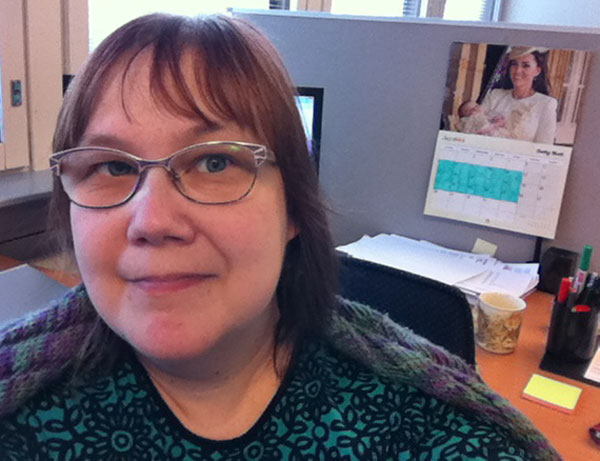
When I left my day job a year ago, I would not have said all this. I had my last days marked on the calendar (a special gift from a friend from the UK!) and I could not wait to forget most of the things I had learned from developing IT systems.
But the more I got distance from my past, the more I began to realize why I chose computers before art some 25 years ago. I realized that I also love to think, not only create. When I get a crazy idea, I try to put it into a logical form too. The architecture of computer systems still inspires me. Layering, hierarchy, interfaces … all those are concepts that I often apply to my art too. Being accurate and always questioning why – these basic nerd characteristics continue to describe me.
In the eyes of a systems developer, the world is full of details that have to be edited and classified.
I have realized that the more I show my understanding in my art, the more it also relates to other people. They don’t have to be computer engineers to feel drawn to my art. Behind every expertise, there are values that communicate much more widely.

In computer science, innovations are constantly made. People working in the field always have to be ready to learn new things. And not only that, but they also have to make existing systems work with the latest technology, so they are constantly adapting old with the new. For me, creating new from the history of art and design is one way to use that skill.
I believe that when people say they don’t know what to create, they overlook their expertise. It is not very easy to notice all the things you already know and deeply comprehend. In information technology, it is common knowledge that the projects where many systems are integrated together are the trickiest ones. I used to manage that kind of projects. I became interested in them after I realized: if you really want to build something that will have a bigger impact, integration is the key.

When you begin to integrate your other expertise to your art, I am pretty sure that things get … just like in IT projects … a bit rough. Different values and opinions will fight, and co-operation seems impossible at first. But after the merging process begins, you will be more creative, and you will have much more to express than ever before.
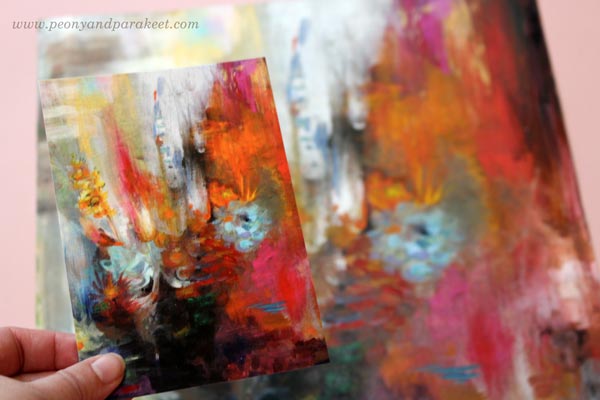
When I create art, I try to always arrange the time for the little nerd inside me. I know that if I just let my creativity decide, there’s a nagging voice inside my head saying: “You could do this better, why did you do that …” By taking breaks and thinking before creating, I accept my past and the part of my personality that is more logical than creative.
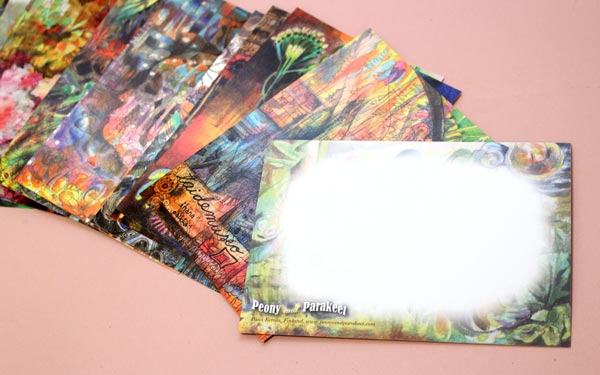
When you hear your inner critic speaking, maybe it is the voice of your expertise! Maybe part of you is disappointed not to get fully involved. Make your inner critic work with you, not against you!
Subscribe to my weekly emails – Get a free mini-course!
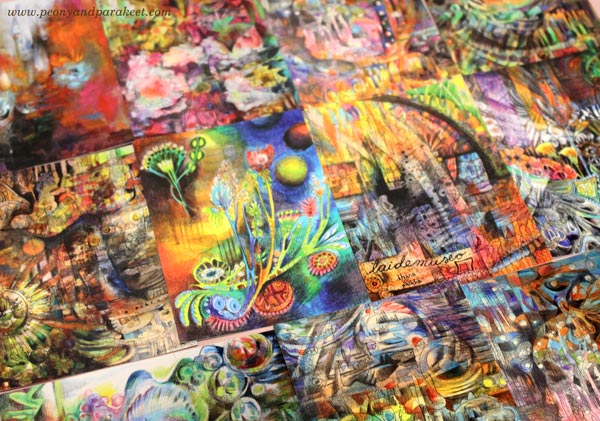
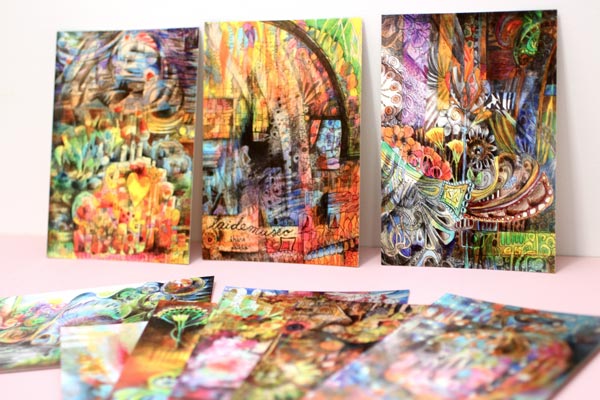
P.S. You can buy postcards at Paivieerola.com
Inspirational Adjectives for Your Art
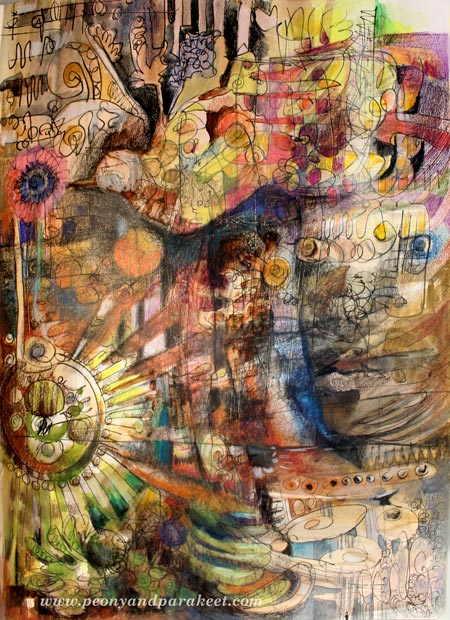
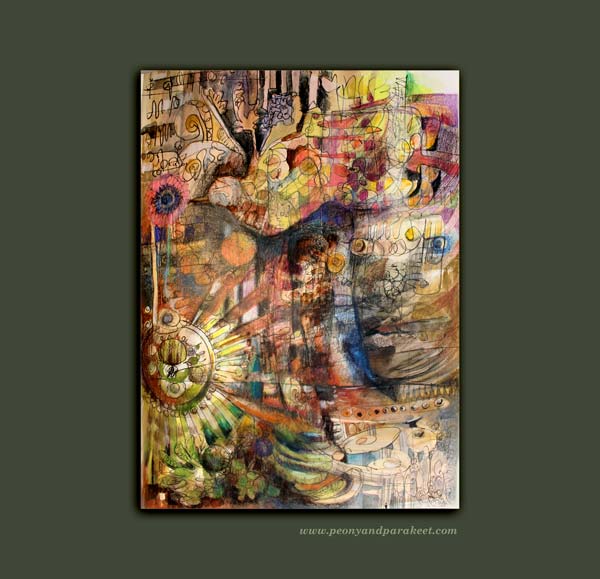
This art journal page is called “Introvert.” I made it while thinking about how much I enjoy spending time alone. My love for sharing and interacting are not the only things that make me; I am also an introvert who needs time to ponder and visualize what’s going on in my inner world. I find it often difficult to express myself in writing, so I like to create an image first and then write down the thoughts. Usually, my thoughts have moved forward and become clearer after processing them visually.
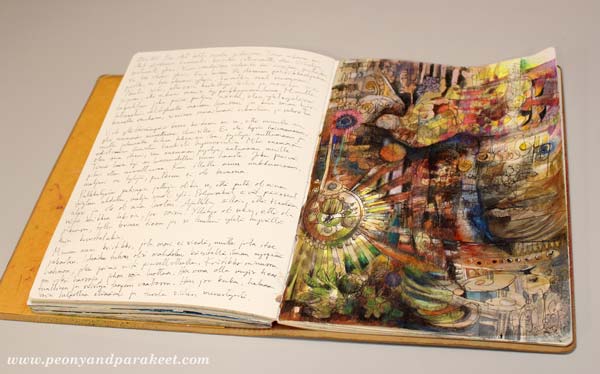
My Inspirational Adjectives
When I begin creating and while I am creating, I often get inspired by single adjectives. The same words continue to fascinate me, at least for a while, before I have found new ones. These words challenge me to both start and finish the artwork.
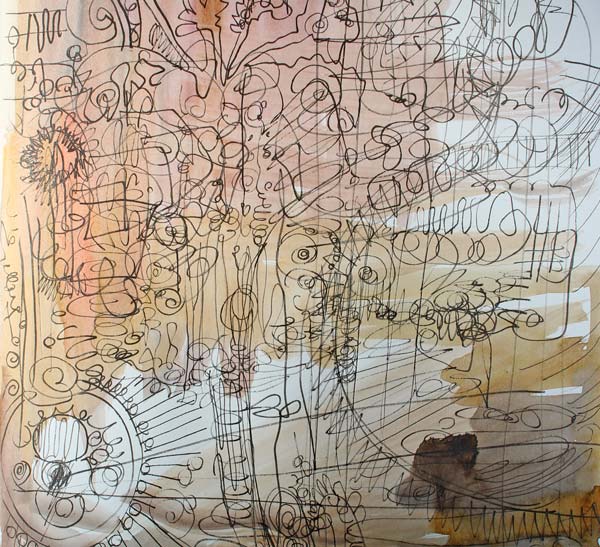
These are my current adjectives: “imaginative”, “forward-thinking”, “avant-garde”, “visionary”, “historical”, “futuristic”. I am especially fascinated by the words that are somewhat opposites like “historical-futuristic” or which describe a new kind of idea like “forward-thinking – imaginative”. While creating the page, I introduced the word “introvert” and got inspired by the word pair “visionary – introvert”. Brown watercolor felt just the right choice to express those words!

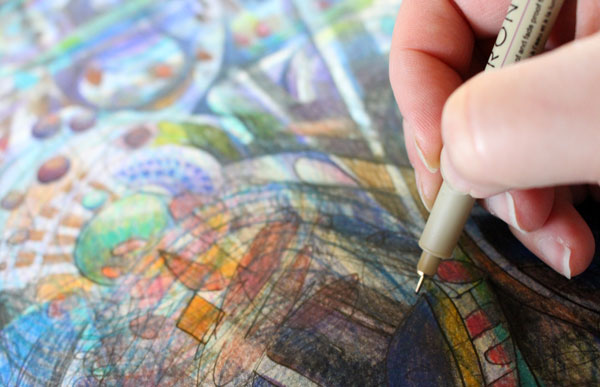
I continued with the black pen, not worrying about what to draw. Namely, it’s difficult to express “visionary” without first having something to look at!
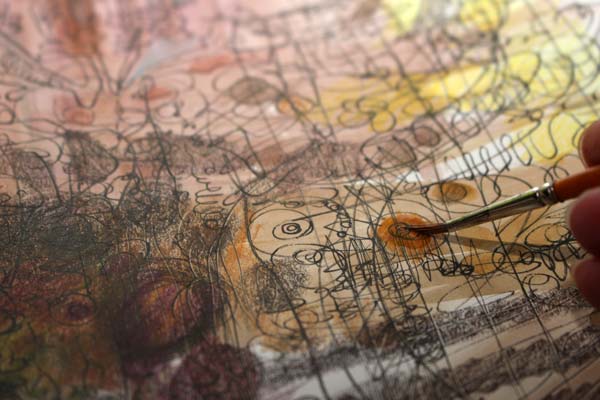
It was a warm summer day, so I took my colored pencils outside and started coloring carelessly.

After a while, I added some watercolors with a thinner brush.
How to Choose Your Words?
Some people think that art is a set thing. But pre-named styles and standards don’t define it adequately. On a general level, yes. But when creating art, your uniqueness should be your standard. Thus your adjectives should be set so that you respond to them emotionally. They should make you feel not only excited but also a little bit scared. For example instead of “caring” you might choose “sensitive” or “connected”. Think about your personality and what you value. Don’t take the first words that come to your mind. Seek for specific words that define the adjectives more accurately.
Express Your Adjectives!
Start seeing and enhancing your words, your personality, and your values in what you create. Whatever your piece looks like when you are in the middle of the creative process, think about those adjectives and find ways to express them.
“Introvert” instantly brought black color to my mind. “Visionary” made me look for circles like eyes. As there’s something mystique in the combination of those adjectives, I set a quite dark and little bit dramatic color scheme.
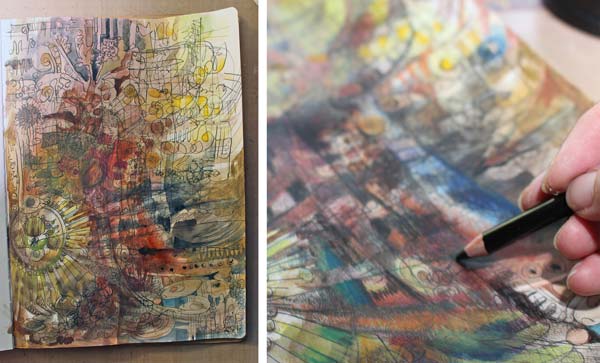
When you focus on things that excite and scare you, your art becomes more meaningful. It can bring new kinds of thoughts and ideas not only for you but also for others. Everybody doesn’t need to know your adjectives. Art can often be interpreted in many ways. But your creativity is most powerful when it’s focused, and few inspirational words can bring that focus!
Subscribe to my weekly emails – Get a free mini-course!