
Start Art Journaling!
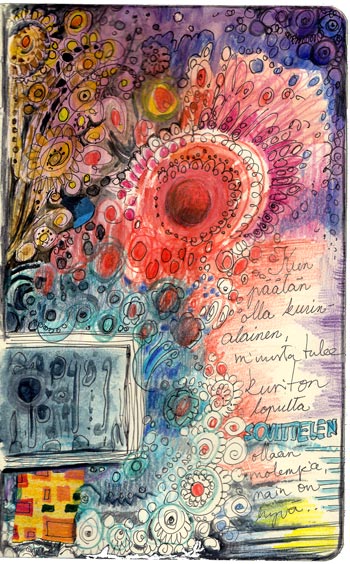 With this post, I want to introduce more people to art journaling. I will create this art journal page step by step using a simple concept and few basic supplies. You only need watercolors, colored pencils, and a thin black marker pen.
I have created this page on a Moleskine notebook (size: 5 x 8 1/4 inches, 13 x 21 cm). Your journal can be larger or smaller. This page is created on the actual page of a journal. But you can also use a separate paper and attach it later, so you do not even need a journal to get started!
Journals
You can make an art journal from almost any notebook or old book. You can also bind one yourself. If you paint on the pages, thick pages are better than thin ones. For watercolors, absorbent paper is better than waxy one. But if you use water sparingly, even pages with a waxy surface can handle some watercolor.
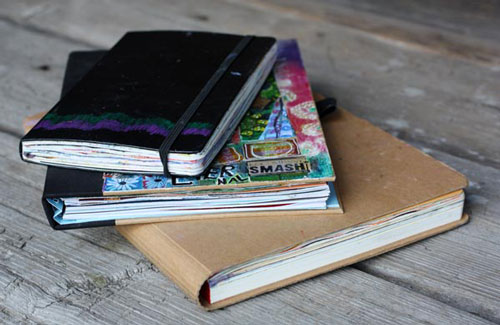
I am currently working on three various sized journals. In addition to the Moleskine notebook, I have a black Smash book and a Dylusions journal. The paper in Moleskine notebooks is less absorbent than in the other two, but it still works with watercolors.
General Inspiration
An art journal can consist of any visual material. You can create a collage of cut-out images or printed photos. Or you can paint or draw, or do it all! The pages often have some writing too. You can cut words from magazines, write them on a computer and print them or journal by hand. As art journaling is a form of self-expression, I think that pages are at their best when you create everything by hand.
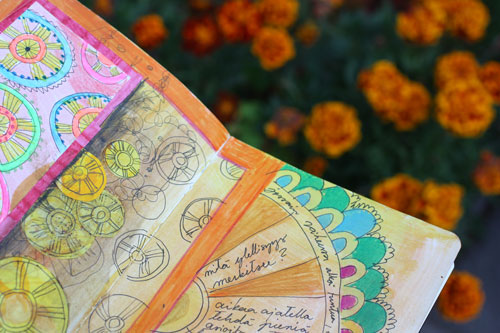
I do not believe in waiting for the inspiration. Once I have made the page, I usually realize what things have affected on it. Like when walking in the garden, I realized that my marigolds had had something to do with the page! So, do not wait until you have something to say or draw, just start creating! With these step by step instructions, you do not need a single idea before you begin!
Step by Step Tutorial for an Art Journal Page
1) Choose the page and draw the first shape
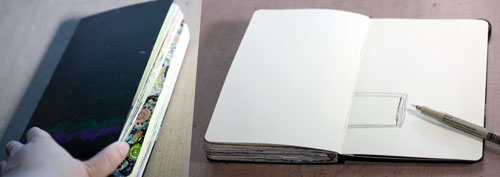
When I begin an art journal page, I usually feel quite stiff. The routines of everyday life can block our creativity. So it is no wonder that when you hold that brand new journal, you feel intimidated to start. Pick the page randomly as the first pages are the most usual causes of the blank page syndrome. Then take your thin marker and begin to draw. Slowly. Then a bit faster.
My imagination at this point was close to zero. I drew a rectangular and was able to mess it up so that I needed many lines to hide those clumsy strokes. Now I could have easily given up, no inspiration, nothing, just ruined one perfect blank page. But I knew better and went on.
2) Paint the shape with watercolors

To get my creativity flowing, change the marker to the watercolors. Constant interruptions are something that our rational side hates. That’s why it is important to be impatient, work quickly and continuously change the way of working. Paint the shape with watercolors and do not care how ugly it looks!
Painting the square did not make me feel especially creative. And with all the color choices I had, I chose a very conservative blue. Some would say that all the hope is lost, but I promised myself to continue to the next step.
3) Doodle around with colored pencils and finish with a large shape
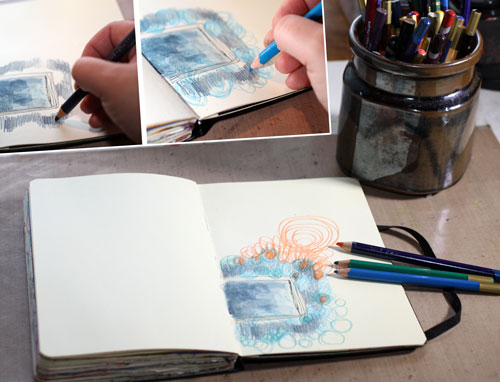
Start doodling with colored pencils. Believe me; you want to stay focused and work close to the shape. The rational thing to do would be doodling all over. Just stick to the area around the shape!
At this stage, I began to feel a bit anxious. It would have been so much fun to fill the page. But I followed my rules and remembered to change the color so that the process of coloring got interrupted. You can see that I began very traditionally, just with strokes. Then I changed the color and moved to drawing circles. After that, I picked another pencil and colored the circles.
The whole process so far has been pretty dull: First a square, then strokes, then circles. I felt a bit sarcastic at the moment: “What next? Triangles?” You can choose your doodles freely but end this phase with a bold movement: draw a large shape. Then abandon the colored pencils for a while.
4) Paint a new large shape with watercolors
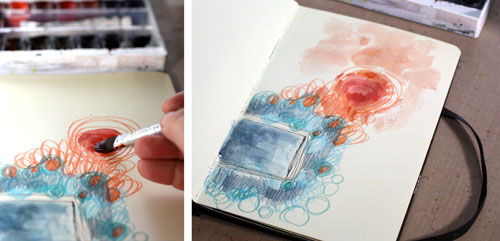
Watercolor the large shape drawn in the previous step. Then clean your brush by dragging it around the shape.
You can see that when choosing the colors, I did not repeatedly use the same colors so that they would have spread evenly. Instead of that, I created two color areas: blue and orange. They both contain various hues of color. The blue area varies from gray-blue to blue-green, and the orange area includes warm red. This way there are two elements on the page: blue rectangle and orange circle.
They say in poetry: two is a conversation. Even at this early point, the page looks like an image. It makes you think: who are they?
5) Doodle with the marker
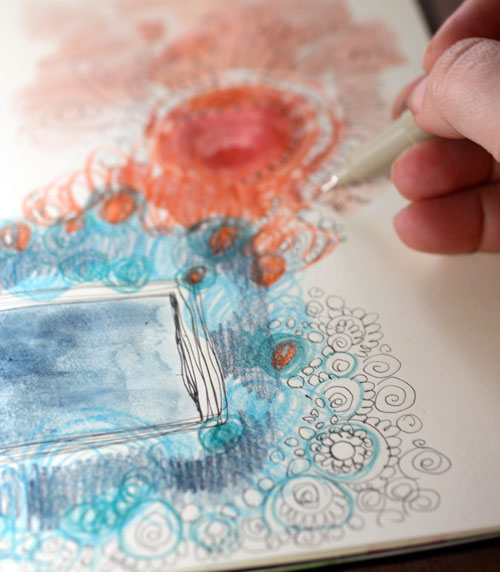
Fuzzy watercolors and soft color drawings look beautiful when they are partnered with a thin marker. Like in photos where something is blurry, and something is sharp, your page will look more appealing when you create the same effects.
Doodle around and over the shapes that you created in the previous steps. Don’t be afraid of crossing the shapes. In art journaling, a lot of time and energy can be spent in layering, but it requires nothing more than drawing over something beautiful to create even more beauty!
6), 7), 8) Colored pencils, watercolors, doodling
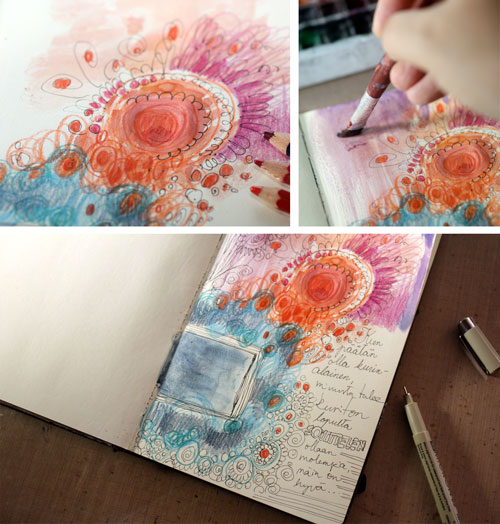
At this point of repetition, I began to feel pretty inspired. After coloring some doodles with colored pencils and painting some blank areas with watercolors, I felt inspired enough to write something that I thought that I am experiencing. I wrote: “When I decide that I have to be under control, I will be out of control. Then I make an agreement with myself: let’s be both!”
9), 10), 11) Watercolors, colored pencils, doodling
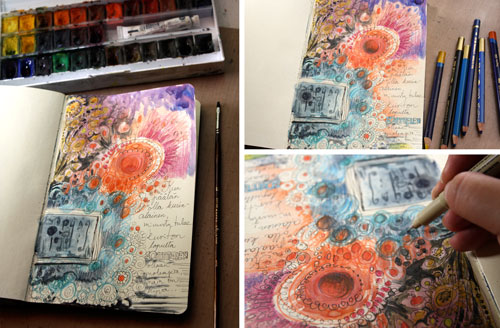
Now we are in the final round of making the page. Because these are the steps where you fine-tune your artwork, use a thin brush and very little water with watercolors. When adding details with the marker, change the orientation of the work once in a while. Many times it is easier to focus on the details if you turn the page upside down.
In poetry, they say that if two is a conversation, then three is a dance. I emphasized the upper left area to create a third element. It made the page more dynamic. Namely, at that point, I was feeling super dynamic and inspired!
12) Finished?
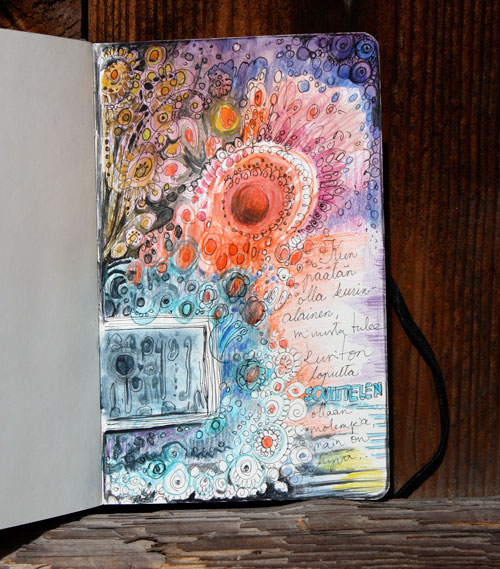
When you assume that your page is finished, it is time to take a pause and examine the work.
When I examined mine, I saw that my rational side is there in the form of a computer screen and my creative side in the form of an orange flower. I decided to add a little hand decorated paper piece under the computer screen to make it look more like a computer. Then I added another tiny blue piece besides the orange flower to make the orange pop.
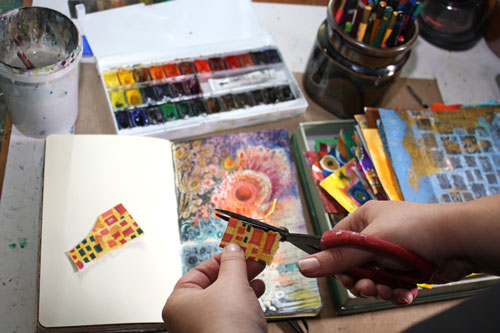
When you use your own hand drawn papers for collage, they will integrate beautifully. (New to hand decorated papers? See the basic instructions.)

The finished piece now expresses my love for the internet and computers. If that subject was given to me at the beginning, would you think that I could have created that image? Never! I would have stared the blank page and after a while, be as bored as my beagle is at the moment! Getting started even if you don’t feel like to and still finding the happiness of self-expression along the way – that is the magic of art journaling!
Let me be your art teacher: Subscribe to my weekly emails!
Art Journal Inspiration from Children’s Books

The art journal spread shown above is created from hand decorated papers, colored pencils, and markers. The main message here is “You can ride with your imagination in any way you want.” As it implies, I like my art journaling to capture dreams and fairy tales, not so much everyday life.
Mini-Worlds and Fantasies
I think that an art journal can be childish and playful. The way I see it, children’s books are the predecessors of them. Children’s books also combine illustrations and text to create mini-worlds and stories. I love to add both decorative and naive elements on the same page, and children’s books are great inspiration for that!
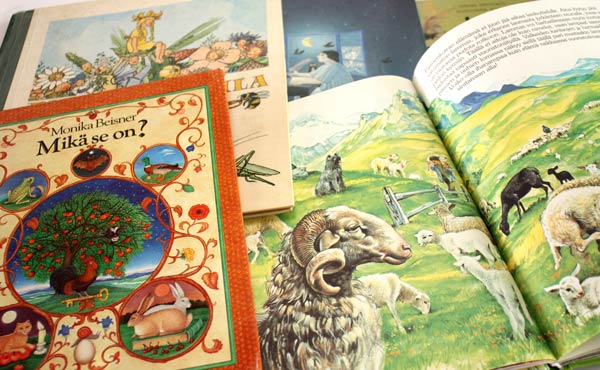
I buy used children’s books from recycling centers. They cost only a few euros (few dollars). That is a fantastic value considering all the inspiration they can give. I pick the books that have a lot of good quality illustrations. As I love detailed drawings, I try to find books with sharp lines and many details. Browsing children’s books can be a good practice for finding your artistic style. Pick the books that you feel most drawn to and then list all the things they have in common. I prefer books that have matte pages because I sometimes create collages from them. Then it is good if I can draw or paint on them.
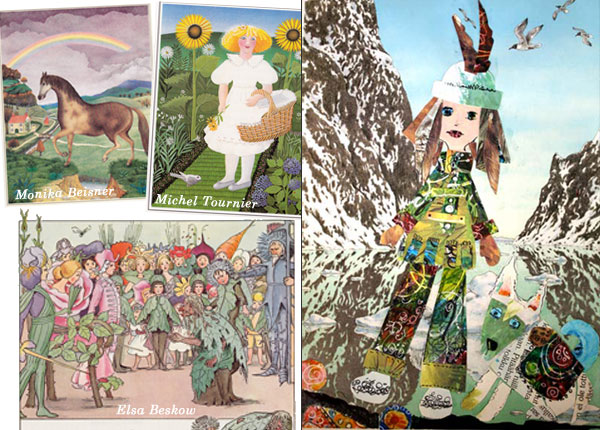
I made the collage on the right while teaching at a workshop last fall. It’s one of the pages where I have used the papers from children’s books. I often give few pages from various books for each participant of the workshop. It’s much easier to start creating when you don’t need to stare blank paper.
That little explorer resembles anyone who is entering the world of children’s books!
Subscribe to my weekly emails – Get a free mini-course!
Illustrating Poems in Art Journaling
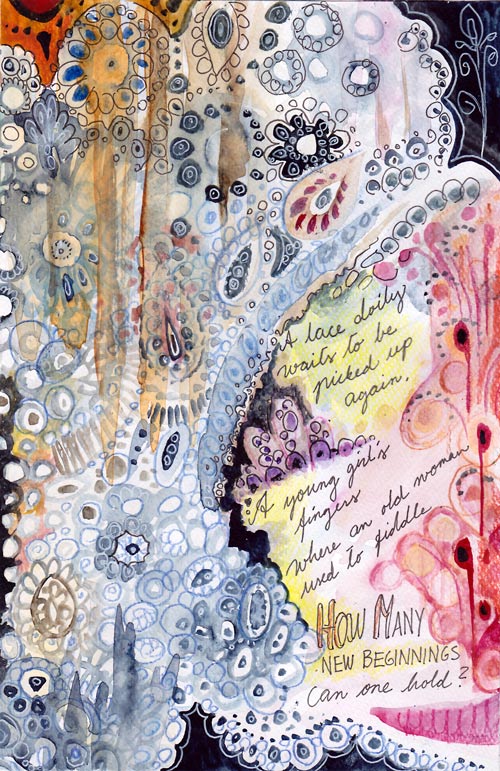
A lace doily waits to be picked up again.
A young girl’s fingers where an old woman used to fiddle.
How many beginnings can one hold?
This is an art journal page which illustrates a poem. I usually create the image first and then add the text. This time, I wrote the poem first and then illustrated it. Namely, for a long time I have had a desire to include creative writing in my art journals. I have loved poems since a small child and I used to write them all the time. After I grew up and moved away from home, it gradually stopped. But now years later, poems seem a great addition to art journal pages. Especially because I usually start writing a poem with a visual image in mind. Wouldn’t it be suitable to document that image too?
Of course, you do not have to be a poet to get into illustrating poems. You can also illustrate the poems that other people have written. Poems are great tools to get connected with the visual images that represent feelings. I think poems make a perfect pair with visual self-expression!
Illustrating Poems
1) Getting in touch with the feeling
Read the poem several times.
What kind of atmosphere does it create? What metaphors does it use? Are there physical objects or people to include?
There’s a risk of getting too rational here. Try answering these too:
What kind of memories or thoughts does the poem raise in you? What kind of rhythm, music or dance does it resemble?
2) Sketching
Lightly sketch the elements you want to include to the page. Write the poem or at least reserve a place for it.
I used watercolors for sketching. Light painting can bring a more intuitive approach to your work than using a pencil. You don’t need to know your exact composition yet. Think this phase as the first steps in the dark! Do not take it too seriously (= too rationally)! Focus on the feeling you want to express!

3) Expressing with composition
After sketching, adjust the composition by adding more elements to the page! With poems, I often feel that if the composition delivers the message, the rest is trivial or easy. There’s so much content in the words itself.
I wanted my page to lean to the right and then up. Right – because there’s a strong connection to the future in the text. Up – because the doily waits to be picked up in the story. I also chose the colors accordingly: blue representing the old and red representing the new.
4) Finishing
This phase is to fine-tune everything already created.
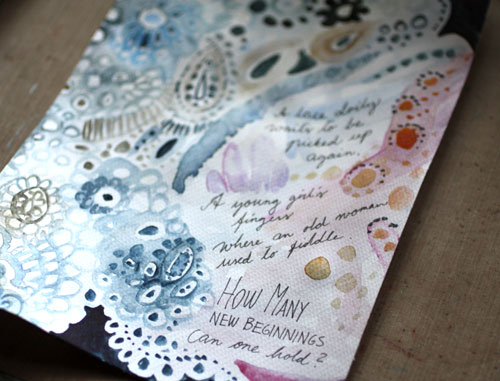
I wanted to add the feeling of fabric and emphasize the upward movement by adding thick lines with watercolors. I also made the lace more detailed. Then I added some dark areas to make lighter areas pop. A thin black marker and colored pencils are great for the finishing touches when using watercolors on the page.

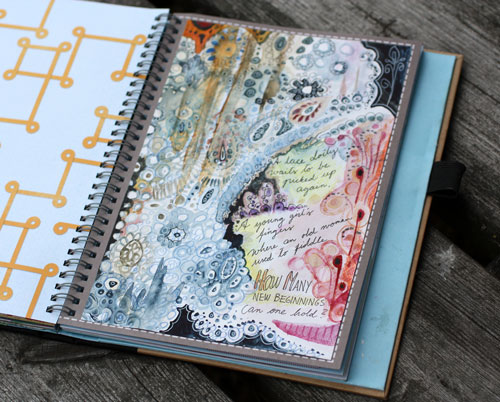
The page was made on a separate watercolor paper and then attached to the journal. Watercolors work best on watercolor paper. Even if you use a thin watercolor paper it’s better than using a smoother surface.
Illustrating Poems – A Minimalistic Approach
You know that I am not a particularly fond of minimalism in self-expression but with poems, I think it can be a very effective approach.

A yellow spot on a white painting.
A happy thought when leaving.
I saw the sun on a cloudy morning,
The one to brighten my being.
This poem of mine began with a visual image that called for simplicity. When aiming for lots of space, acrylic paints can be a better medium to use than watercolors. Acrylic paints have more substance themselves, and it’s easy to add slight, yet powerful color changes with them.
In this page, I divided the poem into three parts. The composition was built accordingly.

The first part is focused on expressing the latter sentence: the leaving. It is bittersweet, light peachy orange.
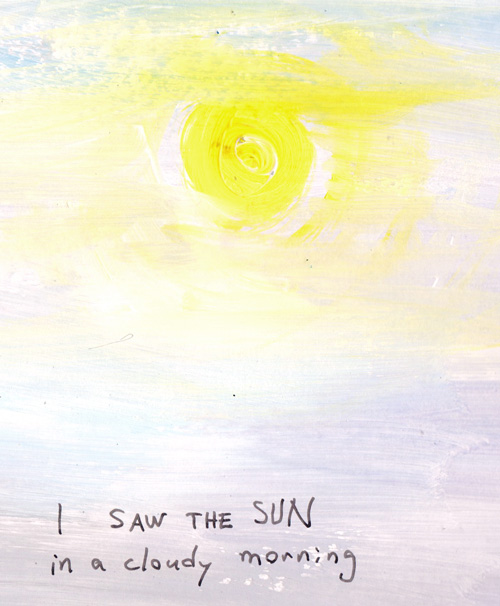
The second part visualizes the sun in cloudy weather.
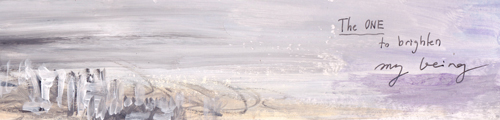
The last part communicates the person, her being and her relation to the world that she is leaving behind.
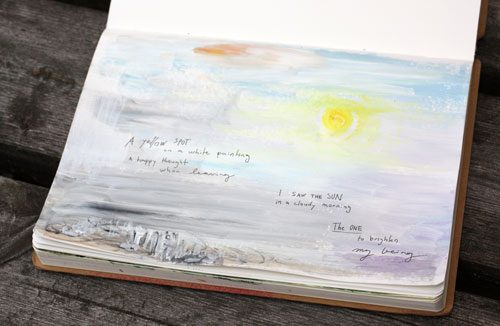
With acrylics, it’s easy to work on any surface. I used white gesso instead of white paint but only to save some money.
Art Journal of Poems
Think about having an art journal that is filled with illustrated poems! What a treasure would it be! The best things in life are those we can create ourselves.
Let me be your art teacher: Subscribe to my weekly emails!
Express Yourself with Colored Pencils
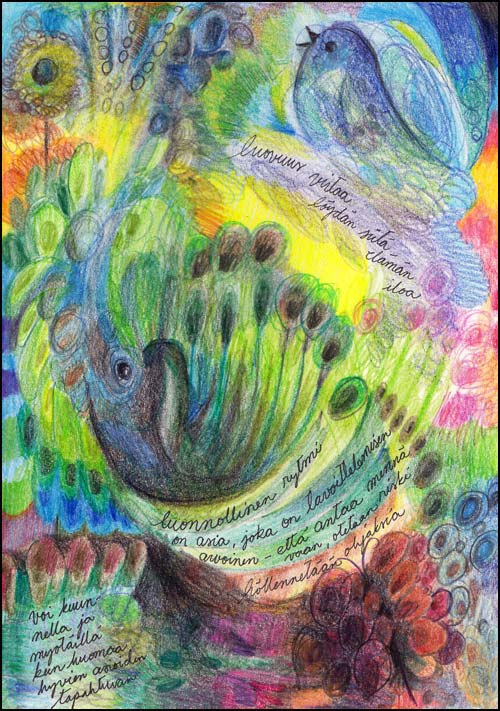
Simple art supplies fascinate me. Colored pencils have been my favorites recently. They are so easy! There are no worries about making the pages too thick even if there’s a lot of layers.
Colored pencils seem to be used for traditional artwork mostly. I think they are as suitable for improvising as any other media, like watercolors. In this post, I will show you few easy techniques for expressing yourself with colored pencils.
1) Color by Doodling
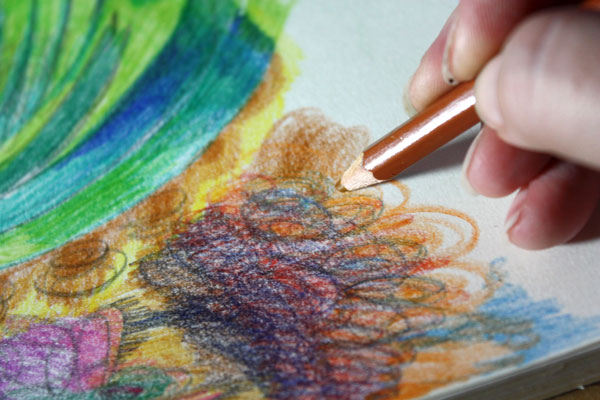
Starting with a blank page or paper, draw circulating and continuous lines to color a small area. Then change the color and continue. Create layers and let the colors intersect. You can get a wide range of colors with layering. Think your pencils as doodling tools!
2) Rotate the Page while Coloring
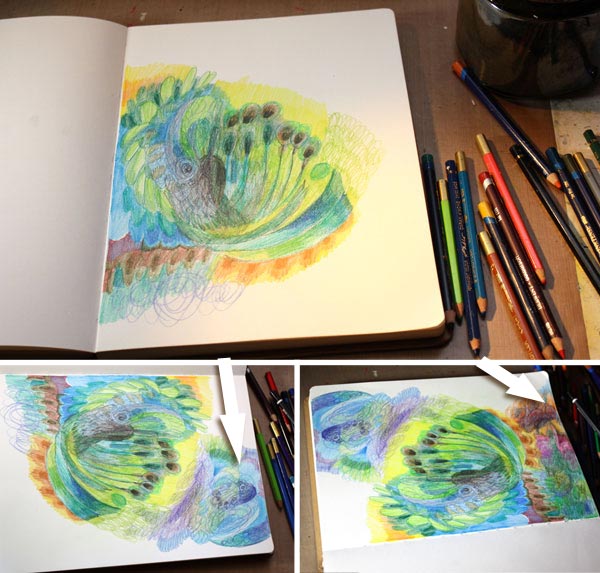
You will get more variety and interest to the page if you rotate it while working. Work one area at a time, changing the orientation once in a while. The areas can be fairly large as in my page, or smaller.
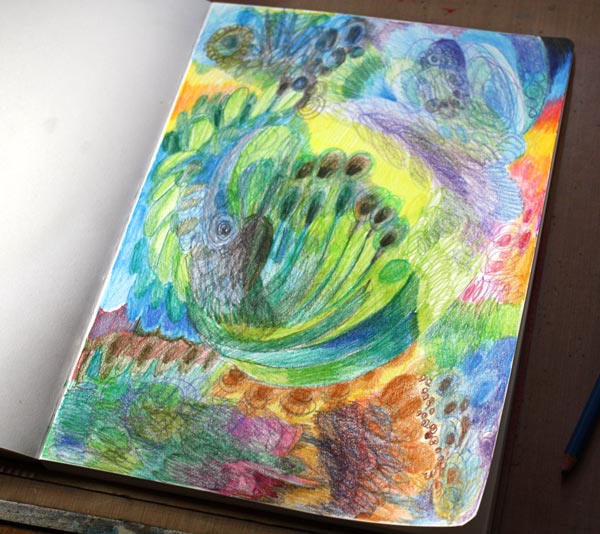
Here’s the page before I used the eraser …
3) Use Eraser to Create Lighter Areas
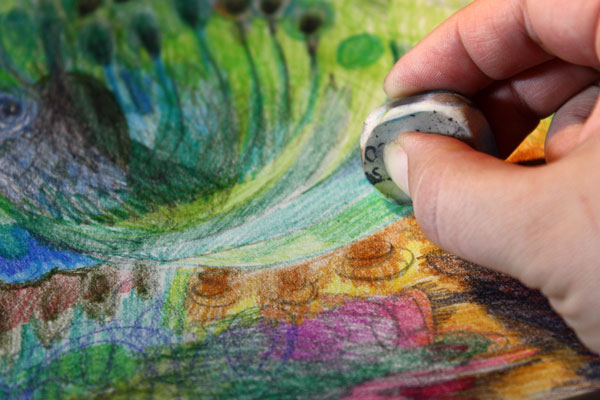
Erased areas bring light to the work. In an art journal page, use the eraser for the areas where you want to write the journaling.
4) Add More Clarity

I am a big believer of finishing. When you improvise, the result may be self-explanatory for you without the finishing touches. But if you want to communicate with others too, then sharpening some areas and adding some layers here and there for more intensive color is a minimum. I realized that my page had some animals in it so I made them easier to see. Like the photos include sharp and unsharp areas, you do not need to work through the page. Picking the focal points and working with them is often enough.
Coloring with Pencils is Like Painting by Drawing
By discovering these easy techniques, I have learned to love colored pencils. It is like mixing painting with drawing. With colored pencils, you can have a gorgeous art journal or a unique greeting card collection! Show your free expression with colored pencils!
Express yourself with colored pencils! >> Buy Coloring Freely!