
Intuitive Abstracts with Colored Pencils
This week, we create abstract art with colored pencils so that we let our intuition lead us.
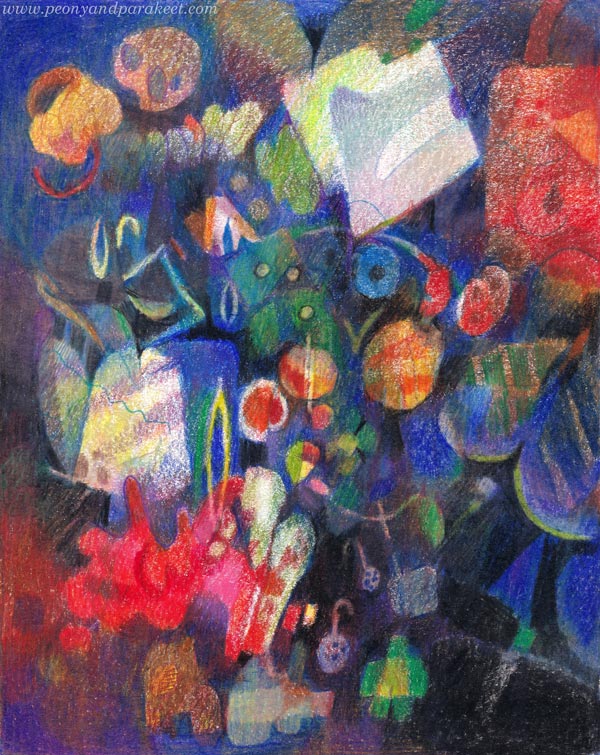
If we only draw realistic art, we miss the layer that is under it. I often call my abstracts “skeletons.” They show how my art is constructed and what its spirit is. By creating abstracts, I can adjust my visual language and discover new shapes, techniques, and color combinations without being constrained by how things “should look.” It’s like Wassily Kandinsky has written in his book “Point and Line to Plane”:
Not everything is visible and tangible or – to be more explicit – under the visible and comprehensible lies the invisible and incomprehensible.
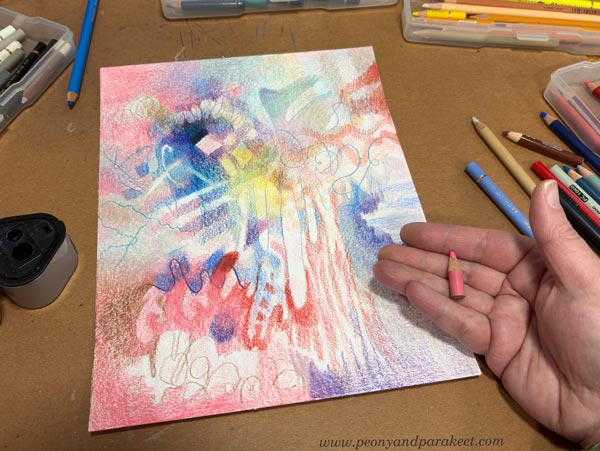
Step #1: Pick Your Shortest Pencil and Color Lightly
The first layer is a seed for future layers, so create a variety of shapes.
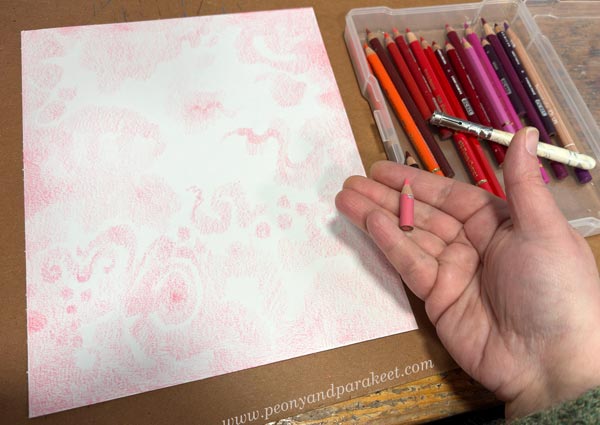
You don’t have to feel anything; just focus on variety.
Step #2 – Add Colors and Shapes Over the First Layer
The new shapes and lines don’t follow the first layer but get inspiration from it.
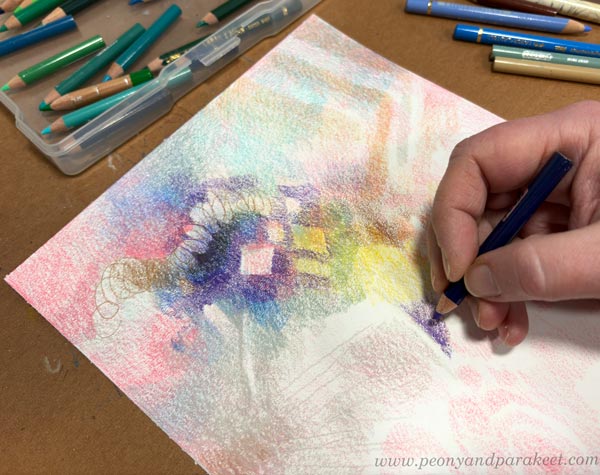
Rather than following the first layer, take a different direction and create the opposite of it. If the stripes of the first layer go in one direction, now color something else in a different direction. If the first layer has a big shape, now add something that is not so heavy, for example, thin lines. Get out of the traditional solutions, and find new ones.
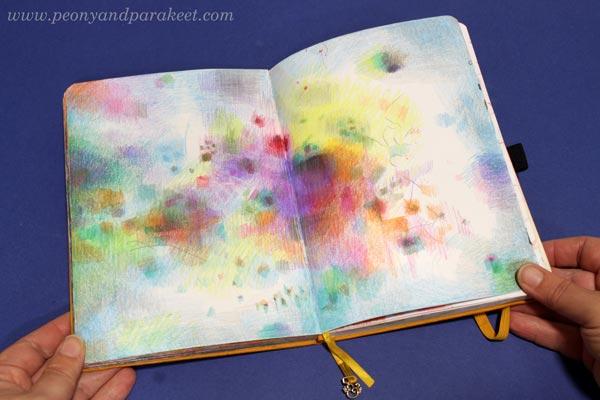
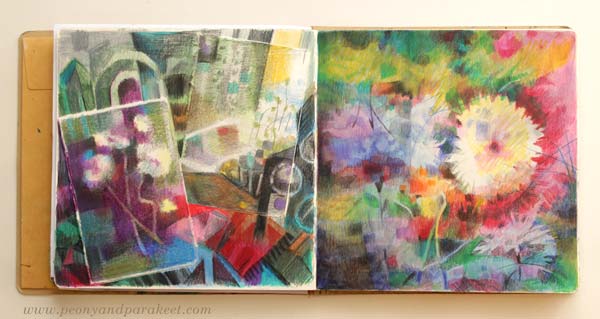
If you don’t have the patience to continue longer, you can leave your abstract to be just a color play. Here’s one of mine in an art journal. This is from 2024.
Step #3 Remember Thin Lines
Stripes are fun to color with zig-zag strokes, but by using thin lines, you will bring more of yourself to the drawing.
See how I have used lines in these art journal pages (See the full art journal in this post from November 2025). More than outlining, I like to let the lines wander freely.
You can also use an eraser for lines. The eraser pen is great for thin strokes, but you can also use a regular eraser and then color around the erased part to make the line thinner and more elegant.
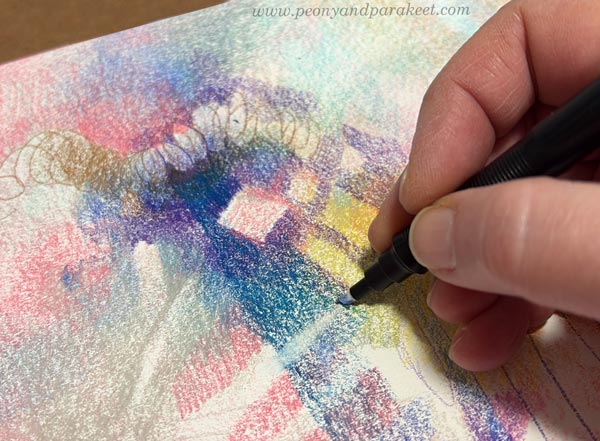
Any straight line is just a stripe, but when the line gets curvier and becomes winding, the artist behind the pen comes up, and more intuition can be brought in.
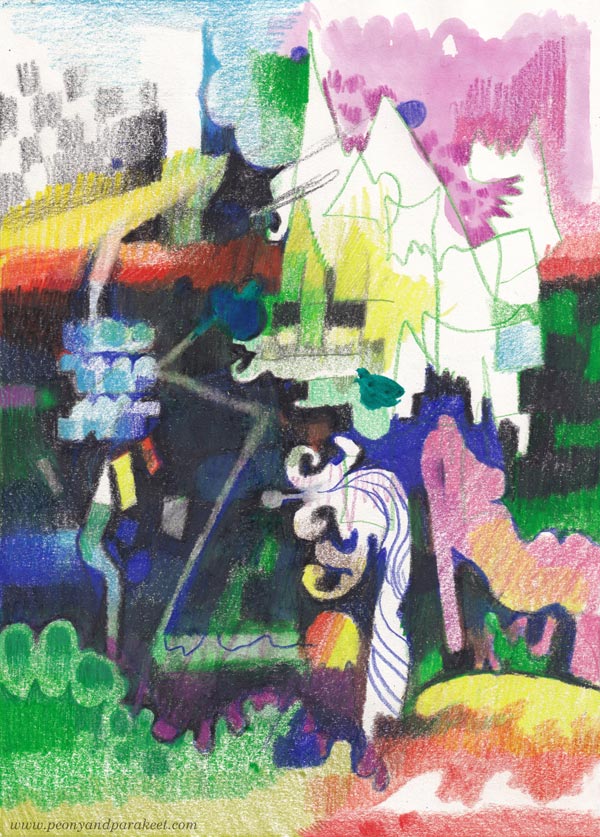
A line that is curly like writing can appear inside a shape or make new shapes. Here’s an example from 2023.
Step #4 Color over Color
Mix colors by adding a new color over the previous one. Color lightly so that the previous layer shows through.
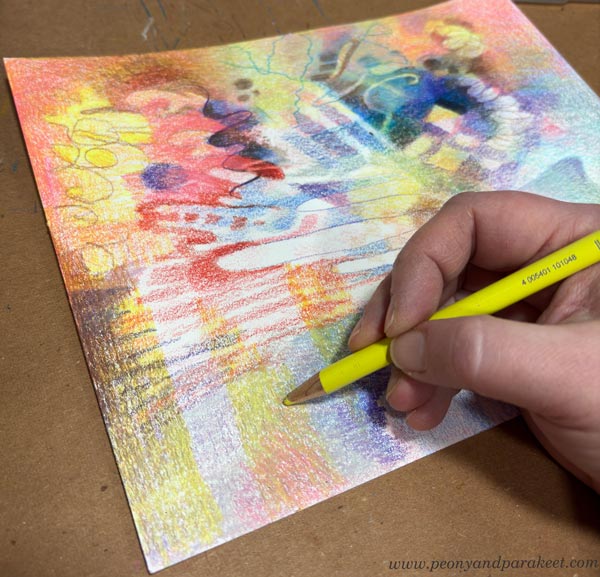
Step #5 Into the Darkness
Be bold and add dark colors too.
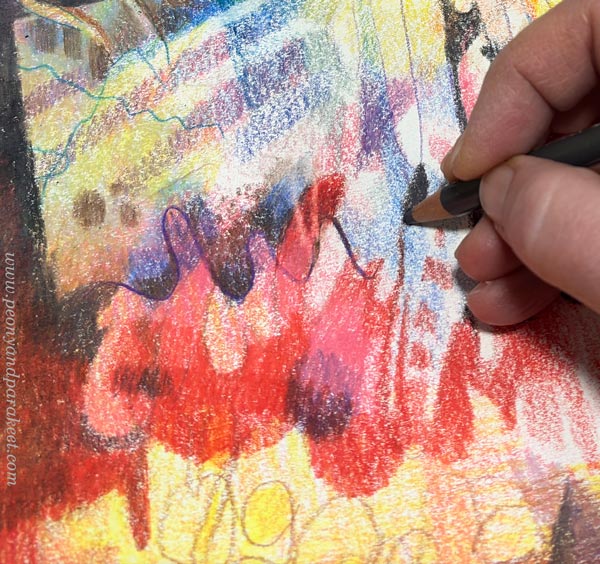
The dark parts make these simple pages look finished. The examples are from 2015.

Step #6 From Intuition to Intention
The further you progress, the more you begin to wonder what the image is about. Remember Kandinskys words: “under the visible and comprehensible lies the invisible and incomprehensible.” I like to keep the abstract drawing in the incomprehensible stage for quite a long time.
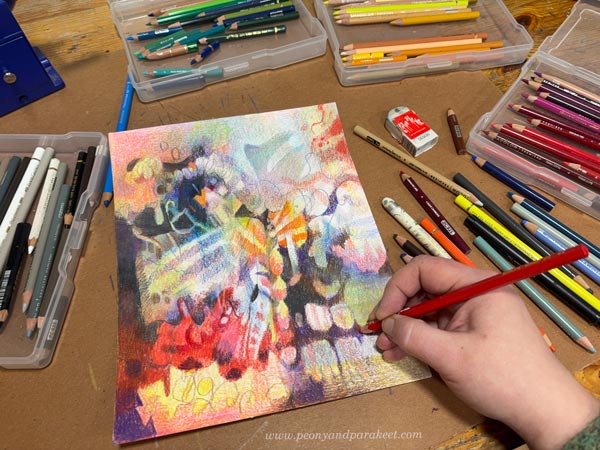
At this stage, I was thinking about sweets, fruits, and drinks. But then I just let go of that thought and allowed the drawing proceed further. The easy thing for me is to make a floral piece from “a skeleton.”

And even now, my drawing started to get more flowery shapes.
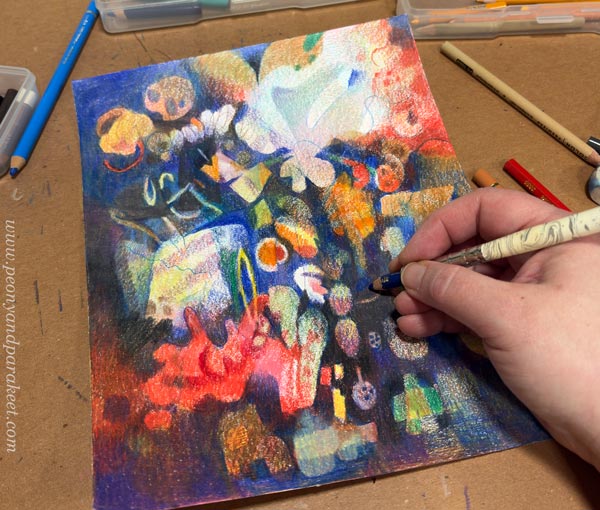
It reminded me of the drawing I made in 2024.

But I don’t want to draw flowers only, so I continued to work on the drawing.
Step #7 Hide Most of the Shapes
Don’t fall in love with every detail! My art is full of details, and I have often struggled with which ones to save and highlight compared to others.

Here too, I made lots of decisions about which shape to save and which alter so that it doesn’t show so clearly. It’s not just about improving the composition but about the atmosphere and topic. Here, I was thinking about jewelry, printed fabrics, all the fashionable things, and how great designs are derived from plants.
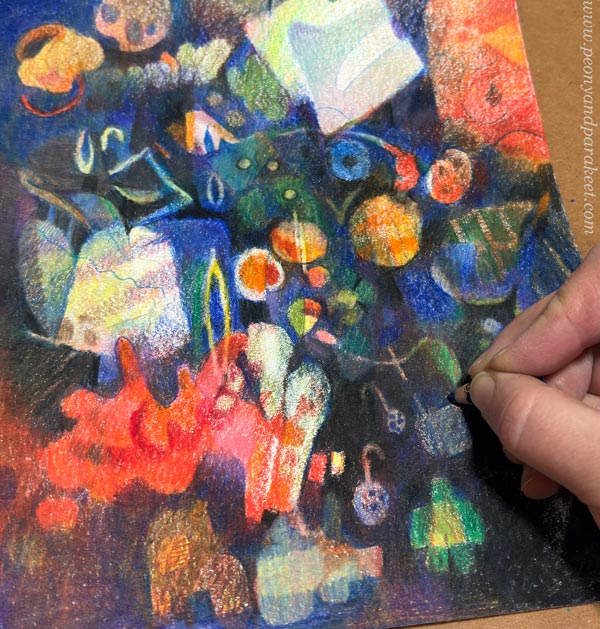
I don’t dress fashionably, and I don’t consider myself to be appearance-oriented, but I have always felt a connection to fashion design. It’s a strange relationship, because all I have to do is catch a glimpse of, say, a Dolce & Gabbana fashion show and my mind is filled with ideas for paintings. My intuition often offers me solutions that I recognize as fashion-related in one way or another. I do have a background, but in industrial design, so it’s a bit mysterious to me!
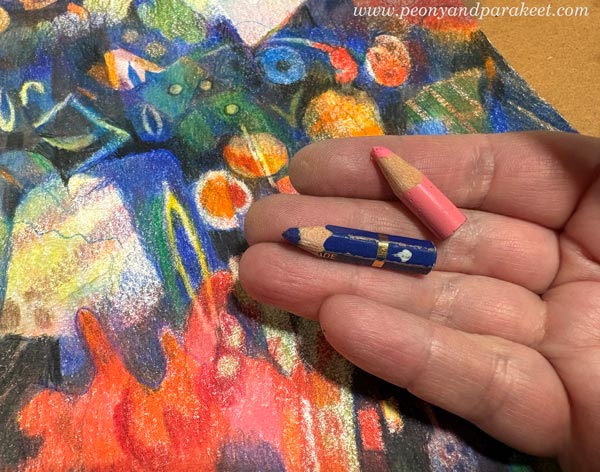
In the end, I tossed these shorties away: Thank you for your service!
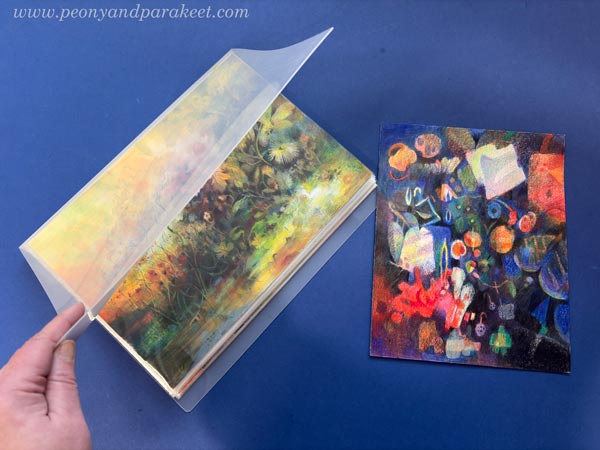
I store my colored pencil drawings in a plastic folder.
Outer vs. Inner Inspiration
We often need outer inspiration to get started, but to continue, we need the connection with the inner inspiration.
Wassily Kandinsky wrote:
In spite of all the apparently insurmountable contradictions, the present-day human being is, indeed, no longer satisfied with the external alone. His vision is becoming sharper, his ear keener, and his desire to see and to hear the inner in the outer ever increases.
In the course Mystical Minis, we color small abstract drawings and move from the outer to the inner. You can’t find a course like this anywhere else. I have got inspiration from Wassily Kandinsky’s colleagues, Hilma af Klint and Georgiana Houghton, as well as the modernist author Virginia Woolf. Every exercise is different, but all are mystical.
Mystical Minis – Draw abstract art with colored pencils – Buy Now!
5 thoughts on “Intuitive Abstracts with Colored Pencils”
Comments are closed.
Hello Paivi! Wonderful post here that is right up my alley. I have been binging on all things Peony and Parakeet over the last few weeks. I am brand new to colored pencils, drawing and alike and stumbled upon your work through a “dark, moody, abstract” Google search. I very much appreciate your philosophy, your abstract, soft eye, and art world in general. My “vocabulary” is limited to the most basic of shapes. Is Mystical Minis for a beginner as myself?? Maybe Intuitive Coloring?? I Did purchase and enjoyed Coloring Freely. Sorry for the ramble, Paivi ! Thank you!!
Hi Scott, thank you for your comment! Colored pencils are so much fun. Both Mystical Minis and Intuitive Coloring are suitable for a beginner.
Thank you for the reply, Paivi! Sounds great. Happy creating and stay safe you all.
I can’t get over the variety of techniques and how you bring everything so beautifully together into these little coloured “windows”! I don’t seem to have the innate ability to relax into abstraction…I’m always in too big a hurry to produce something that is recognizable. But I SO often want to go the other way!!
There is a lot of art that goes into high fashion, so I’m not surprised that you are attracted to it and also we see art in needlework and fabric design, costumes, etc.
Thanks for this excellent post…I know I will be returning to this one to keep learning!
Thanks so much, Lynne! Windows is a great word for this technique! Maybe just take an old piece and start coloring over it, leaving windows to the most interesting parts?