
Using White as a Color in Painting and Drawing
In this post, we explore the color white and find ideas on how we could change the way we use it in art-making.
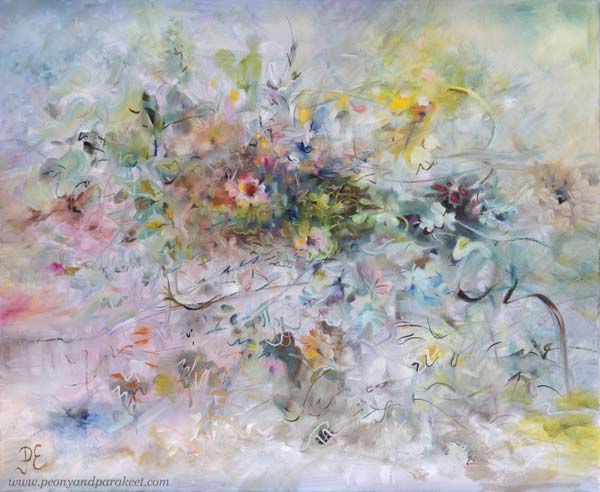
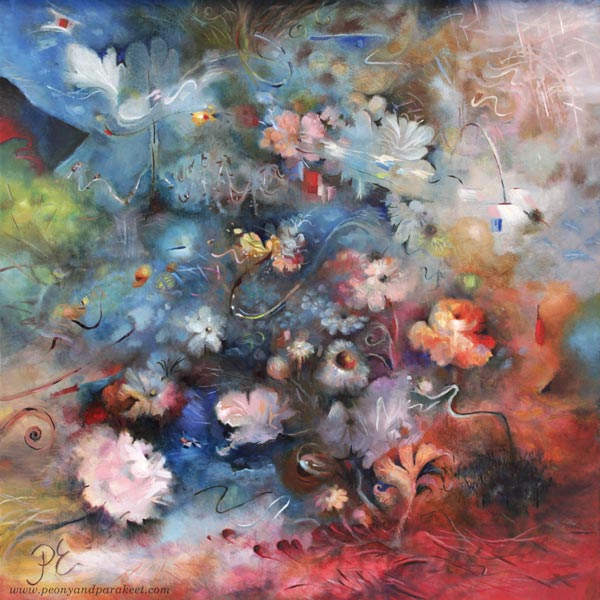
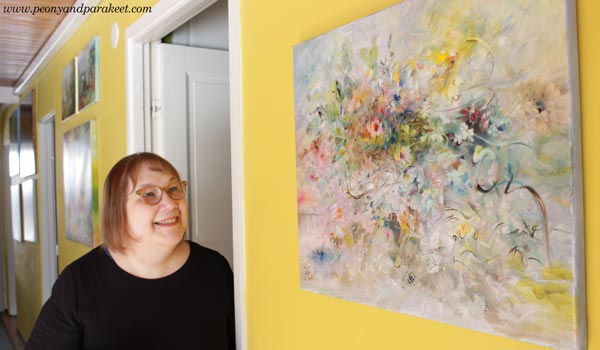
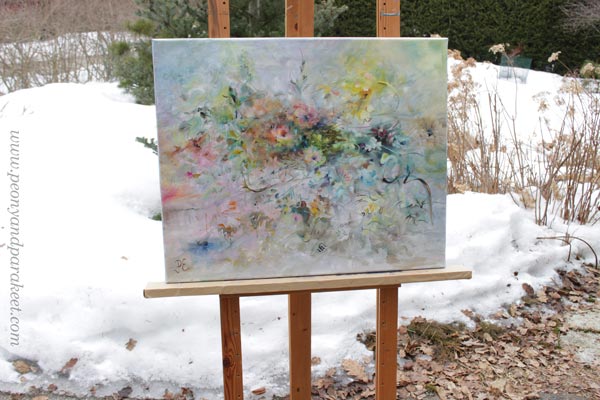
I posted this painting about a month ago, but I still had to fix it! You might not notice the difference, but it matters to me. I have changed the center of the painting so that it is more abstract.
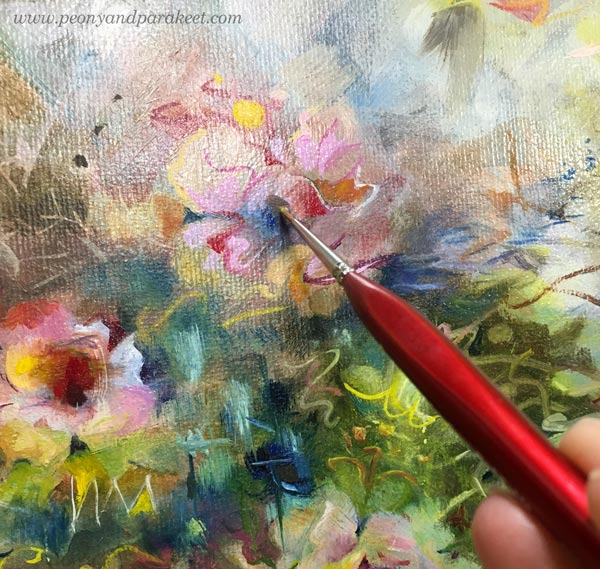
A long time ago I thought that it doesn’t matter if I don’t like some detail of my work or if I don’t like some of my work in general. I thought there would always be someone who would like it.
But the longer I’ve been painting, the more important it has become that I have to be a fan of my own work. When you are a beginner, quantity is more important than quality. But I’ve been working for a long time and the equation has thus turned the other way.
I know some would prefer the more realistic flowers, but I don’t! I have too much reality around me, especially now when the weather has been too cold to be spring.
Living in a White Country
This painting is also special because it has so much color that is difficult for me – white! There is far too much white here in Finland. Even if now is the end of April, we got a lot of snow a couple of days ago!
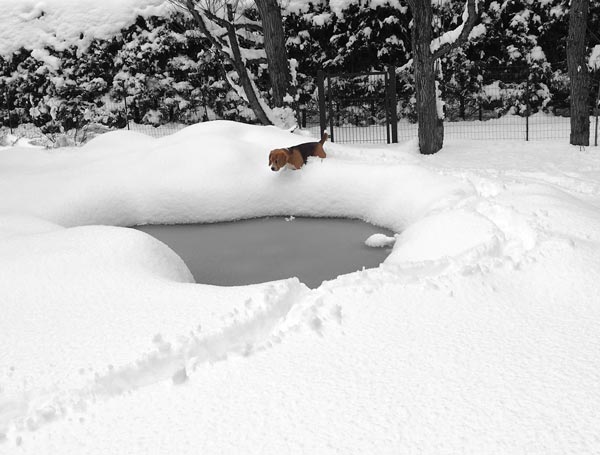
I think white is a terrible color because it is full of emptiness.
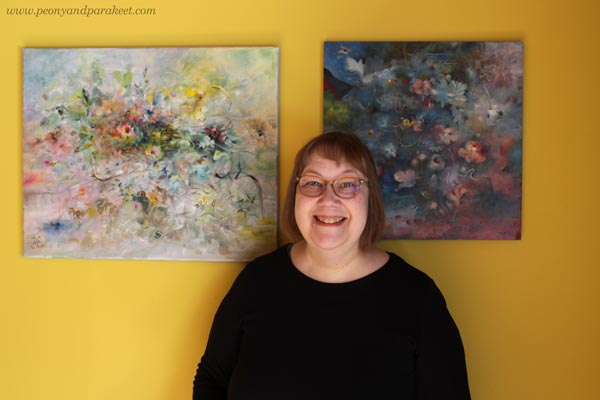
Finnish people usually have white walls and white furniture, but our home is full of colors. I love to display my paintings on this yellow wall.
Not One White But Many Whites
In the recent painting, I wanted to play with pastels and show the side of white that is often not talked about.
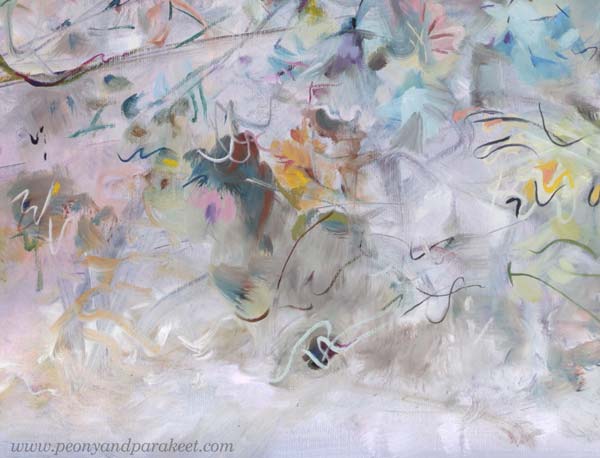
For an artist, there is not just one white. There is a warm white that holds the promise of the sun. There is a purple-toned white that falls in love when it sees a deep cold red. There is a white that allures you with a hint of sweet mint. So, many whites, not just one Finnish white!
It’s exciting to mix various whites and then see how the pastel colors slowly begin to appear. You need a lot of white and just a little bit of color to get the toned whites and pale pastels.
Titanium or Zinc White?
The most common white in paint tubes are Titanium White and Zinc White. In oils, you have to be careful with zinc white because it can cause crackles. I mostly use only Titanium White. I would love to use Zinc White because it’s more transparent. In this painting, I have tried my best to bring the soft transparent effects mostly with Titanium White, but it’s not easy!
In acrylics and gouache paints, you can use Zinc White more freely.
When White is Not Needed
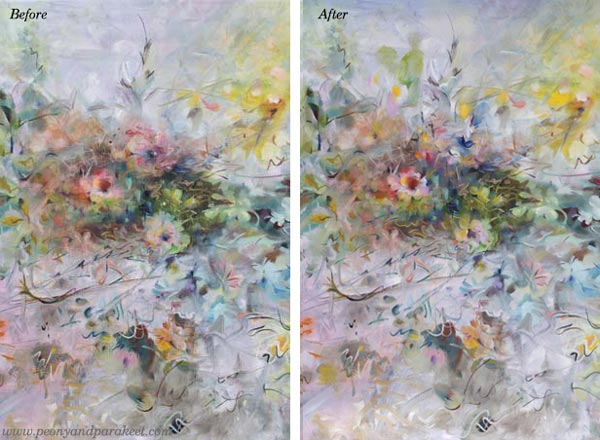
Beginners think that adding white on top can fix everything. Ten years ago, I was madly doodling with a white gel pen. What went wrong, got covered with white circles. But white also can make the piece busy and destroy depth. Here’s a quick example of the small collage piece that I made in 2014 (here’s the old blog post with the video too). The first is the old piece and the second is a photoshopped version showing how I would fix it now.
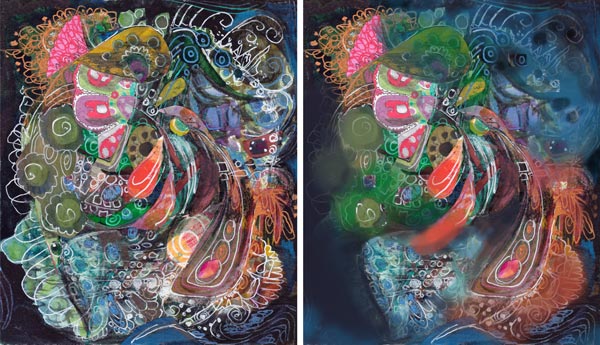
When I tone down the white, the image gets clearer and the depth grows. The highlights in the central parts get more attention and it’s easier to know where to look. I wish someone would have pointed this out to me back then. It took a lot of time to realize this!
If White Were a Person …
I am pretty sure that if White were a person she would say: “I have much more potential than you think. Stop seeing me as a blank background or a quick fix to a piece that lacks contrasts!”
What’s your relationship with White?
Belonging Somewhere as an Artist
This week, I share my word for 2024 and thoughts about the good and bad in the sense of belonging. I also have a new finished painting!
See more pics at the Taiko art store!
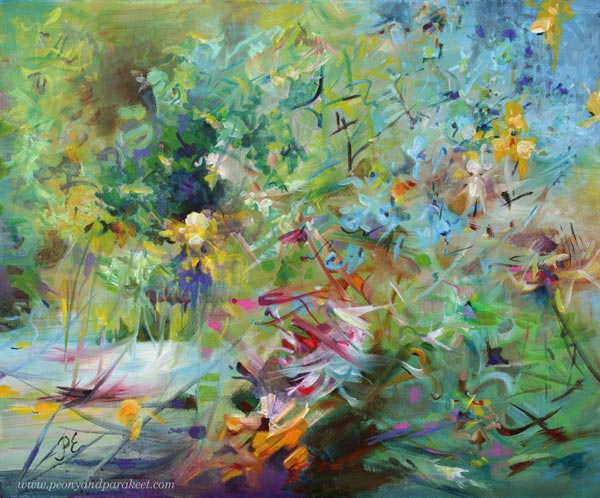
I haven’t used acrylic paints on a canvas for a long time. But now I wanted to paint faster and not wait for the layers to dry.
Painting Freely
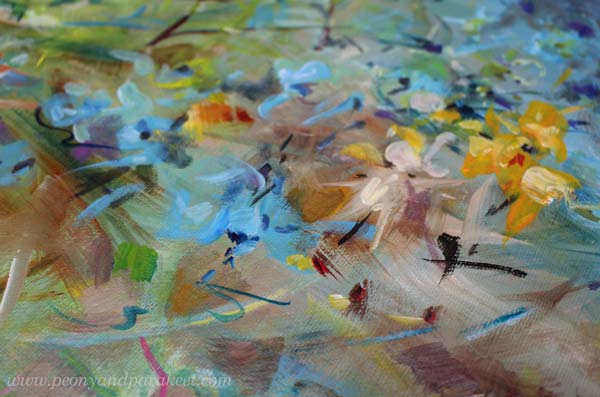
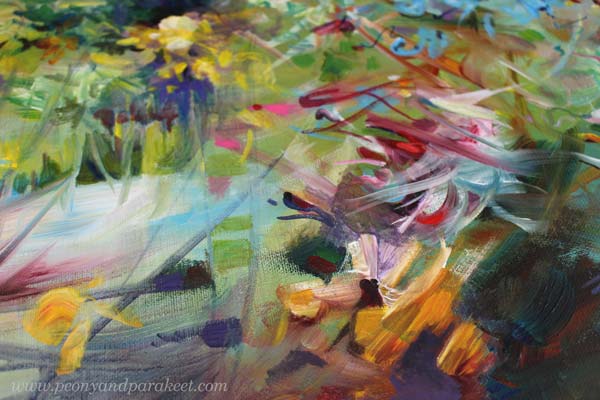
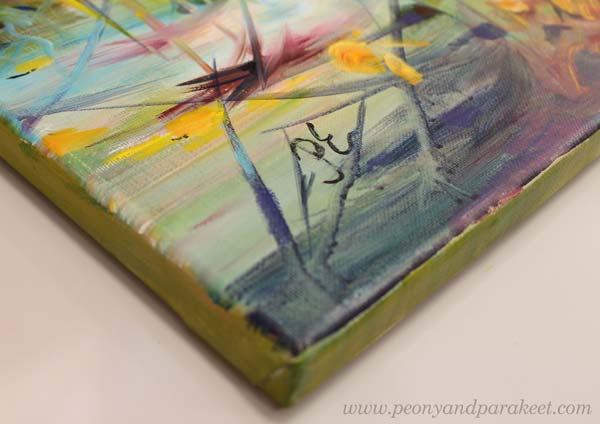
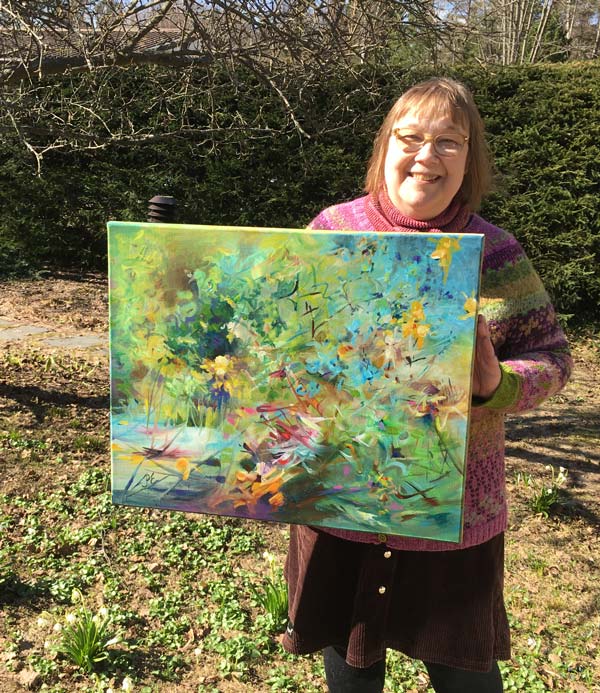
This painting took me a couple of long evenings, and I deliberately left it abstract, because the subject of the painting is not about the flowers, but about the power rising from the ground.
Here’s how the painting started: loose strokes and juicy colors.
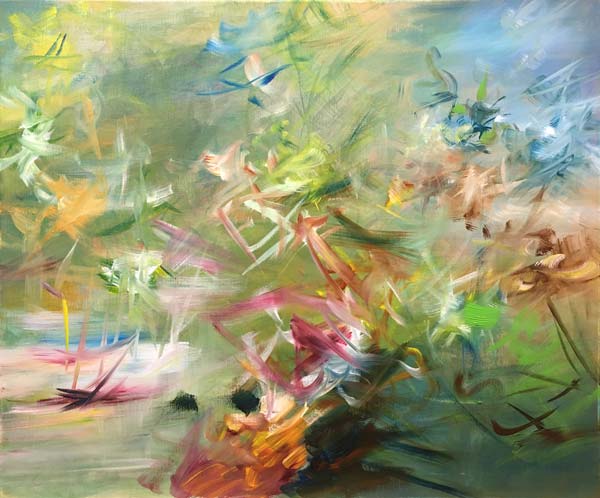
It’s easy to fall in love with colors, but when you want depth, you also need muddy colors: browns and greys.
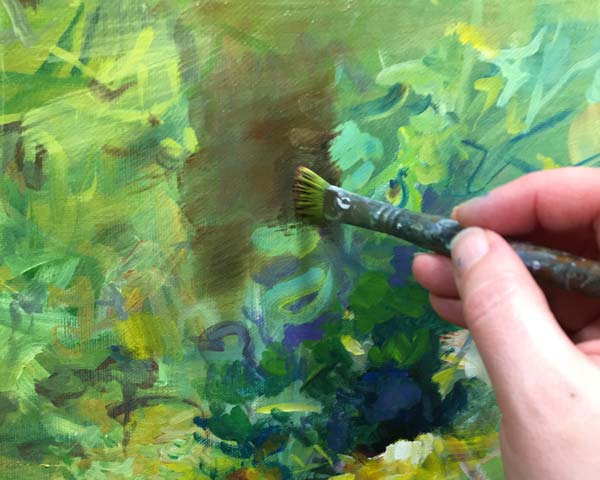
I like to use several different brushes in one painting, and my favorite brushes are very thin.
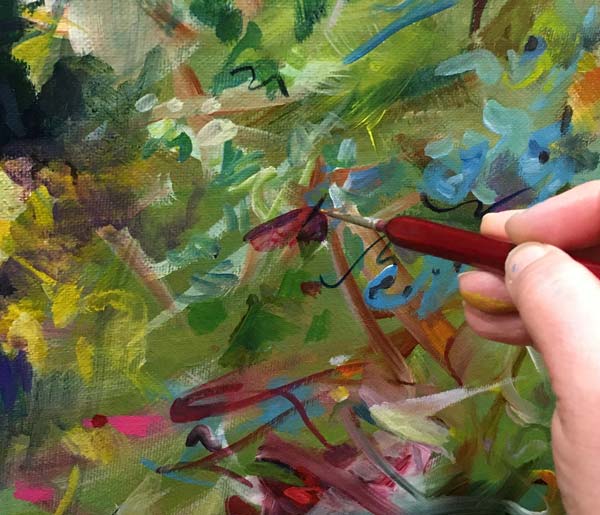
The title “Muutosvoima – Driving Force” sums up what I want to tell with this painting. Muutosvoima could also be translated as “power of change.”
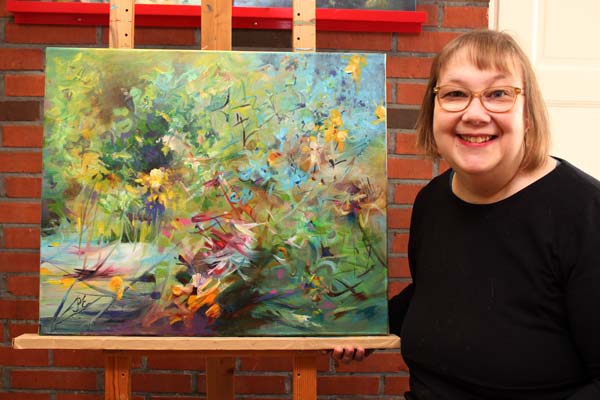
I believe that the best power of change is not the hype created by others, but the inner enthusiasm that has a grounded tone. Because isn’t it so that flowers only bloom when the earth warms up? Sunlight alone is not enough.
Belonging Somewhere – The Good and The Bad
I’ve been thinking about togetherness lately. It’s a wonderful feeling. For example, last week when many people commented on my post, I felt happy that this blog brings us together. One of the best things that has come with the internet is that you can be pretty weird and still find like-minded people.
However, the sense of belonging has its danger. Art is about walking your own path. Encounters are important, but you also need to go in the other direction to create something unique. As a teacher, I have often thought about how I could better guide people in their own direction.
Art is like a pot that you have to break first and then put together again. The pot can be broken in many ways and at best, you find your own way to put it together. You need a driving force to break the pot and then persistence to rebuild it.
Finding Your Places in the Art World
In my career as an artist, I have often wanted to be like someone else. I have envied popular artists and then later realized that I wouldn’t want to create the kind of art that they do. I realized that I would like to be popular in creating something else and somewhere else.
With experience, the art world opens up. Instead of one hall, you begin to see numerous smaller rooms. What is popular in one room can be overlooked in another. Being an artist requires a lot of self-esteem and the power to move from one room to another.
When you find one room that feels like your own, the sense of belonging is at its greatest. However, it’s better to move between several rooms and find many groups. At best, the artist acts as a bridge between different things.
My Word of the Year – Do You Have One?
My word for 2024 is Integrate. This year I have allowed myself to do more diverse things, but on the other hand, I have tied all the pieces together so that one benefits the other.
Have you chosen a word for this year? How has it been realized?
12 Spring Art Ideas from Over the Years
This week, I share spring-themed art from the past 10 years and give ideas for creating spring art.
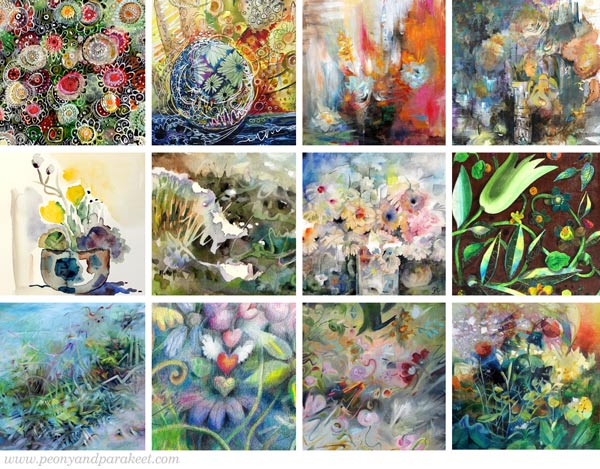
There’s a variety of ideas and I hope everyone can find some that inspire to get creating!
#1 – For Beginners and Dull Moments
Doodle spring flowers with the mindset “more is more”!
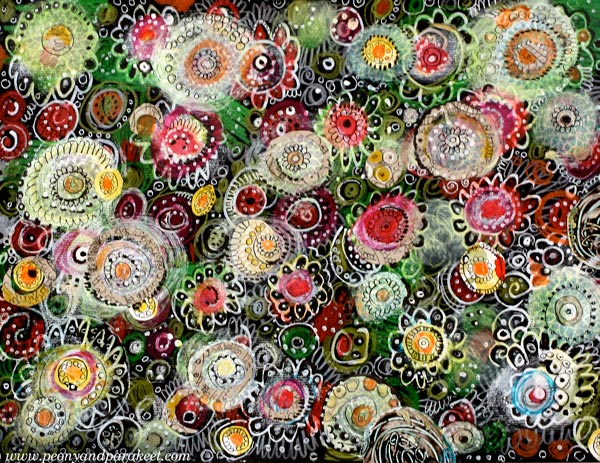
See the blog post: Subconscious Art
Course recommendation: Collageland
#2 – For Self-Explorers
Express your spring energy by following this step-by-step exercise: Bursting Circle
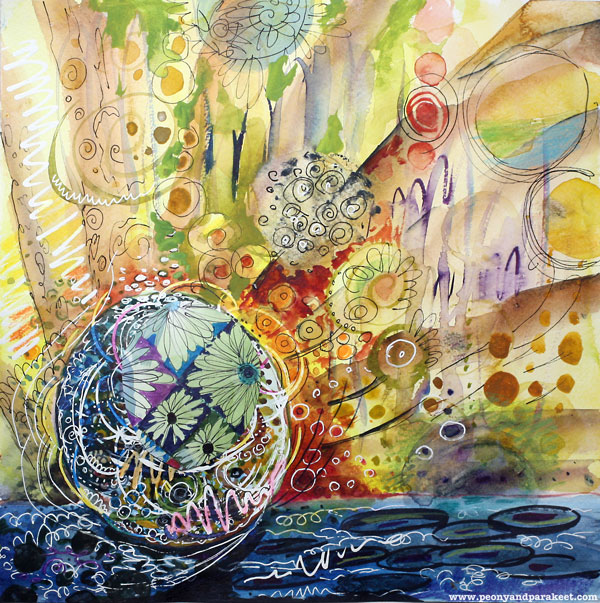
See the blog post: Bursting Circle
Course recommendation: Inspirational Drawing
#3 – For Free Spirits
Splash color and let everything grow from there!
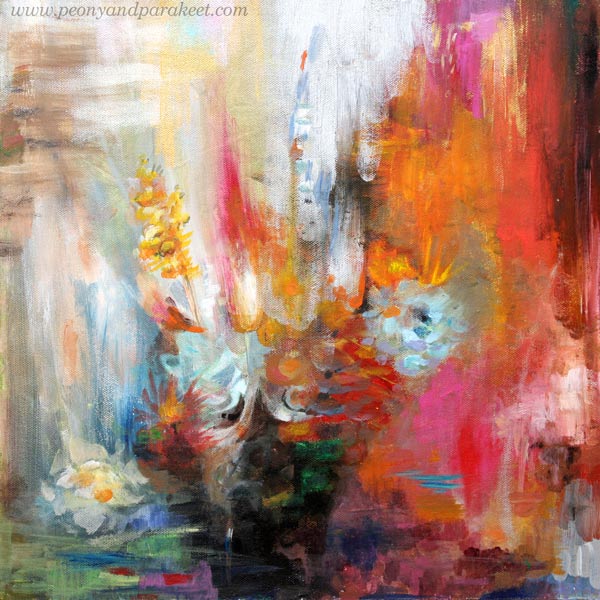
See the blog post: Art is Freedom
#4 – For Those Who Want to be Freer
When you want to be freer, the art of seeing is as important as the art of creating.
See the video of making “March Still Life”: Painting in Liberated Style
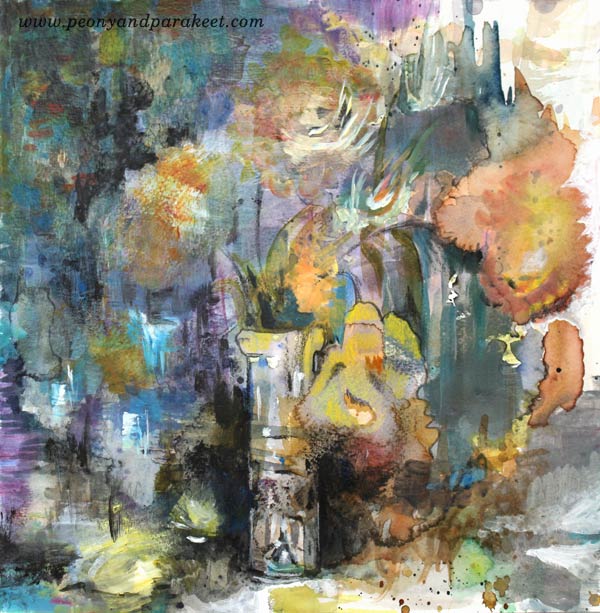
See the blog post: Painting in Liberated Style
Course recommendations: Liberated Artist Revisited and Freely Grown
#5 – For Minimalists
Pick a small piece of watercolor paper, moisten your watercolor pans, and let water do the trick.
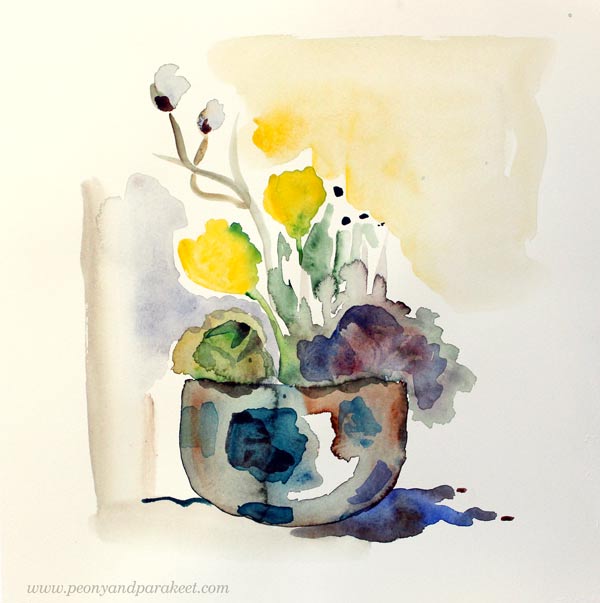
See the blog post: Easter Still Lifes in Watercolor – Video Included!
#6 – For Travelers
Paint a spring panorama. More examples: Watercolor Panoramas to Express Travel Memories
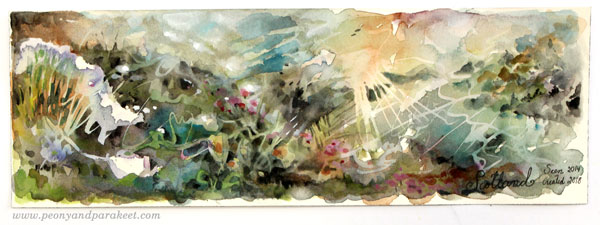
See the blog post: Watercolor panoramas to Express Travel Memories
Course recommendation: Watercolor Journey
#7 – For Beautiful Mess-Makers
Beautify the mess by adjusting the details: paint frilly edges and draw fine lines!
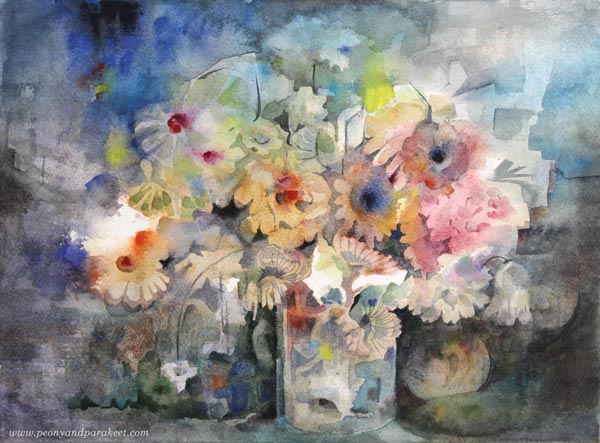
See the blog post: Freely Born Watercolor Florals
Course recommendations: Floral Fantasies and Freely Grown
#8 – For Journalers
Decorate a journal cover with your original art! See more instructions in this blog post: Painted Paper Collage
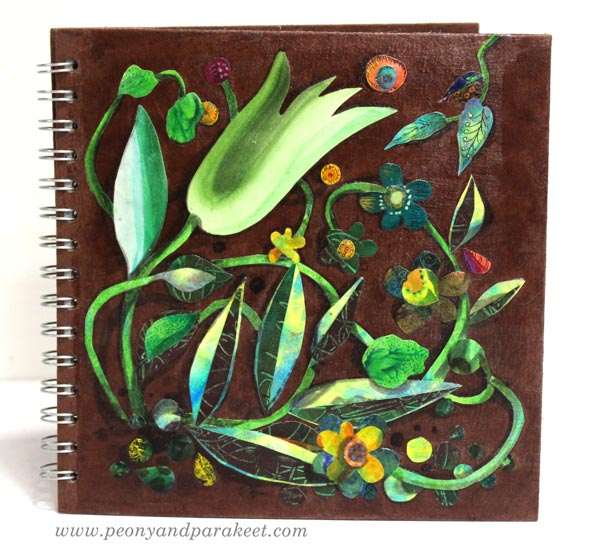
See the blog post: Painted Paper Collage – 6 Tips for Intricate and Fun Art
Course recommendations: Collageland and Decodashery
#9 – For Bird Watchers
Take this challenge to move from illustration to fine art:
Step out of your comfort zone and think about a bird shape as a canvas for expressing its surroundings.
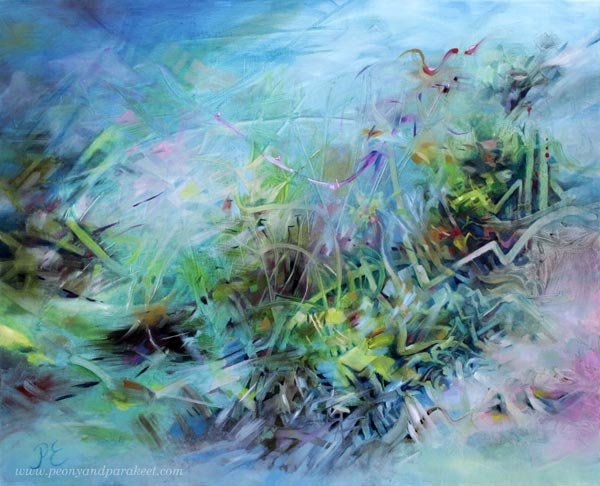
See the blog post: Pros and Cons of Becoming an Artist
Course recommendation: Floral Freedom
#10 – For Art Lovers Who Procrastinate
Reduce watching those photo-realistic colored pencil videos and start coloring freely. One heart shape can lead to many and start your flight to the world of imagination!
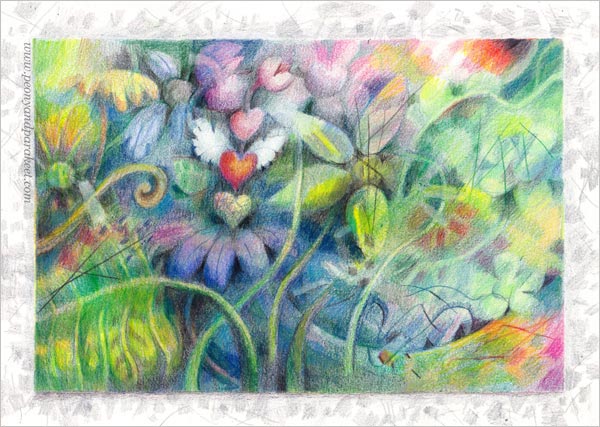
See the blog post: 5 Reasons Why I Love Colored Pencils
Course recommendations: Intuitive Coloring and Fun Botanicum
#11 – For Wannabe Fantasy Artists
Find the story first, then its surroundings! A character is not only described by his face.
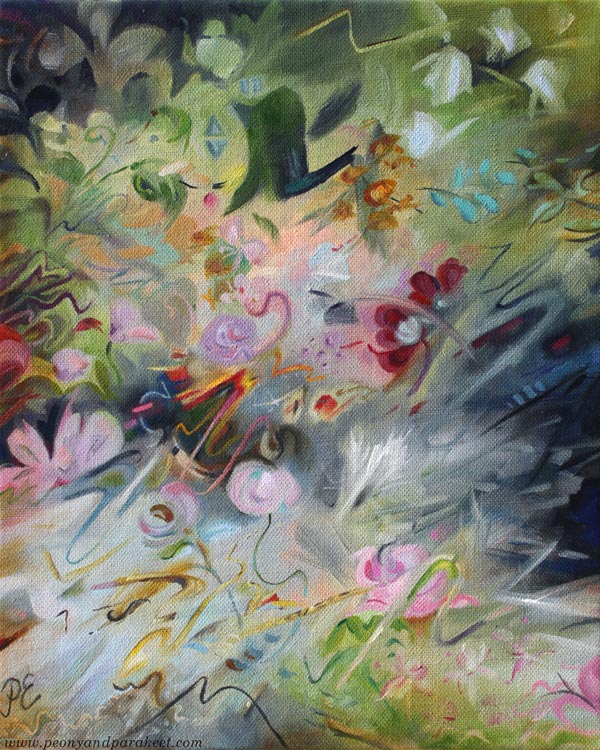
See the blog post: Wonderland Art – Inspiration from Alice in Wonderland
Course recommendations: Magical Forest and Magical Inkdom
#12 For Artists at Heart
Our creativity has winter and spring too. We need each other to keep the inspiration going – to turn the winter into spring.
A challenge for you: How can you make a new start – create a new spring for your art?
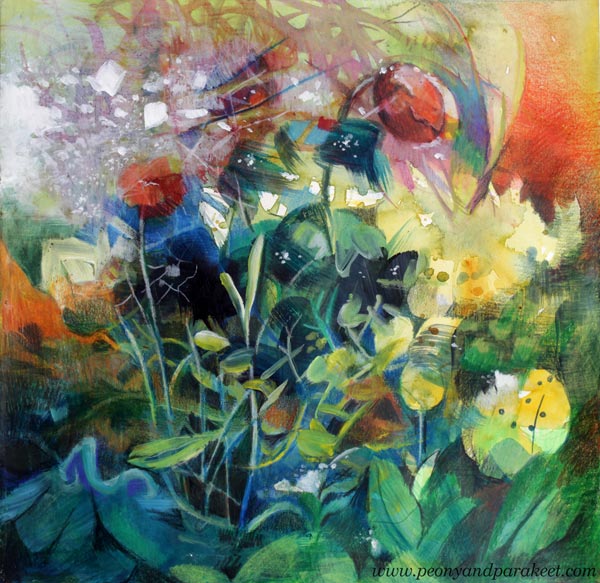
See the blog post: New Beginnings in Art-Making
Course recommendations: Liberated Artist Revisited
Bonus Idea #1: Spring Art Display
Gather your art on a side table for display! Make a collection of all kinds of pieces – even the smallest drawings and collage pieces can look fun this way.
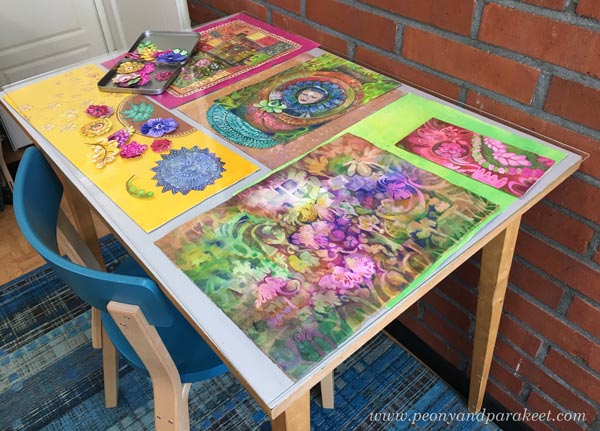
I have a plastic plate that is the same size as my table.
It protects my art, and it also protects the tabletop when painting in watercolor.
Bonus Idea #2: Listen to This!
I also have a music recommendation: “Kevät”
Kevät is spring in Finnish and the song was presented by a Finnish girl band Tavaramarkkinat in 1985. Here’s an English translation of the lyrics. The tone of the song is melancholic. This kind of controversy between melancholy and joy is one of the most inspiring things in spring, I think!
P.S. PostScript for Spring Art Ideas
We still have a lot of snow in Finland, and I miss spring so much! In these spring art ideas, I wanted to combine my yearning for spring and the celebration of being a full-time artist for ten years. The actual anniversary is in September, but I want to celebrate this life span the whole year of 2024.
One part of the celebration has been making the course Liberated Artist Revisited where I invite you to paint with me – to follow directions from Paivi many years ago, and then create more with the current Paivi. At the same time, you can ponder, how your art-making has changed and will change.
Because of the 10-year celebration and the nature of personal stories, Liberated Artist Revisited is a limited edition – only available for purchase until the end of March 2024! >> Buy Now!
Ninety-Ninety Rule for Art-Making
This week, we talk about the agony that’s associated with finishing.

Last fall, I had a turning point when I started making digital art. I’m not giving up painting, though. There will be just fewer oil paintings this year.
New Start
This year’s first oil painting started already in October last year. First, I made a mess with pastel hues. Then I began to figure out what kind of personality the painting could be.

This kind of intuitive painting is wonderful and for example, my latest course Liberated Artist Revisited is based on it. Instead of the model, we study the painting itself and let it go in its own direction.

When I paint, I often listen to some talk or music program at the same time, that’s why the iPad is also visible in these pictures.
Ninety-Ninety Rule
Programming and painting have a lot in common. One of those is definitely the ninety-ninety rule. It states that 90 percent of the work is done effortlessly and takes only 10 percent of the time. And the remaining 10 percent is difficult and takes 90 percent of the time!

For example, in this part of the painting my intuition was working fluently, and finishing these details was also easy. I especially like that beige flower near the edge.

But the further the painting progressed, the less often I worked on it. I wasn’t satisfied with the center and the soul of the painting was missing. I looked at it every day, but all my ideas seemed too ordinary.
Then when I finished the video artwork last week, I suddenly got ideas for the painting. First, I brought similar greenish tones and then, by keeping my mind on the video, I solved the puzzle stroke by stroke!

The name was now easy to find: Käännekohta – Turning Point.

The ninety-ninety rule applies to the fond factor as well. It’s easier to like an unfinished painting than one that is close to a finish. When under 90 percent, you can see the potential and ignore the unpleasant parts by saying that the piece is not ready yet. When working on the last 10 percent, things get more complicated and there are times when you hate the piece!
Old Supports New
During big changes, I have often thought that I leave the old completely and jump fully into the new. But this time I feel that the old and the new support each other.
Life is an interaction between the past and the present and that applies to art-making as well.
Liberated Artist Revisited
With the newest course Liberated Artist Revisited, I invite you to paint with me – to follow directions from Paivi many years ago, and then create more with the current Paivi. At the same time, you can ponder, how your art-making has changed and will change.
Liberated Artist Revisited is a limited edition – only available for purchase until the end of March 2024! >> Buy Now!