Explore by Drawing!
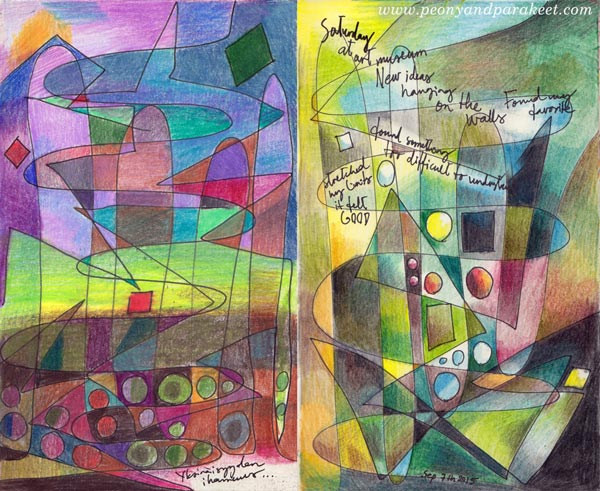
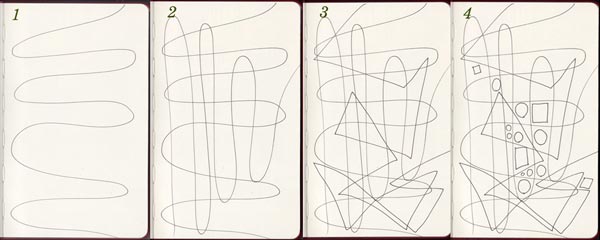
This blog post is illustrated by students of the 4-week online workshop Inspirational Drawing. All the illustrations shown here are created at the class by these wonderful artists: Dianne Guerin, Ellen Schulz, Terri Elverum, Joan Gaetz, Alison Schockner, Cheryl Rayner, Carol Dickson, Debbie Kreischer, Virginia Clinton, Rosemary Bosse, Mary Joyce Weening, Donna Peake, Joyce Brown, Nancy Kvorka, Judy Shea and Janet Joehlin.
I have often thought about the contradiction between maintaining who I am and being open to what I can become. My friend said that when you know somebody for a long time, you can look through life circumstances and see the person that’s behind all those. And still, while situations change, we change too.

By creative drawing, we can find out where we are swimming and how deep we can go.

We can take personality tests but sometimes the best way to find out what kind of fish we are is to take a pen and start drawing.

By drawing, we can explore how we see ourselves in our surroundings.

We can pick ideas from new places and cultures.

And we can explore what’s going on inside our minds.

When we illustrate what we seem to be and how we see the world, new combinations start to grow and inspire us.

Our art journals become our inspiration books.

If we just use thinking, we can endlessly question our creativity and ability to find new solutions. But when we get into the habit of creative drawing, it will be evident that we are creative people regardless of circumstances.

When we draw out our new thoughts and ideas, we become more aware of who we are and what our style is.
Let me be your mentor in art: Subscribe to my weekly emails!
Do You Have a Talent for Creating Art?
This blog post is illustrated by students of the 4-week online workshop Inspirational Drawing. All the illustrations shown here are created at the class by these wonderful artists: Deb Weiers, Chrissie, CHB, Valerie Lima, Sandy Guderyon, Mary W, Gloria Schurman, Katia Maliantovich, Nea Wiseman, Gina Meadows, Joanne, Jacqueline Kriesels, Marie Jerred, Sue Rowlands and C in Ohio.
Let’s start the actual blog post with a personal question: Do you ever wonder whether you are talented enough?
I used to think that some day I will meet a person, both knowledgeable and prestigious, who would tell whether my art is good or bad. That thought made me both excited and worried. I became excited when I thought that someone saw more in my art than I did myself. And I became worried when thinking about the opposite result: that my art, that beautiful tower I had built, would just collapse. I would collapse.

Years went by and I got tired of waiting for a specialist’s opinion. Maybe I could be my own critic? I went to study industrial design to find out how the quality of art and design would be set. While studying I realized that there are no right or wrong. People are different. Some may like art that somebody else does not, even if they both are art critics.
Somehow that made me even more puzzled. I didn’t know what kind of people would be my people, who would enjoy my art. And furthermore, if my art was bad, there wouldn’t be many of them.
However, I became convinced that somewhere in the world, there must be people that want to use their imagination and design whatever they like. They want to build houses …

… they want to travel …

… they feel drawn to beautiful patterns, and dream about enchanting gardens …

They want to learn from the history and use it to move forward in their own direction.

The more I examined whether I have the talent, I realized that art is not an absolute in any way. Art is a channel to express and communicate. If I look outside the window, and let my mind wonder on a path, the question is not how dimensional the window frames look like or how grey the stepping tones are. I find my people by sharing how uplifting the coolness feels like when walking barefoot on a hot summer day.

Even if there are theories about aesthetics, originality, playfulness etc. which determine good art, it is the experience that matters the most. If we feel connected to our art, there are much more chances that others will too.

By strengthening our connection, we will become more talented. We start creating more and seeing more. We will have more to express and more imagination to use. We can make people calm down in front of our art, or make them run and catch thoughts about their possibilities.

Nowadays, many ask me whether they have the talent. Even before they actually start.
Here’s the answer: Your talent cannot be determined by the grades you got while you were at school. Your talent cannot be determined by an opinion of a knowledgeable and prestigious specialist. Art is not about talent. It is about having something to say and work for saying it. It is about asking “what if” and finding the answer by using both your life experience and imagination. It is about looking out the window, seeing numerous possibilities for the perspective, and bravely picking your point of view.

So, do you have a talent for creating art? Always.
Subscribe to my weekly emails – Get a free mini-course!
Put Thoughts and Feelings into Your Art

I am excited to start the fall season with a video blog post! I will create the mixed media painting above from start to finish and show the atmosphere of my creative space as authentically as I can. I will also talk about Inspirational Drawing, my online drawing workshop that will begin in September!
Subscribe to my weekly emails – Get a free mini-course!
A Natural Approach to Creating Art

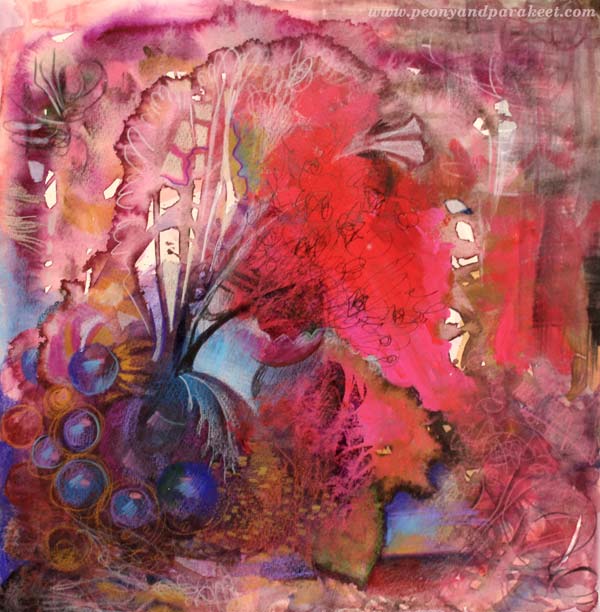
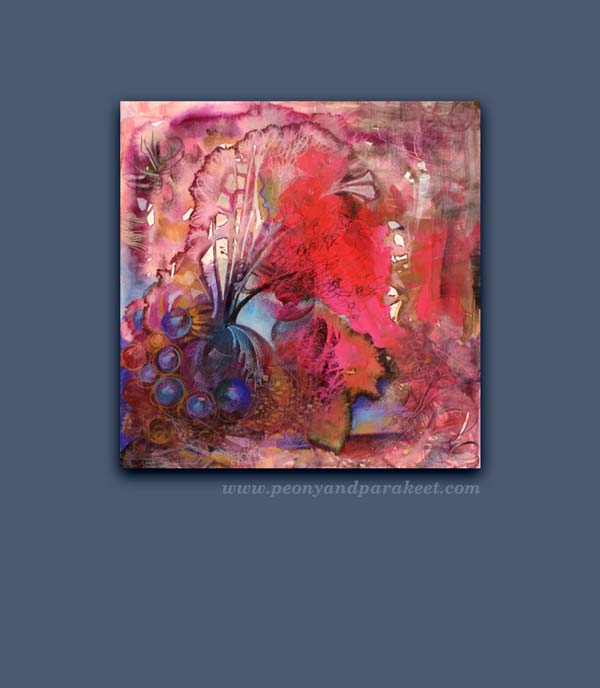
My latest art journal page is called “Withering Peonies.” What I love most about peonies is that they are always graceful and brave, whether they get ready for blooming or withering, whether it is late autumn or early spring. They are living in the middle of the continuous transformation, and it’s always enjoyable to watch them. They seem unique and individual; even every flower looks different from each other.

No Fixations, Just Painting and Doodling
When watching peonies, I think about the word “natural.” To be able to grow as artists, we need to learn to express ourselves naturally. Like peonies bend towards the light, we should bend towards our inner thoughts and feelings. So when I began to create the artwork, I did not think about anything particular, not even about peonies.

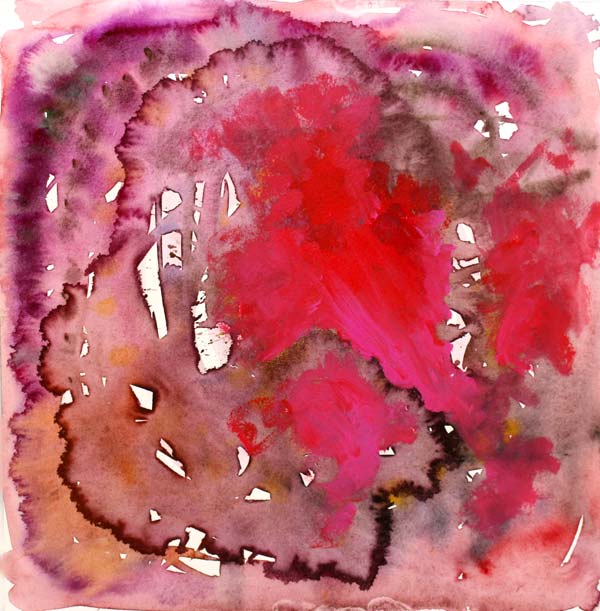
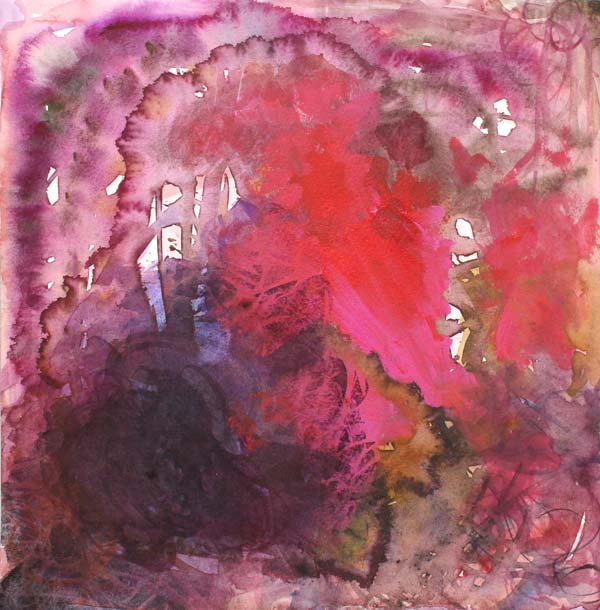
I started with acrylic paints and a palette knife creating thin spots of color using a restricted color palette. Then I changed to a drawing pen and let it move freely, without any fixated thought.

I believe that we suffocate our creativity when we have fixed images in our minds. We get disappointed if we cannot copy the images exactly on paper. But then, the fixed image is often imperfect, impossible to copy. It is more like a collection of visuals, a movie or an emotion that is not very detailed. If we fixate on that, we turn away from what is natural.
Moving forward is natural. It’s natural to let thoughts flow freely and add more colors and layers.

More Mixed Media
I used watercolors for some areas.

After watercolors, I worked with colored pencils.

A Theme Emerges
While coloring, I saw peonies emerging on the page and I remembered the peonies that were put in a vase to save them from the rain.

When peony flowers mature, they will lose their color. That gave me the idea to take some gesso and rub it on the surface of the piece. First with a palette knife but then with fingers, to soften parts of the edges.

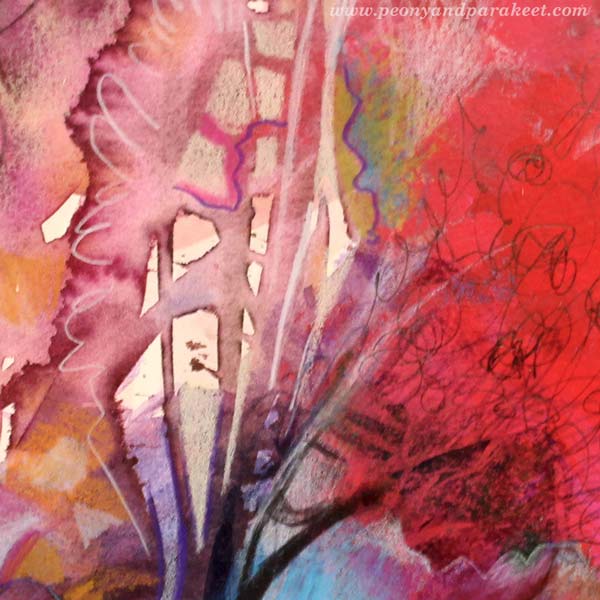
Finally, I sharpened some details with a drawing pen and made some color areas clearer with colored pencils.

Journaling
Writing thoughts after creating an artwork feels natural too. Drawing or painting is not only a technical process, but it’s also a way to process thoughts.

The Natural Approach
Withering peonies can be a symbol of letting go. When you open yourself to art, something beautiful might disappear. But it is so exciting to see what else will appear – naturally!

Subscribe to my weekly emails – Get a free mini-course!