
Mystical Art Making Inspired by Textiles
This week, I talk about mystical art making and share two big revelations that made my art feel more mystical. Maybe these help you too!
Inspiration from a Magical Place
My dogs, Stella and Saima, have been having some health issues. Older Stella has had some teeth removed, and Saima got a bad wound on her paw during a walk. Medications and other care routines pace our days. But things are getting better, and this week Stella was able to go on a slightly longer walk. Or should I say, I was able to, because short walks don’t bring me similar satisfaction!
I knew right away where I wanted to go with Stella. A short distance from our home is a neighborhood with apartment buildings, and right on the edge of it, there is a large pond, like a small lake. The place is a quite ordinary Finnish neighborhood in daylight, but it is a magical sight at night. When it gets dark and the lights turn on, looking over the pond makes me feel like being abroad, near a big city.
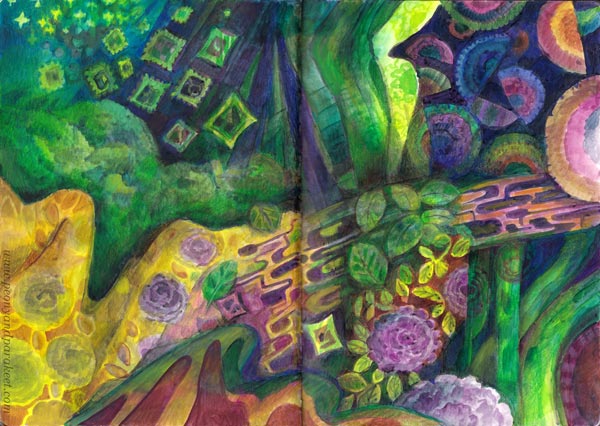
When I came home from the walk, I wanted to make a playful spread in my art journal.
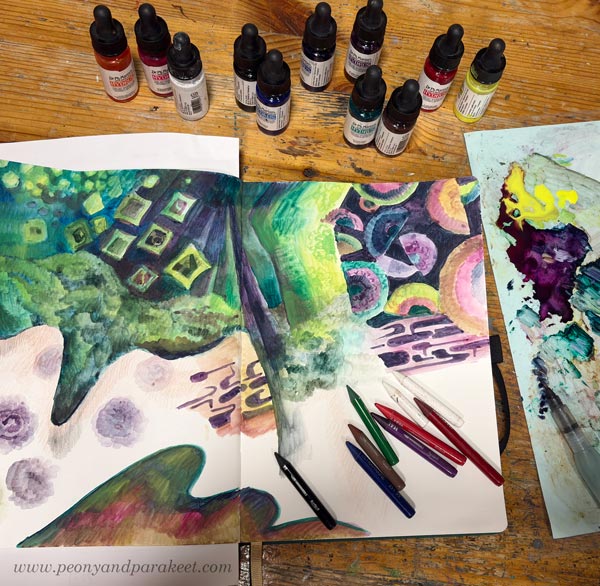
I took out art supplies that I wanted to use up. I still have some Dr. Ph. Martin’s watercolor bottles left. And I also have a few Cretacolor Aqua Monolith watercolor pencils and some other leftover shorties.
Crossing Two Boundaries
Most of the time, I start with colors without any specific plan, but this time I wanted to create an illustrative image. I thought about flowers or animals — things that often inspire me. But it didn’t take long before I realized that I wanted to illustrate the magical moment at the pond —not realistically, but abstractly and freely. And I wanted to cross two big boundaries that I have had.
The first boundary is related to surface patterns. On the one hand, I love them. But on the other hand, I don’t like shapes that have no depth at all. Instead of two-dimensional, I always choose three-dimensional. But recently, I have realized that surface patterns can flow freely in three-dimensional space and playfully wrap around a three-dimensional shape. And the patterns themselves can also have a three-dimensional feel.
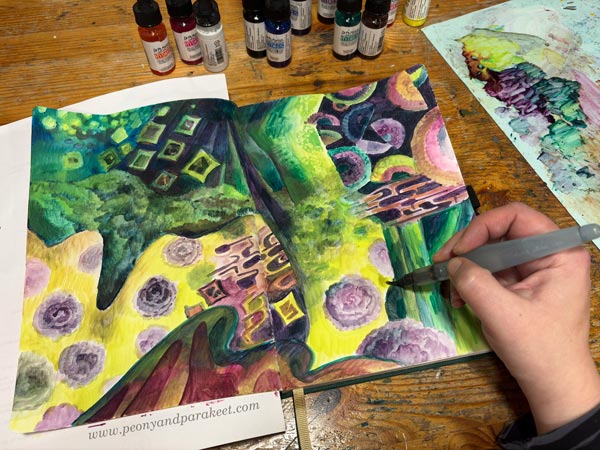
The second boundary is related to textiles and needlework. In my free time, I knit, crochet, embroider, sew, and quilt. Needlework brings rhythm to my life alongside the dogs. But even though I wanted to be a textile artist at some point when I was a child, my artistic core is still in painting. On the other hand, my educational background is in industrial design, so I am interested in imitating materials when drawing and painting.
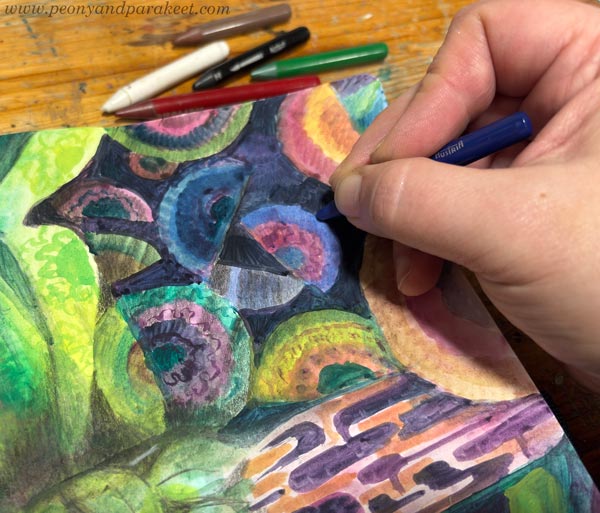
Sometimes I feel ashamed of this materialistic side of myself, because I would like to be purely spiritual and a particularly deep person! But I have now realized that my love for materials is actually a path to the kind of spirituality that feels most like my own. When I think about materials while painting, I get deeper into my expression. I don’t have to choose between figurative and abstract. Instead, I can create somewhere in between and thus become fully present in the creative process.
Mystical Art Making
An exhibition of female esoteric artists that I visited a couple of weeks ago has encouraged me to cross the two boundaries. It was as if Hilma af Klint had whispered to me: “Walk your own path, find your own mystical places!” The exhibition featured many textile pieces, and it made me think about how common it is for women to find their mysticism through textile work.
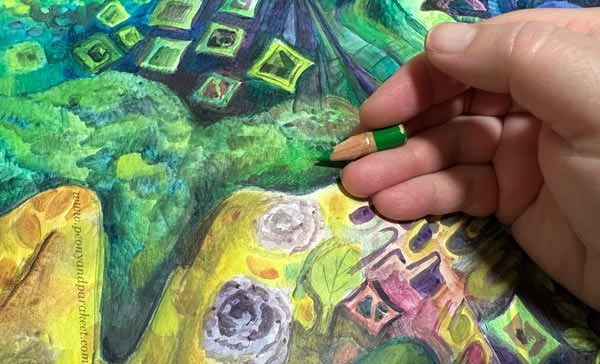
I suppose there is some kind of mystic living inside every artist. Searching for your own mysticism changes art-making into a more unique adventure. Religions and other teachings about the world order, including natural science, are just tools in a mystical artist’s backpack. The same goes with the art techniques.
When I look at my small embroidery pieces and other textiles, I feel like there’s a tighter connection between my craft and my art.
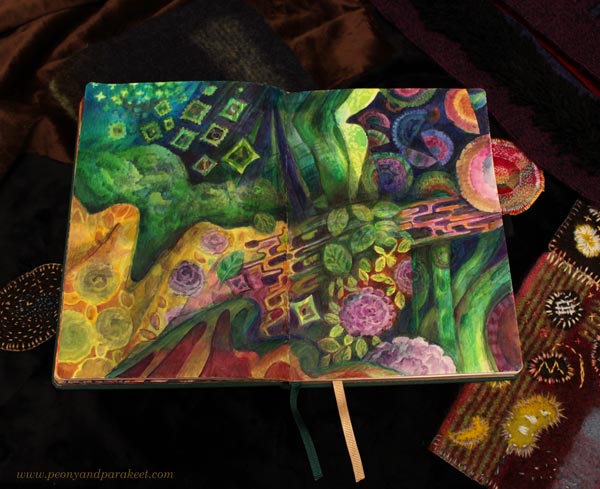
My newest art journal (Dingbats Pro Notebook) could also be called a sketchbook because it has started to fill up with ideas that I could also use in bigger paintings.
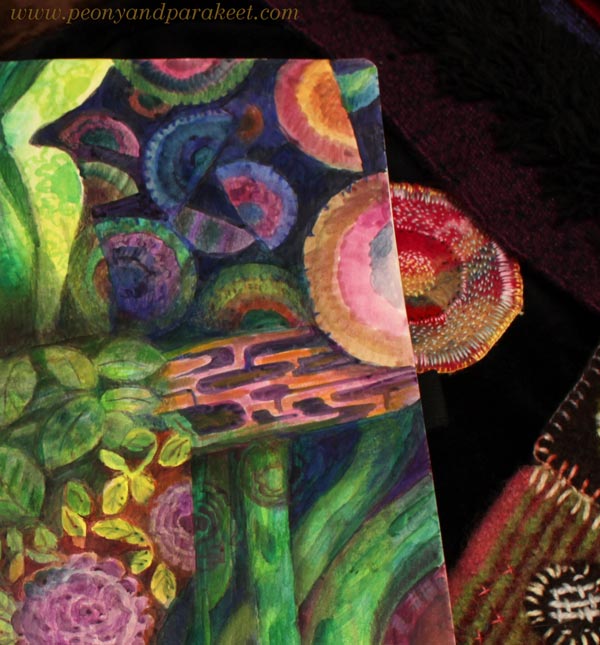
It’s a pattern lover’s sketchbook, really! Especially because I am currently working on a new course where surface patterns are in the spotlight.
I’d love to know what you think! Share your thoughts below!