
Look Back to See Your Artistic Style!

We often search for something new: new art techniques, new ideas, new approaches. When I pulled out a worn-out cardboard box filled with my old drawings and paintings, they all felt very familiar at first. I saw only the obvious: a skill level, a theme or technique. But when I stopped looking at the pieces individually and started grouping them, new insights occurred.
1) Look for Repeating Elements and Themes
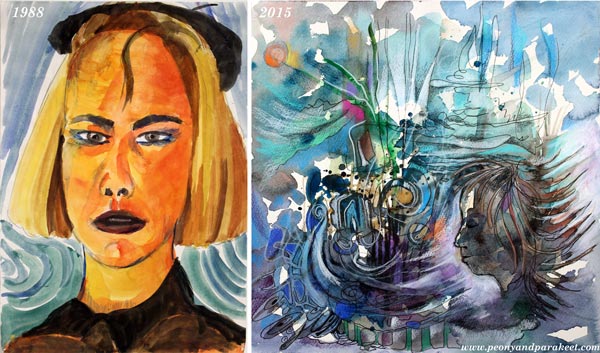
In 1988, when I was 19 years old, I made a watercolor painting called “Self-Portrait as an Artist.” Soon after that, I went to study computer engineering, and art didn’t seem so important anymore. But now, when working full-time in art, I love to compare these two paintings. There are 27 years between them, but they still relate to each other. It is interesting to see how my understanding of being an artist has changed. The importance of ideas, visions, and expression has grown, and the ego and stereotyped appearance have shrunk. I see similarities too: color choices, dynamic lines and dramatic atmosphere, foundational elements of my artistic style.
If you are hoping to find a new style, it is easy to miss that most of the elements are already there, just a little bit of fine-tuning is needed!
2) Combine Past Ideas
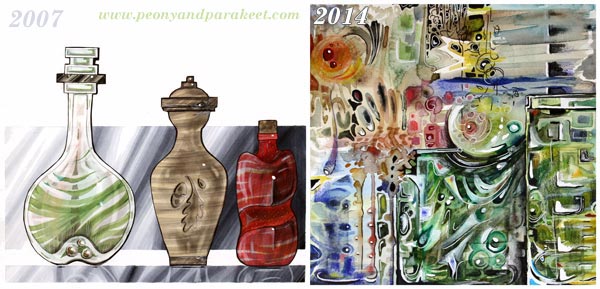
In 2007 I began studying industrial design. One of the courses taught us to draw various materials like glass, wood and plastic. After seven years I realized that I could use that kind of imitations for more expressive art too. I could play with the proportions and compositions. I also understood that I could use the things learned in the past, more widely and more freely. Instead of having only some ideas and simplifying those, I can have hundreds of ideas and combine most of them!
If you don’t know what to create next, combine what you have done before to a single artwork!
3) Embrace Your Roots

In 1985 I made this watercolor painting and remembered my family liking it. For me, it was important that this image came out of my imagination, it wasn’t made by following a photo or anything. It was born surprisingly easily, and I felt a bit puzzled: “So quick, and everybody likes it!”

In 2014 I worked with a similar theme and again, with watercolors. This painting contained more emotion than the old one. This painting was about leaving back a certain phase in life and entering a new one. However, when I look at both of them now, I think about my country, Finland, and its nature. This country is a land of forests and lakes and for Finnish, it is natural to use them as symbols in self-expression too. I can’t escape my roots and the older I become; I don’t even want to.
When you look back at your work, what kind of themes and changes do you see? Could you create collections showing art that tells your personal stories and your journey to your current artistic style? See also the post about stretching your artistic style!
Subscribe to my weekly emails – Get a free mini-course!
Add More Creativity to Your Art!
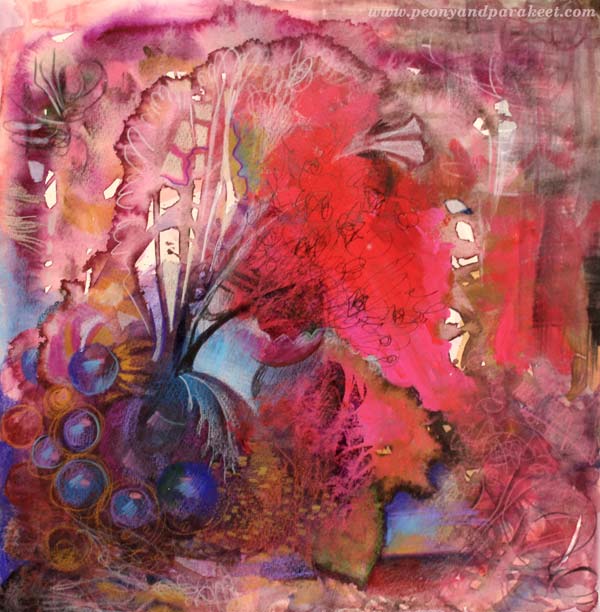
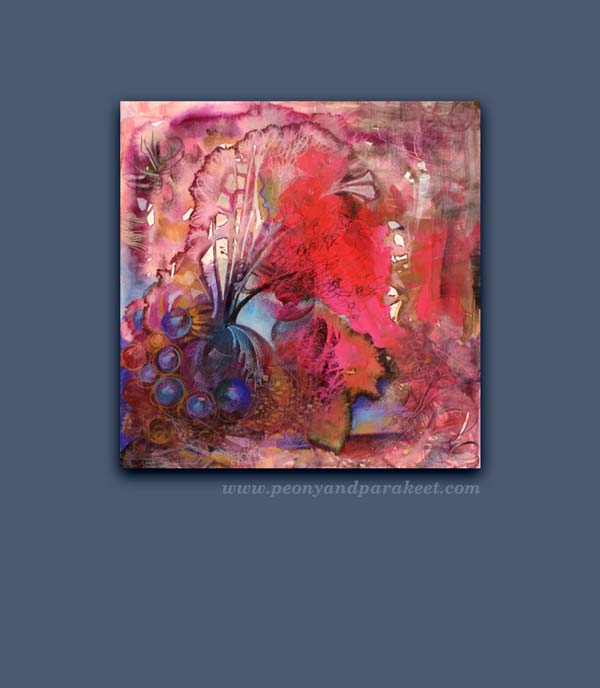
Here is my abstract still-life with watercolors, acrylic paints, and colored pencils, called “Harvest Stillife.” It’s created very intuitively, without any idea of the end result when started. But like so often before, when I selected images for this blog post, I found recent photos that must have been in my mind when I made this.
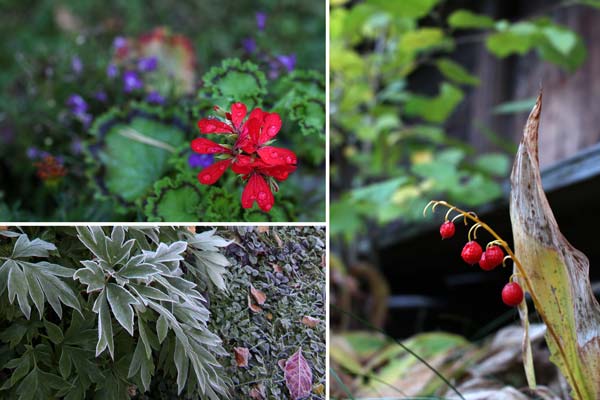
I love the complexity and the number of details that can be seen in these shots from my garden. Many who struggle with creating art overlook the complex nature of reality. In these photos, they only see a flower, bush, and some berries. Instead of labeling the obvious, you can examine all the color variations, different shapes, sharpness and blurriness of the elements, depth, patterns, the way each color connects with the next … Then you can try to summarize what the hierarchy of all these factors in the photos could be, how all this could be modeled. It seems too complex to describe in a simple way. That’s when creativity starts working for the solution, figuring out what things to bring out without losing the connection to all of it.
A big part of the visuals today has a simple, graphic look. If you get exposed to that a lot, you might think that simplicity is the key to creating good art. I believe it’s totally opposite: complex things are the best source of inspiration. Trying to see complex systems behind simple stereotypes feeds our creativity much more than trying to simplify the simple.
The same idea applies to painting: Embrace the complexity by adding a lot of variation and then bring out the essential.
Painting an Abstract Still-Life
Watercolors and acrylic paints:
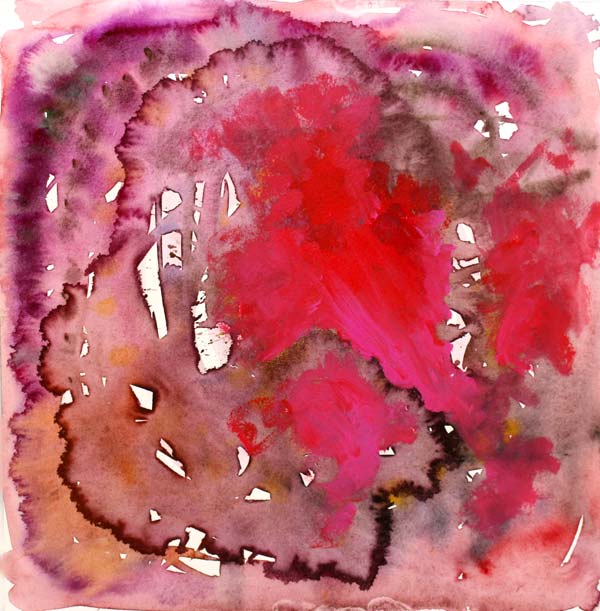
Placing a plastic wrap over the wet watercolor paint to add more delicate details:

Ready for finishing:
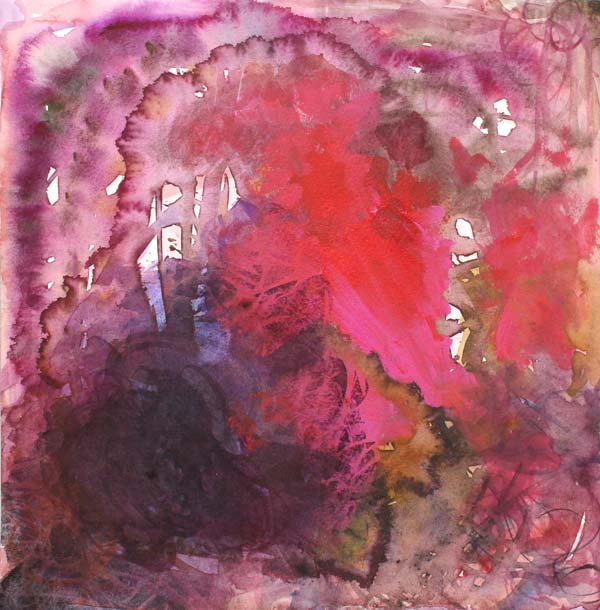
A detail of the finished look, done with colored pencils and a black drawing pen:
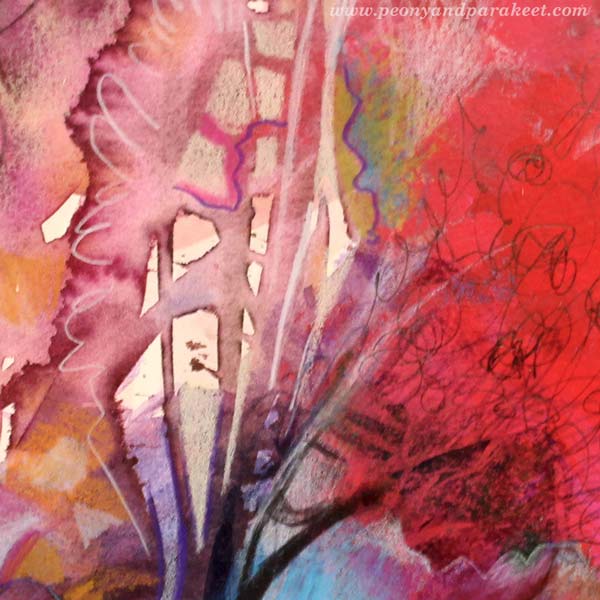
Creating abstract still lives so that they appear naturally is so much fun!
Subscribe to my weekly emails – Get a free mini-course!
5 Steps to an Abstract Landscape

Let’s paint together! The idea for this painting came from nature. Have you noticed that when the sun shines after the rain, everything sparkles! It’s so beautiful!
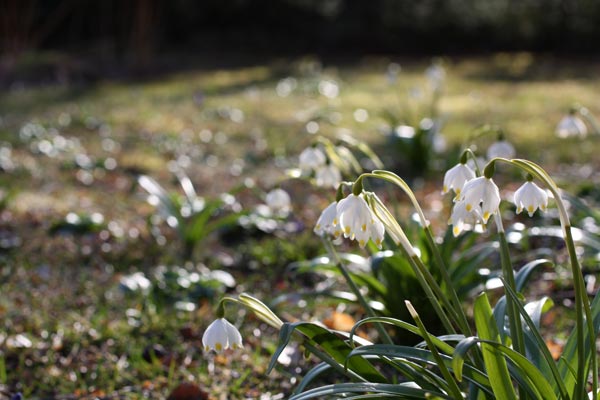
Soil, the sun and rain – even if they are different from one another, they all work together to make plants prosper. In the painting, the soil is made with colored pencils, the sun with acrylic paints and the rain with watercolors. These art supplies are so basic but they also work so well together! Watch the video and create your own abstract landscape – “Soil, Sun and Rain”!
More instructions for watercolors: Buy Watercolor 101 for Intuitive Painting
What Are the Cornerstones of Your Art?
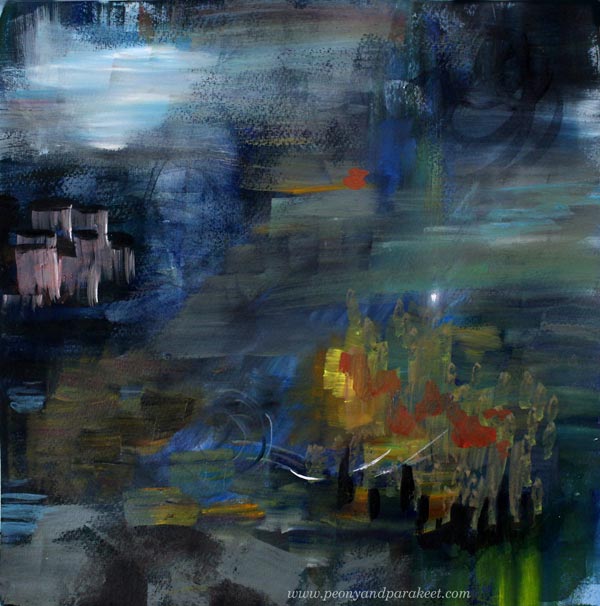
I have always loved abstract paintings. It occurred to me just recently that even if I rarely create realistic art, I rarely go to extremes in abstract. But then, what would prevent me from doing that, putting those cornerstones of my style to a new order.
Namely, if you know what you love to create, why not play with that? Thick black color, sharp lines, dramatic color transitions, sense of movement and muted but distinct colors – those are what I always seem to aim.
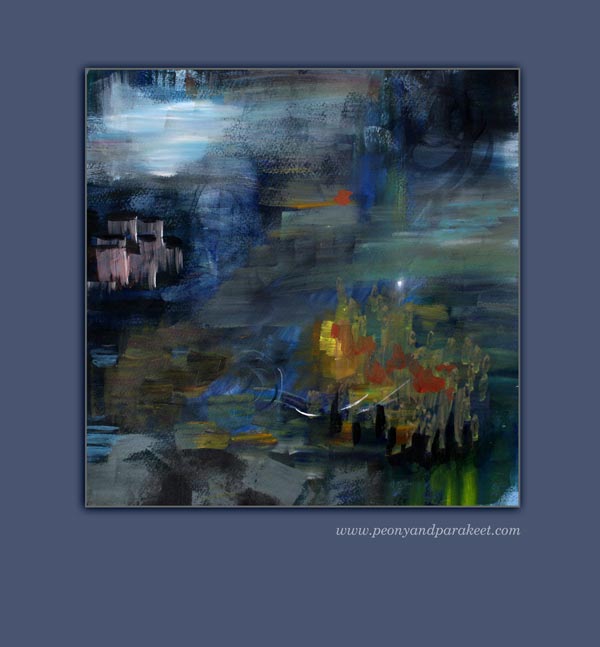
This painting is called “Cornerstones” as I like this detail the most.
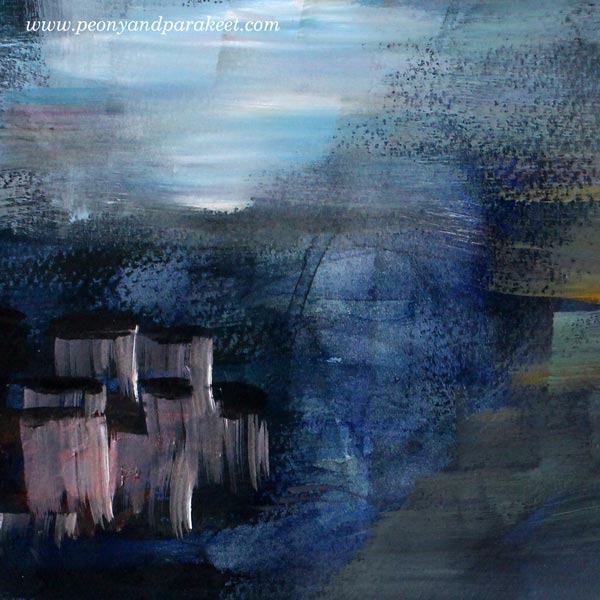
When you have your cornerstones set, you can feel free to experiment: use less of something, more of another thing, express deeper thoughts or become more playful.
My favorite supplies are watercolors, acrylic paints, and colored pencils. They can be seen as cornerstones as well. If I create something a bit different, it isn’t so scary when I use these old friends.
So I started the painting with watercolors. I had some leftover acrylic paints from other projects, so I stopped to watch the watercolored surface and tried to figure out how to create something a little bit different with them.
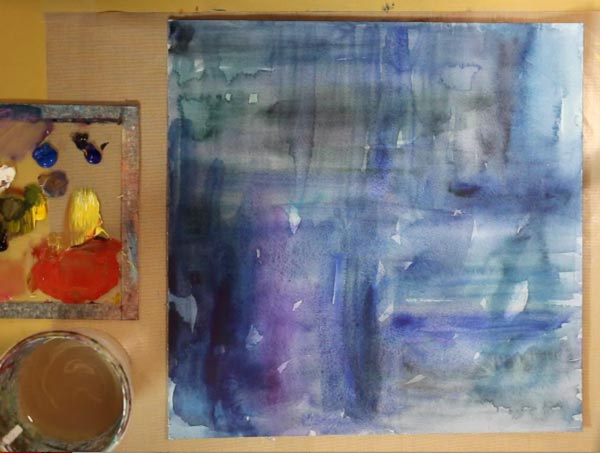
One thing that I love in acrylic paints is to have many colors on a brush at the same time and get delicious color effects.

I worked with fairly thick brushes so no wonder when the artwork reached this point, I felt it needed some sharpness and movement.
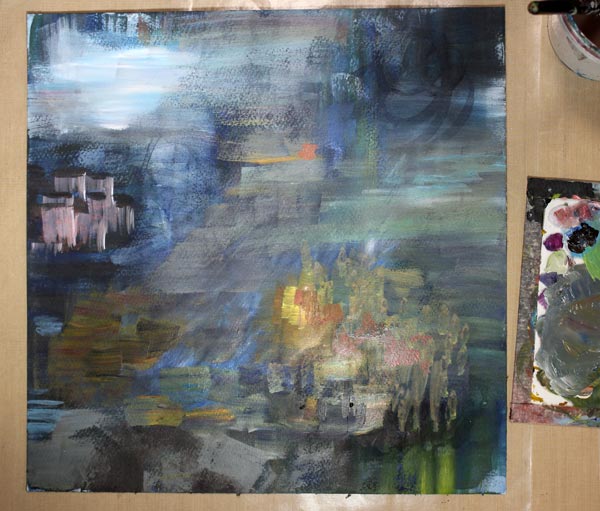
Then I remembered the photos that I love to shoot. I adjust the shutter speed low and move my camera to doodle with light. My photos are not brilliant, but I absolutely love playing with the camera this way. These photos make me think of bit streams and all the wonderful technical innovations.
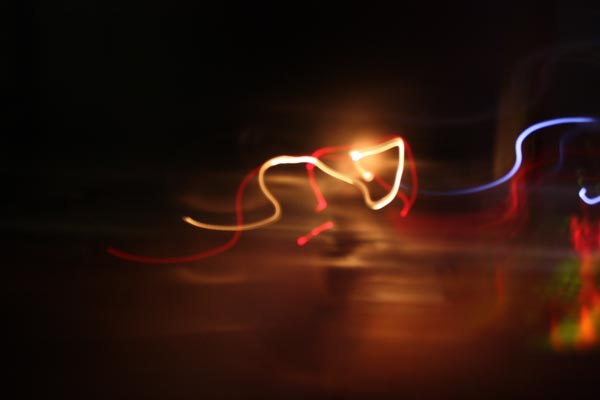
So I added a few sharp light details, and it was finished!
Subscribe to my weekly emails – Get a free mini-course!