
Express Yourself with Colored Pencils
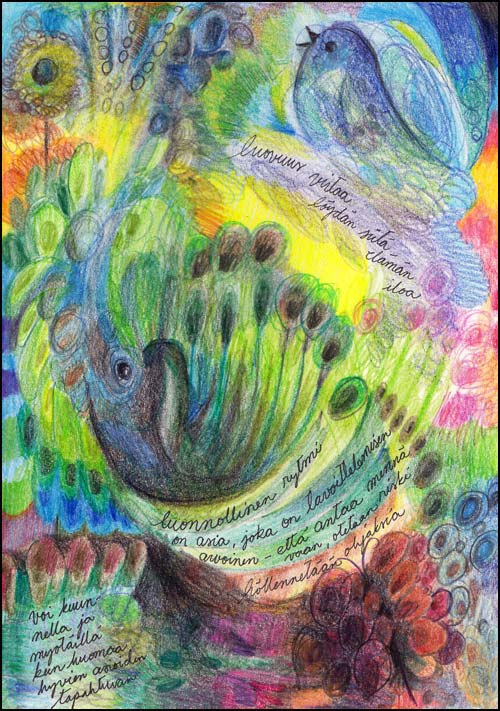
Simple art supplies fascinate me. Colored pencils have been my favorites recently. They are so easy! There are no worries about making the pages too thick even if there’s a lot of layers.
Colored pencils seem to be used for traditional artwork mostly. I think they are as suitable for improvising as any other media, like watercolors. In this post, I will show you few easy techniques for expressing yourself with colored pencils.
1) Color by Doodling
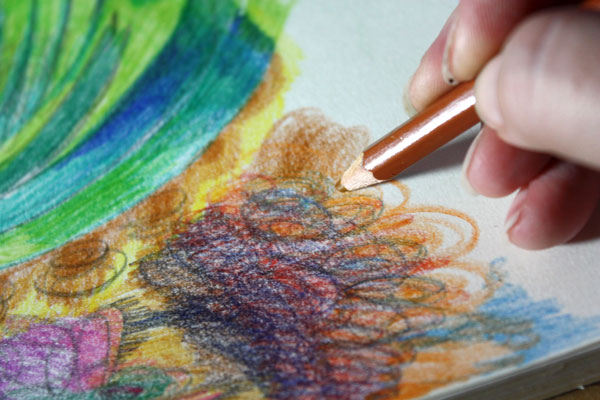
Starting with a blank page or paper, draw circulating and continuous lines to color a small area. Then change the color and continue. Create layers and let the colors intersect. You can get a wide range of colors with layering. Think your pencils as doodling tools!
2) Rotate the Page while Coloring
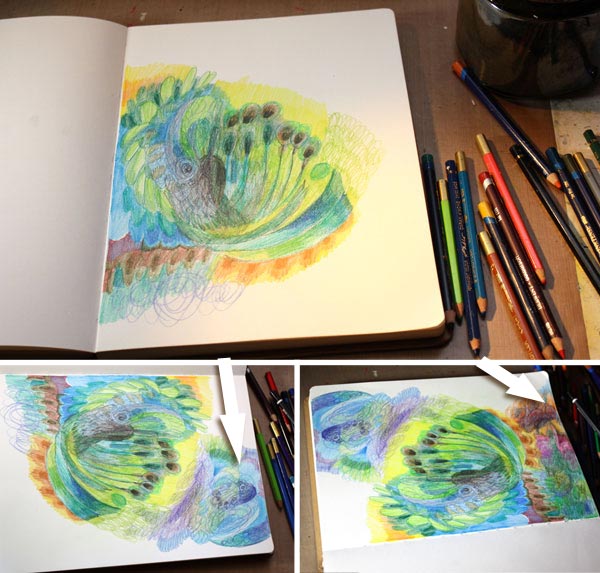
You will get more variety and interest to the page if you rotate it while working. Work one area at a time, changing the orientation once in a while. The areas can be fairly large as in my page, or smaller.
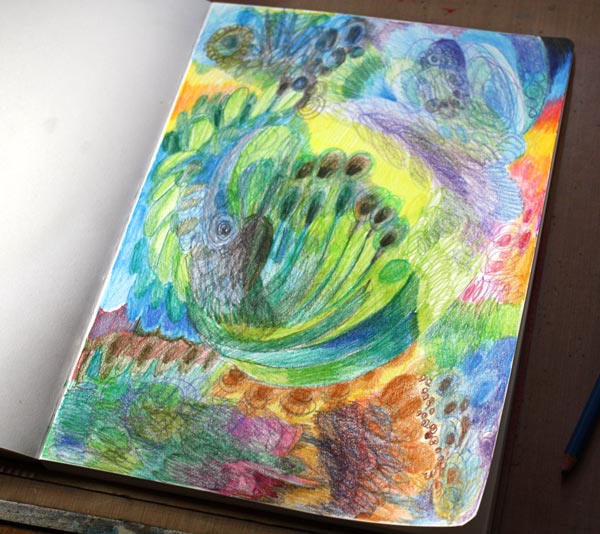
Here’s the page before I used the eraser …
3) Use Eraser to Create Lighter Areas
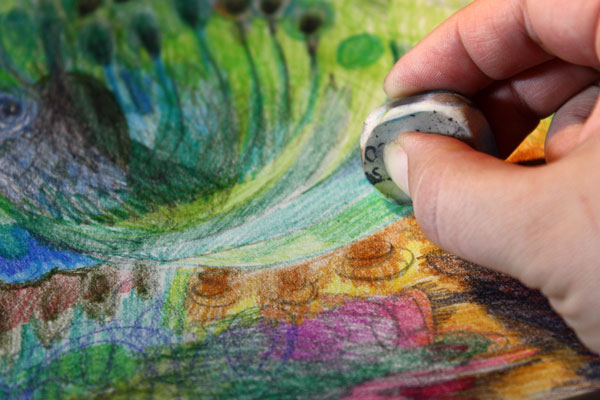
Erased areas bring light to the work. In an art journal page, use the eraser for the areas where you want to write the journaling.
4) Add More Clarity

I am a big believer of finishing. When you improvise, the result may be self-explanatory for you without the finishing touches. But if you want to communicate with others too, then sharpening some areas and adding some layers here and there for more intensive color is a minimum. I realized that my page had some animals in it so I made them easier to see. Like the photos include sharp and unsharp areas, you do not need to work through the page. Picking the focal points and working with them is often enough.
Coloring with Pencils is Like Painting by Drawing
By discovering these easy techniques, I have learned to love colored pencils. It is like mixing painting with drawing. With colored pencils, you can have a gorgeous art journal or a unique greeting card collection! Show your free expression with colored pencils!
Express yourself with colored pencils! >> Buy Coloring Freely!
Move Towards the Flow State!
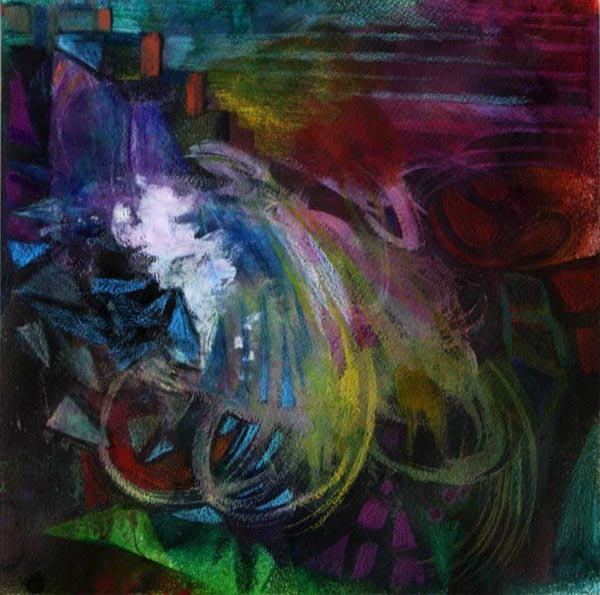
This mixed media painting is called Waterfall. It is inspired by the light in dark spaces.
Last week, I visited two places with old glass windows. The first was National Museum of Finland in Helsinki. The second was the Finnish painter Pekka Halonen’s summer cottage “Halosenniemi” in Tuusula. Both of them were built at the beginning of 20th century. Despite their windows, there’s fairly dark inside. While walking there, I saw how dark colors can be seen as soft and how daylight can look sharp.
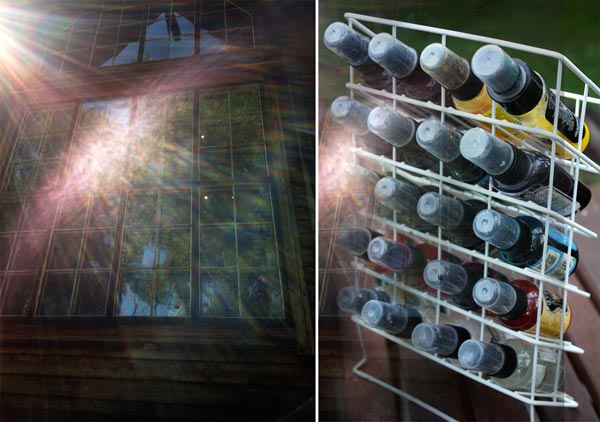
Perhaps the especially hot summer weather had it’s role too. No wonder I thought so positively about shadows and … water! I was tempted to use color sprays for this artwork. That way I could work outside and move around while creating.
A Big Mess with Acrylic Paints
Before spraying, I used acrylic paints to create color areas. They would work as a resist so that I could reveal them again after spraying. But the most important thing with the acrylics was: I grabbed a wide brush and said goodbye to rational thinking.
When you start with big brushes and create intersecting layers, you will naturally get into the creative mood. You will also begin to move. It’s often necessary to even stand up to make those big strokes wide enough. Check the front page of Heikki Marila’s website. He is a Finnish painter who creates huge paintings inspired by art history. See how those paintings are created, lots of movement there!
Also remember to change and mix colors as often as possible! Think that you are climbing towards the flow state where the creativity meets the happiness! Each interruption, the change in the movement and color, is one step closer to the flow.

The mess that I created with acrylics made my rational side cry and emotional side warm up. I was ready to get some fresh air and start even the bigger mess with sprays.
Entering the Flow State using Spray Mists and Handcut Stencils
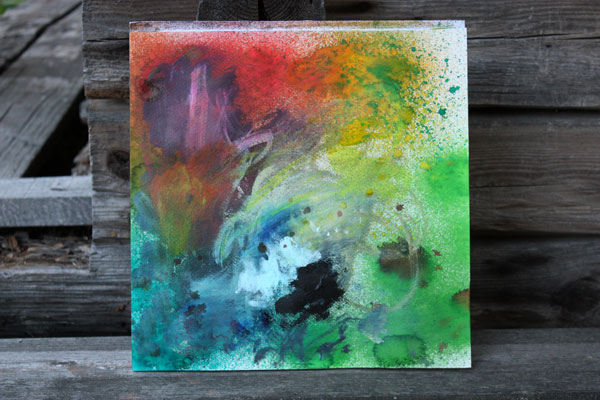
Here’s the first sprayed layer. Moving around the lawn and shaking the spray bottles were like a jump towards the flow state. I shook away the last rational thoughts and entered the happy state. I was flying.
Now, this is important: Be prepared to work quickly! When you get creative, you will get faster. There should be no need to rationalize what to do next or where to get the materials. They all have to be there. I had taken the scissors and a piece of paper with me. That allowed me to create stencils while waiting the layers to dry. I had also set up the blow dryer near the back door.
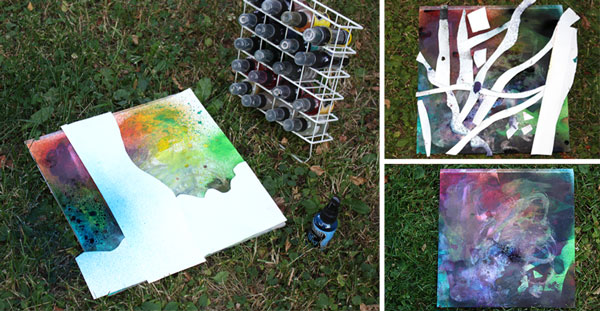
Running around the back garden with spray bottles, then inside to dry layers, then back again, I sprayed about five layers in total. As a result, I got the ugly mess shown in the photo right below. But I was not worried. I thought it looked amazing! One good thing when moving towards the flow: the inner critic leaves far behind!
I ended the day with spraying some areas with water. When wiping some of the spray ink away the acrylic paint areas were revealed.
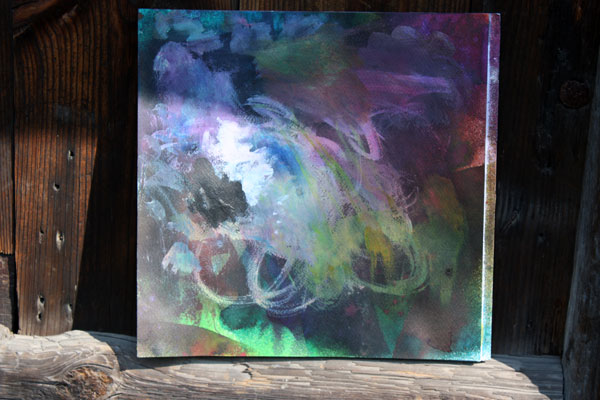
Next morning I had a problem to solve. How to finish the painting? I decided to create small geometric shapes with colored pencils to resemble the sharpness that light makes in the dark space.
Finishing with Colored Pencils
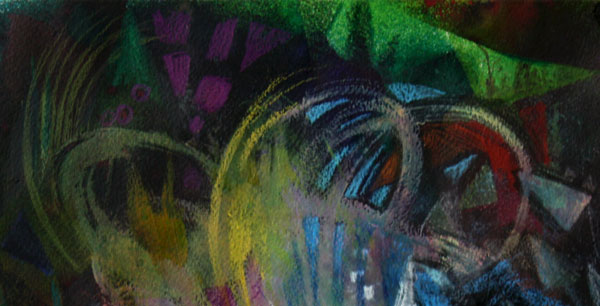
When using big brushes and big movements, creating details with small strokes adds interest and balance.

Colored pencils are wonderful to highlight the best and reshape the worst areas. When working with small details, I try to focus on one small area at the time.
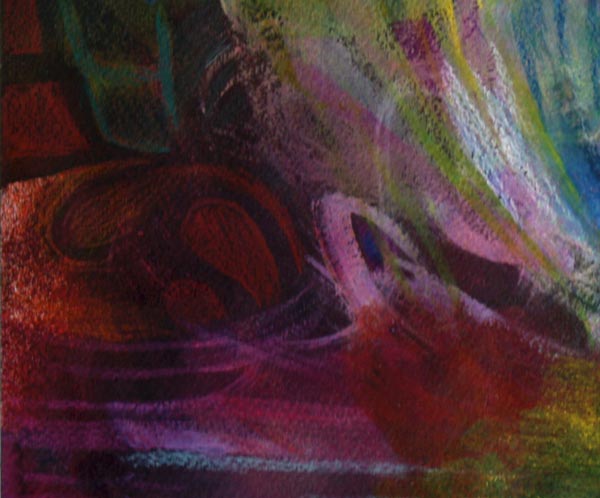
In the “big” phase, my focus was in the big picture. Now, when working small, my focus is in the details.
Balanced Composition
When I had gone through all the areas, I began to look at the big picture again. Then I made the final tweaks. So here it is:
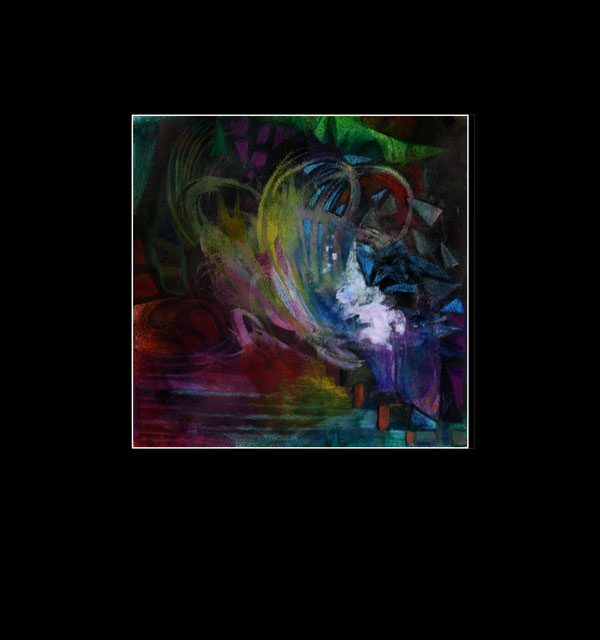
Hmm … wait a minute! Now it is upside down! Well, while coloring the work, I thought the direction would be this. But then, I noticed that it could be any of these three:
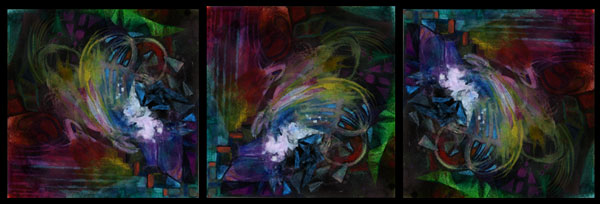
If the composition is balanced, the work will look balanced in any directions. By changing the direction, you can test if your composition is successful. Still, I rarely come to the result where changing the direction not only works but also tells the same story. I think that moving around the lawn had an impact here!
Experiment this in your art: Try to include physical movement into your creative process!
Subscribe to my weekly emails – Get a free mini-course!
Surface Patterns for Hot Summer Days

This July has been wonderful in Finland. I have enjoyed gardening and photographing and it shows in my art journal too.
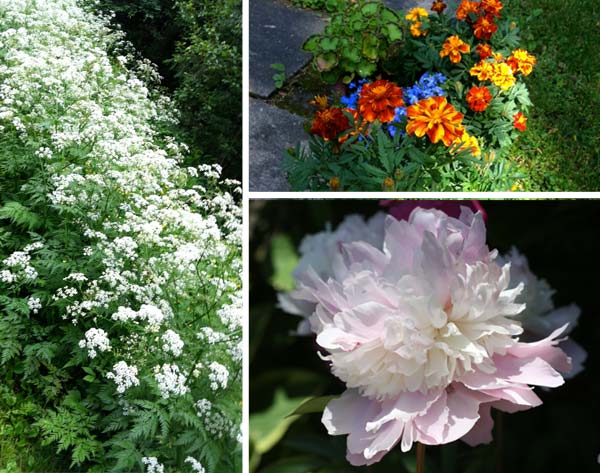
Both the wildflowers and flowers in the garden look great with a dark background. So when I made the drawing with colored pencils, I added some shadows too. Great way to express sunshine is to combine black with yellow!
But my main focus was on summer fabrics. It is so much fun to design prints for summer dresses.
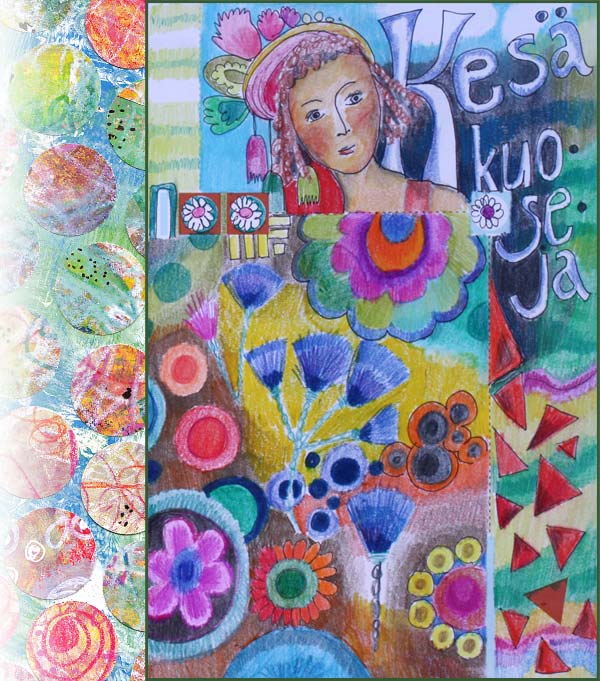
The collage of the left is an old one. A sketch for a surface pattern made in 2011. It was made by cutting circles from handdecorated papers. This time I replicated the design by cutting circles from stamped papers.
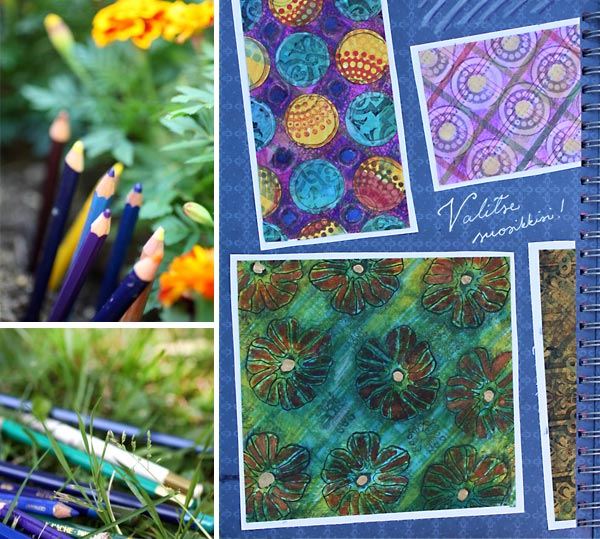
The summery prints are mostly made by stamping here. Paper scraps like old scrapbooking papers can be altered easily with markers, colored pencils and stamps. I always try to add subtle color variation in the background to keep the result interesting. Thinking about shadows help here too.
As you can see, my colored pencils are always with me! Hopefully your summer has been as wonderful as mine!
From Fact Finding to Quick Start
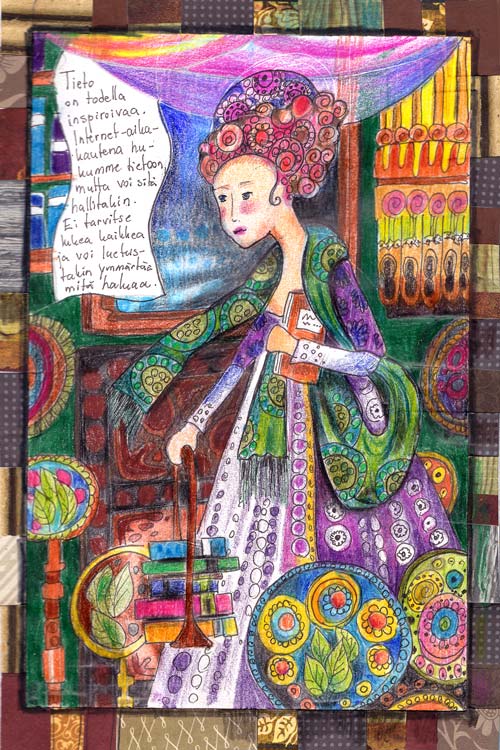
She searched ideas by watching what others had made. Then she realized that she had spent hours trying to find the inspiration. And it was already too late to start making anything by her own. Besides, she was feeling overwhelmed.
Does this sound familiar to you? You might get inspired of this or that, but feel powerless to start making your own. It can be only that you are tired after a long day. Then the best you can do is to go to sleep. But if repeatedly find yourself having difficulties to begin, it might be that you are using the wrong method when searching for inspiration.
Use your imagination when browsing other people’s work.
When you use your imagination, you will get your own, not other people’s ideas. This requires that you do not take anything you see as a fact. Instead, you should focus on the feelings and associations which they raise.

Here’s a crayon drawing which I made as a teenager. It is about a girl coming from the library. The weather is predicting the end of summer.
But actually, you don’t need to know anything like that. The fact that the girl is standing in the middle of the picture should be irrelevant to you too. The purple dress is interesting only if you react to the color. Maybe you are touched by the combination of blue purple and bright yellow? Or maybe you get cold vibes when watching the image? Like when you were sitting on the floor of your new unfurnished home thinking of how to renovate it. Which reminds you of new beginnings and how much hope they hold. A little bit like puppies and young children …
Now you ask: would that mean that I should draw a puppy dog? Or just grab the idea of softness? You could if you feel inspired enough but I would advise you to have a bit larger mix of things. So let’s pick another image.

Here’s another work from decades ago. I used watercolors to replicate a black and white photograph of my grandmother and her three friends. Here you might think how stiff and serious people used to be in photographs. Those forced gestures are a complete opposite for the puppies. How funny the similar photo of four puppies would be!
Now you might get inspired by expressing the two opposites: stiff and free-form, hard and soft. Hard can still be soft inside, like the hearts of the four young girls.
Make a Quick Start using the ideas as a starting point.
When I began working from this standpoint, I knew only this: I would begin with coloring four soft areas and at some point add both organic and angular lines to express the opposites. Then I turned the music on and went with the flow.
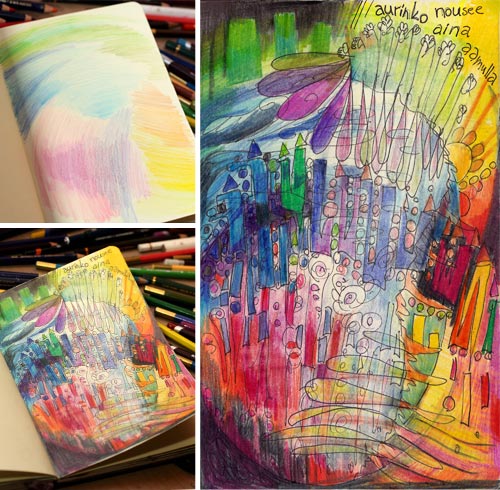
In the end, I wrote where my thoughts had led me to: “The sun always rises in the morning”. I had illustrated the change of day and night and expressed how every morning is a new beginning. Now, there’s hardly any resemblance to the images I started with. Still, they gave me a jumpstart on creating.
When browsing, focus on your inner thoughts.
If you get stuck with having no ideas and being overwhelmed by other people’s work, you think too much about facts and give too little value to your inner thoughts. You will browse endlessly because facts never stop if your own thoughts will never get noticed. Instead, look at few images or read few sentences and think: What is here that comes to my mind? What basic combination could I create from these just to get started?
If you look for the perfect inspiration starter, you may never find it. In fact, there’s no such thing. But if you value your own thoughts, creating art will generate happiness regardless of the source of inspiration. Your art journal or any end result will become more and more perfect because you are perfect for yourself.
Subscribe to my weekly emails – Get a free mini-course!