
How to Paint Watercolor Postcards in Vintage Style
I have beautiful, old floral postcards which inspired me to create some of my own. When making the cards I realized that it would be almost impossible to show the techniques with static images and text only. So I made a short video about how I improvised the cards. Only watercolors, two brushes, and a watercolor paper needed!
Watch a more comprehensive subscriber-only video!
>> Subscribe to my weekly emails!
Illustrating Poems in Art Journaling
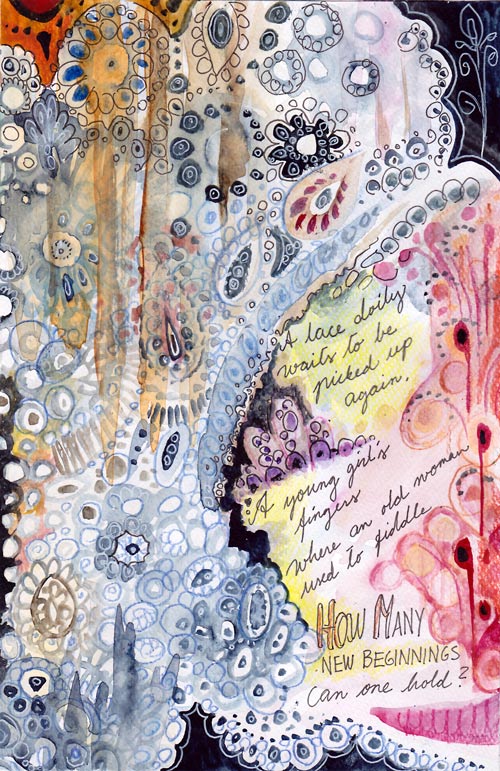
A lace doily waits to be picked up again.
A young girl’s fingers where an old woman used to fiddle.
How many beginnings can one hold?
This is an art journal page which illustrates a poem. I usually create the image first and then add the text. This time, I wrote the poem first and then illustrated it. Namely, for a long time I have had a desire to include creative writing in my art journals. I have loved poems since a small child and I used to write them all the time. After I grew up and moved away from home, it gradually stopped. But now years later, poems seem a great addition to art journal pages. Especially because I usually start writing a poem with a visual image in mind. Wouldn’t it be suitable to document that image too?
Of course, you do not have to be a poet to get into illustrating poems. You can also illustrate the poems that other people have written. Poems are great tools to get connected with the visual images that represent feelings. I think poems make a perfect pair with visual self-expression!
Illustrating Poems
1) Getting in touch with the feeling
Read the poem several times.
What kind of atmosphere does it create? What metaphors does it use? Are there physical objects or people to include?
There’s a risk of getting too rational here. Try answering these too:
What kind of memories or thoughts does the poem raise in you? What kind of rhythm, music or dance does it resemble?
2) Sketching
Lightly sketch the elements you want to include to the page. Write the poem or at least reserve a place for it.
I used watercolors for sketching. Light painting can bring a more intuitive approach to your work than using a pencil. You don’t need to know your exact composition yet. Think this phase as the first steps in the dark! Do not take it too seriously (= too rationally)! Focus on the feeling you want to express!

3) Expressing with composition
After sketching, adjust the composition by adding more elements to the page! With poems, I often feel that if the composition delivers the message, the rest is trivial or easy. There’s so much content in the words itself.
I wanted my page to lean to the right and then up. Right – because there’s a strong connection to the future in the text. Up – because the doily waits to be picked up in the story. I also chose the colors accordingly: blue representing the old and red representing the new.
4) Finishing
This phase is to fine-tune everything already created.
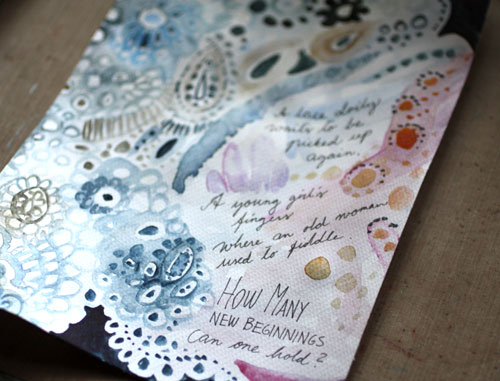
I wanted to add the feeling of fabric and emphasize the upward movement by adding thick lines with watercolors. I also made the lace more detailed. Then I added some dark areas to make lighter areas pop. A thin black marker and colored pencils are great for the finishing touches when using watercolors on the page.

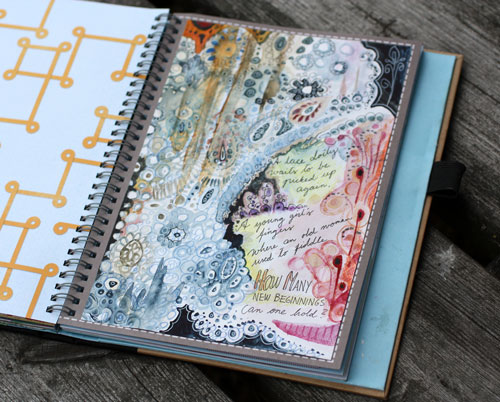
The page was made on a separate watercolor paper and then attached to the journal. Watercolors work best on watercolor paper. Even if you use a thin watercolor paper it’s better than using a smoother surface.
Illustrating Poems – A Minimalistic Approach
You know that I am not a particularly fond of minimalism in self-expression but with poems, I think it can be a very effective approach.

A yellow spot on a white painting.
A happy thought when leaving.
I saw the sun on a cloudy morning,
The one to brighten my being.
This poem of mine began with a visual image that called for simplicity. When aiming for lots of space, acrylic paints can be a better medium to use than watercolors. Acrylic paints have more substance themselves, and it’s easy to add slight, yet powerful color changes with them.
In this page, I divided the poem into three parts. The composition was built accordingly.

The first part is focused on expressing the latter sentence: the leaving. It is bittersweet, light peachy orange.
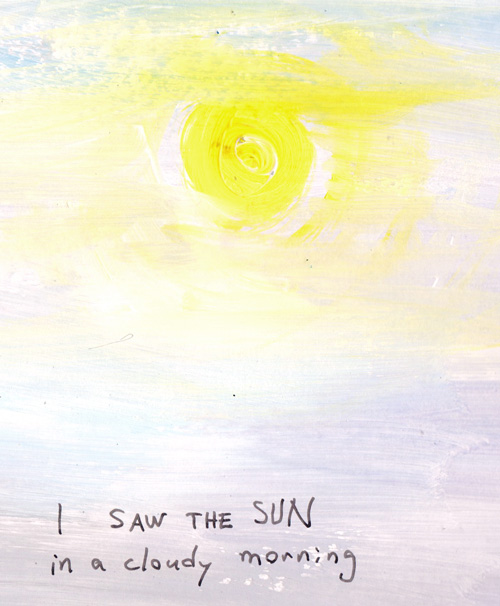
The second part visualizes the sun in cloudy weather.
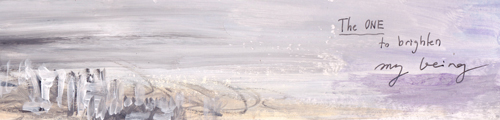
The last part communicates the person, her being and her relation to the world that she is leaving behind.
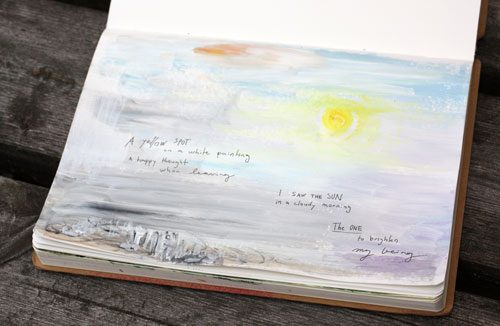
With acrylics, it’s easy to work on any surface. I used white gesso instead of white paint but only to save some money.
Art Journal of Poems
Think about having an art journal that is filled with illustrated poems! What a treasure would it be! The best things in life are those we can create ourselves.
Let me be your art teacher: Subscribe to my weekly emails!
How and Why I Create Art?
I was challenged by Anu-Riikka for the blogging challenge “A Blog hop with a difference”. There are six questions to be answered so let’s begin!
1. What am I working on right now?
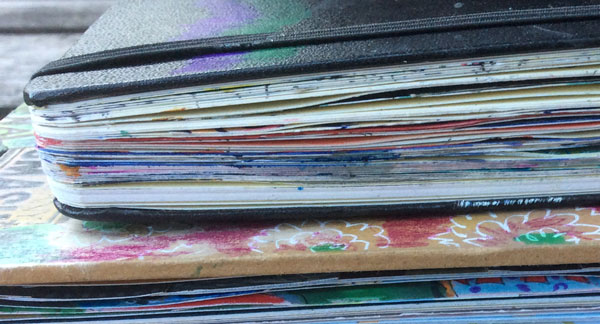
More than a single project I’d like to think about what’s new in my process. I always try to learn new things and expand my skills to keep creating interesting and exciting. At the moment I practice writing poems in English! I want to improve journaling in my art journal pages and use writing to enforce imagination. I used to write poems until young adulthood and have always loved literature. Writing in English provides an additional challenge because my mother tongue is Finnish. The world is so much bigger and better if you are not limited to the language. I can also write in Swedish, and I used to study German at school, but Spanish or Portugal would be great to master too!
2. How long does it take to create a project?
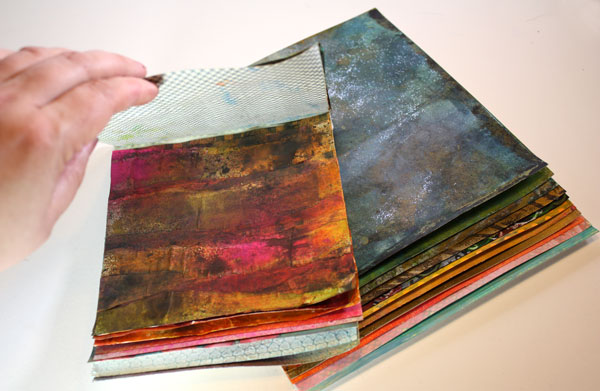
A small art project for the blog usually takes at least two days to create. I do not like to finish anything at one go because the quality gets better if I have time to ponder. I often work with projects in phases so that decorated papers or sketches are created a long time before I execute the final project. I also use a lot of time to think about techniques and ideas before I start. Sometimes when I start creating, I realize that my thoughts have gone wrong. Luckily it is easy to turn a new page from my art journal and start it over!
3. What are my fave things I love to create with at the moment?
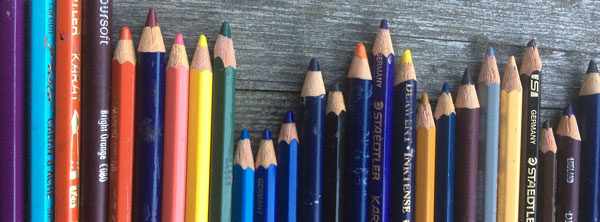
I have tried a wide variety of art and craft supplies but enjoy basic supplies the most. You do not need much to start creating. My favorite supplies are colored pencils, markers, watercolors, acrylic paints, blank paper, and scissors. It has become more and more difficult to enjoy creating projects that use ready-made products. I get a lot of satisfaction of not buying and creating things myself. Even if I enjoy seeing art in general, I do not get much out of following projects that use heavily ready-made products like paper flowers or stickers. I wish more and more people could give a chance for their imagination and experience how satisfying it is to create something from start to finish.
4. How does my writing/creating process work?
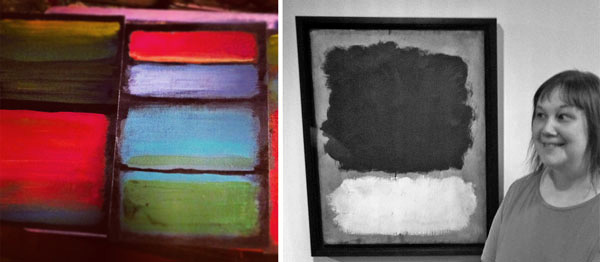
I believe that we should act creatively but ensure that it’s made thoughtfully. That’s why it is good for anybody to clarify the reasons why they create. I make art for two main reasons: 1) to be able to communicate with other people 2) to show my admiration for the great masters of art and design.
My creative process is very formal because I love organization. During my designer studies, I learned the basics of the design process. It includes background study, collecting, combining and testing ideas, executing in phases and getting feedback in appropriate stages. Even if it sounds controlled and complicated, it doesn’t feel like that. Each phase is adjustable: it can take very short or long time, and it can be repeated when needed. Working systematically gives full power to my creativity. I also like to work towards a pre-planned schedule. When I have set a limited time for creating I feel freer than constantly questioning whether the process has taken too much time or not.
5. How do I become inspired and stay inspired?

I love art, design, and architecture. Show me any picture of the history of art and design, and I get inspired! I become very easily inspired, and that can sometimes be distracting. On the other hand, I think that inspiration is overrated and regularity in creating underrated. I hope that I can help people create more regularly so that they get to know themselves and love their own work. I also hope that my regular practice will improve my skills to communicate visually and verbally.
6. What is my signature style?
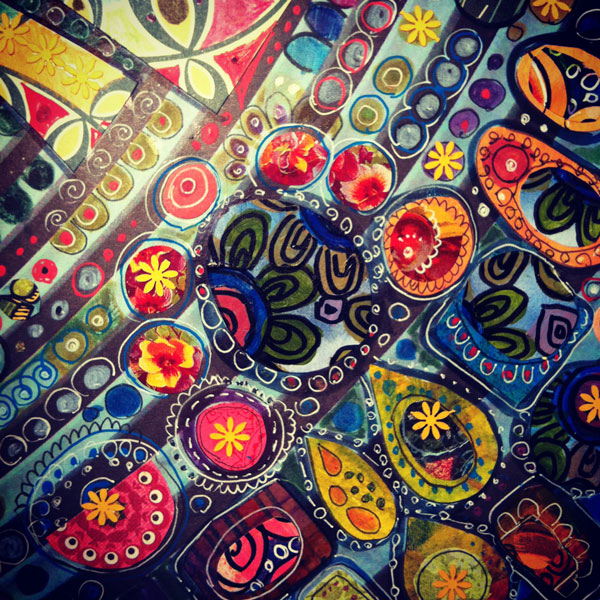
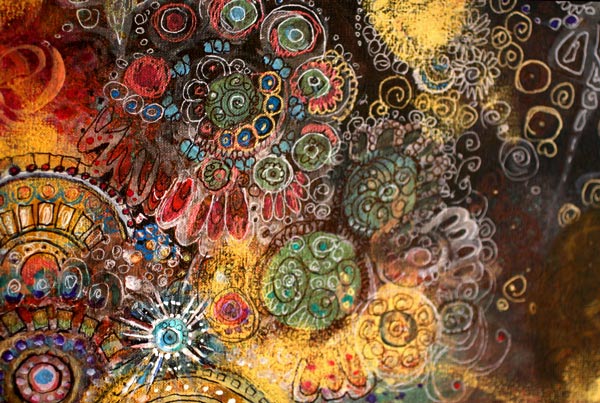
My work has a lot to do with colors. I think that colors can communicate feelings most effectively. In composition, I often aim for dynamicity. I also try to achieve the balance between relaxed and free-flowing line and accuracy, almost engineer-like look. My style is some mixture of folk style and art nouveau with a twist of the 1970s. However, I have begun to hope that I would have no signature style at all! The more I create, the more I have become to value diversity. I want to learn to understand as many styles and artists as possible and help others find them too.
How would you answer these questions? Share it by commenting this post or if you have a blog, linking a post to the comment!
Subscribe to my weekly emails – Get a free mini-course!
Imitate Ceramic Art!
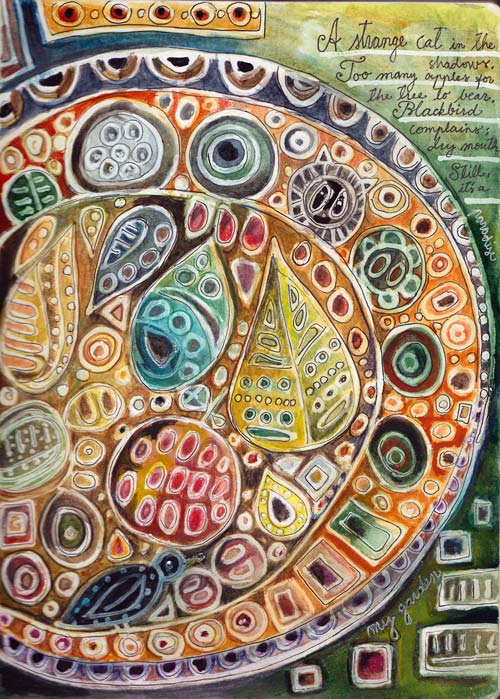
A strange cat in the shadows.
Too many apples for the tree to bear.
A blackbird complains: Dry mouth!
Still, it’s a paradise: my garden.
This is an art journal page where I wanted to achieve two things:
1) imitate Scandinavian ceramic artists of 1940-1960s
2) write a poem and illustrate it
Scandinavian Ceramic Art
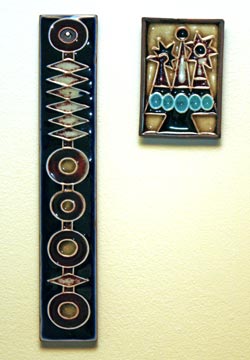 Let’s start with the artists: Annikki Hovisaari from Finland and Lisa Larson from Sweden. They are women who made beautiful ceramic art in 40s-60s. Annikki Hovisaari died in 2004 but Lisa Larson is still alive and she has a website too.
Me and my husband own a couple of Annikki Hovisaari’s work. We have bought those from antique fairs.
I found out about Lisa Larson in Scandinavian Retro magazine nr 1/2014. You can also see the best work of hers by searching from Google with the search term “Lisa Larson tile”
When I examined the work of these two artists, it was clear that a white correction pen would be perfect to imitate the lines. I made a couple of small pages by combining the correction pen with acrylic paints and PITT Artist Pens. However I was not fully satisfied with the outcome. These did not have the liveliness in color that I wanted to achieve.
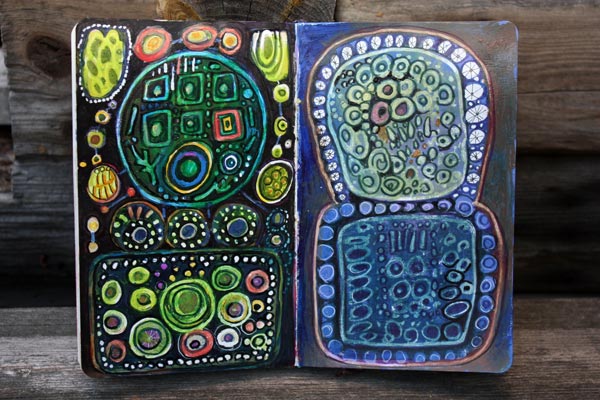
But after making these I realized how I would use the correction pen and what I would combine it with: watercolors! Here’s how you can create your own ceramic tile look!
1) Doodle with correction pen
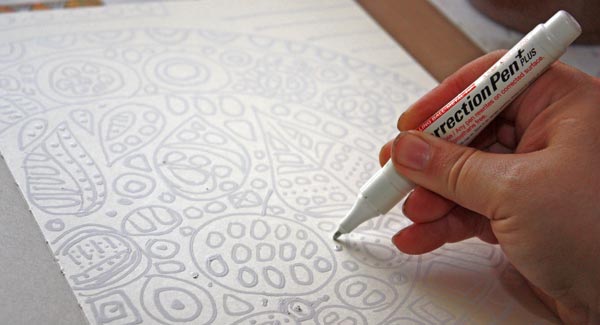
2) Use watercolors for coloring
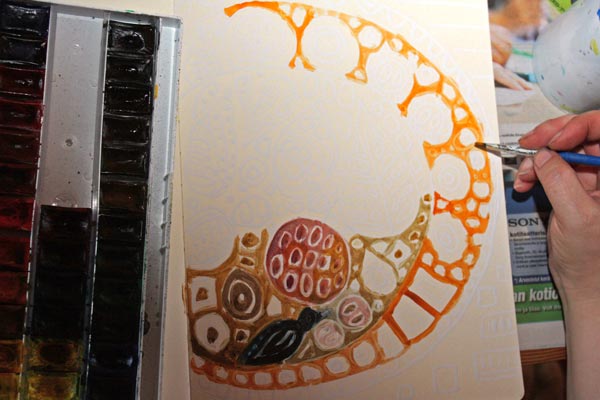
The correction pen works as a resist. You can watercolor over the white doodles. After painting add some water and wipe the paint off from the doodles.
3) Add contrast and draw thin black lines

When you are done with watercolors, don’t stop yet. Add color variation and contrasts to doodled shapes. You can also work with colored pencils when finishing if it feels easier. Finally, take a thin black marker and add thin lines in the center of white doodles or both sides of the doodles. These lines will make your work look sharper and more dimensional.

Here you can see the difference that finishing makes. At this stage, I have also added the poem. Actually, my process began by writing the poem. I have discovered that if I want more depth in journaling, it’s better to write it first.
Have fun with this simple technique!
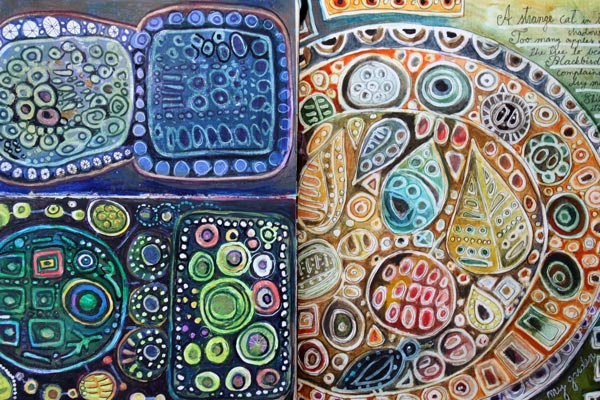
More ceramic art inspiration and playing with simple shapes
>> Modern Mid-Century art journaling mini-course