
Begin Like a Crafter, Finish Like an Artist
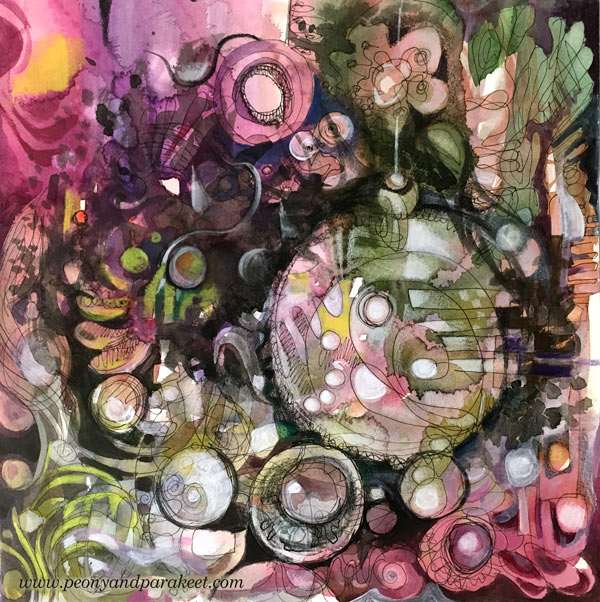
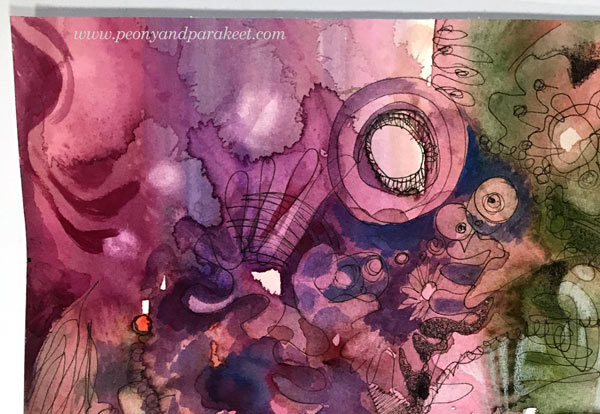
Here’s what I made today: a mixed media painting with a Christmas theme. When I began creating, I had no idea that this will express the season. I didn’t even start with a blank paper but cut a piece of a big pre-painted watercolor paper. It had just careless splotches of color, and I had painted it months before to wait for the right moment. I had just enjoyed knitting some old sock yarn into socks, so I thought to use up that paper with the same mindset: using what I already have and making that more inspirational.
Begin Like a Crafter
I picked a black Zig drawing pen and started doodling without any idea in my mind. I often think about knitting or crocheting when I doodle. I feel more like a crafter than an artist at the beginning of the process. Exploring the paper with a pen is like crocheting with a hook and yarn. It’s much more relaxing than trying to find a grand idea first. When you start as a crafter, you are ready to do the work. You don’t expect miracles to happen, you know you just have to keep on going, and it will get easier after a while.

After filling most of the paper with crossing lines, I felt that there was a lack of connection between the drawing and the background painting. They looked like they were two separate layers, each made by a different person. But because I had used a good quality watercolor paper, I was able to add water and wipe off color here and there so that the layers began to interact.
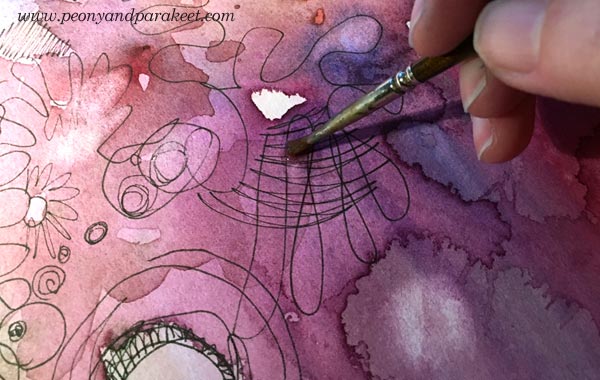
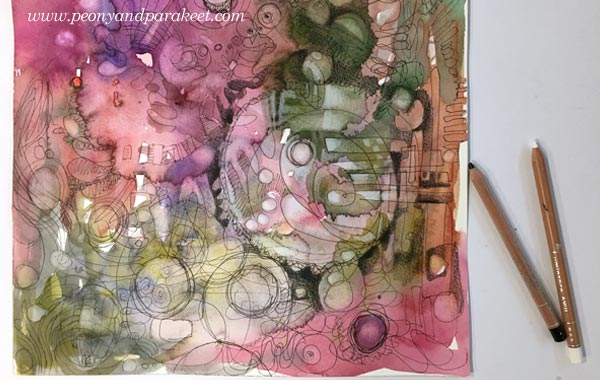
Again, I felt like a crafter adding stitches that would tie the two layers together. I also used white and black colored pencils to enhance the effect.
Find Routines that Start the Change
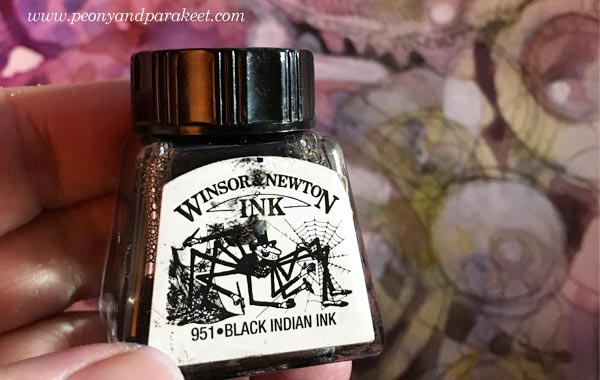
Working with black is my thing. It always brings in more excitement, more drama, and my identity begins to change from a crafter to an artist. This time, just holding a black pencil, made me want to start painting. I picked few bottles of India ink first.
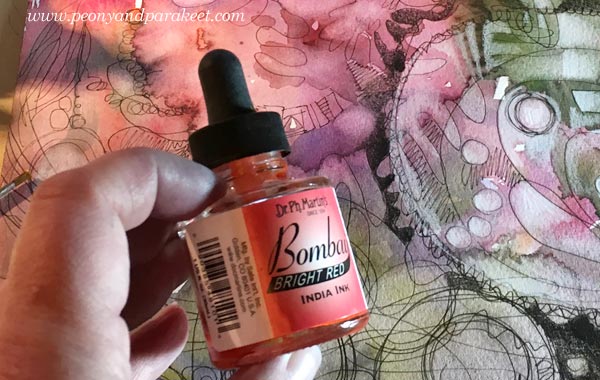
My brush felt stiff, and the shapes that I painted were controlled and modest. But I knew I just had to keep going. There were times when I stopped too soon, and I have seen that happening to many people too. When you stop too soon, you are still too much of a crafter. You try to focus, and you don’t feel like doing anything risky.
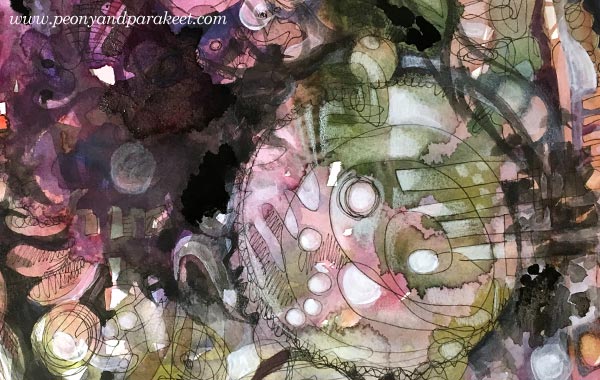
I changed to white acrylic paint to get more ideas and contrasts. There were some round shapes on the paper, but I had no idea what they could be.

Finish Like an Artist – a) Do Something Risky
After spending some time painting, I was ready to take risks. All I needed was to choose a little black ink bottle and turn on Jean-Michel Jarre’s Stardust, a song that always gets me into the flow. Uncontrollable black brush strokes felt scary, and of course, there’s a risk of “ruining everything”. I often set an area, where I don’t go. This time I decided to be as wild as I want but leave the center of the biggest bubble alone.
Before doing this phase, I convince myself that my subconscious knows what I could bring up from the mess because I have been staring that for a while already. I often repeat the words “trust” and “knowledge” before I turn to the music. I try to be as quick as I can and focus on adding more speed to my brush. This short phase where I leave the crafter behind is the most enjoyable thing in creating. I feel free while pushing the limits of my creativity.
Finish Like an Artist – b) Bring in the Intention
After adding those black strokes and splotches, I knew what I was expressing: holiday decorations on this black Christmas. In the southern Finland where I live, all the snow melt away just before Christmas Eve. I had taken photos just a couple of days ago that connect well with the painting. In this last phase, I try to find the fastest and most natural route to finishing the painting and focus more on composition and clarity than trying to make the image other than what it seems to be already. Accepting that my image can go to the area that is unknown to me at the beginning of the process, allows me to be less stiff.
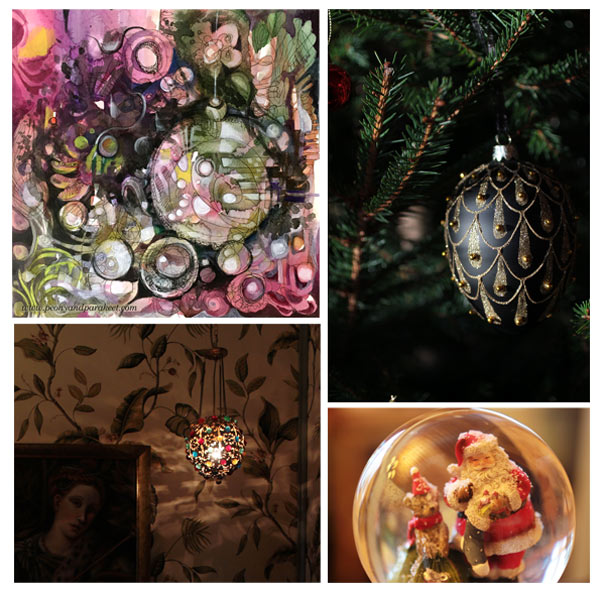
I find it so fascinating that art is a combination of knowledge and letting go. There are clear guidelines for communicating visually such as how to set your composition. And still, it’s also about taking all that knowledge and jumping into the unknown. Every day, I want to know more and then, relax more!

First Lesson of Inspirational Drawing 2.0 – Start with a Mood, Finish with an Image!
Like knitting starts from the first stitch, drawing starts from the first line. Somewhere between the lines the transformation happens and the crafter changes to an artist. The ideas grow with the imagination. Moods turn to motifs, motifs to modules, modules to streams, streams to images.
The first lesson of Inspirational Drawing 2.0 will be published on January 1st. This is the class you don’t want to miss! Every lesson takes you further in enjoying drawing from inspiration and imagination! I will help you create unique art in unique ways that will make you absorb the knowledge and then let your ideas grow.
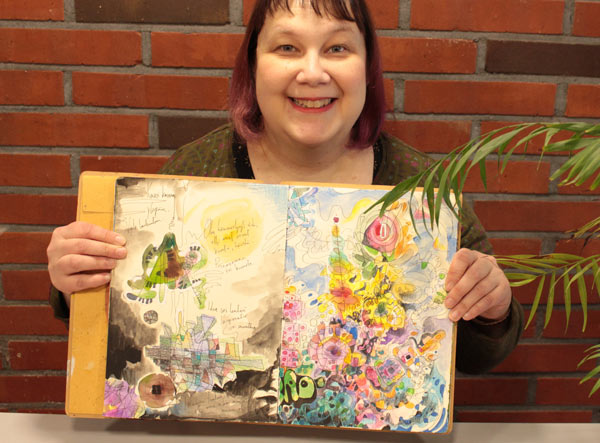
Enjoy drawing from inspiration and imagination!
>> Sign up for Inspirational Drawing 2.0
What’s in a Good Composition?
Quick question:
When you create art, how much time do you spend for composition?
I mean: trying to make it work, trying to balance it, trying to make it look more eye-catching?
For me, finishing the composition can take as much as 50% of my creating time! Some years ago, it was easily 75 % … I don’t find adjusting the details particularly relaxing. I take photos, use a mirror, and change the orientation of the piece to see if I have missed something. Sometimes I sleep overnight and make the last adjustments in the morning.
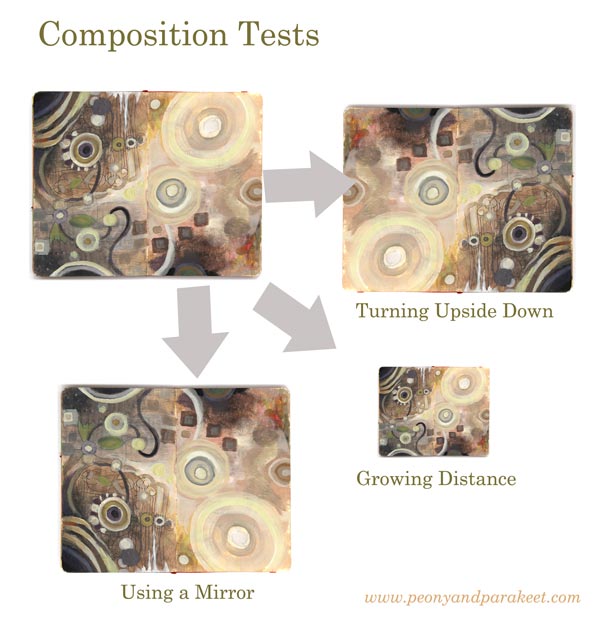
But teaching art has had some benefits here. I get to help people to make better compositions and thus, I have become faster. Namely, the two top requests that I get in my classes are: 1) How can I make this look finished? 2) What more could I add here?
So when I created a new class, Planet Color, I wanted to build a step-by-step creative process so that when you add elements, you don’t have to worry about the composition so much. I wanted to find ways that support you so that you can release your mind and fully enjoy working with colors.
What’s in a Good Composition?
Here’s my conclusion. A good composition has elements that a great party has:
1) concierges who invite the viewer to the painting
2) a star singer who takes the viewer’s attention
3) clear routes and breathing space which make wondering around easy
4) good food and good company which makes the viewer stay in the party
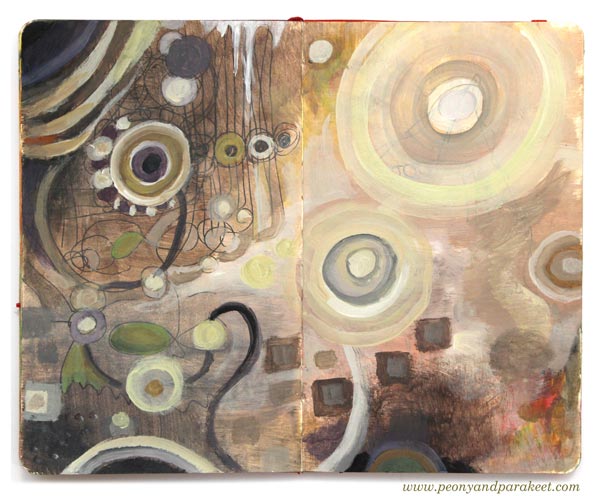
I have built all these elements in one 7-step process. It doesn’t mean that this process produces identical paintings. It means that when you enter the finishing phase, you have already done most of the work you should do anyway. But without all the agony and with all the creative enjoyment! That’s why my workshop Planet Color is as much about composing elements as about releasing your mind with colors.
And again, if you have problems in making the final adjustments, I am there to help for all the 14 days.
See you there!
How to Know when Your Artwork is Finished?
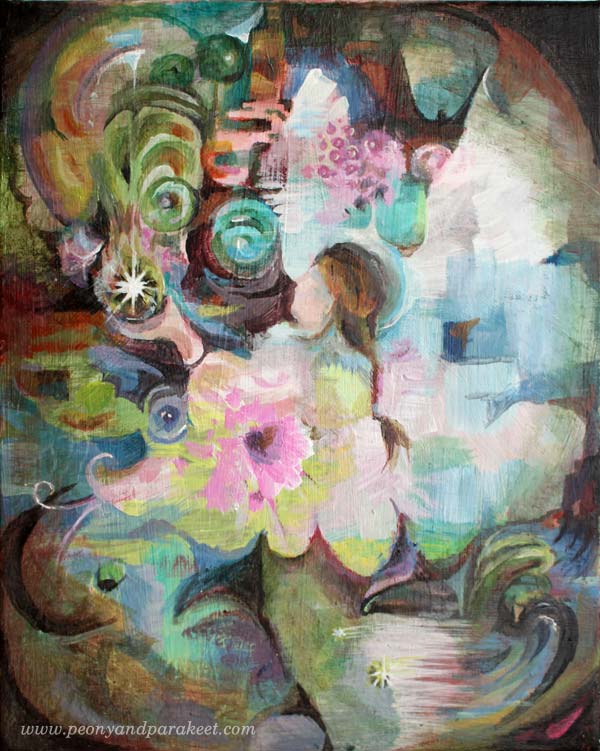
This is my latest painting called “Healing Power”. Painting this piece was so much fun so I decided to work with acrylics on a canvas. I’ll show you the main phases of creating this painting while giving my view on how to know when the artwork is finished.
Finished Artwork? – How to Analyze?
I have heard many bits of advice on how to decide when your artwork is finished. The worst is: “When you feel like it is”. Often you are just tired, fed up and that’s not a good point to finish. Take a break instead, sleep overnight and then continue!
Then there are more technical approaches like this one including infographics or based on historical studies and interviewing artists like this one. But as my students usually want to bring more content and self-expression to their art I have composed a simple and short check list focusing on those only. And instead of diagrams, I show how I deal with the issue in practice.
1. Do You Have an Opinion?
Every time I begin creating, I have pretty conventional ideas. Like here, I thought that I would make a flower painting and express “tranquility”. But to truly express tranquility, I show also include anxiety. I should have an opinion, a personal view on the difference between tranquility and anxiety.
Now you say: “But this is just flowers and nothing deeper”. I don’t think so. If you want to express yourself, you should express an opinion of some kind. This doesn’t mean you have to begin with an opinion. It’s more like vice versa: stay open to what is going to appear! But if you don’t have any more thoughts than “flowers”, “tranquility”, “pink”, you are not finished yet.
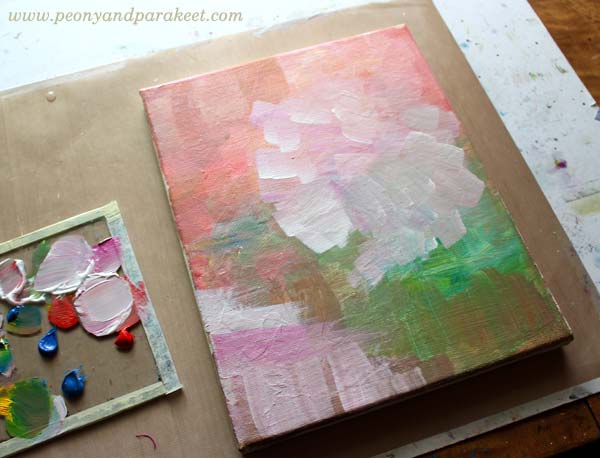
So while thinking about opinions, I got anxious and added some of it: brownish red!
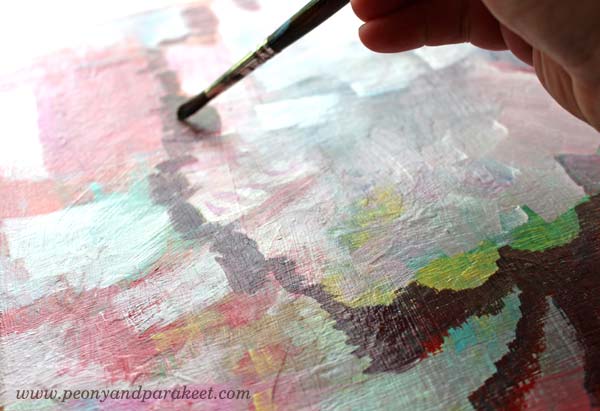
Another way of asking this: “Does the painting have both light and darkness?”
2. Do You Have a Focus?
When I continued the painting, it felt good to add rectangular shapes on it. Then some more colors, then some directional brush strokes. But directional or not, I really didn’t have a clue where I was going. Maybe this could be a flower bunch and the white part on the bottom could be a pot. If so, I should make them more clear.
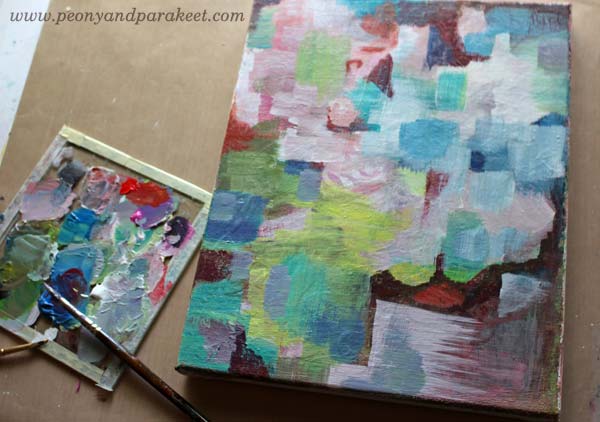
Another way of asking this: “Is it easy to know where to look at first?”
3. Have You Told a Story?
I continued the painting by turning the it upside down as it seemed to be even easier to build a pot with flowers that way. When I was at step 1 (see the image below), the painting was a bit too busy so I added dark thin layers to make it easier to look at (step 2). But then, what does this painting mean? Does it really connect with my thoughts? No, not really!
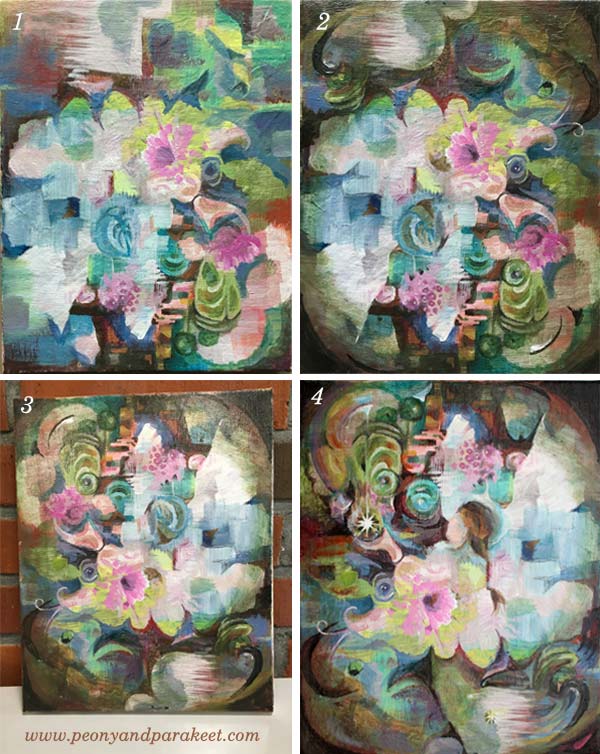
After a break, I turned the painting upside down (3). I saw a woman there, wearing a hat and taking care of the flowers. Maybe that could be a start for a story? I continued painting, trying to make the woman clearer.
Then it hit me: she was some kind of an angel, holding some kind of a magic ball. And finally: this is about healing, a subject I have been thinking a lot lately. My older dog Cosmo has had stomache problems and I have worried about him. I have also thought about many of my students, either in the middle of the sickness or having someone close to worry about. If only I could have the magic power to make everything what’s wrong, back right!
Another way of asking this: Does every element on your artwork contribute or lead to what’s most important?

This finished artwork is for you who would like to have that magic ball of healing power.
Let me be your mentor in art: Subscribe to my weekly emails!
Making the Most of Visual Nuances
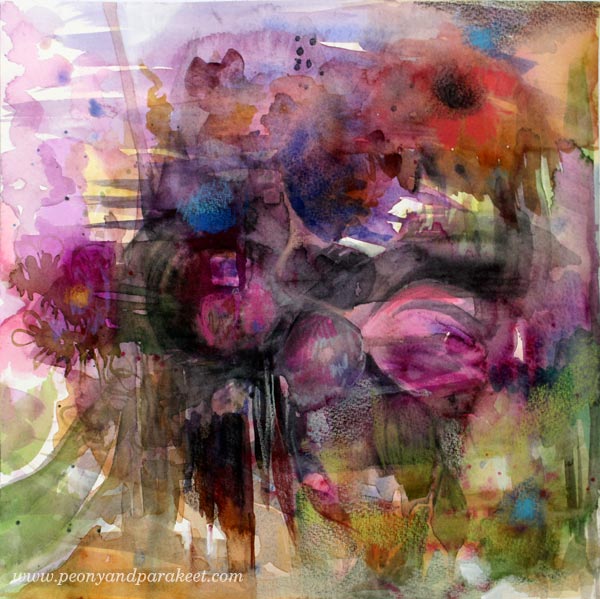
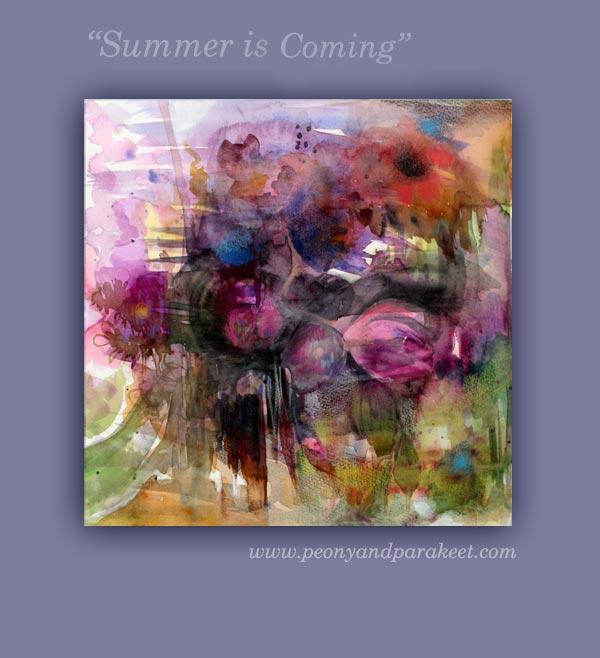
This is my latest mixed media painting “Summer is Coming”. It has been exceptionally warm weather in Finland and all that sunshine has brought summer not only to my mind but to my painting too. I tell you now how I created the painting!
First Layers: Having Fun with Watercolors
The painting began with watercolors. I made a mess that didn’t look so good when looking at it from a distance. But it looked wonderful when taking close-up photos!

After splashing the first couple of layers with a big brush, I changed to a smaller one. I painted simple shapes with soft edges and thought that maybe this will be an abstract piece.
Is This a Still life – Again?
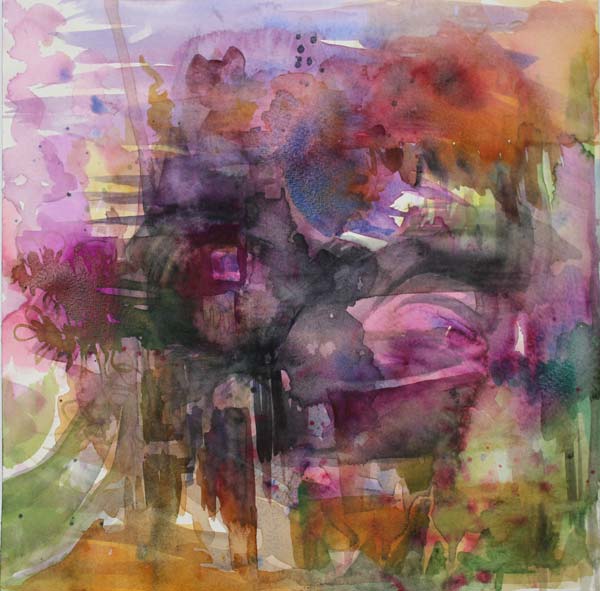
But after a while, it looked like a still life! I must admit that I have developed some kind of obsession for still lives. I have loved them for a long time already. But recently it has begun to feel that anything could be expressed with them. Well, a Finnish artist Miina Äkkijyrkkä has painted and sculpted cows for all her life, so still lives might not be so bad …
More Details with Colored Pencils
With colored pencils, I made the flowers more distinct. I wanted to work as softly as I could so that the delicate look of watercolor paint would still be dominating.
Almost There – Visual Nuances
Then I entered the actual finishing phase. This is what I call “Almost There” phase. It is the point where many just call the painting finished, and they try not to think about it too much. But if I am teaching a class, I encourage people to continue. One way is to show them what they can do next. So I open the photo of the painting in Photoshop and make little adjustments. With these suggestions, I try to add more visual communication and interest to the painting. Sometimes a little spot of color can make a big difference! See what kind of suggestions I made for my painting!
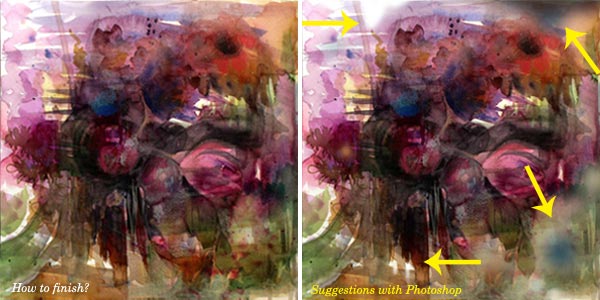
What’s the Magic of Using Photoshop for Suggestions?
One thing is that I can zoom as far as I can. Another thing is that I can try out different kind of adjustments without making a mess. I don’t do this often for my paintings, but I wanted to show you how little guidance can take the image to the next level. This is one thing that an art teacher can do: show you how you can fine-tune your work so that it has those visual nuances that make the painting more dynamic and alive.
Finished Painting
Here’s the painting after finishing it according to the suggestions. I used colored pencils and white gesso for the final details.
Subscribe to my weekly emails – Get a free mini-course!