
How to Create Comforting Art
This blog post is for you who want to spread more joy through your art, and make your art more comforting and captivating.

I am listening to an interesting course on writing. It’s Neil Gaiman Teaches the Art of Storytelling. Writing and making a picture have a lot in common. When you look at your piece, can you find a story – so, a conflict and a solution?
Conflict Creates More Comfort
Neil Gaiman says that beginning writers leave conflict out of their stories. And that it’s the conflict that makes the story interesting. The same goes for the picture. Beginner artists usually want to use only happy colors and draw or paint only beautiful and joyful things.
I too want to make comforting art – something that takes me to a softer world right in the beginning and that will lift the viewer’s mind when finished. But the conflict must still be allowed because first showing it, and then finding a solution for it, creates comfort and happiness.
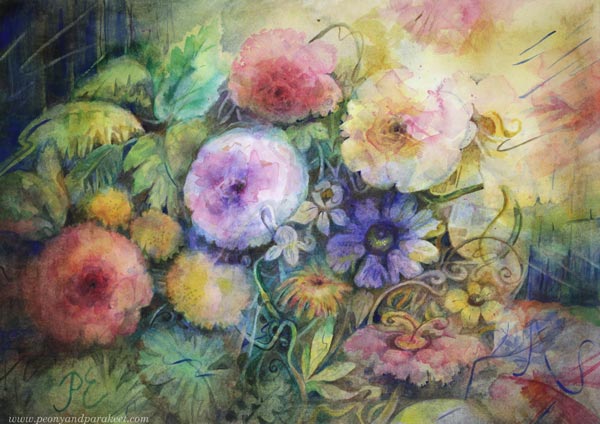
Purchase this painting via the Taiko art store!
For example, in this watercolor painting above, the flowers have run indoors because it has started to get windy and rain a little.
Imagine how they first evaluate the houses: “Where would we be welcomed the most?” And then they would push through the darkest window and settle on the windowsill close to each other.
Imagine stepping into that room and seeing shattered glass and feeling unpleasant coldness. But then the colorful flowers would bend towards you. What a pleasant surprise to receive in these windy times!

When I painted this, I wanted to protect myself from the winds of the world. I started with the flowers, but the painting only came true when the wind joined in.
Overcoming Difficulties Brings Comfort
For me, the most comforting art is the one where difficulties are overcome. For example, in this painting, the flowers have experienced loss, but are still ready to take risks again.

Build Different Characters
Neil Gaiman says that his stories are largely in the hands of the characters. Also in painting, you have to identify the main characters. Blots easily turn into flowers, but don’t leave it at that! Make small changes to the shapes so that the personality of each flower comes out. Often it’s a very small adjustment that a beginner easily ignores as insignificant. The skill of building an expression for a form no matter what it represents develops with making.
Strong characters and an understanding of the place where everything happens create a story in the picture. My main characters are strong-minded and independent and the conflict is often a fight against wild conditions.
For example, winter has arrived here, but the flowers stubbornly decide to turn the clock back to a warmer time. In this conflict, the flowers lose their color to stay alive.
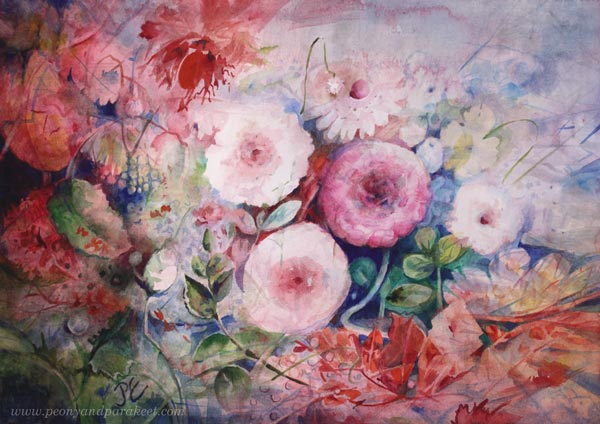
Sometimes what feels good at first can break down in the long run. Can a flower live only in light? Don’t we get a better understanding of our outlines and boundaries in the shadows?

On the other hand, when life has been nothing but darkness and the colors have faded, the power of light enables a fast recovery.

Observe the Surroundings with Empathy and Imagination
As a director of disaster films, I am inspired by the survivors around me. This autumn, I listened to the lily of our new pond, who described how boldly she would soon bloom. Fall progressed and my suspicion grew. But just before the big storm, the bud opened for one day.
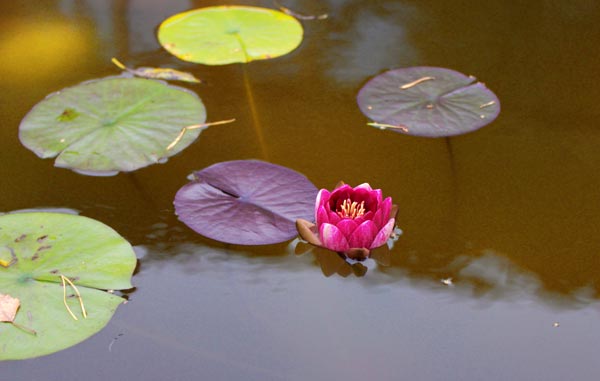
You can survive of the deep waters – even only for a moment!

The world of inanimate objects is also full of ideas when you use your imagination.
For example, wallpaper is one of the most pathetic things I know. The flowers are glued in place, but they still see and hear everything. If they were released, a lot of pent-up energy would be present. The silent and motionless wall flowers would party around the room. They had been thirsty for life for a long time.

Isn’t that what happens when a person starts creating art? The frenzy inside her finally gets out!
Expressive Flowers in Watercolor
This week, I share how I found the expressive idea for this floral watercolor painting. I go into more detail about this process in the course Freely Grown.
This week I am presenting a watercolor that is part of a small series I painted for the gallery Gumbostrand Konst & Form. The title of this piece is “Syvältä selviytyneet” in Finnish. The English translation could be “Survivors of the Deep” or “those who survived the deep.” The first of the series was “Talven voittaneet” – winners of winter.
Starting with Random Strokes and Splashes
When I start painting, I usually have no idea what the finished piece will express. That keeps my excitement up! The flowers grow gradually and the overall expression takes turns during the painting process.
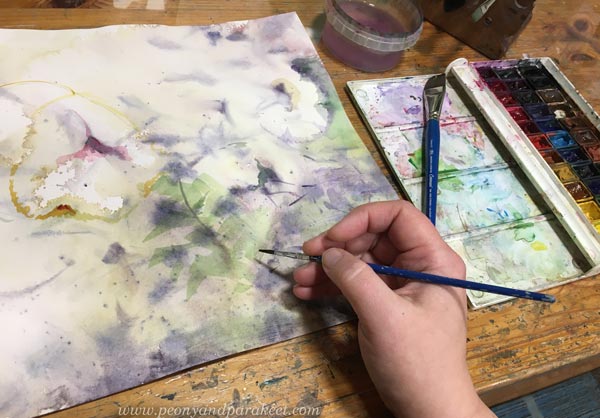
Even now, I only had an assignment to paint flower paintings with watercolors in the same style as what I had already painted earlier this fall. After the first random layers, I could see big flowers.
Wondering About the Expression
The large size and fearless look of the flowers reminded me of strong wild animals. But the further I painted, the more I began to think about the environment where the flowers had appeared.

In nature-themed paintings, it’s important to find the right atmosphere, and that’s where the location matters a lot. I got the feeling that these flowers can withstand even the harshest conditions. Would they live in the desert?

But the softness and roundness of the flowers told of something other than the desert.
Finding the Answer from the Flowers
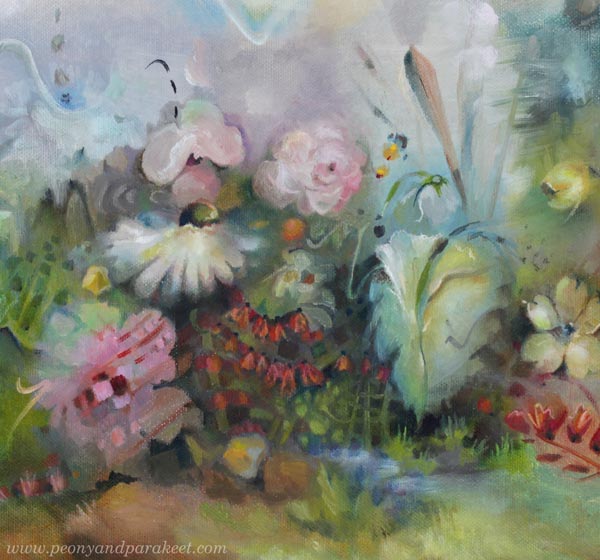
I looked at the big rose at the bottom edge and asked myself where a flower could swell before decomposing. Then I realized that these have come from deep water and are on their way to the surface. After that, it was easy to add the references to water – like bubbles and water lines – and finish the painting. Painting expressive flowers in watercolor is not only about adjusting the flowers but also finding their back story.

I think it’s a wonderful idea that you can not only grow from difficulties but also soften. And that difficulties can be overcome by staying together. Surface water which seems cold and drowning to others, can be like a gentle sea of light to these survivors.
Every time I paint flowers, my mood rises!
Art-Making and Garden Life
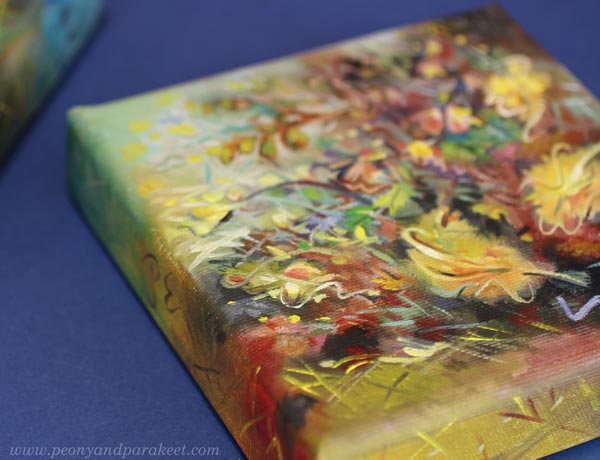
This week, I talk about how gardening inspires both my husband and me. The garden is present in these two new miniature paintings as well.
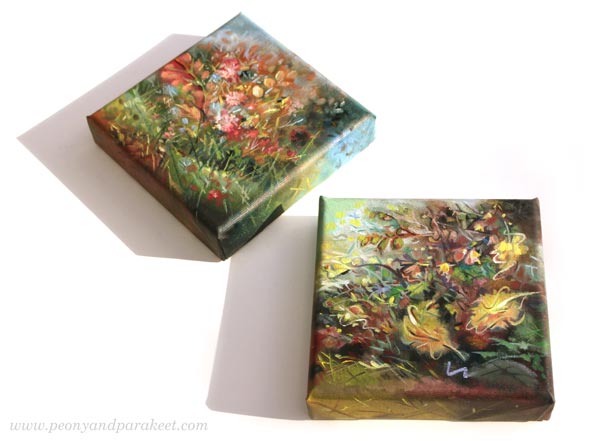
It is already autumn in Finland, but we have summer in our hearts because we have done a lot of work in the garden during the summer. My husband has put all his energy there, I don’t have quite as big a passion. The garden is his canvas, but for me, painting is the most important.
Freely Grown – and a New Sweet Spot
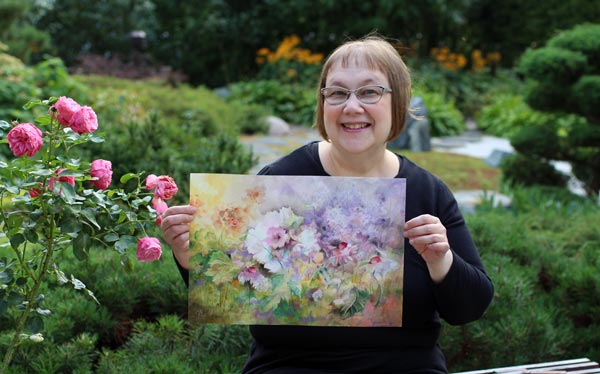
I have a new course in the making called Freely Grown, which I hope to run in late October and get for pre-sale next week. There we will paint layered flowers in watercolor and finish the painting with colored pencils.
Lately, I’ve found my sweet spot in the way I look at plants. I can see both playfulness and soulfulness in them. This perspective has brought new positivity to my life. I think that art always has a lot of possibilities. Making art is like walking down a long corridor full of doors. Now I have found a door where I can be funny and profound at the same time. This insight also affects the creation of the course. I’ve had a lot of fun, although I haven’t compromised on explaining the details.
Making a Dream Come True
The garden is my husband’s canvas. He’s been making a bigger water feature all summer. It’s big enough to be called a pond. I wasn’t terribly excited about it, but the further the project has progressed, the more I understand his vision.
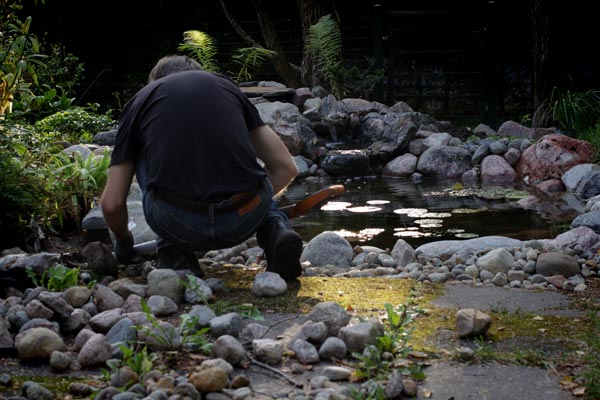
One of the hardest things both in art-making and garden life is visioning – so, dreaming! The dream must be simplified so that it can be remembered during the making. All projects have ugly phases. The dream must still be maintained.
Even these miniature paintings, for which I use leftover paints from the palette, looked pretty terrible at first.
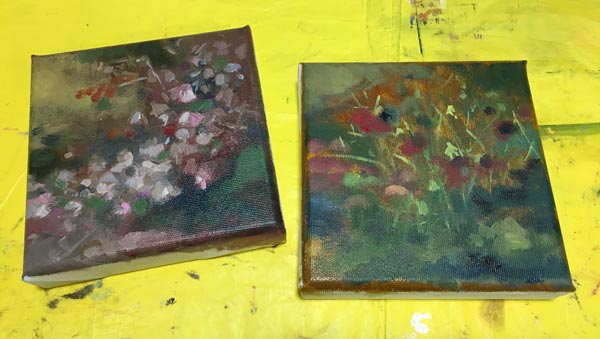
However, I had a dream and knew these would become really nice.
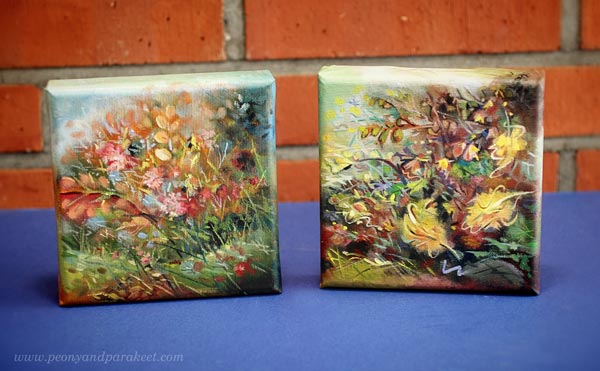
I also made small paintings like this earlier this year, remember?
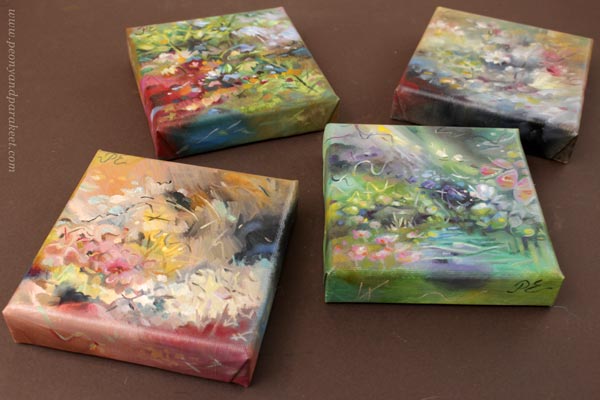
See this blog post for more pics!
Planning a Garden
In the spring, we hired a professional garden planner to draw a plan for a part of our backyard.
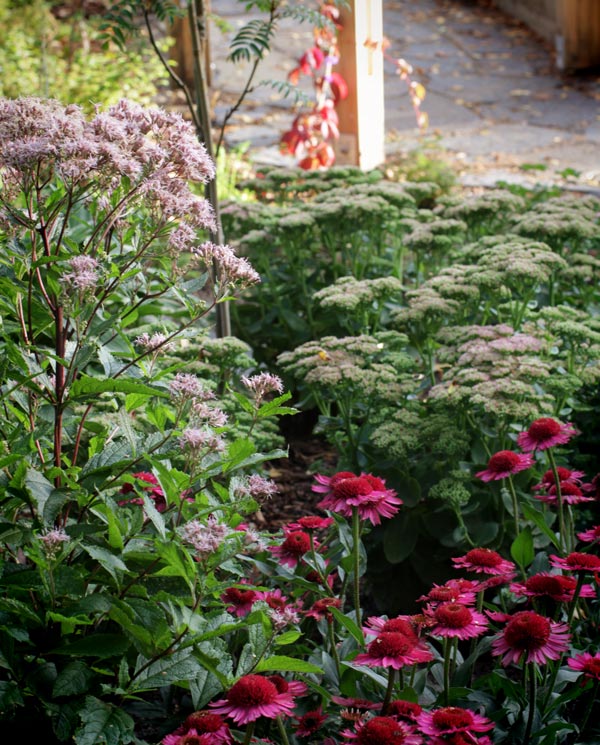
It was a bit like taking a course. We got points of view from a professional and she helped us to see further in our dreams. With that, I learned a lot about plants and how to plan a garden like dividing a house into rooms. It is not very far from a painting.
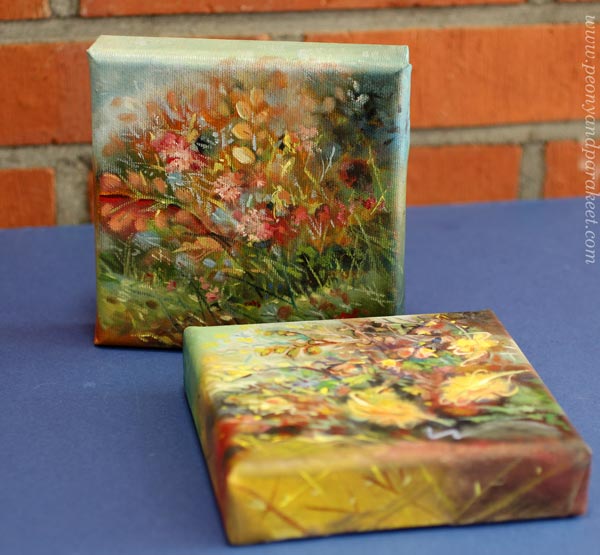
Think about a painting as a place that has its own identity. My small paintings are like tiny closets but bigger ones often like halls.
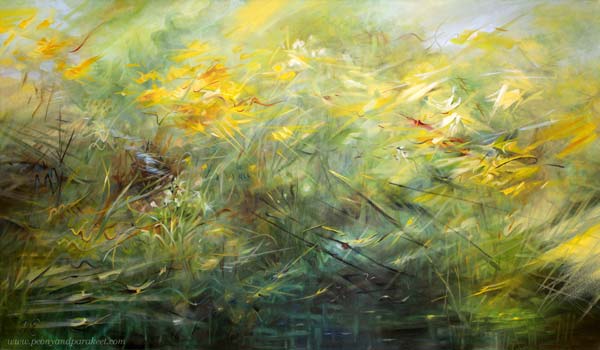
See more pics about this big painting in this blog post!
Art-Making and Garden – Back to the Pond
The pond is entirely my husband’s work – although he has probably watched all the pond-building videos on YouTube!
I feel that the pond already affects my paintings. Do you remember this watercolor painting I presented a couple of weeks ago?

See this blog post for more pics!
I think I already have a little love for that pond, its plants, its reflections, and how it reminds me of Monet’s garden.
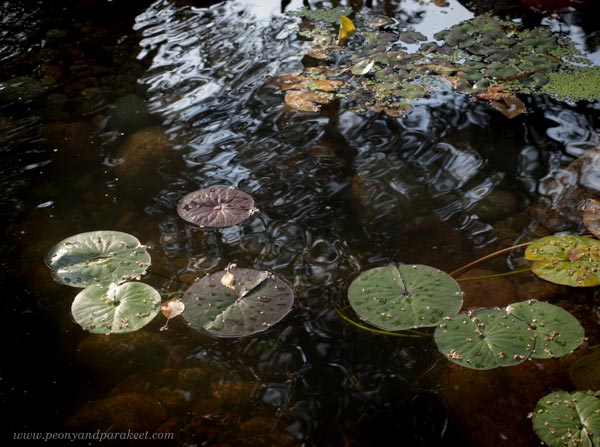
However, winter is already coming. Art-making and garden life will be a bit more separate then. But the flowers will bloom on the canvas. And my husband will start watching YouTube again to see what he could create next summer.
Can you relate? Do you have a garden?
Start with Something – Following Picasso and Edelfelt
This week, we are using inspirational art as fuel for our own art. I show how I created my own version of Albert Edelfelt’s masterpiece by following the advice given by Pablo Picasso.
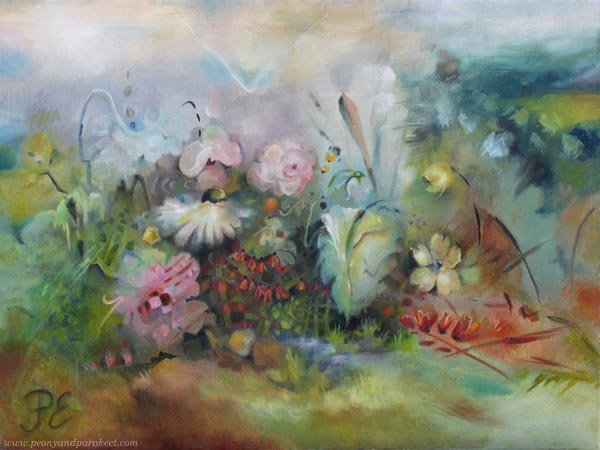
“Friends by Fate” is a small painting, but one of my favorites from the series that I made for the current exhibition. Because the title of the exhibition is Taiteilijat Edelfeltin tunnelmissa – Artists in the Mood of Edelfelt, I wanted to make my versions of some of Albert Edelfelt’s (1854-1905) artworks. For example, I made this one, and this one. “Friends by Fate” uses Albert Edelfelt’s painting “Women of Ruokolahti on the Church Hill” as inspiration.
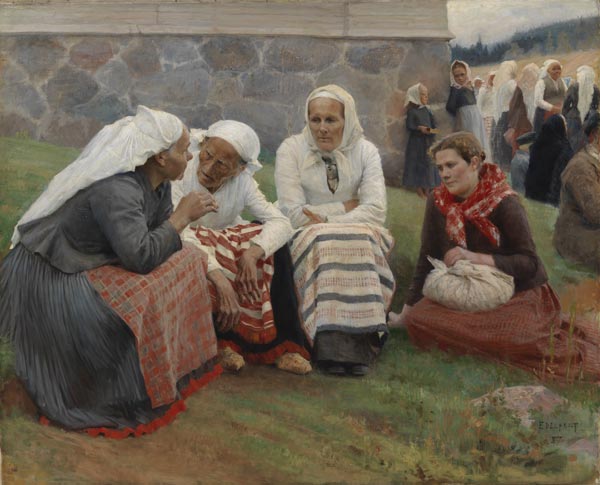
This is a very famous painting in Finland. Even if Albert Edelfelt painted a lot of portraits of wealthy people to finance his profession, he became known for pieces like this that depict ordinary folk.
Start with Something!
I have always been intrigued by this Pablo Picasso’s (1881-1973) quote:
“There is no abstract art. You must always start with something. Afterward, you can remove all traces of reality.”
In my opinion, this applies to any art, not just abstract. You can always start with something and then make your own version.
For example, even if there are people in Albert Edelfelt’s painting, it doesn’t mean that my version has to have them.
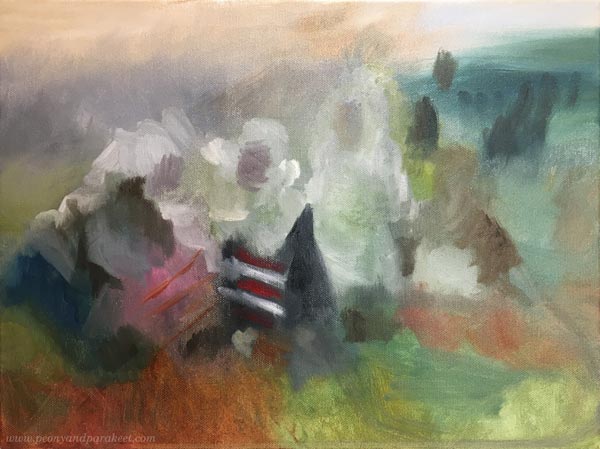
Start the painting with a similar composition, but then slowly let it grow in its own direction.
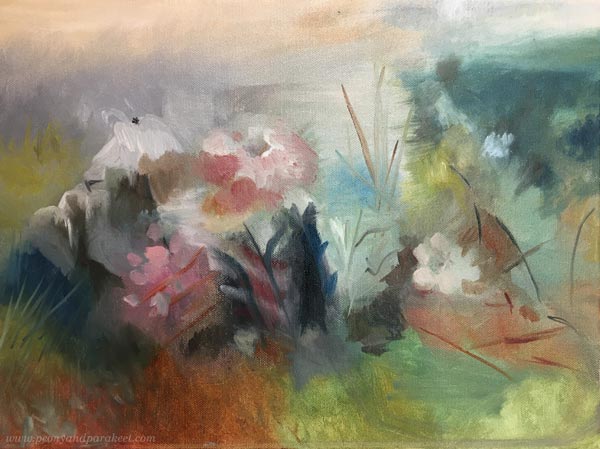
In my version, the flowers and plants replace the women, and the location is different too. I was thinking about the area where I live and how people gather together on a summer evening.
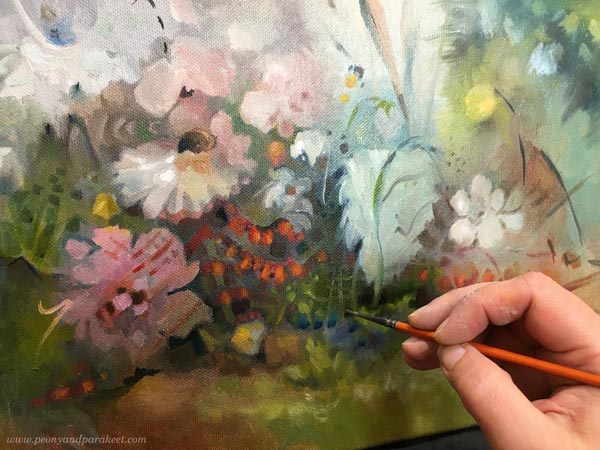
There was quite a lot of work in the details. Albert’s work is not clumsy, so I wanted mine to be well-finished too.
Following Picasso and Edelfelt
I love to paint so that flowers and plants are the characters of the painting. I feel I can combine my sense of humor with my yearning for beauty.
Flowers have given me a secret language that I can use to express anything. With this realization, I feel more and more drawn to the boldness of Pablo Picasso, the re-creator of Diego Velázquez’s 1656 masterpiece “Las Meninas”.
Others have seen what is and asked why. I have seen what could be and asked why not.
Albert Edelfelt was also appreciated in his lifetime, but he didn’t have the confidence that Picasso had. He wrote to his mother:
” I fear nothing else than that I become a raté – a half-talent and an unhappy person.”
(Free translation from Finnish)
This kind of seriousness is what I recognize too: puolilahjakkuus – half-talent – who would like to be that! But still – or maybe because of that, it’s good to embrace playfulness when creating art.
Like Edelfelt, you can recognize the fears and set the bar high.
But then, act like Picasso – Start with something and then ask: what could be and why not!