
How to Trust Yourself when Creating Art
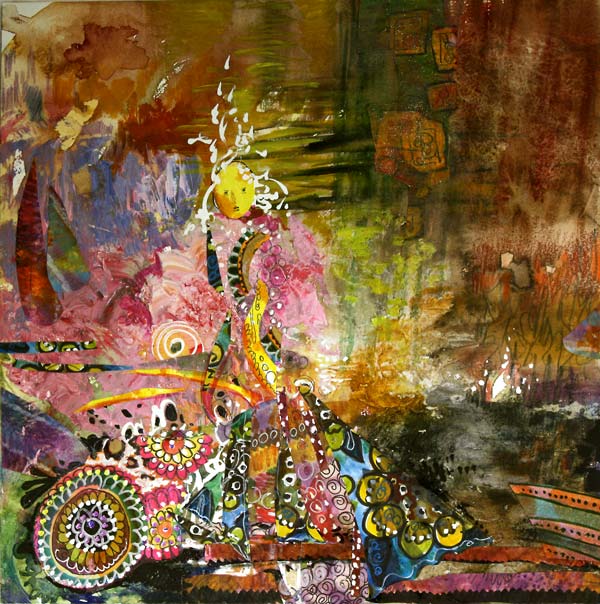
When I begin creating art, I often have petty thoughts like: “I want to draw a flower” or “I want to create something pink.” Even if I create regularly many times a week, I am still bothered by the fear of failure. I know I have to handle that at as soon as it comes, preferably before the first brush stroke. Why? Wouldn’t it be fun sometimes to draw that single flower or create that pink square? I believe that if we give ourselves that kind of clear commands and simple tasks, we don’t really trust our creativity. The big question is always: do you trust yourself when creating art?
The Unpredictable Nature of Art
If you trust yourself, you can step into the world of unpredictability. Not knowing exactly what to aim for is a major factor when creating art. We can set restrictions and principles, but we have to leave space for unpredictability. It means that we are more creative if we do not have the clear picture of the result.
Setting Restrictions on Supplies
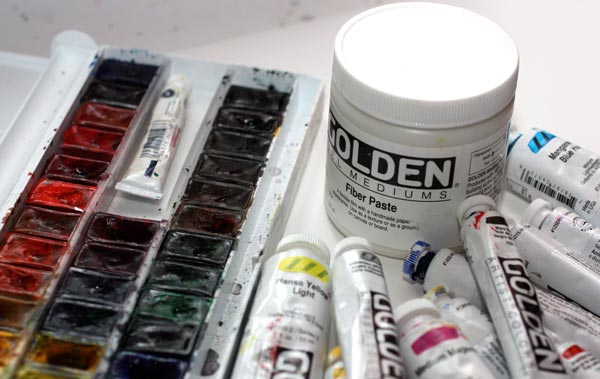
These are the art supplies that I gathered when I began making the collage of this post. Watercolors, acrylic paints, and fiber paste. I also picked a thick watercolor paper and cut it to a square. I chose the supplies but left behind the thoughts about what I was going to make.
Find what You Want to Express
My method is to browse art books just before creating art. I do it only for few minutes, and I try to pick art that really lifts my spirit, raises the bar, sparks my imagination. Usually, it is something from the history of world art. This time I browsed a picture book from impressionism.
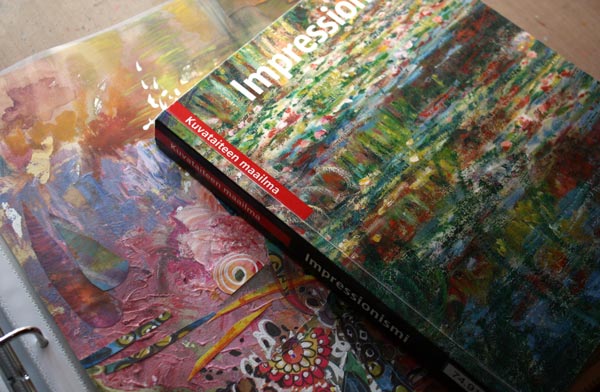
So, do I advise you to get a book of impressionism? No. I advise you to name what spheres you want to reach when making art and pick images which resonate with that. They do not have to be the same style than what you want to accomplish. The more important is the feeling that they evoke in you. When I browsed the book of impressionism, I thought how art is above all the mundane things. How those artists who lived at the end of the 19th century have managed to describe the beauty in the way that is still understood. How the brush strokes, full of paint, were successfully set to represent weightless light. All that would be exciting to see in my piece too.

When the first watercolors hit the paper, I still had some self-doubt: I could not ever do anything like the great impressionists. I heard the sarcastic voice in my head: “Reborn Monet, yeah right!” But that sarcasm is the moment when I know I am almost there: I am almost leaving the rational side of me behind. Then I just need to wow to trust myself, stop seeing any desired images in my mind and start working fiercely.
Layering (With Some Moments of Self-Doubt)
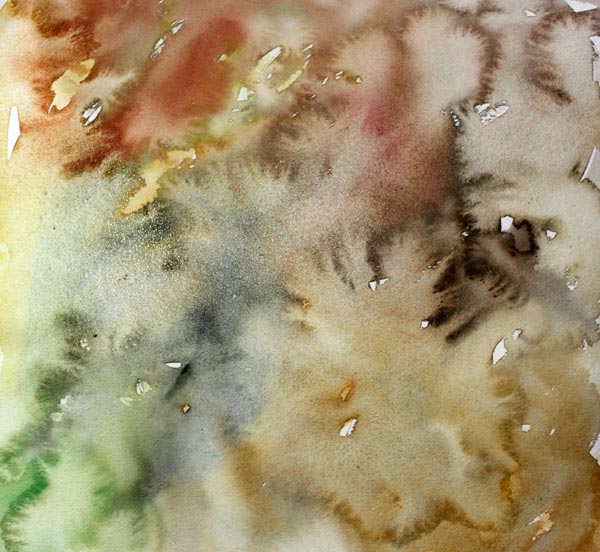
I often start with watercolors because they cover the paper quickly. Even if I have the idea of creating some surface structure, I wanted to use watercolors first to get into the mood of uncontrolled splashes.

While waiting for the watercolors dry, I mixed some acrylic paint. Pastel shades like many impressionists used to choose. 
To get some interesting texture with the paint, I used a palette knife instead of a brush.
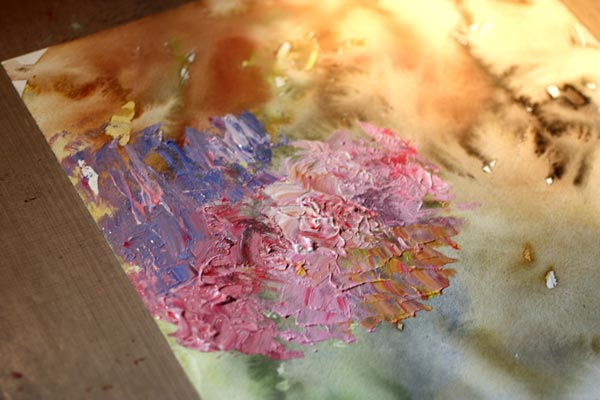
After playing a little with the palette knife and thick paint, I became clueless of how to continue. It’s important to recognize these moments. If you are not aware of these, your rational side takes the control and decides to do things you really cannot justify. Like: “Let’s use the rest of the paint to cover the surface evenly.” Or: “Let’s get some other colors and splash the paint here and there.” When you feel that you do not know what to do, don’t do the obvious. I might browse some pages of the book again to get back into the mood. Or change the media, the solution that I made this time. I doodled something not so important with the colored pencils just to realize I wanted to continue with watercolors and a thin brush.
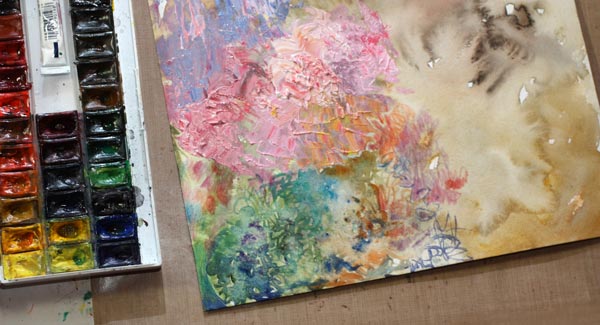
When I got bored with colored pencils and watercolors, I opened the jar of fiber paste. Even if I often prefer to stay with the basic art supplies, fiber paste is something I like. It not only creates an interesting texture like watercolor paper, but it also works like a watercolor paper. You can paint over it with watercolors and create beautiful details to your work! 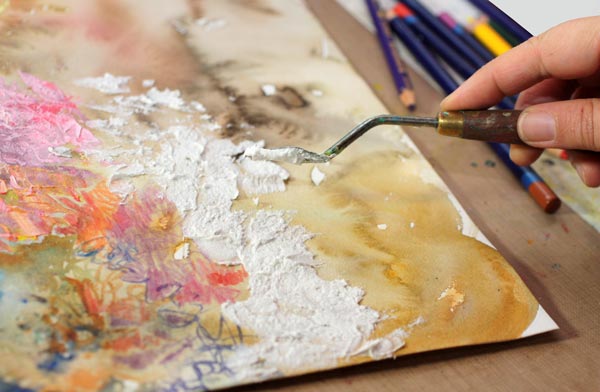
Trying to achieve distinct variation in the surface texture, I used the palette knife again.

Then my mind was empty again, so I browsed few pages from the book again and then continued with colored pencils.

When I reached the next point of frustration, I decided to change to the watercolors and work with high speed. Working fast helps to get creativity flow.
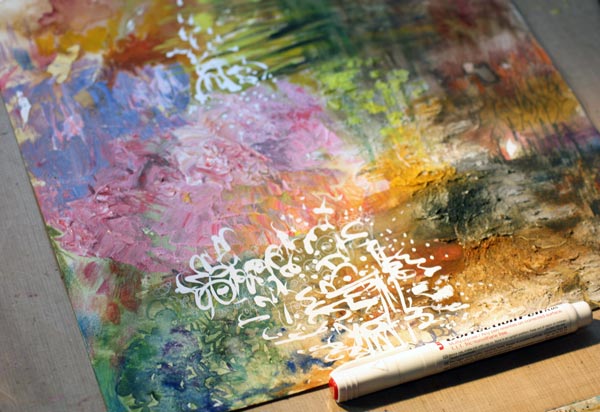
Once the paper was covered all over, I started adding details. A white correction pen is great as it usually works on any surface.
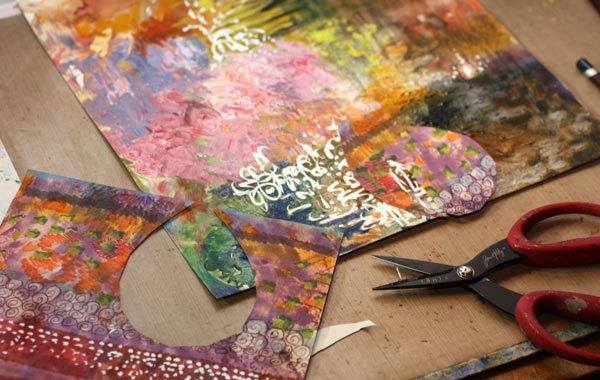
Hand decorated papers are great for details. I picked some of my prettiest papers and began to cut them. The paper shown in the picture isn’t that great as an artwork, but it’s versatile for collages as it has a lot of variation.
Finishing
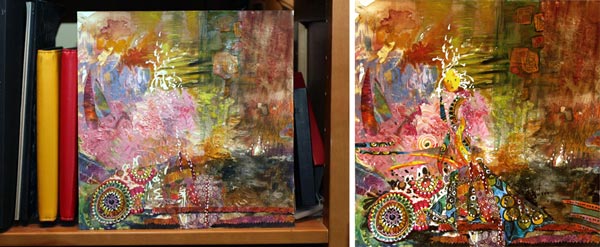
I felt that it was time to begin finishing the work. It is always useful to stop and think. I often put the artwork somewhere where I can look at it, like on the nearest bookshelf. Then I step away and try to figure it out where to lead the viewer’s eye. Here’s another step where you should not question your trust: It will be great! You just need to connect some dots and find the lost pieces of the puzzle. Like I did when I realized that there is someone in the picture. I added the faces and made the rest of the character more visible. Then some tiny adjustments to the composition and after that, the work was finished.

I think that this piece is aesthetically very much my style, but the impressionistic approach to the surface structure makes the work interesting.
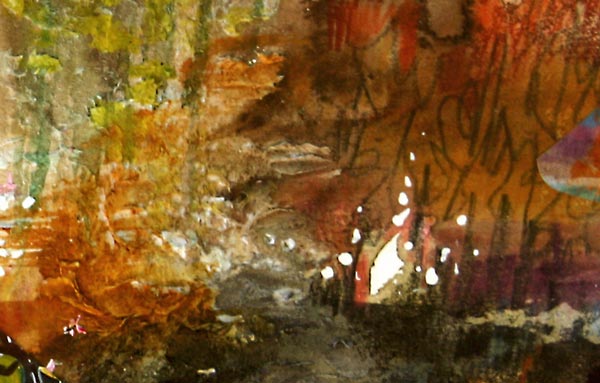
Never underestimate the power of layering: this is my favorite detail, the white area showing the blank watercolor paper. It was created in the first phase, and it still exists in the end. If I had done the obvious and filled the paper with each media layer by layer, this little detail would not exist. So, cherish each stroke and trust your creativity! Focus on the feeling, not to the result! You are allowed to feel like a world-class artist even if you know you are not. Fly to the world of imagination!
This might also interest you: – Stretch Your Artistic Style
Let me be your mentor in art: Subscribe to my weekly emails!
Wait till the Painting is Finished

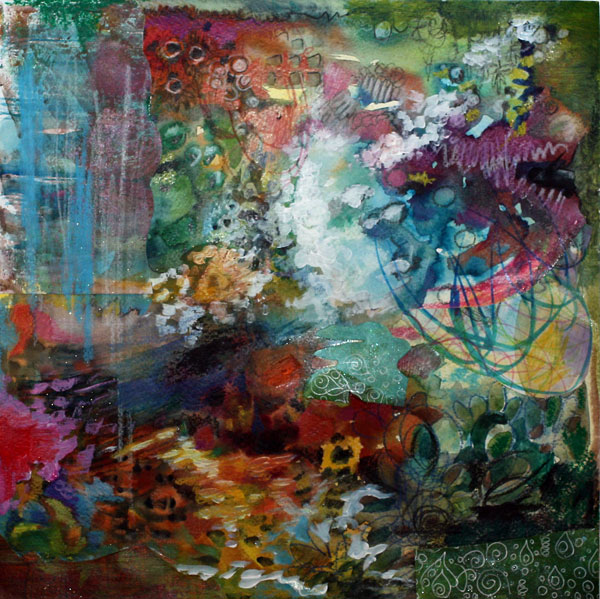
What’s the definition of art? For me, art happens when something unexpected is allowed to step into the creative process. Today’s story begins with the watercolor background that I painted without further thinking. Just had some fun with my favorite media. Watercolors are so easy, light and forgiving!
After the background had dried, I decided to increase the color intensity in some spots with color pencils. I did not mean to start doodling but those pencils spoke to me: “Come on, let us dance a little”. How could I say no!
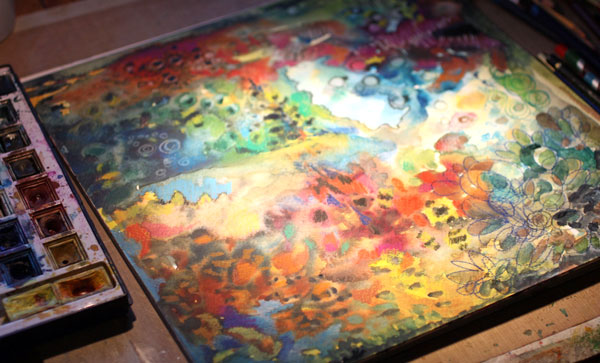
At some point, I got deeper into my thoughts. I saw something happening in the painting.
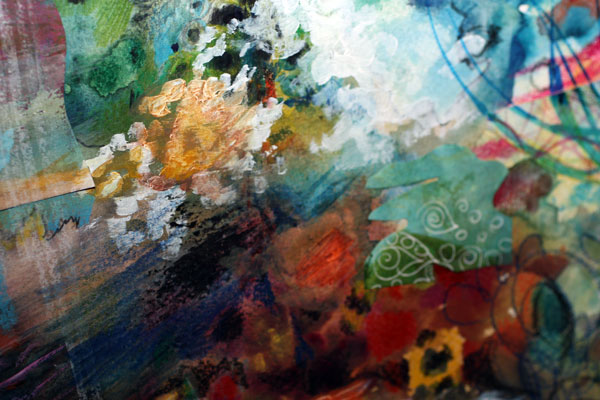
The strokes of acrylic paint shortened. Some collage papers were added. The smaller the area I worked, the clearer the big picture looked. That phase was so exciting! Like opening the door and getting ready for the view.
Style Change
Once the painting was finished, I heard my own comment: “You’ve been there before. The colors, the atmosphere – nothing new here! Get your greys and paint it over!” And then, louder: “Jump, JUMP!” And while my left brain cried and right brain celebrated, I mixed the greys and painted how I felt and what I longed for.

I could have stopped at any phase and declare the painting finished. But after jumping from cliff to cliff I found something new: the beauty of blacks, the simplicity behind the decorative style! So, my advice is: when you think about tossing that art journal page or craft project, don’t do that. Step towards the unexpected and let art reveal what you have escaped from!
Subscribe to my weekly emails – Get a free mini-course!
Bursting Circle – Self-Expression Exercise
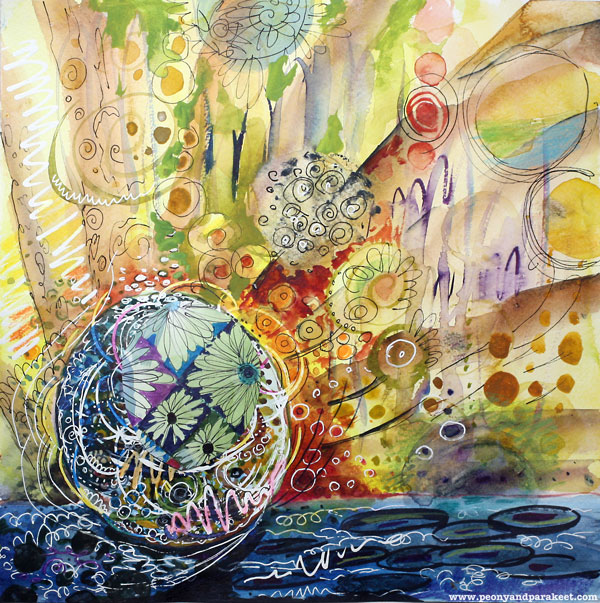
Here’s my interpretation of the creative self-expression exercise called Bursting Circle. It might sound too simple or a bit mechanic, but it can be used as a framework for self-expression: how am I today, how am I feeling?
Do the Self-Expression Exercise – Create Your Bursting Circle!
1) Pick a paper or a page of your art journal.
2) Draw freely a circle on a random area of the paper or the page.
3) Fill the circle with whatever you can think of: shapes, colors, anything. You can also use collage pieces.
4) Divide the paper by drawing a horizontal or vertical line.
5) Color each side of the line differently.
6) Imagine that the circle begins to leak or burst – how would you illustrate that?
Analyze After Creating!
Is your circle big or small?
What does it contain?
Is it located left or right?
Is it on the surface or under the surface?
Is it inside or outside?
Is it clearly shaped or is it merging into the background?
Does it burst, spill or radiate?
Is there any movement or does it stay still?
and so on …
Do not analyze the image before you are finished. There’s no one interpretation, but you can consider yourself as a circle and start from there. The part of the exercise is to get in touch with your own thoughts.
My painting tells me this: I feel more exposed than many times before. It is a good thing and it might even be a beginning of a life change. I might not be able to control it, but I feel I have a lot of decisions in my hands. I want to impact others, but I am also impacted at the same time. Maybe there’s a network where I am heading.
What does your picture tell you?
Another Version of Bursting Circle
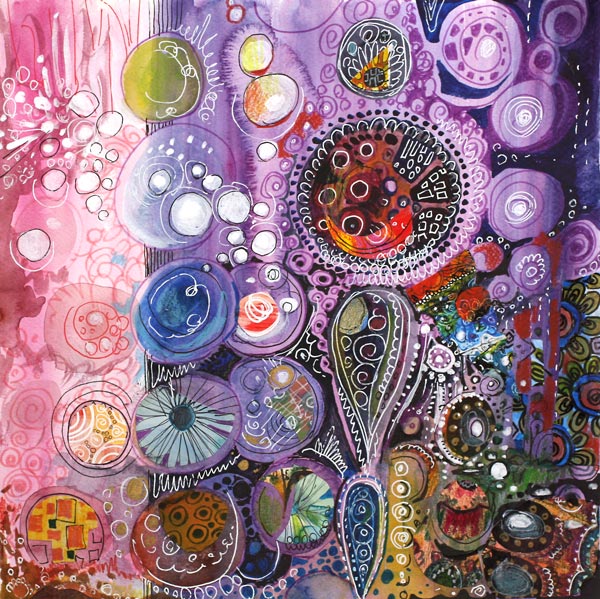
I made this using watercolors, markers and color pencils. When looking at this, I wonder: Is there too much going on in my life at the moment? Well, it might be so but if I need to choose between too much and too little I always pick too much!
Let me be your mentor in art: Subscribe to my weekly emails!