
Art Journaling with Colored Pencils
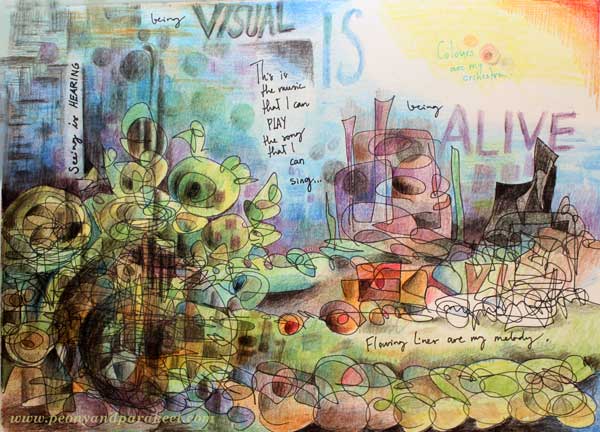
My latest art journal page started with new colored pencils and rambling thoughts of the latest news from Helsinki: the architecture competition of Guggenheim Museum has ended and now there’s a big debate whether the city of Helsinki should finance the museum or not. I did not mean to include the winner building on the page, but you know how it goes: once you think something, it will appear! See the black element on the right!
Cretacolor Aqua Monolith Watercolor Pencils
Last Monday I went to the biggest art supply store in Helsinki to buy some paper and see if they had any Cretacolor Aqua Monolith Watercolor Pencils. I had bought one pencil about a year ago just to see how it works. After many months, I noticed the growing use of that pencil. So now I was thinking to buy a couple more. It turned out that they did not sell the pencils individually anymore, so I bought the smallest set of 12.
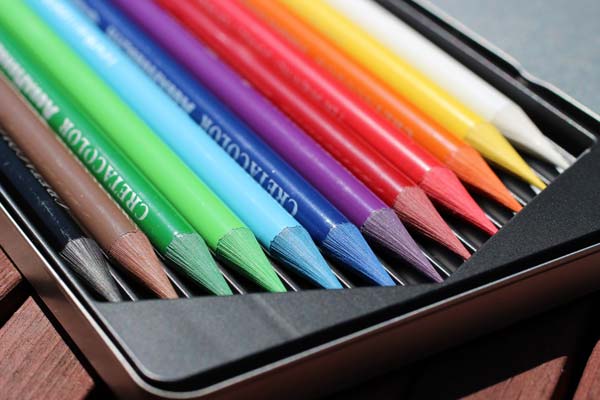
As you can see from the picture, these pencils are nothing like ordinary colored pencils! They are not wooden at all; they only have a thin lacquer coating! For me, it took some time to get used to how they feel when holding them. But once I got over it and started treating them as any pencil, (pressing lightly and creating multiple thin layers), I noticed that they work great. These pencils are soft enough to make the coloring pleasurable but not too soft for detailed work.
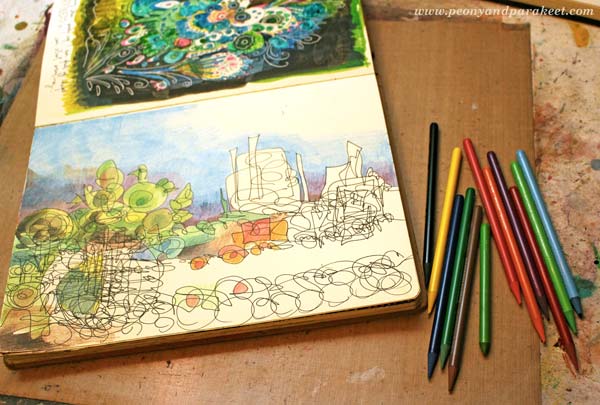
It is fascinating that you can also use shavings if you add a little bit water to them!

My art journal page was made without water – these watercolor pencils work well that way too.
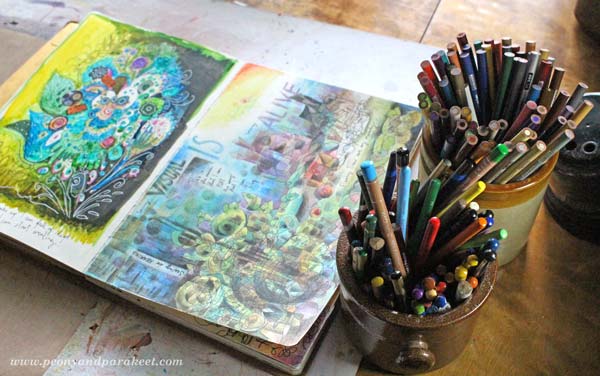
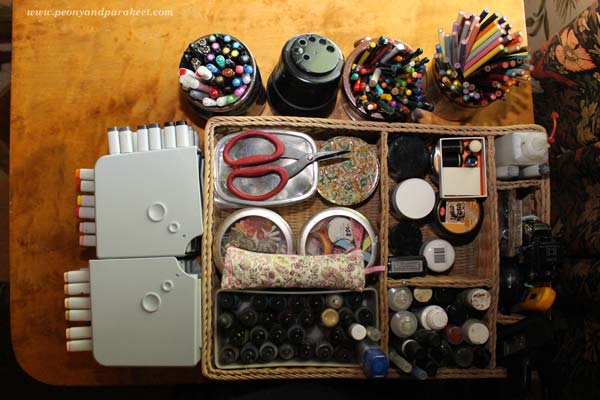
All of my colored pencils fit in two jars as I usually use them all at the same time, no matter what their brand or type is.
Adding Journaling to the Page
I was drawn to green tones even if I was thinking of the city view. There’s something magical when the tourists arrive Helsinki in the spring. They make shy and withdrawn Finnish people more friendly and helpful. When the hard winter is over, everybody is willing to make a fresh start.
While continuing the coloring of the page, I thought about cultural institutes and their events. Whether it is a city full of tourists or a concert hall full of audience, it feels alive and uplifting. It gives me energy and inspiration to create once I get back home. I felt drawn to the word “alive” and decided to add some words to the page too. By erasing some areas after coloring, I created areas for writing.
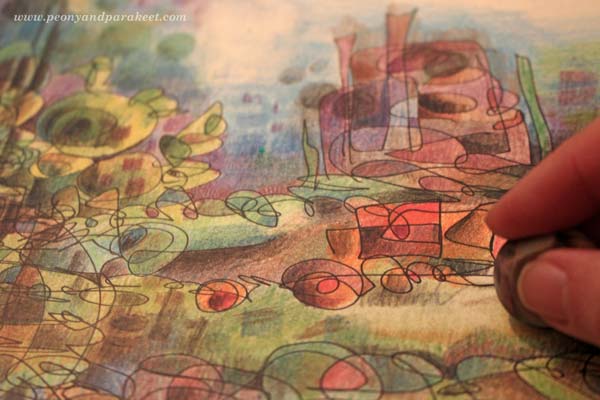
For me, being alive is a visual thing. When I am using my senses, I see images. When I draw the images, I feel alive.
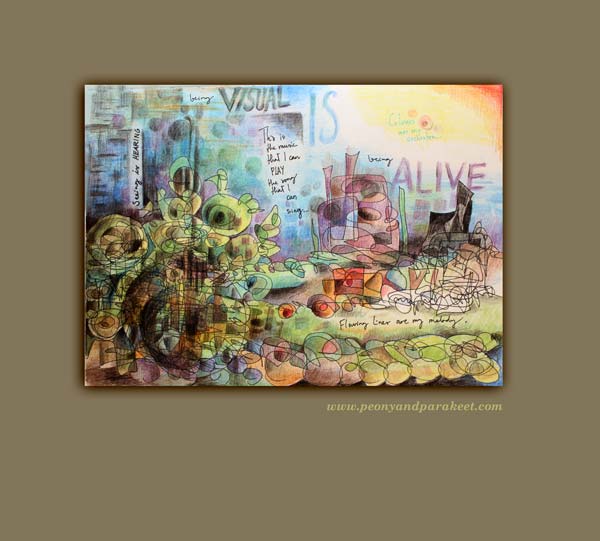
Create an art journal page with colored pencils and words by answering:
What does make you feel alive?
Subscribe to my weekly emails and get a free mini-course!
Organizing Art Supplies with Konmari Method
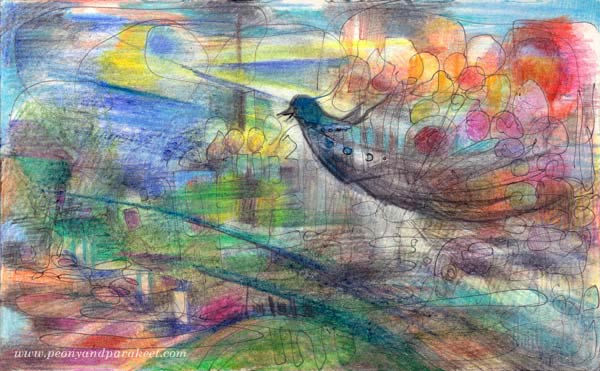
This art journal page is about how less stuff can uplift us. I feel like a bird with balloons after I sorted out my art and papercrafting supplies.
The Life-Changing Magic of Tidying Up
It all started from a book: The Life-Changing Magic of Tidying Up – The Japanese Art of Decluttering and Organizing. It is written by Japanese professional organizer Marie Kondo and she calls her method “Konmari”, which is an abbreviation of her name.
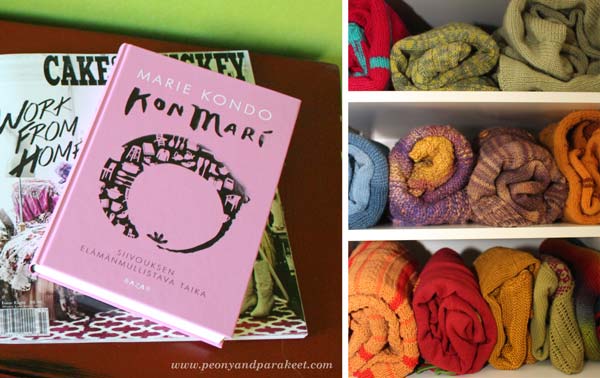
The Konmari method is fairly simple. First you get rid of all the stuff you don’t use or enjoy, and then you store them by type. The process is explained more in detail in the book. The book recommends starting with clothes so I organized my sweaters first. Most of them are my own handknits. Marie Kondo explains how to fold each type of clothing and recommends storing things so that you can see them in a row. I have always believed in little joys in life. However I had never thought of how much joy seeing those sweaters can bring. Each time I open the closet, it joyfully reminds me how much I enjoy both knitting and colors!
Art Supplies that Spark Joy
Marie Kondo believes in handling each object separately and considering if it sparks joy. These spark most joy to me: colored pencils and watercolors! These most simple art supplies delight me more than any new product on the market.
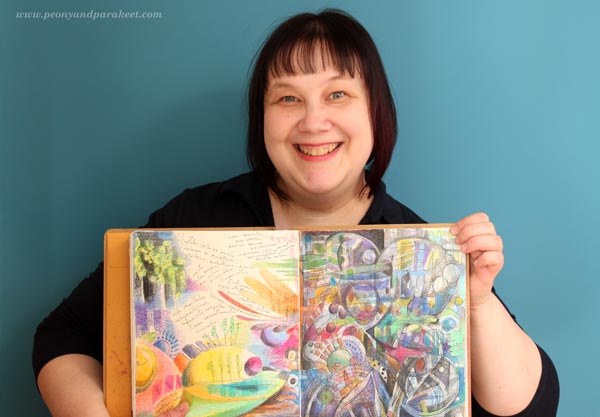
If you have followed this blog for a longer time, you might have noticed that the variety of mediums that I use in my art has been reduced gradually, especially during the last year. I noticed that I had bought many of the products believing they would solve my creative problems. I thought they would make me create better art faster and make creating more fun. But when experimenting with new products I forgot how little ingredients are actually needed for creating meaningful art. Nowadays I feel sad when I see beginners reading instructions that involve a huge variety of art supplies. The long lists of supplies are overwhelming and prevent many from start creating.
I believe we should focus less on things and more in our inner world. And Marie Kondo thinks exactly the same! She believes that when we are surrounded by fewer things, we can treat them better and start thinking what we really want to do in life. I believe that when you use fewer supplies, a lot of energy is saved from picking and choosing for the actual creating. You will also grow attached to the supplies and start displaying them and taking care of them more often.
Working Area Before and After
Even if I organize my creative space regularly, I felt it was the time for a bigger change. I had already started re-organizing my creative space before reading Marie Kondo’s book, so it felt natural to continue that process.
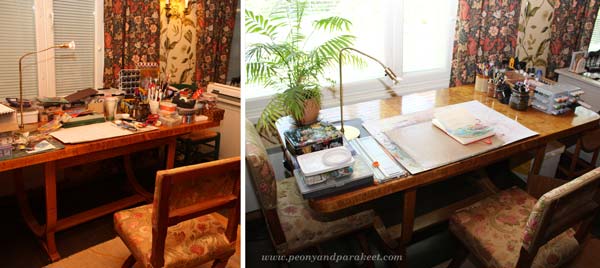
The photo on the left has been taken some time ago. After that I had already cleared the view to the window. But I had not actually got rid of anything, I had just removed some of the stuff to the nearest shelf unit. This time I picked out every single object and decided to give away or throw away those that I had not used for a long time. The photo on the right shows how the table looks like now!
Konmari Method Applied to Art Supplies
Marie Kondo suggests not to put items on the top of each other. That is quite difficult to achieve with art supplies. I managed pretty well though. Jars and boxes help with that.
My creative space also includes shelves. Here organizing was a bit more challenging and the end result might not be how Marie Kondo had done it. She would probably group all the paper booklets, albums, and magazines together. However, I quite like it as there’s enough logic in how everything is located. As one of my hobbies is scrapbooking I have a large collection of stamps. I was able to put them all in one place on the upmost shelf.
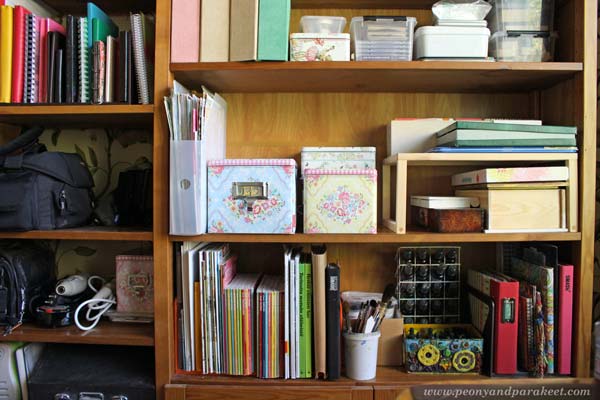
Marie Kondo believes that we should take time to consider which is the best way for storing each item. I found that odd bottles of ink are much happier in spray bottles with other liquid inks. Paints are now in boxes on the right side of the middle shelf. I love how easily accessible all the supplies are and how my art journals and inspiring magazines fitted there too.
How to Prevent Decluttering?
According to Konmari method the secret of staying organized is this: once you have dramatically reduced the amount of stuff and organized by type, you will consider buying new things much more carefully. When you group items by type, you will remember what you already have. When I saw what I had bought during the years, I thought that many times I could have just left the store early and put the time in creating. Focusing on fewer art supplies has reduced my yearn for shopping, so I do believe what Marie writes about.
Make your colored pencils spark joy!
Buy my e-book Coloring Freely
Using Molding Paste in Collage Art
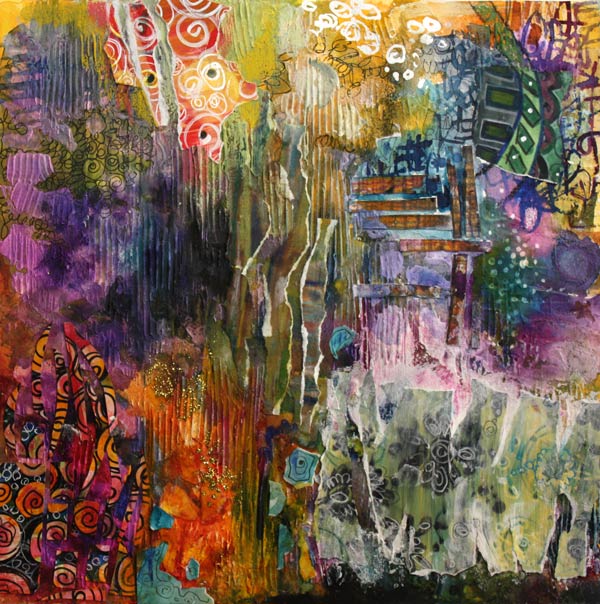
I have had the idea for this painting for a long time: to mimic fabrics including their surface structures. I wanted to combine watercolors and decorated papers with the structures I also had a deeper theme: being open for combinations. Fabrics in a quilter’s stash have no hierarchy between each other. Similarly, we can accept different sides of ourselves and our lives and make them work together.
Creative Process with Molding Paste
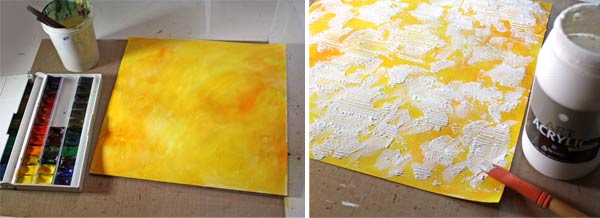
I began the artwork by painting a watercolor paper yellow. I love my White Nights watercolor set, its colors have such a great intensity! After the watercolor background, I added splotches of molding paste and made it look like corduroy by drawing straight lines. My paste is a Danish product, Schjerning Smooth Structure Paste, but if you are going to purchase some, I would recommend Golden Molding Paste.
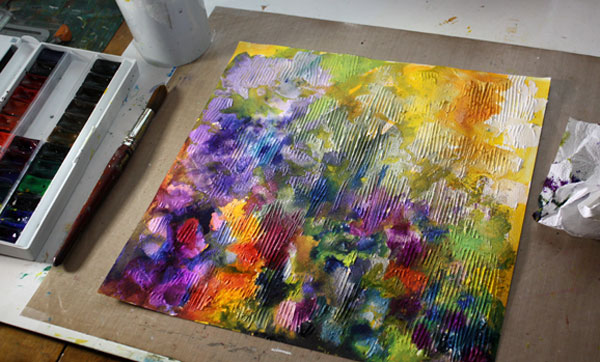
The great thing about molding/structure paste is that, after it dries, you can watercolor on it.

You can also paste extra layers.

It is difficult to doodle on the layers but if you leave some areas free of paste, you can doodle there. The combination of the structured surface and doodled areas create great contrast.

You can also add decorated papers and achieve a more detailed look that way. I tore most of my papers by hand so that their soft edges remind from the softness of fabrics.
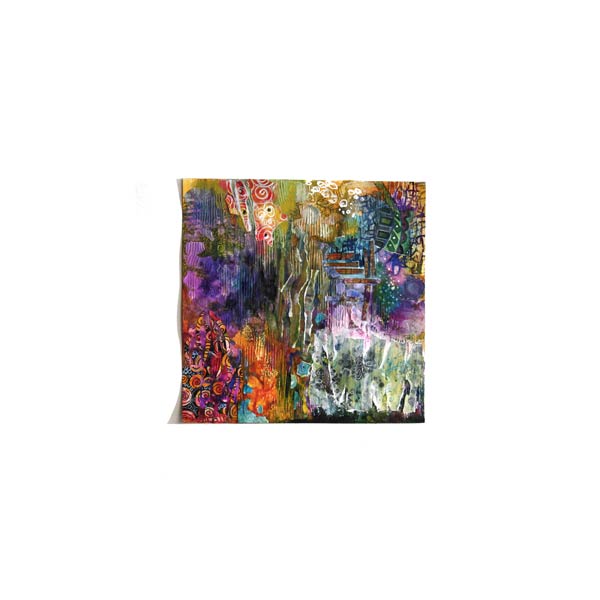
I do not usually look my paintings from the distance before they are almost finished. I feel it is unnecessary to try to balance an unfinished work. The last little details are added based on what I want to emphasize. In this work, I wanted to create a composition of several equal areas. The final step was to add the little turquoise pieces in the lower part of the work. Working as a contrast color, that made the weight of the orange equal to the other bigger areas.
Have you ever used surface structures in your art or craft? How? Which do you enjoy more: structure or color?
Let me be your mentor in art: Subscribe to my weekly emails!
Tribute to the Old Watercolor Set
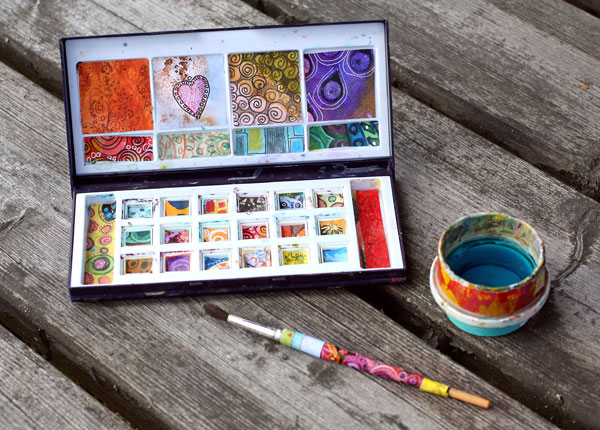
I loved my old watercolor set. I bought it at the time I thought I should learn how to use watercolors. I also bought a book about watercolor painting. It would explain to me how to do it in correct way. That meant: merrily paint those landscapes and still lives in a row like all watercolor artists seemed to do. Soon I realized that even if I admire all those great artists I got nothing out of painting like that myself. Partly blaming my watercolors for it I put them away.
They must have been sad. All those beautiful things that they held inside was in the dark for years. How happy and thirsty they must have been when they were finally able to see the light again. They persuaded me to give them another try. They promised to be ready what ever I would assign them to. “Come on, stroke us with those soft brushes you have”, they pleaded.
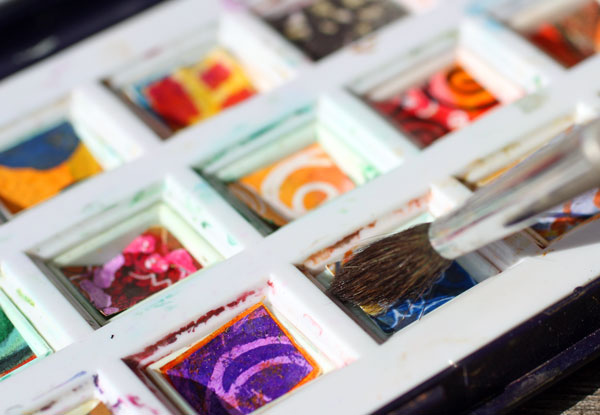
I gave them a stroke, and another… After many long and hard discussions I realized that all I had to do is to let go. Not only put away my assumptions about their purpose but also their nature. These were social guys. Ready to talk not only with me but also with my color pencils, acrylics, inks, markers, you name it.
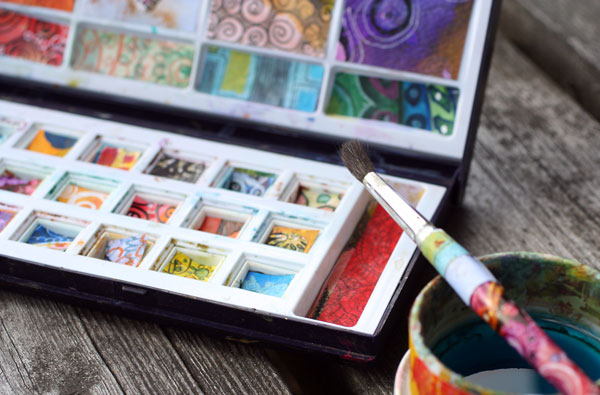
Now the pads are all gone. But even if the tray is empty, the beloved colors can be found in my art journals and display books. I kind of think that I have set them free. To celebrate their freedom and the happy moments spent with them I made a tribute for them. I even dressed their favorite brush and their water cup.
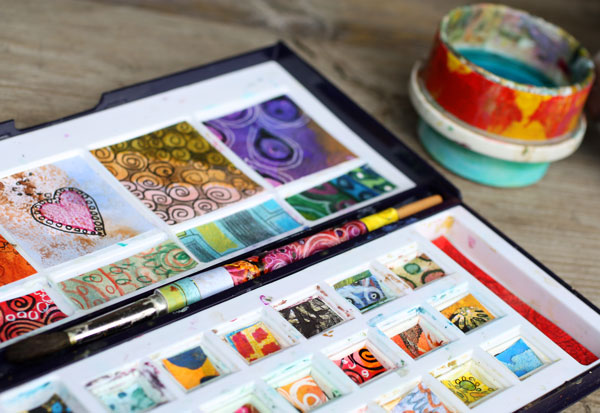
With this tribute I let my watercolors speak to you: use your art supplies and let them show you where art can take you. Art is not a competition, neither any other predefined experience. Art is not too noble or too serious. You have the privilege to fly to the world of imagination and your art supplies crave to help you with that!
Let me be your art teacher: Subscribe to my weekly emails!