
Paint Brush Holders and Artful Woodworking
This blog post is dedicated to my skillful husband. He has always supported me as an artist. The support he has given to me hasn’t only been mental but practical as well. He has made countless of wooden items that I have needed for my art, using hand tools mostly. These projects often begin so that I carelessly draw something on paper and ask him to follow the drawing. My sketches inspire him to ask more questions, create prototypes, and when I see the final piece, it’s much more detailed and beautiful than I ever could imagine.
Paint Brush Holders
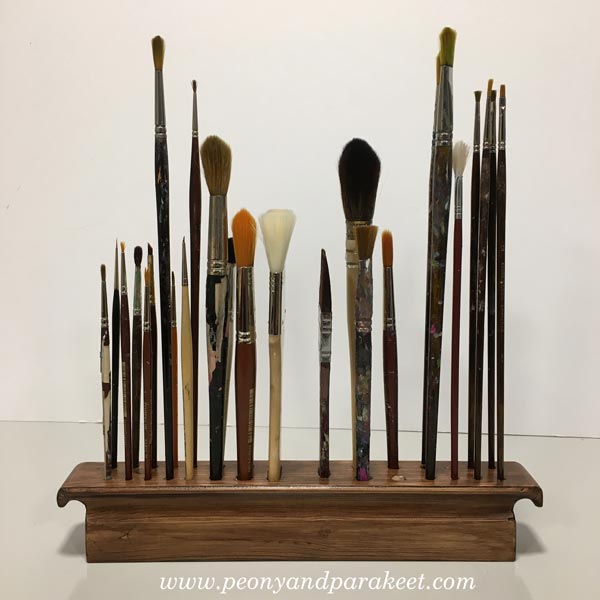
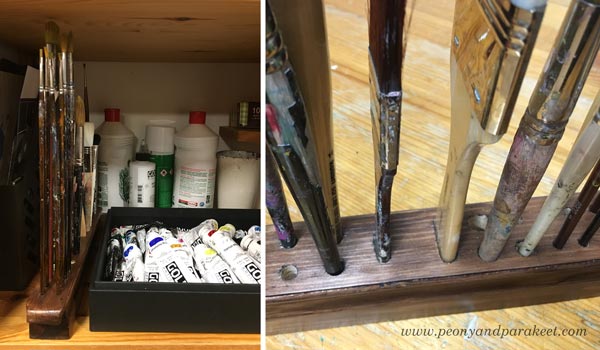
One of my favorite wooden treasures is the paint brush holder that can hold most of my brushes. It is designed so that I can put it on the shelf and then take it out when needed. I love seeing the brushes in one glance and storing them so that the bristles won’t pend. My original idea was just a simple wooden block with holes but my husband designed and finished the holder so that it’s like a valuable antique piece!
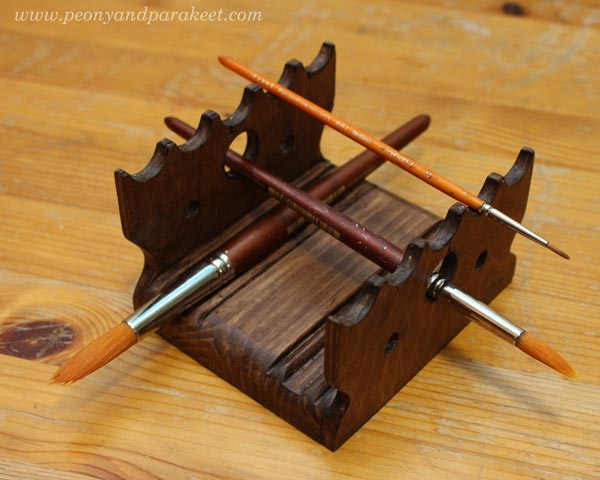
Because the vertical position ruins wet brushes, I always dry the brushes first. That gave me the idea of having a separate holder for wet brushes. “Something simple,” I said again. But my husband came with a better version. This beautiful paint brush holder can hold a lot of brushes in different sizes, and I love how practical the decorative holes are as well. The other side of the holder is slightly taller so that the brushes point downwards. It makes sure that the water won’t travel to the handle.
The Best Easel
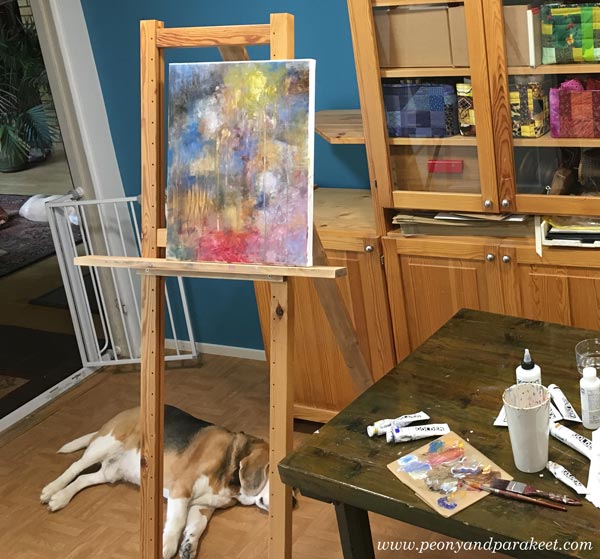
We had an extra upright support of a shelving unit, and I wanted a new easel that would fit with the rest of the furniture in my studio. By adding one more leg and a holder for a painting, my husband turned the support into an adjustable easel!
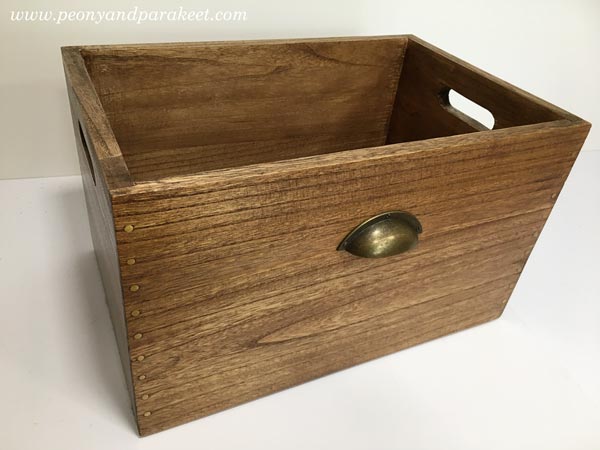
Light-Weighted Storage Box
My husband has made many storage boxes for the art supplies, and this is the newest one. It’s made from paulownia tree that comes from Asia, and it’s very light-weighted. I wanted this box look heavy but feel light, and my husband found the solution!
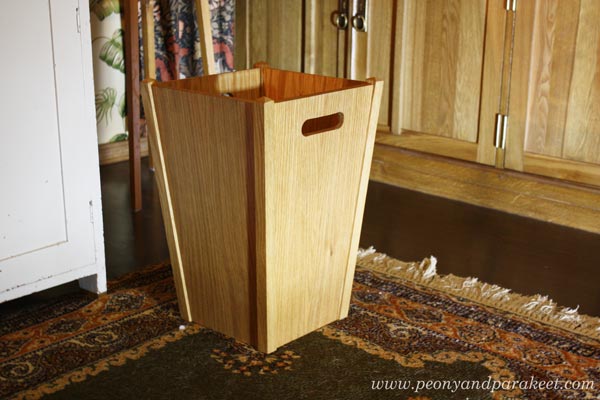
Perfectionist’s Wastepaper Basket
Much heavier but one of my ultimate favorites is the wastepaper basket made from oak. I think it’s luxurious and it makes me smile every time I see it. There’s some humor in living an imperfect life, creating imperfect art in the imperfect world – and having a perfect wastepaper basket!
My Husband’s Journey as a Woodworker
When we were living in our previous home, there was no room for woodworking. About five years ago, we moved to our current house that has more space. That enabled my husband to start the hobby he had dreamed for a long time. Namely, for years he had watched woodworking videos from Youtube. While I was dreaming about the life as an artist, my husband sat on his computer and watched skillful woodworkers drill and plane. Based on the sounds of our small living room, it was like some serious wood projects were going on all the time.

Then, finally when he got his space, he was able to join the gang – get a collection of hand tools and make something beautiful that he can be proud. He thought that his skills would grow in a very short time – that he had learned the most of the necessary lessons by watching the videos. But as you may guess, it wasn’t that easy. He got disappointed. He drew a hole in a wrong place, he chose wood that wasn’t perfect for the project, he made errors when calculating the proportions, and he was surprised by the visual skills that the woodworking required. It was not only that his technical skills were lacking. His ability to balance his designs and to generate ideas for unique pieces were lacking too.
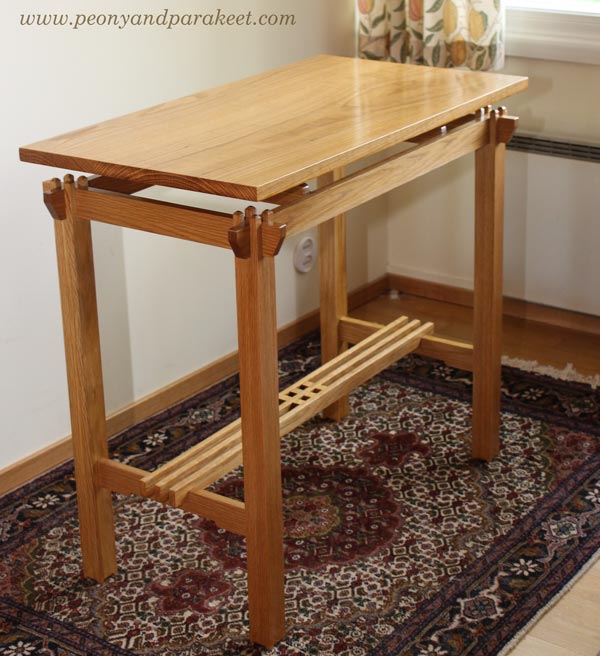
But I encouraged him to continue, and he did. Every project grew his skills. After a couple of years, he made a small table that shows how far he has come. It’s inspired by Japan and the early 20th century. It’s made from oak and finished with shellac.
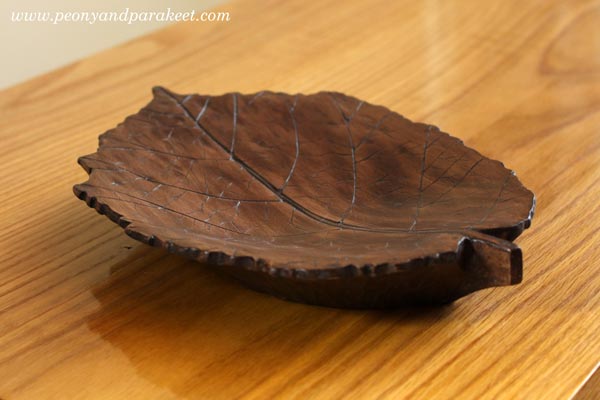
At the beginning of the hobby, my husband wanted to learn to carve. So the very first project of his was a wooden leaf. He started the carving, but it felt too difficult, so he gave up. After finishing the table, he remembered the unfinished project and completed it without struggles.
Even if this post was not directly about painting and drawing, I think that we all can relate to my husband’s journey. Creating art is never as easy in practice than in our dreams. But the happiness that it can bring is priceless. You just need to start and keep on creating!
Let me be your art teacher: Subscribe to my weekly emails!
Knitting and Painting – A Video Visit to My Studio!
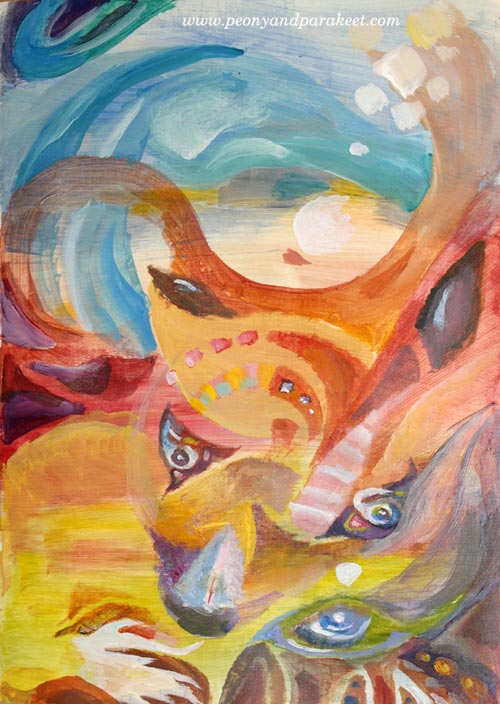
This time I have something for you who likes to watch long videos. I love to knit (especially Leftie scarves) while watching video podcasts, so maybe you can pick up a project too and come to spend some time in my studio, talking about crafts, art inspiration, and painting supplies. I will create a craft-inspired art journal page and show many other pieces too.
A Day at the Studio – One Video in Two Parts
It is a really long video, so I have divided it into two parts. The first part is an introduction to a small project that I paint on the second part. The second part also shows some painting supplies. I hope you will enjoy both of them!
Here’s the first part:
And here’s the second part:
Planet Color is now available as a self-study class: Buy now!
Year 2016 in Review – In Terms of Art Supplies
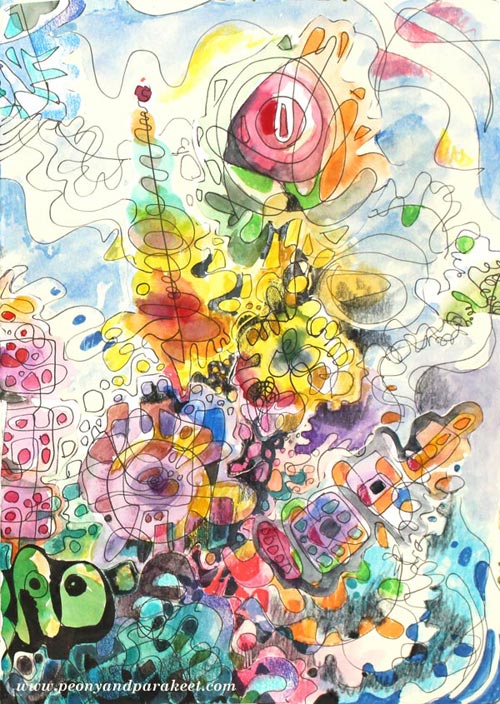
I am not usually so keen on “year in reviews,” but I thought it would be interesting to look back regarding art supplies used in 2016. When people ask me what supplies do I use, my quick response is: “Acrylic paints, watercolors, and colored pencils.” If I get detailed questions, I often refer to these blog posts: What Art Supplies Do I need? and What Acrylic Colors to Buy?
But it hit me that I have used a more diverse selection of supplies in 2016. And then, there are all kinds of necessary stuff that we don’t often mention but still use all the time. So, I dedicate this blog post to supplies. It’s not so much about the single pieces created in 2016. If you want to have a look at those, go to 2016 Gallery!
Must-Haves for Collage Art
The image that is at the beginning of this post is a collage made for January’s lesson at Inspirational Drawing 2.0 while teaching how to create unique collage pieces and enjoy freehand drawing. I have been blown away by the beautiful art created by my students, and I am more certain than ever that introducing the ideas for drawing piece by piece makes freehand drawing and the use of imagination easier than trying to build a bigger illustration in one piece. (You can still sign up for the class and get the first lesson immediately after the purchase!)
I like to create collage art to my biggest art journals. I have two of large Dylusions Creative Journals. The first one is almost full, so I hope I can fill it in 2017 and make a flip-through video of it. I purchased the second one last year because I love the quality of the paper. It’s perfectly smooth for colored pencils and sturdy enough for collage art.
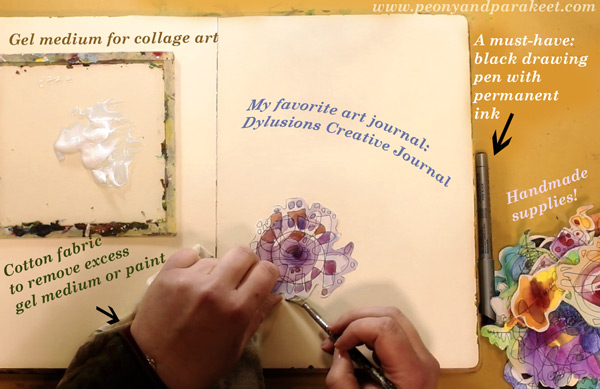
Like in the previous years, I have used “Golden Soft Gel Gloss” gel medium for attaching the collage pieces and Tim Holtz’s non-stick scissors for cutting the pieces.
A new discovery is to use a piece of cotton cloth to remove excess gel medium. First, I started using old t-shirts for finger painting. But when learning old masters painting techniques at a class, we used old linens for cleaning the brushes and realized that they work well for wiping off too. Since then, I have been a collector of old cotton fabric pieces. A fellow artist told me that she has several plastic bags filled with waste cotton fabric for art making!
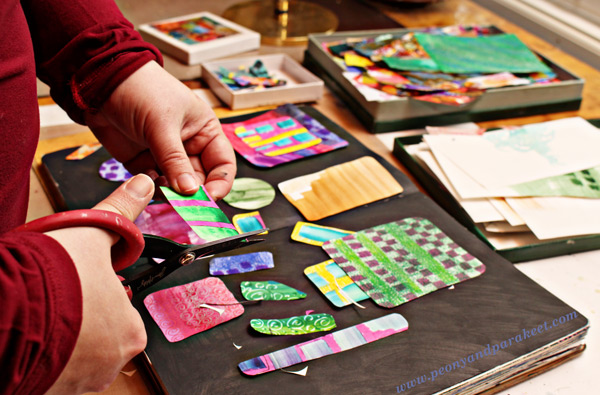
Speaking of collecting, I am still a collector of the best handmade supplies: hand drawn and hand painted paper pieces! If you have never tried creating collage pieces, see Step by Step page for basic instructions! I also have a mini-course called Doodled Luxury, that shows how to combine doodling with collage techniques.
Colored Pencils – Not for Art-Making Only!
Because I create a lot with colored pencils, I often get questions about which colored pencils to buy. Many contemplate between regular and water-soluble pencils. I love regular colored pencils because they are easy to carry and easy to use when you only have a minute or two. I use regular colored pencils also outside my art-making. I love to use them to make written notes more visual and add visual ideas to my notebooks and planners.
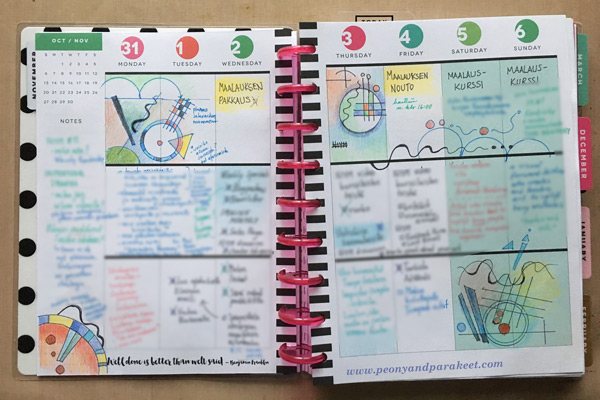
It’s why I always have colored pencils in my reach, and I think it’s also why I find it so easy to create with them. If I have to create something quickly that isn’t very big in size, it feels natural to choose them. I use Prismacolor Soft Core pencils when I create art pieces and a selection of old pencils for more mundane purposes. My e-book Coloring Freely focuses on regular colored pencils and shows easy techniques for creative coloring.
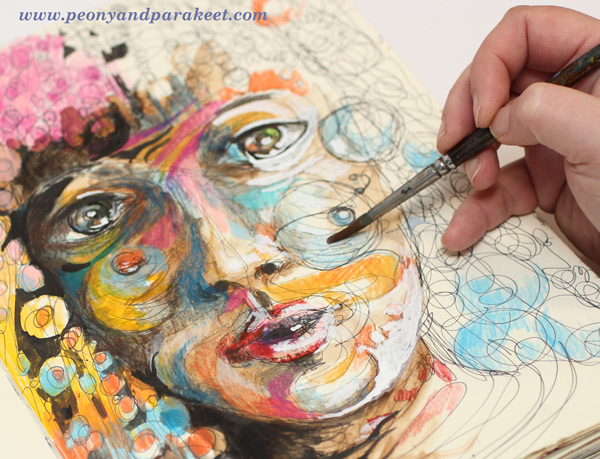
I also have a mixed selection of watercolor pencils, and I enjoy using them too, especially in the beginning of coloring. Using water makes it quicker to fill a paper with a soft mix of colors. It is the technique I use a lot at Inspirational Drawing 2.0: starting the coloring with watercolor pencils, inks or watercolors and then moving on to dry supplies like colored pencils and felt-tipped pens.
Using Watercolor Paper – and Not!
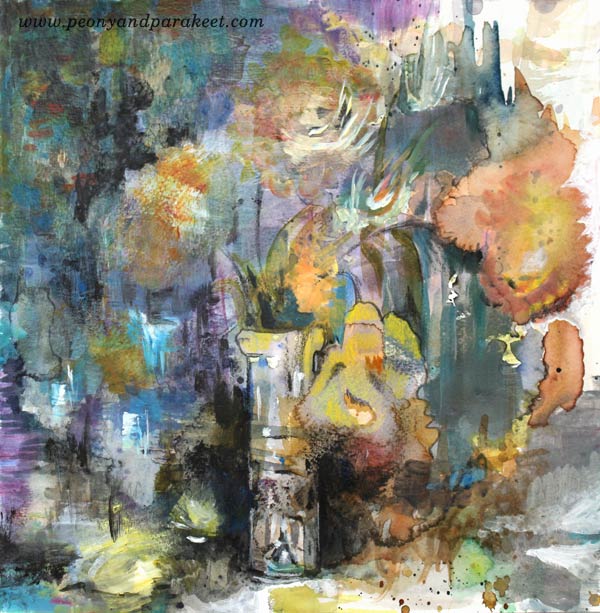
This is a supply that makes my heart sing – I only have to touch it: a good quality watercolor paper! My absolute favorite: St Cuthberts Mill’s Saunders Waterford HP watercolor paper. It’s smooth and thick (300 gm2/140 lbs), and it’s perfect for both watercolors and colored pencils. I especially enjoy creating intuitive still lifes on the thick paper. I often cut the paper to a square to enable easy changes in orientation. See this blog post to watch me creating the intuitive mixed media painting below on a watercolor paper!
Even if I love smooth watercolor paper, I don’t want to limit the use of watercolors. I use watercolors constantly and often with paper that is not designed for it. I like to carelessly splash watercolors on any paper because there are a lot more opportunities to use watercolors than to use watercolor paper. For example, watercolor paper is not good for collage pieces because it’s too thick. I like to use sketching paper instead.
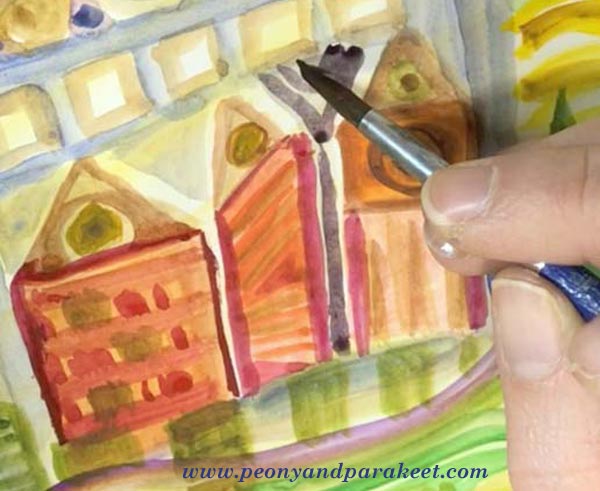
The best exploration with watercolors so far happened in 2016. I studied Friedensreich Hundertwasser’s way of using watercolors and created a mini-course about imaginative painting style. This painting style uses only a little water, and it’s easy to apply on almost any paper. See the mini-course Painter’s Ecstasy!
The Year of Canvas
If I had to name one supply that marks 2016, it would be canvas. I have created more canvas pieces than ever before. I have painted five small acrylic paintings and two medium-sized paintings. “Human Nature” was not a wall-sized, but so far the biggest that I have painted. See this blog post: 5 Lessons Learned When Painting on Big Canvas
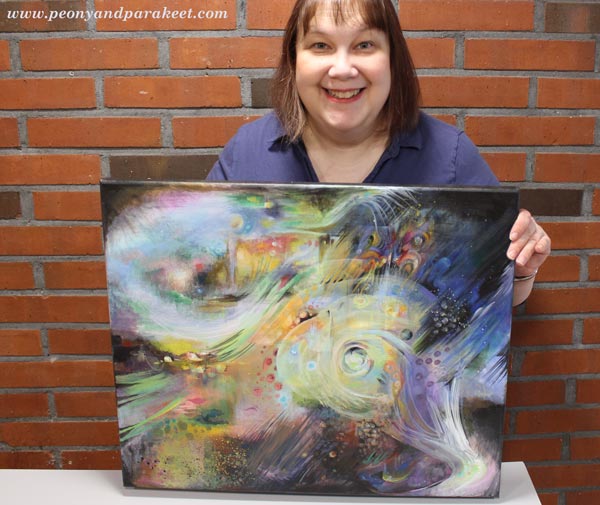
I always take the canvas more seriously than if I create a painting on a watercolor paper or an art journal. A blank paper syndrome is nothing compared to a blank canvas syndrome! But I enjoy larger projects between smaller ones, and I have two blank canvases waiting for 2017 creations.
Experiments with New Supplies
Oil paints
I would have never guessed that I would be 47 years old before trying out oil paints for the first time, but that was how it went. I started painting as a young teenager and my parents purchased acrylic paints to me. They explained that using oil paints would require all kinds of liquids that would not be safe and acrylic paints were better in that way. They were so right! Not to mention all the smells! I live in a house built in the 1960s, and the smell stays there for some time. It would be impossible to me to use oil paints daily just because of that.
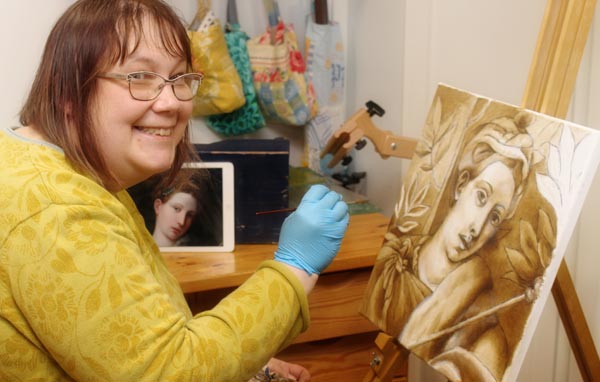
But I have signed up for an art class and will start my second oil painting next week using the old masters’ techniques. (See this blog post to read what any artist can learn from old masters!) I love the pigment and gloss of good quality oil paints. We are using Schminke’s Mussini oil paints, and they are the best quality paints that I have ever experimented with.
Soft Pastels
During 2016, I saw quite a lot of art that was created with soft pastels. I almost bought Unison soft pastels to treat myself but then realized that I already had a small set of Rembrandt soft pastels. I had purchased them many years ago for industrial design studies, but we had been using them very differently than how people use them usually. We scraped them to get powder and used the powder to create soft shadows.
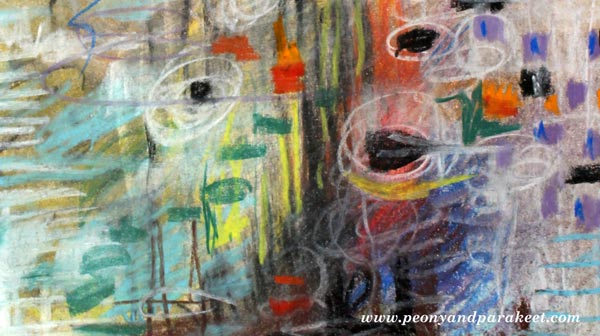
I created an art journal page (see the full image in the middle of this blog post) to try them out. Now I just grabbed the sticks and drew with them, but it felt like there was powder everywhere. And then, in the end, I had to use fixative, of course. It felt tedious even if it was not. I had no desire for new pastels anymore, but afterward, I have wondered if I gave up too easily. Maybe I should try the soft pastels again sometimes in 2017.
Liquid Watercolors and Watercolor Markers
In the late fall, I got a couple of surprise packages from one of my students! I got to use liquid watercolors and watercolor markers for the first time, and I liked both of them.
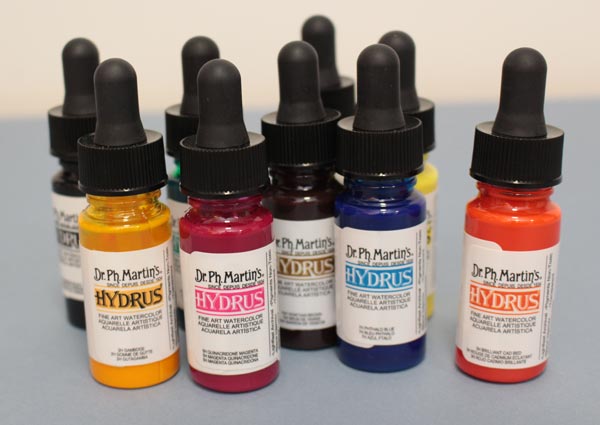
I like the intensity of color in liquid watercolors. Mine are Dr. Ph. Martins’s Hydrus watercolors.
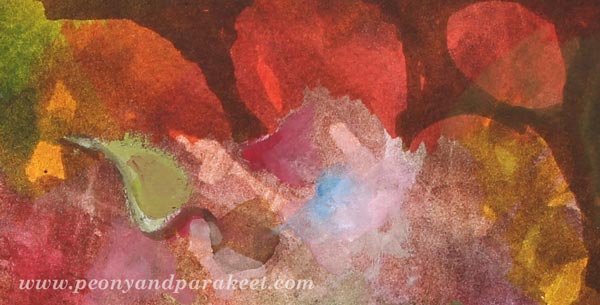
Watercolor markers seem to be very versatile because you can use them with or without water. I also received a set of gouache paints, and they encouraged me to dig out my old gouache tubes as well. To see what I created with the new supplies, watch this video blog post!
Going Digital?
Based on 2016, my answer is both yes and no. Yes, I have created digital art, see this blog post especially! I have used Adobe Photoshop CS5 for so many years that it feels very intuitive and I don’t have to think about the commands and such, I can just focus on the fun stuff.

But when I create digital art, I like to use my hand-drawn and hand-painted pieces as building blocks. I know that many buy stock photos, but it feels much more exciting to me to use my art as a starting point. Sometimes when I don’t work I buy a digital kit and have fun with it, but that’s just playing in my spare time (Sometimes I do wonder, how much do I have to create, to stop creating …)
I have a student at Inspirational Drawing 2.0 who is adapting the exercises to work with her iPad mostly. I look forward to seeing more of this happening because I see a potential of more people going into creating art. However, I don’t want to spend all of my time with devices, so I enjoy creating pieces by hand and as long as I can do it, I think I will, also in 2017!
What about you? What supplies were new to you in 2016, and what supplies are you going to continue using in 2017?
What Acrylic Colors to Buy?
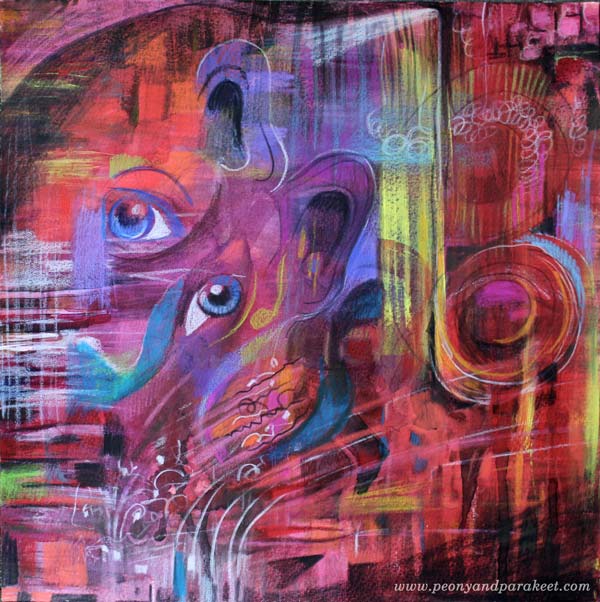
This is a very practical blog post but let’s start it with my recent artwork, called “Tosca.” It is inspired by Giacomo Puccini’s opera. I went to see the opera last week and it was an experience that I wanted to communicate visually. The drama has always appealed to me and the contrast between the most beautiful sounds and the big emotions, often agony, was unforgettable.
Before the evening at the opera, I had just realized that I need to buy some more acrylic paints. I had run out of almost all the basic colors. I love Golden Heady Body Artist Acrylics, so I went to a local art supply store to get some. I know there are lists of what colors you should buy when buying the basics, but as my selection is a bit different, I thought I might not only share it but also give some general guidelines of what acrylic colors to buy. These can be applied to colored pencils and watercolors as well.
Guidelines that I Follow when Choosing Acrylic Colors
1) Always buy basic white and black. They give contrasts and are great for color mixes.
2) Never underestimate the number of yellows you need. I use yellows for everything. I love the color itself, and use it a lot for color mixes as well. I often make a mistake of adding too much another color with yellow and then I need to add some more yellow to get the right tone. So I need a lot of yellows!
3) Warm and cold tones of each primary color are usually enough. I don’t buy browns and greens unless I find a specific tone that I fall in love with.
4) Always include some personal favorites. When I open the box where I store the tubes, I want to become happy. Cerulean blue reminds me of the time when I painted icons. I think of the sky when I see it and it makes me feel creative and happy. Whatever the current color trends are, cerulean blue always feels great. When I buy colors, I think about creating as an experience and don’t just focus on what is generally recommended.
My Basic Collection of Acrylic Paint Colors
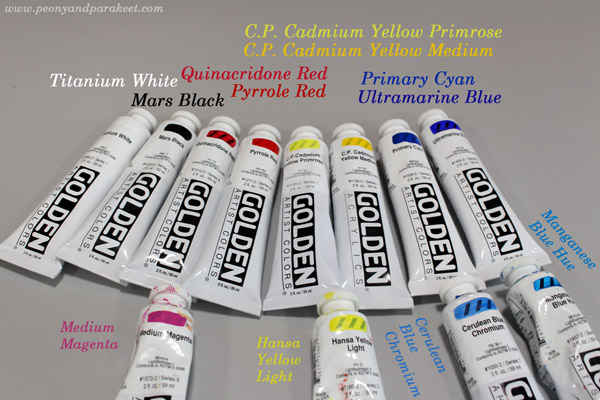
Basic Colors:
1) Titanium White – because it’s basic white
2) Mars Black – because it’s basic black
3) Quinacridone Red – because it is great for mixing pinks and purples
4) Pyrrole Red– because it’s fiery and pure warm red
5) C.P. Cadmium Yellow Primrose – because it’s ideal to get beautiful greens but it is still a strong pigment, not a mix
6) C.P. Cadmium Yellow Medium – because it’s the most beautiful warm yellow I know
7) Primary Cyan – because it’s basic and more affordable than many other blues
8) Ultramarine Blue – because I have used to using it for decades
Extra Colors:
1) Medium Magenta – because I like pinks
2) Hansa Yellow Light – because it is an affordable extra yellow
3) Cerulean Blue Chromium – because it makes me happy
4) Manganese Blue Hue – because I like turquoises
I also have some special effect tubes, for example, gold and silver and some odds and ends. The more I paint, the more I rely on basic pigments and don’t like to spend money buying color mixes in tubes or jars.
A Red Day
Sometimes one color seems to be more appealing than the others. This happened to me last week; it was “red red red” that I thought all morning.
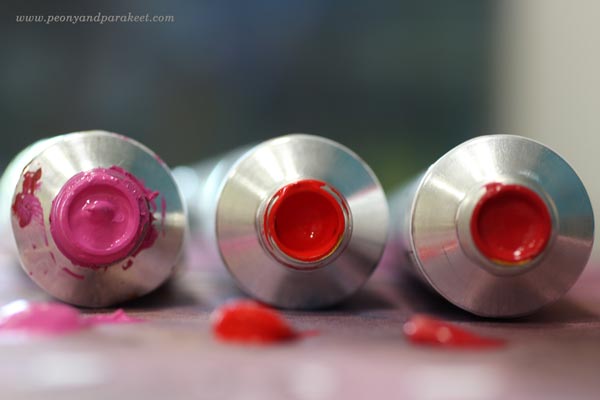
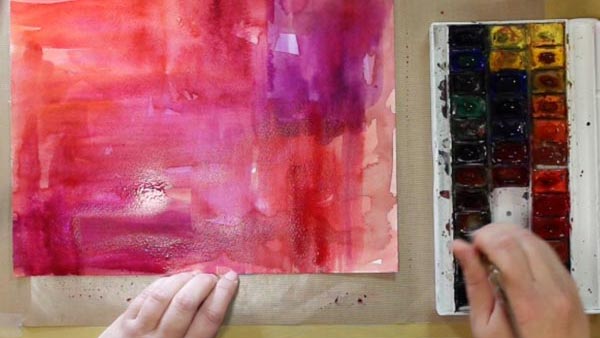
Even if I had the new tubes and all, I started with watercolors and 12-by-12 inch watercolor paper. Playing with water is so liberating!
Then I changed watercolors to acrylic paints and turned the music on.
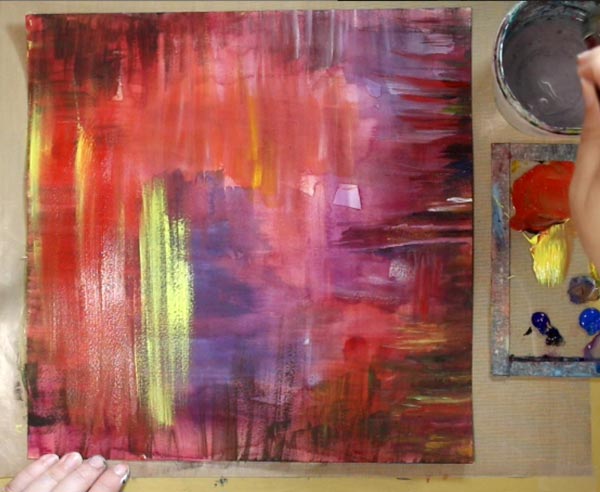
Puccini’s Tosca was playing in the background but as I had not visited the real performance yet. So I put this away to wait for the more detailed insight.
Colored Pencils Make the Details
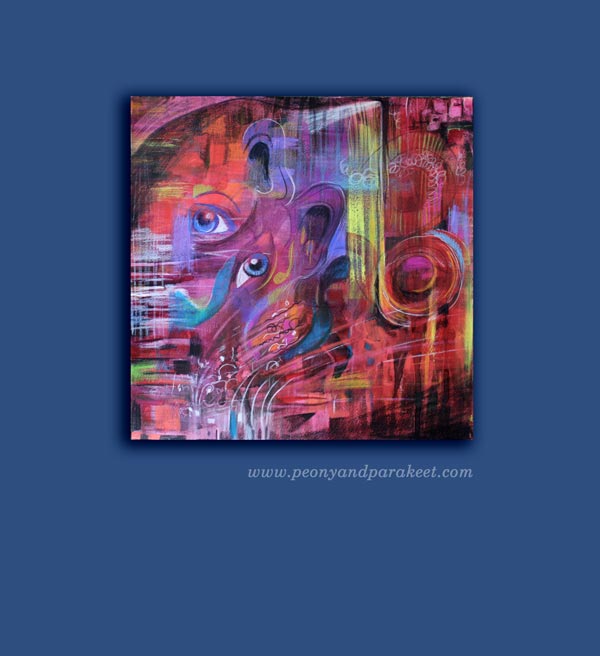
A couple of days after seeing the opera, I was ready. I continued with colored pencils. They are wonderful art supplies. They are brilliant with watercolors, but they are ok with acrylics too of you create thin and even layers.
Subscribe to my weekly emails! Get a free mini-course Loosen Up!