
Ninety-Ninety Rule for Art-Making
This week, we talk about the agony that’s associated with finishing.

Last fall, I had a turning point when I started making digital art. I’m not giving up painting, though. There will be just fewer oil paintings this year.
New Start
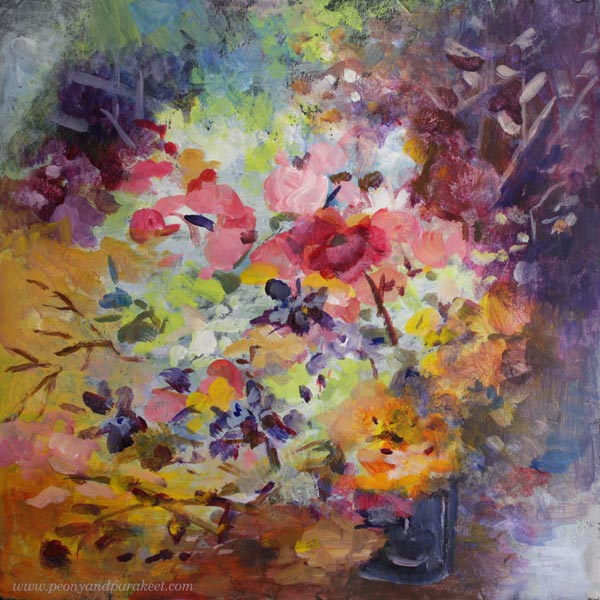
This year’s first oil painting started already in October last year. First, I made a mess with pastel hues. Then I began to figure out what kind of personality the painting could be.

This kind of intuitive painting is wonderful and for example, my latest course Liberated Artist Revisited is based on it. Instead of the model, we study the painting itself and let it go in its own direction.

When I paint, I often listen to some talk or music program at the same time, that’s why the iPad is also visible in these pictures.
Ninety-Ninety Rule
Programming and painting have a lot in common. One of those is definitely the ninety-ninety rule. It states that 90 percent of the work is done effortlessly and takes only 10 percent of the time. And the remaining 10 percent is difficult and takes 90 percent of the time!

For example, in this part of the painting my intuition was working fluently, and finishing these details was also easy. I especially like that beige flower near the edge.

But the further the painting progressed, the less often I worked on it. I wasn’t satisfied with the center and the soul of the painting was missing. I looked at it every day, but all my ideas seemed too ordinary.
Then when I finished the video artwork last week, I suddenly got ideas for the painting. First, I brought similar greenish tones and then, by keeping my mind on the video, I solved the puzzle stroke by stroke!

The name was now easy to find: Käännekohta – Turning Point.

The ninety-ninety rule applies to the fond factor as well. It’s easier to like an unfinished painting than one that is close to a finish. When under 90 percent, you can see the potential and ignore the unpleasant parts by saying that the piece is not ready yet. When working on the last 10 percent, things get more complicated and there are times when you hate the piece!
Old Supports New
During big changes, I have often thought that I leave the old completely and jump fully into the new. But this time I feel that the old and the new support each other.
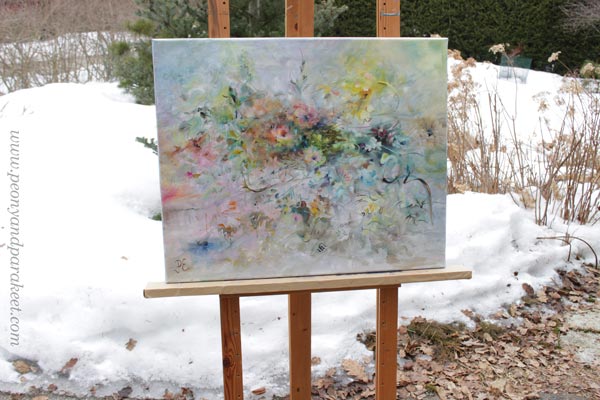
Life is an interaction between the past and the present and that applies to art-making as well.
Liberated Artist Revisited
With the newest course Liberated Artist Revisited, I invite you to paint with me – to follow directions from Paivi many years ago, and then create more with the current Paivi. At the same time, you can ponder, how your art-making has changed and will change.
Liberated Artist Revisited is a limited edition – only available for purchase until the end of March 2024! >> Buy Now!
5 Tips for Quick Abstract Flowers
This week, we paint quick abstract flowers freely without any references.
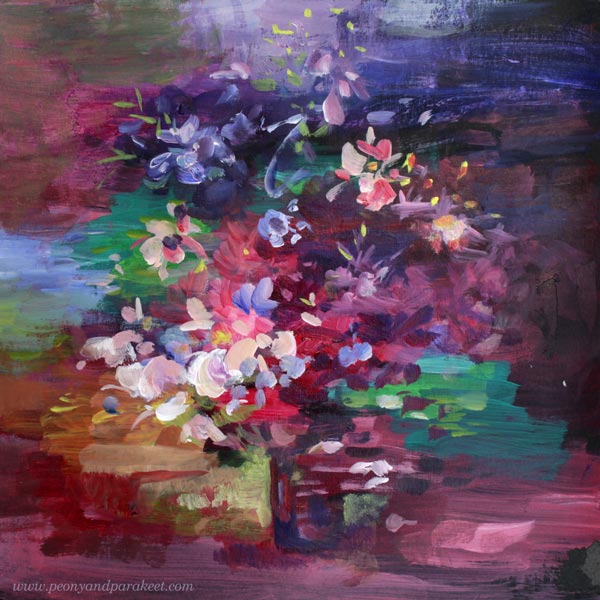
I have a black Dylusions Creative Journal and make small paintings there occasionally. It is especially good when there’s still paint left on the palette at the end of the painting session. I think it makes sense to use all the paint, and not throw the leftovers in the trash.
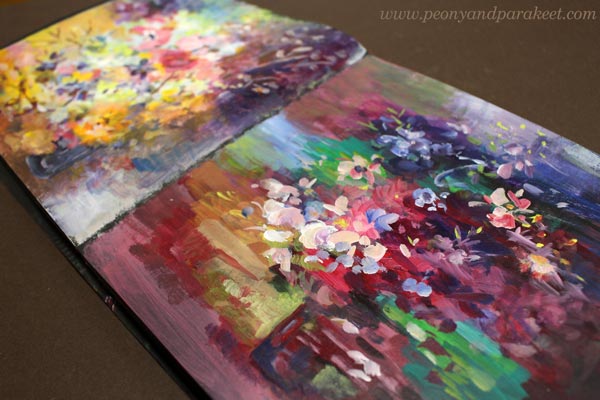
I don’t use any gesso but paint directly on the page.
When I painted pieces for the course Liberated Artist Revisited, I noticed that there had been a long break in acrylic painting and some of the tubes had started to harden.
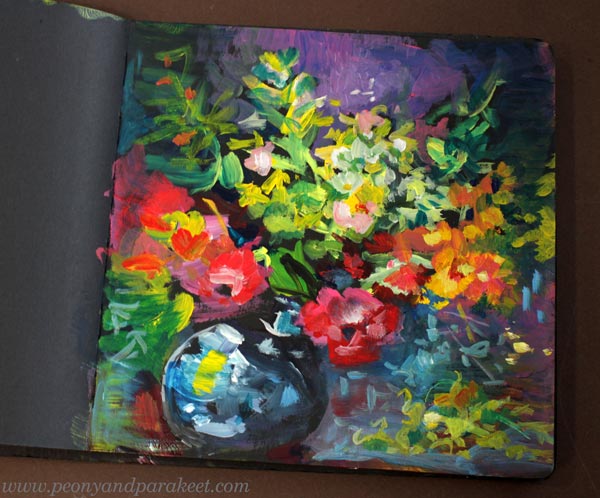
It motivates me to paint in the black art journal again because I don’t want those paints to go to waste. And sometimes it’s nice to paint something small quickly and see what comes out most effortlessly.
Quick Abstract Flowers – Five Tips!
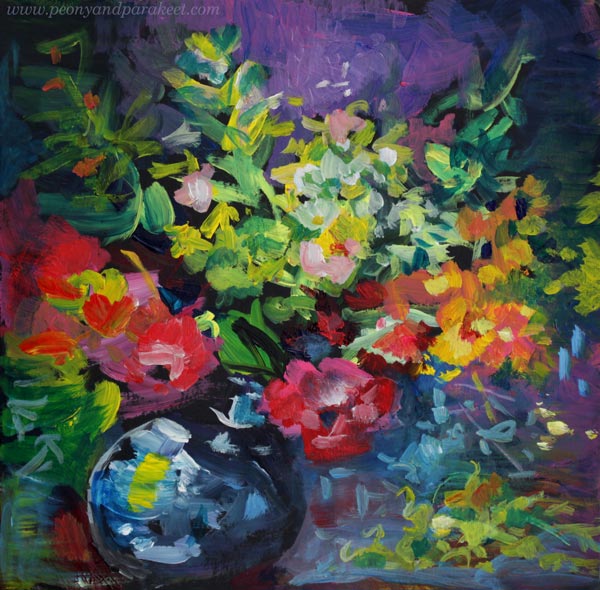
I like painting abstract flowers, and thick paints are very suitable for abstract flower paintings. Here are my five tips for painting flowers quickly.
1) Start from the Old Mess
The fastest way is to start from an old painting.
I have a lot of pages in my journal where I’ve hastily painted shapes with leftover paints.
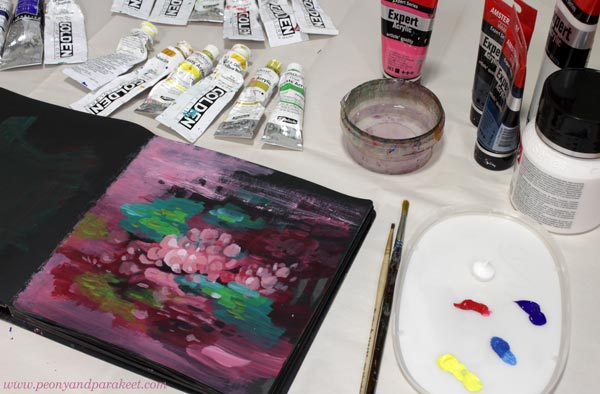
Continuing the beautiful mess feels much more effortless than starting a new one from the beginning.
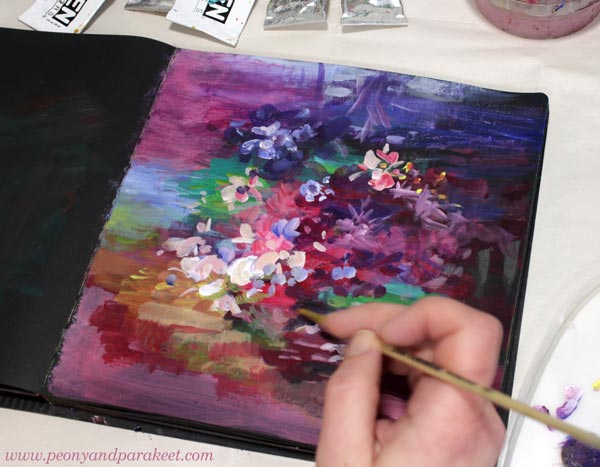
For example, here’s one page that still waits its turn to become a finished painting.
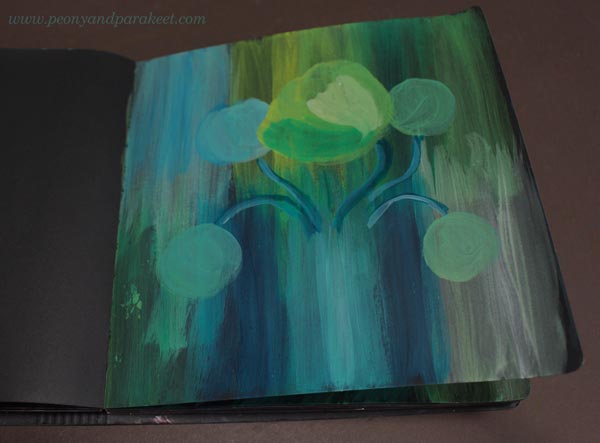
Most of my beginning messes are much more messy though!
2) Dark-Bright-Light
Include all three degrees of darkness in one painting.
Make color mixes and compare them in terms of darkness. By including all three – dark, bright, and light – you can achieve depth and atmosphere.
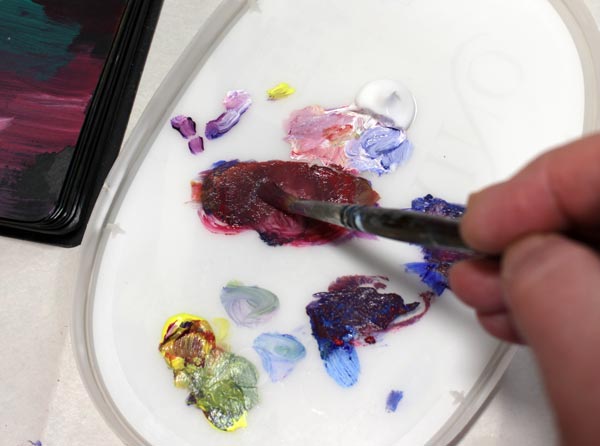
Make clear larger areas so that you can point to different places in the background and say, there is dark, there is bright, and there is light.
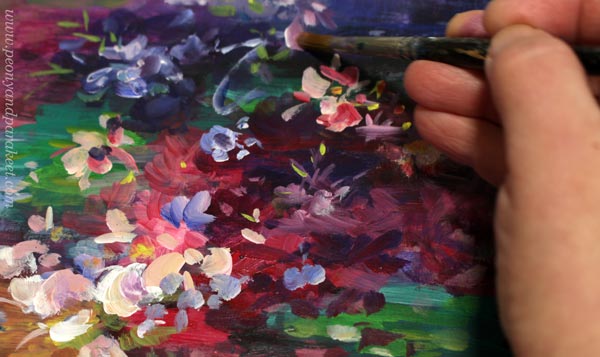
Flowers can have all three – dark, bright, and light colors.
3) Forget the Real Flowers!
Don’t think too much about the real flowers.
Don’t think about what a rose looks like or what flowers you want in your painting. All that stiffens your expression.
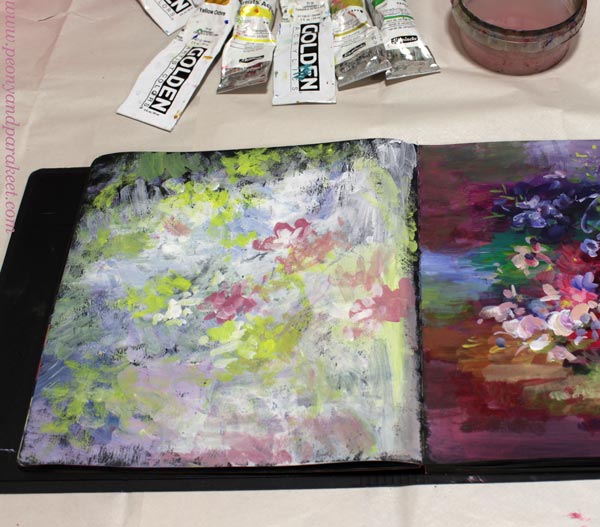
Focus on the colors and let the flowers form from the brushstrokes.
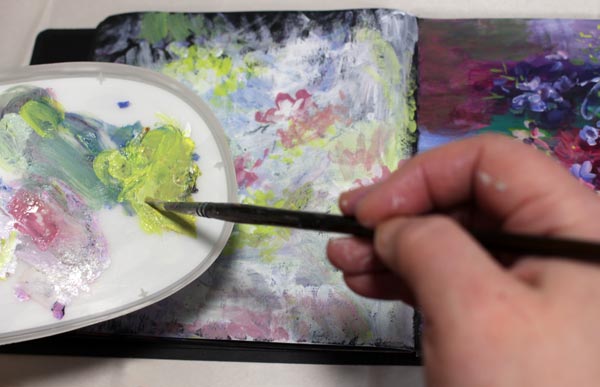
After all, a flower is just a few colorful strokes and a line for the stem.
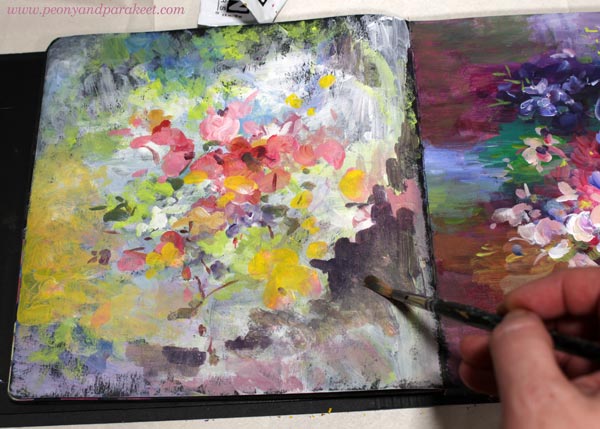
Use your imagination when you look at your work in progress!
4) Leave Room for Spirit
Not everything needs to be defined or look like a flower.
Flowers are concrete matter, so let the colors express the spirit!
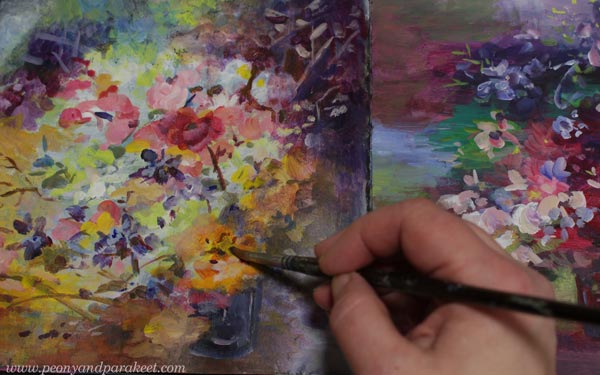
If you want to be extra quick, sharpen just one flower near the center and leave the others more abstract and vague.
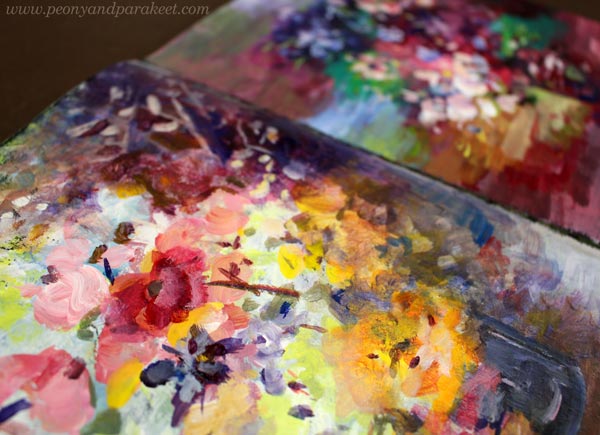
5) No Forced Feelings
Open yourself up to an emotional experience.
The speed of the painting depends highly on how soon you get an emotional connection with yourself and what you are doing. Let even the darkest thoughts come. For creativity, everything genuine is equally good.
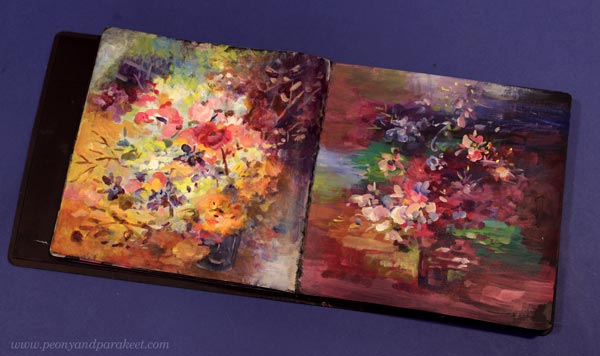
The beauty of making art is that imagination creates abundance and eternal life from almost nothing – from the leftover paint and leftover energy. And the more often you create, the more you get out of it!
Liberated Artist Revisited – Buy Now!
In Liberated Artist Revisited, we time-travel to meet the teacher – Paivi from 2015, and create new art with her.
This course is both for the left and right brain. The young Paivi gives systematic instructions while the older Paivi enjoys her freedom and ponders about art-making and life in general.
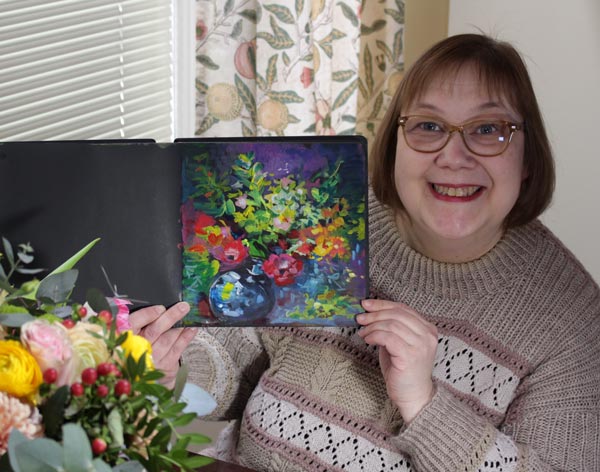
Liberated Artist Revisited is a limited edition – only available for purchase until the end of March 2024! >> Buy Now!
Liberated Inspiration – Painting Freely
This week, I talk about liberated inspiration and share what I discovered about 8 years ago.
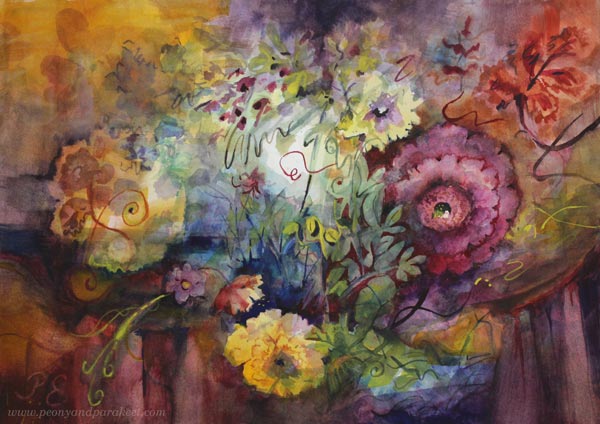
>> See more pics at the Taiko art store!
Liberated Inspiration from 2015-2016
Recently, I have been thinking a lot about the years 2015 and 2016. Then I combined watercolors, acrylic paints, and colored pencils for intuitive still lives. At the same time, I thought about how complex the forms of nature are and how I could create a more finished impression with nuances.
I have those pieces saved in an album. Watch a short video of me browsing the folder! Here you can see only a small part of the pieces – the album is thick!
Liberated Inspiration
These last couple of pieces shown in the video have stuck in my mind. This one:
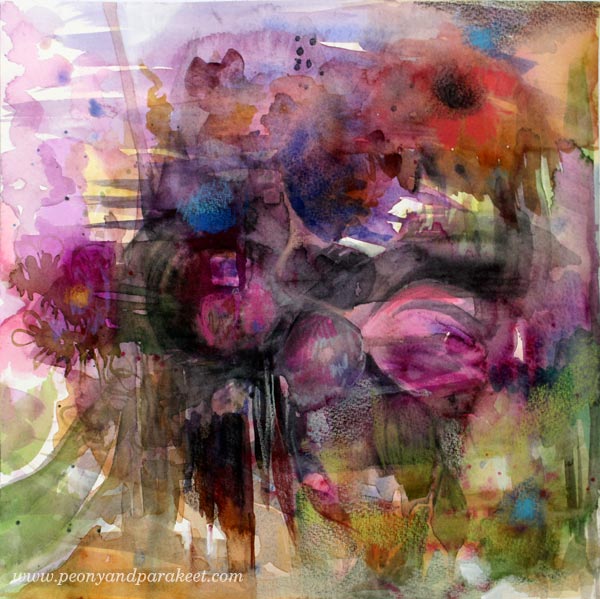
See the blog post about making this!
And this one:
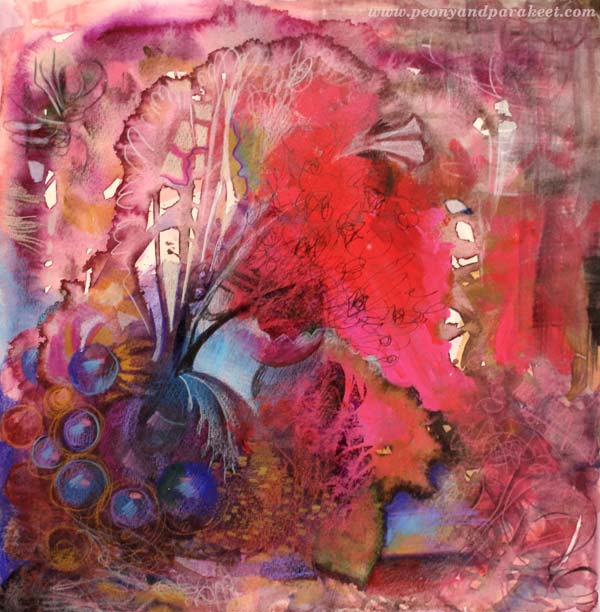
See the blog post about making this!
Both of these have a dark and romantic atmosphere that can be seen often in historical paintings, but there’s also liberated inspiration – meaning that no one dictates what that kind of painting should or shouldn’t have.
You can be inspired by what you have seen, but only pick the atmosphere from it.

I like this kind of inspiration the most. That you are inspired by something, but don’t take it too literally. Liberated inspiration boosts your enthusiasm but doesn’t tell what the final image should be.
I wanted a similar romantic yet liberated feel for this watercolor painting.
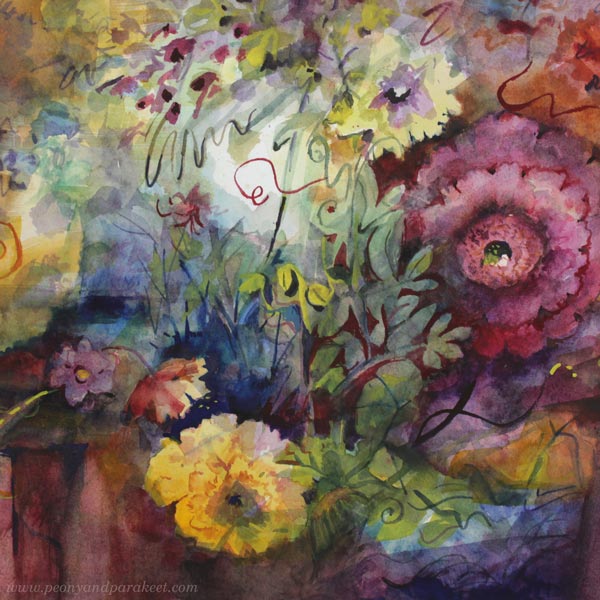
Imagine someone saying: “dinner is served” and bringing you to a table where good company and classical music would make the world look like it’s full of possibilities.
Painting Freely in Watercolor
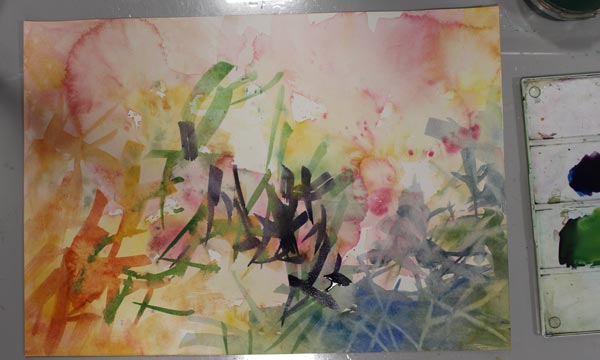
It has always been important for me to paint freely without models and let randomness meet my imagination. In 2015, I developed a course called Liberated Artist. It was about creating a mess first and then solving it. It was a fun course.
I started this watercolor with a similar mess.
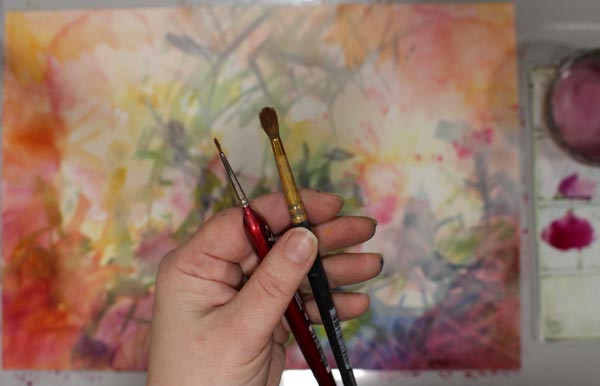
Then I switched to thinner brushes to finish the image.
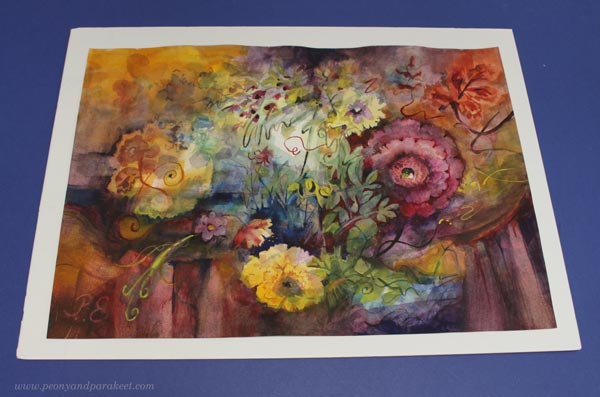
I like the way the imaginative scenery, flowers, ornaments, and the table came all together into one image.
Coming Up: Liberated Artist Revisited
The Liberated Artist course is no longer available, but I got the idea to redo a small part of the course. In that, Päivi from 2015 will teach Päivi from 2024! I will follow the old instructions again, but like an experienced student, I also offer a bit of my current knowledge.
Here’s a sneak peek at the new mini-course called Liberated Artist Revisited.
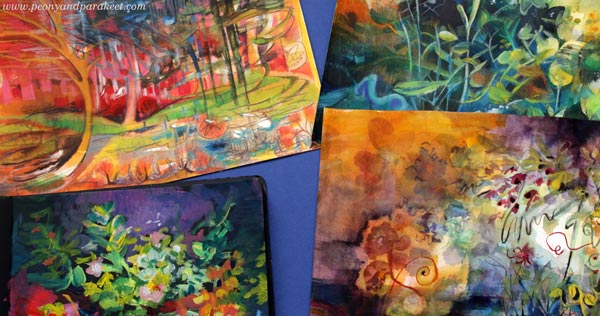
Liberated Artist Revisited will be published within a few weeks, but it’s likely to be a limited edition – only available for a limited time – so stay tuned!
Life After Death – Commissioned Art
This week, I have a commissioned art piece to show you. I have fewer words than I normally do – not only because the project is confidential, but also because this project went beyond words in many ways.

Last fall, I got a commission for this oil painting. It was ordered by a man in memory of his recently deceased spouse. We brought elements of the wife’s life and references to what she liked into the painting. The painting is, therefore, a secret portrait, from which loved ones recognize familiar things, but which do not need to be explained to strangers, unless they want to.
Commissioned Art – Sketch First
I started with a digital sketch. Here you can see the sketch and the final painting side by side.

I painted the sketch freely in the ProCreate app. The sketch is more abstract than the finished work and is more about the impression than the details.
Painting Process
After the sketch was approved, I ordered the canvas. The size of this piece is 50 x 40 cm (about 19.5 x 15.5 inches). Here are the first blurry layers.

I worked several sessions and let the painting dry for 1-2 weeks between the sessions.

The sketch helped with the painting process so that I could save my energy on the details.
Final Treatments
When the painting was finished, I photographed it outdoors. The natural light is wonderful now when Finland has a lot of snow, but the shoot had to be done quickly.

I varnished the painting with Gamvar after the photoshoot.

I like to think that varnishing was like giving a special blessing to the painting.
Spiritual Meaning
This project made my work as an artist feel even more meaningful than before. I learned more about what kind of artist I am.

I thought: “What could be a better assignment than building a bridge between life and death?”
What do you think?