
Can Playful Art Be Serious?
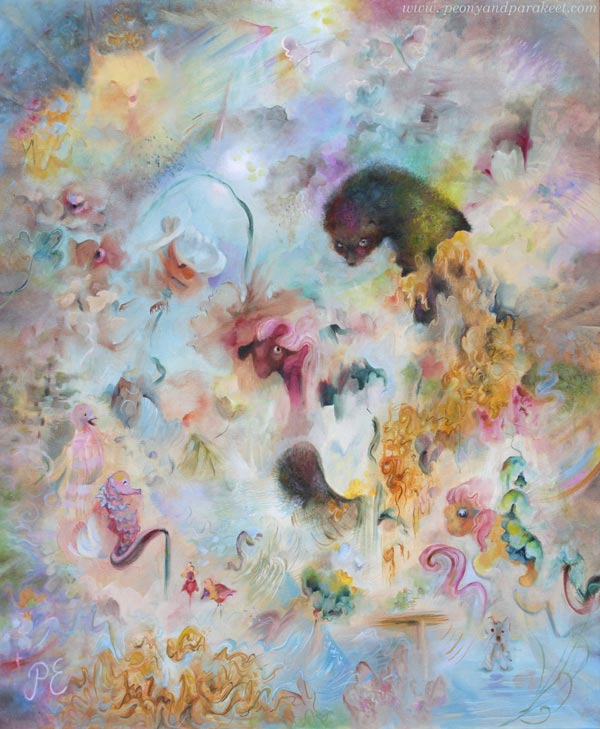
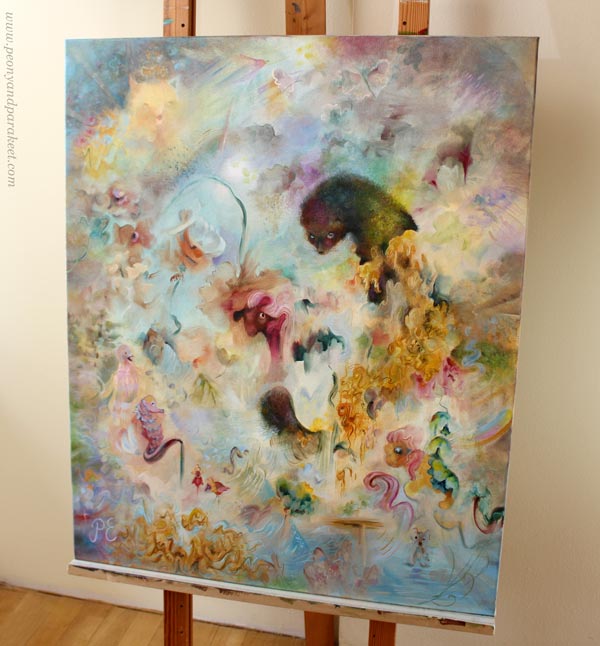
This week, I want to talk about my newly finished painting titled Fauna. This is one of my most peculiar pieces, filled with strange ideas. With this, I want to challenge us to ponder the question: Can playful art be serious?
Ideas Have a Mental Age
This painting combines many ideas. I tend to come up with all sorts of ideas quite easily, and I usually try to categorize them: some make it here to the blog, some become sketches in my planner, and others turn into courses. Only the most mature ones are usually included in the paintings.
But let’s think about this word: mature.
Ideas have a mental age. Some ideas are like those of a five-year-old, while others contain ancient wisdom. For a long time, I have tried to ensure that my best ideas are “sensible adults”.
Fauna’s Ideas
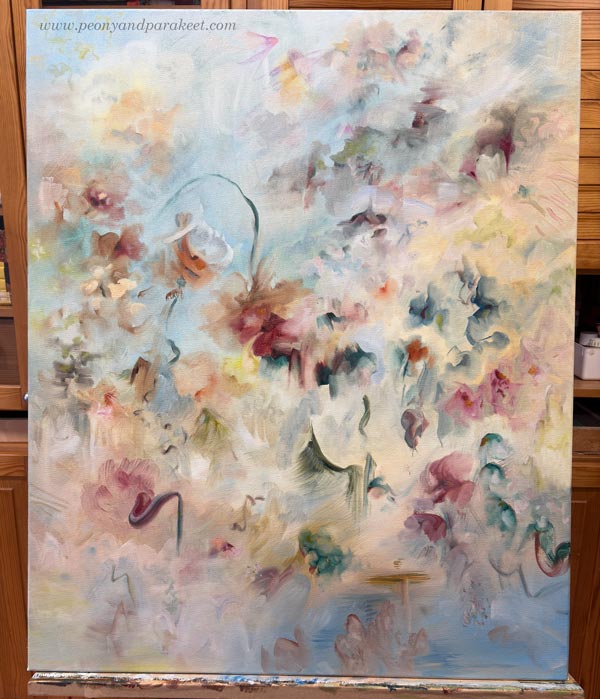
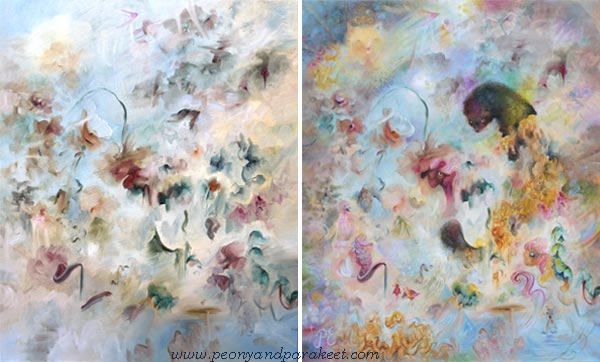
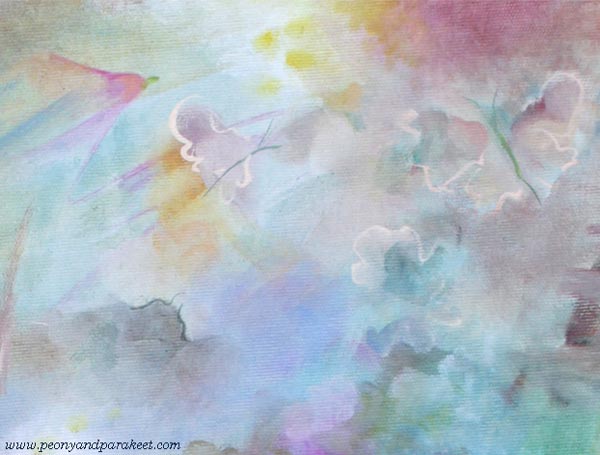
Fauna started from an old idea: the Baroque style and historical ceiling murals. So I thought that the painting could feature flowers and have plenty of light blue. Here’s how it started:
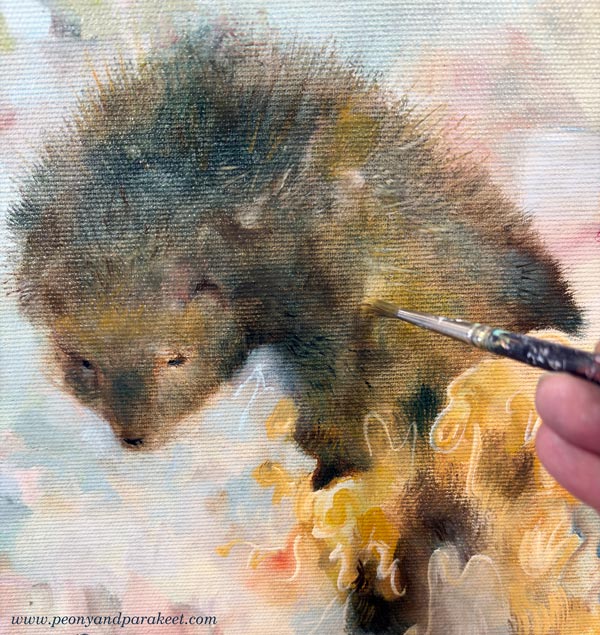
But then I heard my inner child whisper that I should include an animal: “Fur is so wonderful to paint. Let’s include something like a ferret!” The adult me wondered, “Who would want a painting featuring a weasel?” But you know, some ideas are like tiny butterflies that appear and vanish in an instant, while others are like moose that take over your entire mind. And this was a “moose idea.” It wouldn’t leave me alone, so fine —let there be a weasel of some kind!
But what else could be included?
Words help when I am brainstorming. I read through various word lists and wait for the moment my intuition says “Bingo!” That’s how I found the word “hunaja” – honey. I thought about the intricate swirls of the Baroque style and the way honey drips, and I boldly added them to the painting.
Here I am painting the fur. I use not only short strokes, but also paint small patches with different tones. Layering is the key!
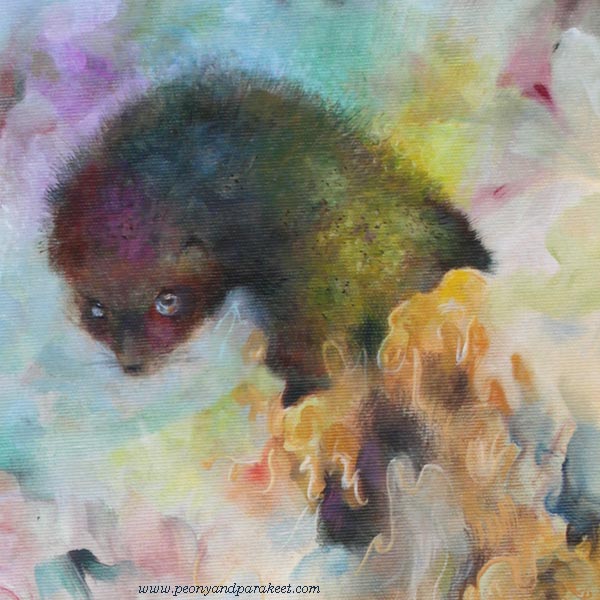
In the final version, the fur is softer and shorter, and lit by a rainbow. It took some time to decide whether the fur should be spiky or softer.
With the idea of painting honey, I found myself on a “mad path” where I stopped categorizing my ideas and challenged myself instead: could I create a painting that looks like a floral piece from a distance, but reveals a more playful character upon closer inspection? Could the animal theme lead toward animal figures—even toys? I wanted to achieve a purity of style that isn’t tied to a single era, but rather to my own way of dealing with shapes and lines.
Here you can see the beginning and the end side by side.
Playful Art – Drawing Animals
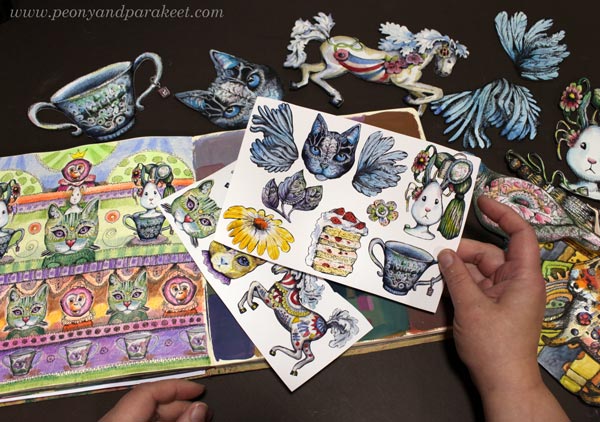
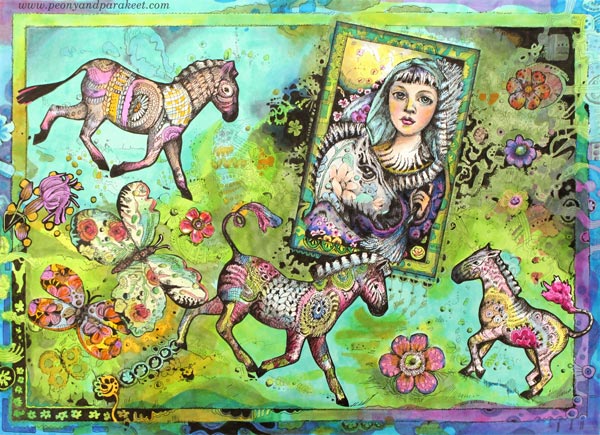
I have always loved animals and have drawn them a lot. Drawing with a pen is much easier than drawing with a brush.
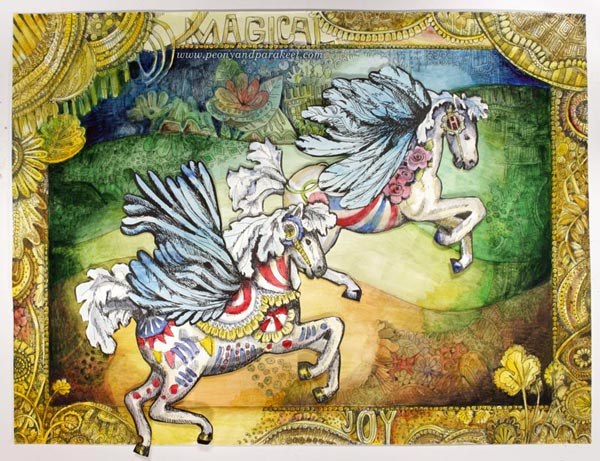
Animal Inkdom and Magical Inkdom have been highlights of my course creation because, while making them, I decided to believe that everyone wants to draw animals. That mindset brought a lot of confidence and joy to the process, which also translates into the atmosphere of the courses.
I have had so much fun with all the animals drawn in those courses. My father used to draw with quite a similar technique, so I have continued on his path here.

The Playfulness is in the Details
Fauna is full of playful details. Many of them are quite subtle, barely noticeable. Here are some detail pics.
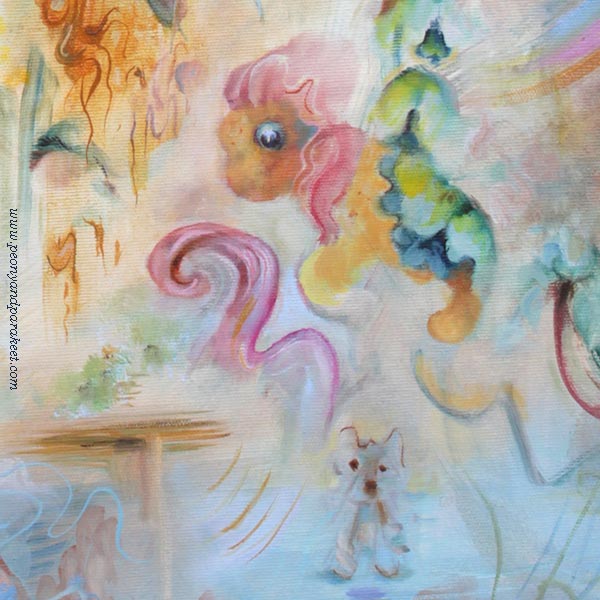
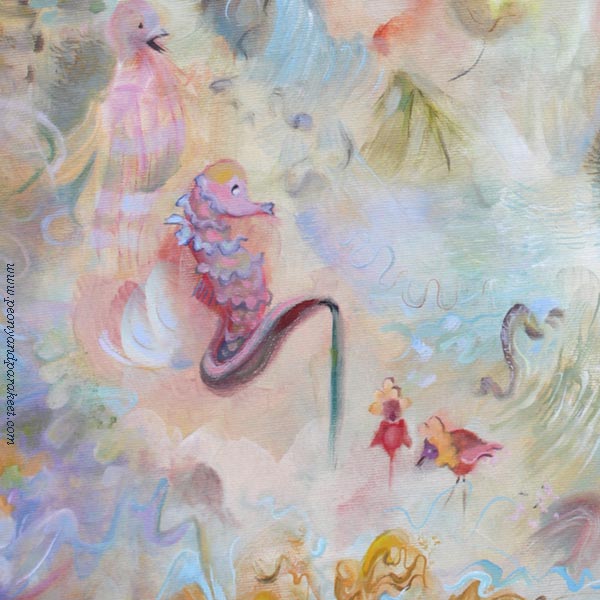
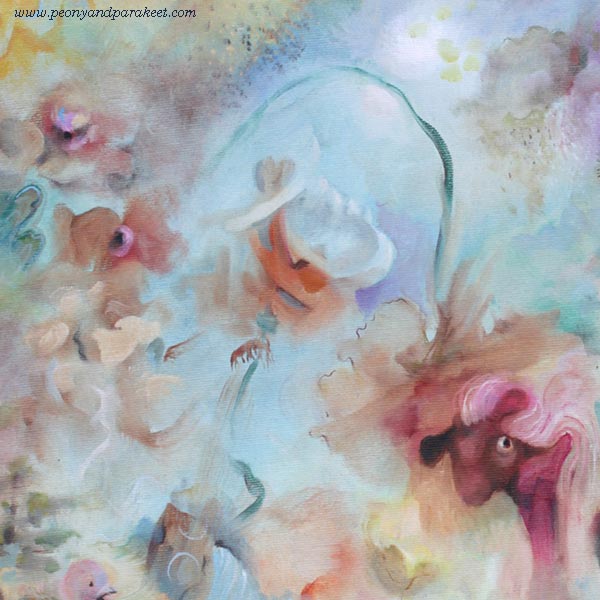
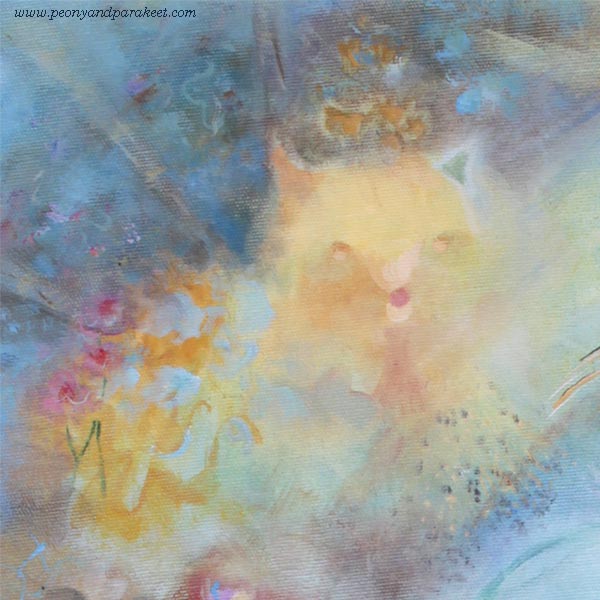
I see myself in this painting—all the versions of me at different ages, with ideas of all ages.
Even if Fauna was a challenge to create, it was also fun. I think I will create more of this kind of playful art.
Age of Ideas – Just Playing or Only Focusing on the Serious Side
This painting process made me reflect on how people who start making art often fixate on the “age” of their ideas. Some decide they are just having fun and playing. Others believe that skills—and thus art—can only be born through realism. But as artistic thinking and skills develop, there is an opportunity to combine the playful with the more serious. It is possible to be a child, an adult, and an elder all at once. Art doesn’t need to be narrowed down, because creating is a search not just for oneself, but for a broader understanding of humanity.
Fauna is a bit different from Halo – the painting that I showed last week.
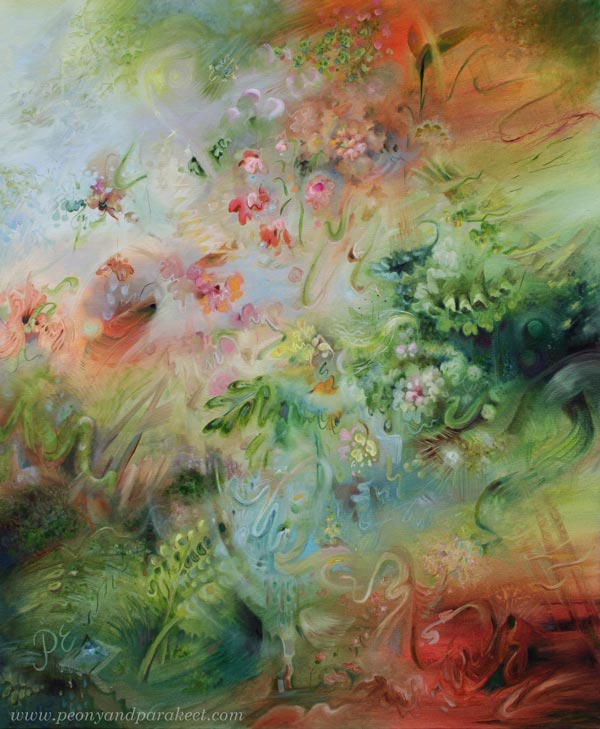
See the blog post about creating this painting
See more pics and a video at Taiko Finnish Online Art Store
Which one do you like more – Halo or Fauna?
Exploring Light and Mass When Creating Semi-Abstract Art
This week, I show my latest painting and talk about creating semi-abstract art where some details are quite realistic, and others are more abstract. I also give five concrete ideas for creating semi-abstract drawings or paintings.
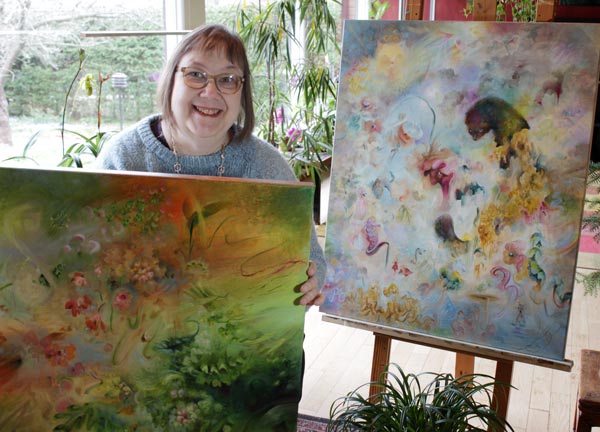
For the past couple of months, I’ve been working on four “sisters.” They are all the same size, yet each possesses a distinct personality. Halo was the first to be completed. She is the most delicate of the sisters, and perhaps the most beautiful. Fauna is nearly finished, just awaiting the final touches. She is a rule-breaker and a trailblazer who faces the world without fear.
Then there are the two who are still so early in their journey that they only have working titles. I often give my paintings temporary names that may change many times before the final version. The third sister is currently Ikigai, referring to “meaning of life.” She reminds me most of my mother; despite her shyness, she is strong, and though she might wish to blend in, she never truly will. The fourth sister, with the working title Jade, is the only one who has a landscape orientation. As the youngest, she views the world with the brightest, most optimistic eyes.
You will get to see Halo’s sisters once they are finished and photographed. I also always update the new paintings in the gallery page at paivieerola.com.
Light and Mass – Spiritual and Concrete
As an artist, I am fascinated by light. I often feel that once I’ve captured a unique atmosphere and lighting — something you might even call its temperament—the most important work is done.
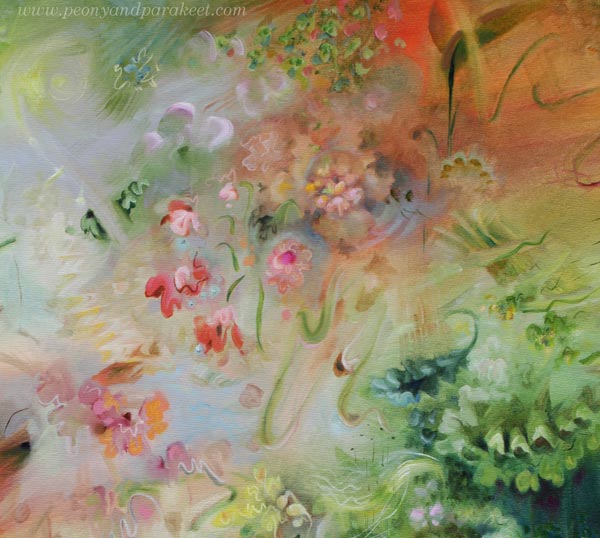
Beyond light, I think deeply about the physical mass within a piece. In the case of Halo, for example, I contemplated how realistic the vase needed to be versus how abstract I could leave the flowers and other forms. After all, the phenomenon of light carries an inherent sense of mystery.
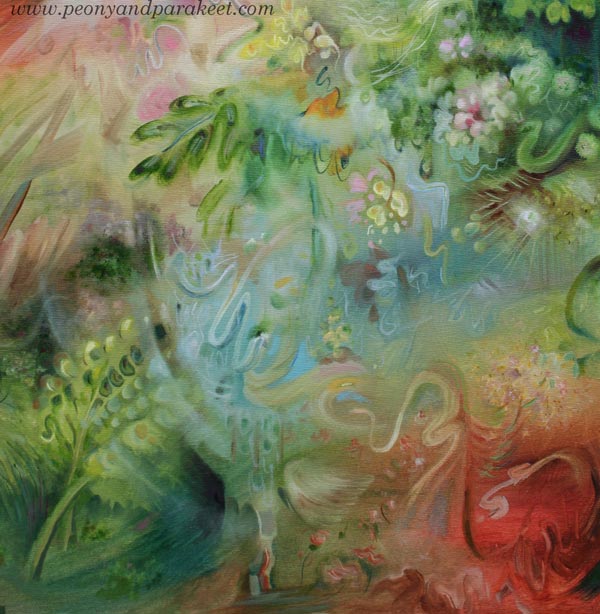
When light plays, it blurs the line between the concrete and the abstract. Just by looking, it becomes difficult to distinguish what is light and what is physical matter. I believe the same applies to us as human beings: the physical affects the spiritual, and vice versa.
Creating Semi-Abstract Art
This interface between spirituality and reality exists in all art, but it is, of course, most visible in semi-abstract art. Whether it’s a small sketch or a large painting, it’s fun to analyze which parts are tangibly real and which are spiritual in nature.
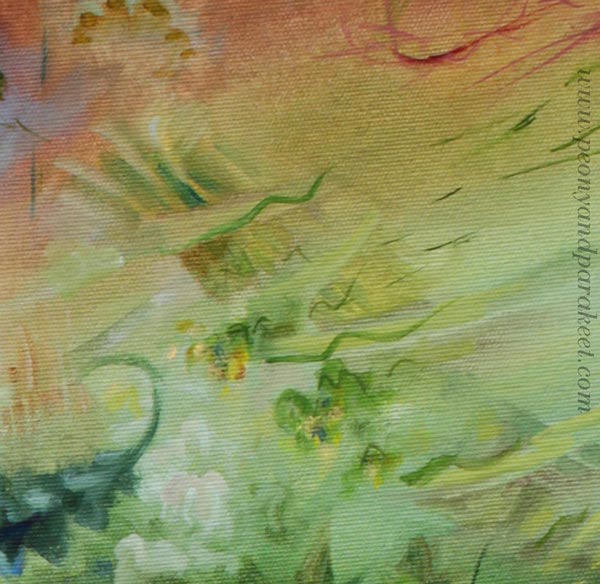
And when creating, it’s good to stop and think about which parts can remain abstract and which could be more concrete.
I challenge you to look at your own work through this lens! I also have some practical tips for …
Making Your Art More Abstract – Five Ideas to Experiment with!
For simplicity, I’ve used colored pencils and drawn flowers in the examples, but you can apply these tips to any medium and any realistic object.
Vanishing – Let some of the petals fade away so that the flower is partly invisible.
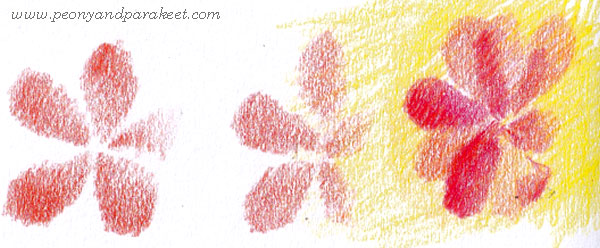
Lightline – By erasing, create a line that travels over the flower. The thickness of the line can vary, and it can also continue on the background.
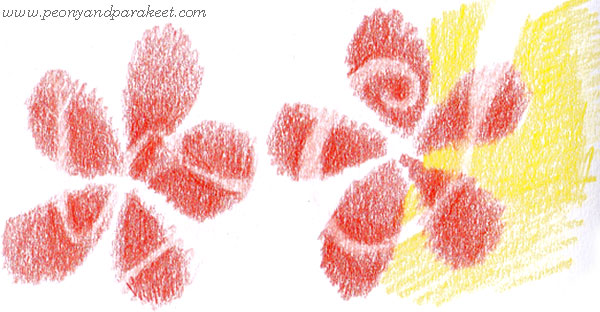
Living Line – Draw a contiguous line that lives, breathes, and touches your soul. The line can form a part of the object, for example, the center of the flower, or express the object’s spirit and stay in the background.
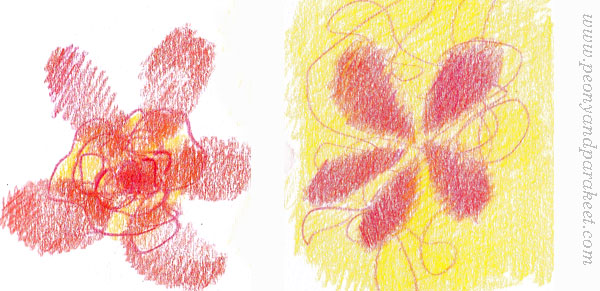
Echo – Repeat the object so that its color is weaker and its position slightly different. You can also make the echo smaller or bigger than the original object.
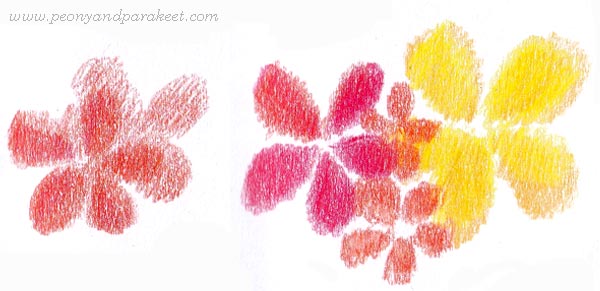
Geometric – Include geometric shapes in your organic drawing. A geometric shape can be partly on the top or in the background, or become a part of the object.
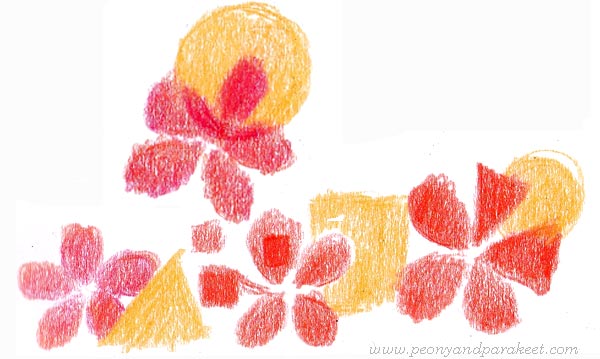
I hope these tips inspire you to create semi-abstract art!
Learn more about creating freely – welcome to my courses!
Semi-Abstract Floral Still Life: A Painting Inspired by Dutch Masters
This week, I want to show you a piece called Damask. It is a dark, semi-abstract floral painting. I often try to create lighter works because they sell faster, but if it were up to me, I would paint almost only dark pieces.

There is something valuable and very private about dark tones. The painting felt so private that I originally thought about just posting a photo of the finished work and keeping the process to myself. But the purpose of my blog is to inspire you to create. Seeing only the final result rarely inspires as much as seeing the imperfect beginning where everything started.
Inspired by Dutch Old Masters
My painting is about how ornaments can be traced back to nature, but it is also a tribute to 17th and 18th-century Dutch floral paintings. The concept – dark background, lots of details, beauty after beauty – doesn’t leave me alone – it is like a recurring fever.
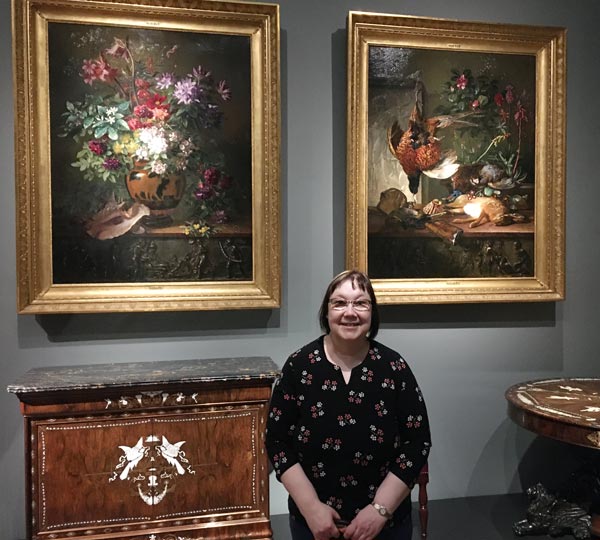
>> See the blog post “Flower paintings at Rijksmuseum”
And there is only one cure: starting a new dark still life, without references, just by painting freely.
How to Start a Semi-Abstract Floral Painting
At first, I used a broad brush and painted simple shapes with different colors.

Then I decided what flower to enlarge and what to hide. Some flowers appeared, but then disappeared when the painting progressed. I like to think that some flowers are born just to give birth to other flowers.

Why Mastering Technique Is Never Enough
I have noticed technical progress in my work. As things get easier, I can set more challenging goals for myself. However, I don’t believe that art is just about mastering technique, or that painting flowers is only about using them as decoration.
When you start a new work, you create a space around you.
It is a private and special place.
While I was making this piece, I felt like I was in an old room. I could hear the wooden floor creak and the wind blowing behind the old window glass. And yet, I felt I was wealthy. I was far away in the past, but I didn’t feel homesick at all.
The longer I have made art, the clearer my vision has become. Intuitive work is not about copying an image from your mind. It is about your work and your imagination starting to share the same atmosphere.
Here you can see the painting in different stages. Some might please you more, but I was after the special place, remember.


Here’s the finished piece, ready to be photographed.

Your Intuition – Your Private Atmosphere
So, what matters is the atmosphere you want to build. This is why it doesn’t really matter if you paint flowers or faces. From this perspective, all art is abstract. It is not just about thinking of the composition as abstract —it is about the character of each detail and how it connects to your private place (that then opens up to the viewer, too).
Here are some detail pics of my semi-abstract floral painting called Damask.


Friends in Art
Art is a private experience. Through my online courses and videos, I am visiting your private space. I often imagine that we are visiting each other. When the lesson ends, we both return to our own worlds, feeling inspired. It is hard to grow—both technically and as an artist—if you always keep the door closed.
Welcome to my courses to improve your skills and your artistic thinking! If you need more inspiration, feel free to browse my blog archives by date, category, or supply. I have shared my journey here every week for over ten years.
Inside the Creative Process: Art, Words, and Morning Robes
I often find that the bridge between painting and words is a difficult one to cross – especially when your latest work decides to speak a language of its own.
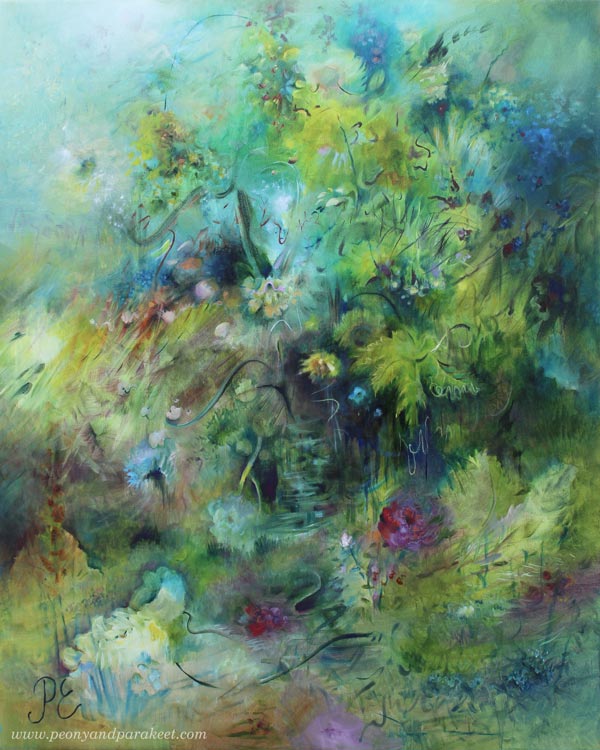
Even though I’ve always loved writing, being a visual artist often brings moments inside the creative process where words simply disappear.
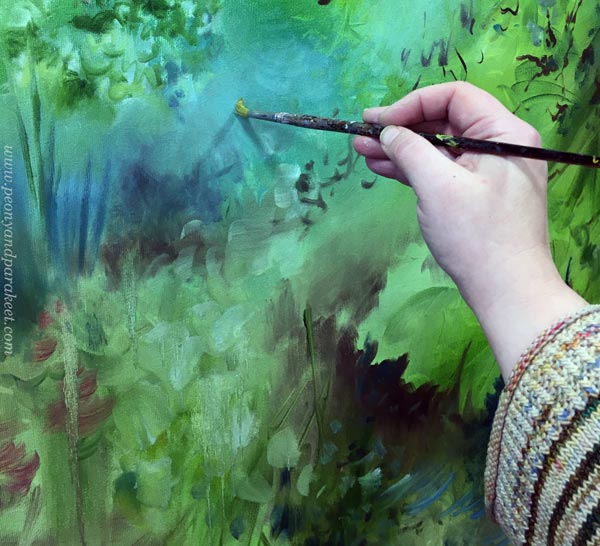
Lately, I’ve been painting a lot. The more I paint, the harder it feels to write all those applications and descriptions that an artist is constantly expected to produce. It’s just as difficult to read what other artists write about their work—and even harder to read a critic’s take on anyone’s paintings.
It feels like words just bounce off the surface of a painting without ever sinking in. When you paint, you are inside the artwork, living between wordless layers. It’s a good place to be. At least until you make the mistake of asking yourself: “Hey, what exactly are you painting right now? Tell the camera! Write it down! Share it with the world!”
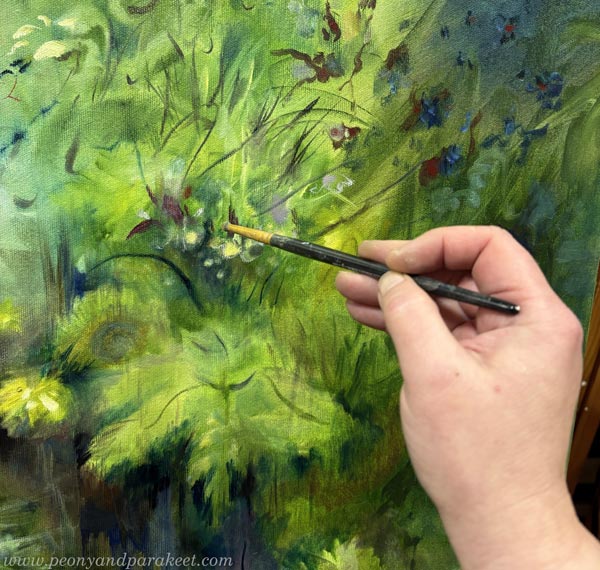
When that happens, my confident grip on the brush vanishes, and I start to stutter: “I’m just… putting some green here… and a little bit of red. Just a tiny bit …”
Inside the Creative Process: When the Painting Speaks First
As a painting gets closer to being finished, the words come more easily. Or rather, it feels like I don’t have to go looking for them because the painting has something to say for itself. Even though I don’t speak French, I feel like my latest work speaks the language. I call her Boheme. She is like a woman opening her front door in a morning robe, with everything in her life a bit scattered and messy.
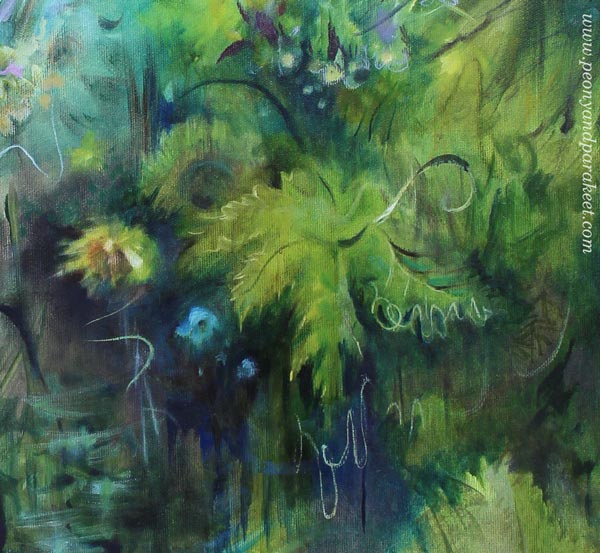
In my own life, I think I’ve only opened the door in a morning robe once when a surprise package arrived. Back then, the postman certainly didn’t see a mess behind me — everything was in its place. So, it’s a mystery why this opposite creature appeared on my canvas. I knew from the start that I couldn’t control her with a heavy hand. Not because Boheme would be afraid of orders, but because I have no desire to fight that kind of energy. I’d rather let her grow, be free, and express her own kind of beauty.
Dreams I Didn’t Know I Had
Maybe that’s where the conflict lies. My own world is small, and I find myself quite uninteresting as a person. Yet, my paintings reach further and bring out things I didn’t even realize I was thinking about. That’s my favorite part of this job—seeing your dreams come true, especially the dreams you didn’t even remember having.
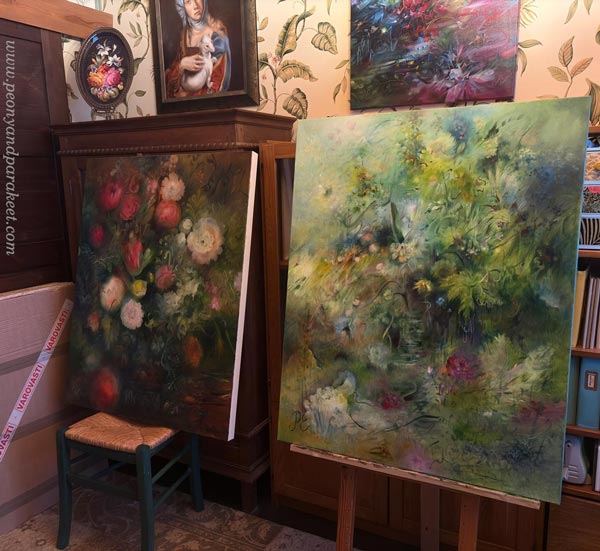
Despite all this “unconsciousness,” it’s still good to recognize the words, music, scents, and moods that belong to your artistic vision.
Finding the Right Mood
A few weeks ago, my husband told me about a record review he had read. He hadn’t heard the album yet, but the description stuck with him. Just from his brief explanation, I got a strong feeling it could be interesting for my art. We searched for the article to find the singer’s name. It was the album LUX by the Spanish artist Rosalía, and it felt familiar from the very first notes. I love her track Bergheim. It mixes different styles with classical music, creating a luxurious, grand, and slightly mystical atmosphere.
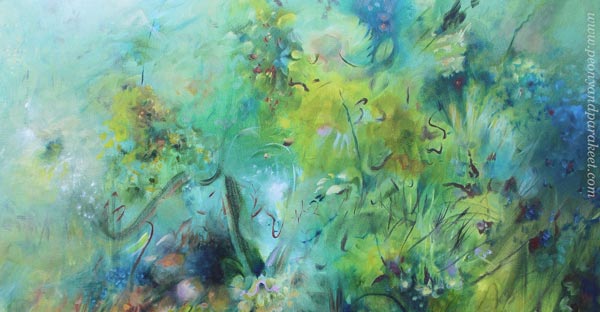
Boheme and I have been listening to the song together. Through her, I’ve realized that when it comes to morning robes, the mint-green terry cloth one my mother once bought me has nothing to do with the luxurious creations Boheme has in her closet. And those are the kind of closets you actually want to leave open when you answer the door.
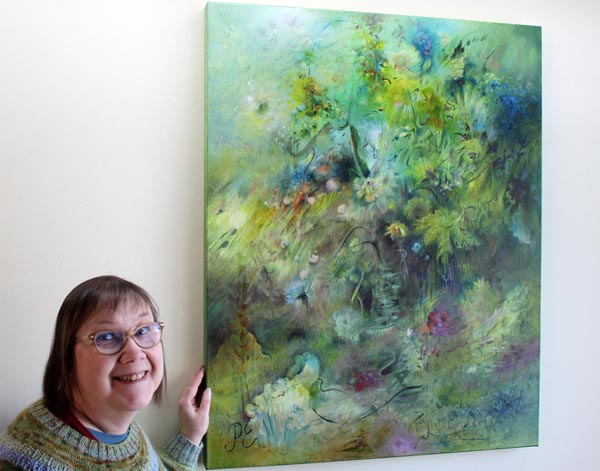
And that’s the true beauty of art: it always gives you a better view.
The annual major painting event, the Sales Event of the Finnish Painters’ Union, takes place in March at the Cable Factory, Helsinki. I am participating in the event with this painting, along with a few others.