Do You Aim for Clever or Honest Art? – Series of Inspiring Quotes #1
This post and the next two posts of the following weeks will be about inspiring quotes that I have heard or read recently. I hope you will enjoy this series!
This Week’s Quote
“Art is the competition of honesty,
not the competition of cleverness.”
Who Said?
American fantasy artist Sam Flegal, originally a quote of an American painter Ran Ortner
Where?
One Fantastic Week YouTube Channel, episode “Artist Mentorship #15 – Fantasy Artist Allie Briggs“
Fantasy artists Sam Flegal and Peter Mohrbacher run art discussions every week on YouTube, and they also mentor other fantasy artists to find their path. When their current mentee Allie Briggs tries to find her way to success, Sam and Peter dig deeper to discover what kind of art comes naturally to her. They talk about how important it’s to find themes that we want to create rather than consume. Then it’s not so much about what we would love to see ourselves doing and what we would like to invent but what we truly want to spend time with when we are actually creating. They also talk about how we can take almost any prompt and use the things we love to create to express the message behind the prompt.
Honestly, You Don’t Need a Grand Idea to Start Creating

When I participated in Inktober art challenge last October, I understood that the basic idea doesn’t have to be anything grand. It’s the add-ons that bring the image to a new level. The more I drew by following the prompts, the more honest my art began to feel.
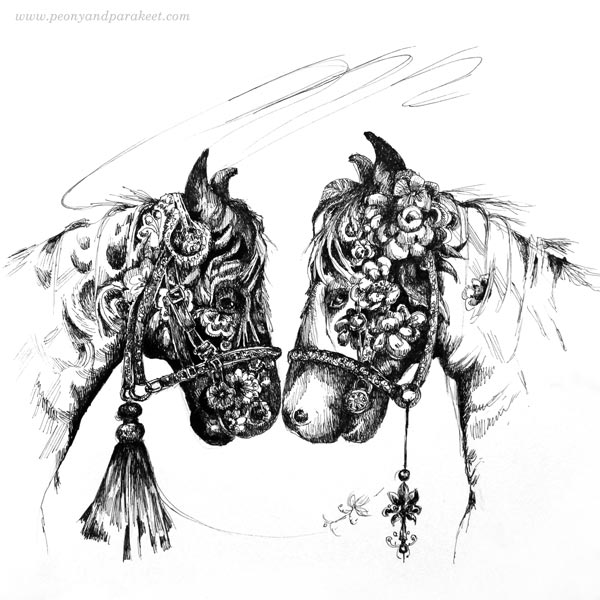
During the challenge, I confessed to both myself and to the world that I like to draw luxury, beautiful physical objects that I have taught to treat as vanity. Jewels, tassels, decorative flowers, luxurious fabric, glass, crystals, etc. I also permitted myself to first draw fur, then decorative animals, and get back to my childhood years of always yearning for a new pet.
Read also:
Honesty Is Not Modesty
Many foreigners say that Finland is a land of honesty. They feel that in Finland you are safe. Nobody steals from you, and you can trust to find your treasures where ever you leave them.
But for a Finnish person, this country is often a land of modesty. When Finnish people call somebody as an honest person, it means that he accepts his limitations and circumstances and doesn’t pretend anything else. We Finnish are supposed to appreciate simple things, and not to be dreamers, but doers. Why draw jewels, when you can document your everyday life?

However, to me, creating honest art has required that I accept my love for unapologetic beauty. I am in my element when designing overwhelmingly beautiful things and dressing up beautiful animals and ethereal creatures.
Start Your Path to Honest Art – Do This!
What are the little things that you don’t consume or possess, but you do often dream about just for fun? Draw them!

More inspiration: Join us to draw fantasy art – Sign up for Magical Inkdom!
Revamp Art Journal Pages So That They Spark Joy!
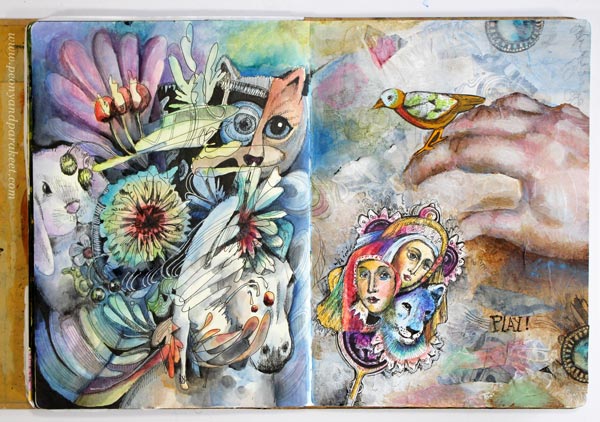
Here’s an art journal spread that I just finished. First, it was just a couple of old black and white drawings that – like Marie Kondo would put it – didn’t spark joy. But I used the old floral drawings as an inspirational foundation for the revamped spread. How and why revamp art? Keep reading!
Why Revamp Art?
The more confident I have become in creating art, the more I have begun to see the potential in my old art. Busy sketches, not so beautiful messes, and clumsy paintings and drawings all show the level of inspiration that still satisfies me. It’s the level of execution that I want to change. I want to tidy up some messes and add more expression and depth. I am certain that Marie Kondo would approve the idea of working with the old art journal pages. Isn’t it quite minimalistic compared to buying new journals all the time?
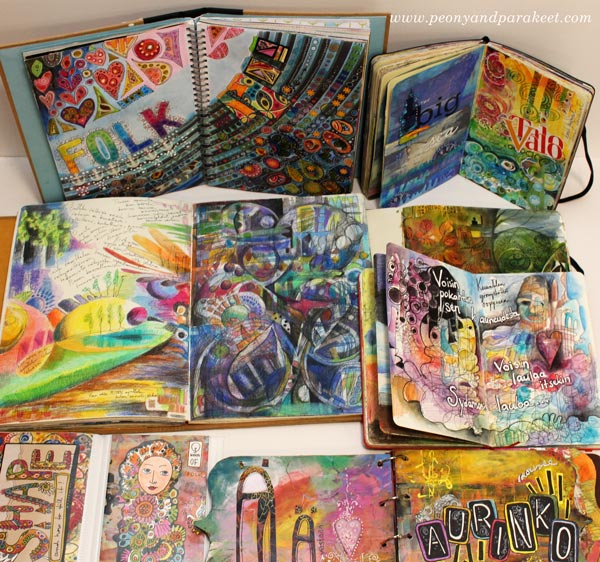
Revamp 1 – Change the Topic of the Page
Maintain the composition but change the topic of the page!
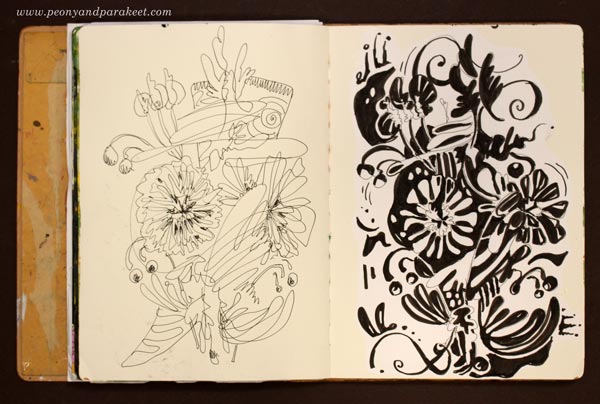
Here’s the spread before I started re-working it. It has a couple of carelessly drawn floral clusters.
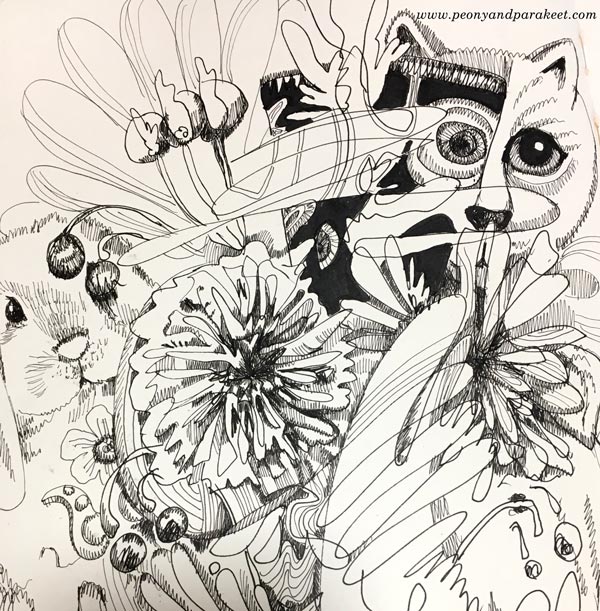
I changed most of the flowers of the left page to animals, added more details and shadows, and made the lines and shapes neater.
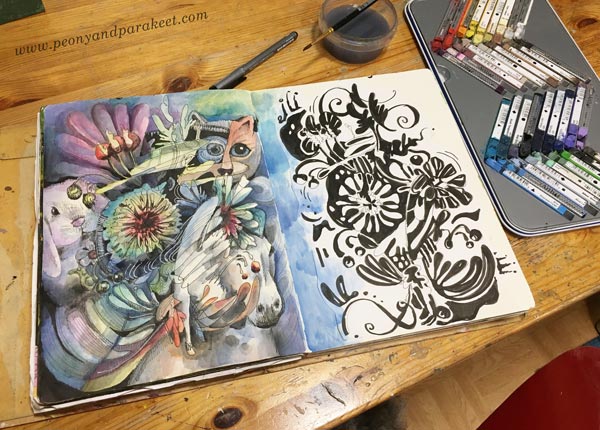
Then I used Derwent Artbars to color the line drawing.
Revamp 2 – Tear the Page and Make Collage Art
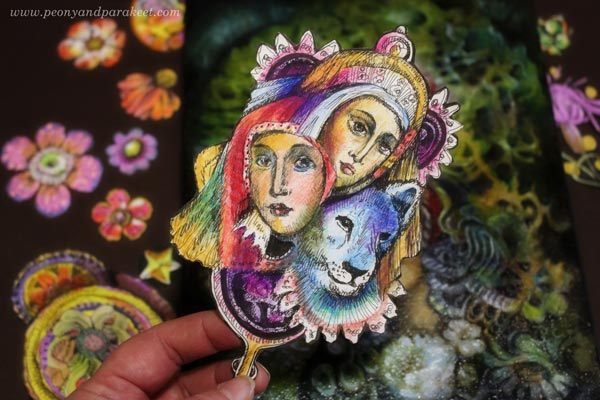
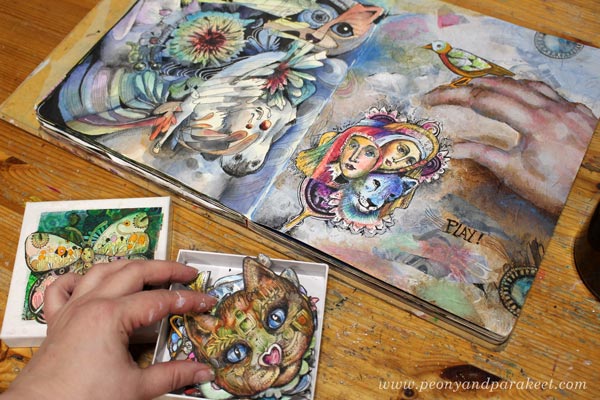
I made some more drastic changes to the other page. I ripped parts of the black and white drawing that had been glued there. Then I went to my boxes of joy – the boxes that hold my hand-drawn collage pieces – and picked this motif.
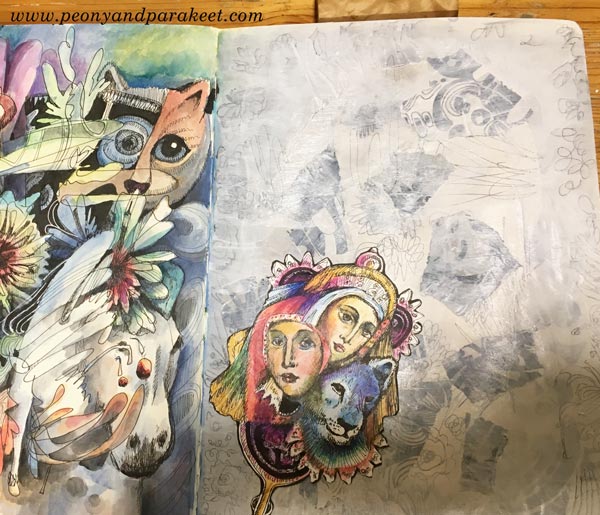
The background was painted with white acrylic paint. I worked in layers, glued some of the ripped pieces and doodled carelessly, then added more paint.
Revamp 3 – Paint Over a Part of the Page
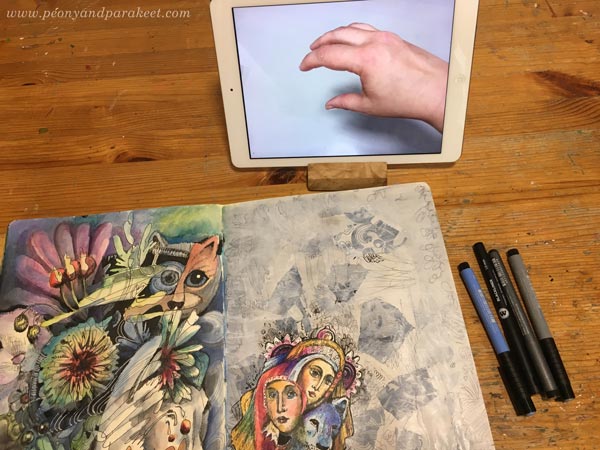
I wanted to include a hand showing how I currently play with my art. I took a quick photo and used it as a reference.
See how similar a page from my first art journal from 2010 is!
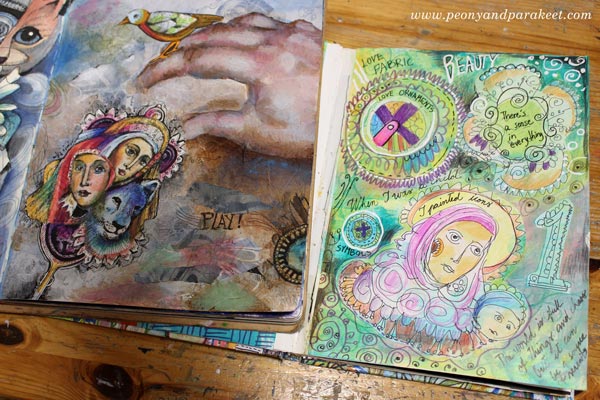
Have you documented your creative play? How you do it and how it makes you feel?
Revamp 4 – Cover a Page with a Piece from the Archive
Before I finished the spread above, I re-vamped another spread. This one only had some doodles on the right page, and then a drawing inspired by Mark Rothko glued on the left one.
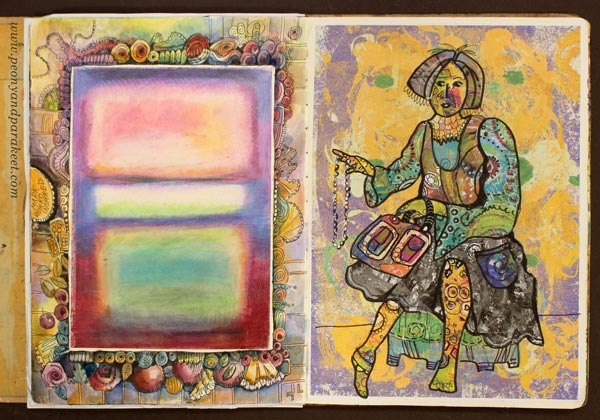
I found an old hand-drawn collage and glued it on the right page. In 2010, the collage was disappointing to me. I wanted to find my style and as a fashion illustration, the image looked clumsy.
However, it seems now that I wasn’t able to translate the message of the image correctly. Now, the piece makes me smile – there I am, sitting and handing the things that have always been inspirational to me: jewels and bags! I just wasn’t able to draw them like I did last October so I didn’t realize that they are the key elements for my visual voice.
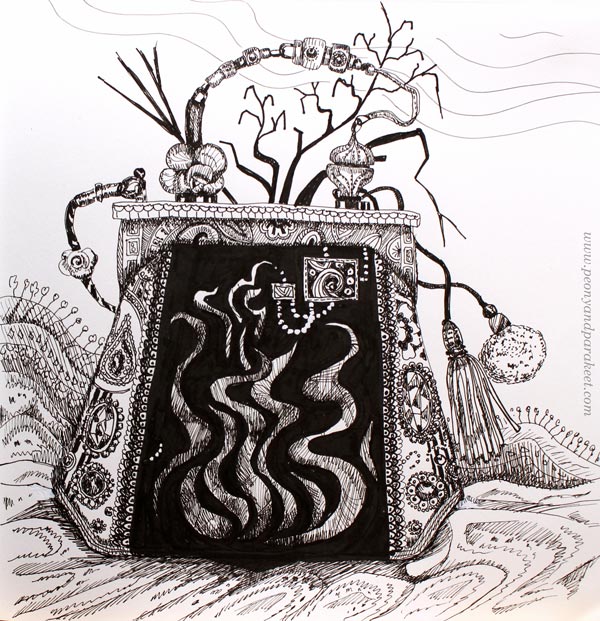
My collage was saying: “You should draw more bags and jewels, Paivi!” What does your old art speak to you now?
Revamp 5 – Add a Decorative Frame
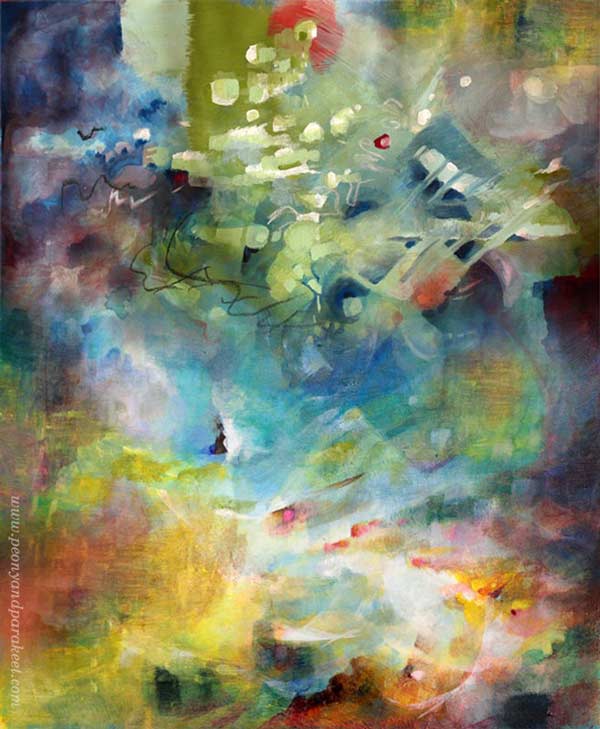
During the years, I have made quite many of Mark Rothko inspired drawings, see this blog post! I love detailed drawings, and no matter how skillfully I would try to replicate Mark Rothko and other minimalists, I was never satisfied with the result.
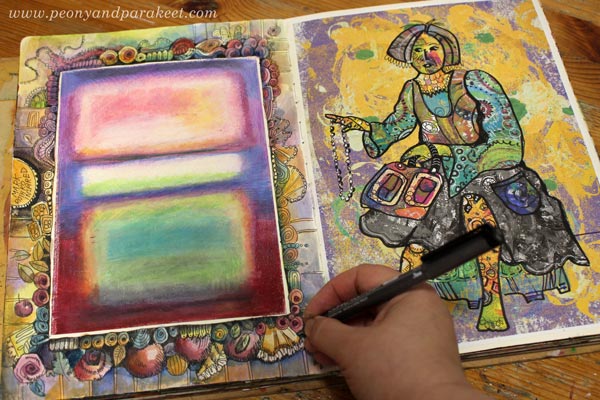
I wanted to hug the idea though and make a decorative frame around the old abstract.
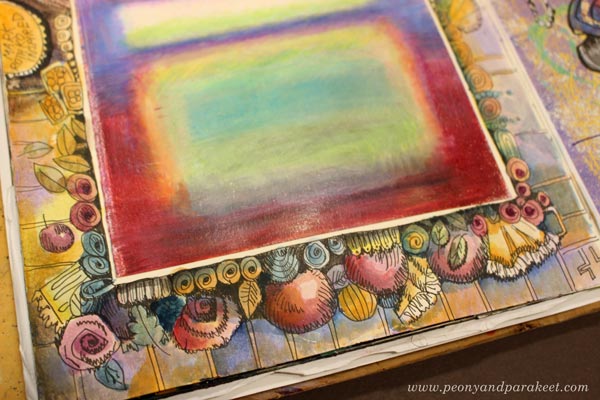
This way I am saying that the level of inspiration is there – Mark Rothko really makes me want to create whenever I look at his paintings. But the level of execution that I enjoy and am best at is something totally different.
This spread really sparks joy to me now, and I also couldn’t resist playing a bit with the collage pieces.
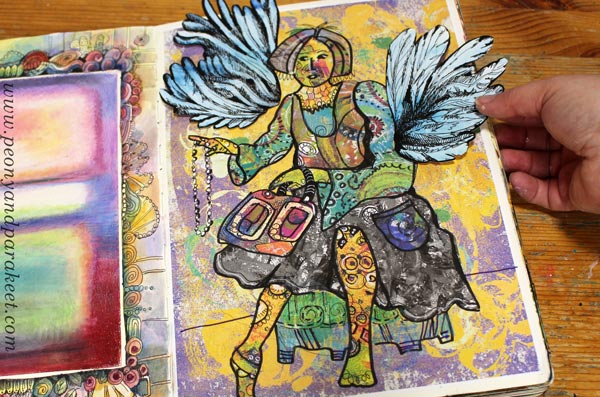
Isn’t it amazing how similar the style can be after so so many years, and after spending so long time trying to figure it out!
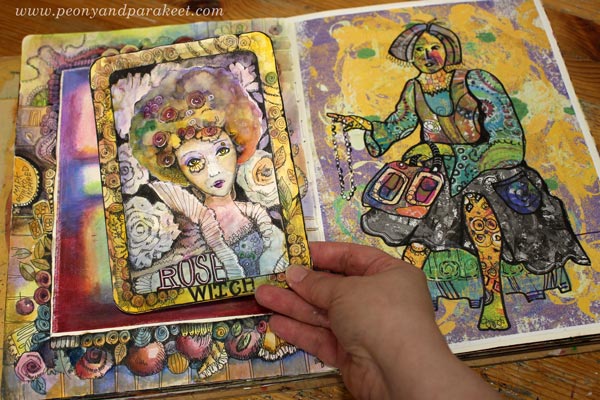
Here’s to Mark Rothko!
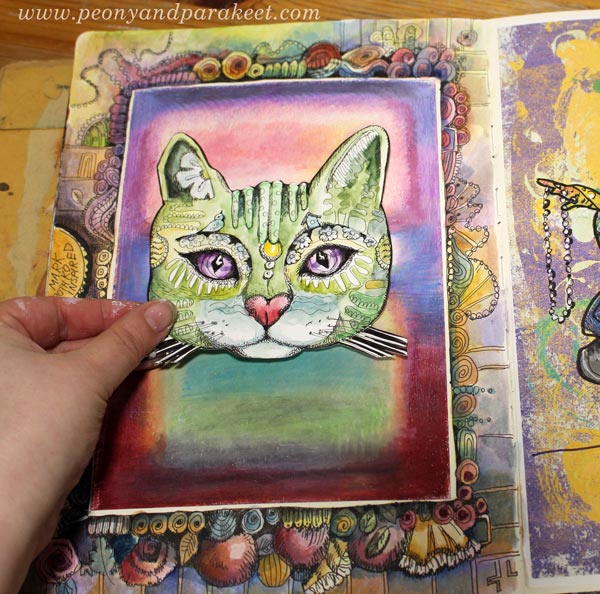
I am loving playing with the old art journal spreads, building the bridges between the years. If you separate inspiration from execution, does it make you look at your art in different eyes?
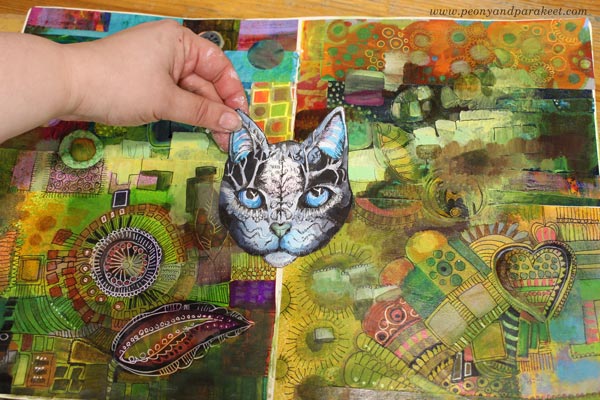
The Idea For This Blog Post Came from These
a) One of my notebooks mixes writing and drawing so that randomly scribble, doodle, and write there. It’s a private journal, and I didn’t want to publish its pages but the more full it has got, the more I have realized that when the sketches and writings are not organized chronologically, and I can revamp the pages repeatedly, they naturally produce new ideas.
b) Mackie d’Arge, a wonderful fellow artist from the USA, has shown her beautiful art in my art community Bloom and Fly. She has made many pieces by rebuilding and revamping her old artworks. It has given me the idea of looking at the potential of my old art and what could be made from there.
c) My classes Animal Inkdom and the upcoming Magical Inkdom are all about playing by drawing. I have wanted these classes to be fun, so they have made me include humor, fantasy, and play in my artistic process as well. They have made sure that my boxes of hand-drawn collage pieces stay filled even if I would “shop” there all the time! In Magical Inkdom, we will also draw decorative frames. >> Sign up Now!
Three Creative Approaches that Affect the Way You Feel About Your Art
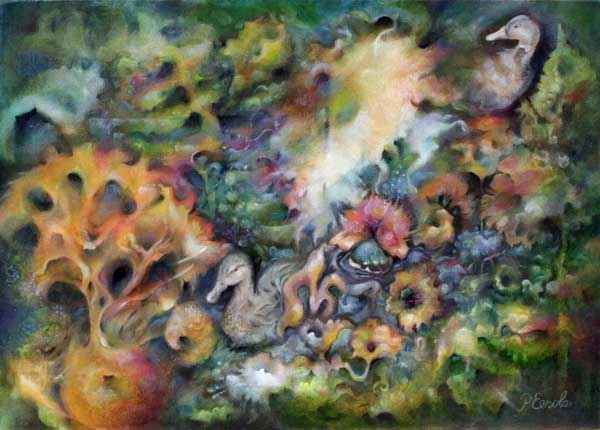
Here’s my latest oil painting called “Dreaming Ducks.” I started it in December 2017 and finished it just recently. It’s the biggest oil painting that I have made so far – 70 x 50 cm. I painted it too long, too many sessions, and lost my motivation several times. Painting became more challenging layer by layer and I demanded more of myself, never feeling fully happy what I had made.
1) Fine Art is a Stone on the Bottom of the Sea
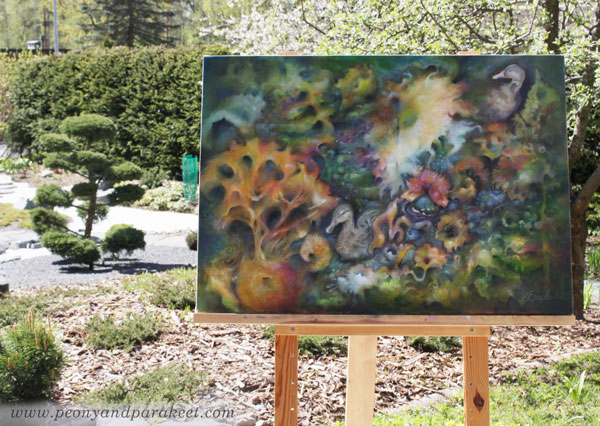
The deeper I dive into fine art, the heavier it feels. If creativity is a sea, fine art is like a big stone on the bottom. I have to dive deep, it takes time to reach it, and then it feels so heavy, that it’s often impossible to lift it. But then, on the other hand, it’s also an anchor, the core of my visual voice and artistic identity.
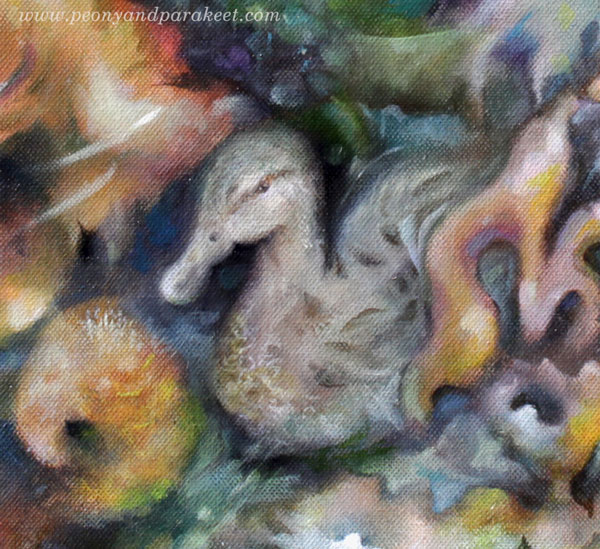
But at the same time, I believe that if we only create fine art, it narrows everything. It narrows our artistic vision because we lean too much towards what is appreciated in the art world. It narrows our audience, and we no longer serve all the people we are meant to serve. It suffocates our enthusiasm because we raise the bar all the time. We forget what really matters because we block ideas based on whether it’s fine art or not.

Fine art makes us limit ourselves: “I paint abstracts only”, “I have to choose my palette and stick to it”, “I need to find my style”. When we have the mindset of a fine artist, we question what we do all the time.
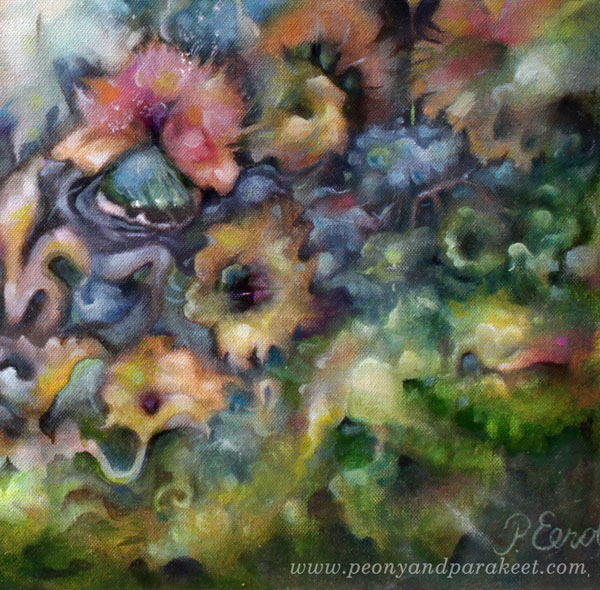
2) Creative Play is the Boat Floating on the Sea
But then, there’s the surface – the fun stuff that I personally missed too many years while growing my skills to reach the big stone.
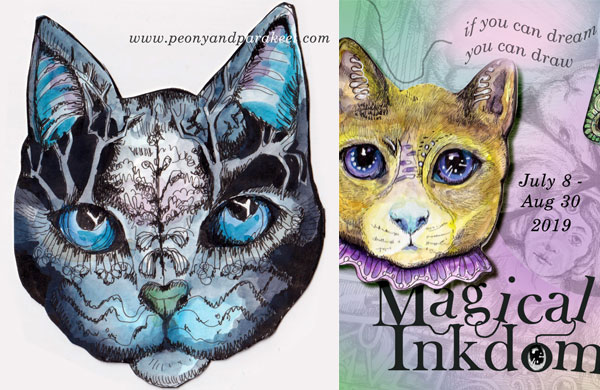
These ink drawings are like a boat to me. I acknowledge now that it’s mindless to make the diving attempts if I don’t have anything supporting me on the surface. Something like drawing witty cats! I have made many for the upcoming class Magical Inkdom!
3) We Easily Miss the Water That Connects the Two
We have been talking about the bottom of the sea and the boat, but it’s all connected, right? It’s easy to forget the water when you are going for the stone or polishing the boat! An artist friend of mine pointed out this to me. She said: “Your work always contains designs.”
Like water, it was a no-brainer: “Well yes, I used to be a designer. I like to design things.” But at the same time, it was something I hadn’t really thought about.
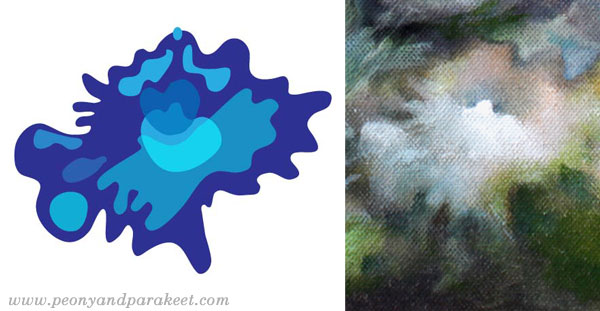
I went to my computer, wiped the dust from my old Intuos 4 drawing tablet, opened Adobe illustrator, and started drawing.
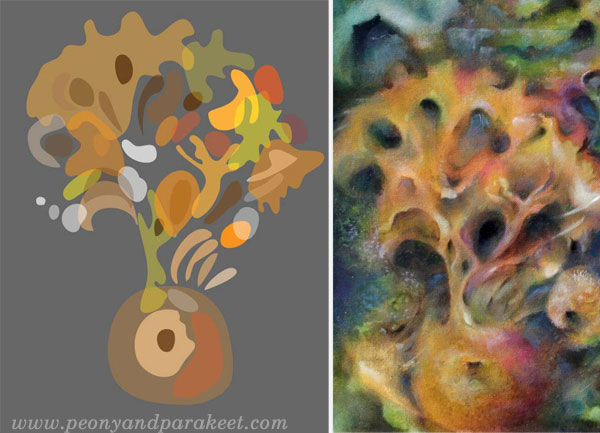
The blue cat got a cousin! Look how I used the motifs above to complete this digital drawing.
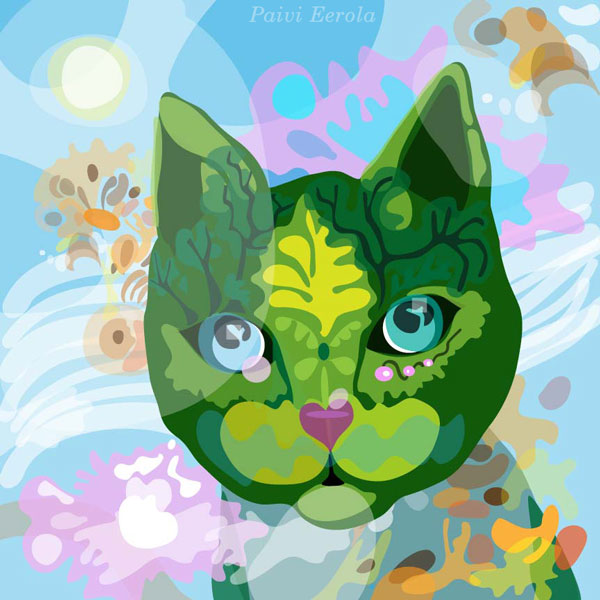
Three Creative Approaches
Now I think that these approaches should be the elements of every creative process:
a) diving deeper to find the anchor – discovering your visual voice
b) sailing happily in a little boat – playing with your imagination
c) seeing the water that connects the stone and the boat – becoming more aware of your current capabilities and what you can accomplish now
When I started to see the water, I got the feeling that it’s all good. Anything that I do can be connected, repurposed, and fed back to the process. What I have dreamt can begin to happen now, not years later.
What do you think of these approaches? Can you apply them into your art? Which is the hardest and which is the easiest for you at the moment?
Drawing on Fabric – Illustrated Quilt Blocks
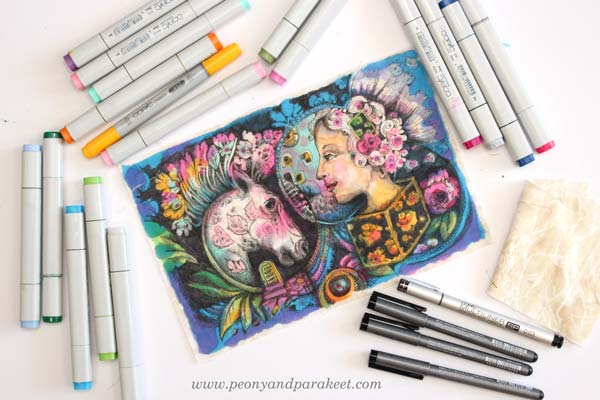
This week’s blog post is for all who love fabric! I have started building a new class, a magical sequel to Animal Inkdom! I want these “Inkdom classes” to be as versatile as possible so that you can use your illustrations in gifts, everyday items, and whatever you like to create. This goal perhaps brings out the designer from me – always seeking for ways to get the most of the beautiful pictures.
Brainstorming when Making a Quilt
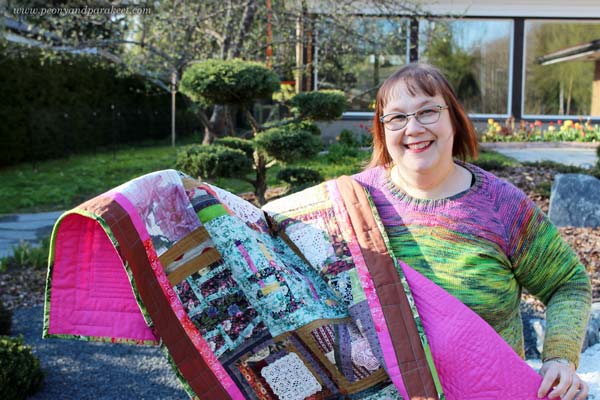
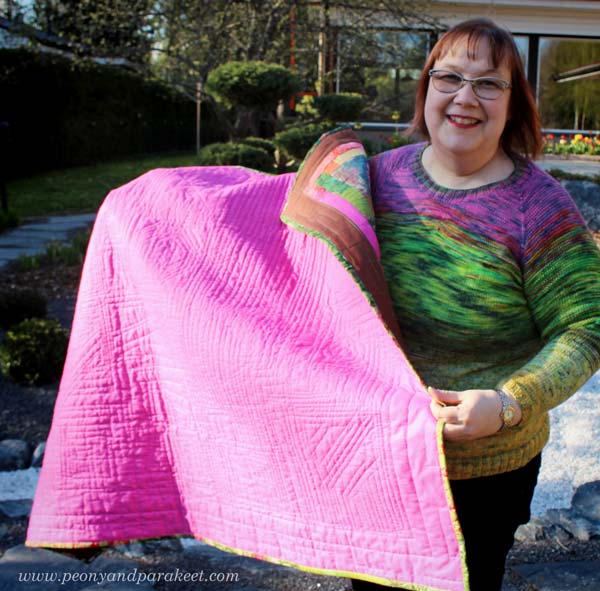
My best ideas come, when I am taking a break. Last week, I had to stop the class development for a few days, because my beagle Stella had been waiting for her quilt far too long. The old ones were so worn out that she could barely carry and wrap herself in them. I had almost finished the top of the new quilt but there was still quite a lot of work in quilting and binding it.
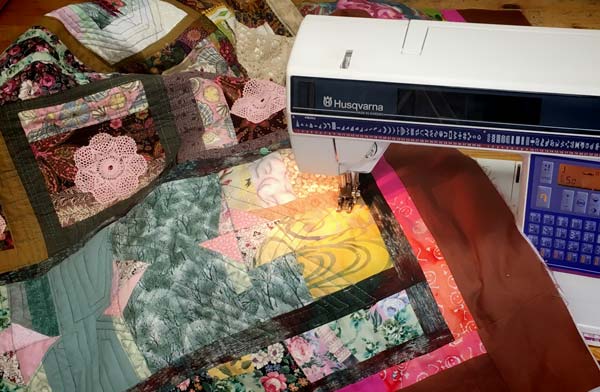
So I put the art supplies away, bought pink fabric for the back, and started stitching. The blocks had printed photos, crocheted doilies, ugly leftover prints, experiments that had piled up … I had just sewn them all together! But the more I worked on it, the more unique the blanket felt, and the improvisational way of working kept me energized. Just like when drawing!
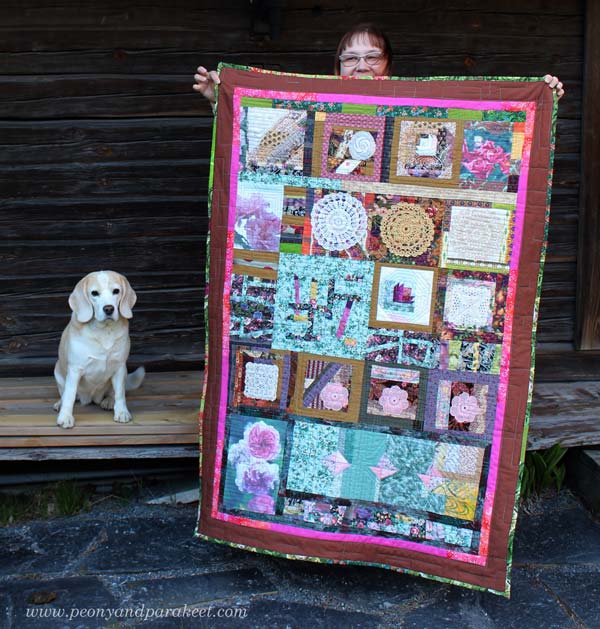
So it hit me, that it would be wonderful to build bridges with this kind of fabric play and drawing.
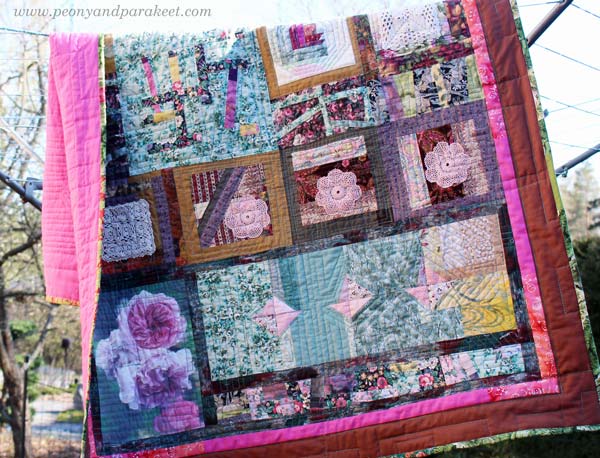
See how full of “doodles”, improvised quilt patterns, the top has!
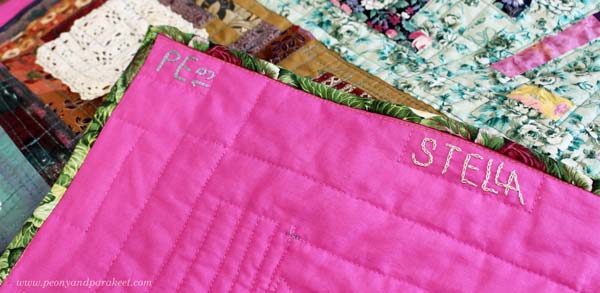
I doodled a bit with the embroidery floss too. But that’s a lot of work, and it doesn’t feel the same as holding a pen in hand. I missed my markers!
Drawing on Fabric with Copic Markers
Once Stella’s quilt was finished, I went to my Copic markers. I ironed a piece of natural white cotton fabric that had some print patterns. To make the patterns even more subtle, I drew on the wrong side of the fabric. So I had a lively background that wasn’t too busy. First, I made a line drawing with thin-tipped black pens. They were Copic brand too.
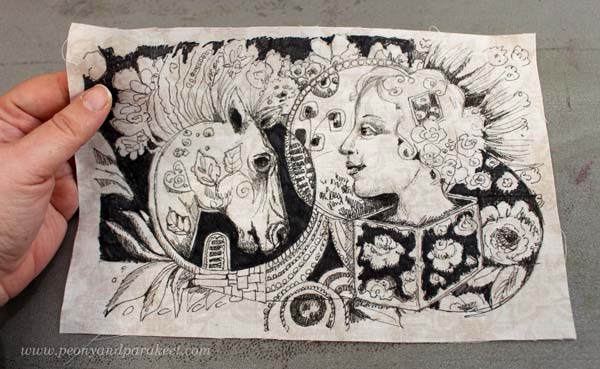
Then I started coloring and making the drawing more detailed.
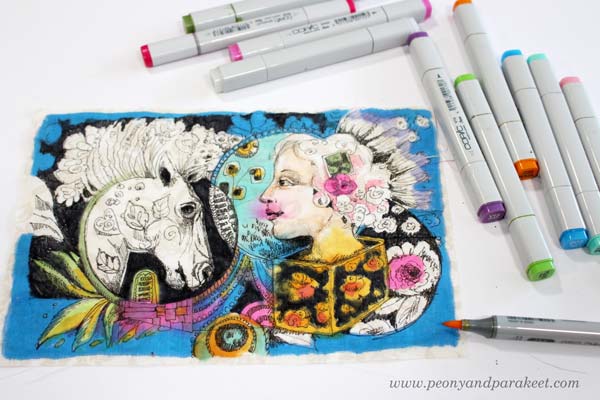
Here’s the finished piece. I loved the easiness, the softness of the lines, and that I now have a unique quilt block. I will certainly draw some more!
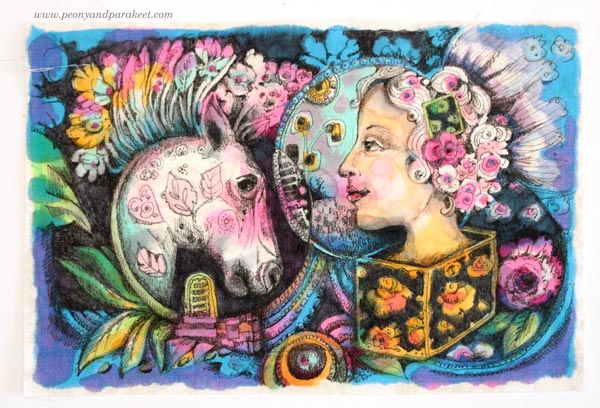
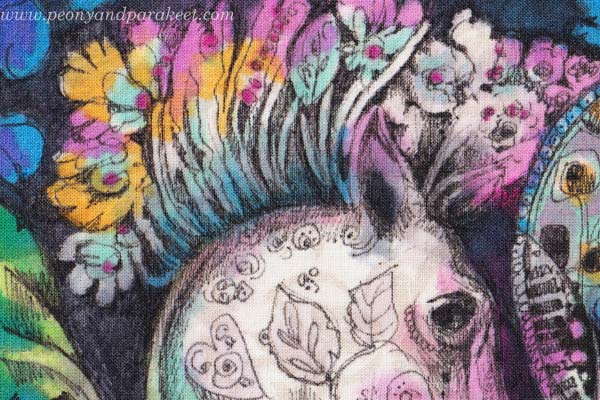
Here you can see how the lines, fabric and color blending go well together.
When I look at my fabric stash, this hand-made piece is definitely what I love the most.
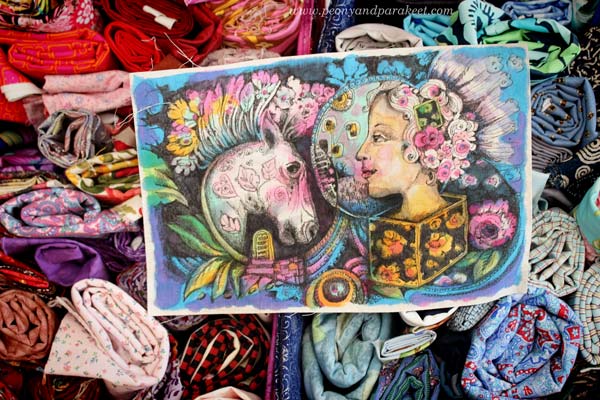
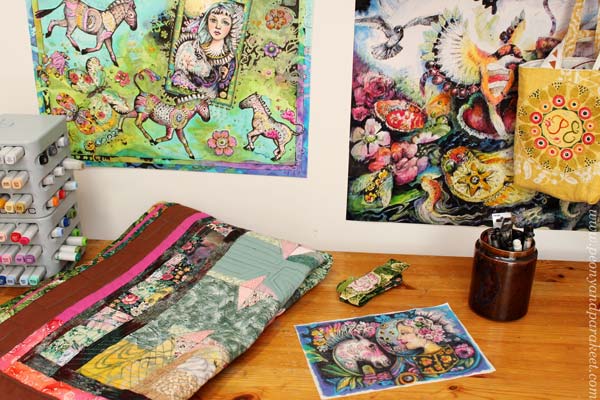
My art studio looks so happy now! The best thing is when many things that I love to create come together.
While I am preparing the new class, tell me, what kind of ideas and instructions have you been waiting for building bridges between your arts and crafts!