
Finishing a Watercolor Painting
This week, I have a video about finishing a watercolor painting.

See more pics on the Finnish art store Taiko’s website!
Painting Freely and The Challenge of Finishing
I paint watercolors freely without models or reference photos. It’s exciting to see what appears on the paper and to examine random spots trying to find flowers and plants, which are my favorite subjects. I believe that if I manage to create favorable conditions, the plants will start to grow naturally on paper.

When painting flowers freely without references, it’s easy to omit the details. But I think that the details make the finished look. Everything doesn’t have to be sharp and intricate but focus on those parts that you want to catch the viewer’s eye.
Making a Color Chart
My watercolor set has colors from many different manufacturers. I use artist-quality colors and always as pans. If I buy a tube, I’ll squeeze the paint into the pan. I like to use a color chart. The colors look darker when wet and on the pans as well. And there are differences in how pigments behave.

My grid follows the order of the pans and I add the names of the pigments below the color samples. A part of the colors are in a separate box waiting for their turn to get to the 36-pan set. I make notes on them at the end of the chart. The color chart prevents me from buying several similar pans (that happened too many times before I made one!) and helps with memorizing which colors are my favorites.
Start Freely – Finish Slowly!
There are watercolor painters who wet the paper, draw a few brushstrokes on it and the painting is finished. I work on the same painting for several hours and slowly approach the result layer by layer. It requires patience, but on the other hand, I can always paint on fine-quality cotton paper because my approach is less experimental.
I love that the painting doesn’t immediately shout but first whispers timidly. Each painting is unique and I like to spend time getting to know it. In doing so, I will not only learn something about the painting or myself but about humanity and nature in general.
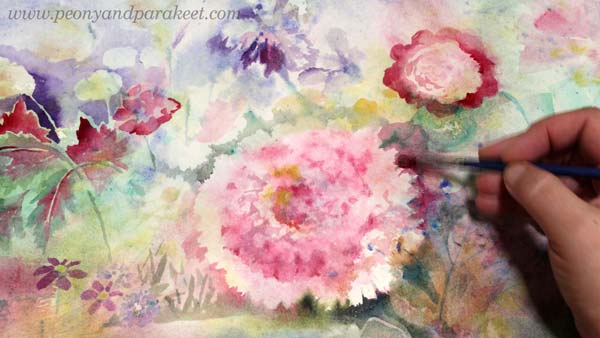
I want the result to look natural, although there is also a lot of decoration in my paintings. I love ornaments – swirls, decorative lines, and shapes, and my favorite historical style is Baroque. It is easy for me to see the luxury of baroque in plants. As a child, I imagined palaces and halls around me when walking in nature. Life in a remote small town in the 1970s was modest, but I got by with imagination.
Finishing a Watercolor Painting – Watch the Video!
In the video, I have footage from the finishing phase. There you can see that when proceeding little by little, you can add all kinds of things even in the final stages. It’s common for me that a shape is just a circle at first, but then I add notches to it and make it a leaf or a flower. Watch the video!
Freely Grown – Using Colored Pencils for Finishing
If you are new to watercolor painting, working with thin brushes can feel challenging. It’s then easier to use colored pencils for finishing a watercolor painting. I have a course called Freely Grown where you learn step-by-step how to make a layered watercolor painting and finish it with colored pencils. All this is done freely without models and by focusing on techniques, so your work has the same steps, but the result will be completely unique.
Freely Grown is now 15% OFF! >>Buy Now!
The sale ends on July 31st, 2024, at midnight PDT.
Drawing Sceneries with Watercolor Pencils
This week, I have a fun drawing idea: fill a paper with many small sceneries!

For this project, I have used watercolor pencils and Fabriano Accademia drawing paper (size: A4). The paper is very nice with colored pencils and goes well with watercolor pencils too.
Inspiration for Drawing Sceneries
Creating mini-sceneries is easy when you start playing with the scale. Think about a bumblebee – how it first flies over fields admiring the view and then finds a mini-world inside a flower.
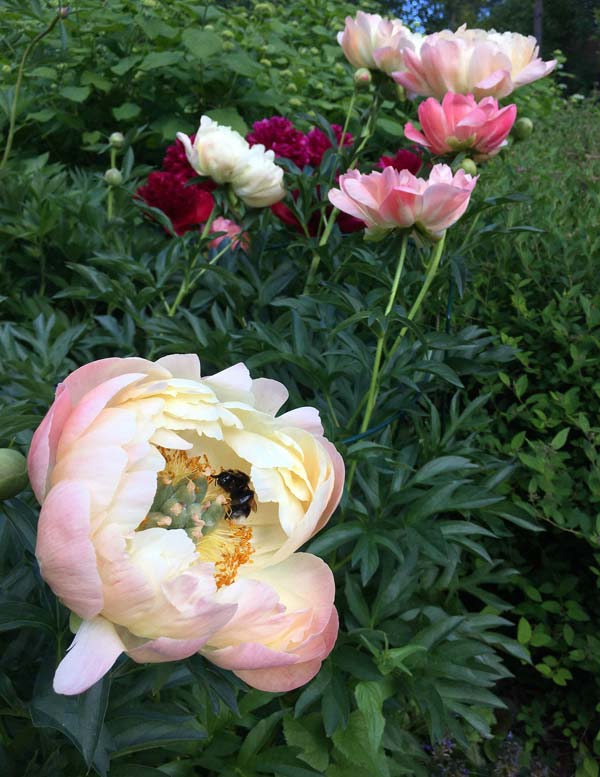
Your mind can be a busy bee, collecting a variety of ideas – big and small.

Your hand can then pick some of those ideas and put them into one picture like it would be a treasured collection in a secret museum. “Faberge eggs,” said my husband when I showed my picture to him.
Watercolor Pencils
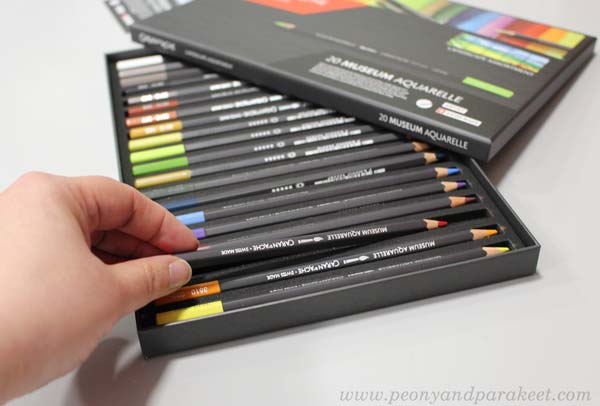
I often use regular colored pencils but slowly I have become interested in watercolor pencils too. I have had a few Caran d’Ache Museum Aquarelle pencils for a while and I love their quality – vivid colors, lovely to hold, and work well without water too. A couple of weeks ago, I bought 20 landscape colors to accompany what I already have.
Mini-Sceneries – Start Here!
Start your collection by picking a circle template, for example, a lid. Draw circles so that they overlap partially. Put one idea into one circle and color each of the circles separately.

This can be a “one in a day” project. Take your time to focus on each circle.
Watercolor Pencils in Use
Watercolor pencils are great for quickly filling larger areas. Color the area lightly and then add water over the colored area.

Let dry before adding a new layer on the top.
Drawing Sceneries – Playing with Styles
My favorite thing is to combine nature-related ideas such as landscapes and flowers with decorative motifs. I like to draw dots, other simple shapes, and lines so that they form frames and ornaments.

In this project, the circles are nature-related while the background has a more ornamental approach.

When you keep the background unified, you can use many styles in one piece. One paper then becomes a diary where anything handmade looks great together because it’s made by one hand and one mind.
Drawing in Ornamental Style

This project is another variation of the earlier blog post: Colored Pencils – Ornamental Approach. If you have taken the course Intuitive Coloring, would you be interested in creating something like this on a course next?
Motion Art – Ornamental Land
This week, I have a short video artwork that has motion and sound. It’s been made as a part of the big project that I am working on. I have received a grant for it from The Finnish Cultural Foundation.
This is my first video artwork that also has audio. I recorded bird sounds and other natural sounds earlier in the spring and composed the soundscape from those recordings.
The 3D shapes are modeled in the 3D modeling program called Blender, and I have programmed the movement in C# programming language. Everything except the audio was put together in the Unity game engine. I added the soundscape in the video editing program called DaVinci Resolve. These are all pretty complicated tools, and it has taken time to learn them. If you are interested in the process, watch my video: “From Painting to Digital 3D Art” where I tell about the first half of the grant project.
Motion Art – Working with New Media
The big project is called “Unknown Land,” and I call this video artwork “Ornamenttien maa” which is “Land of Ornaments” or “Ornamental Land” in English. It has been a challenge to transfer my drawing and painting style to a new media, but I think I am getting closer and closer. What do you think? Does it look like my work?
Creating movement and sound has been new to me, and I will also add interaction to the final piece.
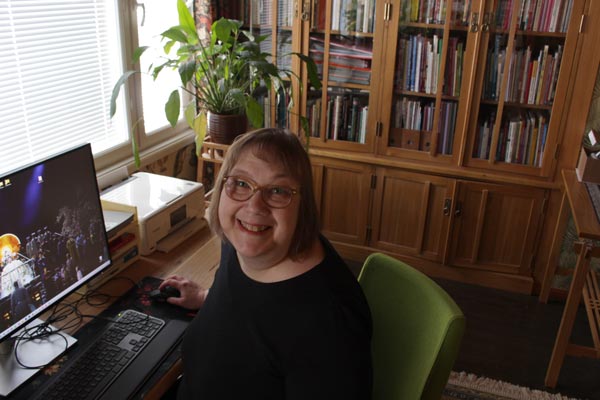
Even if I have spent a lot of time on my computer called Turandot (named after my favorite composer Giancomo Puccini‘s opera), I am not leaving painting and drawing. You will see my digital artworks from time to time, but there will be a lot of other content too. For an artist, working with one medium can help with other. My main inspiration always starts from drawing what ever I create.
How to Add Depth When Coloring Freely
This week, we will color freely on a watercolor background and learn about adding depth to our colorings. I am using regular colored pencils, but you can also use watercolor pencils.

My drawing is inspired by the garden and the ornamental shapes of the plants, insects, and birds. So, let’s go deep in the garden and create lushness!
Quick Start with Watercolors
Blank paper can feel intimidating, but if you fill it first with watercolors, coloring is fun.
I was going through my paper pads when I found an unfinished watercolor painting.

It was just a background with random spots but the paper was smooth, just perfect for colored pencils. I think the paper is Arches Aquarelle Hot Press, nice and sturdy, 300 gsm/140 lbs thick.
I picked up my pencils and started drawing and let my inspiration come from the painted shapes.

I drew flowers, leaves, swirls, and all kinds of odd organic shapes that I would then later adjust.
Add Depth – Expand the Outlines!
When you draw, don’t just outline, but broaden the lines to form larger areas. For example, a black outline can be broadened so that it gradually gets lighter (“shadowing”) or so, that it remains dark and solid but expands to a larger and exciting shape.
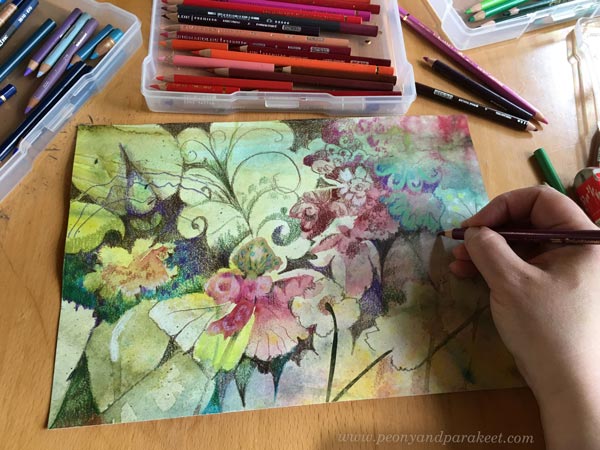
Dark and light should have clear differences so that you can point out separate areas: here’s dark, here’s light, here’s dark again, and so on.
Adding Depth is a Slow Process
When you are working without any references, you are on an adventure! What first looked like a flower, can become a butterfly after a while. Art is a shy fairy and it takes time to attract it.
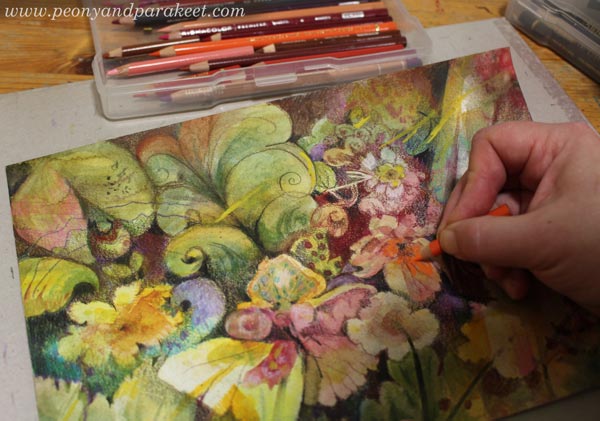
In this intuitive coloring style, adding depth is a process where you slowly brighten or darken different areas. Start with a transparent layer, then add another one. When you have areas that haven’t been worked on with colored pencils yet, you can also use watercolors for layering.

Compared to accurately replicating a photo, this kind of free coloring may first feel much faster. But if you aim for depth, it’s not!
Add Depth – Find the Spirit!
At some point, your piece feels full and finished. But at this point, let me ask you a question:
Have you found the spirit of your piece?
Have you found something soulful that seems too gentle for this world?
Or is there something that cuts your heart and feels painful?
The depth in art is not only visual but something that evokes emotion.

In my piece, I discovered a spirit in the right upper corner. It’s not a flower or anything recognizable, but I felt it strongly.
After you have found the spirit, give more visibility to it. Make it so that it impacts the overall piece.
You Are the Sun
In your art, you are the sun. First, you can bring warmth to the piece by adding yellow. If you have areas that still take in watercolors, add a yellow wash over the greyish tones and let the warmth in.

Second, remember that you really are the sun. So, you can decide how the light travels and where the shadows are. You don’t need to calculate how the shadows should go like there would be one correct solution. Start deciding who deserves the sunshine, and who doesn’t! Who gets more color, and who will stay more in the shadow?
In nature, there are all kinds of reflections, and I find them artistically inspiring. Look at this photo that I took today from our garden pond!
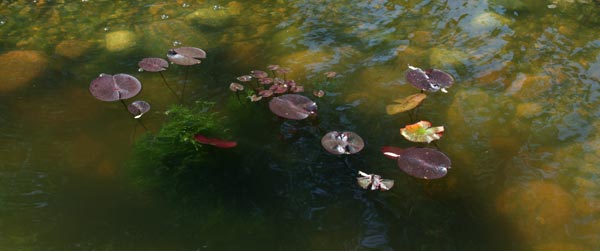
Playing with light, shadow, colors, and reflections is a lot of fun when you are creating freely. Remember that there’s no “shadow judge”, only “sun goddess” – you!
Add Depth – Force Yourself to Choose the Winners
Some people think about the composition all the time when they are creating, but I try to push that urge away as long as I can. You may have a lot of stuff on paper, but if you only highlight your favorites, balancing is easy. The problem is that you really have to choose!
Here, I have turned the paper upside down to get a different view of my work. That yellow flower looks very pretty, but the yellow butterfly shape near it is maybe even more attractive. Decisions, decisions!
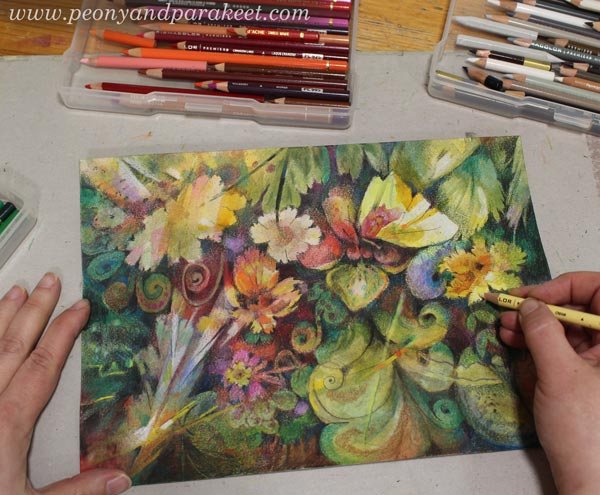
When I was at this point, I thought this was finished.
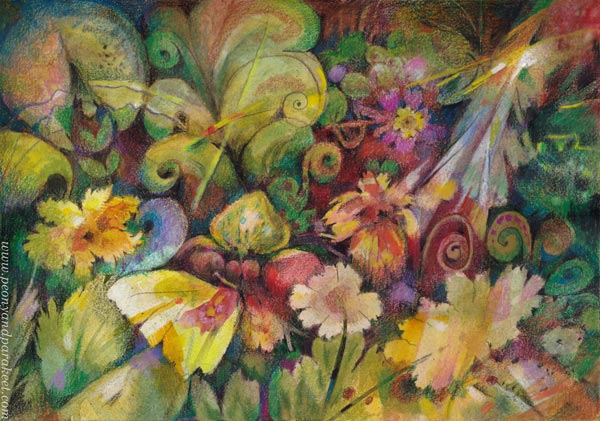
But when you want to add more depth, you want to reduce the competition for attention. I wanted to make the spirit in the upper right corner and the yellow butterfly clear winners even if it meant I pushed back many pretty things.
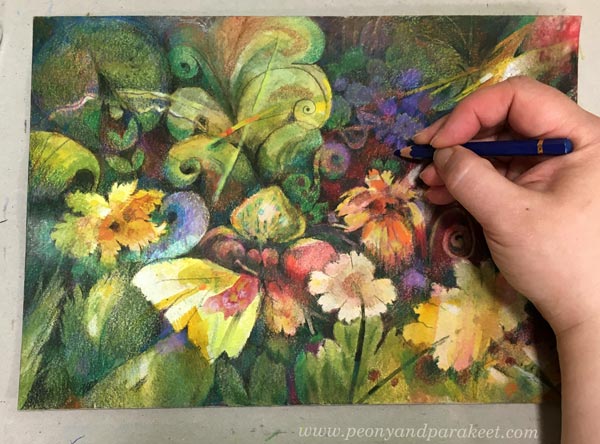
For example, the pink rose got toned down.
Room for Imagination
Things that are further away are blurry, like whispers, and things that are close, are sharp and louder. If everything shouts, and nothing whispers, the viewer will likely turn away. And vice versa, if everything only whispers, the viewer easily walks by.
If depth is lacking, you look at a wall and can’t see further. Depth is not only the impression but the imagination. With depth, you begin to imagine what more could be there. That’s especially why I want to add depth to my art whatever the subject is.
Learn more about watercolors and colored pencils together: See my course Freely Grown!