
Painting an Intuitive Fantasy
This week, I have a new fantasy painting, and I also share tips about selecting colors.
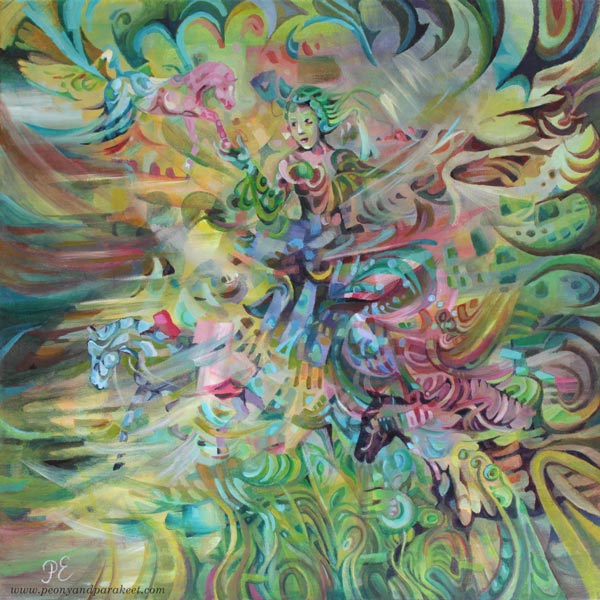
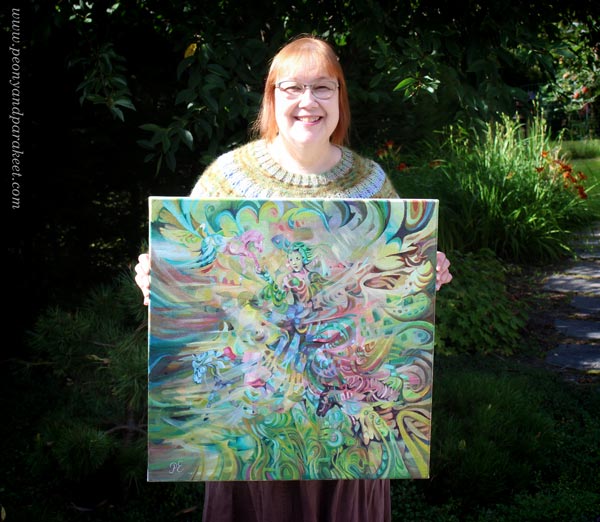
This painting is called “Arotuuli,” which is “Steppe Wind” in English. “Aro” must be one of the few words that are shorter in Finnish than in English, as Finnish words are often very long. We write compound words without space, so it makes words look even longer.
Intuitive Fantasy Painting – Two Tips for the Beginning
I like to paint intuitively, and even if this painting has horses and a woman, it started with random strokes and abstract blocks, and I had no other idea than a secret wish to be able to include a horse at some point.
Tip 1 – Dark and Light
When filling the canvas with color, I like to make dark and light color mixes so that the 3-dimensional effect tickles my imagination.
Tip 2 – Less Can Be More
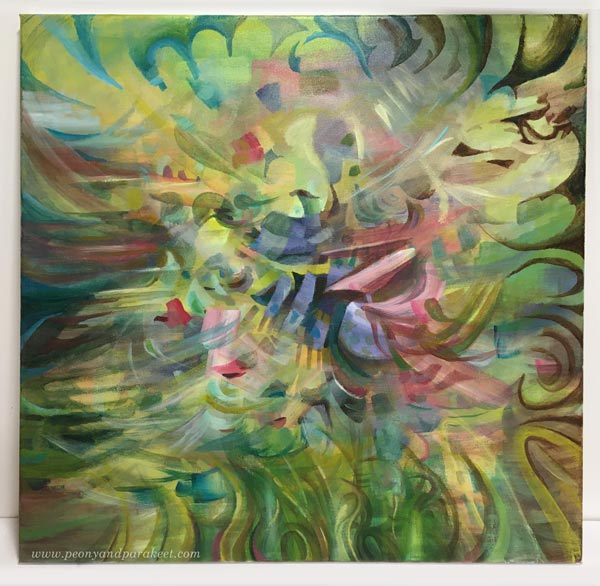
I also like to pick a narrow selection of colors so that the elements look like they are exposed to the same light. In this painting, I mostly used Phthalo Turquoise, Alizarin Crimson, Yellowish Green, and Titanium White. When mixing colors, less can be more!
A Couple of My Favorite Colors
I am especially fond of Yellowish Green and Alizarin Crimson, and I recommend them warmly. Let’s talk about them a bit more.
Color 1 – Yellowish Green
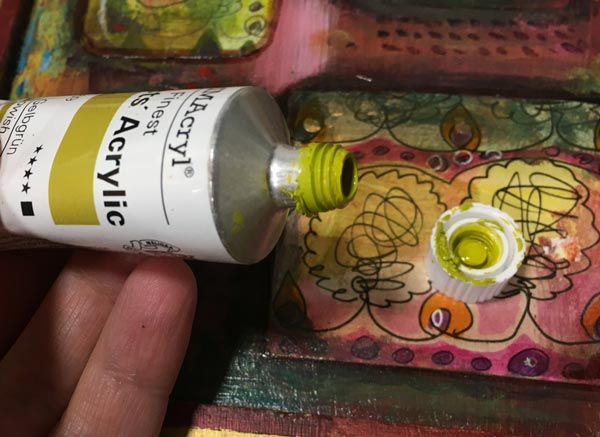
Yellowish Green is a color mix manufactured by Schminke Primacryl. I bought this tube because I love Daniel Smith’s Rich Green Gold in watercolors, and I wanted to have a similar tone in acrylics. I like colors that remind me of lemons and lime fruits – one of the most beautiful things in the world – and I always find use for yellows. This color is like two colors in one tube: it works very well with the mixes that require yellow, but it also produces beautiful greens with blues.
Color 2 – Alizarin Crimson
Alizarin Crimson is an ugly red. I don’t think you would buy it if you didn’t know more about it. It looks like dried blood but works very well with color mixes. White reveals its gentler side, and when mixed with blues, you can get beautiful blacks, browns, and dark purples. It produces a pleasant and quite sunny orange with yellows, and in general, it’s a workhorse, always willing to step in.
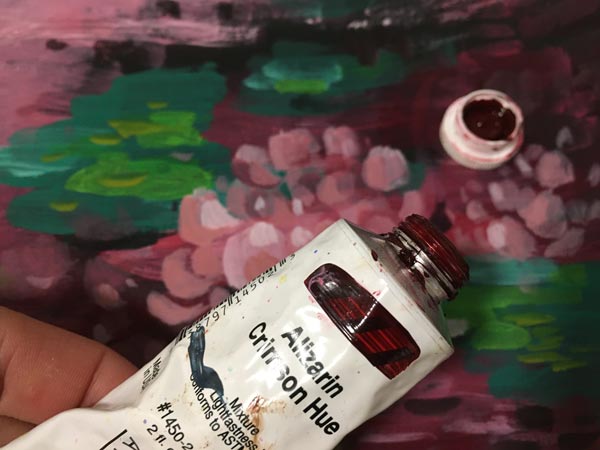
Alizarin Crimson was originally manufactured from madder, but these old organic dyes faded or changed within time, so nowadays we use synthetic substitutes. I found this color in oils first. Schminke’s oil paint is called “Alizarin Madder Lake”. My tube, manufactured by Golden, is “Alizarin Crimson Hue”. Alizarin Crimson is sometimes called “Madder Lake” or “Alizarin Red,” and the tone may vary. Pick the darkest and ugliest one!
If you are a color nerd, Bright Earth by Philip Ball is a comprehensive book about pigments and their origin.
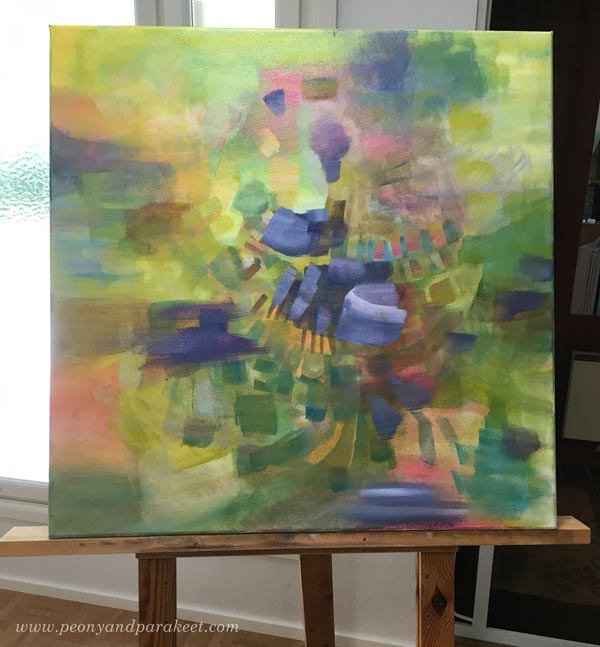
Here’s the painting before I started adding the figures. The image shows well how Yellowish Green and Alizarin Crimson work in color mixes.
Intuitive Fantasy Shape by Shape
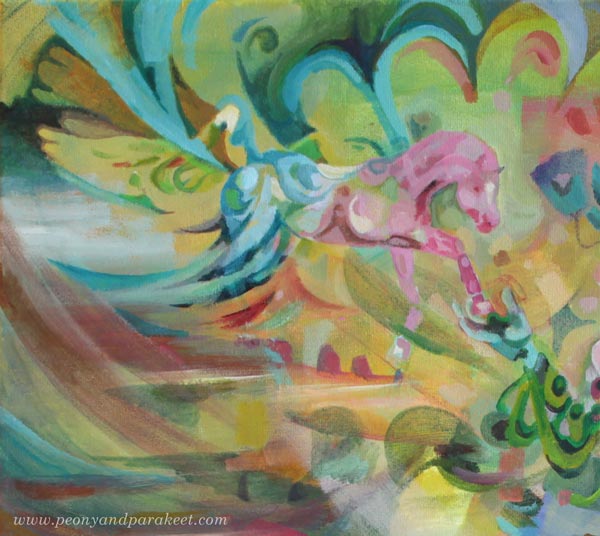
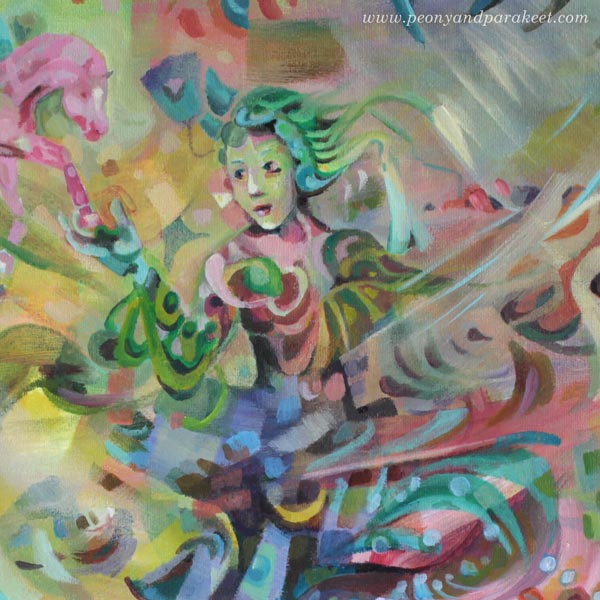
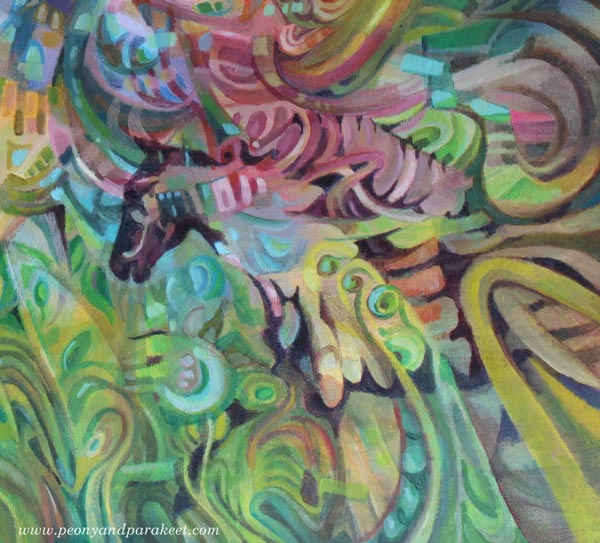
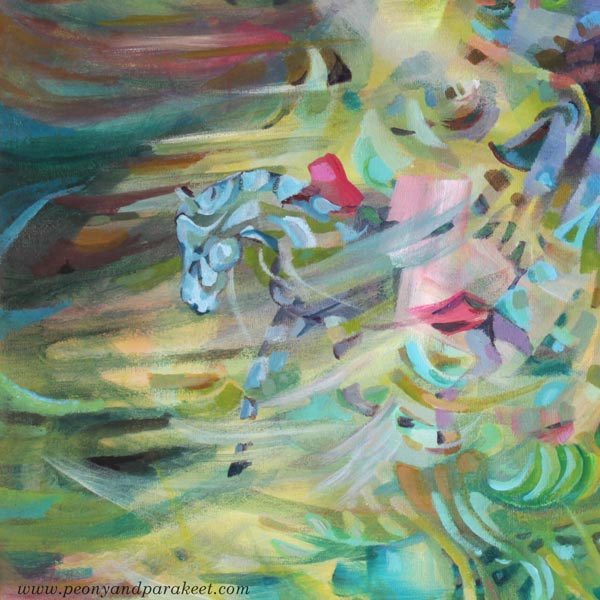
I painted the woman and the horses so that they are partly abstract and partly realistic. Some shapes exist just because they look beautiful, others because they are building blocks for the figures.
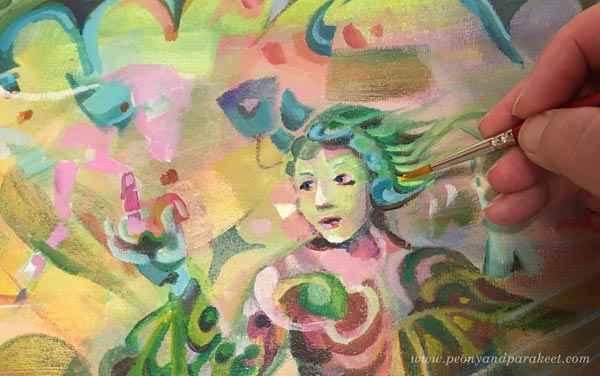
Here are some details of the finished painting. The more you zoom in, the more abstract the painting looks.
Here’s the whole painting again.
I wanted to keep the colors light and bright to create an airy impression.
Intuitive Fantasy Painting – Big or Small?
“Arotuuli” is one of my biggest paintings. It’s 60 x 60 cm (about 23,5 x 23,5 inches) and painted on a stretched, fairly thick canvas. I like painting on smooth surfaces. My style is detailed, and the coarse structure doesn’t go well with it. The painting was started about a month ago, and I took few-hour sessions now and then. It’s not as slow as you would think, because the small strokes aren’t as tiny as with small pieces. Sometimes we produce clumsy just because we select a small size. For me, the bigger size has helped to create dynamic scenes rather than static portraits. “Arotuuli” continues the previous bigger painting “Paratiisi / Paradise.”
But next week, something much smaller, even if I do have a new big canvas waiting!
Creating Small-Sized Art
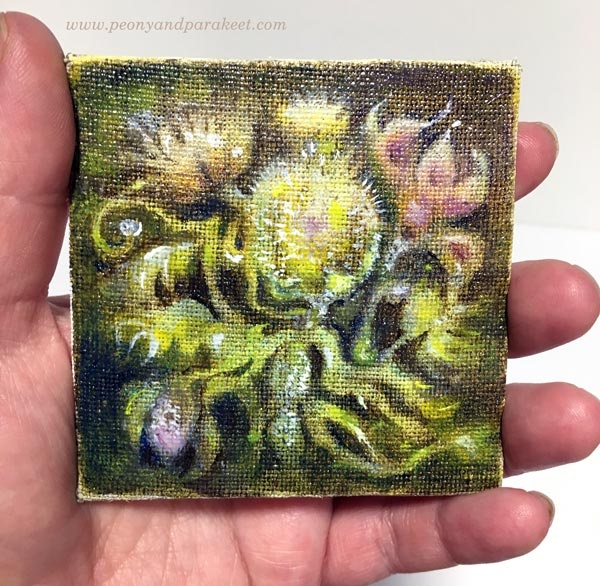
Creating Small-Sized Art – Watch the Replay of the Live Broadcast!
Artist Trading Cards
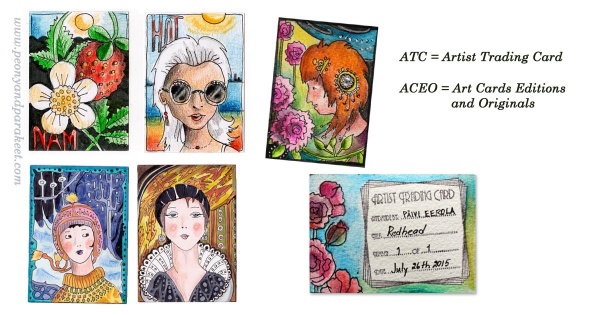
>> Pointillism in ATC cards – Instructions
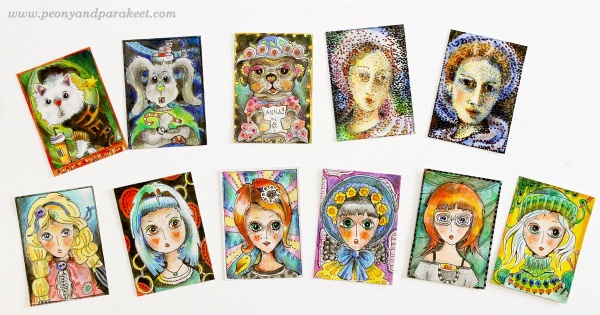
>> My drawing class for those who can only draw stick figures!
Small Watercolor Panoramas
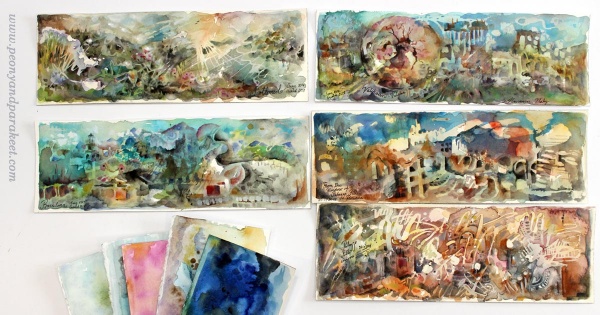
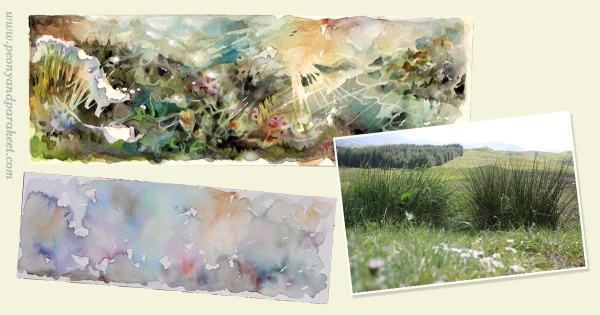
See more in this blog post: Watercolor Panoramas to Express Travel Memories
Creating a Small Canvas Painting
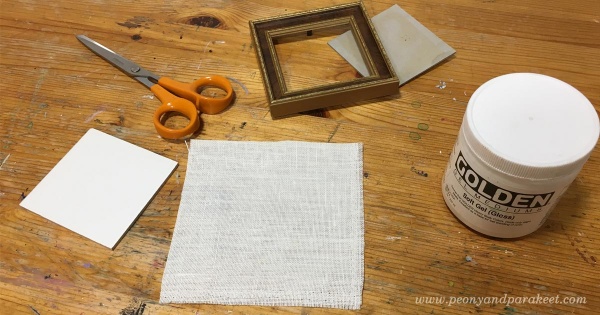
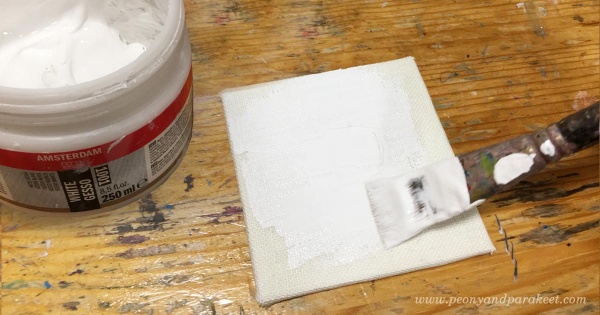

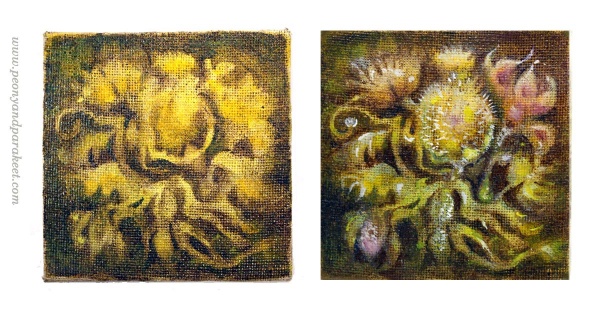
>> Add richness to your artistic expression – Join my art community Bloom and Fly
Eeva Nikunen’s Miniature Art
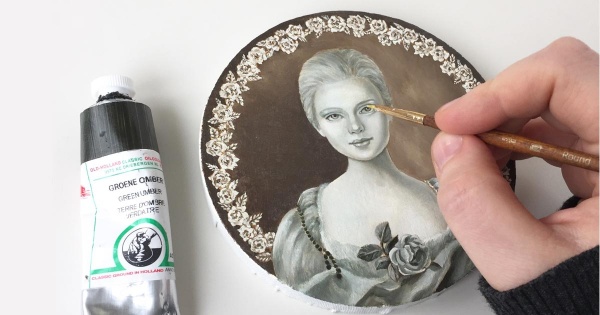
See more of Eeva’s detailed art at eevanikunen.com
Next Week: Eeva Nikunen
Resilience – How Eeva Nikunen Managed to Create a Series of 50 Drawings
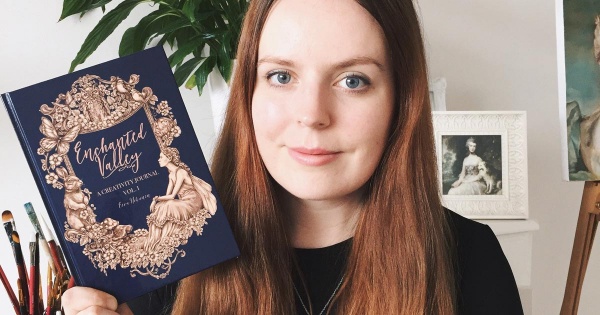
I will interview fantasy artist Eeva Nikunen on May 3rd 6 PM Finnish time (4 PM in the UK, 8 AM PDT) This is another live broadcast of my blog, and everyone is welcome to listen to us. Eeva has just launched a self-published journal of over 50 detailed pencil drawings. We will be talking about resilience and what she has learned from creating a series and how she has been able to carry through the project all by herself.
If you can, come see us live:
>> Save your spot here!
Painting a Series – How I Managed It!
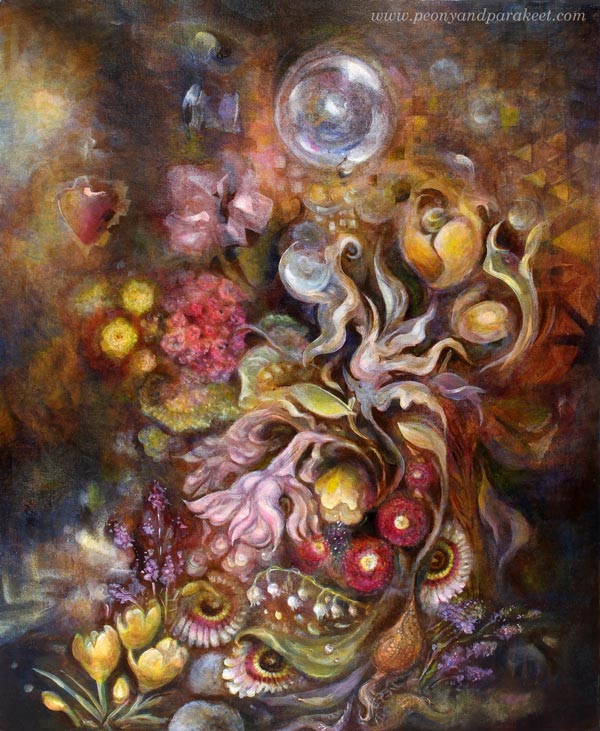
I have just finished a series of five flower paintings on canvas. Yesterday, when I was walking back and forth from my studio to the rest of the house, preparing for the photography and the varnishing, I felt both relieved and terrified. I was relieved because nine months of hard work was at the end. I felt terrified because I had run out of excuses for delaying the start of a new series.
Technique Came First, Themes Second
But let’s get back to early spring when I was painting the first of the five paintings. My goal was to master old masters’ painting technique in acrylics so that I could teach it. I had no idea of how many pieces it would require. Before teaching, I needed to understand “why” not just “how.” I also had to develop a logic that makes learning possible, variations that show the possibilities of the technique, and the systematic way of working to make everything as understandable and to the point as possible.

When I was painting Strawberry Madonna, it soon became clear to me that I was nowhere near to be teaching the technique. I needed to fix my strokes constantly. Even if the fixing doesn’t show in the finished painting, it became clear that I needed more practice. I couldn’t fuss around that way while teaching.
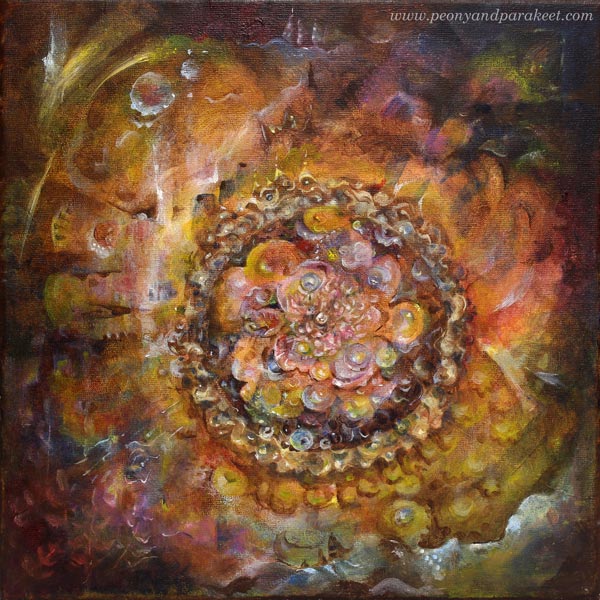
So I bought new canvases and kept on painting. I made experiments, art journal pages, and had several paintings in progress at the same time. I focused on painting what I wanted to include in the class as well: flowers and playing with historical styles. Crafts like crochet, decorative painting, jewelry, fabric, etc were also sources of inspiration. Most of the pieces took tens of hours from me to finish. The quickest is “Four Seasons” that I recorded for the class. With the final touches added after the recording, it took less than ten hours to paint. “Queen of Fantasy” took much longer. You can see me starting it in the free video, but I adjusted the painting many times after that.
Painting a Series – The Most Important Insight
The funny thing about all this is that I wasn’t intentionally painting a series. Working towards the goal of mastering and understanding the old masters’ technique, gave direction to my work. If I had thought about the series more intentionally, I would have probably freaked out! Now when I look back, the most important thing to me was that I expressed the power of flowers in all my paintings but thought about it differently in all the five paintings.
- For “Living Treasure” I got ideas from gardening.
- “Strawberry Madonna” connects flowers with fruits and their taste.
- “Queen of Fantasy” is about flowers representing romance.
- “Blooming Centuries” tells how flowers have always inspired painters, designers, and crafters.
- “Four Seasons” shows sisu, a Finnish word for resilience when you work against all the odds and still find the spirit to bloom and prosper.
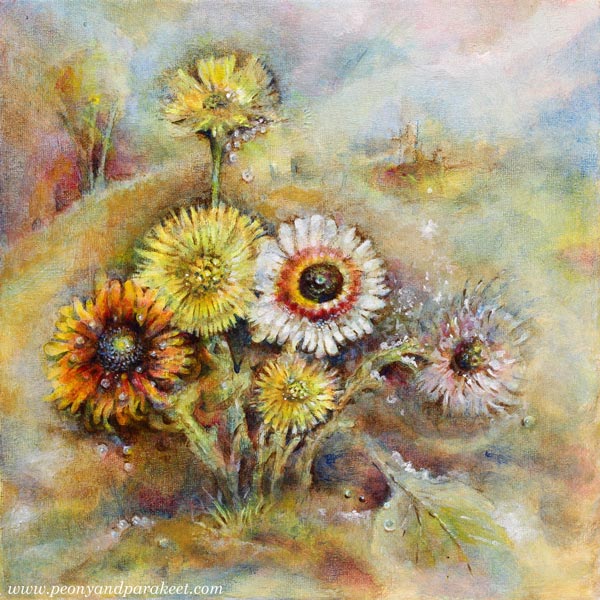
So I had a set of generic themes that were repeated in all the paintings, but different interpretations of them. That made them work as a series but so that they don’t look identical at all. Being very intentional about the series and prohibiting new ideas emerge while working can lead to a very boring result and in my case, it would probably make me quit because the lack of excitement and adventure that keeps me going.
I think this insight could also be useful for those who seek for their style. Rather than painting the same thing and get bored by it, find bigger themes and use your creativity to approach them from different angles.
New Era – New Series
During the past couple of months, I have felt fear when thinking where I want to go with my art. I have contemplated that can I share my plans or just keep them hidden because it’s likely that I will fail. For quite some time, I have felt the need to paint abstract art that plays with textures and geometry. I think many of the paintings of this series already have some of that.
I have a funny name for the style of the new series. It is “kinetic-romantic abstract realism.” “Kinetic” means that I want to include movement that is related to machines. “Romantic” means that I want to express through beauty and relationships. “Abstract Realism” refers to the idea of mimicking realistic surface materials for abstract shapes. Very odd, I know, and it terrifies me.
Creativity is a Living Treasure – Watch the Video!
Before the new beginning, it’s time to celebrate the finished series. I have made a short video of the five pieces and the thoughts that came to my mind when painting them. Hopefully, you’ll enjoy the video!
My Painting on Your Wall?
These paintings are also for sale!- Buy them directly from me here!
Three Artist Types and Why You Should Become All of Them!
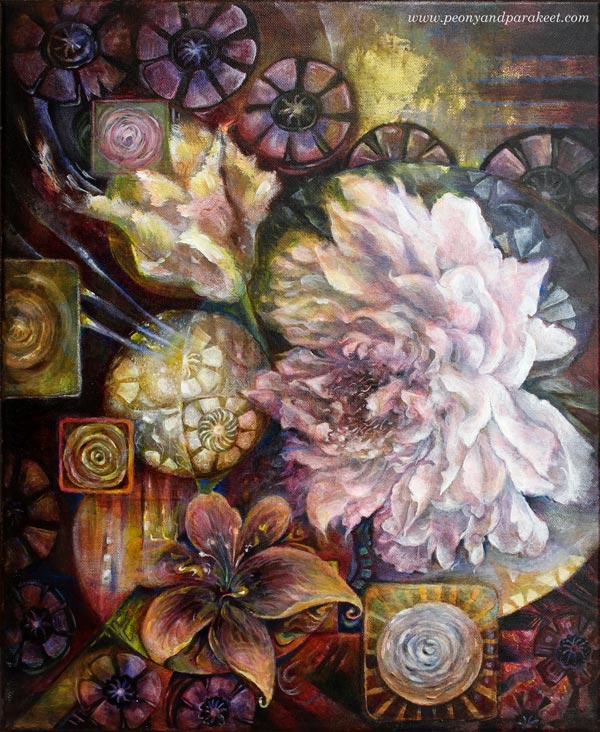
Here’s my latest acrylic painting “Blooming Centuries”. With this piece, I show you how stepping into roles of three different types of artists can grow your skills.
Tight Focus – Don’t Believe it!
The conventional way to grow artistic skills is to choose your media, mindset, and style and stick with the choice. To me, this kind of tight focus has never worked. It feels boring and too straight-forward to work in practice. It forgets the fact that creativity comes with limited persistence but with unlimited imagination.
For example, when I have a heavy heart and want to get quickly into the core of it, I don’t want to stick with the technique that is more labor-oriented. On the other hand, when I want to think and adjust, quick and simple is not what makes the most of the contemplation. Sometimes my imagination wants to be playful, other times it wants to be timeless and deep. When the moment and the mood can define the supplies and techniques, I not only enjoy more but also surprisingly, learn more!
3 Moods – 3 Artist Types
In my upcoming workshop, I will expand your toolbox for creating art in various moods, rather than trying to force everything under one media and one way of working. I have defined three types of artists and picked the techniques accordingly.

The most interesting column in the table above is “Emotion” because it brings up the benefit of the mood. When you imagine being a designer, you aim for clarity. You get happiness out of clearing your thoughts and communicating the essence. When you step into the role of an intuitive watercolorist, your core desire is freedom of expression. What appears on paper, is exciting and your adventurous mind makes the most of it. As a Renaissance painter, you are searching for the peace of mind. By creating a layer after another, you gently caress your way away from busy life.
Now you might say: “But Paivi, I am nothing but an intuitive painter. I am all about quickly creating a beautiful mess.” But don’t let your successes take you on the wrong track. Think about your struggles and what you can learn from the other artists. For example, if your mess has become nothing but beautiful it’s often because the small portion of clarity that we all need has been missing. Or if your mess looks too flat, it’s because your work doesn’t follow the concepts of the three-dimensional world. Also, the time that it takes to create tens of pieces quickly could be used to creating one piece that rises to another level.
I believe that growing as an artist is about learning the best of the many approaches. It’s like getting ingredients for the soup and then making a personal recipe to fit the current mood and style.
3 Artist Types – 1 Painting!
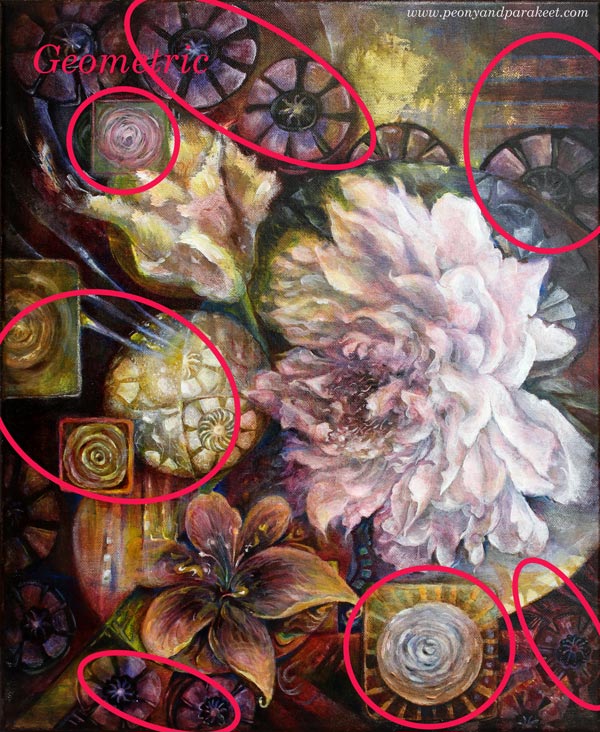
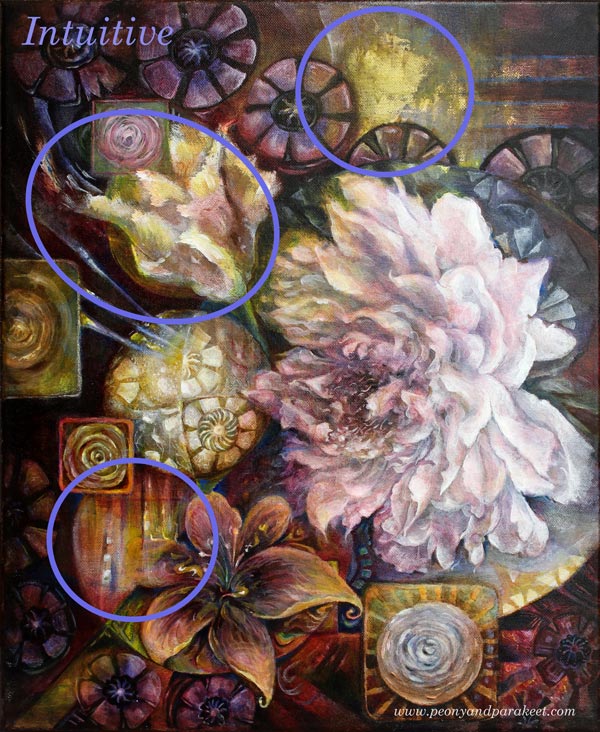
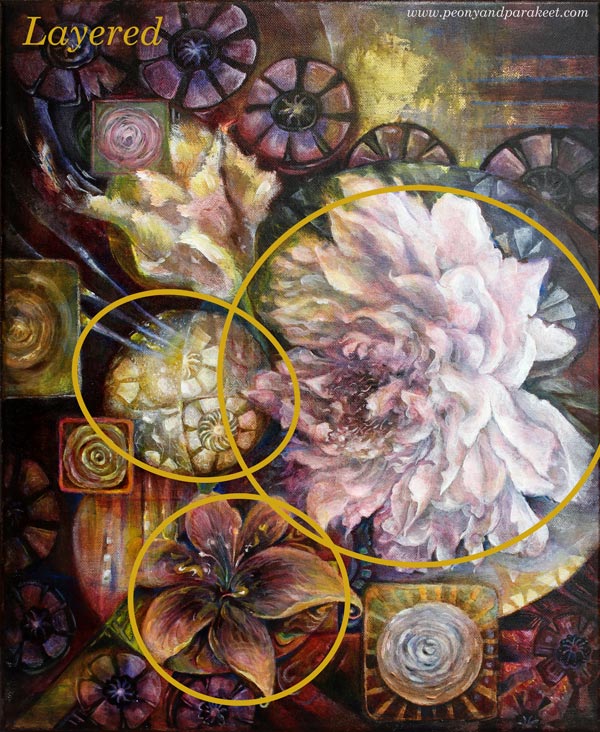
With “Blooming Centuries,” I wanted to express how flowers may be fleeting things, but in general, they have a strong position in the history of art and design. Flowers have inspired artists and designers through past eras, and they still inspire us to create no matter what mood we have. This painting is based on playing with different artist types from a designer to a Renaissance painter.
Designer: Some elements of the painting are more related to crafts and design than to the fine art. They are built from geometric shapes and are quite minimalistic.
Intuitive artist: There are also elements that have been born freely and intuitively.
Renaissance painter: Some of the elements have a lot of layers and are more 3-dimensional than others.
Another Example – Combining Intuitive with Art Nouveau
Let’s imagine that you love Art Nouveau. You adore Alphonse Mucha’s work and everything from the beginning of the 20th century. You want your style to include a lot of Art Nouveau but in a refreshing way. So you might think you need to focus on developing your drawing skills only. You draw and draw, and you get closer and closer to Alphonse but the new twist that you want to give to your drawings, “your personal style,” is missing.
But if you start learning from Intuitive Watercolorist and Renaissance Painter, your Art Nouveau designs will take a new turn. By adding more transparent layers, you can express liveliness so that it still looks graceful. By finding ways to manipulate water, you get free-flowing shapes more effortlessly. Your art no longer is a copy of what someone else has created, but it takes a direction of its own. You begin to appreciate all kinds of art because you want to add more spices to your recipe. Your passion for art gets stronger, and the joy you get from it grows bigger. When you struggle, you see a wider range of solutions than before.
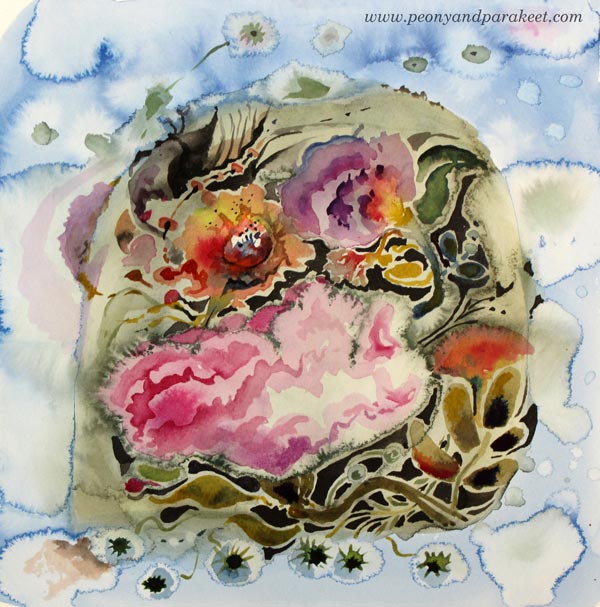
So, every Designer or Illustrator has something to learn from a Renaissance painter or an Intuitive Watercolorist. And the same applies to all artist types.
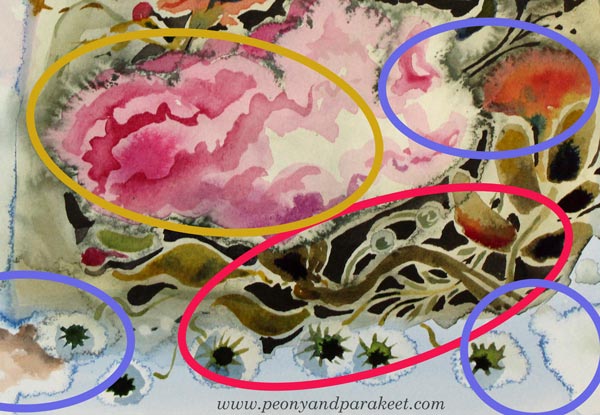
Get into the Minds of the Three Artist Types!
In my online workshop Floral Fantasies in Three Styles, we will dive deeper into the three artist types. It will expand your impression of style and how to construct one. It’s the class you don’t want to miss if you love flowers and want to become an imagination-driven artist! Reserve Your Spot Now!
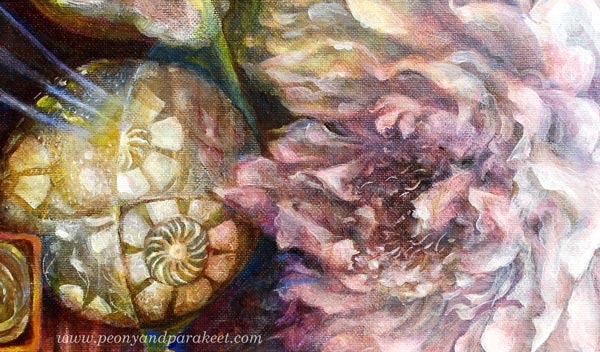
Floral Fantasies in Three Styles: Reserve Your Spot Now!