
Art Journal about Love for Home!
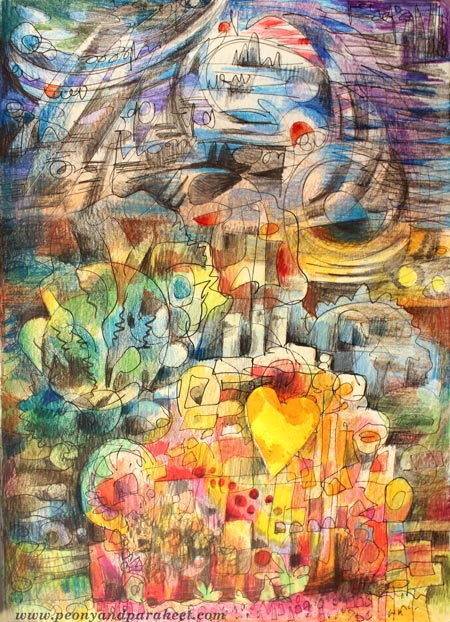
I am honored to be the featured artist in Documented Life Project this week! The theme is Hometown inspiration: “There is no place like home”. This, if any, is suitable for me and for my art journal! I had a stay-at-home mother and we did not travel much as a family. Probably because of that, I have always loved being at home. When I worked away from home, I missed it all the time. Nowadays, especially every morning when I wake up, I am extremely grateful to be able to work from home!
Let’s create an art journal page to celebrate home!
1) Background – Outside from Home
How do your surroundings look like when you are not at home?
Bring those things to the background of your page!
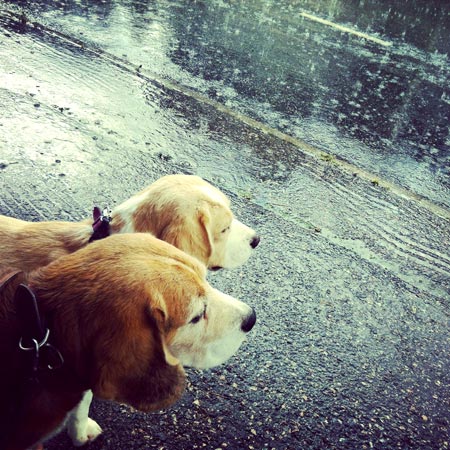
I thought about the situations when arriving home is most appealing. The house, and the living room couch, looks the most welcoming after walking the dogs on a bad weather.

Being a dog owner and living in Finland, I have been in the middle of snow storms, pouring rain and everything between.
2) Focal Point – Inside Your Home
Pick some of the items from your home which represent your love for home!
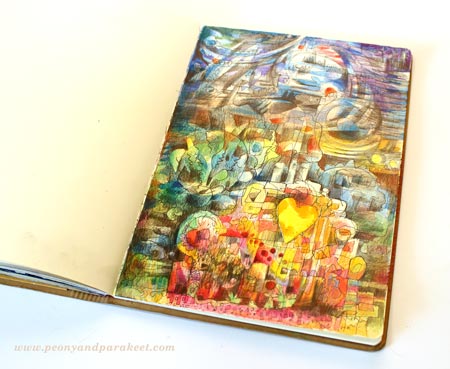
I wanted to express the experience of staying inside, feeling happy, warm and safe from the blowing winds. A couch and house plants are good symbols for that.
3) Location, Location!
Create the page where you feel most at home!
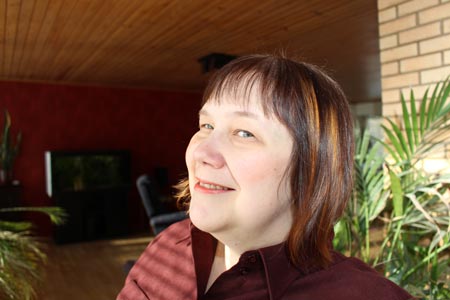
We, visual people, are often very easily affected by the environment where we create. To make sure that the page would express of a warm and comfortable place, I created the page by sitting on the living room couch.
4) Start by Drawing Freely
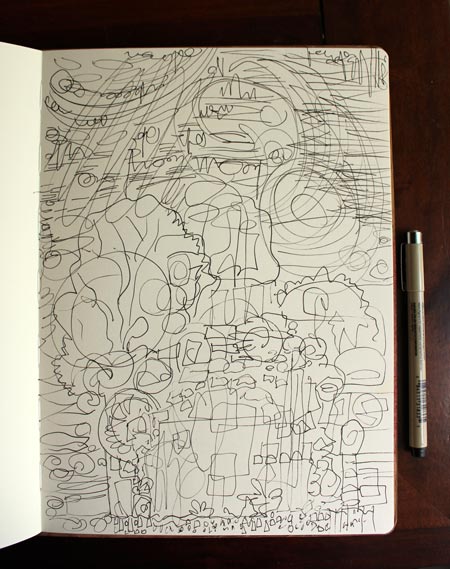
Draw and doodle on the page. Don’t worry too much about the end result!
5) Add Color (+ 3 new ideas)
To make sure that your page expresses an experience and is not only a static illustration, add few new thoughts and ideas when coloring the page.
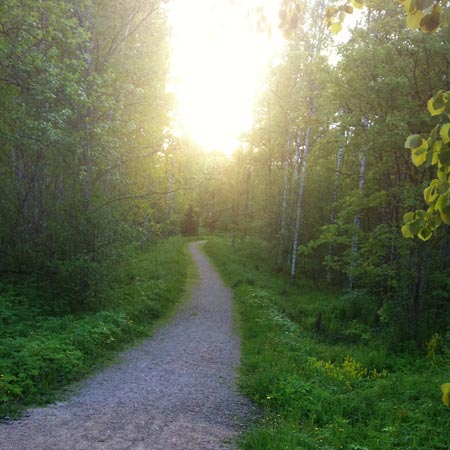
1st: For me, the first idea was the green color. Namely, living in Finland is not only enduring snow and rain. Now in summer, we have daylight almost through the night. Actually, if you read this on 20th June, we Finnish will be celebrating Midsummer, one of our biggest holidays.
This photo was taken just a week ago when walking the dogs 11 pm in the evening.
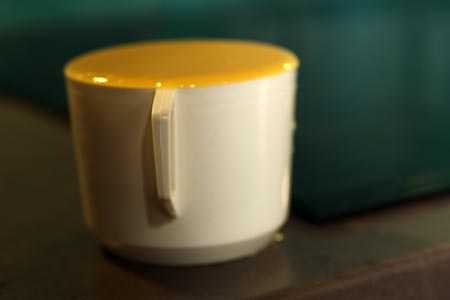
2nd: My second new idea was that home is not only a house or an apartment. It is a mental state. When I feel at home, my cup gets filled, I become peaceful and energetic at the same time.
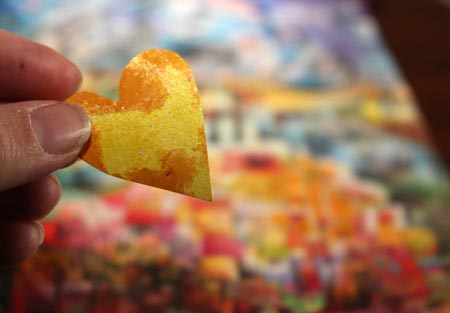
The combination of peace and energy looks yellow to me. So I made sure that the focal point has a lot of yellow. I also cut a yellow heart and glued it to the page with a gel medium.
3rd: Where ever we go, we always carry a piece of home with us. My third idea was to add some red spots to the background to express that.
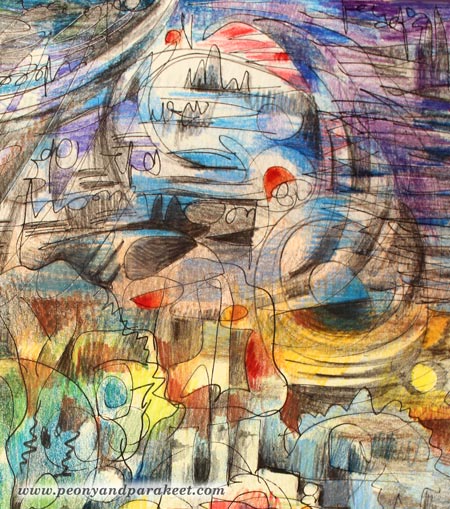
Boosted Expression
When you bring new ideas and thoughts on the theme while you are creating, you are not only making the page look more lively and expressive. You are also allowing your thoughts to move forward with creating.
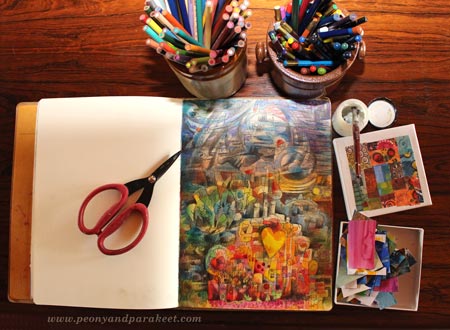
Supplies Used
A black drawing pen (Micron 0.8 mm), colored pencils, a piece of scrap paper and some gel medium were the only supplies used on this page.
Subscribe to my weekly emails – Get a free mini-course!
Stop to See Your Inner World!
If you watched my recent video interview, you know that I love technology and innovations. People often say that technology is a tool. I do understand that phrase and agree with that to a certain point. But if I had to define technology, I would say that like art, it’s an experience. Whether I read about innovation in technology, or see an interesting artwork, I like to stop and think how I feel about it.
Now you might ask: “Why would I take any abstract concept or inanimate object and add emotion to it?”
My answer is: “Because that’s how you boost your imagination!”
When we see technology as a crowd in a concert or a tea cup as a gentle old lady, we will open the door to our inner world.

Often it requires that we stop. Stop taking in universal generalizations, and start adding our associations. It does not mean that you should do it all the time, but in small moments, every day. Because like Terry Pratchett has said: “Humans need fantasy to be human.”
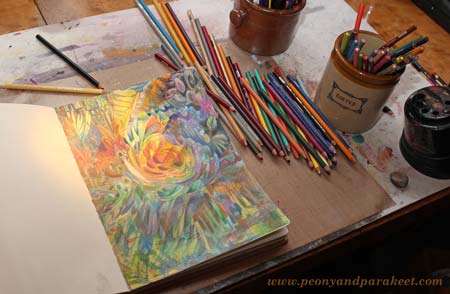
By drawing, we can work our fantasies so that they become insights. Instead of continuously searching inspiration from outside world, we can take time for processing information inside. When we integrate our past experiences with new ones, we can have an improved view of our life as a whole. As visual people, we can produce images that have that unified vision. These kind of holistic visions are almost impossible to express with words, that’s why they are called “the big picture.”
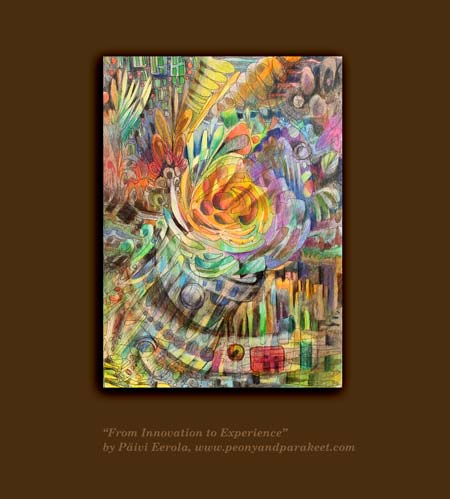
Sign up for Inspirational Drawing 2.0!
You will learn not only practical ways for processing inspirational material
but also how to let your subconscious take control.
Produce “the big pictures” of your experiences!
>> Sign up now!
Why History, Computers and Art Belong Together
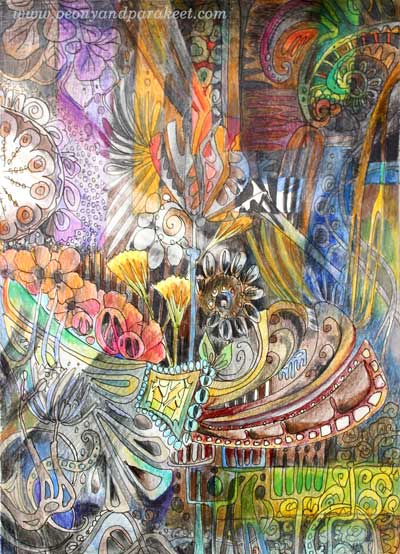
This art journal page is about two things that are close to me: art nouveau and computer engineering. With my background in technology, many find it surprising that historical styles like Art Nouveau fascinate me so much. And vice versa: why someone so interested in history, has studied and worked with computers.
Inspiring Periods of World History
For me, history, computers, and art have a natural connection. Think about the era of Art Nouveau: the end of 19th century and the beginning of 20th century. It was the era of the industrial revolution when many technical inventions were born. Also, at the same time, new kind of art was emerging. For example, Virginia Woolf wrote books using the stream of consciousness, Vincent van Gogh painted Starry Night, and Charles Rennie Macintosh designed a grand building for Glasgow School of Art. After inventing computers, we are experiencing another great era with a lot of innovations, the internet, and smartphones among others. I am certain that it will be seen as one of the most exciting time in the world history. We have new tools for art and design and we if any can use art to look at what the future could hold.
The Stream of Consciousness – Creating a Coloring Page
When I started to create the art journal page, I thought about the two eras and their similarities. With a black drawing pen, I began drawing art nouveau style shapes. It was exciting to think about modern things while drawing in the old style. It is very inspirational to stay focused on two things that have both similarities and differences.

It is relaxing to draw like imitating Virginia Woolf: using the stream of consciousness. Rotating the page makes it easier to keep the stream flowing.
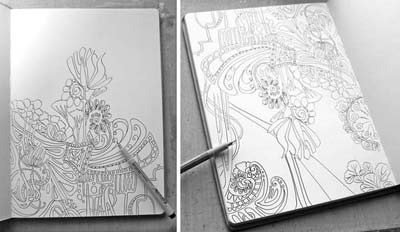
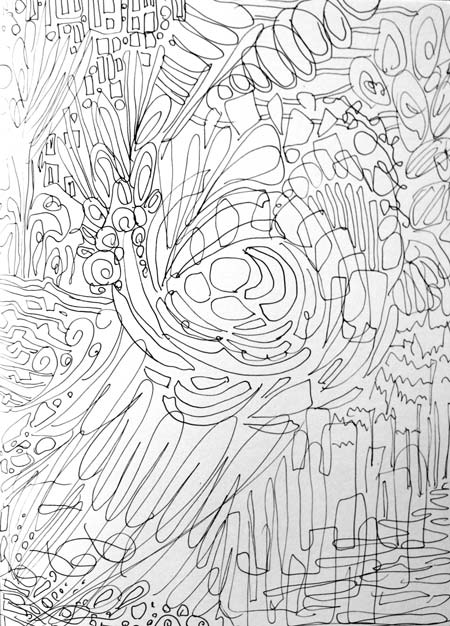
Coloring books seem to be popular at the moment. We art journalers can make our own! Here’s my page before coloring.
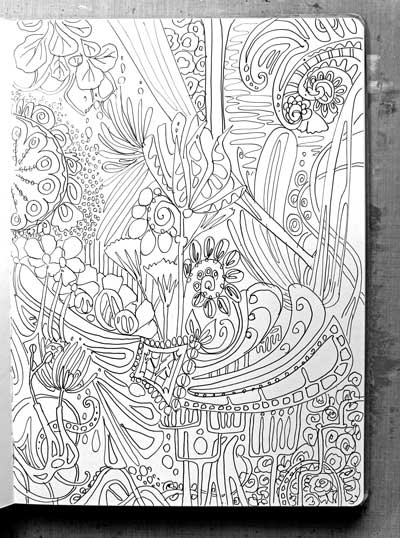
Past, Present, Future – Art Is an Equation
When I studied computer engineering, I had to understand a mathematical equation that was used widely to control technical systems. It was called Kalman filter and it was composed of three parts: past, present and future. I found the philosophy behind the equation most fascinating: to get better at what we do, we must understand the past, stay grounded to the present and be brave enough to predict the future.
Art can be our equation. We can use art to ponder on what has happened to us. We can use art to record the present. But most importantly: art can make us get off the ground. We can predict what the future will hold by taking old and current stuff and create new combinations. We can imagine what Virginia Woolf would do in the 22nd century and illustrate it. There are no limits and we already have most of the information.
That’s why I think that history, computers and art belong together. They are all parts of the same equation.
Adding New Dimensions by Coloring
To bring today’s graphic shapes to the work, I drew rectangular areas on the top of the drawing. Then I colored them with a different color scheme.

Finally, I expressed how past can bring us the future by erasing color with a light strokes. The light comes from the past. With the past, we can see the future.
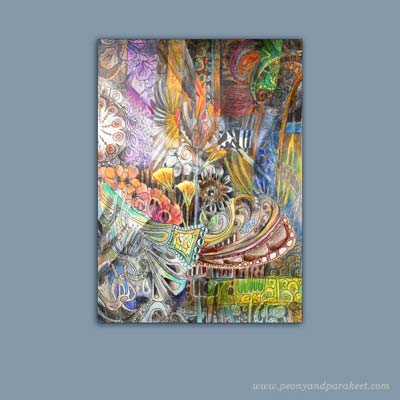
Tell me, what have you picked (or would like to pick) from the past to your art?
Create your own colored version of this page!
>> Buy Coloring Freely!
Find Your Hidden Inspiration for Drawing Details

This colored pencil drawing is an art journal page. It is called “Growing Towards Light.” It’s inspired by the beauty of tiny details found in plants.
For a long time, I have wanted to write about looking at tiny treasures for drawing inspiration. It is the subject that I might have mentioned, but not put fully in focus. Last week two things happened that made me decide to bring it up.
Blooming Houseplant
First, one of our houseplants blossomed. The plant is probably a prayer plant, and it has such modest flowers that we almost missed the whole thing. But once I took few photos and examined them more closely, I was in awe of the blossom’s beauty.

I admire the shape of the stem, how beautifully angled it is, the sharp buds, dark seeds, and the delicate flower. It all looks like perfect, well-thought, well-executed combination of aesthetics and science. I feel not only inspired by the little details but how it also makes me think of the quality of my art: I should continuously raise the bar a little bit higher, work more carefully, become more patient and get further in my thoughts. It sounds a bit harsh as I am writing this, but when watching the nature, it is very inspiring. Maybe we all should sometimes follow the prayer plant: use the time to create a smaller work but take more care of the details!
Mr. Mac and Me
The second thing that is related to the subject of the post is the email that I got from Claire, one of the readers. One of the best things about writing the blog is the interaction. My favorite thing is when I get ideas and suggestions about what to examine next. Claire remembered that I am a big fan of Charles Rennie Macintosh and his wife (see this post when I visited Scotland to see their art). She sent me a link to the review of a newly published novel. The novel is Esther Freud’s “Mr. Mac and Me, “ It tells a story about Charles Rennie Macintosh through the lens of a 13-year-old boy who gets to know him. Very interesting! I added the book immediately to my wish list.
At the end of the review, there’s a quote from the book where the young boy talks about Macintosh’s flower drawings: “I go closer. I look at everything for what else is hidden. There’s the head of a duck folded into a sunflower’s stem …” For me, that implies how the beauty can be the result of many little details. That challenges us to build our art from well-formed shapes, no matter how small they are, and believe that each of them will increase the beauty of the whole artwork.
Drawing Details
Like said, the perspective in decorative art is in the details and their perfection. Instead of sketching something grand, the decorative artwork starts small and gets bigger by adding tiny details one after another.
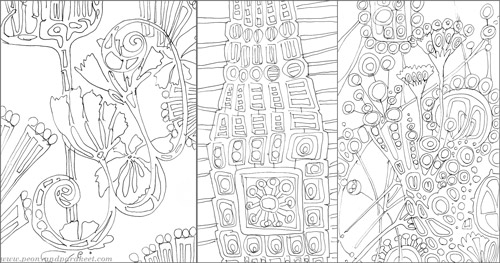
These are some of my unfinished art journal pages. I love to draw with a thin black permanent pen. The inability to erase anything makes me start small! If a blank paper feels scary for you, create a watercolor painting first and then start doodling. My video “Watercolor 101 for Intuitive Painting” presents the method how to get started without any specific pre-thought idea in mind.

More Skills and Inspiration!
Grow your skills in creative coloring >>Buy the e-book Coloring Freely!