Peony and Parakeet

Fly to Your Inner World and Color the Emotion

Author : Päivi

What to Create from Simple Shapes? 6 ideas

When I catch myself building a visual image in my mind, I say to myself that my hands have to process the idea first. The idea can be a decorative design or a new painting or anything visual. When my mind is vigorously trying to create images that I would be happy with, my hands don’t understand my mind at all. My mind is a fool and my hands are ruthless.

160810g

In my mind, I can easily miss the elements that are needed for building the beautiful image. If I imagine a scene, the details that make the scene look so wonderful, are not all there. My mind only has a glimpse. The connection from the mind to the hands feels easier if it’s the other way around. The hand draws a couple of circles and the mind gets creative with them. This way building the bridge from my mind to my hands seems to work much better. Big pictures, personal stories, attractive designs are not born in my mind first. They are born in a conversation that is led by my hand drawing with pen on paper.

But hands don’t decide when to get started, the mind does. This is why I will give you few ideas to start the conversation between your hands and your mind. Like this, this and this post, this blog post is illustrated by my students. The art journal pages that you see here have been made at Modern Mid-Century art journaling class.

1) Build ornaments by grouping simple shapes.

6 ideas to play with simple shapes. By Peony and Parakeet

Nel Wisse has created colorul clusters and then grouped them to bigger ornaments.

Nel Wisse, Netherlands. A student artwork for the art journaling class Modern Mid-Century.

2) Create a surface pattern and cut a shape from it.

6 ideas to play with simple shapes. By Peony and Parakeet

For example, see Darci Hayden’s cat and the stairs! Shapes that include patterns look always fascinating. (More patterned paper ideas)

Darci Hayden, USA. A student artwork for the art journaling class Modern Mid-Century.

3) Play with Sizes and Layers

6 ideas to play with simple shapes. By Peony and Parakeet

Cut some elements smaller and add dimension to your page by playing with layers.
Sue Jorgensen has a good variety of both large and small elements.

Sue Jorgensen, Australia. A student artwork for the art journaling class Modern Mid-Century.

4) Build a map, a house or a room plan

6 ideas to play with simple shapes. By Peony and Parakeet

A clear hierarchy between the elements pleases also your left brain.
Marie Jerred’s fox is in the middle of an adventure!

Marie Jerred, Canada. A student artwork for the art journaling class Modern Mid-Century.

Stephanie Carney’s Flamingo is just entering a house of dreams.

Stephanie Carney, USA. A student artwork for the art journaling class Modern Mid-Century.

5) Express Micro or Macro World

Both micro and macro biology deal with basic shapes. Explore either molecules or satellites!
Susan Prothero’s micro world is captivating.

Susan Prothero, UK. A student artwork for the art journaling class Modern Mid-Century.

Elise Tobler‘s space is full of life!

Elise Tobler, USA. A student artwork for the art journaling class Modern Mid-Century.

6) Find a connection to a story

Explain what you associate with the shapes and then move on to a more illustrational approach. Elaine Wirthlin’s spread is an awesome example!

Elaine Wirthlin, USA. A student artwork for the art journaling class Modern Mid-Century.

Buy the class: Modern Mid-Century!

Modern Mid-Century, an art journaling class that teaches drawing and collage art based on simple shapes. By Peony and Parakeet.

Designers in 1950s and 1960s (like Annikki Hovisaari from Finland and Lisa Larsson from Sweden) truly knew how to play with simple shapes. Modern Mid-Century is a self-study art journaling class where I am inviting you to my living room and showing inspiring examples from the middle of the 20th century. Then I will help you to design your own unique motifs and build a collage that is both decorative and expressive.

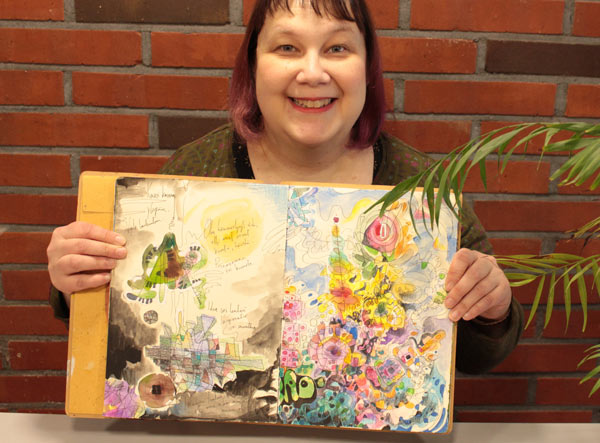
Paivi from Peony and Parakeet with the art journal spread playing with simple shapes.

Modern Mid-Century
Start playing with simple shapes!
 >> Buy Now!

Have Some Vincent van Gogh in Your Life!

Paivi Eerola from Peony and Parakeet has an art journaling class about painting like Vincent van Gogh.

When I opened Imagine Monthly Fall 2016 art journaling class for registration, my question to the first participants was: “What is your favorite artist?” The ultimate winner was Vincent van Gogh. So I went to the local library and picked up two huge books showcasing all his paintings. I wanted to create a class that inspires not only playing in his style, but which also makes people relate to him. I wanted to enable people to put their world next to his and see it in full color like he did.

Life in Full Color

Whether you are an actual engineer or not, I think that you too have an inner engineer. She likes the home to be organized and clean. She takes responsibilities seriously. She worries over the practical stuff.

I have some ironing to do again!

But then, truly, you also have an inner artist. She doesn’t care what time it is or whether she’s hungry or not. She doesn’t have a clue if somebody needs her to be somewhere else. Her world has no linear time. She has no other duties than to explore. She sees colors and textures when the engineer sees dirty laundry and a shopping list. No, she would not stay alive without the inner engineer. But the inner engineer could never live the life in full color without the inner artist.

Vincent van Gogh

Thinking about Van Gogh, an art journal page spread by Paivi Eerola from Peony and Parakeet
Me and Vincent van Gogh, merged into one person.

Here’s what every inner engineer knows about Vincent van Gogh: He was a poor artist from the 19th century, painting with thick medium. He had mental issues and he sold only one painting.

But the inner artist feels that he was her soul-mate. He saw the yellow sky and blue ground when other people saw the perfect weather to sow the seed. He saw glorious sunset when other people saw withering flowers. For people of that time, his portraits and sketches looked clumsy even if he had caught the essence. Namely, in his world, the essential thing to do was not to engineer but to express. Instead of aiming for objectivity, he was the master of subjectivity.

Van Gogh Moments

Paivi Eerola from Peony and Parakeet has an art journaling class about painting like Vincent van Gogh.

I believe that most people create art because they need “Van Gogh Moments”. In those moments, you can pick any color for any object, not only green for the grass like the inner engineer would suggest. In those moments, you can not only play with colors but also experience the interaction between the hues and shades. Just like van Gogh did! If you look at any detail in his paintings, you will see the interaction of colors.

Selfie Fantasy is an art journaling class about painting like Vincent van Gogh.

So while the inner engineer waits for the important phone call, the inner artist hears her colors speaking. While the inner engineer worries if she will ever meet someone again, the inner artist paints him or her right there beside her.

Selfie Fantasy

Selfie Fantasy is an art journaling class about painting like Vincent van Gogh.

When I browsed through the two big books of van Gogh’s paintings, I realized that a big part of his production was portraits. They were either self-portraits or portraits of other people. So in Selfie Fantasy, you will not only learn easy ways to create a colorful and swirly scene in Vincent van Gogh’s style. You will also get step-by-step instructions for adding some familiar faces onto your art journals. In the class video, I use those methods to paint my mother and me. My mother is there on the spread, glowing on her wedding day, much earlier than when I was born. This time she is in the foreground because in real life she was always the one in the background, supporting my creativity. She truly was my inner engineer until the day she passed away about 25 years ago.

Give some “Van Gogh Moments” for your inner artist!
Sign up for Imagine Monthly Fall 2016
and get an immediate access to Selfie Fantasy – Sign up now!

Limited Creative Time – A Personal Story

The Sense of Time, a watercolor painting created in limited creative time. By Peony and Parakeet.

Here’s my latest watercolor painting “The Sense of Time”, made just a couple of days ago. I limited my creative time immensely when painting this. But this time I want to share the whole story, not just images of how I made the painting. At the same time, you will see some of my summer crafting projects and learn a couple of fun facts about Finnish summer.

Peonies Embrace the Midnight Sun

When people ask what would be the best time to come to Finland, I always suggest summer. Finnish summer begins in June and ends in August. In my opinion, the best month is July. Even in the south, where I live, you can experience the midnight sun, warmth and see the best in Finnish people. Like peonies, we are all introverts in the dark and cold winter, But when the sun comes up, it’s all smile.

Finnish peonies grown under the midnight sun. By Peony and Parakeet.

Colors Compete with Shapes

My husband always has his summer vacation in July. As dog owners, our possibilities to travel are limited to day trips unless we take them to kennels or arrange somebody to look after them. As both of us love old art and antique, we always go to Billnäs and Fiskars for an antique fair. If you have watched a British television series Lovejoy, these are the places where you could see him and his assistants if they traveled to Finland. There are two antique fairs at the same time. They last 4 days and are packed with people selling and buying antique items in the middle of Finnish countryside. The fairs are partly indoors, partly outdoors and truly a collector’s heaven whether it rains or shines.

At an antique fair. Art class designed by Kaj Franck. A photograph by Peony and Parakeet.

When looking at the sales tables, I always notice color first. My husband, a skillful woodworker, examines the shapes. Together we are unbeatable!

Art Rises from the Dollhouse

It was both unfortunate and fortunate that I found an old display cabinet from Billnäs. Fortunate, because it’s just what I had dreamed of for my doll collection. Unfortunate, because I didn’t have the space for the dollhouse anymore. I had to empty the tiny kitchen with miniature wine bottles and delicacies as well as all the other tiny rooms filled with similar items.

Dollhouse dining table. By Peony and Parakeet.

While taking the little paintings off from the walls, I realized that one of them wasn’t just printed image. It was a cross-stitch project that I had made years ago! I remembered not being very happy with it. When I started it, I thought that I could make more than one and then sell some. I didn’t have any pattern and the end result didn’t look as painterly as I would have wanted. So I gave up the idea of making more and placed the piece above the dining table, in the spot where it wasn’t as visible as other pictures. No wonder I had forgotten it!

Miniature cross stitch sea painting. By Peony and Parakeet.

But now, it looks just perfect to me. Now I see more than just clumsy stitches. I see how my love to combine arts, crafts and design came out even when I was decorating a dollhouse.

William Morris Visits Ikea

One of my creative routines is organizing things. Even at antique fairs, I sometimes get the urge to rearrange items and I have to restrain myself. This spring, I was organizing a storage space of our house and found an old Ikea Moppe mini chest of drawers. Putting old stuff to use is a creative challenge that I am often willing to take. I went to Pinterest, saw boards like this and was ready to get started.

The first challenge was that I also wanted to use up old paints. The only paint with the suitable quality was baby blue. I wanted to place the mini chest in the library room near my doll collection and store fashion doll clothes in it. I had a hard time seeing baby blue suit to the style and color scheme of the library room. We have decorated the library room in the styles of 1890-1930s. The curtains have William Morris’s pattern. How could the Ikea mini chest ever with the style? Trusting that I could figure it out, I refused to buy new paint as I had another purchase in mind. I wanted to buy ceramic knobs for it.

Interior decoration and crafting. By Peony and Parakeet.

If I had to choose one material that I adore, it would be a difficult decision between ceramics and glass. But I think the winner would be ceramics. Even if I have never really dived deep into creating with clay, I love ceramic items. Especially if they are both decorative and expressive. I also like them to be a little rustic, have some handmade feel without being overly clumsy. The knobs I wanted to buy should also have some baby blue, some William Morris, look both old and modern and be traditional but somewhat innovative. Despite the high expectations, I optimistically began to search handmade ceramic knobs. It took a couple of days but my optimism paid off and I found just the perfect ones! They are made by an English woman living in Israel. Her Etsy shop is called “Clay is My Art”, a heaven for anyone who loves rustic, but sophisticated ceramics.

Ikea Moppe mini chest of drawers. Hacked by Peony and Parakeet. Ceramic knobs by Clay Is My Art Etsy shop.

As you can see in the photo, I was able to find decorative papers that not only matched the knobs, they fit perfectly to the style of the library room. The papers with palm plants are leftover wallpapers. The other two are from my scrapbooking paper stash.

Ikea Moppe mini chest of drawers. Hacked by Peony and Parakeet. Ceramic knobs by Clay Is My Art Etsy shop.

But wait, this story continues …

Leftover Flosses Praise the Pattern

Have you ever had anything in your home that was ok before you changed everything in its surroundings? My number one thing was a small key storage cabinet, which was fine in our old home on a muted dark red wall. But when placed on a bright yellow wall of our current home, it really bothered me. With the experience in cross stitching for dollhouses, I got an idea of stitching a dollhouse carpet pattern from Janet Granger‘s book Miniature Dollshouse Carpets.

Key cabinet with a cross stiched design and its new cover. By Peony and Parakeet.

It took all spring when working slowly but at the beginning of summer, I got it stitched. I also repainted the wooden parts. This time I did buy the dark green paint but this is still a project using leftovers. Namely, I didn’t just use the few colors set in the pattern. I used leftover skeins of embroidery floss creatively so that the carpet looks like an old antique one. I much prefer this look to using only a few colors.

Key storage cabinet with a cross stitch cover using leftover flosses. By Peony and Parakeet.

The cabinet looks great on the yellow wall. I temporarily took it down for photographing it in a better lighting. There was also another reason, connected to the watercolor painting …

Limited Creative Time – Craft Projects Inspire the Painting

This time I had limited creative time. Before I started painting, I placed the three handcrafted items on the table in front of me. The key cabinet, the mini chest and the miniature cross-stitch work were all there to inspire me. Then I glanced my watch and gave myself 15 minutes to paint the first layer. Namely, I had another project in progress too. I was editing one of the videos for Imagine Monthly Fall, the art journaling class that begins on August 1st. Editing videos requires a lot of concentration and I wanted to keep the quality good by taking small breaks. So after 45 minutes of editing, I had 15 minutes for my painting, all day.

Craft projects inspire the painting throughout the limited creative time. By Peony and Parakeet.

If you work in short periods of time like this, inspiration items become essential. Seeing the same objects again and again, even if you are not actually recreating any of them, maintains the focus and direction.

After four 15 minute sessions I was at the point where I had painted this and that with five different brushes but had no clue of what I was trying to express. It was fun to paint like this but clearly, I couldn’t finish the painting without setting up a longer session.

Watercolor painting in progress. By Peony and Parakeet.

Finishing – Summing Up

I soon discovered that being so aware of the time had also affected the painting. I saw clocks and pointers which made me ponder about the concept of time. It flies so quickly in creative activities that it’s difficult to think about it as a simple measure. This, in turn, made me think about the antiques and how great designs last time. After my husband and I are gone, there will always be new enthusiasts who will drool over those Kaj Franck‘s bowls.

I often finish my watercolors with colored pencils to easily add new layers of details and decorative lines. But this time, I was reminded of my craft projects: “Make the most of what you currently have.” So I resisted the urge to go to another room and get the jars of colored pencils. It only took an hour to finish the painting.

The Sense of Time, a watercolor painting created in limited creative time. By Peony and Parakeet.

Some midnight sun, some glassware, mini horizons, small amounts of leftover colors, block shapes and last but not least: the description of how my inner artist sees the sense of time.

The Way I Process Ideas and Produce Classes

This blog post demonstrates how I work with ideas. It’s not only one idea that goes into one piece of work, it’s a collection of ideas that have different levels. Some are more abstract, others are more concrete. I believe that every good art class is filled with multi-level ideas that in turn, embark your own ideas. That’s why I never underestimate the importance of the background study that I do for my classes. I listen to audiobooks. I go to libraries to browse books. I collect Pinterest boards and inspirational items. I make sketches and paintings that I call pre-class paintings (yes, the one above is one of these). They prepare me to bring my best to the classes that I produce. They ensure that the class is not only about one whimsical thing that I fell in love with but about a holistic, yet clear and inspiring view to the subject. All in all, we all have limited creative time.

Sign Up for Imagine Monthly Fall!

im_closeup1_fall16_600px

Take your art to a new level by practicing drawing and painting with themes inspired by fine arts. Express prestigious nostalgia, impactful aesthetics, and futuristic imagination through art journaling. Let’s make idea-full art journal pages your channel to move forward in art making!

Imagine Monthly Fall 5 challenges, great community >> Sign up now!


Build Imagination with the Students of Peony and Parakeet

During the last spring, I have seen gorgeous pieces of art made from the mini-course Painter’s Ecstasy. Like in the previous blog posts (this one and this), I want to share some of them with you.

Build Imagination with Watercolors!

The pieces of this post are made with watercolors mostly. In my experience, watercolors are the supplies to go if you just stare at the blank paper and have no ideas in mind. They are soft and not so exact than pens or acrylics. It’s also easy to see something interesting appearing and start building new details from that. Maintain an open mind and not try to figure the end result beforehand. Instead, start with a general idea in mind.

1) Start with Mixed Emotions

Because creating art should be enjoyable, we often want to express positive feelings. But to get more connected to your piece, analyze your emotion more in detail. It’s often mixed: joy can hold tears of affection, happiness can contain worry, love can include dependency of some kind. This doesn’t mean you have to dwell on negative emotions but pondering about the more complicated nature of emotions can also free up your imagination. When controversial issues are allowed, it’s a sign to your mind that anything is allowed. This, in turn, will build imagination!

Sheila McGruer, Australia - a piece created at the art journaling class Painter's Ecstasy

Sheila McGruer’s art journal spread tells a visual story about a woman who has an origin. This would not be so expressive without the teardrops!

2) Get Surreal

People say: “I do only abstracts”, “I focus drawing faces”, “I like landscapes”. Break the rules and combine various approaches. Could abstract contain faces? Could faces include landscapes? Could geometry meet human parts? Could 3-dimensional meet 2-dimensional?

Terry Whyte, Canada - a piece created at the art journaling class Painter's Ecstasy

Terry Whyte‘s piece is fascinating. It’s simple if you count the elements but mind-blowing if you examine their relations. A wonderful example of how the surreal can look like!

3) Play with Proportions, Colors, and Abilities

Can houses be smaller than faces? Can trees be red and purple, then change their color and leave off the ground? Anything can be possible in your art journal!

Annemarie de Brujin, The Netherlands - a piece created at the art journaling class Painter's Ecstasy

Annemarie de Brujin plays brilliantly with proportions, colors, and dynamics. The painting feels like an experience, more than just an ordinary scene.

4) Envision Your Location

Mind-travel to a place where you would like to go! It can be a real location, an imaginary one or the mix of many! Nothing has to be exact. Get inspiration from the colors and the atmosphere. Make your art journal a mind-traveler’s notebook!

Gal Brule, USA - a piece created at the art journaling class Painter's Ecstasy

Gail Brule‘s art journal spread is a wonderful interpretation of the city Barcelona. Mountains, the beach, Gaudi, the colorful street life … it’s all there!

5) Treat Inanimate Object as Humans

One of the easiest ways to get the imagination going is to treat anything inanimate as a living object. Can a house have an identity of its own? Can a group of items look like a choir of brilliant singers? How do the trees look like when they are smiling?

Claudia Kern, USA - a piece created at the art journaling class Painter's Ecstasy

Claudia Kern has created more than a landscape. The painting is like a big and inviting party!

6) Merge Everything into One Flow

Instead of adding single elements, build connections and flow to your piece. Connecting lines also connect the viewer to the painting and it all seems to make sense. This way, small elements can be used to build big pictures.

Debbie Kreischer, USA - a piece created at the art journaling class Painter's Ecstasy

Debbie Kreischer shows it so well: we are all part of the same flow!

7) Express a Conversation

If you always do faces, why not creating more than one and express a connection between them. Then take it even further: what are they talking about, where are they walking, why are they together? Show it all visually!

Patty Furey, USA - a piece created at the art journaling class Painter's Ecstasy

Patty Furey’s dreamy woman and dynamic man is the perfect couple to dive deeper into the story. They seem to live in a city. Maybe the man has brought the flowers for her. She seems to be the country girl in her heart, though! These kind of pages that evoke stories are the best ones. If you like creative writing as well, use your image as a starting point for a poem or for a short story!

8) Get Ideas from Treasured Items

Open your treasure box or shopping wish list and analyze how the single items are constructed. Does your favorite blouse have ruffles? Do you grave for jewelry that holds the beads elegantly? How are the details of your dream handbag? Thinking like a designer can give ideas to an amazing art!

Vikki Hoppes, USA - a piece created at the art journaling class Painter's Ecstasy

Vikki Hoppes’ painting is a great example of how to build imagination by constructing elements creatively.

Painter’s Ecstasy

When planning Painter’s Ecstasy, I spent weeks examining the paintings of Friedensreich Hundertwasser. He had students but to my knowledge, they didn’t get much guidance, only a green classroom:
– “I tell them nothing. I just put the plants there and leave them alone together.”

My first sketches were made with few bold strokes but they didn’t catch the essence. Sketch by sketch, I slowed down and toned down. Hundertwasser called his way of working “vegetative painting” as it develops slowly. It doesn’t start with drum rolls but with little bell sounds. The techniques that I discovered with trial and error
make starting easy but stopping almost impossible when you reach the spheres of painter’s ecstasy!

This mini-course, Painter’s Ecstasy, was published at “Imagine Monthly Spring 2016” art journaling class. It’s now available individually as a self-study class – Buy here!

You can also buy all the 6 monthly classes as a bundle. I will also release the classes individually one by one later this summer, and show more ideas on how to apply them.

Build Imagination with watercolors - Art journaling class Painter's Ecstasy by Peony and Parakeet

Build imagination, right now!

Scroll to top