
Paint Your Mental Images!
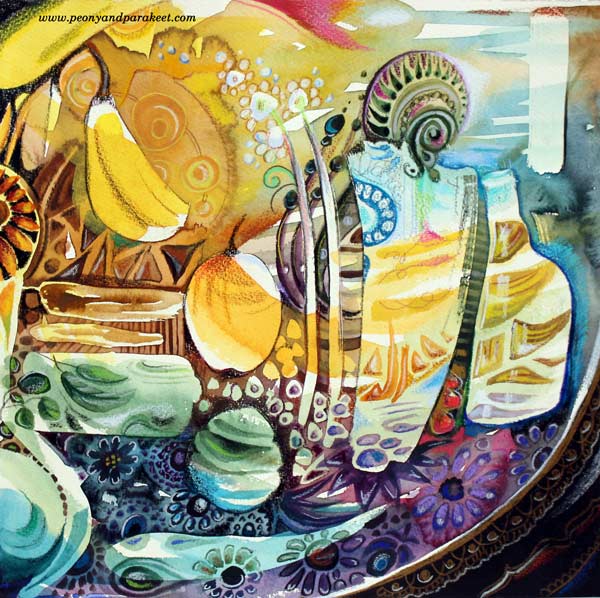
This artwork is inspired by the subject that keeps on fascinating me: beautiful objects like Russian handpainted plates! My admiration for them began many years ago, and only got stronger when I saw them in 2013 at St. Petersburg, Russia.
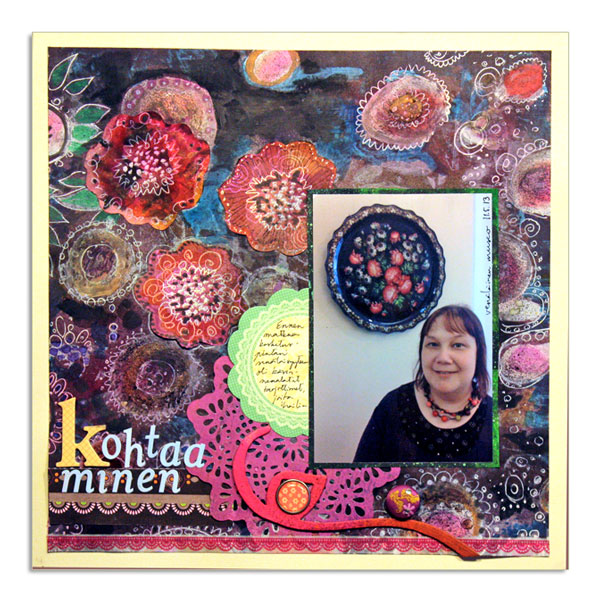
Here’s a scrapbook page which I made back then. My husband took the snapshot in The Russian Museum. Even if I look a bit worn out from the amount of walking we did during our travel, I love how my clothing and the plate match up!
We also bought one plate as a souvenir. I placed it on the table near me while finishing the painting. Just to keep me inspired to fine-tune all the details. But let’s not go that far yet! Before that, a lot happened, in my mind at least!

From Photos to Mental Images
Before starting the painting, I spent quite a lot of time thinking what to paint and how. I feel that it is easiest to think while walking, so I took the dogs out to the snowy nature. Then I took some photos, which is also a great way to observe and examine things.
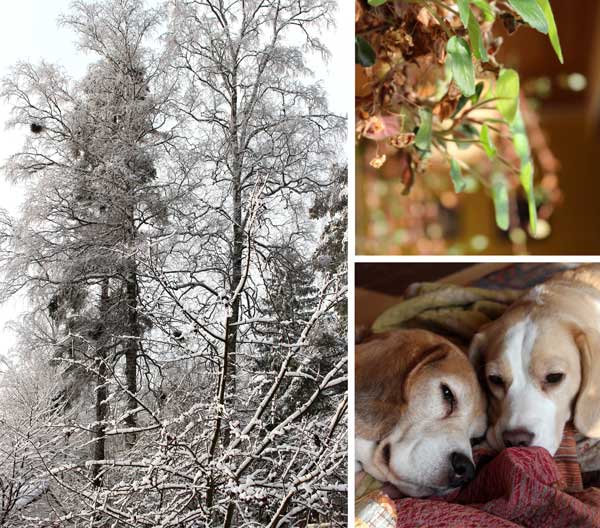
After my beagles had fallen asleep, I browsed the photos. “There’s a difference of how I those subjects in my mind,” I thought. If I think of a Russian plate, I might see one detail of it, then other images come to the mind, then the fraction of a Russian plate again. The thoughts move so quickly that the images seem to get mixed up and change.
I could not help looking up what psychology says about it. Yes, there’s a concept called mental image and several theories about how mental images are formed in the mind.
What I find fascinating is, that when creating art, we tend to pick one photographic image instead of a mental image. Then we get disappointed when the artwork does not represent the realistic, photographic image. Replicating the photographic image to the mental image is extremely hard. Let’s try! Look at any of the photos above, then close your eyes and imagine every little detail of the image – impossible! Similarly, if you read a story for the first time, then try to repeat it exactly from word to word, you will certainly fail! But could we paint what we remember and see in our minds, like Edward Munch said: “I painted only memories, adding nothing, no details that I did not see.”
Using Mental Images in Art
I thought it would be both philosophically and practically interesting to use the mental image as a starting point for a painting. So, I decided to paint the mental image of my souvenir, the decorated plate. I forcefully thought about the plate for few minutes. But at the same time (as focusing on one thought is so dull), I was also cleaning. When I grabbed the morning newspaper to put it away, I saw an article of Paul Gauguin‘s artwork being sold at a high price. Just when I had gathered my thoughts around the Russian plates, there it was, a picture of Gauguin’s art! Whoosh … my mental image changed to a mixture of a decorative plate and Gauguin’s art, not just that specific one but many others too that I have seen!
While walking towards the room where I create art, I saw a banana on the kitchen counter, then thought about the wine we are going to taste to celebrate my coming birthday. My mind wondered towards glass objects – how I love them and how I should really paint only them … Before I began painting, my mental image had grown into a huge collage!
The complex thing in mental images is, that if you think very visually, holding the static view is difficult. Instead of trying to focus on one thing only, let it go and replace it with a more general subject. I chose my love for decorative art, beautiful concrete things and how they are at their best when they represent the beautiful shapes and shades from nature.
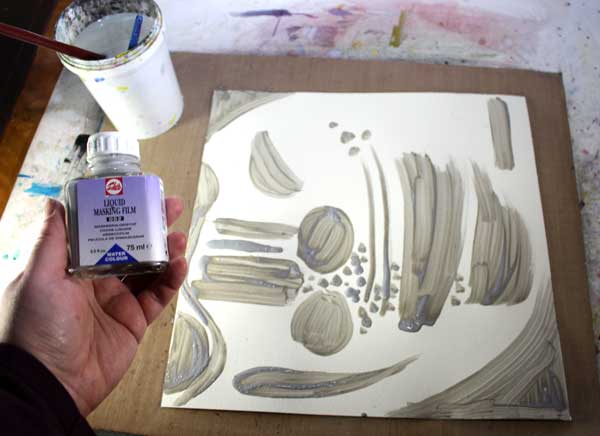
Instead of trying to build one controlled mental image first, accept the short-term, fractional nature of them. My artwork could be a collection of mental images appearing while I work. To emphasize that, I decided to start the painting with masking fluid. That way I could not even start building one complete image.
Masking Fluid
… or liquid masking film as my bottle says creates a rubber-like surface which you can remove afterward. You can add as many layers of paint as you like, then remove the masking fluid and you still have white areas to fill – or you can pick a colored area which you want to preserve and cover it with the fluid. It is a great way to obtain a layered look without too much thinking. Just remember to let the fluid dry properly before moving forward.
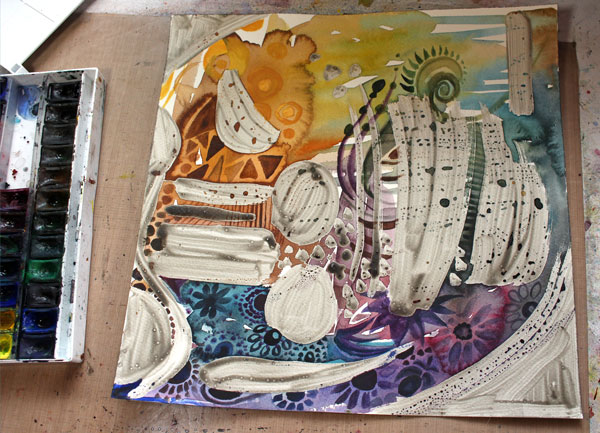
You can remove the dried fluid easily just by pulling it off with your fingers. With the help of the fluid, I was able to create very detailed areas before focusing on bigger objects so that they still look very sharp.
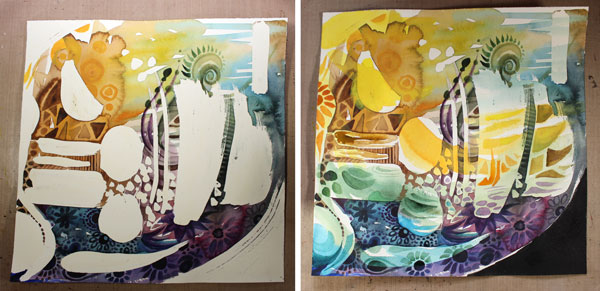
The painting was finished with colored pencils. The process was very similar to the one I teach in the video “Watercolor 101 for Intuitive Painting“, I just added the masking fluid before starting to paint with watercolors.
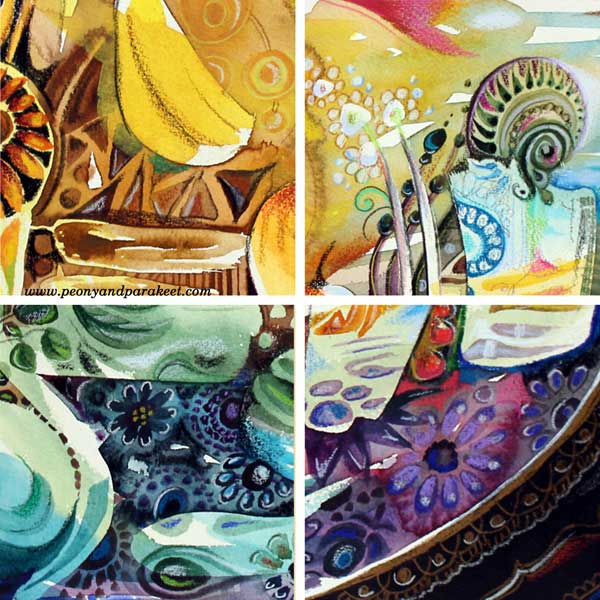
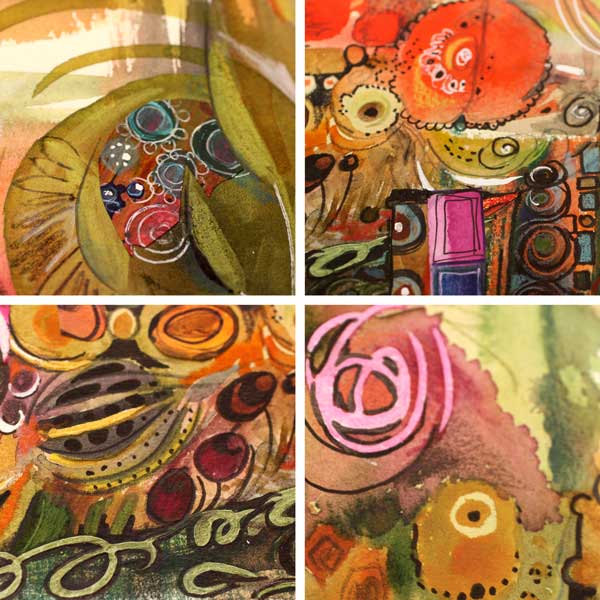
Here are some details of the finished piece:
And here’s the painting again:
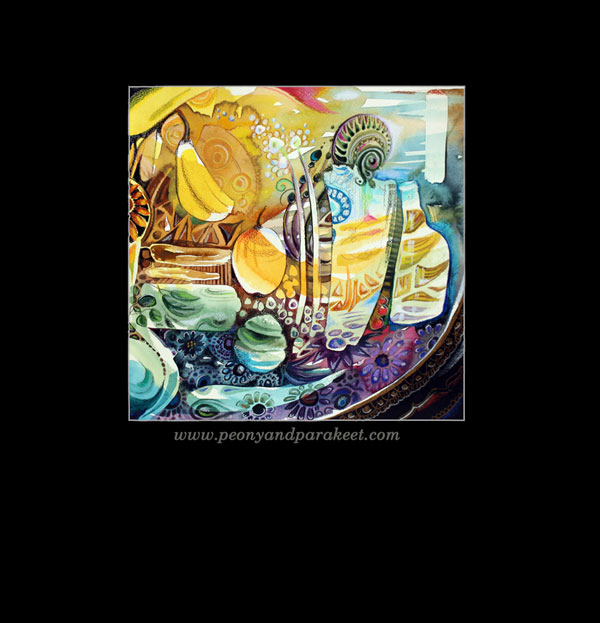
Before finishing, I realized that the banana from the kitchen counter had made it’s way to the painting. It seemed awkward at first but then, why not accept it to be the part of this surrealistic still life, surprisingly exact copy of the collection of my mental images!
What do you think? Could increasing intuition and including mental images improve your art?
Combine ideas with techniques – Buy Imagine Monthly Art Journaling Bundle!
Embrace Chaos while Creating Art
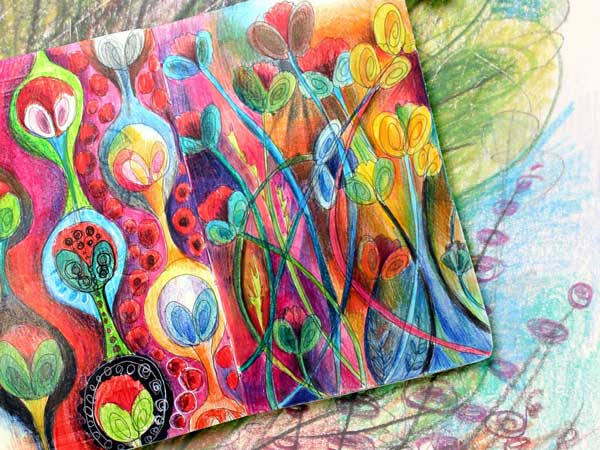
The first video blog post of the new year! This time the video a bit longer than usual as the subject is so close to my heart! The subject is the chaos and how you can use it while creating art. Hopefully you will enjoy the video!
Fast Start for Creative Painting
If you also like to paint, purchase my video: Watercolor 101 for Intuitive Painting. With the video you will learn the method where you don’t have to question your ideas before you start. You can just start and find the ideas along the process! Read more here!
How to Create More Often
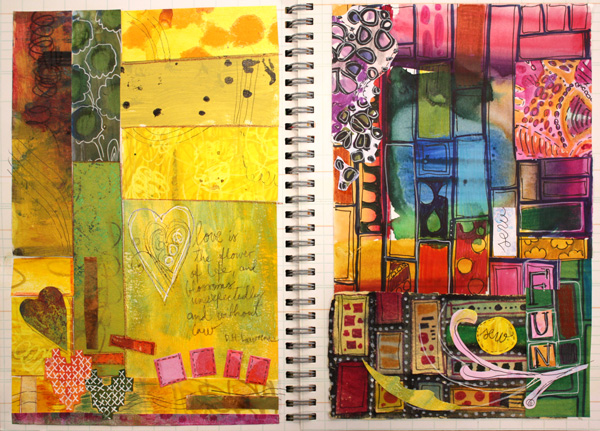
For many years, I have been dreaming about constantly making quilts. I have even recorded that into my art journal. Even if I have quilted almost all my life, especially in the recent years, I have had difficulties to arrange time for it. It has always seemed to require so big block of time that I am able to arrange that only few times in a year.
I am especially fond of modern quilting. One of my favorite quilting blogs is Crazy Mom Quilts by Amanda Jean Nyberg. She is especially focused on quilting from fabric scraps. I also love her book Sunday Morning Quilts. There are so many days that I have browsed the book, admired my fabric stash and felt sorry for myself not to have enough time for the actual making.
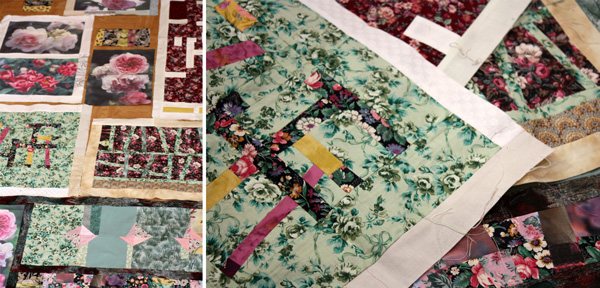
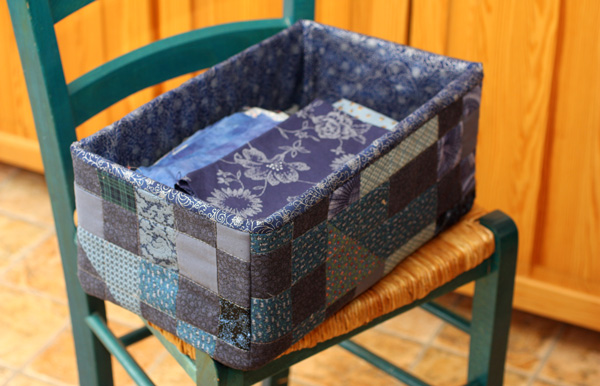
I don’t like showing unfinished projects, but as a proof, here’s one of the many patchwork projects which has been untouched for months. And, my dream is to make more of these quilted boxes for the fabrics (the pattern is from the book Sunday Morning Quilts)
The problem: How to create more often?
I have asked so many times:
– How to quilt more often?
and answered to myself:
– Arrange more time.
– Buy more fabrics, books, classes or subscribe to a magazine.
– Follow more blogs, have a Pinterest board for inspirational quilts.
– Organize your scraps first.
– Take more/less time for planning … etc.
None of that worked. But now have found the solution! I have developed a method derived from digital scrapbooking, another hobby of mine.
A Case Study: Scrapbooking as a regular practice
I had a similar kind of problem with digital scrapbooking, just not so bad. I wanted to do more of that but often realized that I had not done anything for a long time. Last October I decided to start scrapbooking one page a week with Project Life style: insert photos to a grid and make it simple. I only included one photo of each day or two, so it was not a big task to fill the page during the week. I decided that one page per week would be my minimum dosage. If I wanted to do more digital scrapbooking and be more creative, I could create more pages if I had any energy left.
What happened? I have not only created those weekly pages but 12 other layouts as well. That’s 33 pages total in 3 months which much more than my usual pace! Surprised by the result, I began to think about the magic behind that. And – could it be use for quilting as well?
Here’s is what I discovered.
1) Lack of time is not an issue, moving from one task to another is.
It did not require much time to take a sewing machine and start sewing. The reason I needed bigger and bigger time blocks to begin, was because I was thinking about too big tasks that seemed overwhelming. In other words, I required too much of myself. After working late in the evening, I should have started sewing a big quilt in a snap! The more I thought about starting, the less time I had to actually to do that and the less inspiring it sounded. When moving from one very different task, like writing, to another, like quilting, is not easy for the brain.
2) Lack of energy is not an issue, if the task is small and interesting enough.
It’s amazing how tired we can feel ourselves, but still spend time browsing computer or watching tv instead of going to sleep! There must be some energy left in us! I got that energy in use by telling myself that I was allowed to make only one little task. That way I did not imagine doing a lot and feeling a lack of energy for that. It also helped if I had some freedom to perform it. Then it sounded not only manageable but also interesting.
3) When the task is done, move to working with bigger projects.
The biggest thing that I learned is that I should always keep the promises for myself. If I presented a little task to get myself going, I should never ever make the task considerably bigger. Why? Because the next day I remember that one small task is actually a huge one and I don’t want to start it anymore. After I have made the small task and if I feel like doing some more, I can move to the bigger projects – to those unfinished ones that I actually want to finish!
Here’s how I adapted all that for quilting:
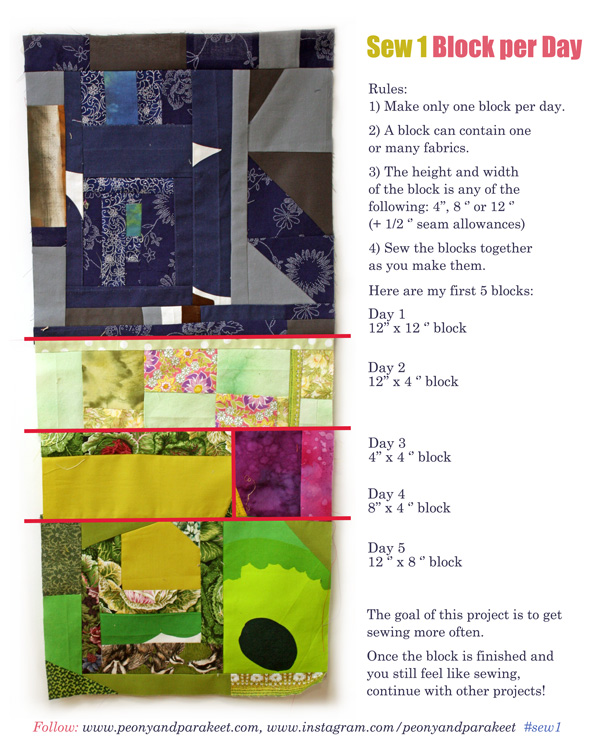
Sew One Block per Day
I decided to start a new quilt. But instead of planning and measuring, I just set few simple rules for each block. If I feel exhausted I can only pick one fabric, cut one 4-inch square and call it the block of the day. At the most I can make one 12 ” square with as much piecing as I feel like. But that’s it – no other blocks are allowed on the same day.
I started the quilt on the 1st January and here’s what I have made so far. This won’t most probably be my greatest quilt but more importantly, I have started to make a quilted box, a red one for the red fabrics. And – it is so much fun to sew it!
As the result of the new project, my studio has turned into the sewing room!
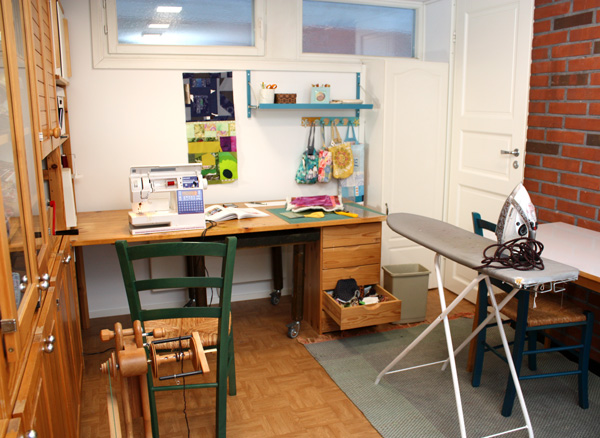
The little project bags are also handsewn (two of them are made just recently!). The old cardboard box is for buttons and been inherited from my husband’s grandmother.
Now you might ask:
How to apply this to art journaling?
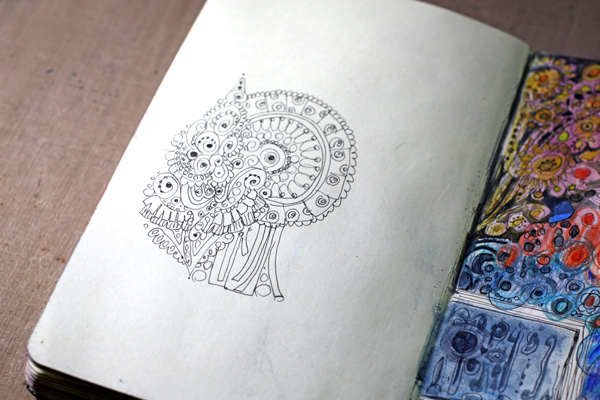
Why not make a page in phases from element after another! Here’s what I have made in two days: two little ornaments. I continue adding one doodled element or text each day. When the page is full, I will start coloring the elements, each at the time.
Preorder my class: Artistic Embroidery with Pens and Paper
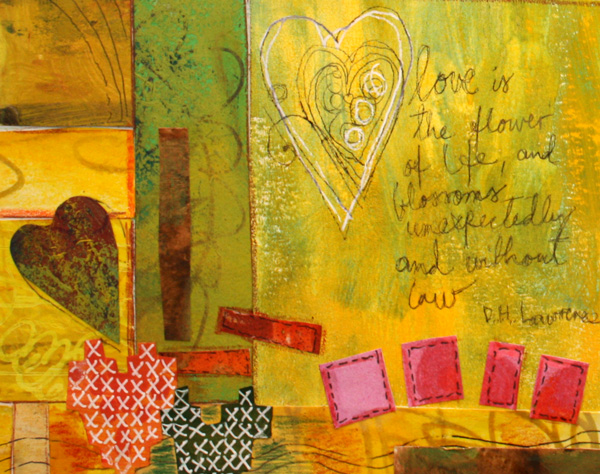
D.H Lawrence has said: “Love is the flower of life, and blossoms unexpectedly and without law.” You can replace the word “love” with the word “creativity”! But whether love or creativity, I believe that we need to do a little push to make the blossoming really happen. Like one doodle per day!
If you love crafting, quilting and needlework and want to show it in your art journal too, preorder my class from 21 Secrets Spring 2015 art journaling workshop! Let’s add little treasures to our pages! (Here’s also a recent blog post about the class).
The Power of Positive Self-Criticism in Art
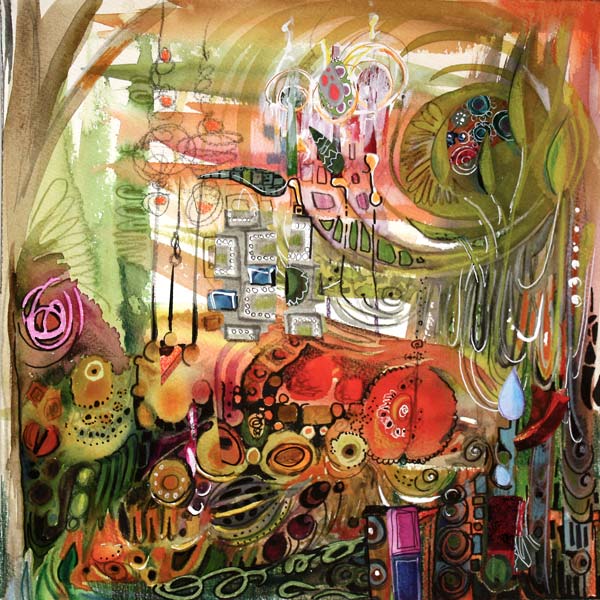
My latest mixed media artwork is called “Positivity Grows”. It is dedicated to all of you who have a strong inner critic. If you want to improve, it is essential to evaluate your own work. But sometimes the self-criticism can have too negative tone. Have you experienced any of these?
1) Big Picture Panic
The artwork gets evaluated as a whole in a too early stage. It is like making a meal and after tasting the raw potatoes, you’d decide that it’s not going to succeed. “I must have done something wrong when peeling those potatoes!”
2) Overclean Obsession
You take the safe way: you don’t mix colors, don’t let anything intersect, draw sloo-owly, keep everything plain, simple and controlled. This reminds me of a tadpole (a baby frog) which I got from my friend when I was a child. The tadpole lived in a jar filled with muddy water. I picked a clean vase, poured plenty of tap water and put the little frog there. It did not live long. I did my best to take care of it but did not understand that for the tadpole, there was nothing to eat, nowhere to hide. So – Mix those colors! Add diversity! Give some nourishment to the growing artist in you!
3) Mistake Hunt
If you focus on the things that “went wrong” instead of those which “went right”, you are playing the wrong game. Art is in small nuances, it requires sensitivity and openness. If your self-evaluation is too negative, you do not notice the beautiful little details that appear in your art. They are often lucky accidents if you take care of the diversity. When enhanced, those details can take over and bring your end result to the new level.
Positive Self-Criticism
You can get cured of any of those diseases with a healthy dose of positive self-criticism. From the moment you make the first brush stroke, focus on the details and look for beautiful and interesting areas. I will show you how I did that while creating the artwork of this post.
Phase 1 – Watercolors
When I began the artwork of this post, I just made a mess with watercolors. I kind of made the muddy jar for tadpoles to prosper!
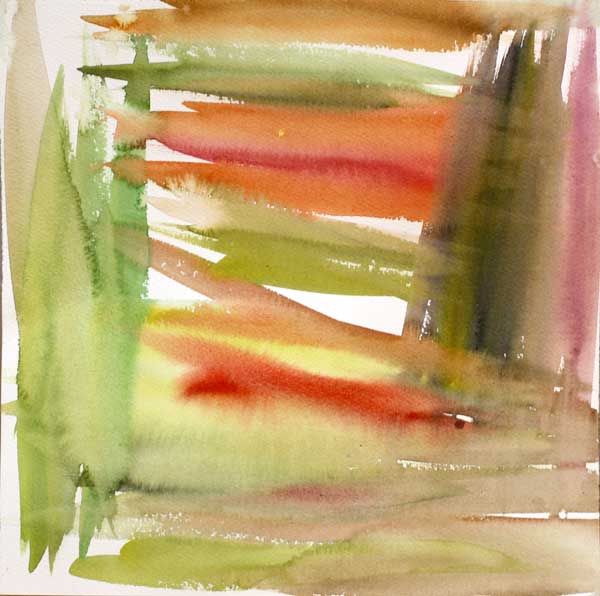
After painting this, I could have just quitted and called it ruined. Or I could have tried to make that dark muddy area brighter. But instead, I began to investigate the painting closely.
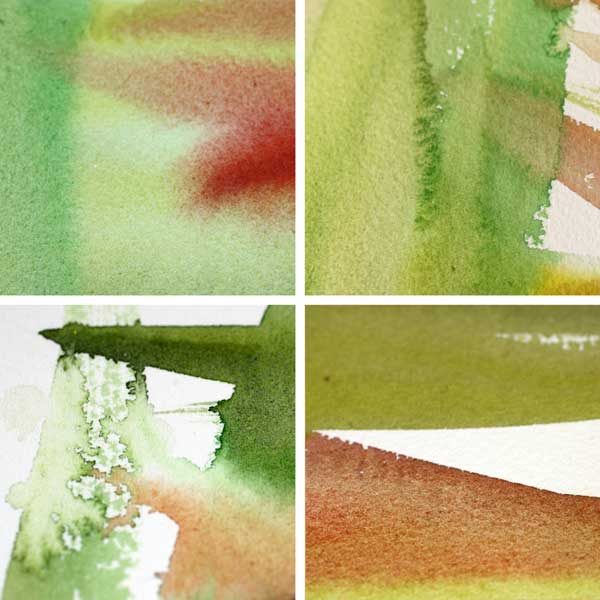
My inner critic pointed the little details with so much beauty that I began to feel confident and excited. The whole process of making this artwork began to feel like an adventure. Instead of mistakes, I was hunting treasures!
Phase 2 – Watercolors
Next, I continued with watercolors and created new layers of elements. I took care of the diversity: there’s a lot of various hues and shapes. And even more important: the layers intersect so that they create new happy accidents.
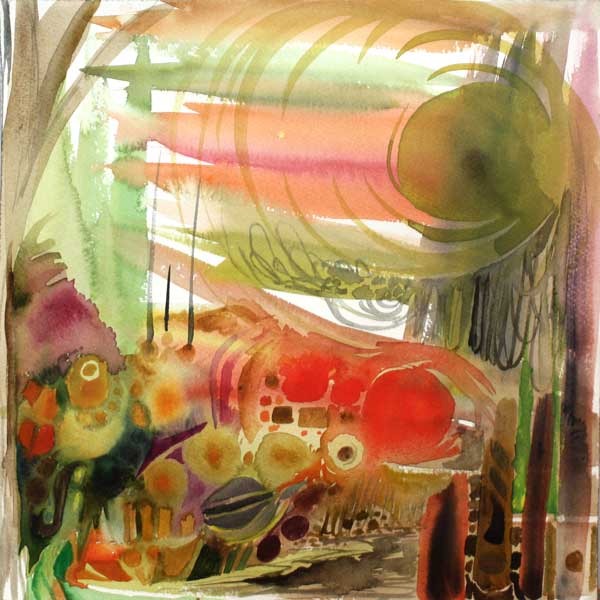
After painting this, I enjoyed this tiny detail: a yellow spot. It was like a little star! I felt I was lucky and genius at the same time.
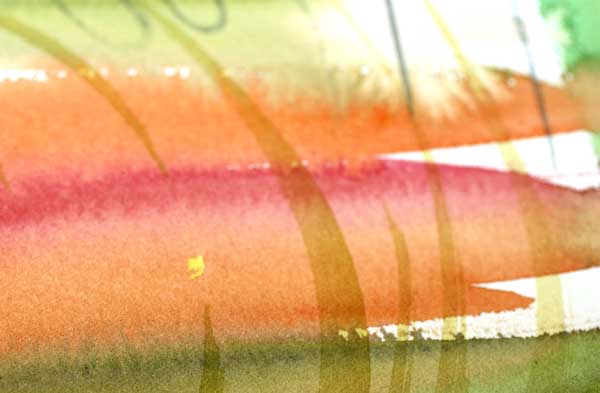
I spent some time searching for more beautiful areas and enjoying them. With watercolors, the edges of brush strokes are often really beautiful.

Phase 3 – Colored Pencils
To keep the diversity level high, I changed watercolors to colored pencils. I also changed the music I was listening to. Working from a small area to another, I enlarged the beautiful details found after another.
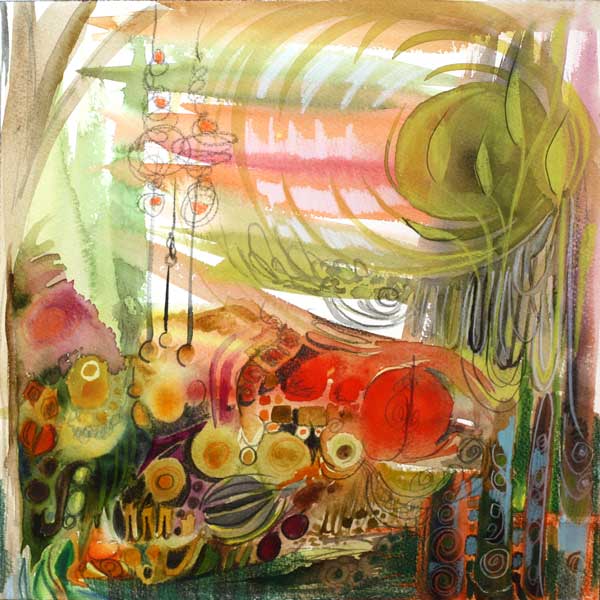
In this phase I realized that the main theme of the artwork would be growth. I searched for the details that would express the theme. I found several and they made me happy!
Phase 4 – Pens
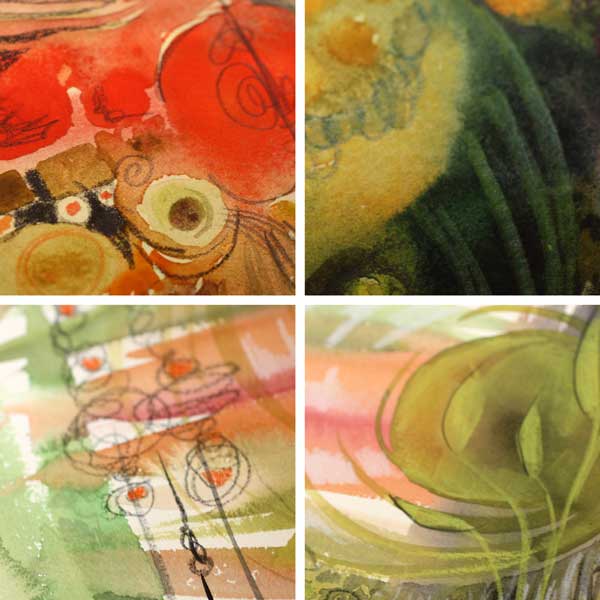
New music and new supplies! This time I picked a black PITT Artist Brush Pen and a white gel pen (Uni-Ball Signo). I was encouraging myself to create strong contrasts. They would make the pretty details really pop. Again, I was not worrying about hiding the not-so-pretty details but enhancing the good ones.

In this phase I began to look the artwork as a whole. However, instead of correcting the poor composition, I analyzed which of the details looked most appealing and how they were located.
Phase 5 – Finishing
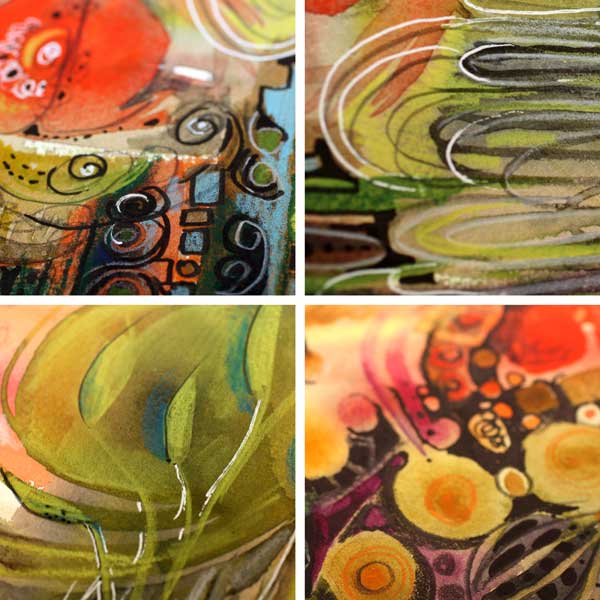
When finishing, I like to listen to the rhythmic music which gives me the confidence to carefully adjust the balance of the work. I picked a white correction pen and a box of hand decorated papers. By doodling and cutting papers, I changed the composition so that the eye would find all the pretty little details one by one.
The Summary
You can be analytical and critical when making art. You can also be strict: mix the colors, change the tempo, keep the image alive! But maintaining the gentleness and sensitivity is crucial too. Let the little details that appeal to you be the foundation for your self-expression!

Blank Page Syndrome before Big Picture Panic?
Buy the video “Watercolor 101 for Intuitive Painting” where I will show you how you can get a fast start and keep going! Click here for the preview!