
Weekly Art – Creating Regularly in Any Mood
This week, I talk about making weekly art and the feelings behind creating regularly.

I feel that although artists talk a lot about techniques and creative process, something gets left out. It’s a time perspective. I don’t mean how much time it takes to make one piece, but what it’s like to make art week after week. If you create art, you will surely recognize this: sometimes you feel excited, sometimes you don’t. People’s moods vary and you can’t always choose the best day.
Not the Ideal Mood
I felt nervous when I started doing this watercolor. The best part of the morning was already over and I was splashing color very fast. My weekly art session had a messy start.
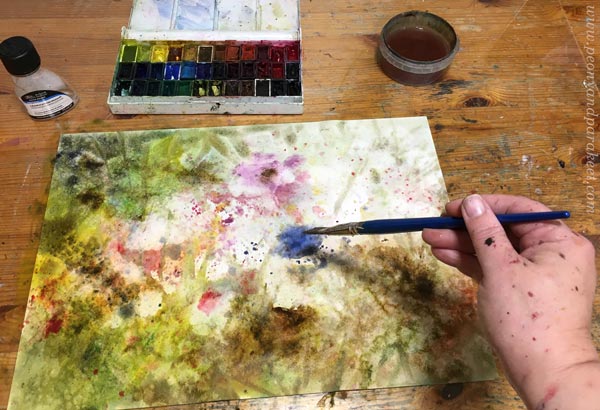
I found an unopened bottle of granulating medium in my stash and thought it might speed things up.

But I found the medium a useless acquisition. Some of the pigments are naturally spreadable and the spray bottle works better for them. All this took time, and my nervousness was still present and there was a new feeling too: self-doubt.
Not Feeling Confident
When you make art week after week, success is based on self-confidence more than mood. It’s easier to be confident at the beginning than later.

I usually paint with intuition and don’t use any models, so I often end up feeling hopeless. All I can say then is something like: “Keep going!” with a fake smile, and I don’t know if that helps at all.
Different Mood – Different Ideas
But art doesn’t put one mood above the other. Different mood brings different ideas. For example, if I am feeling nervous, there is an opportunity to be less conventional and express something that I would not otherwise come to mind.

The idea of this painting culminated in the Finnish expression “alavilla mailla hallanvaara.” It means “the danger of frost in the lowlands” in English, but the beauty of the statement is not in its content, but in how it sounds in Finnish. While painting, I began to think about those lowlands that suffer from rain and cold. Similarly, as painters paint week after week, flowers bloom constantly there, also in bad weather.

For me, in art, it’s not important in which mood it’s started, but that the end result contains both a trigger and a solution. Here, wind and rain bend the grass and break flower petals, but at the same time they make room for light.
Who Are You Creating Art For?
Within time, the mood evens out and focus is on the finishing. Then I also change who I think as a recipient.
I often start the weekly art by saying that “this piece is for me,” but when I finish I try to reach “for us.” There “we” includes all who like my art, both old and new friends in art. I don’t want to make art only “for you”, because then I lose myself while doing it, and not ” for them”, because it’s hopeless to hope that maybe someone would like the work even if we wouldn’t.

So, weekly, this happens again: the wrong moment, the wrong mood, the choice of brushes and colors, calming down, “I’m just doing it for myself”, uncertainty, slowly emerging ideas, concentration, triggers and solutions, happiness, and a feeling of gratitude that I can do this again for us.
Do you too create art regularly?
“Start Small”
In the spirit of “Start small”, have you tried this?
Draw lines and color the shapes! Art can be this simple.
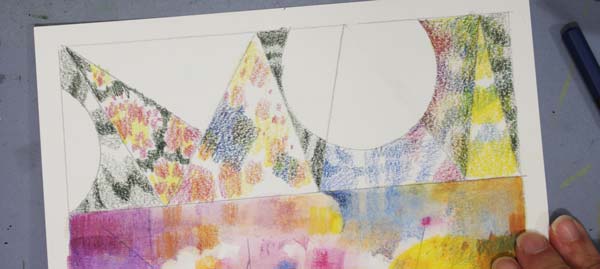
But isn’t it so, that everything just flows when you have the inspiration, and when you don’t, even a simple exercise (picked from the new course Joyful Coloring) can feel tedious.
Browsing for inspiration is never quite the same as participating in a course.
My goal in Joyful Coloring is not only to widen your mind about how you can create
but also to keep your inspiration level up.
Yes, we “start small” but with inspiration, we can also do bigger things.
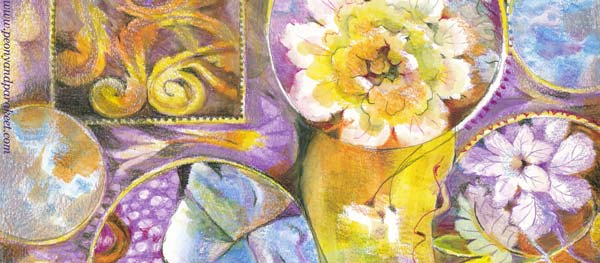
Watercolor pencils feed inspiration because they make coloring faster.
Joyful Coloring
Come with me to start small, and then create landscapes and seascapes, ornamental flowers, colorful fantasies, and modular magic.
Joyful Coloring – The new course begins on Sept 16! >> Sign up Now!
Drawing Sceneries with Watercolor Pencils
This week, I have a fun drawing idea: fill a paper with many small sceneries!

For this project, I have used watercolor pencils and Fabriano Accademia drawing paper (size: A4). The paper is very nice with colored pencils and goes well with watercolor pencils too.
Inspiration for Drawing Sceneries
Creating mini-sceneries is easy when you start playing with the scale. Think about a bumblebee – how it first flies over fields admiring the view and then finds a mini-world inside a flower.
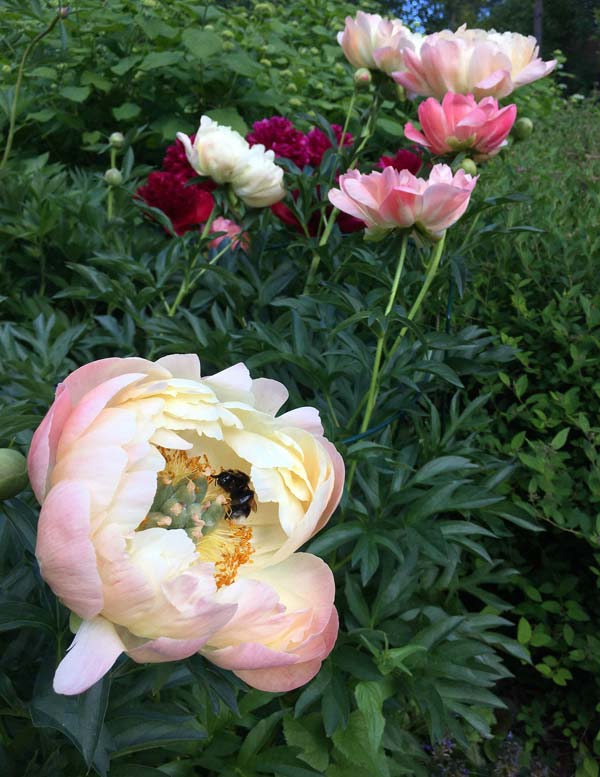
Your mind can be a busy bee, collecting a variety of ideas – big and small.

Your hand can then pick some of those ideas and put them into one picture like it would be a treasured collection in a secret museum. “Faberge eggs,” said my husband when I showed my picture to him.
Watercolor Pencils
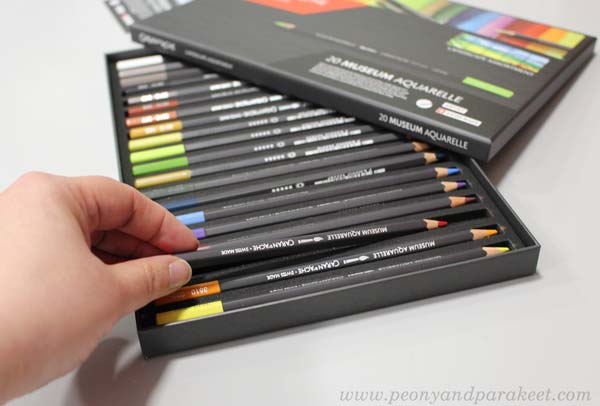
I often use regular colored pencils but slowly I have become interested in watercolor pencils too. I have had a few Caran d’Ache Museum Aquarelle pencils for a while and I love their quality – vivid colors, lovely to hold, and work well without water too. A couple of weeks ago, I bought 20 landscape colors to accompany what I already have.
Mini-Sceneries – Start Here!
Start your collection by picking a circle template, for example, a lid. Draw circles so that they overlap partially. Put one idea into one circle and color each of the circles separately.

This can be a “one in a day” project. Take your time to focus on each circle.
Watercolor Pencils in Use
Watercolor pencils are great for quickly filling larger areas. Color the area lightly and then add water over the colored area.

Let dry before adding a new layer on the top.
Drawing Sceneries – Playing with Styles
My favorite thing is to combine nature-related ideas such as landscapes and flowers with decorative motifs. I like to draw dots, other simple shapes, and lines so that they form frames and ornaments.

In this project, the circles are nature-related while the background has a more ornamental approach.

When you keep the background unified, you can use many styles in one piece. One paper then becomes a diary where anything handmade looks great together because it’s made by one hand and one mind.
Drawing in Ornamental Style

This project is another variation of the earlier blog post: Colored Pencils – Ornamental Approach. If you have taken the course Intuitive Coloring, would you be interested in creating something like this on a course next?
Selling Watercolor Paintings as Gifts
This week, I talk about making and selling watercolor paintings as gifts. At the same time, we celebrate the playfulness of watercolors.

See more and bigger pics at Taiko (online art store)
I love gift shops. My dream for a long time has been that, in addition to large oil paintings, I could sell smaller pieces as gifts. Recently, this has come true. I have sold many of my watercolor paintings not only directly but also via the Taiko online art store and the Gumbostrand Konst & Form gallery.
Art as Gifts vs. Art for Homes
An art buyer never buys art just for need. The work must appeal to the buyer on a deep level. Still, large paintings are chosen more according to the interior, and smaller ones are purchased as gifts. Sometimes a small painting is a gift to the buyer himself, often to someone else.

As a professional artist, I am more known for oil paintings, but I have dreamt that also my watercolor pieces would be in demand. I love to paint them and the idea of a perfect gift inspires me. However, it has taken time to grow my vision of how they should look.
Because I have grown many of my general painting skills with watercolors, my watercolor paintings have quite a similar style to my oil paintings. But with watercolors, I step in a slightly more illustrative direction. I want my watercolor art not to be too abstract, but approachable and atmospheric. See a collection of my recent watercolor paintings here!
Flower Art But With a Playful Attitude
My watercolor pieces usually have flowers. However, I don’t paint just static and spiritless flower arrangements. I see flowers as adventurous human or animal figures and get playful with them. On the one hand, the flowers are like dolls and teddy bears, and on the other hand, they are imperfectly perfect, feeling natural and real.
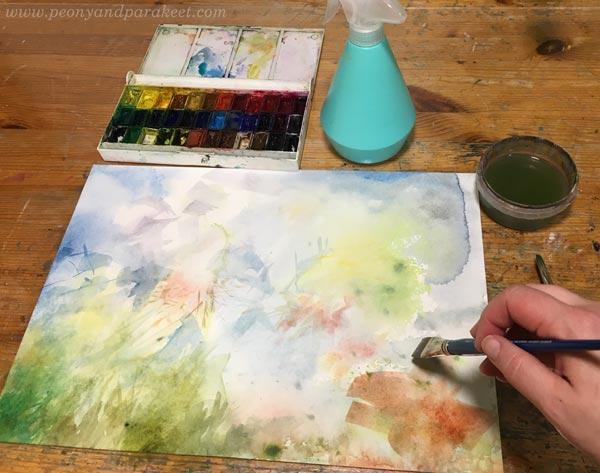
When the playfulness really kicks in, painting is fun.
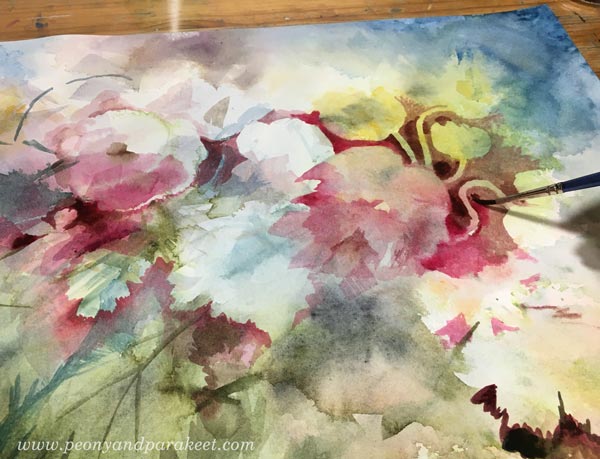
I love to discover plants in the middle of random watercolor spots. I have also a course called Freely Grown about this kind of process.
Taking Several Sessions to Grow the Idea
Usually, the first layers of the painting are fast and only take an hour or two. But that’s when the painting is just a regular flower painting, not a special piece that has a special appeal. Within a couple of hours, there’s not much time to grow the idea further or adjust the details.

I usually paint in several sessions where the first one or two lay the foundation and produce the basic painting, and where the next sessions (usually 2 to 4) grow the story and produce the finished look.

For example, for this painting, I took walks to see flowers and to add some more to the painting. But after a while, that felt too traditional and then decided on the gold mining theme.

The further I go, the smaller the brush strokes become.
Working with a Progress Photo
I find it helpful to take a photo of the unfinished piece, and then use it as a reference. The small-sized picture makes it easier for me to spot the areas that still need adjusting.

Looking at the photo also helps with distancing myself from the actual piece. I can ask: Do I love this? Would I buy this? When selling watercolor paintings as gifts, never underestimate the quality, always try a little higher.
Color over Color
Pigments are very different from each other. Some colors require many layers, and others can be used very thickly. Most artist-quality yellows have good coverage and work well for the finishing touches.

I have recently used smooth (hot press) watercolor paper because it’s best for tiny details.
Gentle Breakthroughs
I want to break boundaries with all my art, but in watercolor, I try to do it more gently than usual. In this painting, the flowers have caught Hokusai’s great wave from Japan and taken it to Lapland to pan for gold. And so it happened that the gold and the flowers started a decorative baroque party and everything small became surprisingly big and grand. Despite all this, this is a flower painting where the viewer can relax and enjoy the joyful atmosphere.

But whatever the story is, I try to express it so that it can evoke different memories and associations in different people. Somehow, the painting must make a gentle breakthrough in the eyes of the viewer – find a soft spot where the immersion can begin.
See more pics of “Kultaa huuhtoneet – Gold Panners” at the Taiko art store!
Freely Grown – Paint Watercolor Flowers with Me!
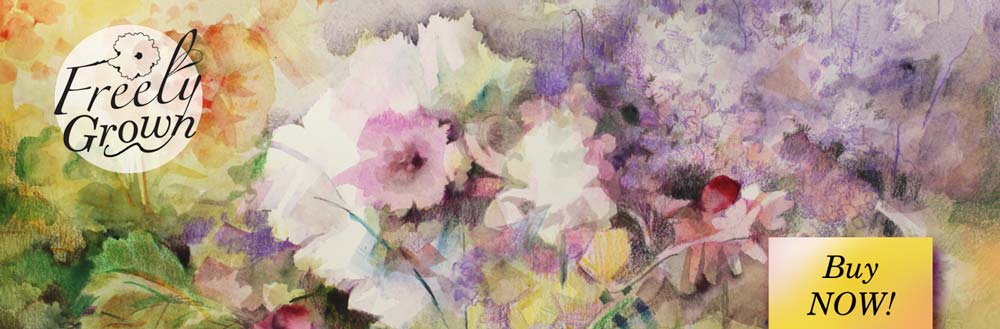
In the course Freely Grown, I walk you through my watercolor painting process. Because the finishing touches with a small brush are the most challenging, we take the easier route and do them with colored pencils. In Freely Grown, you paint flowers freely without reference photos and create a unique painting from the given techniques and guidelines. >> Buy here!