
Get Inspired by Fine Arts
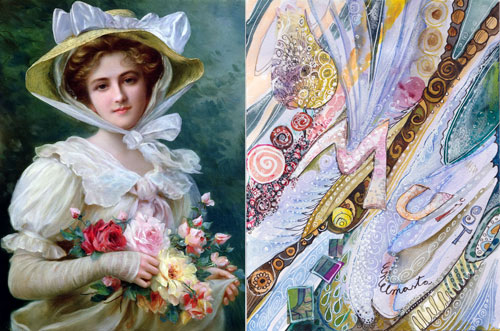
The world of fine arts is bursting with ideas that you can use in art journaling or any crafts. On the left, there is Emile Vernon’s painting Elegant Lady with a Bouquet of Roses. On the right, you can see my interpretation.
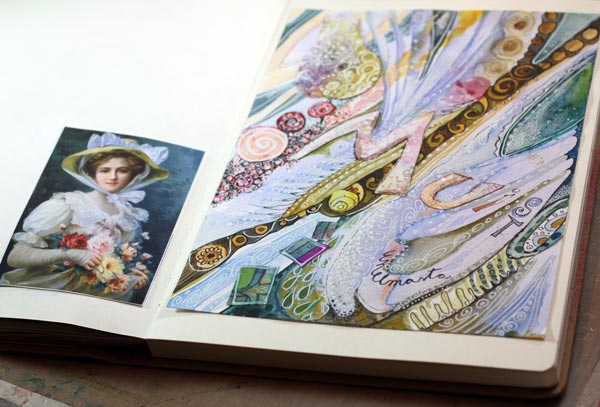
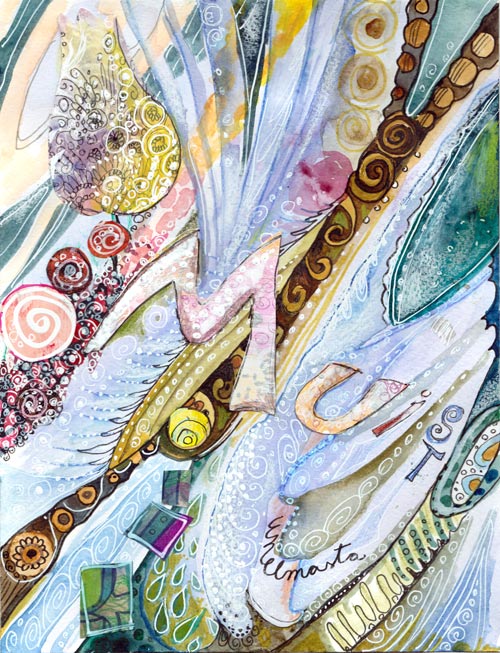
The secret is not to copy but find the concept of the painting and transfer it to your personal style. I began with the dominant factor of the painting which was the beautiful dress. Then I added the various details of the painting in my style. Almost weightless objects and angular lines combined with soft shapes create the atmosphere for both of the work. Because I love surface patterns I wanted to study the painting as a pattern too. I must admit I love the result. It represents the kind of nostalgia that I find very appealing.
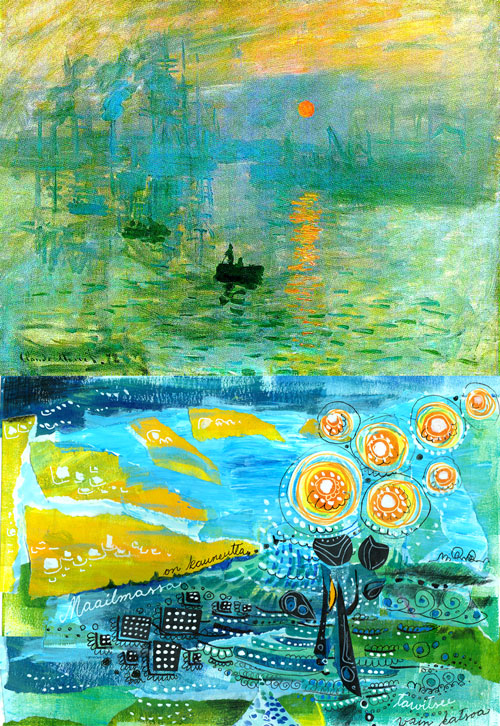
Another painting to go. I chose Claude Monet’s Impression Sunrise.
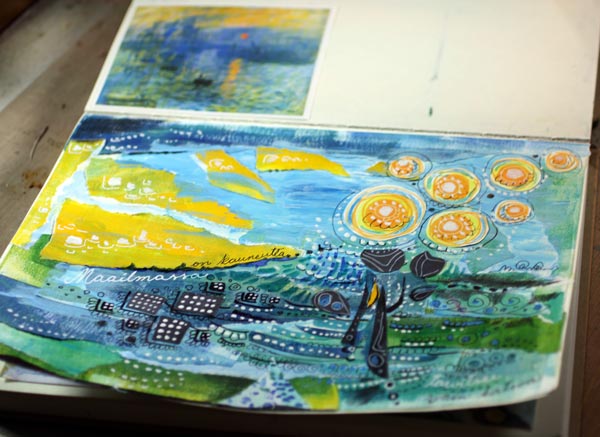
Here I kept the theme of the painting but used torn paper pieces to represent the thick brush strokes. The sun was the most interesting detail, so I made many of them. A horizontal composition combined with vertical lines was also repeated. I copied many of the concepts but not the exact painting.
How to Do It?
1) Take your favorite painting and analyze it to pieces. What is the composition, the colors and their relations, the eye-catching details?
2) Reconstruct the pieces and add some of the things that reflect your personal style.
After this exercise, you’ll never complain about the lack of ideas! The whole world of fine art is waiting for you.
Get Inspired and Express Your Inspiration!
More inspiration from fine arts – Buy Art Journal Class Bundle
Learn the process of using images as inspiration sources: Sign up for Inspirational Drawing 2.0!
Choosing Creativity

This watercolor piece was made last summer. It was found when I organized my papers. During a long summer night I browsed one of my favorite books: Alphonse Mucha Masterworks. After closing the book I wanted to make something Art Nouveau myself!
My sisters used to say that I am an affective person. I get easily excited and affected by everything that surrounds me. Within years I have learned to steer myself by choosing what’s around me. No one can choose everything, but there’s plenty of choices that can be made during the day. Like which book to open.
More than before I choose to close the television. I also try to stop browsing endlessly what others have made. It is surprising how little input is needed to get the creativity flowing. Having a glimpse of Mucha’s masterpieces can be enough. Limiting consuming and increasing creating can take us closer what we want, like time traveling to Art Nouveau.
Subscribe to my weekly emails – Get a free mini-course!
Inspired by William Morris
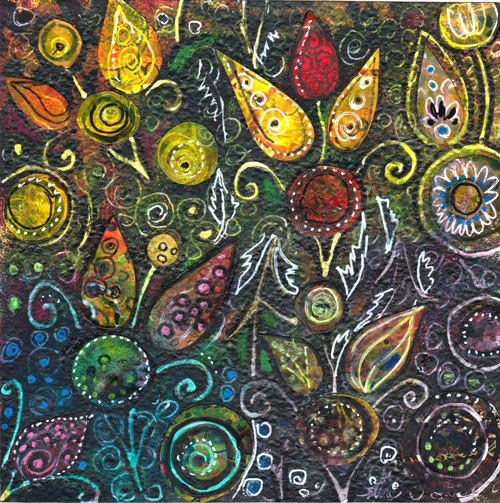
As a big fan of art nouveau and arts and crafts pediod, it may not be a surprise that I adore William Morris designs. Our home has William Morris curtains in two rooms. I love how detailed and decorative elements are combined to create repetative patterns in the two fabrics.
 The little collage of this post was created after browsing some of the old William Morris designs from a book. I wanted to express the beauty of repetitions without creating absolute symmetry. The dark colors in the background change to shiny yellow to give the expression of hope and warmth. William would have used perfect symmetry and more muted colors. I tried to compensate my lack of technical skills by adding self expression.
Being too self-critical is not a good thing. It stops us doing what we really love. I know I cannot be the reborn William Morris. However, in my imagination I can go back in time and pretend to be his apprentice!
Inspired by Mark Rothko
I have some close friends and relatives who have their birthday in May. I came with this idea of Mark Rothko inspired greeting cards when I thought: What would I give them if I had all the money in the world. And I immediately knew the answer: Mark Rothko paintings! Not as genious as the originals of course but still I think this is a fun idea.
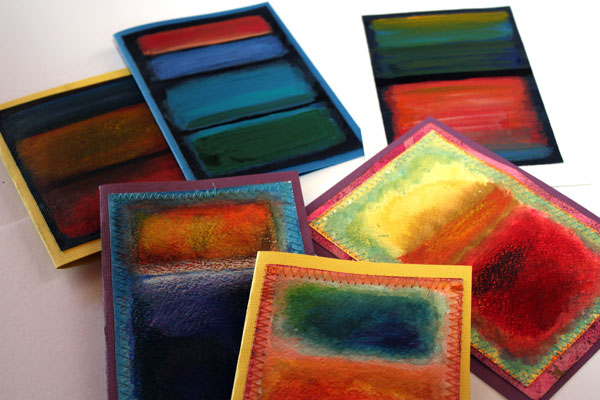
Make your own Mark Rothko inspired card!
1) Paint the borders of the cardstock with acrylic paint.
2) Fill the center with watercolors. Paint rectangular areas using multiple shades.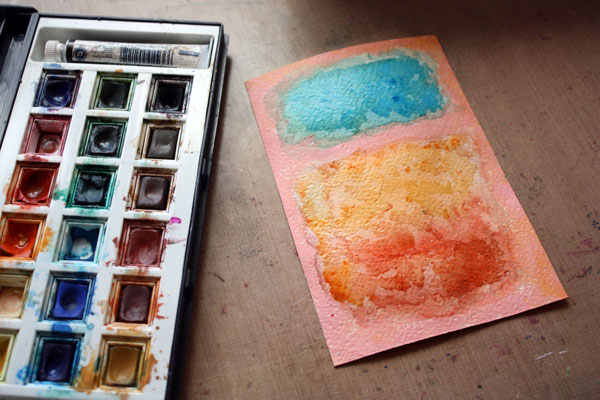
3) Strengthen the watercolors and create layers with color pencils.
4) Attach your artwork to the card base. If you like you can sew zigzag around the edges to add detailing.
You can also use acrylic paints only. In the first row you can see my all-acrylic creations and in the second row are the cards that combine acrylics, watercolors and color pencils.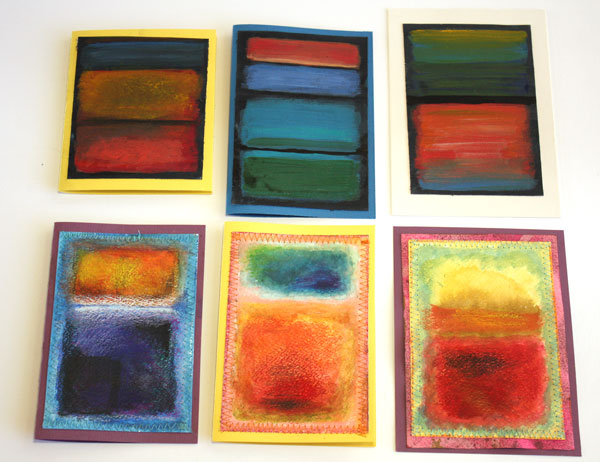
Mark Rothko & abstracts with colored pencils: Buy the e-book Coloring Freely!