
Bringing Old-World Feel to Abstract Floral Painting
This week, let’s dive into the old-world feel and get inspired by the opera singer Edita Gruberová!
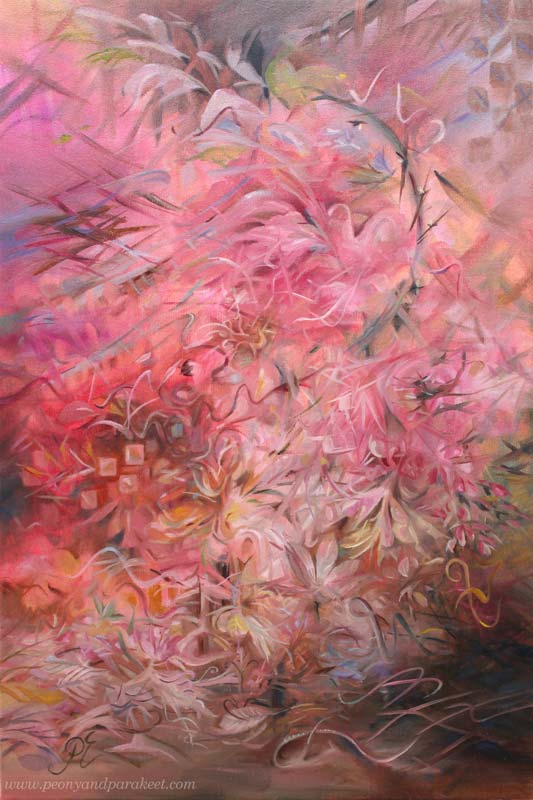
Ideas Behind the Painting
I listened to the opera singer Edita Gruberová (1946-2021) while working on this painting. Her version of the famous aria Queen of the Night from the opera Magic Flute is exquisite. Gruberová’s voice is partly like a bird’s not a human’s voice at all, and the aria brings that up well. The music editor Outi Paananen calls her a nightingale of Slovakia.
The transformation from a human to a bird felt inspiring. Maybe I could do a transformation of a painting so that my free and careless strokes would turn into decorative swirls, adding an old-world feel to an abstract floral painting. I had done something similar just recently but in a much smaller piece. See this blog post where I revamped a flower painting! From that experiment, I knew that it would take both time and patience. In a bigger piece, I could also get lost in the details so that the painting becomes confusing.
Before listening to Edita Gruberová, I already had a lot of ideas, collected in the blog post called Pink Inspiration. And now I wanted to add her and her birds to the painting too. I heard Edita’s story from Outi Paananen’s excellent radio program “Narrin aamulaulu” (in Finnish) on the Finnish Broadcasting Company. She had a clear artistic vision and strong willpower, and she demanded a lot of herself. It inspired me to challenge myself too.
Bringing Old-World Feel – 2 Tips!
In the past, painters often started with sketches and made detailed underpaintings with two or three colors. But a looser approach is not an enemy to the old-world feel.
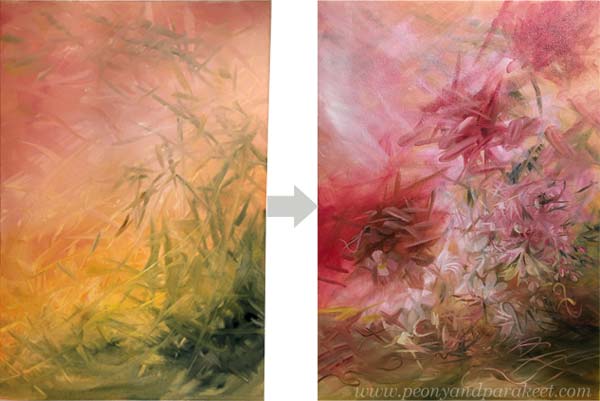
When you want to bring an old-world feel to an abstract painting, two things are the most important:
- Blurry on the bottom! Start from the background with soft transitions from light to dark, add blurry shapes, and paint like you would see the scenery from a far distance.
- Sharp on the top! Add sharp shapes and lines on the top of blurry ones. You can sharpen some blurry shapes but do it only partly, leaving some parts more undefined. But most importantly, let sharp lines and shapes sing the melody of their own. If the background is the orchestra, the top layer is the singer that has a melody of her own.
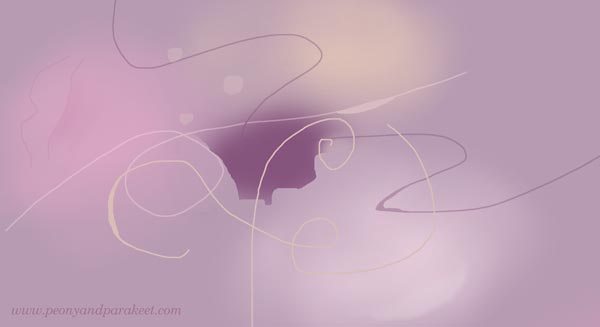
The thickness of the lines can change in places and there can be decorative dots too.
Timelessness Takes Time
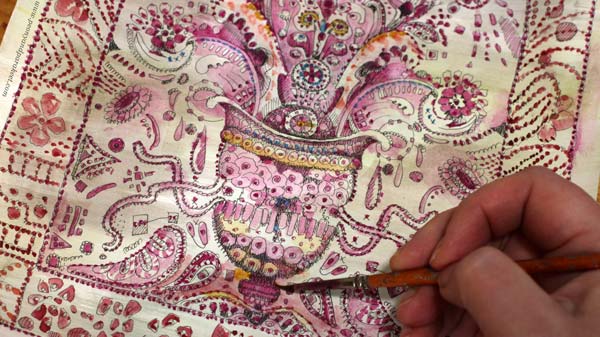
It’s always tempting to get the piece finished quickly, but to get the sense of timelessness, the time has to stop while painting. So, I focused on tiny details and immersed myself in building a wondrous world with curves and swirls.
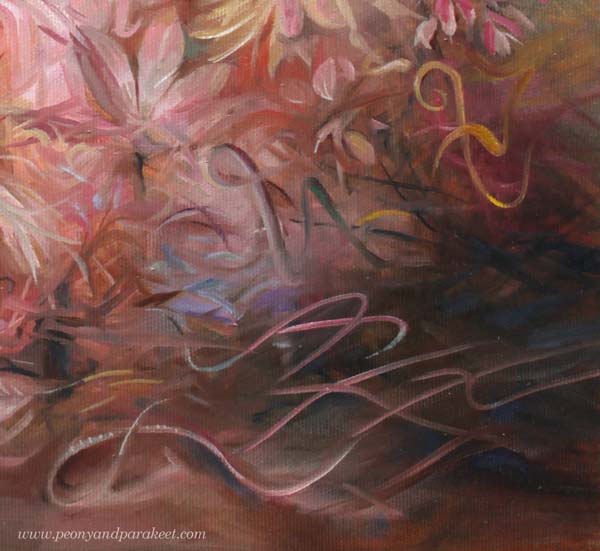
My lines are like old-fashioned handwriting in places. I have practiced them by drawing for a few years. Any note or waste paper can be used for practicing! I often doodled on planner pages.
Intuition and the Ability to (Not to!) See
As usual, I didn’t use any direct reference photos for the painting but worked intuitively. However, I tried to reduce the human ability to see ordinary concrete objects like flowers, faces, or such in simple forms. For a long time, I have thought that the ability to see is a part of creativity. But the more I create, the less I need the ability, at least in the first place. Seeing too soon makes me hurry and my art much less unique. So I try to let the shapes fly free and the big picture appear without too much forcing and seeing.

During the process, a little bird-like mesh appeared on the right. When I was making the final touches, and intentionally made him a partner in the center.

Sadly, Edita died last year, just before I discovered her, so I can’t send her a photo. But I want to honor her with this blog post and ask you to listen to her singing on Youtube. Isn’t that inspiring!
A Series in Progress
I have been painting like mad this month because I have to get everything finished for my solo show in June very soon. So, there are lots of paintings in progress in the studio!
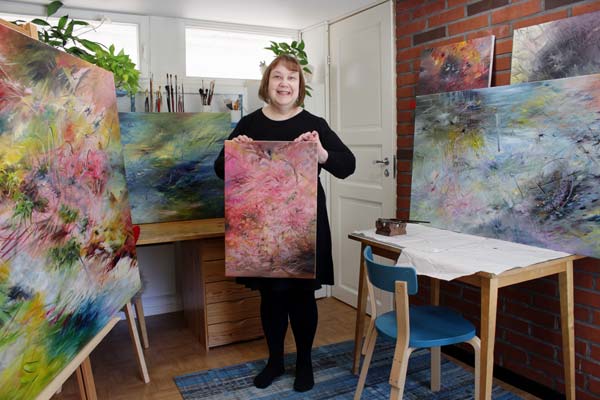
Easter was mostly spent with brushes, and if this wasn’t my ultimate passion, I would be quite exhausted already! Also, seeing the flow of wonderful creations from the students in my community Bloom and Fly energizes me a lot.
Let’s keep creating and inspiring each other!
Art Inspiration from Period Dramas
This week, I am sharing art inspiration impacted by period dramas.
Visual Deliciousness of Period Dramas
I am a fan of period dramas. Recently, I have been watching Gilded Age and Bridgerton. Both of them have beautiful outdoor and indoor scenes, and dresses too, of course! My eyes like the delicious visual world they illustrate and my heart always feels a bit lighter after an episode or two.
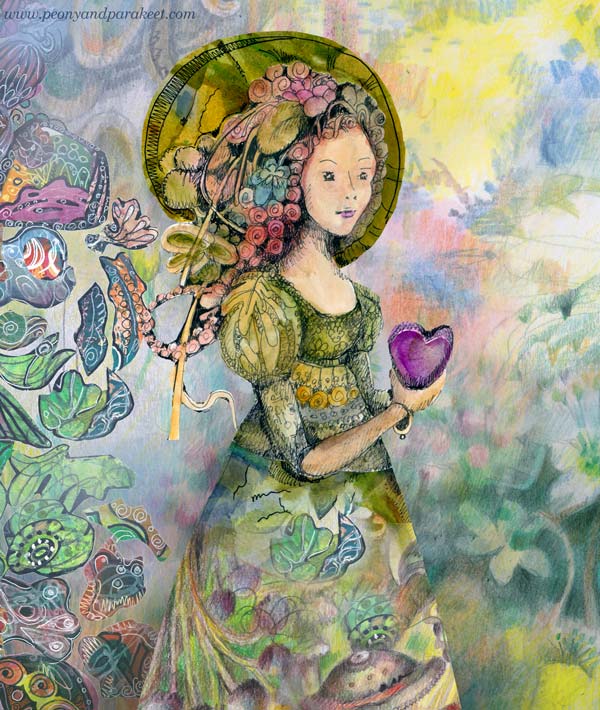
Even if the dramas have historical settings, their colors are not dull at all. A picnic in the forest looks vibrant and is full of sunlight.
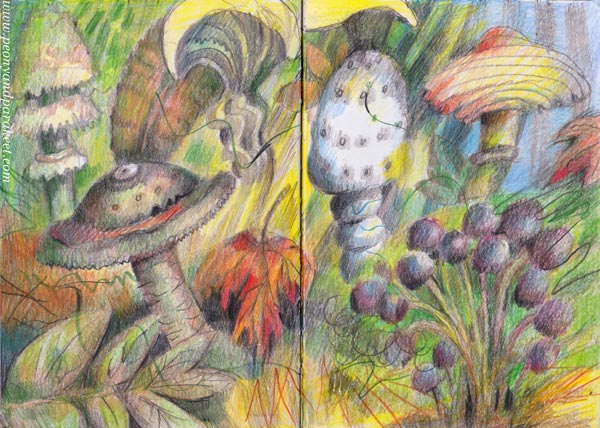
I like how flowery everything is, and how the jewelry frames the faces of young ladies.
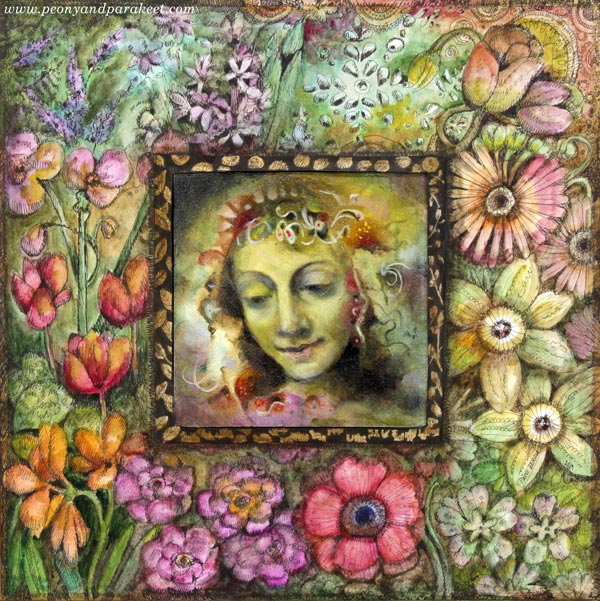
Being so inspired by period dramas, it’s no wonder that my art is full of romantic and old-fashioned elements. They speak fantasy to me.
Fantastic Old-World Impact
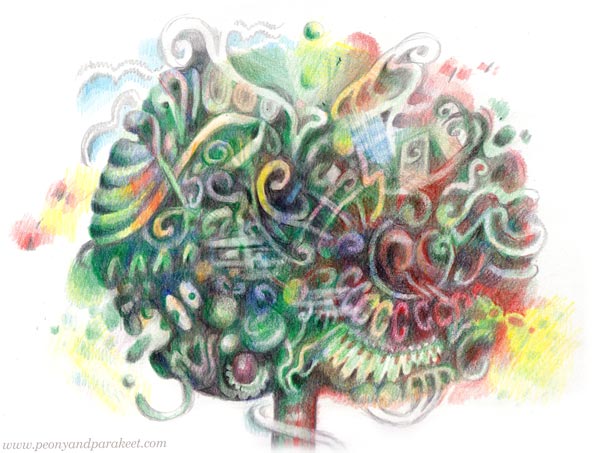
I think that every artist needs to find their approach to fantasy and fairytales – how to use imagination and what to express with it?

I am fascinated by the power of the inner world and all my pieces are inner sceneries in one way or another.
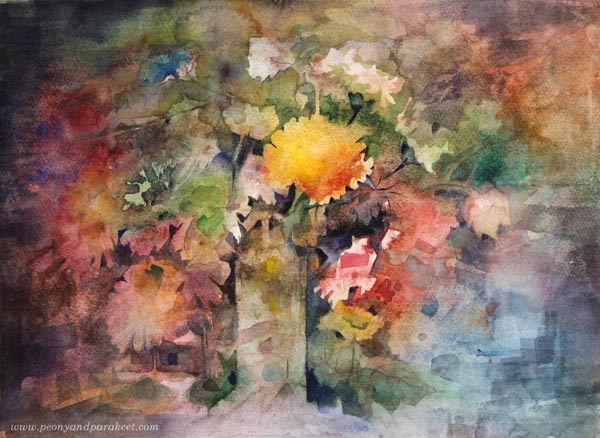
Pablo Picasso has said: “Art is a lie that tells the truth.” Similarly, I would say that art is a fantasy that gives us what we need.
Bringing Fantasy to Life
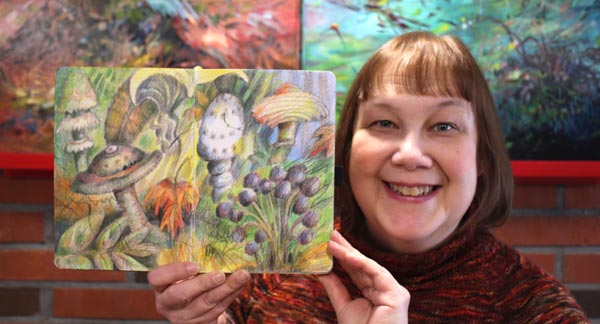
I often talk about seeing art as a story or a collection rather than a single piece. In the new class, Fun Botanicum, we create a set of illustrations that are all unique but still a part of the series. This is a great project for setting a style and bringing different coloring techniques together.
Plants are a fun theme to explore what you can do with colored pencils and imagination!
>> Sign up here!
Before and After – Which Painting Style Do You Prefer?
This week, I share a revamp of a small painting and talk about painting style.
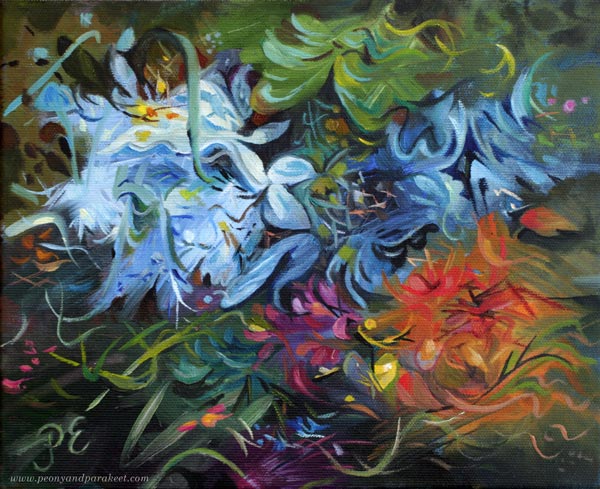
Here’s my newest piece that I am quite fond of. But wait! This isn’t totally new, but a revamped one.
Husband Didn’t Approve
Earlier this month, I made a small painting that didn’t get approval from my husband.
– “Unfinished,” he said.
– “No, it’s just loose and abstract,” I claimed.
But soon after, I considered adjusting something a little. My husband has good taste, and I appreciate his opinion. Like most Finns, he is brutally honest, and often that’s what I want to hear, even if it would hurt a bit.
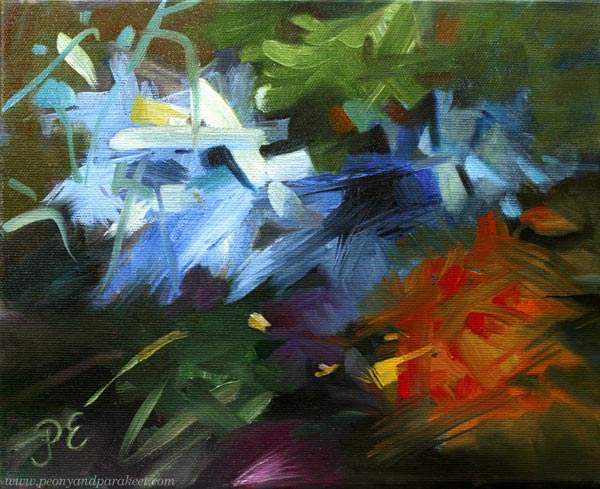
But what to do with this one? Maybe just make a couple of clumsy shapes a bit curvier. But after having a wonderful conversation about conventionality with a friend who is also an artist, I felt that I could do it – go from one extreme to another.
Several Levels of Style
During the last couple of months, I have been trying to define my approach to art as levels of some sort – when should I go abstract, when do I want to make illustrations, and when my style needs to be decorative or design-oriented.
I have always thought that these levels are connected to what supplies I use. Like this:
If I paint, I am more abstract.
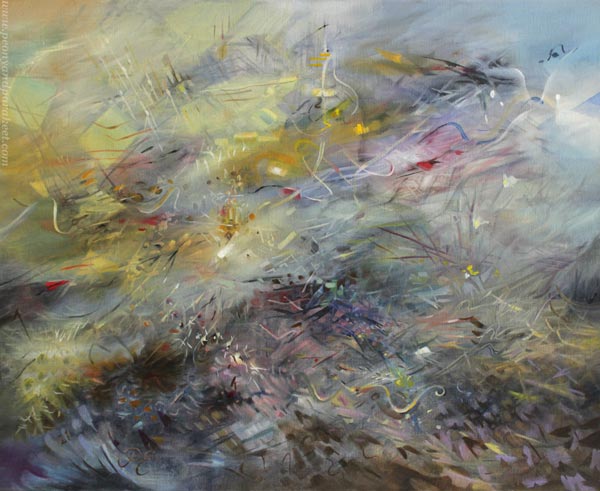
If I draw, I go in the illustrative direction.
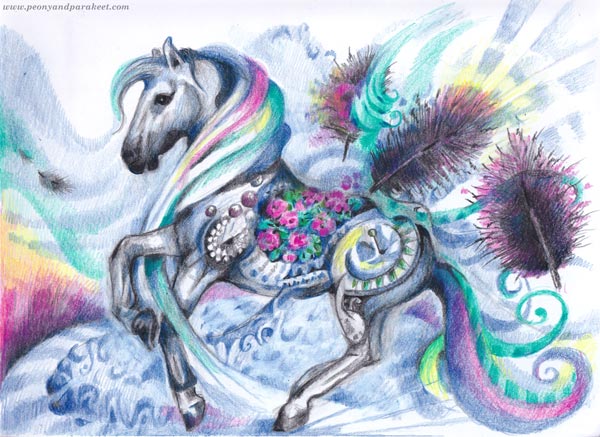
And if I embroider, it’s just decorative work for relaxation.
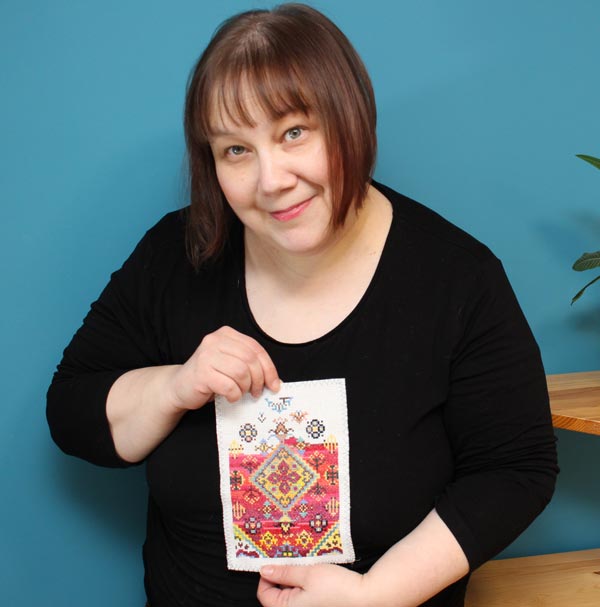
But it shouldn’t always have to be like that. The opposite could happen too.
Untraditional Use of Supplies – Mixing Levels of Style
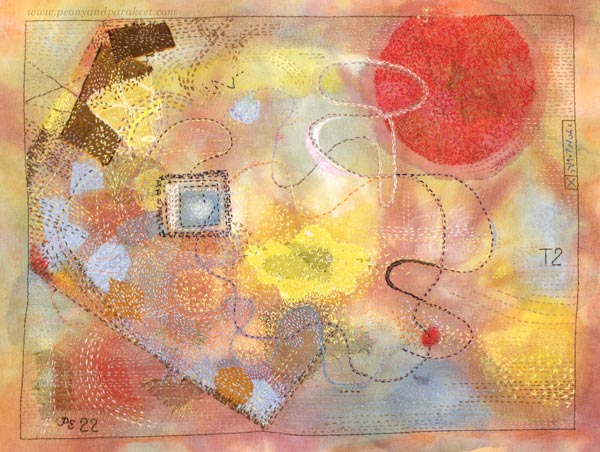
Last summer, I started to do slow stitching – random simple stitches on fabric. Surprisingly, what first felt like decorative needlecraft started to produce abstract art. This piece is not traditionally decorative at all.
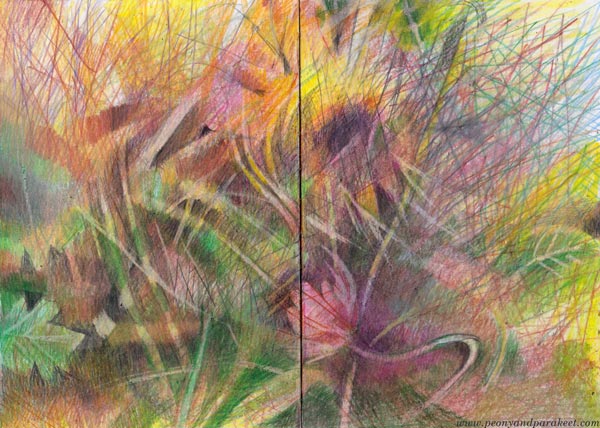
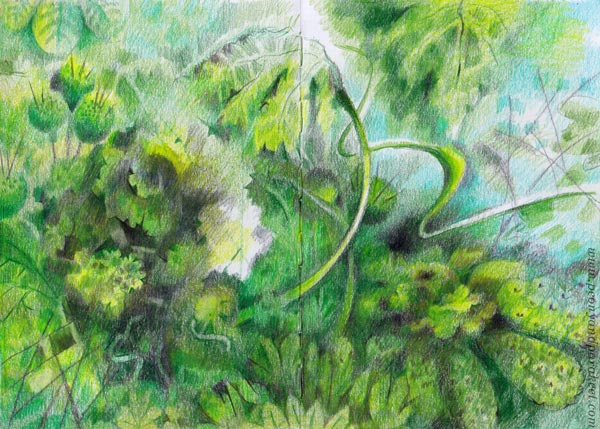
And many of my recent images in colored pencils have been quite abstract and painterly, like this spread from my colored pencil journal.
The art world is full of presumptions based on supplies.
Colored pencil artists replicate photos.
Watercolorists throw water on the paper and wait for the landscape to appear.
Abstract painters do it for interior design.
Decorative is reserved for folk artists.
And so on!
But I have come to the conclusion that supplies don’t define the levels of my style. I can freely choose how much I want to show each level of style in one piece.
So, we can break what’s expected and do what we want!
Inspiration from Many Styles
The same unrestricted approach applies to inspiration.
I went to Sinebrychoff Art Museum to see floral paintings, but the most inspiring piece was a traditional textile – what??? When I looked at the photos taken from the exhibition, it felt like a dirty secret.
There were many old masterpieces in oil, but a small traditional textile captivated me.
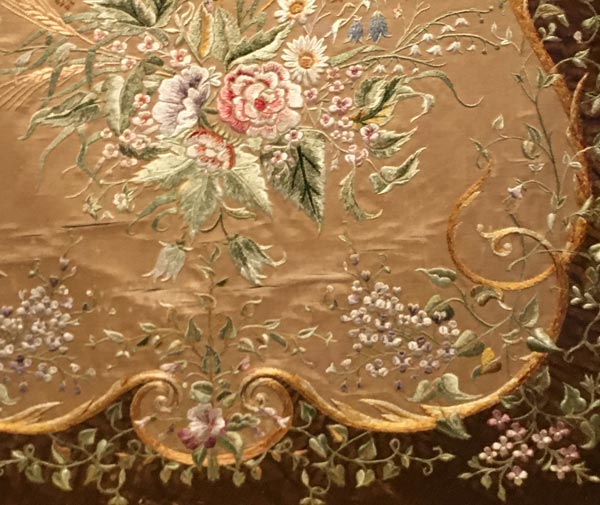
“How can I be so inspired by that?
I shouldn’t think about that anymore.
At least, don’t tell anyone!”
But my creativity has a mind of her own when it comes to inspiration. If I look at my Instagram saves, sometimes I like to see old palaces or churches, and other times I find simple and rural terribly inviting. I love old portraits, but I am not particularly fond of painting humans myself. I consume all kinds of kitsch – banal florals, round-eyed dolls, plastic horses – like crazy, but I also love modern and straightforward that’s not similarly pretty at all.
And now, my creativity told me to revamp that abstract painting and go wild with decorative strokes.
“Take it to the Kitsch goddess,” she shouted.
“No one will like it,” I heard myself saying. But then it hit me that maybe we could do it together. I asked my inner Kandinsky: “Would you go decorative with me?” He nodded quietly but without hesitation.
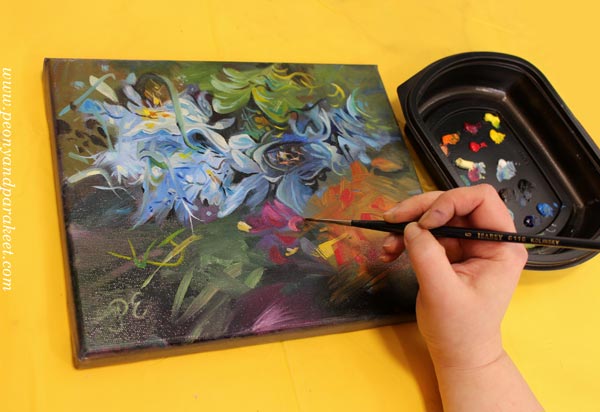
And so it happened that Mrs. Decorative, Mr. Abstract, and Miss Illustrative all painted together. It was a lot of fun!
Which One Do You Like Best – Before or After?
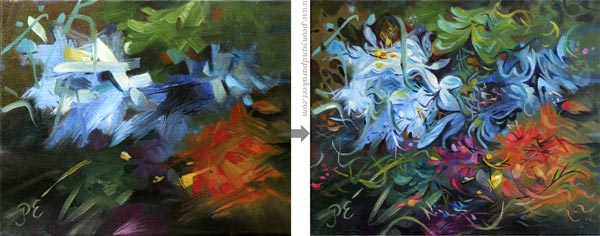
Which painting style do you prefer? It would be interesting to hear, leave a comment!
I have no regrets and my husband approved too. While I am waiting for the painting to dry, I glance at it frequently, smiling.
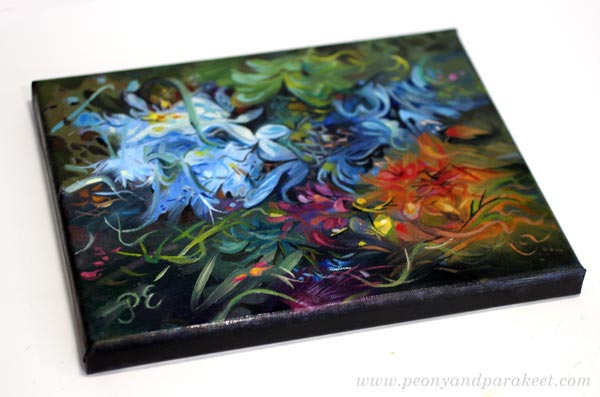
The painting follows a tradition but still feels like a breakthrough. I can now see further and wider. I could mix different painting styles in one big piece and bring a wider variety of inspiration into one work. So often, I have tried to move to the next level in technique, but now it feels that I need to level up artistic thinking!
News from My Little Studio
I have lots of painting work to be done in April. My private exhibition in June is still half-empty, but that’s partly a happy problem. My paintings have sold well, and I have a new prestigious gallery representation. The gallery is called Gumbostrand Konst och Form. I think it’s a great fit for my art because they also sell design pieces. Here’s my page on their website.
My home feels like a work in progress.
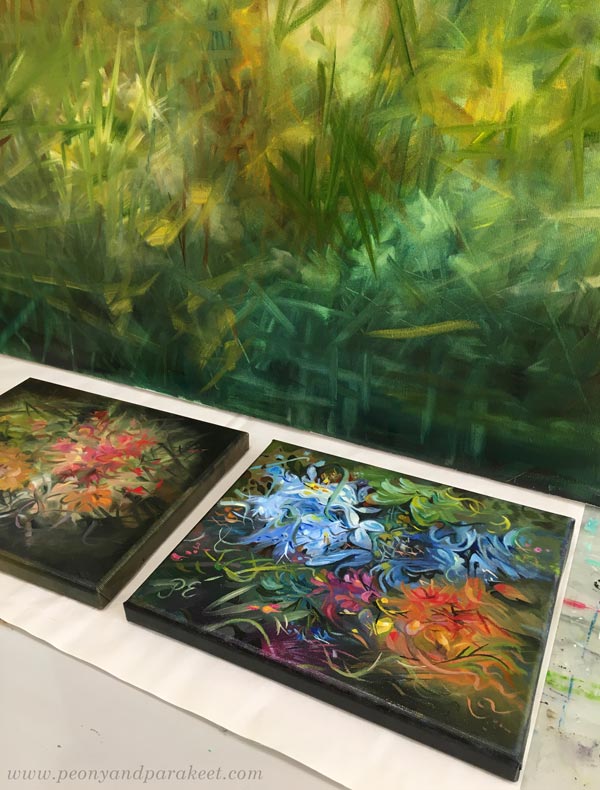
The little studio space has unfinished paintings, and big blank canvases are waiting in the library room.
I also have a new online class going on – Fun Botanicum!
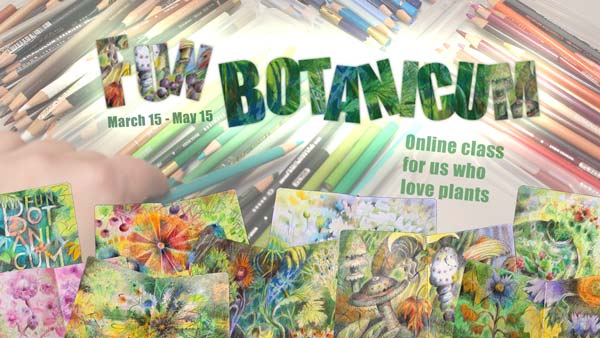
It’s so wonderful to see work from the students and have conversations about art. It makes all the other work less lonely, and I feel blessed to lead the lovely community. Especially now, when most of my spare time is spent worrying over the world situation, it feels good to be connected and also, serve others.
You can still hop in, sign up here!
Green Flowers in Colored Pencils
This week is about embracing green flowers and making your art stand out.
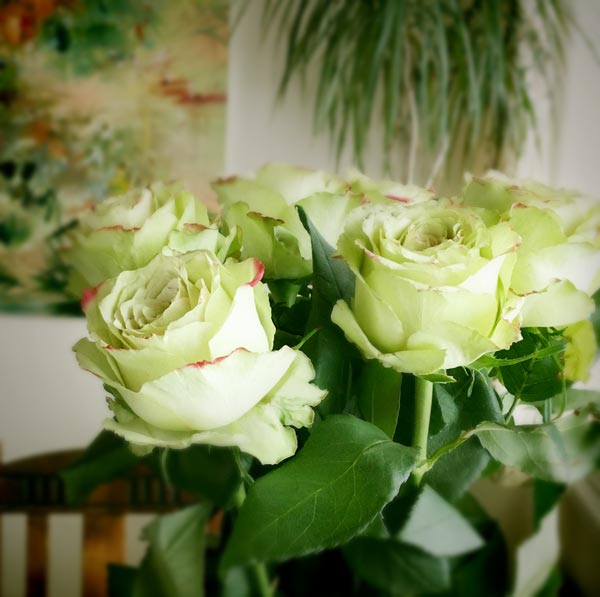
Last month, my husband let me choose flowers for my birthday. I picked green roses that had a hint of pink on their petals. Of course, there were plenty of colors available, but green ones touched my heart. I have always liked old romance novels where the emotions are kept under the surface, and I see a similar kind of suffocation in this bunch.
A rose dreams about becoming pink but sadly realizes that her petals are not much different from her leaves.
I feel a strong bond with green flowers because my art is very similar to their petals, only a slightly improved reflection of the ordinary self. My art goes only as far as I can imagine, and the imagination is often limited.
But green flowers can be enough. So, grand innovations can be replaced by many small tweaks.
Traditional or Not – Let’s Look at Jacob Marrel’s Flowers
Last week, I went to see old floral still lives at Sinebrychoff Art Museum. Still lives from the 17th century, like this one from Jacob Marrel, were my favorites. The subject is not creative: flowers in a glass vase, but small additions to a stereotypical interpretation make the painting stand out: butterflies and dragonflies, drops of water, red currants on the tabletop, black leaves that are easy to miss because they express the lighting so naturally, and the roses that sadly hang down, ready for withering.
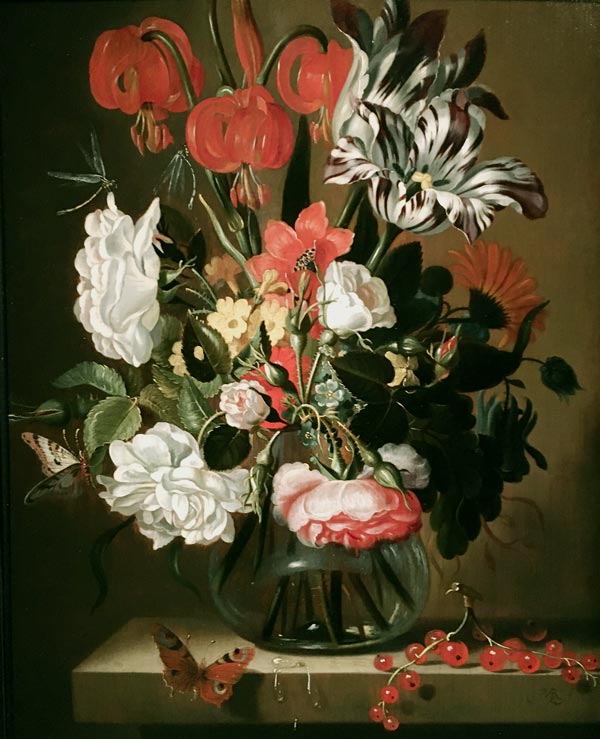
The best floral still lives from the 17th century are often Dutch, but Jacob Marrel (1613-1681) was German. He was a teacher, too, running a school for floral painters. I would love to turn back time and participate in his lessons! I would also have a question:
“Do you, Herr Marrel, think about the plant’s personality when you are painting it?”
Flowers Are Free Souls
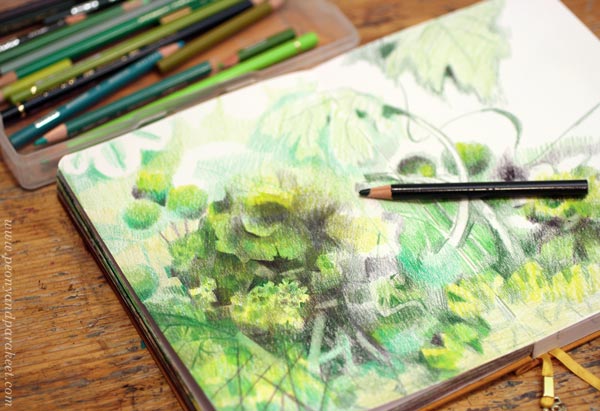
When I started this spread in my colored pencil journal, I felt that I just needed to let the flowers dance the way they wanted. So I didn’t sketch the big picture but worked little by little and endured the chaos, trusting that the flowers and leaves would find their natural gestures.
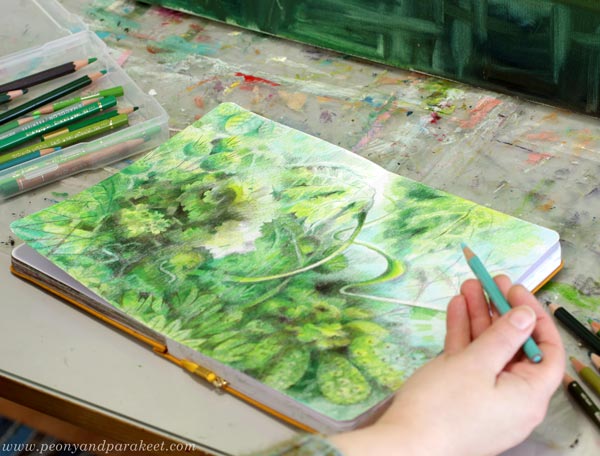
I want to let my art express itself as freely as possible.
How to Free the Flowers – 5 Tips
- Don’t make every flower similar, but let the diversity capture the viewer.
- Don’t differentiate flowers only with color but with shapes and lines too.
- Color a spot and ask what it wants, and allow green flowers – so, odd variations!
- Get inspired by the imperfection of reality! It’s natural to grow curvy, wither, have texture on the leaves, and get really dark or bright.
- Allow shapes and colors to breathe. You don’t have to know what every element in your drawing represents.
From Drawing to Painting
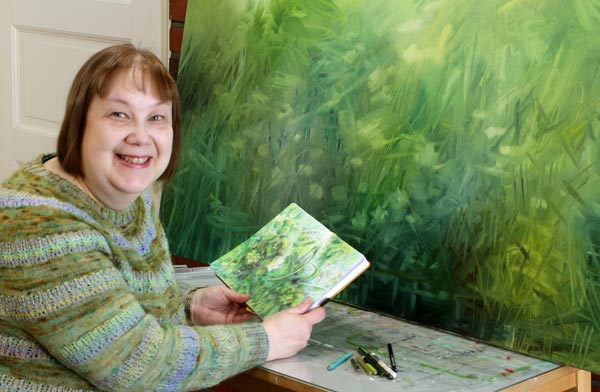
The first quarter of the year has been full of drawing and building the new class Fun Botanicum. But now a new series of paintings have started, and I have lots of big canvases to paint before the solo show in June. In the photo above, you see the first painting still in progress. My journal pages and my paintings live separate lives, but still, they inspire each other. It’s exciting to translate illustrative journal pages to more abstract paintings, and vice versa. I like this way of working a lot.
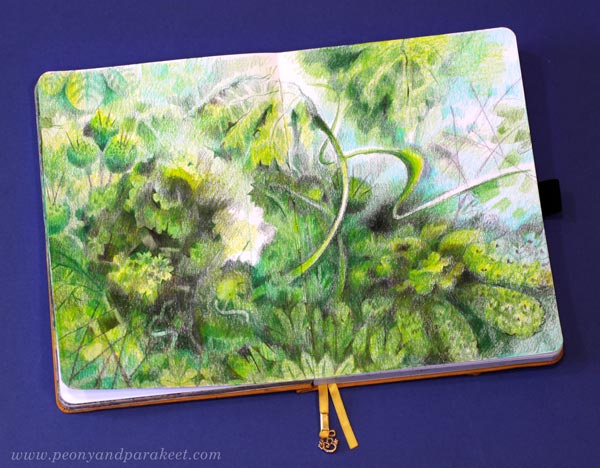
Now, when Fun Botanicum has started, I am also looking forward to seeing art from the participants: flowers, hays, fruits, berries, mushrooms … in all colors!
The new class Fun Botanicum has just started. You can still hop in and sign up!