
Making a Creative Impact – My Words for 2025 and 2026
I like to choose a word for the year that guides my actions. In 2025, it was “Release”. This year, it’s “Impact”.
I think that Impact is a natural continuum of the word Release. Once you have learned to release a lot, it’s time to learn more about making a creative impact.

Have You Chosen Your Word?
Tips for choosing your word from last year’s blog post:
>> Choosing the Word for 2025
Discover your word through art journaling from 2019:
>> Guiding Word – Choosing and Visualizing Your Word of the Year
How Did My Word Work in 2025?
In 2025, I released a lot. It was not only because I wanted to, but also because I had to. The year was very challenging financially, and the world events have been depressing. It has meant bad things for the Finnish economy as well.
My art year could be divided into three sections: oil painting, watercolor painting, and drawing/art journaling.
Reflections on 2025: Exhibition + The Best Painting
In February 2025, I had a solo exhibition at the gallery Gumbostrand Konst & Form, where I presented not only my paintings, but also my virtual reality artwork, Unknown Land, which I completed the previous year.
Here’s a video about preparing for the exhibition.
Another highlight of the year was a visit to the Rijksmuseum in Amsterdam.
In 2025, I painted five oil paintings and a couple of acrylic paintings. It is usually difficult to choose the best painting, because they are all unique, but I think I am most proud of this painting called Elixir. It has already been sold, because I had to, but I have looked at the image of it many times since then.
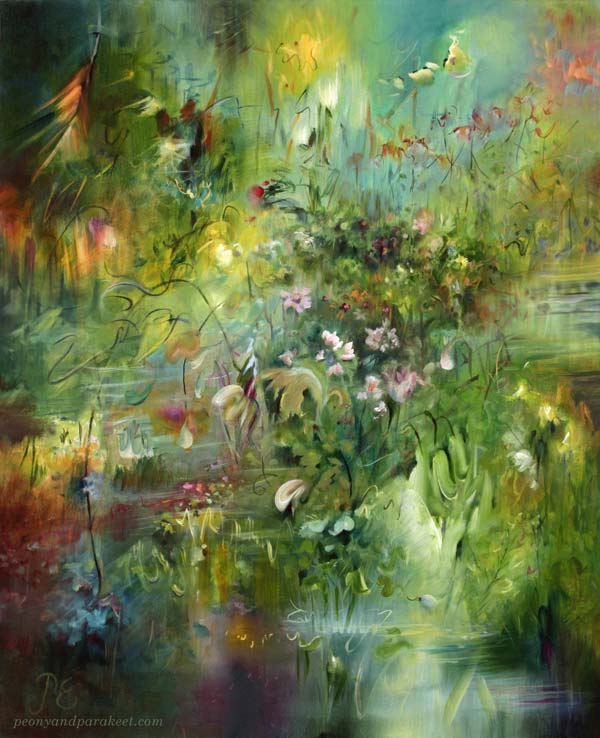
See how Elixir was made: Following the Inner Color
Watercolor Painting in 2025: Wild Garden
One of the biggest projects of 2025 was making the course Wild Garden. I made a lot of recordings for it, some of them from our garden. Before Wild Garden, I had made a course called Freely Grown, where you also paint flowers freely. But in Wild Garden, I wanted to go deeper and expand the subject. Wild Garden is a tribute to flower gardens, where we paint flower greeting cards and larger garden views.
>> Wild Garden – Flower cards and garden scenes in watercolor – Buy Now!
I love painting flowers freely with watercolors. I painted several flower watercolors in addition to the pieces for the Wild Garden course.

>> See how this painting was made: Let’s paint Like Emily Wrote
Happened in Drawing/Art Journaling: Fun & Mystical
In 2025, I pulled together everything I’ve done over the recent years in art journaling. In spring, I made a course called Hearts and Stories, where you make small drawings and use them as collages on the journal pages.
>> Hearts and Stories – Draw hearts and characters – Buy Now!
In summer, I went through my art supplies (Art Supplies I Should Not Use Anymore) and donated the supplies I no longer needed to a person who had just started an art hobby. In the fall, I went through all my art journals (Half-Empty Art Journals I Should Fill Up) and combined or discarded some. I also finished one of my art journals and made a video about it.
In December 2025, I released a course called Mystical Minis, where you draw abstract art with colored pencils. This course really captures the essence of the word Release. When I got the idea for the course, I decided to just follow my own lead – the words “Intuitive Power” – and let my creative engine run at full speed. I was in a flow state, and making the course felt exciting. I hope Mystical Minis is also an exciting and mind-opening experience for you, too!
>> Mystical Minis – Draw abstract art with colored pencils – Buy Now!
Word for 2026: Impact
I have been thinking about the impact the outside world has on me and how I can positively influence it. Even if creative ideas arise naturally and intuitively, I also want to think about what kind of impact they make.
For example, when finishing a freely-born painting, highlighting one detail above the others increases the impact. In the painting Cosmos, it was important to paint a small blue flower so that it connects the universe in the upper right corner and the beautifully rising vase.
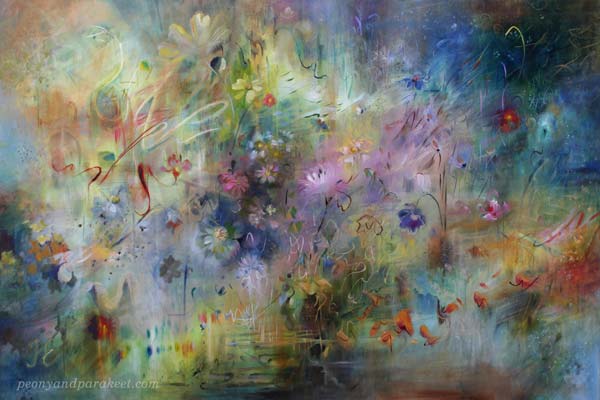
>> See how this painting was made: About Music and Painting
In my work, whether it’s creating or teaching, I want to adjust small things to achieve even greater impact and connect many kinds of things in an impactful way.
The word Impact is not only directed outward, but also inward. We can ask whether all inspiration has to come from the outside. We are exposed to a large amount of information and external events anyway. So, could now be the time to give more space to inner inspiration that will have a more creative impact? I want you to start this kind of process with my course Mystical Minis, and in 2026, I aim to support you on this path.
I think that the biggest threat to art is that people give responsibility for their own thinking and entertainment to others. Then there are no paintings at home, only screens. Then moments become fragmented, and there is never enough time for yourself and your art.
Smilingly: Tell me, am I getting old? Or am I just too Finnish with these thoughts?

Anyway, I hope to remain relevant to you and make a positive creative impact on your art-making in 2026.
About Music and Painting
This week, I share a painting that had a big goal: to achieve a similar effect to uplifting music.
I think that all painters envy musicians because music can make great emotions flow in an instant. Music can make us feel that the world is expanding into the universe and at the same time, shrinking to the size of a heart.
When I listen to Luciano Pavarotti sing Nessun Dorma, his complete self-confidence makes me, who is a mere listener, feel almighty too. And Avicii’s Levels is often my choice when I want to celebrate an achievement, for example, a newly completed painting.
But even if we painters envy musicians, I also think that musicians also envy painters. Music is experienced in a fleeting moment, but a painting can capture that more permanently.
Music I Listen to While Painting
When I start a new painting, I often listen to Kaija Saariaho‘s music. It is art music, and I don’t find it entertaining at all. But it helps me to think more spatially and paint a 3-dimensional space instead of a 2-dimensional surface. (See the video of my first encounter to Kaija Saariaho’s music from 2015!)
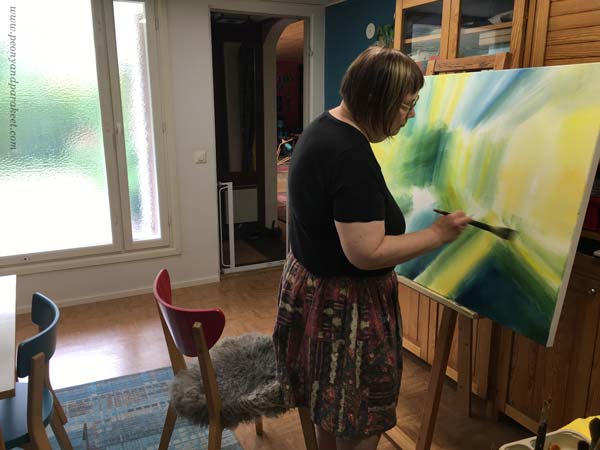
I try to avoid letting the music leak ideas into my paintings. I don’t want the music to create the illusion that the unfinished painting is better than it is. The music’ should mainly’s main function is to entertain my impatient side while my patient side paints.
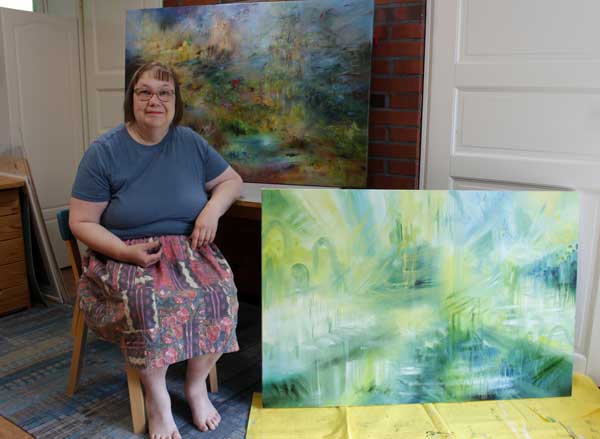
As the painting progresses, I gradually move to lighter music. First classical piano and violin concerts, then entertaining music television shows that play pop and rock.
When the painting is in the finishing stage, I listen to dry talk programs such as political analysis.
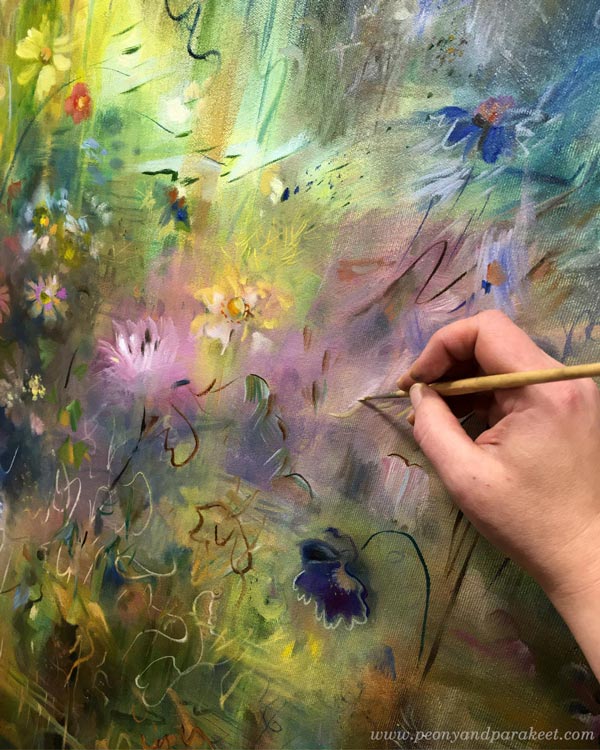
Music helps me to keep going. It takes many sessions to finish a big painting.
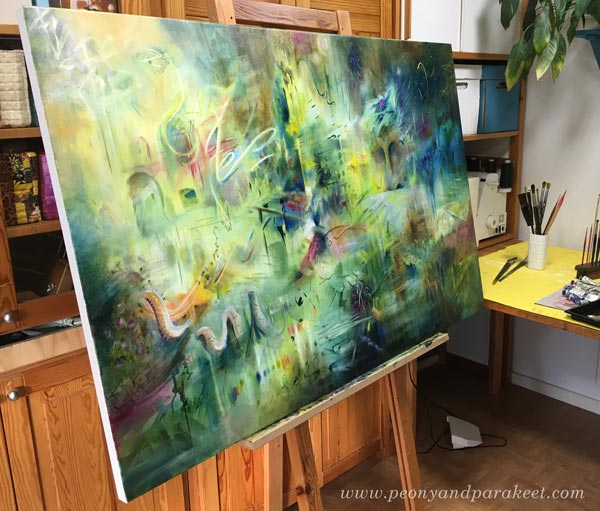
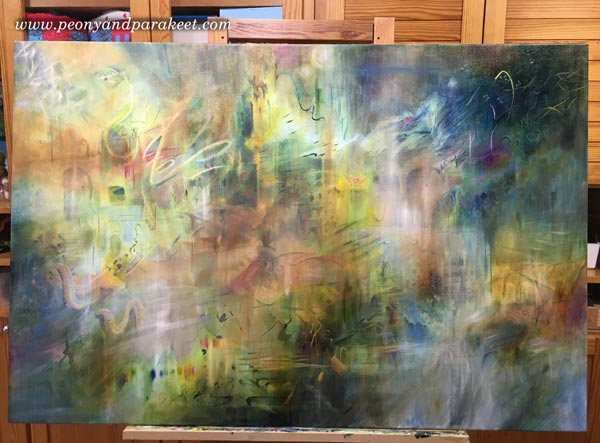
I painted this painting in 7 parts and as you can see from the pictures, it changed quite a lot over the months. I started in early August and the painting was finished in late November.
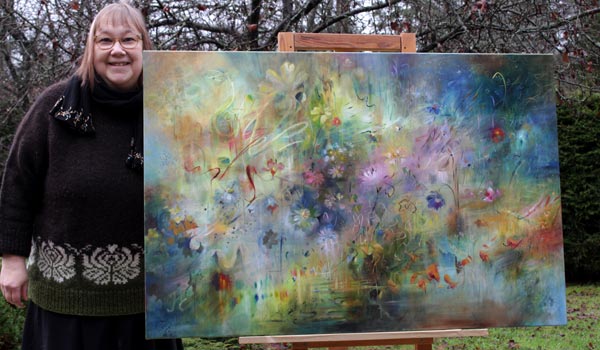
My painting called Cosmos is a flower arrangement, but at the same time, I was aiming for much more. I wanted to express both meanings of the word cosmos – both the flower and the universe. So I was aiming for the same thing that music can give: the expansion into a larger whole and the contraction into a single moment.
Details of Cosmos
The blue flower was the most difficult to paint because I wanted it to be modest and small and still refer to the universe. It had to be simple and delicate, but still strong enough. I rarely use Cobalt Blue this much. It’s my most expensive pigment and not very good with historical pigments that I mostly have. But in this piece, I think it perfectly represents the universe.
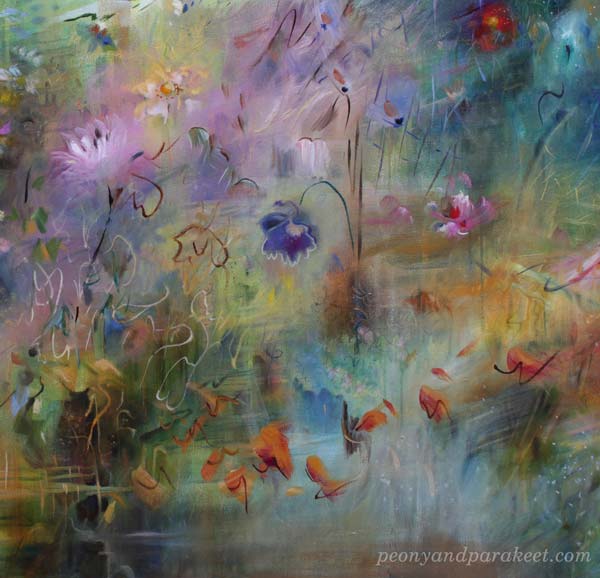
One of my favorite details is the flying orange petals. I think they look like a little melody playing in the background as the song slows down.
Some areas come more easily than others. The top right corner was finished early, and it was a lot of fun to paint. I prefer dark backgrounds over light ones, but dark paintings can be difficult to sell, so I try to be moderate with dark colors.
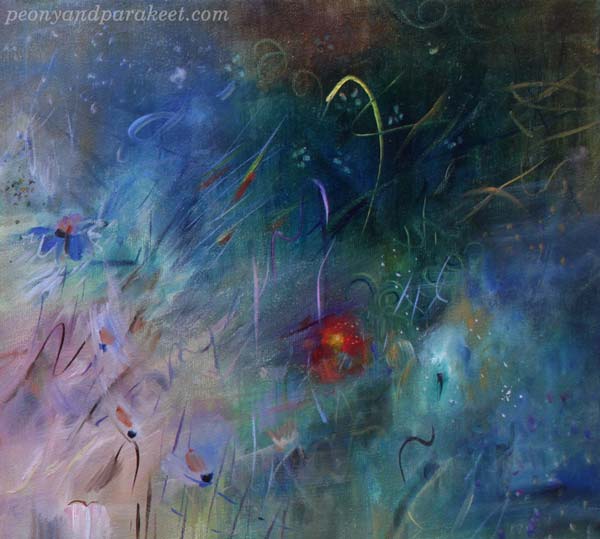
The red spot is both a supernova and a flower.
I love painting bowls and vases, especially when I can just freely compose them from strokes and shapes.
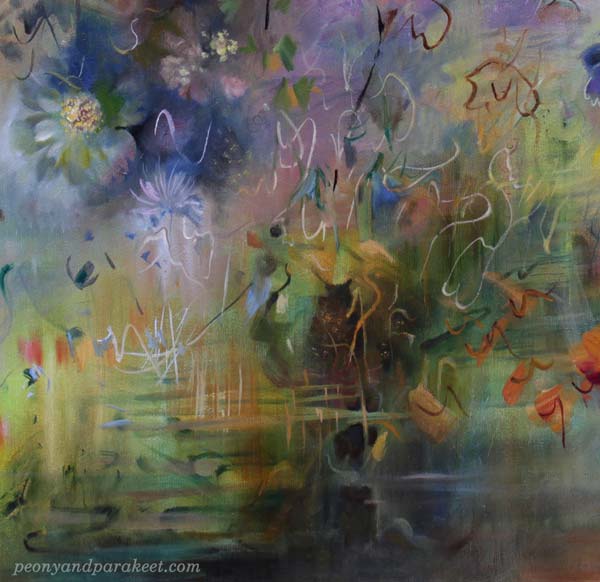
I also love to paint water. Here, the vase disappears under the waterline.
I often paint a flower so that it’s partly quite sharp and partly blurry or invisible.
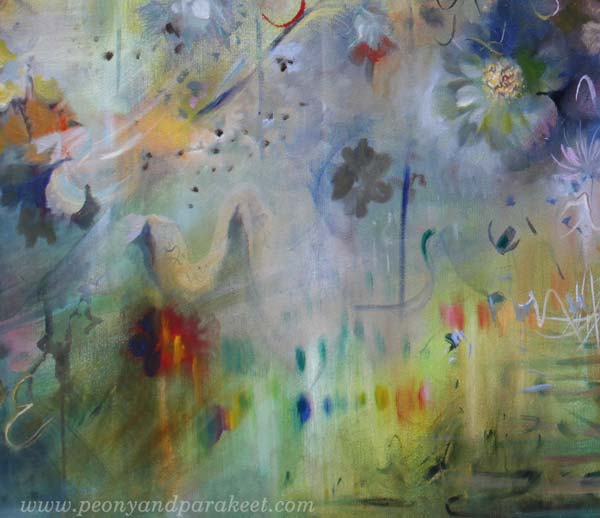
Music can use echoes as an effect, while visuals can have mirror images. The echoes and mirror images can differ slightly. I played with this idea when painting the red flower and its dark echo.
Ornaments and ornamental strokes inspire me a lot. I think that when you have found out how you want to draw a single line, you are really close to finding your style.
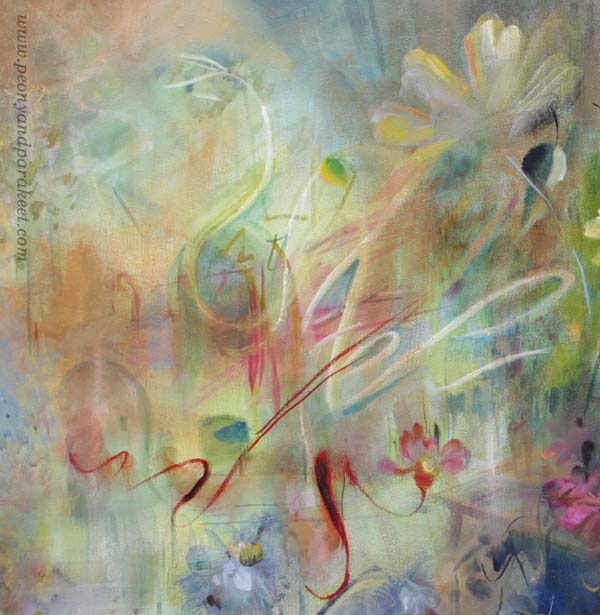
Lines are like musical notes that a mind can interpret and sing. They have the painter’s voice.
What kind of music do you listen to when you paint or draw?
Making Florals More Modern
This week, we are making florals more modern! So, when you want to get away from a botanical look, and draw and paint flowers that are more abstract and expressive, here are my tips for you!
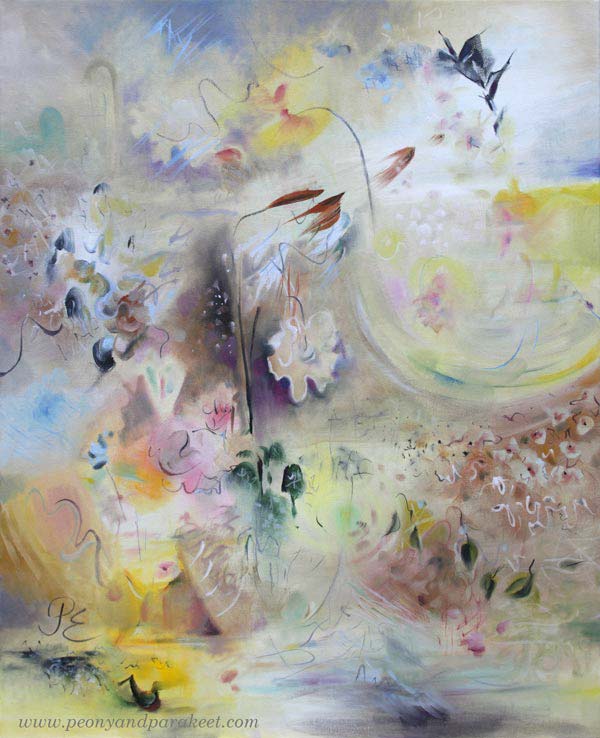
In my recent painting Gossamer, I have stretched my style to a modern direction. The painting was born much faster than usually if you count the actual painting time only. But that’s not the whole truth because I practiced this style several times. You too, can make your florals more modern in this way!
#1 Choose Your Muse!
Pick a painter that has a modern abstract style for flowers.
My choice was Helene Schjerbeck (1862-1946). She was a famous Finnish modernist, and even if I find many of her paintings a bit too melancholic, her style fascinates me.
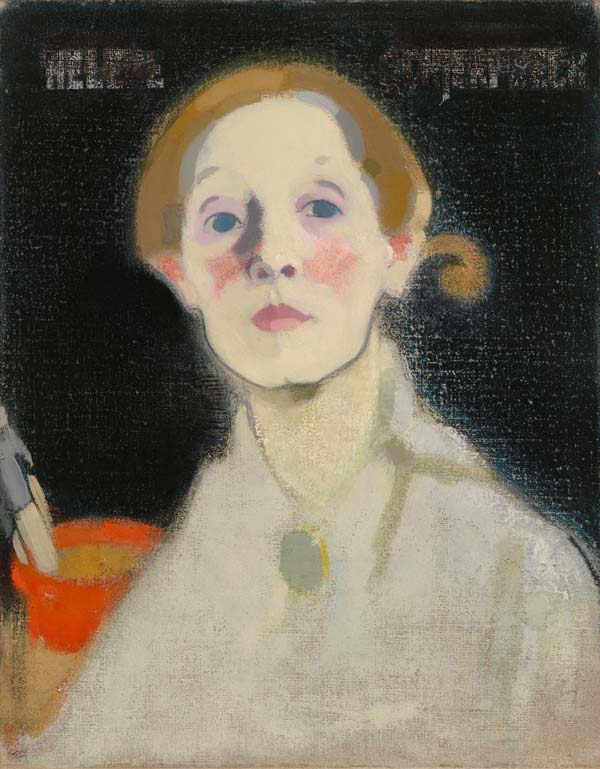
Helene is more of a portrait painter, but she also painted many still lives. (By the way – I also have a blog post about mimicking Helene Schjerfbeck’s style in portraits in colored pencil.)
#2 Make Many Tiny Sketches on One Page
Paint or draw small sketches where you pick ideas from your muse’s paintings. Combine many paintings on one page. When the size is small, you need to simplify and thus, find the core of your muse’s modern style.
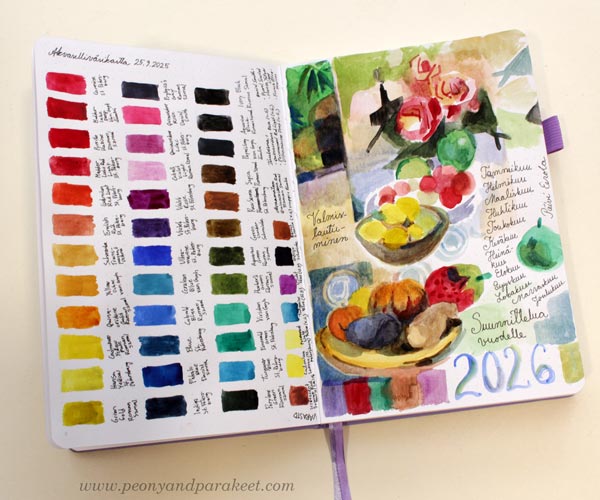
I examined several Helene Schjerfbeck’s paintings in watercolor and combined them on one art journal page.
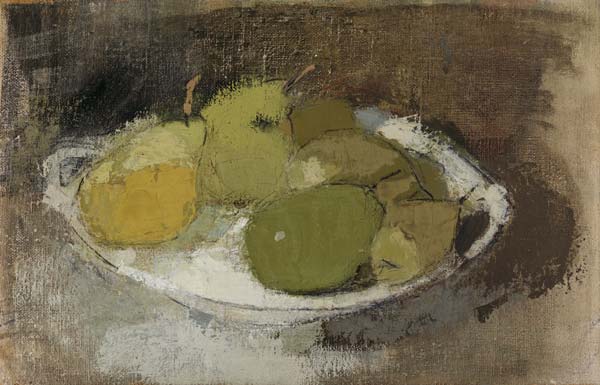
Focus on the shapes and lines and answer to these questions while working:
- Are the muse’s shapes light or heavy?
- How angular are the single strokes?
- How light and shadows are expressed?
- Where can you find playfulness and creativity?
Helene Schjerfbeck’s shapes are rather heavy, and her strokes are quite angular. The light and shadows are treated like they are objects as well. The result is a puzzle where the material and immaterial are treated identically.
I didn’t first think that Helene’s paintings are playful, but when I browsed more of her paintings, I started to see humor in the way she painted the shadows. There is something human in their shapes. It is shown brilliantly in this piece “Trees and Sunset.”
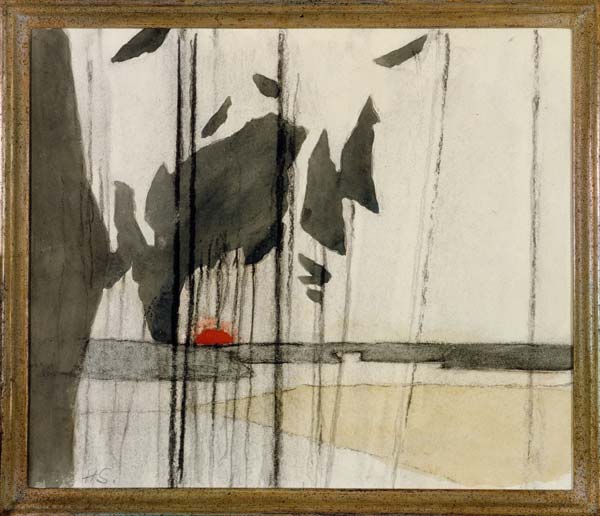
I started to think that maybe for my muse, the shadows were like animals, or dolls, and that they could be a little like toys in my paintings too.
#3 Create a Bigger Study More Freely
Next, use your observations to create a bigger study. Work freely and mix the observations with your original style.
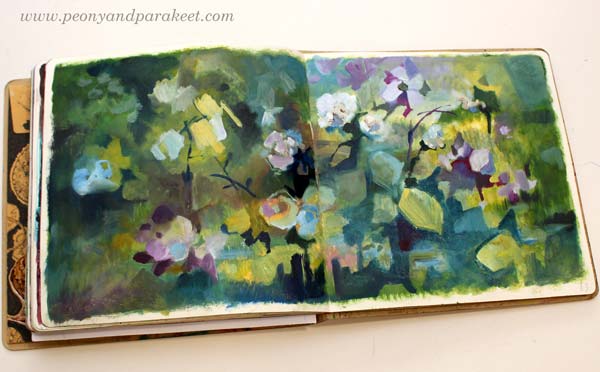
I used left-over oil paints and made this spread for my Dylusions Creative Journal. I really like how playful the shadows are, and painting this was a lot of fun!
In the detail pic below, you see how angular my strokes are.
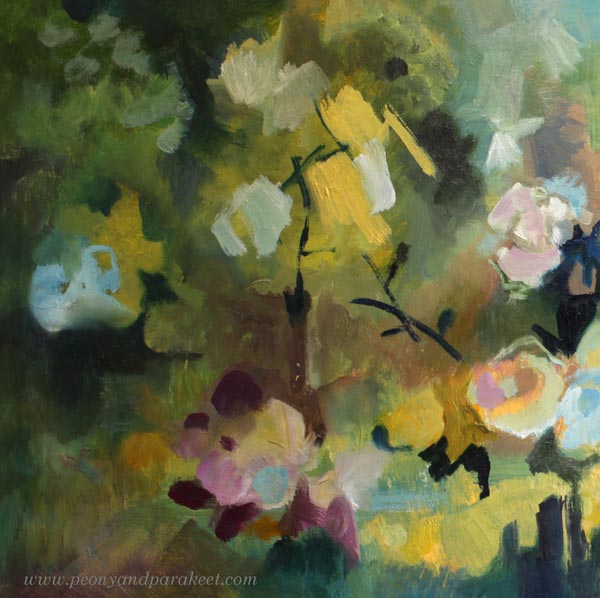
When searching for images for this blog post, I found this small painting from Helene Schjerfbeck. My flowers are different, but still there are similarities as well.
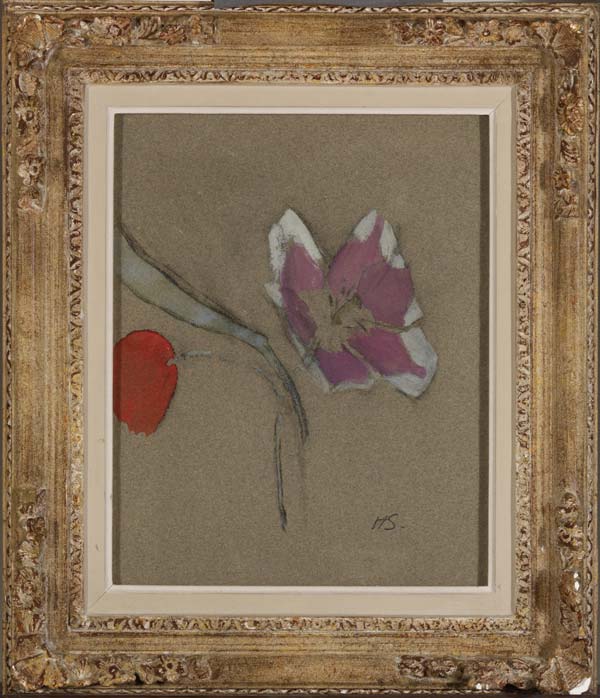
My best tips for making florals more modern:
- While working, think about surface patterns in interiors and clothing rather than the actual flowers.
- Use angular strokes to build puzzle-like compositions.
- Similarly to the parts of the colorful flowers, see the shadows and light as the shapes of the puzzle.
#4 Make the More Modern Piece
After practicing, you can now create a piece where you spend more time for finishing. Modern strokes often appear quick and careless, but they are still packed with aesthetics and style. Those kind of strokes can take a lot of attention and focus.
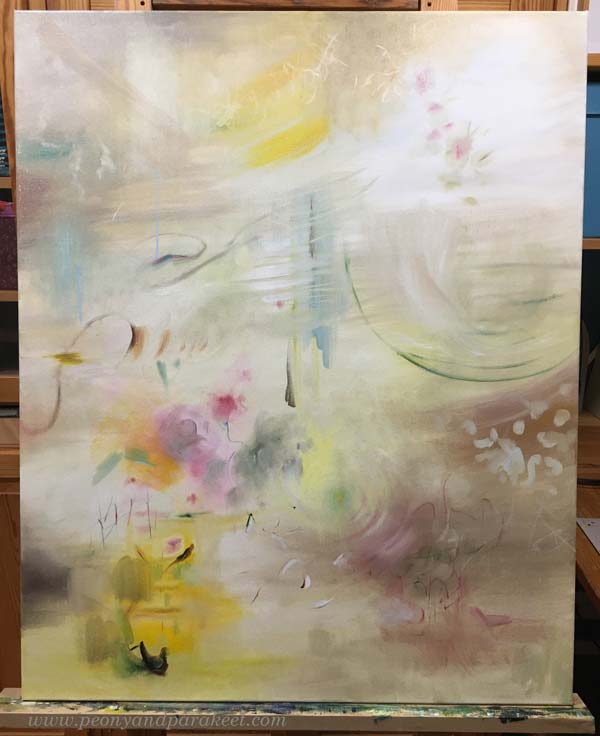
Here’s a pic from the early stage of my painting Gossamer. I started with a narrow color scheme, and many of the shapes and strokes were more like suggestions – a whispering start, you could say!
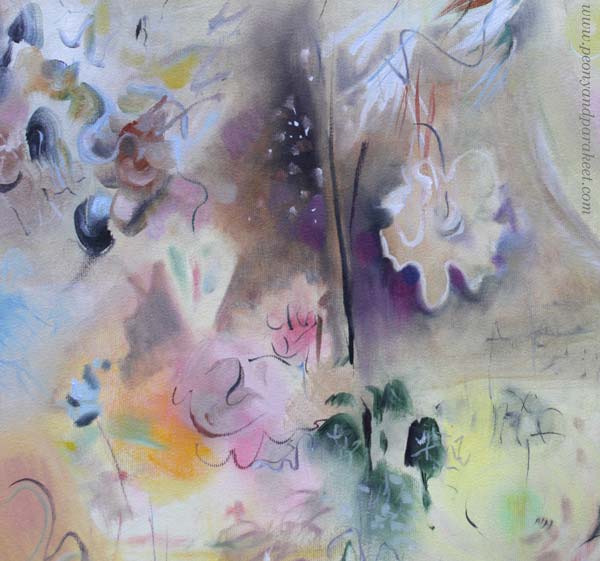
In the finished piece, I especially enjoy the playful color changes in the background and the new playfulness is present in lines too.
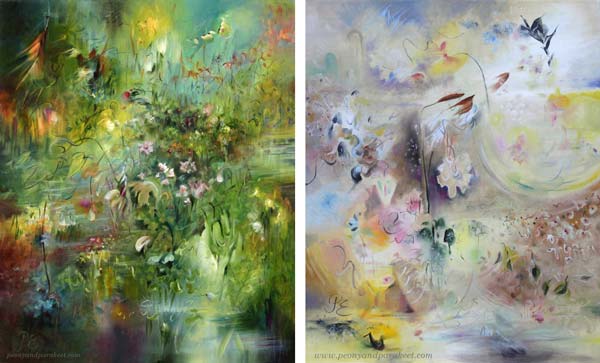
#5 Old and New – Compare!
Here you can see my previous painting of the same size and the finished Gossamer side by side. The styles of the two paintings are slightly different, but not totally!
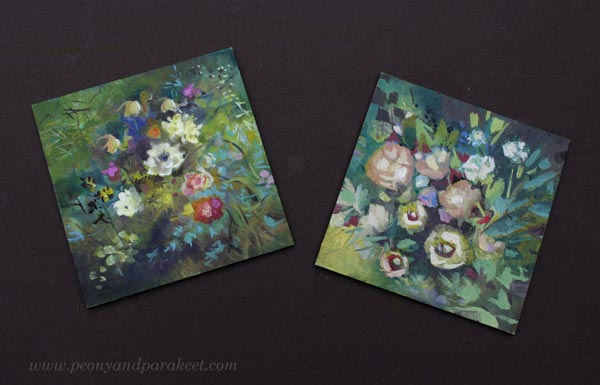
I used leftover paints for these two miniature paintings. The one on the left is more of my original style, the other one is more modern.
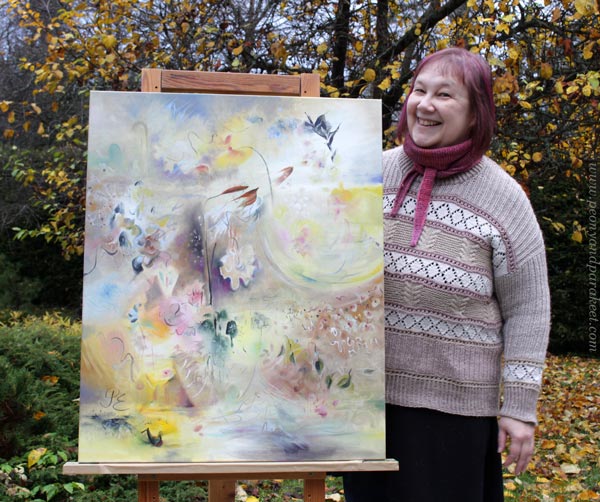
If the weather allows, I always take the photo of the final piece outdoors. This fall has been exceptionally long and warm. There are still leaves in the apple tree, and it’s November!
I hope you enjoyed this little tutorial on how to make florals more modern!
Following the Inner Color
Here is my latest completed oil painting “Elixir.” I start my abstract paintings with the idea that I follow an inner color.
Color Chooses Color
The inner color is the color I feel drawn to, so I tend to pick and mix the first colors intuitively. And then, they wish for other colors to accompany them.
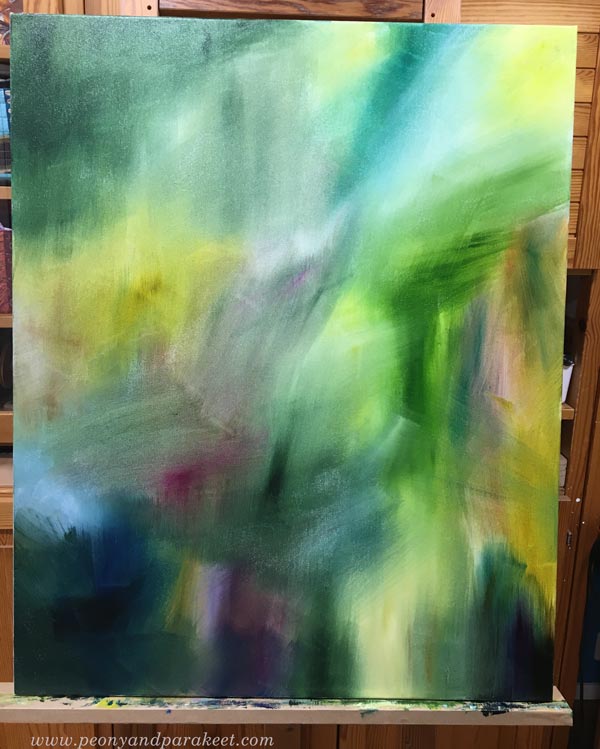
Colors also evoke shapes, and the shapes bring in more colors. A raw and bright color selection changes slowly to a more sophisticated one. In this color-driven technique, the inner color changes as the painting matures.
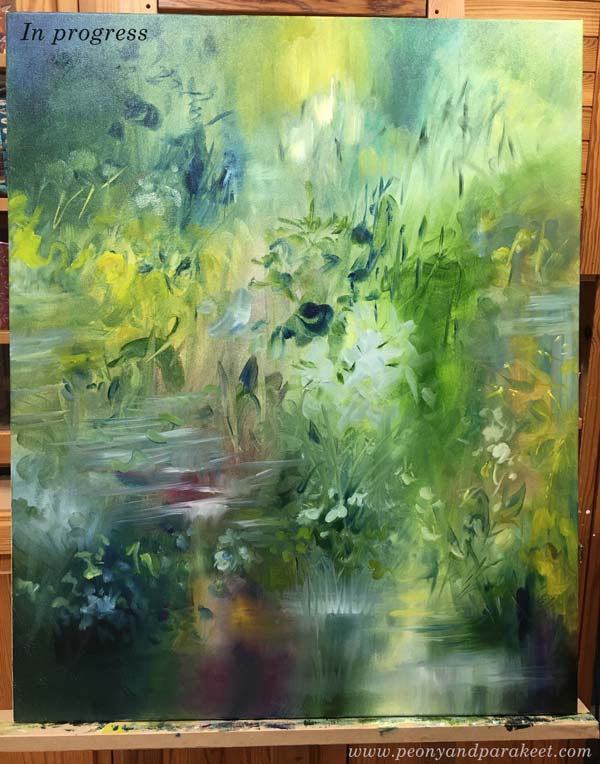
I try to give my painting enough time to find its own soul and paint several sessions, letting the paint dry between them.
First a Child, Then a Teenager
When the painting is only a child, I don’t care about the composition or what it will represent. I don’t want to force a short childhood or early adolescence. When puberty begins, it’s tempting to call the painting finished. But only then does she begin to find her own, unique mission and get prepared for a long life.
Teenagers often tell how they want to be called. When this painting was still unfinished, she was Ophelia because she saw herself as John Everett Millais’s painting from the 19th century.
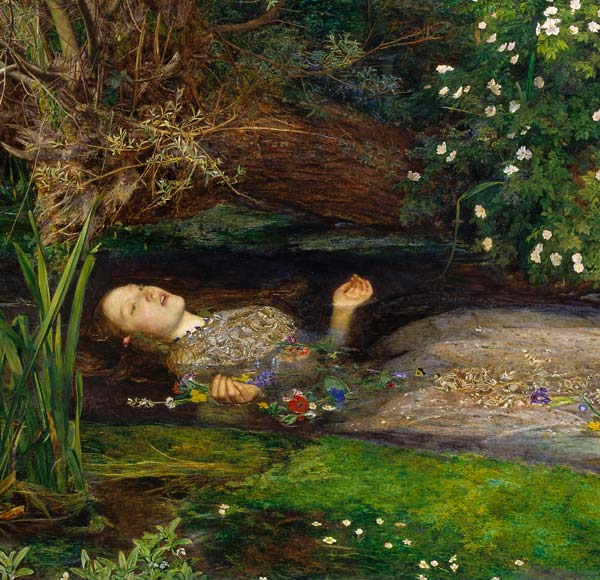
I usually give the final name only when the painting is almost finished. Then I know what I want to emphasize with the name. Maybe we humans should get our final name a little later too?
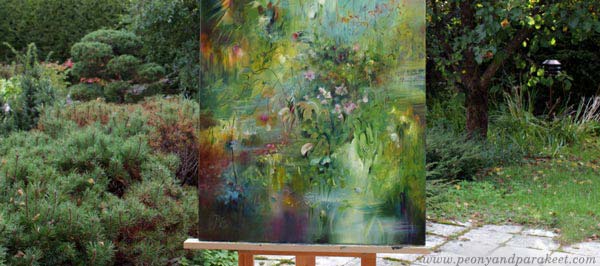
Early Goodbye
I take pictures of my canvas paintings outside if possible, because that’s where the light is most natural. My husband often acts as my assistant and holds the painting against the wind. Most of the time, I end the photoshoot by saying to him, “Hey, come take a picture of us together!”
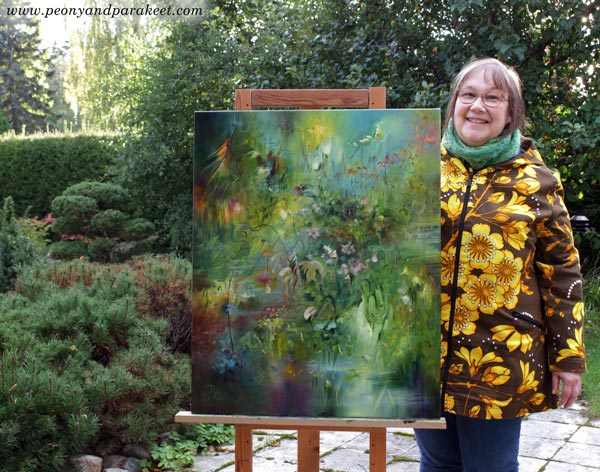
Since I sell all my paintings, this is the moment when I’m saying a mental goodbye to them. I assure them: “You’ll be fine. Everything’s going to be fine.” Even though I often miss my paintings, I don’t tell them. I feel like their mission is bigger than mine, and my job is to deliver all this for others, not for myself.
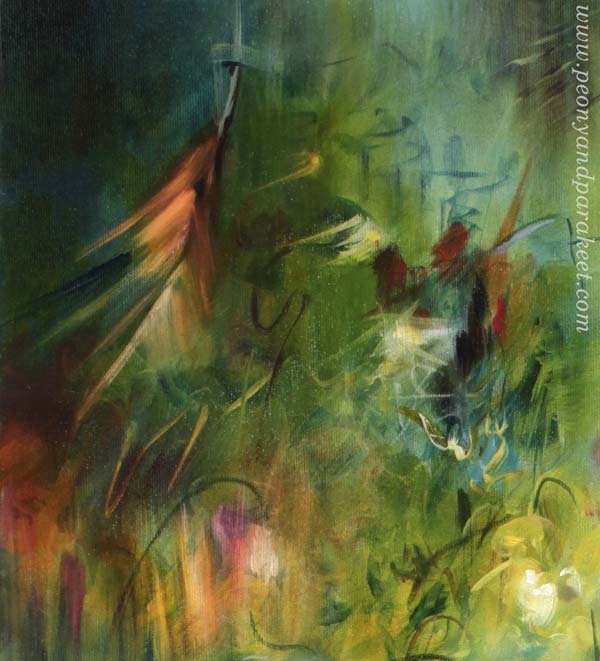
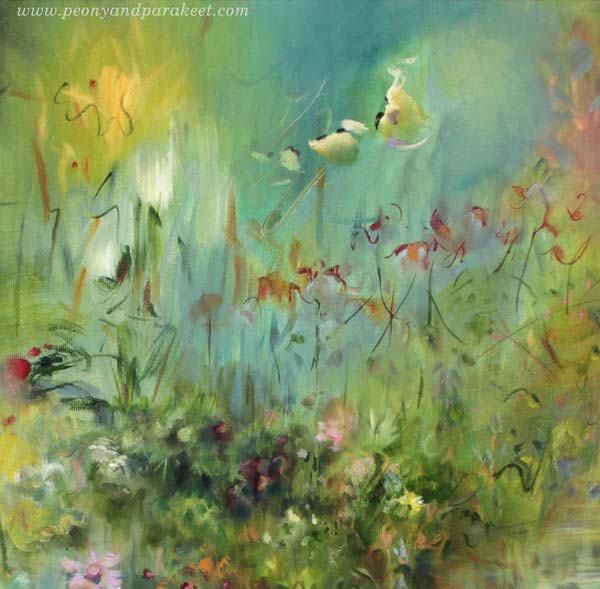
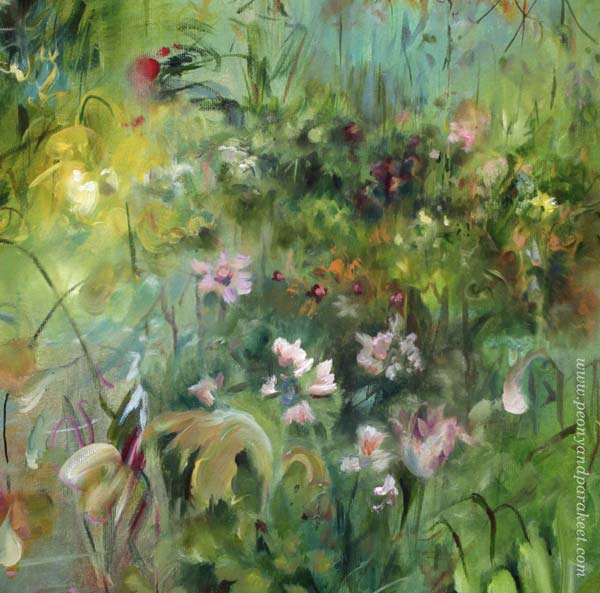
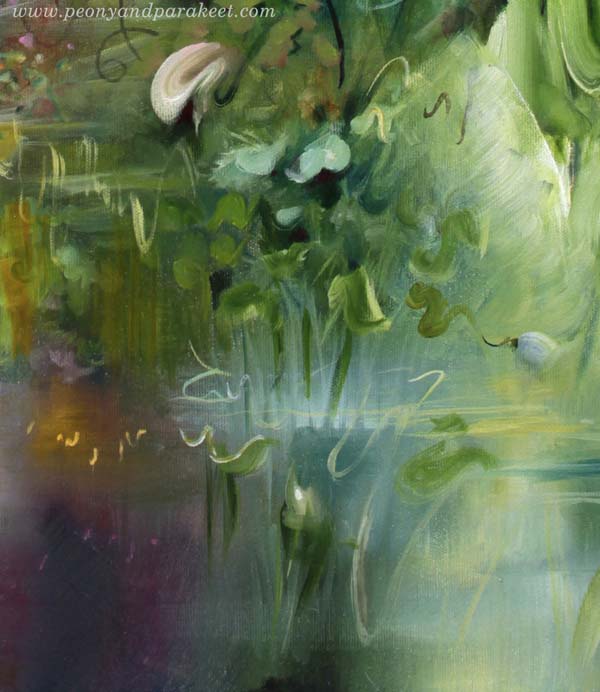
I have practiced most of my oil painting techniques in a quicker medium, so in watercolor!
Wild Garden – You Can Still Hop in!
In Wild Garden, we will paint freely, intuitively, and expressively in watercolor from Sept 22 to Nov 14. We will begin with floral greeting cards and gradually move forward in expression.
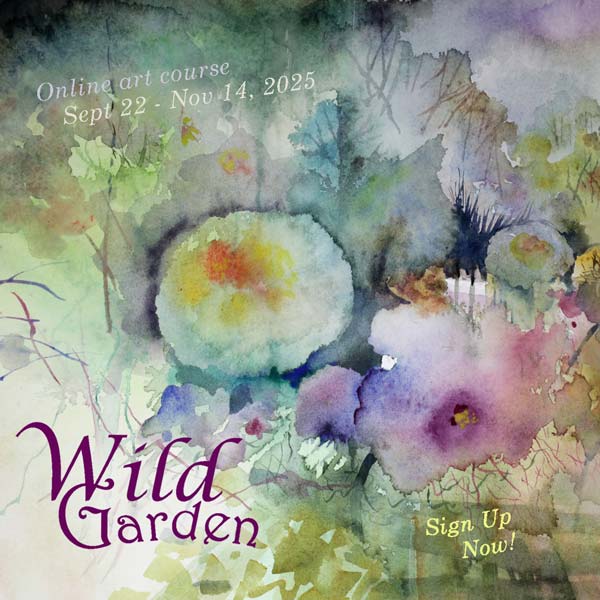
The course has just started but you can still hop in!
>> Sign up now!