
Could Needlework Define Drawing?
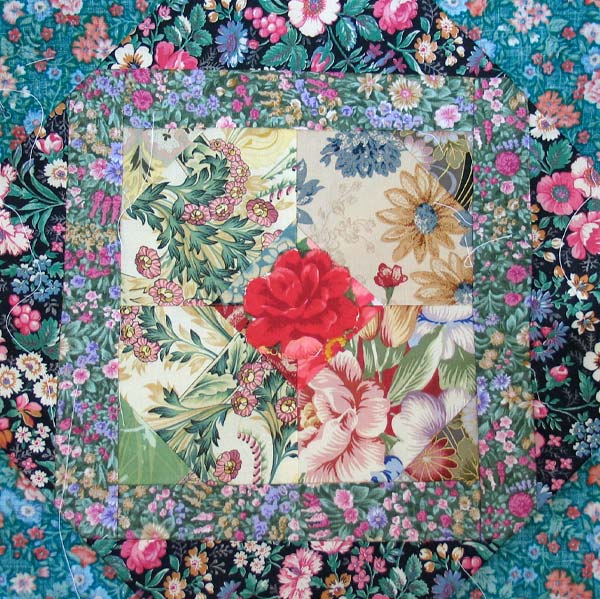
Over 20 years ago, when studying computer science, control engineering, and automotive engineering, I got used to being the only girl in many lectures. But it was not only that. Whatever book I read, whatever formula I learned, it was all written by men. Soon, it felt natural. The field of technology was ruled by men.

When I think about drawing, I see the same thing. Throughout the history, the skill of drawing has been defined by men. Many say that if you draw 3-dimensional and photorealistic images, you can draw.
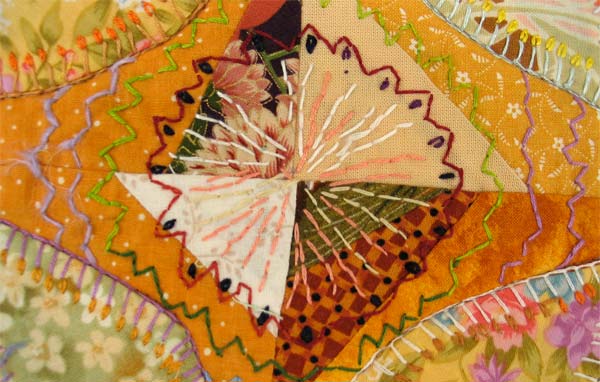
But could needlework define the way we draw? Could we think more about textures, structures, and shapes than the actual dimensions? Could we tell stories where we travel inside rather than outside?
I don’t say men can’t do all that. My message is that too many women who are experienced quilters, seamstresses, needleworkers feel that they are far away from drawing.
Why Draw?
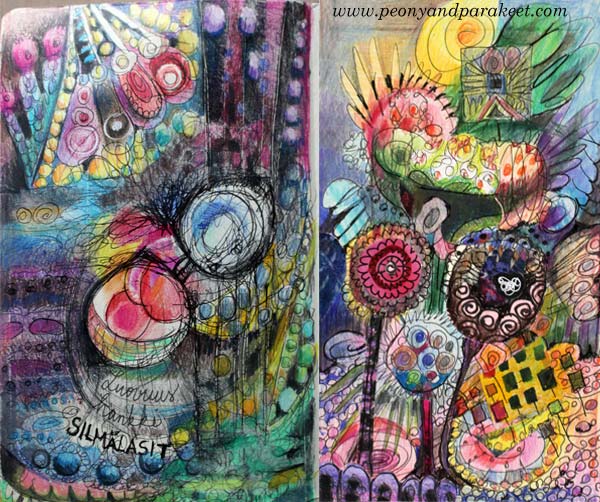
When you hold the pen instead of the needle, you are able to experiment in much less time. With a little bit of guidance, your imagination will start to grow. You will be able to see your creativity in a new light!
My quilting and embroidery got a friend from art journaling when I began to draw.

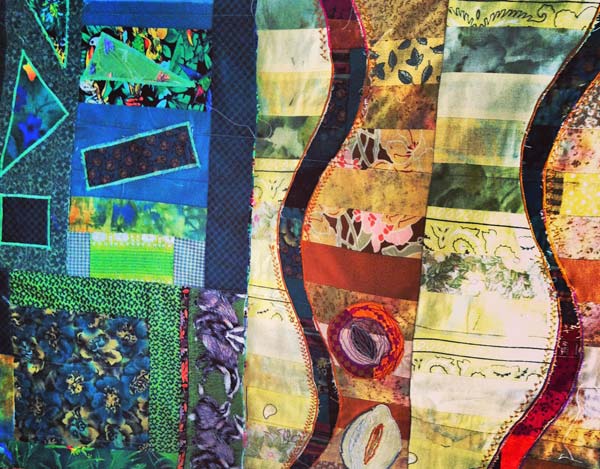
There’s no reason why needlework could not define the way we draw. Or at least be our inspiration when we draw.
Let me be your art teacher: Subscribe to my weekly emails!
Video: Abstract Painting
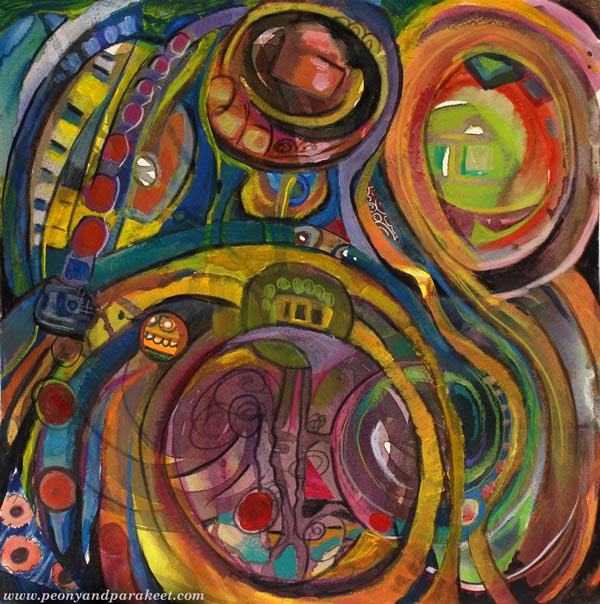
I made this abstract mixed media painting last fall and it has been waiting in the queue ever since as I also recorded a video of the process and had no time editing it.
The painting is called “Wheel Mechanics”. It expresses my thoughts about how good engineering, design and art are connected together but maybe you see something else? With abstract art, it’s good to present a basic idea (in this case: “merging”) in such a general level that it leaves room for interpretations. That’s one of the main difficulties in creating abstract art, I think.
I was about to make a video introducing my online classes so I combined the two together. You can watch me painting + get info about the classes.
Inspirational Drawing is the next class!
It’s my “the drawing class” and especially good for you who wants to enjoy drawing without boundaries. See these blog posts for fabulous drawings created by the students of this class: Explore by Drawing!, Do You Have a Talent for Creating Art? and sign up now!
Tribute to Finnish Art Rugs
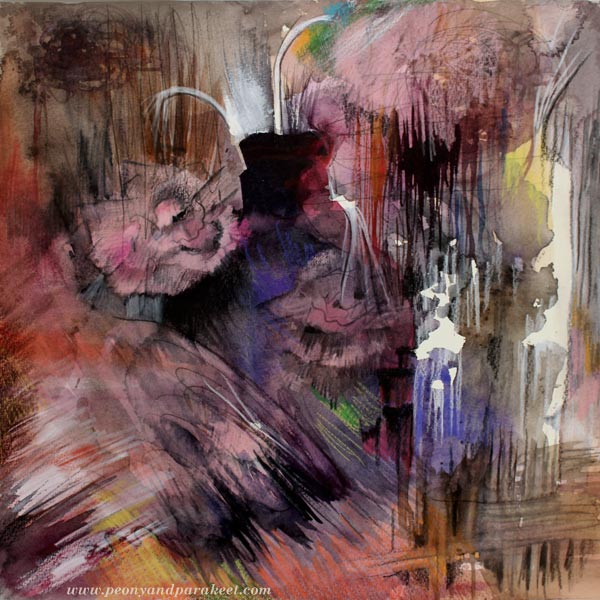
I made this painting just before Christmas but as it has a special story, I wanted to blog about it later when I had more time to write. Actually, I didn’t even plan for creating anything in the middle of holiday cleaning and cooking. But I just had to.
Finnish Art Rugs
Namely, my husband bought a wall art rug (“ryijy” in Finnish) from an online auction and it happened to arrive just before Christmas eve. We had been searching for one for some time. It had to suit with the colors and style of our living room and not be enormous (as many of them often are). We had a designer in mind too – Ritva Puotila, a Finnish woman who has recently designed carpets for her own company Woodnotes. In 1950-60s, she used to design beautiful, painterly Finnish art rugs. The rug that my husband found was her design called “Fireside Evening” and I think it looks wonderful in our mid-century modern living room (which has a fireplace in the opposite wall).
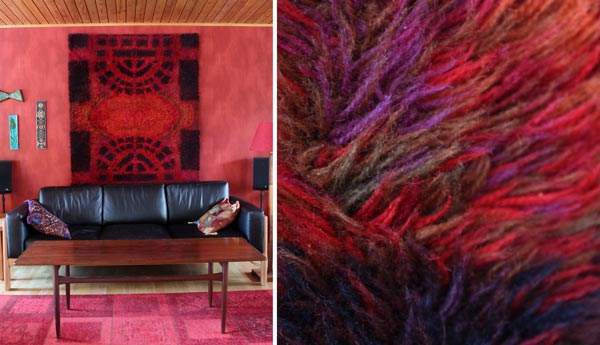
As you can see from the close-up photo, the rug is not only black and red but has many colors to create the painterly effect. At those times, in 1950-60s, wall rugs were fashionable in Finland and especially these kind of rugs that are as much modern art as home textiles. Many women bought the patterns and sewed or weaved their rugs by themselves. My mother was one of them. She chose a rug design called “Ruutrikki” (a made-up word that resembles “broken squares”) and the designer might have been Päikki Briha, if I remember correctly. Here’s an old photo of me and my father showing the rug in the background. That rug also has a lots of colors. It was difficult to zoom in, but hopefully you get the idea.
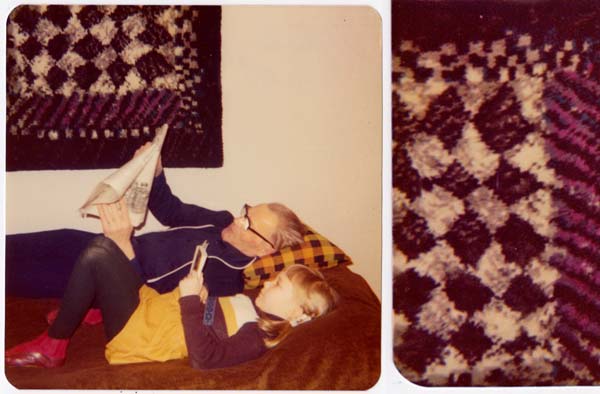
While touching and admiring our new red rug, I got very emotional. My mind was filled with mixed emotions. I was happy about the new art textile that would bring a warm atmosphere to our living room. On the other hand, while browsing the old photos, I saw people that have passed a way, photographed in front of my mother’s rug. When I remembered that many of those art rugs were sketched with watercolors and then transformed to a grid pattern, I just couldn’t help it. I had to take out my watercolor set and start a new painting even if it was getting late and I felt pretty tired.
Creating a Mixed Media Painting
While painting, I didn’t think about anything particular, but of course, the rugs found their way to the end result …

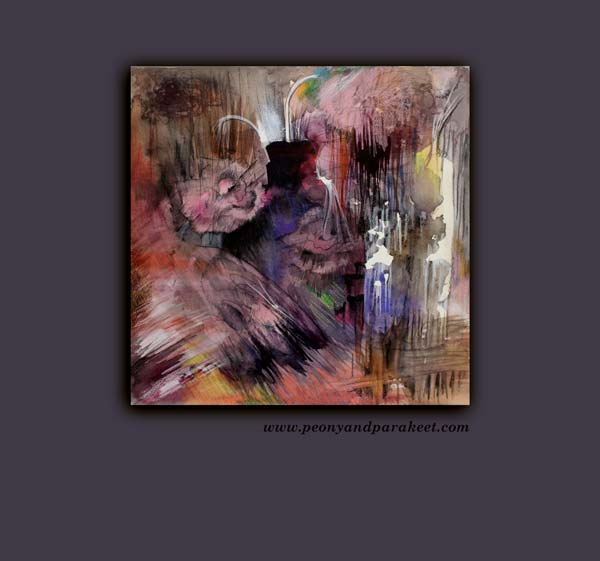
The painting turned out to be some kind of still life with a dark vase and few sad-looking carnations. Carnations were my mother’s favorite flowers and my father used to buy them for her every year, at their wedding anniversary.
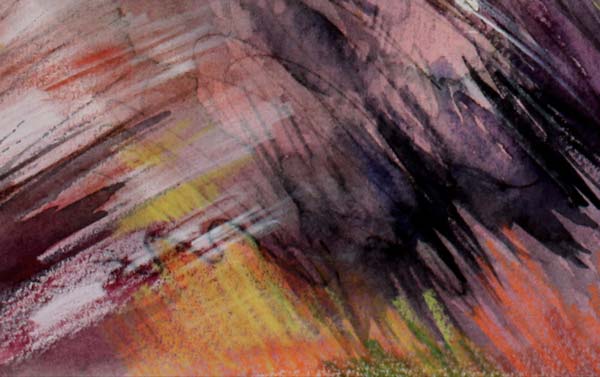
If you look at Finnish art rugs at my Pinterest board, many of them have some kind of melancholy in them. Maybe it’s caused by a combination of muted colors, high contrasts and simplified, abstract approach. These were the elements that used in my painting too.
I finished the painting with colored pencils and named it as “Ryijyneilikat” – “Rug Carnations”. They are imaginary flowers that grow downwards, that are not used to be centerpieces, that blend in the background. They enforce other elements of the still life to step up and go forward. Just like my modest mother did for her children.
Create midcentury modern designs from simple shapes!
See more of my living room and get step-by-step introductions!
>> Buy Modern Midcentury!
Create Doodled Luxury!
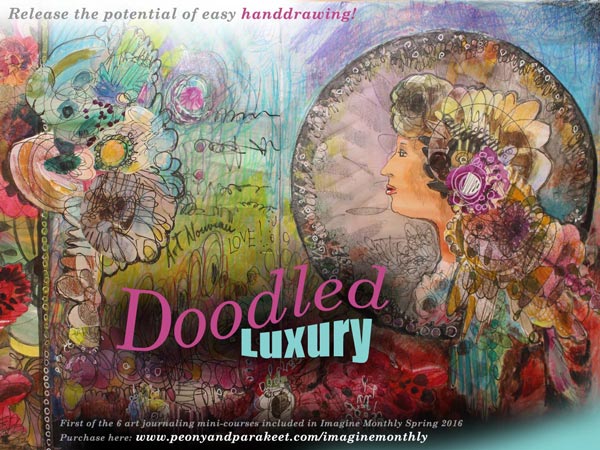
Happy New Year everyone! With the new year, a new class has started. Imagine Monthly is a series of 6 mini-courses, released one by one from January to June. Imagine Monthly is a bit different than my other online workshops. It has a slower pace and you can sign up even if the class is already running. January’s mini-course “Doodled Luxury” has just been released. You will get it right away after signing up!
Why This Course?
I wanted to start the series of 6 mini-courses by showing the potential of free hand drawing. For many, drawing is about being able to copy something realistic but there’s so much more that you can do with flowing lines. I think drawing should be redefined and enabled for everyone. It’s my mission to enable you to enjoy drawing and have a great time with your growing imagination! (Want to ponder more about the ability to draw? Read this blog post: “Can You Draw?”)
Creating with Luxury in Mind
When developing “Doodled Luxury”, I spent a lot of time thinking about the concept of luxury. I think it’s not just something to buy, it’s more about creating something unapologetic and self-sufficient. Something which makes you feel rich in a way that has very little to do with money.

While experimenting with the techniques used in “Doodled Luxury”, I created an art journal spread that summarizes the ideas that I had in my head: bringing a clear focal point, getting inspired by the many layers of luxurious clothes, letting quantity increase the quality.
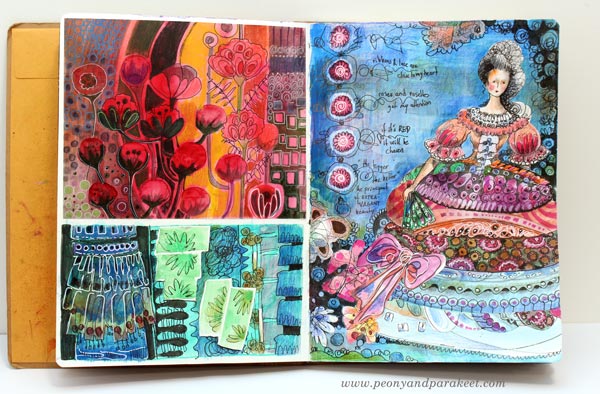
The spread above is just a background study for the course, but I wanted to show it as an example of how your art journal can contain “idea boxes” which in turn can lead to more advanced ideas like this one:
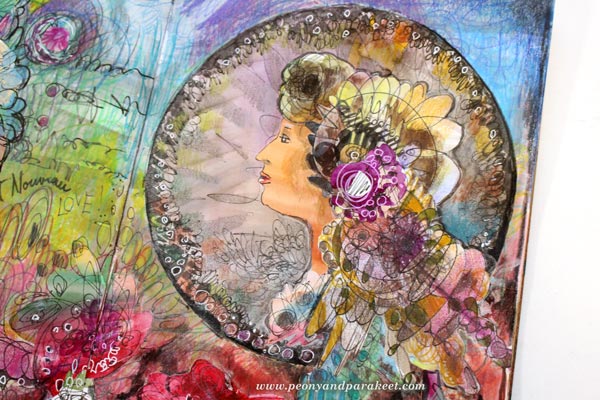
This Alphonse Mucha inspired collage has influences from Marie Antoinette’s period. Can there be anything more luxurious than art nouveau combined with rococo, expressed by hand-drawn elements? Doodling truly can produce luxury when there’s more than enough of it!
Experience the power of simple handdrawing and other easy techniques
Buy Imagine Monthly!